

The influence of digital literacy on mHealth app usability: The mediating role of patient expertise
Open accessThe DOI matches its Crossref record; 69 of the 69 references it cites were found in a registry or an index; 9 of the 39 sources its claims cite were checked for support.
Abstract
Objective: Mobile health (mHealth) applications are emerging as important healthcare technologies that can provide cost savings, better access to care, contribute to improved clinical outcomes, and support public health. An increasing number of mobile health (mHealth) applications are becoming available to download and use on mobile devices. However, unlocking this potential requires ensuring widespread acceptance and adoption of these applications. In this context, the aim of the study is to determine the impact of individuals' digital literacy levels on mobile health application usability and the mediating role of patient expertise in this impact. Methods: The population of our study consists of individuals who reside in Yozgat city center and are 18 years old and over. Within the scope of the study, 647 individuals who agreed to participate in the research were reached. A survey form consisting of four sections (Socio-demographic characteristics, Digital Literacy Scale, mHealth App Usability Questionnaire, and Patient Expertise Scale) was used as a data collection tool in the study. Descriptive statistical methods were used to analyze the data and partial least squares path analysis (PLS-SEM) was used to analyze the research model. Results: = 0.000). Conclusions: It appears that individuals' digital literacy is an important precursor to the usability of mHealth apps and increases their usage experience. In this sense, it is thought that the concept of digital literacy can be used to increase the usability of mHealth apps for individuals. Overall, the findings provide new evidence for the healthcare context by integrating user diversity, particularly individuals' digital literacy, mHealth apps, and prior experience with mHealth.
Overview
CoChat Summary
TL;DR
This cross-sectional study in Yozgat, Türkiye, finds that digital literacy is positively associated with mHealth app usability and patient expertise, with patient expertise mediating the digital literacy–usability relationship. The authors conclude that digital literacy is an important antecedent for mHealth app use and usability.
Key findings
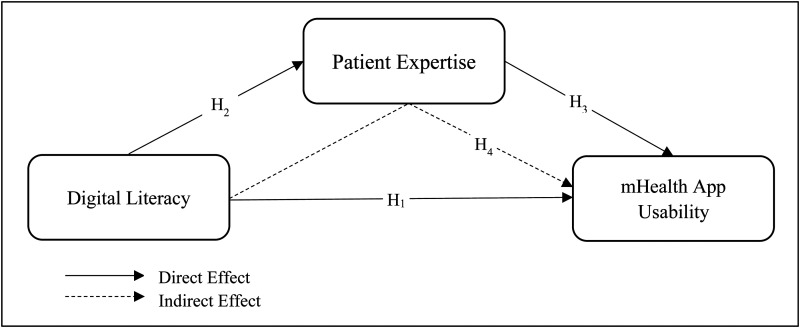
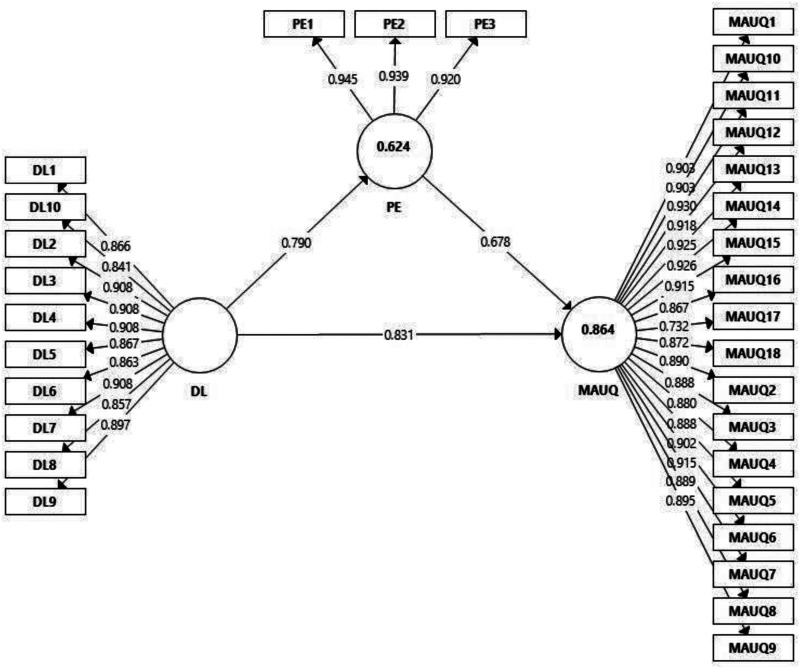
- Digital literacy had a positive and significant influence on mHealth app usability (β = 0.831, t = 46.020, p = 0.000) and on patient expertise (β = 0.790, t = 35.560, p = 0.000).
- Patient expertise had a positive and significant influence on mHealth app usability (β = 0.678, t = 19.594, p = 0.000).
- Patient expertise mediated the influence of digital literacy on mHealth app usability (β = 0.536, t = 17.477, p = 0.000); hypotheses H1, H2, H3, and H4 were accepted.
- The PLS-SEM model showed good fit: SRMR = 0.033, NFI = 0.911, RMStheta = 0.119.
Methods
- Descriptive cross-sectional study following STROBE; population was individuals aged 18 and over residing in Yozgat city center, Türkiye, with 647 participants reached and data collected between 15.02.2024 and 15.03.2024 by face-to-face survey.
- Measures included socio-demographic items, the 10-item Digital Literacy Scale, the 18-item mHealth App Usability Questionnaire with three dimensions, and the 3-item Patient Expertise Scale; all scales were adapted into Turkish and content validity was assessed by 6 experts, with a content validity index of 0.90.
- Data were analyzed with descriptive statistics in SPSS 24 and partial least squares path analysis (PLS-SEM) using SmartPLS 4; validity and reliability were assessed with factor loadings, Cronbach’s alpha, composite reliability, AVE, and Fornell-Larcker criteria.
Limitations
- The paper states that the study was conducted in a single city in Turkey, limiting generalizability to the whole country, and that the cross-sectional design limits causal inference and long-term exploration.
- The paper also states that contextual factors such as socioeconomic status and cultural background may influence the relationships, that health status differences between healthy and acutely/chronically ill individuals were not fully captured, and that long-term perceived benefits and engagement were not objectively assessed.
- Evident from the text: the study relies on self-report survey scales, includes only participants who had previously used mHealth apps and had internet/digital device access, and does not use objective assessments of digital literacy, patient expertise, or app engagement.
Model-written summary. Check it against the paper before relying on it.
Integrity signals
Registry
Cites
Statistics
Figures
Verification
Claims the paper makes
6 Valid · 1 Not valid · 19 Not checked · 50 Own results and interpretations
The sources with a verdict support this claim; the rest weren’t checked yet, have no full text we could read, or their verdicts aren’t rated yet.
In the paper
“Specifically, the results suggest that digital literacy plays a crucial role in determining how effectively individuals can use mHealth apps, a conclusion that aligns with prior research emphasizing the importance of digital competency in navigating technology-driven healthcare services.83–85”
§ The influence of digital literacy on mHealth app usability: The mediating role of patient expertise > Discussion
What the sources say
- Supportedcites [83] Alkureishi MA Choo ZY Rahman A, et al. Digitally disconnected: qualitative study of patient perspectives on the digital divide and potential solutions. JMIR Hum Factors 2021; 8: e33364. PMC8675564 34705664 source
The citation supports the citing sentence’s claim about prior research: the Results (Impacts of the Digital Divide; no page available) describe difficulties less technologically able patients face using online patient portals, while the Discussion (Principal Findings; no page available) identifies literacy and training as important to using health care technology. The paper does not itself test mHealth app effectiveness; that is framed as the citing authors’ own result. (LLM, conf=0.88)
- Supportedcites [84] Arias López MDP Ong BA Borrat Frigola X, et al. Digital literacy as a new determinant of health: a scoping review. PLOS Digital Health 2023; 2: e0000279. PMC10569540 37824584 source
The Introduction (page unavailable) says that patients who do not know how to use digital health tools ultimately will not use them. The Results section on definitions (page unavailable) identifies mHealth literacy as relating to information accessed through mobile devices. Together, these passages support the cited background point that digital competency matters for using mHealth apps, though the review does not quantify its effect on app use. (LLM, conf=0.86)
- Not checked — no full text of the sourcecites [85] Lin TT Bautista JR. Understanding the relationships between mHealth apps’ characteristics, trialability, and mHealth literacy. J Health Commun 2017; 22: 346– 354. 28323546 source
hedgedstates a cause- Asserted: passes — The authors put it forward as true.
- Checkable: passes — It can be checked against evidence.
- Load-bearing: passes — The paper’s conclusions depend on it.
- Based: passes — The paper gives a reason why it holds.
- Supported
The cited sources support only part of this claim — read each source’s verdict below.
In the paper
“In other words, the influence of individuals’ digital literacy on the use of mHealth apps becomes much stronger when combined with their experience with mHealth apps.80,81”
§ The influence of digital literacy on mHealth app usability: The mediating role of patient expertise > Discussion
What the sources say
- Not checked yetcites [80] Binyamin SS Zafar BA. Proposing a mobile apps acceptance model for users in the health area: a systematic literature review and meta-analysis. Health Informatics J 2021: 1– 27. DOI: https://doi.org/10.1177/1460458220976737. 33438494 source
Checked before — its earlier verdict is held back until a new check runs.
- Partly supportedcites [81] Smith B Magnani JW. New technologies, new disparities: the intersection of electronic health and digital health literacy. Int J Cardiol 2019; 292: 280– 282. 31171391 PMC6660987 sourceExperimental — accuracy not yet measured
The Abstract and “Limited digital health literacy: disparities in access and guidance” section link digital literacy challenges to difficulty using digital health services and apps. They do not say that experience with mHealth apps makes digital literacy’s influence on app use stronger; searches for app experience and an interaction found no such finding. Page numbers were not available in our copy. (LLM, conf=0.77)
boostedstates a cause- Asserted: passes — The authors put it forward as true.
- Checkable: passes — It can be checked against evidence.
- Load-bearing: passes — The paper’s conclusions depend on it.
- Based: passes — The paper gives a reason why it holds.
- Not checked yet
Every source the paper cites for this claim was checked and supports it.
In the paper
“Existing literature supports the notion that digital literacy is a crucial determinant of individuals’ willingness and openness to utilize mHealth applications. 82”
§ The influence of digital literacy on mHealth app usability: The mediating role of patient expertise > Discussion
What the sources say
- Supportedcites [82] Fan S Jain RC Kankanhalli MS. A comprehensive picture of factors affecting user willingness to use mobile health applications. ACM Trans Comput Healthcare 2024; 5: 1– 31. source
Section 5.1.1 reports that digital literacy had the strongest impact in the authors’ model and describes it as critical to users’ intentions to use mHealth apps. The Conclusion likewise highlights its critical role in user willingness. (LLM, conf=0.94)
plainstates a cause- Asserted: passes — The authors put it forward as true.
- Checkable: passes — It can be checked against evidence.
- Load-bearing: passes — The paper’s conclusions depend on it.
- Based: passes — The paper gives a reason why it holds.
- Supported
A result the paper reports from its own data — it cites no other source for it, so there is none to check. The quote shows it is in the paper.
In the paper
“Digital literacy affects both patient expertise (β = 0.790, t = 35.560, p = 0.000) and mHealth app usability (β = 0.831, t = 46.020, p = 0.000).”
§ The influence of digital literacy on mHealth app usability: The mediating role of patient expertise > Abstract > Results
plainstates a cause- Asserted: passes — The authors put it forward as true.
- Checkable: passes — It can be checked against evidence.
- Load-bearing: passes — The paper’s conclusions depend on it.
- Based: passes — The paper gives a reason why it holds.
- Rests on an assumption not shown here.
19 more claims
Create a free account to see all 76 claims and to verify the 1 reference still open.
- Probably not a substantial claim. 40
- It may state two separate claims as one. 26
Self-check
Percentages, sums and reported differences re-computed from the paper’s own numbers.
Each contradiction between two passages listed here was confirmed by an independent check.
Rated minor: it would not touch a result — a value no result rests on, a p-value that stays on the same side of the significance level, or a conflict that is clerical, resolved elsewhere in the paper, or outside its own findings.
In the paper
§ The influence of digital literacy on mHealth app usability: The mediating role of patient expertise > Method > Population and sample
“Participants who reported having used their smartphones at least for one of these purposes were included in the analysis.”
§ The influence of digital literacy on mHealth app usability: The mediating role of patient expertise > Method > Population and sample
“Exclusion criteria: Being under 18 years of age, being illiterate, being unable to use a smartphone, and not having used any mHealth apps before.”
Citations
Cites
Evaluating structural equation models with unobservable variables and measurement error
Fornell, C., & Larcker, D. F. (1981) · Journal of Marketing Research · doi:10.1177/002224378101800104 · Cited by 109,190
Perceived usefulness, perceived ease of use, and user acceptance of information technology
Davis, F. D. (1989) · MIS Quarterly · doi:10.2307/249008 · Cited by 68,483
On the Evaluation of Structural Equation Models
Bagozzi, R. P., & Yi, Y. (1988) · Journal of the Academy of Marketing Science · doi:10.1007/bf02723327 · Cited by 26,163
Pls-Sem: indeed a silver bullet
Hair, J. F., Ringle, C. M., & Sarstedt, M. (2011) · Journal of Marketing Theory and Practice · doi:10.2753/mtp1069-6679190202 · Cited by 21,631 · cited 1×
“Besides, ours is an exploratory approach 49 for which this type of data analysis is highly recommended.”
A primer on partial least squares structural equation modeling (PLS-SEM)
Leguina, A. (2015) · International Journal of Research & Method in Education · doi:10.1080/1743727x.2015.1005806 · Cited by 18,921
Qu, X. (2007) · Technometrics · doi:10.1198/tech.2007.s455 · Cited by 14,705
Bundesgesundheitsblatt - Gesundheitsforschung - Gesundheitsschutz
(2013) · Bundesgesundheitsblatt - Gesundheitsforschung - Gesundheitsschutz · doi:10.1007/103.1437-1588 · Cited by 11,796
Polit, D. F., & Beck, C. T. (2006) · Research in Nursing & Health · doi:10.1002/nur.20147 · Cited by 7,510 · cited 1×
“40 This coef fi cient is generally applied as 0.80 in studies.”
InfluentialUsing pls path modeling in new technology research: updated guidelines
Henseler, J., Hubona, G., & Ray, P. A. (2016) · Industrial Management & Data Systems · doi:10.1108/imds-09-2015-0382 · Cited by 7,173 · cited 1×
“44 The PLS-SEM statistical analysis technique, which is based on the structural equation model, was employed due to its particular suitability for exploratory research.”
Determination and Quantification Of Content Validity
LYNN, M. R. (1986) · Nursing Research · doi:10.1097/00006199-198611000-00017 · Cited by 6,775
Health Literacy: A Prescription to End Confusion
Committee on Health Literacy, Board on Neuroscience and Behavioral Health, & Institute of Medicine (2004) · doi:10.17226/10883 · Cited by 3,444
Two Structural Equation Models: LISREL and PLS Applied to Consumer Exit-Voice Theory
Fornell, C., & Bookstein, F. L. (1982) · Journal of Marketing Research · doi:10.2307/3151718 · Cited by 3,364
An empirical comparison of the efficacy of covariance-based and variance-based SEM
Reinartz, W., Haenlein, M., & Henseler, J. (2009) · International Journal of Research in Marketing · doi:10.1016/j.ijresmar.2009.08.001 · Cited by 2,906 · cited 1×
“47 Reinartz et al. 48 examined the circumstances in which PLS-SEM is appropriate for research analysis and determined that the approach can be utilized for a relatively novel research subject with a model that is not yet fully established.”
Consistent Partial Least Squares Path Modeling1
Dijkstra, T. K., & Henseler, J. (2015) · MIS Quarterly · doi:10.25300/misq/2015/39.2.02 · Cited by 2,898
Statistical Strategies for Small Sample Research
Hoyle, R. H. (1999) · Cited by 2,122
Partial least squares structural equation modeling in HRM research
Ringle, C. M., Sarstedt, M., Mitchell, R., & Gudergan, S. P. (2020) · The International Journal of Human Resource Management · doi:10.1080/09585192.2017.1416655 · Cited by 1,943
Estimation issues with PLS and CBSEM: Where the bias lies!
Sarstedt, M., Hair, J. F., Ringle, C. M., Thiele, K. O., & Gudergan, S. P. (2016) · Journal of Business Research · doi:10.1016/j.jbusres.2016.06.007 · Cited by 1,795
Can we teach digital natives digital literacy?
Ng, W. (2012) · Computers & Education · doi:10.1016/j.compedu.2012.04.016 · Cited by 1,621
Bridging Design and Behavioral Research With Variance-Based Structural Equation Modeling
Henseler, J. (2017) · Journal of Advertising · doi:10.1080/00913367.2017.1281780 · Cited by 1,020
Choi, N. G., & DiNitto, D. M. (2013) · Journal of Medical Internet Research · doi:10.2196/jmir.2645 · Cited by 871 · cited 2×
“28 Digital literacy encompasses a variety of skills, including the ability to critically evaluate online information, communicate effectively through digital channels, and navigate complex digital interfaces.”
On Comparing Results from CB-SEM and PLS-SEM: Five Perspectives and Five Recommendations
Rigdon, E. E., Sarstedt, M., & Ringle, C. M. (2017) · Marketing ZFP · doi:10.15358/0344-1369-2017-3-4 · Cited by 800
The Delivery of Public Health Interventions via the Internet: Actualizing Their Potential
Bennett, G. G., & Glasgow, R. E. (2009) · Annual Review of Public Health · doi:10.1146/annurev.publhealth.031308.100235 · Cited by 800 · cited 2×
“32 In other words, while digital literacy facilitates users ’ navigation of these apps, patient expertise serves as a critical intermediary in maximizing their utility and effectiveness.”
The mHealth App Usability Questionnaire (MAUQ): Development and Validation Study
Zhou, L., Bao, J., Setiawan, I. M. A., Saptono, A., & Parmanto, B. (2019) · JMIR mHealth and uHealth · doi:10.2196/11500 · Cited by 675 · cited 1×
“36 mHealth App Usability Questionnaire (MAUQ): The scale was developed by Zhou et al. 37 in 2019.”
Tips to use partial least squares structural equation modelling (PLS-SEM) in knowledge management
Cepeda-Carrion, G., Cegarra-Navarro, J.-G., & Cillo, V. (2019) · Journal of Knowledge Management · doi:10.1108/jkm-05-2018-0322 · Cited by 667
New directions in eHealth communication: Opportunities and challenges
Kreps, G. L., & Neuhauser, L. (2010) · Patient Education and Counseling · doi:10.1016/j.pec.2010.01.013 · Cited by 546
Business research for decision making
Davis, D. (1985) · Andalas University Repository (Andalas University) · Cited by 489
Health literacy revisited: what do we mean and why does it matter?
Peerson, A., & Saunders, M. (2009) · Health Promotion International · doi:10.1093/heapro/dap014 · Cited by 484
New technologies, new disparities: The intersection of electronic health and digital health literacy
Smith, B., & Magnani, J. W. (2019) · International Journal of Cardiology · doi:10.1016/j.ijcard.2019.05.066 · Cited by 446 · cited 1×
“80,81 Existing literature supports the notion that digital literacy is a crucial determinant of individuals ’ willingness and openness to utilize mHealth applications.”
Digital literacy as a new determinant of health: A scoping review
Arias López, M. D. P., Ong, B. A., Borrat Frigola, X., Fernández, A. L., Hicklent, R. S., Obeles, A. J. T., Rocimo, A. M., & Celi, L. A. (2023) · PLOS Digital Health · doi:10.1371/journal.pdig.0000279 · Cited by 422
Ölçek Geliştirme Çalışmalarında Temel İlkeler
Karakoç, A. G. D. F. Y., & Dönmez, P. D. L. (2014) · Tıp Eğitimi Dünyası · doi:10.25282/ted.228738 · Cited by 380
van Deursen, A. J. A. M., & van Dijk, J. A. G. M. (2015) · The Information Society · doi:10.1080/01972243.2015.1069770 · Cited by 353 · cited 1×
“31 Therefore, endeavors to enhance digital literacy among patients have the potential to strengthen patient expertise, enabling individuals to take a more active role in managing their health and to make informed healthcare decisions.”
Differences in mobile health app use: A source of new digital inequalities?
Bol, N., Helberger, N., & Weert, J. C. M. (2018) · The Information Society · doi:10.1080/01972243.2018.1438550 · Cited by 350
Son, J.-Y., & Benbasat, I. (2007) · Journal of Management Information Systems · doi:10.2753/mis0742-1222240102 · Cited by 338
Bitar, H., & Alismail, S. (2021) · DIGITAL HEALTH · doi:10.1177/20552076211009396 · Cited by 325 · cited 1×
“12,13 Moreover, individuals with higher levels of digital literacy may be more proactive in seeking health information, exhibiting self-management behaviors, and participating in joint decision-making processes with healthcare providers.”
Managing the Personal Side of Health: How Patient Expertise Differs from the Expertise of Clinicians
Hartzler, A., & Pratt, W. (2011) · Journal of Medical Internet Research · doi:10.2196/jmir.1728 · Cited by 259 · cited 2×
“20,23,24 Conversely, those lacking expertise may adopt a more passive role due to their limited experience, potentially leading to incorrect assessments.”
Hsu, W., Chiang, C., & Yang, S. (2014) · Journal of Medical Internet Research · doi:10.2196/jmir.3542 · Cited by 239
Pattern classification problems and fuzzy sets
Roubens, M. (1978) · Fuzzy Sets and Systems · doi:10.1016/0165-0114(78)90016-7 · Cited by 205
Knitza, J., Simon, D., Lambrecht, A., Raab, C., Tascilar, K., Hagen, M., Kleyer, A., Bayat, S., Derungs, A., Amft, O., et al. (2020) · JMIR mHealth and uHealth · doi:10.2196/19661 · Cited by 201
Mobile apps for healthy living: Factors influencing continuance intention for health apps
Yan, M., Filieri, R., Raguseo, E., & Gorton, M. (2021) · Technological Forecasting and Social Change · doi:10.1016/j.techfore.2021.120644 · Cited by 182 · cited 1×
“87,88 Thus, mHealth app expertise not only mediates but also ampli fi es the effects of digital literacy, facilitating a more seamless and intuitive user experience.”
Liew, M. S., Zhang, J., See, J., & Ong, Y. L. (2019) · JMIR mHealth and uHealth · doi:10.2196/12160 · Cited by 179
Financial Literacy in Developing Countries
Karakurum-Ozdemir, K., Kokkizil, M., & Uysal, G. (2019) · Social Indicators Research · doi:10.1007/s11205-018-1952-x · Cited by 175
Alkureishi, M. A., Choo, Z.-Y., Rahman, A., Ho, K., Benning-Shorb, J., Lenti, G., Velázquez Sánchez, I., Zhu, M., Shah, S. D., & Lee, W. W. (2021) · JMIR Human Factors · doi:10.2196/33364 · Cited by 143
Approaches to Improvement of Digital Health Literacy (eHL) in the Context of Person-Centered Care
Busse, T. S., Nitsche, J., Kernebeck, S., Jux, C., Weitz, J., Ehlers, J. P., & Bork, U. (2022) · International Journal of Environmental Research and Public Health · doi:10.3390/ijerph19148309 · Cited by 131
The best experts: The narratives of those who have a genetic condition
Petersen, A. R. (2006) · Social Science & Medicine · doi:10.1016/j.socscimed.2005.11.068 · Cited by 131
Determinants of mHealth success: An empirical investigation of the user perspective
Birkmeyer, S., Wirtz, B. W., & Langer, P. F. (2021) · International Journal of Information Management · doi:10.1016/j.ijinfomgt.2021.102351 · Cited by 115 · cited 1×
“22 This can be attributed to individuals ’ experiences, whether positive or negative, with the services they receive.”
The thing-power of the human-app health assemblage: thinking with vital materialism
Lupton, D. A. (2019) · Social Theory & Health · doi:10.1057/s41285-019-00096-y · Cited by 110
Toward a Better Understanding of the Intention to Use mHealth Apps: Exploratory Study
(2021) · doi:10.2196/27021 · Cited by 108
Bittlingmayer, U. H., Dadaczynski, K., Sahrai, D., van den Broucke, S., & Okan, O. (2020) · Bundesgesundheitsblatt - Gesundheitsforschung - Gesundheitsschutz · doi:10.1007/s00103-019-03087-6 · Cited by 103 · cited 1×
“15,16 Individuals with higher levels of digital literacy tend to exhibit greater con fi dence and competence in navigating digital platforms, including mHealth apps.”
Virtual reality as a tool to promote wellbeing in the workplace
Adhyaru, J. S., & Kemp, C. (2022) · Digital Health · doi:10.1177/20552076221084473 · Cited by 97
World Literacy: How Countries Rank and Why It Matters
Miller, J. W., & McKenna, M. C. (2016) · Cited by 92
Lin, T. T. C., & Bautista, J. R. (2017) · Journal of Health Communication · doi:10.1080/10810730.2017.1296508 · Cited by 89 · cited 1×
“82 85 When the results of Lin & Lou ’ s 86 study and the previously mentioned information and fi ndings are evaluated together, it can be said that digital literacy and the use of mHealth apps positively support each other and that both of them increase continuously with the experiences gained.”
Binyamin, S. S., & Zafar, B. A. (2021) · Health Informatics Journal · doi:10.1177/1460458220976737 · Cited by 89 · cited 1×
“80,81 Existing literature supports the notion that digital literacy is a crucial determinant of individuals ’ willingness and openness to utilize mHealth applications.”
Saura, J. R., Palos‐Sánchez, P. R., & Blanco‐González, A. (2019) · Journal of Business and Industrial Marketing · doi:10.1108/jbim-12-2018-0412 · Cited by 88
Threading together patient expertise.
Civan, A., & Pratt, W. (2007) · PubMed · Cited by 74
Effects of mHealth‐based interventions on health literacy and related factors: A systematic review
Lin, Y.-H. P., & Lou, M. (2020) · Journal of Nursing Management · doi:10.1111/jonm.13175 · Cited by 64
The relevance of health literacy to mHealth
Kreps, G. L. (2017) · Information Services and Use · doi:10.3233/isu-170828 · Cited by 62
Zou, P., Yu, B., & Hao, Y. (2011) · Journal of Computers · doi:10.4304/jcp.6.3.484-488 · Cited by 61
Hernandez-Ramos, R., Aguilera, A., Garcia, F., Miramontes-Gomez, J., Pathak, L. E., Figueroa, C. A., & Lyles, C. R. (2021) · JMIR Formative Research · doi:10.2196/25299 · Cited by 53 · cited 1×
“75,76 With the increase in health-related applications and the use of the internet to obtain health information, the importance of individuals ’ digital literacy levels has emerged.”
Locating patient expertise in everyday life
Civan, A., McDonald, D. W., Unruh, K. T., & Pratt, W. (2009) · Proceedings of the 2009 ACM International Conference on Supporting Group Work · doi:10.1145/1531674.1531718 · Cited by 48
A Comprehensive Picture of Factors Affecting User Willingness to Use Mobile Health Applications
Fan, S., Jain, R. C., & Kankanhalli, M. S. (2024) · ACM Transactions on Computing for Healthcare · doi:10.1145/3626962 · Cited by 40 · cited 1×
“82 85 When the results of Lin & Lou ’ s 86 study and the previously mentioned information and fi ndings are evaluated together, it can be said that digital literacy and the use of mHealth apps positively support each other and that both of them increase continuously with the experiences gained.”
Shan, W., Wang, Y., Luan, J., & Tang, P. (2019) · JMIR mhealth and uhealth · doi:10.2196/15544 · Cited by 39
Addressing and evaluating health literacy in mHealth: a scoping review
Emerson, M. R., Buckland, S., Lawlor, M. A., Dinkel, D., Johnson, D. J., Mickles, M. S., Fok, L., & Watanabe-Galloway, S. (2022) · mHealth · doi:10.21037/mhealth-22-11 · Cited by 36
The Relevance of Health Literacy to mHealth.
Kreps, G. L. (2017) · PubMed · Cited by 27
König, L., & Suhr, R. (2023) · Journal of Medical Internet Research · doi:10.2196/46336 · Cited by 16
Smith, S. W., DeJong, W., Turner, M. M., Park, S., Jang, Y., Poole, A., Martell, D., & Salerno, J. (2021) · Journal of Health Communication · doi:10.1080/10810730.2021.2009597 · Cited by 14
BİREYLERİN MOBİL SAĞLIK UYGULAMASI KULLANIM DURUMU ve E-SAĞLIK OKURYAZARLIĞI İLİŞKİSİ
Emin, K. A. Y. A., & Eke, E. (2023) · İşletme Bilimi Dergisi · doi:10.22139/jobs.1159206 · Cited by 11
Hastalık Yönetiminde Dijital Sağlık Okuryazarlığı
TEMÜR, B. N., & AKSOY, N. (2022) · Dokuz Eylül Üniversitesi Hemşirelik Fakültesi Elektronik Dergisi · doi:10.46483/deuhfed.1009986 · Cited by 8
Use of partial least squares (PLS) in strategic management research: a review of four recent studies
Hulland, J. (1999) · Strategic Management Journal · doi:10.1002/(sici)1097-0266(199902)20:2<195::aid-smj13>3.0.co;2-7
Research works printed but not linked: 17
- Livingstone S. What is media literacy? Intermedia 2004; 32: 18– 20.
- Eshet-Alkalai Y. Digital literacy: a conceptual framework for survival skills in the digital era. J Educ Multimedia Hypermedia 2004; 13: 93– 106.
- Adams R Garcia E. Digital literacy and digital inequality: examining the roles of digital literacy in health information behavior. Inf Res 2018; 23: 785. http://InformationR.net/ir/23-2/paper785.html
- Tarhan N Ekinci Y Tutgun-Ünal A. Dijital sağlık okuryazarlığı: Dijital hastalıklar ve siberkondri. İstanbul: Der Yayınları, 2021.
- Jones RB Ashurst EJ Atkey J, et al. Exploring digital literacy and its implications for health literacy: a study of social media use in a low-income area of London. J Med Internet Res 2019; 21: e14210.
- Karagöz Y. SPSS 21.1 Uygulamalı Biyoistatistik. Ankara: Nobel Yayın Dağıtım, 2014.
- Bal H. Bilimsel Araştırma Yöntem ve Teknikleri. Isparta: Süleyman Demirel Üniversitesi Basımevi, SDÜ yayın No:20, 2001.
- Üstündağ MT Güneş E Bahçivan E. Turkish adaptation of digital literacy scale and investigating pre-service science teachers’ digital literacy. J Educ Future 2017; 12: 19– 29.
- Altunışık R. Anketlerde veri kalitesinin iyileştirilmesi için öntest (pilot test) yöntemleri. Pazarlama ve Pazarlama Araştırmaları Dergisi 2008; 2: 1– 17.
- Wong KKK. Mastering partial least squares structural equation modeling (PLS-SEM) with Smartpls in 38 h. Bloomington: iUniverse, 2019.
- Alarcón D Sánchez JA De Olavide U. Assessing convergent and discriminant validity in the ADHD-R IV rating scale: user-written commands for average variance extracted (AVE), composite reliability (CR), and heterotrait-monotrait ratio of correlations (HTMT). In: Spanish STATA Meeting, 2015, October, pp. 1– 39. https://www.stata.com/meeting/spain15/abstracts/materials/spain15_alarcon.pdf
- Garson GD. Partial least squares: regression and structural equation models. Asheboro: Statistical Associates Publishing, 2016.
- Kopmaz B Arslanoğlu A. Mobil Sağlık ve akıllı sağlık uygulamaları. Sağlık Akademisyenleri Dergisi 2018; 5: 251– 255.
- Yeşildal M. Yetişkin bireylerde dijital okuryazarlık ve sağlık okuryazarlığı arasındaki ilişki: Konya örneği. Doctoral dissertation, Necmettin Erbakan University, Turkey, 2018.
- Şengül H Çınar F Çapar H, et al. Sağlık bilimleri fakültesi öğrencilerin e-sağlık okuryazarlığı düzeyleri ve internet kullanımına yönelik tutumları: bir vakıf üniversitesi örneği. Int J Soc Humanit Sci Res 2017; 4: 1277– 1287.
- Monkman H Kushniruk AW. Ehealth literacy issues, constructs, models, and methods for health information technology design and evaluation. Knowl Manage E-Learn 2015; 7: 541– 549.
- Değerli M. Mobl Sağlık Uygulamalarına Genel Bir Bakış ve Özgün Bir Mobil Sağlık Uygulaması Geliştirilmesi. EMO Bilimsel Dergi 2021; 11: 59– 69.
Cited by
Huang, Z., McCoy, D., Cooper, R., Crytzer, T. M., Chi, Y., & Ding, D. (2025) · JMIR Rehabilitation and Assistive Technologies · doi:10.2196/70063 · Cited by 10
Presby, D. M., Jasinski, S. R., Capodilupo, E. R., Holmes, K. E., von Hippel, W., Grosicki, G. J., & Lee, V. (2025) · Journal of Medical Internet Research · doi:10.2196/64955 · Cited by 15
Jallad, S. T., Mujahed, A., Al-Zeer, I., Samman, S., Al-Qaisi, T., Abu-Tair, S., Dabbous, D. A., & Bada, N. (2025) · Digital Health · doi:10.1177/20552076251393399 · Cited by 10
Planning for the Unexpected and Unintended Effects of mHealth Interventions: Systematic Review
Cao, W., Cao, X., & Sutherland, A. D. (2025) · Journal of Medical Internet Research · doi:10.2196/68909 · Cited by 4
Adoption of Telemedicine for Dementia Care in Nigeria: Scoping Review
Adedeji, A., Doğan, H., Adedoyin, F. F., & Heward, M. (2025) · Interactive Journal of Medical Research · doi:10.2196/75168 · Cited by 4
Metadata
- Authors
- Durmuş, A.
- Affiliations
- Yozgat Bozok Üniversitesi (TR)
- Corresponding author
- Durmuş, Ayhan
- ORCID
- Durmuş, Ayhan
- Venue
- Digital Health
- Publisher
- SAGE Publications
- Published
- 2024-01
- Volume
- 10
- Pages
- 20552076241299061-20552076241299061
- ISSN
- 2055-2076 (ISSN-L)
- PMC
- PMC11590160
- OpenAlex
- W4404695471
- Cited by
- 30
- References
- 68
- Citations by year
- 2026: 16 · 2025: 14
- FWCI
- 17.49
- Type
- journal article
- Language
- en
- Open access
- gold
- doi.org
- Licence
- Locations
- Digital Health (publishedVersion, cc-by-nc)
- PubMed Central (publishedVersion, cc-by-nc)
- PubMed (publishedVersion)
- DOAJ (DOAJ: Directory of Open Access Journals) (submittedVersion)
- Topics
- Health Sciences › Health Professions › General Health Professions › Mobile Health and mHealth Applications
- Health Sciences › Health Professions › Health Information Management › Health, Technology, Consumer Behavior
- Health Sciences › Health Professions › General Health Professions › Health Literacy and Information Accessibility
- Keywords
- digital literacy, mobile health apps, patient expertise, mediating effect, technology acceptance, user experience, health technology adoption
About these checks
Registry, retraction, Cites and statistics results are computed, not judged, with one exception: a printed reference that no index lists is read once by a model before it counts as a citation error. Claims are extracted by a model and kept only when their quote appears verbatim in the text; each cited source is then checked, with a model’s help, for whether it says what the claim relies on. Those verdicts can be wrong — read the claim’s quote and the cited source before relying on one.
The claim verdicts this report counts are experimental: their accuracy is not yet measured.
A language model drew the claims from the paper on 2026-09-30, under version 3 of the claim definition (model deepseek-v4.1-flash, prompt extract-v3).
A second model labelled each claim on 2026-09-30 (model jev-1.13-20260917, definition revision gold-guideline-v0.2).
Cited sources are checked with a language model’s help (gpt-6-sol).
Statistics and arithmetic are recomputed, not judged.
Confidence bands are shown only for fields calibrated on our annotated test set. None is calibrated yet, so no band is shown.
What counts as a claim ›How we measure confidence ›How we check this ›
Are you an author, or do you see a problem with this page? Request a review
Data sources
Bibliographic data: Semantic Scholar, OpenAlex, Crossref.
Contains information from the Semantic Scholar Academic Graph Datasets, made available under the ODC Attribution License (ODC-BY 1.0).
Semantic Scholar’s data is described in: Kinney, R., et al. (2023). The Semantic Scholar Open Data Platform. arXiv:2301.10140.
