

Developing Misinformation Immunity: How to Reason-Check Fallacious News in a Human–Computer Interaction Environment
Open accessThe DOI matches its Crossref record; 54 of the 55 references it cites were found in a registry or an index.
Abstract
To counter the fake news phenomenon, the scholarly community has attempted to debunk and prebunk disinformation. However, misinformation still constitutes a major challenge due to the variety of misleading techniques and their continuous updates which call for the exercise of critical thinking to build resilience. In this study we present two open access chatbots, the Fake News Immunity Chatbot and the Vaccinating News Chatbot, which combine Fallacy Theory and Human–Computer Interaction to inoculate citizens and communication gatekeepers against misinformation. These chatbots differ from existing tools both in function and form. First, they target misinformation and enhance the identification of fallacious arguments; and second, they are multiagent and leverage discourse theories of persuasion in their conversational design. After having described both their backend and their frontend design, we report on the evaluation of the user interface and impact on users’ critical thinking skills through a questionnaire, a crowdsourced survey, and a pilot qualitative experiment. The results shed light on the best practices to design user-friendly active inoculation tools and reveal that the two chatbots are perceived as increasing critical thinking skills in the current misinformation ecosystem.
Overview
The claims and statistics of this paper haven’t been checked yet.
Free: it reads the open-access text and checks the first 5 claims that cite a source we can check. Create a free account to check every claim.
Integrity signals
Registry
Cites
Statistics
Figures


Verification
Claims the paper makes
The claims and statistics of this paper haven’t been checked yet.
Free: it reads the open-access text and checks the first 5 claims that cite a source we can check. Create a free account to check every claim.
Claims other papers make about this one
Each is checked against this paper’s own text: does it say what the citing paper says it does?
The source backs part of the claim, not all of it — or backs it for a different population, condition or comparison.
In the citing paper
“However, the phenomenon of GenAI producing biassed or inaccurate information, commonly referred to as GenAI hallucination, has surprisingly been observed to contribute to the enhancement of students' critical analysis skills.”
From The Mediating Role of Generative AI Self-Regulation on Students’ Critical Thinking and Problem-Solving (2024) · cites this paper as [16]
Experimental — accuracy not yet measured
Self-check
Percentages, sums and reported differences re-computed from the paper’s own numbers.
The self-check needs the paper’s full text.
Citations
Cites
McCright, A. M., & Dunlap, R. E. (2011) · The Sociological Quarterly · doi:10.1111/j.1533-8525.2011.01198.x · Cited by 2,340
Pennycook, G., & Rand, D. G. (2019) · Cognition · doi:10.1016/j.cognition.2018.06.011 · Cited by 2,022 · cited 1×
“…trust values to mainstream media sources, hyperpartisan ones, and fake news websites, despite appearing quite well developed in experimental environments (Pennycook & Rand, 2019), are not well enough developed to identify misinformation across different media platforms and in everyday interactions.”
BackgroundWalton, D., Reed, C., & Macagno, F. (2008) · Cambridge University Press eBooks · doi:10.1017/cbo9780511802034 · Cited by 1,372 · cited 2×
“The heuristics is, in fact, composed of a set of critical questions , which are conceived in Argumentation Theory (Walton et al., 2008) as those questions that scrutinize the soundness of the reasoning expressed by the arguments (e.g., “Is the reported evidence [if any] the only available?” to verify whether cherry pi…”
BackgroundSelf-citationCritical Thinking and Subject Specificity: Clarification and Needed Research
Ennis, R. H. (1989) · Educational Researcher · doi:10.2307/1174885 · Cited by 1,055
An MTurk Crisis? Shifts in Data Quality and the Impact on Study Results
Chmielewski, M., & Kucker, S. C. (2020) · Social Psychological and Personality Science · doi:10.1177/1948550619875149 · Cited by 1,027 · cited 1×
“…post-intervention surveys with the same population of workers, we have encountered issues such as fraudulent, nonsensical, and partial responding, which are common for complex tasks that require a willingness to engage (Chmielewski & Kucker, 2020), but they do not allow for a valid assessment.”
BackgroundCredibility and trust of information in online environments: The use of cognitive heuristics
Metzger, M. J., & Flanagin, A. J. (2013) · Journal of Pragmatics · doi:10.1016/j.pragma.2013.07.012 · Cited by 1,000 · cited 1×
“Another possible explanation lies in the reputation cognitive heuristics according to which “people are likely to believe a source whose name they recognize as more credible compared to an unfamiliar source” (Metzger & Flanagin, 2013, p. 214).”
BackgroundCook, J., Lewandowsky, S., & Ecker, U. K. H. (2017) · PLOS ONE · doi:10.1371/journal.pone.0175799 · Cited by 971 · cited 1×
“…has shown that instructing against misleading rhetorical strategies is a highly efficient way to boost people’s resilience against fake news (Cook et al., 2017) and that content features such as degree of novelty and emotional reactions of recipients are key factors in making fake news…”
BackgroundStrategies for Teaching Students to Think Critically: A Meta-Analysis
Abrami, P. C., Bernard, R. M., Borokhovski, E., Waddington, D. I., Wade, C. A., & Persson, T. (2015) · Review of Educational Research · doi:10.3102/0034654314551063 · Cited by 932 · cited 1×
“This choice is reminiscent of the fact that authentic problems are a crucial factor when teaching critical thinking (Abrami et al., 2015).”
BackgroundMetzger, M. J. (2007) · Journal of the American Society for Information Science and Technology · doi:10.1002/asi.20672 · Cited by 871
The media and the literacies: media literacy, information literacy, digital literacy
Koltay, T. (2011) · Media, Culture & Society · doi:10.1177/0163443710393382 · Cited by 796 · cited 1×
“Koltay (2011) lists, for example, “Having a critical approach to quality and accuracy of content” among the five stages to build media literacy” (p. 213).”
BackgroundCountering Misinformation and Fake News Through Inoculation and Prebunking
Lewandowsky, S., & van der Linden, S. (2021) · European Review of Social Psychology · doi:10.1080/10463283.2021.1876983 · Cited by 773
Types, sources, and claims of Covid-19 misinformation
Brennen, J. S., Simon, F., Howard, P., & Nielsen, R. (2023) · Reuters Institute for the Study of Journalism · doi:10.60625/risj-awvq-sr55 · Cited by 663
Inoculating Against Fake News About COVID-19
van der Linden, S., Roozenbeek, J., & Compton, J. (2020) · Frontiers in Psychology · doi:10.3389/fpsyg.2020.566790 · Cited by 632
Misperceptions, the Media, and the Iraq War
Kull, S., Ramsay, C., & Lewis, E. (2003) · Political Science Quarterly · doi:10.1002/j.1538-165x.2003.tb00406.x · Cited by 587 · cited 1×
“In relation to climate change, they cause/sustain climate damaging behaviors (McCright & Dunlap, 2011); and in political decisions, where they have helped shape justifications for wars such as the invasion of Iraq (Kull et al., 2003).”
BackgroundEvaluating the fake news problem at the scale of the information ecosystem
Allen, J., Howland, B., Mobius, M., Rothschild, D., & Watts, D. J. (2020) · Science Advances · doi:10.1126/sciadv.aay3539 · Cited by 528 · cited 1×
“Similarly, Allen et al. (2020), through the analysis of a multimode dataset of news consumption in the United States, show that blatantly false fake news constitutes 0.15% of Americans’ daily news diet, while misinformation driven by agenda setting in mainstream media is largely understud-ied and…”
BackgroundInfluentialParental vaccine safety concerns in 2009
Freed, G. L., Clark, S. J., Butchart, A. T., Singer, D. C., & Davis, M. M. (2010) · PEDIATRICS · doi:10.1542/peds.2009-1962 · Cited by 503
Tsai, W.-H. S., Liu, Y., & Chuan, C.-H. (2021) · Journal of Research in Interactive Marketing · doi:10.1108/jrim-12-2019-0200 · Cited by 394 · cited 1×
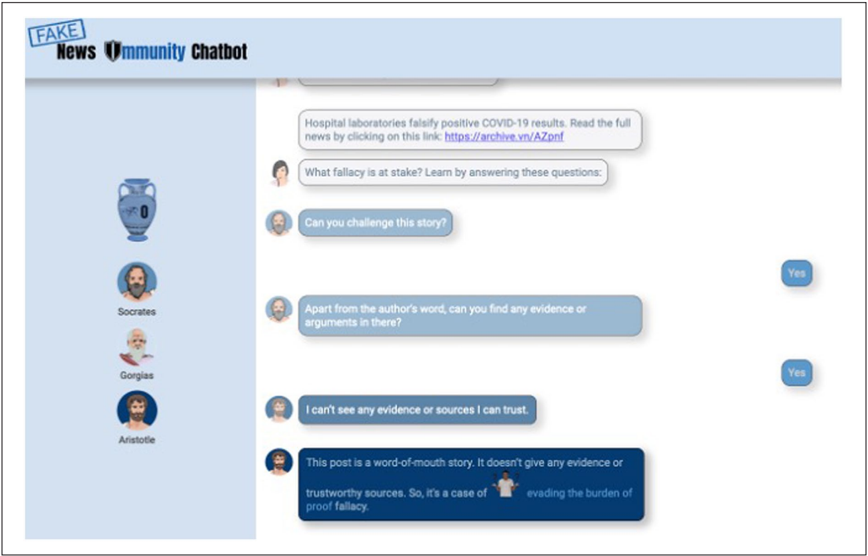
“This stylistic choice is motivated by three main factors: first, interacting with the philosophers’ users inductively learn their dialectical techniques acquiring historical knowledge; second, research shows that building software agents as dialogical personas increases users’ engagement (Tsai et al., 2021); third we…”
BackgroundARAUCARIA: SOFTWARE FOR ARGUMENT ANALYSIS, DIAGRAMMING AND REPRESENTATION
REED, C., & ROWE, G. (2004) · International Journal on Artificial Intelligence Tools · doi:10.1142/s0218213004001922 · Cited by 393
Self-citationThe Carneades model of argument and burden of proof
Gordon, T. F., Prakken, H., & Walton, D. (2007) · Artificial Intelligence · doi:10.1016/j.artint.2007.04.010 · Cited by 393 · cited 1×
“Techniques of critical thinking have long been explored in computational environments to provide scaffolding for better quality reasoning in domains such as law (see, e.g., Gordon et al., 2007) and politics.”
BackgroundEvaluating and Informing the Design of Chatbots
Jain, M., Kumar, P., Kota, R., & Patel, S. N. (2018) · Proceedings of the 2018 Designing Interactive Systems Conference · doi:10.1145/3196709.3196735 · Cited by 376
Basol, M., Roozenbeek, J., Berriche, M., Uenal, F., McClanahan, W. P., & Linden, S. V. D. (2021) · Big Data & Society · doi:10.1177/20539517211013868 · Cited by 271 · cited 1×
“The findings of Basol et al.’s (2021) study to evaluate the efficacy of the Go Viral! game on 1,777 players reveal an increase in skepticism toward both real and fake news right after playing, but an enhanced immunity toward disinformation only after 1 week.”
BackgroundThe use of crowdsourcing in addiction science research: Amazon Mechanical Turk.
Strickland, J. C., & Stoops, W. W. (2019) · Experimental and Clinical Psychopharmacology · doi:10.1037/pha0000235 · Cited by 250 · cited 1×
“The Amazon Mechanical Turk platform has been fruitfully employed to gather respondents for a range of tasks across domains ranging from social sciences to computer science (Strickland & Stoops, 2019).”
MethodCarmi, E., Yates, S. J., Lockley, E., & Pawluczuk, A. (2020) · Internet Policy Review · doi:10.14763/2020.2.1481 · Cited by 222
Self-citationPaul, R. (1984) · Informal Logic · doi:10.22329/il.v4i2.2766 · Cited by 200 · cited 1×
“…an object of discussion across disciplines ranging from Philosophy to Psychology to Informal Logic and has become a buzzword in pedagogical settings since the late 20th century (Goodnight, 2009), leading to a proliferation of definitions (e.g., Ennis, 1989; Hatcher and Spencer, 2005; Paul, 1981).”
BackgroundChallenges in Data Crowdsourcing
García-Molina, H., Joglekar, M., Marcus, A., Parameswaran, A., & Verroios, V. (2016) · IEEE Transactions on Knowledge and Data Engineering · doi:10.1109/tkde.2016.2518669 · Cited by 161
Health Chatbots for Fighting COVID-19: a Scoping Review
Almalki, M., & Azeez, F. (2020) · Acta Informatica Medica · doi:10.5455/aim.2020.28.241-247 · Cited by 127 · cited 1×
“As remarked by Almalki and Azeez (2020), a plethora of health chatbots have been developed during the pandemic to “disseminate health information and knowledge; self-triage and personal risk assessment; monitoring exposure and notifications; tracking COVID-19 symptoms and health aspects; combating…”
BackgroundGroup behavior in social media: Antecedents of initial trust formation
Shareef, M. A., Kapoor, K. K., Mukerji, B., Dwivedi, R., & Dwivedi, Y. K. (2020) · Computers in Human Behavior · doi:10.1016/j.chb.2019.106225 · Cited by 125 · cited 1×
“These results seem to challenge a key component of the social media trust framework, namely, that social media users tend first of all to trust their peers rather than institutions, equating familiarity with credibility (Shareef et al., 2020), what Yates & Carmi (2022), call “networks of literacy.””
Carey, J. M., Guess, A. M., Loewen, P. J., Merkley, E., Nyhan, B., Phillips, J. B., & Reifler, J. (2022) · Nature Human Behaviour · doi:10.1038/s41562-021-01278-3 · Cited by 118 · cited 1×
“As for long-lasting effects, Carey et al. (2022), through a large-scale survey in Canada, the United States, and the United Kingdom show that exposure to fact-checks reduced beliefs in false claims with no spillover effects, but the improvements in accuracy judgments already dissipates after a few…”
BackgroundA comparison of prebunking and debunking interventions for implied versus explicit misinformation
Tay, L. Q., Hurlstone, M. J., Kurz, T., & Ecker, U. K. H. (2022) · British Journal of Psychology · doi:10.1111/bjop.12551 · Cited by 109
Pfau, M., Ivanov, B., Houston, B., Haigh, M., Sims, J., Gilchrist, E., Russell, J., Wigley, S., Eckstein, J., & Richert, N. (2005) · Communication Monographs · doi:10.1080/03637750500322578 · Cited by 105
Altay, S., Hacquin, A.-S., Chevallier, C., & Mercier, H. (2023) · Journal of Experimental Psychology: Applied · doi:10.1037/xap0000400 · Cited by 81
Eftekhari, M., Sotoudehnama, E., & Marandi, S. S. (2016) · Educational Technology Research and Development · doi:10.1007/s11423-016-9431-z · Cited by 72 · cited 1×
“The educational efficacy of the argument mapping software Rationale has been tested across domains ranging from English as a Foreign Language Context (Eftekhari et al., 2016) to business education (Kunsch et al., 2014).”
MethodCollective Intelligence in Organizations: Tools and Studies
Grasso, A. M., & Convertino, G. (2012) · Computer Supported Cooperative Work (CSCW) · doi:10.1007/s10606-012-9165-3 · Cited by 65 · cited 1×
“Assuming that critical thinking in the media ecosystem implies a process of sensemaking the information accessed through the news (Grasso & Convertino, 2012), we have taken as a starting point the sensemaking scale developed by De Liddo et al. (2021).”
BackgroundMusi, E., & Reed, C. (2022) · Discourse & Society · doi:10.1177/09579265221076609 · Cited by 54 · cited 2×
“…recognition of arguments which seem valid, but are not—fallacies—results in the gray area of misinformation, where the information conveyed might be factual, but presented in a misleading way through strategies such as cherry picking, false analogies, and hasty generalizations (Musi & Reed, 2022).”
MethodSelf-citationThe Use of Argument Mapping to Enhance Critical Thinking Skills in Business Education
Kunsch, D. W., Schnarr, K., & van Tyle, R. (2014) · Journal of Education for Business · doi:10.1080/08832323.2014.925416 · Cited by 50 · cited 1×
“The educational efficacy of the argument mapping software Rationale has been tested across domains ranging from English as a Foreign Language Context (Eftekhari et al., 2016) to business education (Kunsch et al., 2014).”
MethodScaling up interactive argumentation by providing counterarguments with a chatbot
Altay, S., Schwartz, M., Hacquin, A.-S., Allard, A., Blancke, S., & Mercier, H. (2022) · Nature Human Behaviour · doi:10.1038/s41562-021-01271-w · Cited by 50 · cited 1×
“With the aim of preventing the formation of misconceptions about genetically modified organisms (GMOs), Altay et al. (2022) have developed a chatbot to provide participants with good arguments rebutting the most common counter arguments against GMOs.”
BackgroundComputer-assisted argument mapping: a rationale approach
Davies, M. (2009) · Higher Education · doi:10.1007/s10734-009-9226-9 · Cited by 49
Visser, J., Lawrence, J. S., & Reed, C. (2020) · Communications of the ACM · doi:10.1145/3397189 · Cited by 49 · cited 3×
“Since their launch in November 2020, the Fake News Immunity and the Vaccinating News Chatbots have registered 1,700 users across 10 countries (United States, 490; United Kingdom, 375; Italy, 122; Germany, 78; Netherlands, 56; Switzerland, 53; Canada, 39), with an average engagement time of 3 min and 14 s. User Experie…”
BackgroundInfluentialSelf-citationA Pragma-dialectical Procedure for a Critical Discussion
van Eemeren, F. H., & Grootendorst, R. (2003) · Argumentation · doi:10.1023/a:1026334218681 · Cited by 48
Developing Fake News Immunity: Fallacies as Misinformation Triggers During the Pandemic
Musi, E., Aloumpi, M., Carmi, E., Yates, S. J., & O’Halloran, K. L. (2022) · Online Journal of Communication and Media Technologies · doi:10.30935/ojcmt/12083 · Cited by 48
Self-citationThe presence of unexpected biases in online fact-checking
Park, S., Park, J. Y., & Kang, J. (2021) · Harvard Kennedy School Misinformation Review · doi:10.37016/mr-2020-53 · Cited by 45
SALEH, N. F., ROOZENBEEK, J., MAKKI, F. A., MCCLANAHAN, W. P., & VAN DER LINDEN, S. (2024) · Behavioural Public Policy · doi:10.1017/bpp.2020.60 · Cited by 42 · cited 1×
“More specifically, active inoculation (Saleh et al., 2021) through engagement in a digital game has turned out to be particularly effective for cognitive reasons (Pfau et al., 2005).”
BackgroundA domain specific language for describing diverse systems of dialogue
Wells, S., & Reed, C. (2012) · Journal of Applied Logic · doi:10.1016/j.jal.2012.09.001 · Cited by 39 · cited 1×
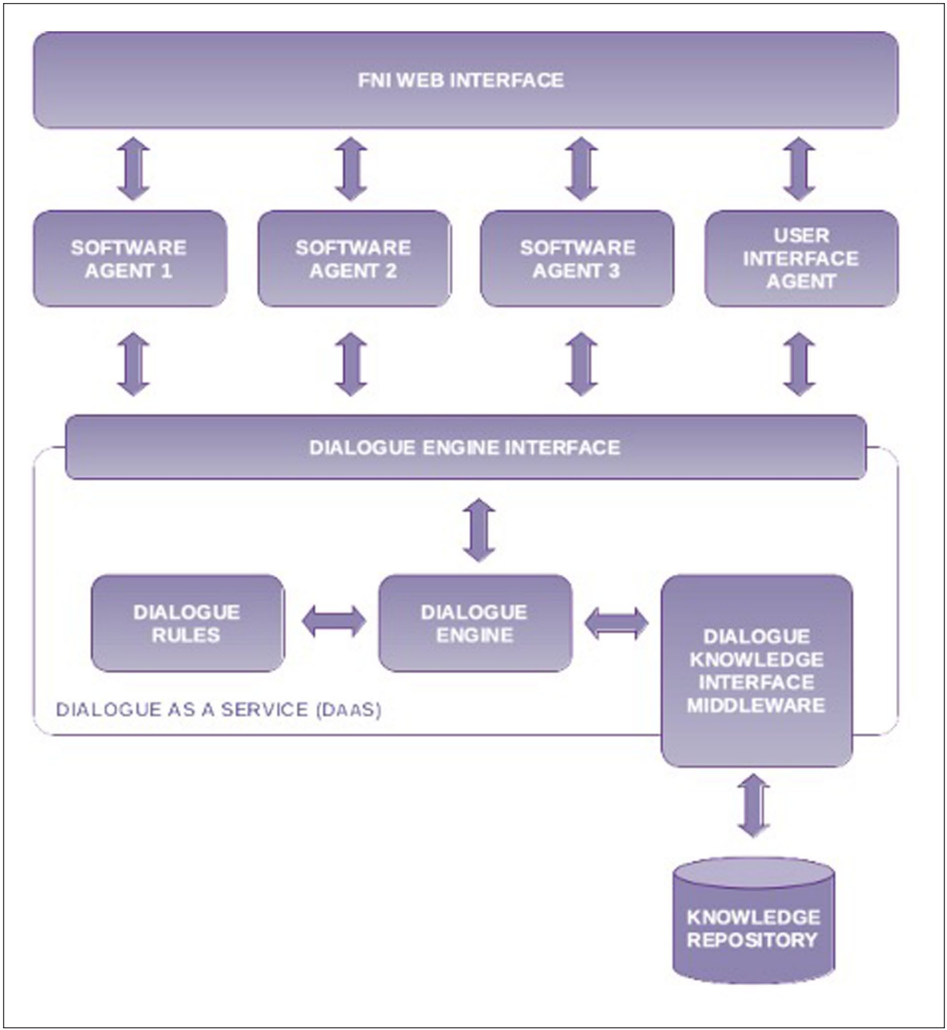
“The structure of the dialogue game, written in the tailored dialogue game programming language DGDL (Wells & Reed, 2012), is detached from the knowledge over which the game is to be played.”
BackgroundSelf-citationMisinformation, Crisis, and Public Health—Reviewing the Literature
Starbird, K., Spiro, E. S., & Koltai, K. (2020) · doi:10.35650/md.2063.d.2020 · Cited by 36 · cited 1×
“For example, in health they have prevented the timely adoption of measures and treatments to counter the epidemic (Freed et al., 2010; Starbird et al., 2020).”
Asked and Answered: Building a Chatbot to Address Covid-19-Related Concerns
HerrimanMaguire, MeerElana, RosinRoy, LeeVivian, WashingtonVindell, & VolppKevin, G. (2020) · NEJM Catalyst · Cited by 34
Siedlikowski, S., Noël, L.-P., Moynihan, S. A., & Robin, M. R. (2021) · Journal of Medical Internet Research · doi:10.2196/27283 · Cited by 27 · cited 1×
“The latter group of chatbots counter misinformation mostly offering accurate, tailored, and easy-to-access correct information (Altay et al., 2021; Herriman et al., 2020; Siedlikowski et al., 2021), rather than teaching citizens how to recognize misinformation in messages spread across digital media.”
BackgroundThe Palgrave Handbook of Media Misinformation
Fowler-Watt, K., & McDougall, J. (2022) · Springer eBooks · doi:10.1007/978-3-031-11976-7 · Cited by 22
Liddo, A. D., Pedreira, N., & Plüss, B. (2020) · International Journal of Human-Computer Studies · doi:10.1016/j.ijhcs.2020.102537 · Cited by 21
Trustworthy Misinformation Mitigation with Soft Information Nudging
Horne, B. D., Gruppi, M., & Adalı, S. (2019) · IEEE International Conference on Trust, Privacy and Security in Intelligent Systems and Applications (TPS-ISA) · doi:10.1109/tps-isa48467.2019.00039 · Cited by 20
Understanding Failures and Potentials of Argumentation Tools for Public Deliberation
Liddo, A. D., & Strube, R. (2021) · International Conference on Communities and Technologies (C&T) · doi:10.1145/3461564.3461584 · Cited by 17
Government and media misinformation about COVID-19 is confusing the public
Kyriakidou, M., Morani, M., Soo, N., & Cushion, S. (2020) · London School of Economics and Political Science Research Online (London School of Economics and Political Science) · Cited by 13
Fact Checking Misinformation Using Recommendations from Emotional Pedagogical Agents
Sethi, R. J., Rangaraju, R., & Shurts, B. (2019) · Lecture notes in computer science · doi:10.1007/978-3-030-22244-4_13 · Cited by 12
TEACHING CRITICAL THINKING WITH RATIONALE
ter Berg, T., van der Brugge, E., & Cullen, S. (2013) · INTED proceedings · Cited by 4
Alsufiani, K. D., & Attfield, S. (2018) · Electronic workshops in computing · doi:10.14236/ewic/hci2018.156 · Cited by 1
Research works printed but not linked: 4
- 17. Facione, P. A. (1990). The California critical thinking skills test: College level. Technical report #1-Experimental validation and content validity. https://www.researchgate. net/profile/Peter-Facione/publication/268295703_The_ California_Critical_Thinking_Skills_Test_College_ Level_Experimental_Validation_and_Content_Validity/ links/587677f908aebf17d3b9a162/The-California-Critical- Thinking-Skills-Test-Co
- 24. Hatcher, D. L., & Spencer, L. A. (2005). Reasoning and writing: From critical thinking to composition. American Press.
- 28. Johnson, R. H., & Blair, J. A. (2006). Logical self-defense. Idea.
- 36. Mercier, H., & Sperber, D. (2017). The enigma of reason: A new theory of human undersanding. Allen Lane.
Cited by
Zhou, X., Teng, D., & Al-Samarraie, H. (2024) · Education Sciences · doi:10.3390/educsci14121302 · Cited by 119
“…might undermine advanced cognitive capabilities, the necessity making of GenAI hal-lucination students’ from the tool, which as a result in fl uences their ability to distinguish between accurate and inaccurate AI-generated content—a competency that is increasingly essential as they engage [16].”
Parsakia, K. (2023) · Health Nexus · doi:10.61838/hn.1.1.14 · Cited by 89
Shin, D., & Akhtar, F. (2024) · Journal of Broadcasting & Electronic Media · doi:10.1080/08838151.2024.2323712 · Cited by 40
“…of AI and given the volume of misinformation online, misinformation immunization initiatives have gained prominence for mitigating the spread of AI-generated misinformation (Musi et al., 2023) by alleviating susceptibility to both individual instances of misinformation (Compton et al., 2022).”
BackgroundCountering Misinformation in Private Messaging Groups: Insights From a Fact-checking Chatbot
Lee, T.-H., & Fussell, S. R. (2025) · Proceedings of the ACM on Human-Computer Interaction · doi:10.1145/3701189 · Cited by 21
“Instead of information providers, AI systems could stimulate reasoning, such as chatbot enhancing critical thinking skills via peer discussion [72].”
Johnston, S., McGrane, J. A., Morancho, M. V., & Hopfenbeck, T. N. (2023) · Review of Education · doi:10.1002/rev3.3442 · Cited by 17
Metadata
- Authors
- Musi, E., Carmi, E., Reed, C., Yates, S., & O’Halloran, K.
- Affiliations
- University of Liverpool (GB)
- City, University of London (GB)
- University of Dundee (GB)
- Corresponding author
- Musi, Elena
- Venue
- Social Media + Society
- Publisher
- SAGE Publications
- Published
- 2023-01
- Volume
- 9
- Issue
- 1
- ISSN
- 2056-3051 (ISSN-L)
- OpenAlex
- W4318313270
- Cited by
- 34
- References
- 55
- Citations by year
- 2026: 8 · 2025: 15 · 2024: 8 · 2023: 3
- FWCI
- 14.67
- Type
- journal article
- Language
- en
- Open access
- gold
- doi.org
- Locations
- Social Media + Society (publishedVersion, cc-by)
- Discovery Research Portal (University of Dundee) (publishedVersion, cc-by)
- City Research Online (City University London) (submittedVersion, other-oa)
- DOAJ (DOAJ: Directory of Open Access Journals) (submittedVersion, cc-by-sa)
- Topics
- Social Sciences › Sociology and Political Science › Misinformation and Its Impacts
- Physical Sciences › Computer Science › Information Systems › Spam and Phishing Detection
- Physical Sciences › Computer Science › Human-Computer Interaction › Innovative Human-Technology Interaction
- Keywords
- misinformation, fake news, inoculation theory, prebunking, fallacy theory, chatbots, multi-agent systems, critical thinking, persuasion, discourse theory, user interface design
About these checks
Registry, retraction, Cites and statistics results are computed, not judged, with one exception: a printed reference that no index lists is read once by a model before it counts as a citation error. Claims are extracted by a model and kept only when their quote appears verbatim in the text; each cited source is then checked, with a model’s help, for whether it says what the claim relies on. Those verdicts can be wrong — read the claim’s quote and the cited source before relying on one.
Statistics and arithmetic are recomputed, not judged.
Confidence bands are shown only for fields calibrated on our annotated test set. None is calibrated yet, so no band is shown.
What counts as a claim ›How we measure confidence ›How we check this ›
Are you an author, or do you see a problem with this page? Request a review
Data sources
Bibliographic data: Semantic Scholar, OpenAlex, Crossref.
Contains information from the Semantic Scholar Academic Graph Datasets, made available under the ODC Attribution License (ODC-BY 1.0).
Semantic Scholar’s data is described in: Kinney, R., et al. (2023). The Semantic Scholar Open Data Platform. arXiv:2301.10140.
