

That’s a Lot to Process! Pitfalls of Popular Path Models
Open accessPublished version of a preprint
The DOI matches its Crossref record; 67 of the 69 references it cites were found in a registry or an index, and 2 are not checked yet.
Abstract
Path models to test claims about mediation and moderation are a staple of psychology. But applied researchers may sometimes not understand the underlying causal inference problems and thus endorse conclusions that rest on unrealistic assumptions. In this article, we aim to provide a clear explanation for the limited conditions under which standard procedures for mediation and moderation analysis can succeed. We discuss why reversing arrows or comparing model fit indices cannot tell us which model is the right one and how tests of conditional independence can at least tell us where our model goes wrong. Causal modeling practices in psychology are far from optimal but may be kept alive by domain norms that demand every article makes some novel claim about processes and boundary conditions. We end with a vision for a different research culture in which causal inference is pursued in a much slower, more deliberate, and collaborative manner.
Overview
The claims and statistics of this paper haven’t been checked yet.
Free: it reads the open-access text and checks the first 5 claims that cite a source we can check. Create a free account to check every claim.
Integrity signals
Registry
Cites
Statistics
Figures

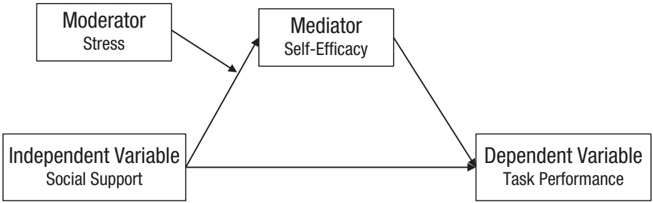
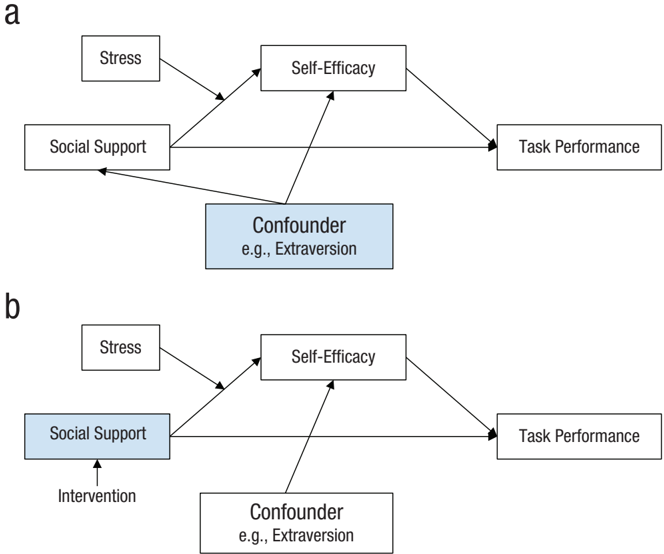
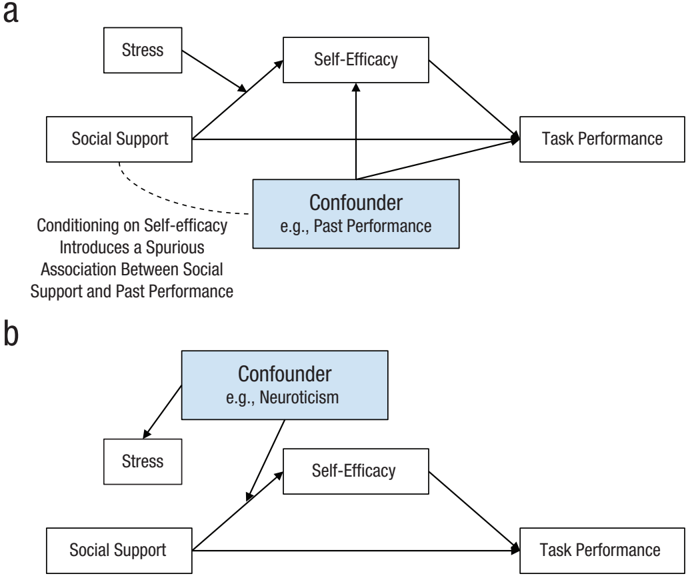
Verification
Claims the paper makes
The claims and statistics of this paper haven’t been checked yet.
Free: it reads the open-access text and checks the first 5 claims that cite a source we can check. Create a free account to check every claim.
Claims other papers make about this one
Each is checked against this paper’s own text: does it say what the citing paper says it does?
The source backs part of the claim, not all of it — or backs it for a different population, condition or comparison.
In the citing paper
“Further, researchers must measure and model all reasonably relevant variables, or risk obfuscating the causal relationships present within the data (Rohrer et al., 2021).”
From Acceptance and Commitment Therapy Processes and Mediation: Challenges and How to Address Them (2023) · cites this paper as Rohrer et al., 2021
Experimental — accuracy not yet measured
Self-check
Percentages, sums and reported differences re-computed from the paper’s own numbers.
The self-check needs the paper’s full text.
Citations
Cites
Unobservable Selection and Coefficient Stability: Theory and Evidence
Oster, E. (2019) · Journal of Business & Economic Statistics · doi:10.1080/07350015.2016.1227711 · Cited by 5,367 · cited 2×
“For example, alternative models with alternative sets of assumptions may be reported, and quantitative methods can be used to estimate to what extent conclusions are sensitive to unobserved confounding (e.g., Blackwell, 2014; Imai et al., 2010; Oster, 2019; VanderWeele, 2010).”
BackgroundEquivalence of the Mediation, Confounding and Suppression Effect
MacKinnon, D. P., Krull, J. L., & Lockwood, C. M. (2000) · Prevention Science · doi:10.1023/a:1026595011371 · Cited by 4,188
A general approach to causal mediation analysis.
Imai, K., Keele, L., & Tingley, D. (2010) · Psychological Methods · doi:10.1037/a0020761 · Cited by 4,143 · cited 3×
“For example, alternative models with alternative sets of assumptions may be reported, and quantitative methods can be used to estimate to what extent conclusions are sensitive to unobserved confounding (e.g., Blackwell, 2014; Imai et al., 2010; Oster, 2019; VanderWeele, 2010).”
BackgroundMethodBias in cross-sectional analyses of longitudinal mediation
Maxwell, S. E., & Cole, D. A. (2007) · Psychological Methods · doi:10.1037/1082-989x.12.1.23 · Cited by 3,401 · cited 1×
“Even in the absence of confounders, mediation chains unfold over time, and trying to recover the longitudinal effects from cross-sectional data works only under very narrow conditions (Maxwell & Cole, 2007; Maxwell et al., 2011; O’Laughlin et al., 2018).”
BackgroundInternational Journal of Epidemiology
(1973) · Journal of Medical Genetics · doi:10.1136/jmg.10.1.100-a · Cited by 2,838
On making causal claims: A review and recommendations
Antonakis, J., Bendahan, S., Jacquart, P., & Lalive, R. (2010) · The Leadership Quarterly · doi:10.1016/j.leaqua.2010.10.010 · Cited by 2,441
Causal Inference in Statistics
Pearl, J., Glymour, M., & Jewell, N. P. (2016) · Cited by 2,058
Choosing Prediction Over Explanation in Psychology: Lessons From Machine Learning
Yarkoni, T., & Westfall, J. (2017) · Perspectives on Psychological Science · doi:10.1177/1745691617693393 · Cited by 1,916
Identification, Inference and Sensitivity Analysis for Causal Mediation Effects
Imai, K., Keele, L., & Yamamoto, T. (2010) · Statistical Science · doi:10.1214/10-sts321 · Cited by 1,628 · cited 3×
“For example, alternative models with alternative sets of assumptions may be reported, and quantitative methods can be used to estimate to what extent conclusions are sensitive to unobserved confounding (e.g., Blackwell, 2014; Imai et al., 2010; Oster, 2019; VanderWeele, 2010).”
BackgroundMethodIMAI, K., KEELE, L., TINGLEY, D., & YAMAMOTO, T. (2011) · American Political Science Review · doi:10.1017/s0003055411000414 · Cited by 1,537
Maxwell, S. E., Cole, D. A., & Mitchell, M. A. (2011) · Multivariate Behavioral Research · doi:10.1080/00273171.2011.606716 · Cited by 1,338
DAGitty: A Graphical Tool for Analyzing Causal Diagrams
Textor, J., Hardt, J., & Knüppel, S. (2011) · Epidemiology · doi:10.1097/ede.0b013e318225c2be · Cited by 1,221
Endogenous Selection Bias: The Problem of Conditioning on a Collider Variable
Elwert, F., & Winship, C. (2014) · Annual Review of Sociology · doi:10.1146/annurev-soc-071913-043455 · Cited by 1,168 · cited 1×
“If we statistically adjust for a collider variable, we introduce spurious associations between its causes (Elwert & Winship, 2014; for more explanation geared toward psychologists, see also Rohrer, 2018).”
BackgroundYes, but what’s the mechanism? (don’t expect an easy answer).
Bullock, J. G., Green, D. P., & Ha, S. E. (2010) · Journal of Personality and Social Psychology · doi:10.1037/a0018933 · Cited by 1,063
Counterfactuals and Causal Inference: Methods and Principles for Social Research
Morgan, S. L., & Winship, C. (2014) · Cambridge University Press · doi:10.1017/cbo9781107587991 · Cited by 1,037
Thinking Clearly About Correlations and Causation: Graphical Causal Models for Observational Data
Rohrer, J. M. (2018) · Advances in Methods and Practices in Psychological Science · doi:10.1177/2515245917745629 · Cited by 1,002 · cited 5×
“If we statistically adjust for a collider variable, we introduce spurious associations between its causes (Elwert & Winship, 2014; for more explanation geared toward psychologists, see also Rohrer, 2018).”
BackgroundMethodInfluentialSelf-citationThe problem of equivalent models in applications of covariance structure analysis.
MacCallum, R. C., Wegener, D. T., Uchino, B. N., & Fabrigar, L. R. (1993) · Psychological Bulletin · doi:10.1037//0033-2909.114.1.185 · Cited by 901
The natural selection of bad science
Smaldino, P. E., & McElreath, R. (2016) · Royal Society Open Science · doi:10.1098/rsos.160384 · Cited by 860 · cited 1×
“We may thus be confronted with normative methods that are suboptimal but favored by the publication process (Smaldino & McElreath, 2016).”
MethodNatural Experiments in the Social Sciences: A Design-Based Approach
Dunning, T. (2012) · Cambridge University Press eBooks · doi:10.1017/cbo9781139084444 · Cited by 705
Muthukrishna, M., & Henrich, J. (2019) · Nature Human Behaviour · doi:10.1038/s41562-018-0522-1 · Cited by 638
What mediation analysis can (not) do
Fiedler, K., Schott, M., & Meiser, T. (2011) · Journal of Experimental Social Psychology · doi:10.1016/j.jesp.2011.05.007 · Cited by 609 · cited 2×
“These issues have been highlighted before (e.g., Bullock et al., 2010; Chan et al., 2020; Fiedler et al., 2011; Thoemmes, 2015) and a large number of methods papers discuss them in great detail.”
BackgroundDesign approaches to experimental mediation
Pirlott, A. G., & MacKinnon, D. P. (2016) · Journal of Experimental Social Psychology · doi:10.1016/j.jesp.2015.09.012 · Cited by 575 · cited 1×
“Combining such independent estimates still requires substantial assumptions (e.g., Imai et al., 2011, p. 770), although they may often be more defensible (Pirlott & MacKinnon, 2016; Strobl & Wunsch, 2018).”
BackgroundStatistically controlling for confounding constructs is harder than you think
Westfall, J., & Yarkoni, T. (2016) · PLOS ONE · doi:10.1371/journal.pone.0152719 · Cited by 547 · cited 2×
“However, the models may be too complex to result in useful description (for a similar argument, see Foster, 2010b), and they are not complex and flexible enough to result in useful prediction (for an introduction to machine learning, see Westfall & Yarkoni, 2016).”
BackgroundIdentification for Prediction and Decision
Manski, C. F. (2009) · Harvard University Press eBooks · doi:10.2307/j.ctv219kxm0 · Cited by 502
Cross-Sectional Analysis of Longitudinal Mediation Processes
O'Laughlin, K. D., Martin, M. J., & Ferrer, E. (2018) · Multivariate Behavioral Research · doi:10.1080/00273171.2018.1454822 · Cited by 475 · cited 1×
“Even in the absence of confounders, mediation chains unfold over time, and trying to recover the longitudinal effects from cross-sectional data works only under very narrow conditions (Maxwell & Cole, 2007; Maxwell et al., 2011; O’Laughlin et al., 2018).”
BackgroundKline, R. B. (2015) · Basic and Applied Social Psychology · doi:10.1080/01973533.2015.1049349 · Cited by 460 · cited 1×
“Spotlight on Testable Implications 2020; Fiedler et al., 2011; Kline, 2015; Shaver, 2005; Thoemmes, 2015) and have been discussed in great detail in a large number of methods articles.”
BackgroundHow Computational Modeling Can Force Theory Building in Psychological Science
Guest, O., & Martin, A. E. (2021) · Perspectives on Psychological Science · doi:10.1177/1745691620970585 · Cited by 460
On the distinction between interaction and effect modification
VanderWeele, T. J. (2009) · Epidemiology · doi:10.1097/ede.0b013e3181ba333c · Cited by 450
Bias Formulas for Sensitivity Analysis for Direct and Indirect Effects
VanderWeele, T. J. (2010) · Epidemiology · doi:10.1097/ede.0b013e3181df191c · Cited by 435 · cited 4×
“For example, alternative models with alternative sets of assumptions may be reported, and quantitative methods can be used to estimate to what extent conclusions are sensitive to unobserved confounding (e.g., Blackwell, 2014; Imai et al., 2010; Oster, 2019; VanderWeele, 2010).”
BackgroundInfluentialIdealization and the Aims of Science
Potochnik, A. (2017) · doi:10.7208/chicago/9780226507194.001.0001 · Cited by 421
Unwarranted inferences from statistical mediation tests – An analysis of articles published in 2015
Fiedler, K., Harris, C., & Schott, M. (2018) · Journal of Experimental Social Psychology · doi:10.1016/j.jesp.2017.11.008 · Cited by 391
Why Hypothesis Testers Should Spend Less Time Testing Hypotheses
Scheel, A. M., Tiokhin, L., Isager, P. M., & Lakens, D. (2021) · Perspectives on Psychological Science · doi:10.1177/1745691620966795 · Cited by 382 · cited 1×
“For example, we may notice that open-ended exploration, description (Rozin, 2001), or prediction (Yarkoni & Westfall, 2017) are more suitable endeavors for the matter at hand or that more basic questions about measurement need to be settled first (Scheel et al., 2021).”
BackgroundMoshontz, H., Campbell, L., Ebersole, C. R., IJzerman, H., Urry, H. L., Forscher, P. S., Grahe, J. E., McCarthy, R. J., Musser, E. D., Antfolk, J., et al. (2018) · Advances in Methods and Practices in Psychological Science · doi:10.1177/2515245918797607 · Cited by 377
When Should We Use Unit Fixed Effects Regression Models for Causal Inference with Longitudinal Data?
Imai, K., & Kim, I. S. (2019) · American Journal of Political Science · doi:10.1111/ajps.12417 · Cited by 369
What Is Your Estimand? Defining the Target Quantity Connects Statistical Evidence to Theory
Lundberg, I., Johnson, R., & Stewart, B. M. (2021) · American Sociological Review · doi:10.1177/00031224211004187 · Cited by 364
Implications of the Credibility Revolution for Productivity, Creativity, and Progress
Vazire, S. (2018) · Perspectives on Psychological Science · doi:10.1177/1745691617751884 · Cited by 359
Social Psychology and Science: Some Lessons From Solomon Asch
Rozin, P. (2001) · Personality and Social Psychology Review · doi:10.1207/s15327957pspr0501_1 · Cited by 349
Adjusting researchers’ approach to adjustment: On the use of covariates when testing interactions
Yzerbyt, V. Y., Muller, D., & Judd, C. M. (2004) · Journal of Experimental Social Psychology · doi:10.1016/j.jesp.2003.10.001 · Cited by 330
Elwert, F. (2013) · Handbooks of Sociology and Social Research · doi:10.1007/978-94-007-6094-3_13 · Cited by 325 · cited 5×
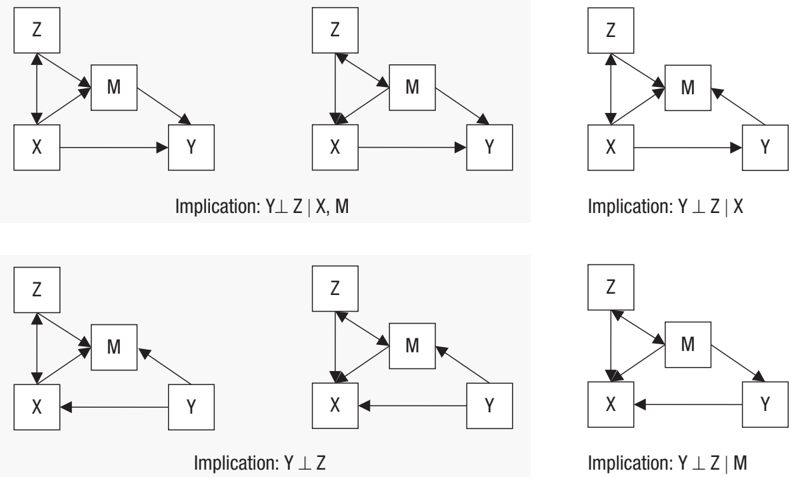
“These issues have been highlighted before (e.g., Antonakis et al., 2010; Bullock et al., 2010; Chan et al., To derive testable implications, we can break up a causal graph into three elementary causal structures (Elwert, 2013) that do (or do not) transmit associations between variables.”
BackgroundInfluentialThe Taboo Against Explicit Causal Inference in Nonexperimental Psychology
Grosz, M. P., Rohrer, J. M., & Thoemmes, F. (2020) · Perspectives on Psychological Science · doi:10.1177/1745691620921521 · Cited by 322
Self-citationShaver, J. M. (2005) · Journal of Management · doi:10.1177/0149206304272149 · Cited by 299
MacKinnon, D. P., & Pirlott, A. G. (2015) · Personality and Social Psychology Review · doi:10.1177/1088868314542878 · Cited by 255
Models Are Stupid, and We Need More of Them
Smaldino, P. E. (2017) · Computational Social Psychology · doi:10.4324/9781315173726-14 · Cited by 236
Mediation Testing in Management Research: A Review and Proposals
Wood, R. E., Goodman, J. S., Beckmann, N., & Cook, A. (2008) · Organizational Research Methods · doi:10.1177/1094428106297811 · Cited by 235
Causal inference and developmental psychology.
Foster, E. M. (2010) · Developmental Psychology · doi:10.1037/a0020204 · Cited by 227
Rohrer, J. M., & Murayama, K. (2023) · Advances in Methods and Practices in Psychological Science · doi:10.1177/25152459221140842 · Cited by 216
Self-citationReversing Arrows in Mediation Models Does Not Distinguish Plausible Models
Thoemmes, F. (2015) · Basic and Applied Social Psychology · doi:10.1080/01973533.2015.1049351 · Cited by 208 · cited 2×
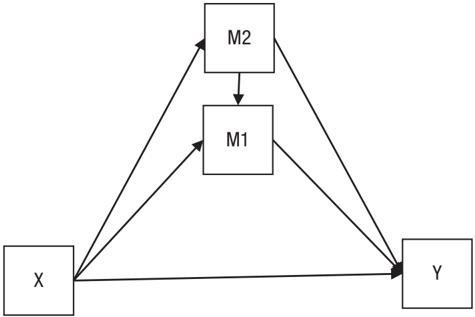
“This means that they share the same implied covariance matrix (Thoemmes, 2015); they are observationally equivalent.”
BackgroundMeasurement bias and effect restoration in causal inference
Kuroki, M., & Pearl, J. (2014) · Biometrika · doi:10.1093/biomet/ast066 · Cited by 169
MacKinnon, D. P., Valente, M. J., & Gonzalez, O. (2020) · Prevention Science · doi:10.1007/s11121-019-01076-4 · Cited by 165
Contributorship, Not Authorship: Use CRediT to Indicate Who Did What
Holcombe, A. O. (2019) · Publications · doi:10.3390/publications7030048 · Cited by 133
Rees, T., & Freeman, P. B. (2009) · Journal of Social and Clinical Psychology · doi:10.1521/jscp.2009.28.2.244 · Cited by 122
Precise Answers to Vague Questions: Issues With Interactions
Rohrer, J. M., & Arslan, R. C. (2021) · Advances in Methods and Practices in Psychological Science · doi:10.1177/25152459211007368 · Cited by 103
Self-citationCausal discovery and the problem of psychological interventions
Eronen, M. I. (2020) · New Ideas in Psychology · doi:10.1016/j.newideapsych.2020.100785 · Cited by 102 · cited 1×
“At the same time, this of course presumes that the mediator can be manipulated in a targeted manner, which may not always be the case, in particular if it is a psychological variable (Eronen, 2020).”
BackgroundCan DAGs Clarify Effect Modification?
Weinberg, C. R. (2007) · Epidemiology · doi:10.1097/ede.0b013e318126c11d · Cited by 94 · cited 2×
“graphs by something similar to the “arrow pointing onto arrow” notation (Nilsson et al., 2021; Weinberg, 2007).”
BackgroundMethodChan, M., Hu, P., & Mak, M. K. F. (2020) · Journalism & Mass Communication Quarterly · doi:10.1177/1077699020961519 · Cited by 92
A Selection Bias Approach to Sensitivity Analysis for Causal Effects
Blackwell, M. (2014) · Political Analysis · doi:10.1093/pan/mpt006 · Cited by 88
A directed acyclic graph for interactions
Nilsson, A., Bonander, C., Strömberg, U., & Björk, J. (2020) · International Journal of Epidemiology · doi:10.1093/ije/dyaa211 · Cited by 82
Behaviour Genetic Frameworks of Causal Reasoning for Personality Psychology
Briley, D. A., Livengood, J., & Derringer, J. (2018) · European Journal of Personality · doi:10.1002/per.2153 · Cited by 66
The “Goldilocks Zone”: (Too) many confidence intervals in tests of mediation just exclude zero.
Götz, M., O'Boyle, E. H., Gonzalez-Mulé, E., Banks, G. C., & Bollmann, S. S. (2021) · Psychological Bulletin · doi:10.1037/bul0000315 · Cited by 58
Rohrer, J. M., & Murayama, K. (2021) · doi:10.31234/osf.io/tg4vj · Cited by 51
Self-citationInterdisciplinarity can aid the spread of better methods between scientific communities
Smaldino, P. E., & O’Connor, C. (2022) · Collective Intelligence · doi:10.1177/26339137221131816 · Cited by 46
The U-shaped relationship between complexity and usefulness: A commentary.
Foster, E. M. (2010) · Developmental Psychology · doi:10.1037/a0020180 · Cited by 21
Alvarez-Vargas, D., Braithwaite, D. W., Lortie‐Forgues, H., Moore, M. M., Castro, M., Wan, S., Martin, E. A., & Bailey, D. H. (2023) · PLoS ONE · doi:10.1371/journal.pone.0286403 · Cited by 19
Interdisciplinarity Can Aid the Spread of Better Methods Between Scientific CommunitiesPreprint
Smaldino, P. E., & O’Connor, C. (2020) · doi:10.31222/osf.io/cm5v3 · Cited by 18
Alvarez-Vargas, D., Braithwaite, D. W., Lortie‐Forgues, H., et al. (2020) · doi:10.31234/osf.io/nkf96 · Cited by 9
Identification of Causal Mechanisms Based on Between-Subject Double Randomization DesignsPreprint
Wunsch, C., & Strobl, R. (2018) · SSRN Electronic Journal · doi:10.2139/ssrn.3237318 · Cited by 8
Moderated Mediation Article Database
Fossum, J. L., Farook, A., Lamarque-Navarrete, K., Polad, V., Yang, N., & Montoya, A. (2021) · UC Los Angeles · doi:10.25346/s6/7utgqh · Cited by 2
Barbero (2014) · doi:10.1016/j · Cited by 1
(2018) · Digital Commons@Becker (Washington University School of Medicine) · doi:10.1371/journal
Research works printed but not linked: 6
- Avin, C., Shpitser, I., & Pearl, J. (2005, June 1). Identifiability of path-specific effects [Conference session]. 19th International
- Joint Conference on Artificial Intelligence, IJCAI 2005, Edinburgh. https://escholarship.org/uc/item/45x689gq
- Bareinboim, E., & Pearl, J. (2012). Causal inference by surrogate experiments: z-identifiability . arXiv. http://arxiv.org/ abs/1210.4842 · arXiv
- Hayes, A. F. (2017). Introduction to mediation, moderation, and conditional process analysis, second edition: A regression-based approach . The Guilford Press.
- Morgan, S. L., & Winship, C. (2015). Counterfactuals and causal inference . Cambridge University Press.
- Pearl, J., & Bareinboim, E. (2014). External validity: From doCalculus to transportability across populations. Schweizerische Monatsschrift Fur Zahnheilkunde = Revue Mensuelle Suisse d'odonto-stomatologie / SSO , 29 (4), 579-595.
Cited by
Rohrer, J. M., & Murayama, K. (2023) · Advances in Methods and Practices in Psychological Science · doi:10.1177/25152459221140842 · Cited by 216
Self-citationTutorial: Power Analyses for Interaction Effects in Cross-Sectional Regressions
Baranger, D. A. A., Finsaas, M. C., Goldstein, B. L., Vize, C. E., Lynam, D. R., & Olino, T. M. (2023) · Advances in Methods and Practices in Psychological Science · doi:10.1177/25152459231187531 · Cited by 275
Chen, H., Shao, B., Yang, X., Kang, W., & Fan, W. (2024) · Computers in Human Behavior · doi:10.1016/j.chb.2024.108216 · Cited by 171
Acceptance and Commitment Therapy Processes and Mediation: Challenges and How to Address Them
Arch, J. J., Fishbein, J. N., Finkelstein, L. B., & Luoma, J. B. (2023) · Behavior Therapy · doi:10.1016/j.beth.2022.07.005 · Cited by 72
Tutorial: Power analyses for interaction effects in cross-sectional regressionsPreprint
Baranger, D. A. A., Finsaas, M. C., Goldstein, B. L., Vize, C. E., Lynam, D. R., & Olino, T. M. (2022) · doi:10.31234/osf.io/5ptd7 · Cited by 73
Metadata
- Authors
- Rohrer, J. M., Hünermund, P., Arslan, R. C., & Elson, M.
- Affiliations
- Leipzig University (DE)
- Copenhagen Business School (DK)
- Max Planck Institute for Human Development (DE)
- Ruhr University Bochum (DE)
- Corresponding author
- Rohrer, Julia M.
- Venue
- Advances in Methods and Practices in Psychological Science
- Publisher
- SAGE Publications
- Published
- 2022-04
- Volume
- 5
- Issue
- 2
- ISSN
- 2515-2459 (ISSN-L)
- 2515-2467
- OpenAlex
- W4288766776
- Cited by
- 267
- References
- 64
- Citations by year
- 2026: 67 · 2025: 61 · 2024: 74 · 2023: 47 · 2022: 15
- FWCI
- 36.33
- Type
- journal article
- Language
- en
- Open access
- gold
- doi.org
- Licence
- Locations
- Advances in Methods and Practices in Psychological Science (publishedVersion, cc-by-nc)
- DOAJ (DOAJ: Directory of Open Access Journals) (submittedVersion, cc-by-sa)
- CBS Research Portal (Copenhagen Business School) (submittedVersion, cc-by-nc)
- Funders
- ministerium für kultur und wissenschaft des landes nordrhein-westfalen (1706dgn006)
- Topics
- Physical Sciences › Mathematics › Statistics and Probability › Advanced Causal Inference Techniques
- Social Sciences › Decision Sciences › Management Science and Operations Research › Psychometric Methodologies and Testing
- Physical Sciences › Mathematics › Statistics and Probability › Statistical Methods and Bayesian Inference
- Keywords
- path analysis, mediation analysis, moderation analysis, causal inference, model selection, model fit indices, conditional independence testing, reverse causality, boundary conditions, research culture
About these checks
Registry, retraction, Cites and statistics results are computed, not judged, with one exception: a printed reference that no index lists is read once by a model before it counts as a citation error. Claims are extracted by a model and kept only when their quote appears verbatim in the text; each cited source is then checked, with a model’s help, for whether it says what the claim relies on. Those verdicts can be wrong — read the claim’s quote and the cited source before relying on one.
Statistics and arithmetic are recomputed, not judged.
Confidence bands are shown only for fields calibrated on our annotated test set. None is calibrated yet, so no band is shown.
What counts as a claim ›How we measure confidence ›How we check this ›
Are you an author, or do you see a problem with this page? Request a review
Data sources
Bibliographic data: Semantic Scholar, OpenAlex, Crossref.
Contains information from the Semantic Scholar Academic Graph Datasets, made available under the ODC Attribution License (ODC-BY 1.0).
Semantic Scholar’s data is described in: Kinney, R., et al. (2023). The Semantic Scholar Open Data Platform. arXiv:2301.10140.
