

The DOI matches its Crossref record; 4 of the 4 references it cites were found in a registry or an index.
Ablation of miR-146b in mice causes hematopoietic malignancy
Abstract
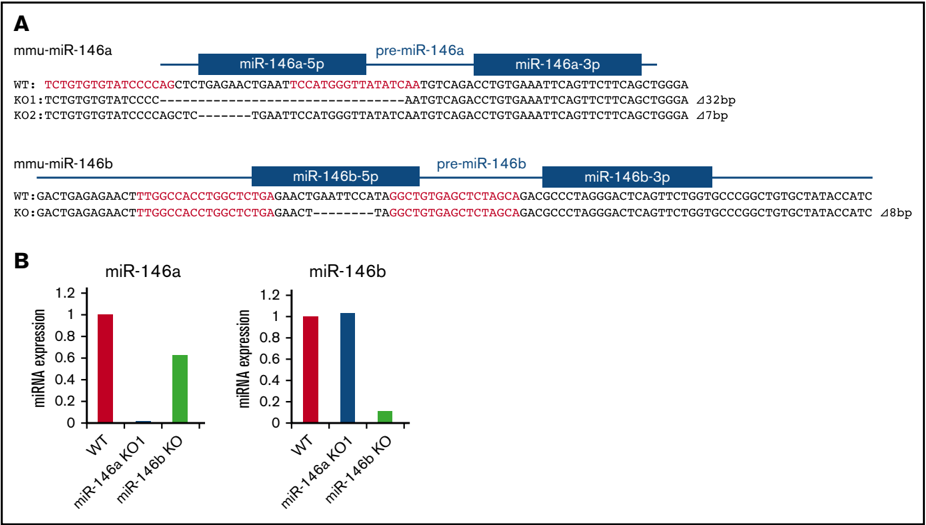
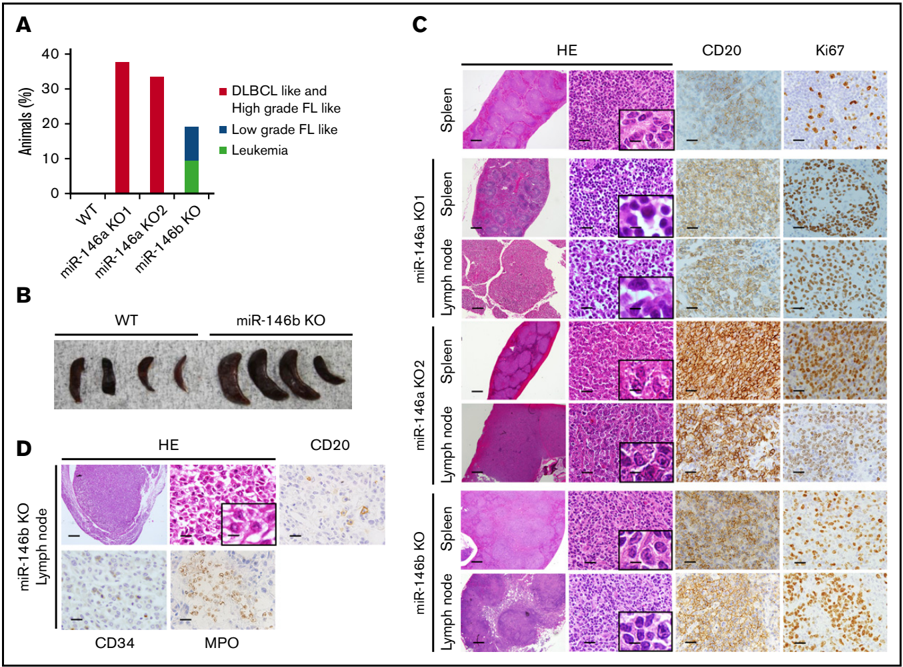
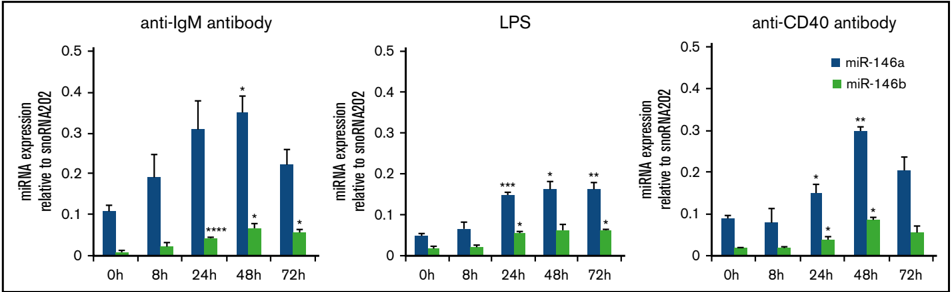
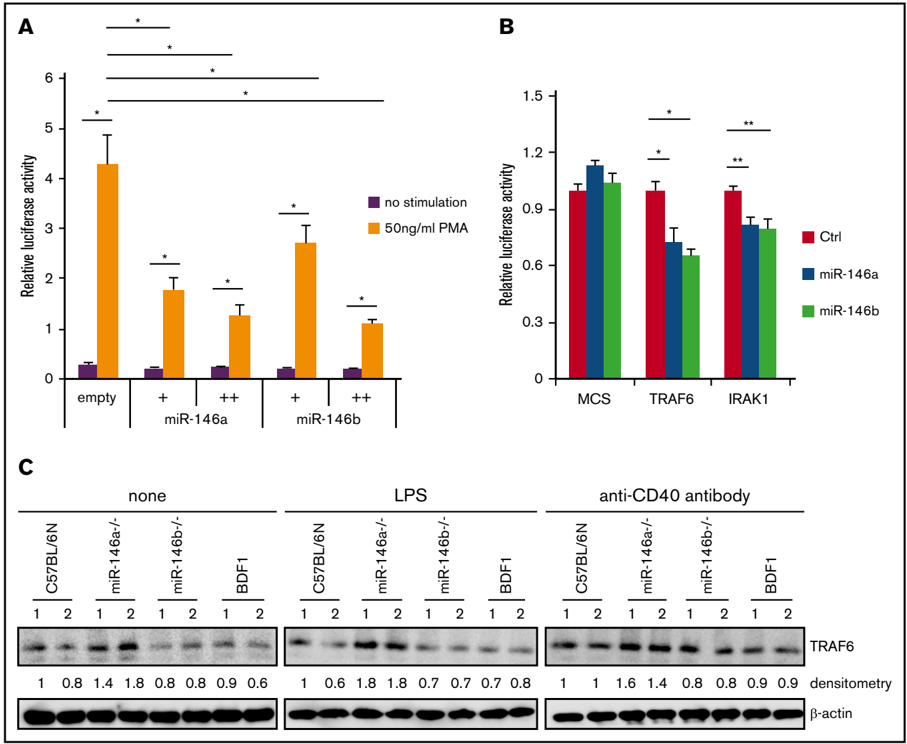
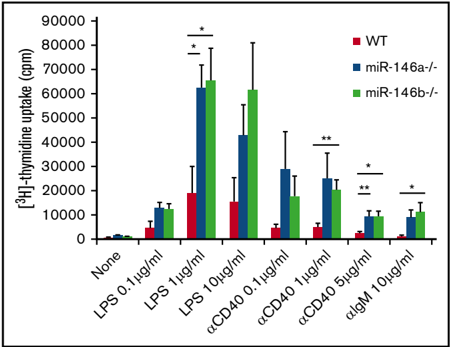
Excessive and constitutive activation of nuclear factor-κB (NF-κB) leads to abnormal cell proliferation and differentiation, leading to the development of malignant tumors, including lymphoma. MicroRNA 146a (miR-146a) and miR-146b, both of which carry an identical seed sequence, have been shown to contribute to inflammatory diseases and tumors by suppressing the expression of key molecules required for NF-κB activation. However, the functional and physiological differences between miR-146a and miR-146b in disease onset have not been fully elucidated. In this study, we generated miR-146b–knockout (KO) and miR-146a–KO mice by genome editing and found that both strains developed hematopoietic malignancies such as B-cell lymphoma and acute myeloid leukemia during aging. However, the B-cell lymphomas observed in miR-146a– and miR-146b–KO mice were histologically different in their morphology, and the malignancy rate is lower in miR-146b mice than miR-146a mice. Upon mitogenic stimulation, the expression of miR-146a and miR-146b was increased, but miR-146b expression was lower than that of miR-146a. Using a previously developed screening system for microRNA targets, we observed that miR-146a and miR-146b could target the same mRNAs, including TRAF6, and inhibit subsequent NF-κB activity. Consistent with these findings, both miR-146a– and miR-146b–KO B cells showed a high proliferative capacity. Taken together, sustained NF-κB activation in miR-146b KO mice could lead to the development of hematopoietic malignancy with aging.
Overview
The claims and statistics of this paper haven’t been checked yet.
Run the check — free, no account needed. It reads the open-access text and checks the sources it cites.
Integrity signals
Registry
Cites
Statistics
Figures
Verification
Claims the paper makes
The claims and statistics of this paper haven’t been checked yet.
Run the check — free, no account needed. It reads the open-access text and checks the sources it cites.
Claims other papers make about this one
Each is checked against this paper’s own text: does it say what the citing paper says it does?
In the citing paper
“Intriguingly, miR-146a-knockout mice also showed constitutive activation of the NF-κB pathway, with excessive inflammation and tumorigenesis during aging [75].”
From The Mitochondria-Associated ER Membranes Are Novel Subcellular Locations Enriched for Inflammatory-Responsive MicroRNAs (2020) · cites this paper as [75]
Self-check
Percentages, sums and reported differences re-computed from the paper’s own numbers.
The self-check needs the paper’s full text.
Citations
Cites
MicroRNAs as regulatory elements in immune system logic
Mehta, A., & Baltimore, D. (2016) · Nature Reviews Immunology · doi:10.1038/nri.2016.40 · Cited by 704
miR-146a Is Critical for Endotoxin-induced Tolerance
Nahid, M. A., Pauley, K. M., Satoh, M., & Chan, E. K. L. (2009) · Journal of Biological Chemistry · doi:10.1074/jbc.m109.056317 · Cited by 423
Macrophage development from HSCs requires PU.1-coordinated microRNA expression
Ghani, S., Riemke, P., Schönheit, J., Lenze, D., Stumm, J., Hoogenkamp, M., Lagendijk, A., Heinz, S., Bonifer, C., Bakkers, J., et al. (2011) · Blood · doi:10.1182/blood-2011-02-335141 · Cited by 123
Reprogramming macrophage orientation by microRNA 146b targeting transcription factor IRF5
Peng, L., Zhang, H., Hao, Y., Xu, F., Yang, J., Zhang, R., Lu, G., Zheng, Z., Cui, M., Qi, C.-F., et al. (2016) · EBioMedicine · doi:10.1016/j.ebiom.2016.10.041 · Cited by 67
Research works printed but not linked: 52
- Bartel, 2009, MicroRNAs: target recognition and regulatory functions, Cell, 136, 215, 10.1016/j.cell.2009.01.002 · DOI · Paper page
- Boldin, 2012, MicroRNAs, new effectors and regulators of NF-κB, Immunol Rev, 246, 205, 10.1111/j.1600-065X.2011.01089.x · DOI · Paper page
- Wallace, 2017, MicroRNAs and acute myeloid leukemia: therapeutic implications and emerging concepts, Blood, 130, 1290, 10.1182/blood-2016-10-697698 · DOI
- Braun, 2006, Targeting NF-kappaB in hematologic malignancies, Cell Death Differ, 13, 748, 10.1038/sj.cdd.4401874 · DOI
- Shen, 2009, NFkappaB signaling in carcinogenesis and as a potential molecular target for cancer therapy, Apoptosis, 14, 348, 10.1007/s10495-009-0315-0 · DOI
- Young, 2013, Targeting pathological B cell receptor signalling in lymphoid malignancies, Nat Rev Drug Discov, 12, 229, 10.1038/nrd3937 · DOI
- Compagno, 2009, Mutations of multiple genes cause deregulation of NF-kappaB in diffuse large B-cell lymphoma, Nature, 459, 717, 10.1038/nature07968 · DOI
- Kato, 2009, Frequent inactivation of A20 in B-cell lymphomas, Nature, 459, 712, 10.1038/nature07969 · DOI
- Lenz, 2008, Oncogenic CARD11 mutations in human diffuse large B cell lymphoma, Science, 319, 1676, 10.1126/science.1153629 · DOI
- Ngo, 2011, Oncogenically active MYD88 mutations in human lymphoma, Nature, 470, 115, 10.1038/nature09671 · DOI
- Pasqualucci, 2011, Analysis of the coding genome of diffuse large B-cell lymphoma, Nat Genet, 43, 830, 10.1038/ng.892 · DOI
- Davis, 2010, Chronic active B-cell-receptor signalling in diffuse large B-cell lymphoma, Nature, 463, 88, 10.1038/nature08638 · DOI
- Taganov, 2006, NF-kappaB-dependent induction of microRNA miR-146, an inhibitor targeted to signaling proteins of innate immune responses, Proc Natl Acad Sci USA, 103, 12481, 10.1073/pnas.0605298103 · DOI · Paper page
- Lu, 2010, Function of miR-146a in controlling Treg cell-mediated regulation of Th1 responses, Cell, 142, 914, 10.1016/j.cell.2010.08.012 · DOI · Paper page
- Zhao, 2011, NF-kappaB dysregulation in microRNA-146a-deficient mice drives the development of myeloid malignancies, Proc Natl Acad Sci USA, 108, 9184, 10.1073/pnas.1105398108 · DOI · Paper page
- Yang, 2012, miR-146a controls the resolution of T cell responses in mice, J Exp Med, 209, 1655, 10.1084/jem.20112218 · DOI
- Boldin, 2011, miR-146a is a significant brake on autoimmunity, myeloproliferation, and cancer in mice, J Exp Med, 208, 1189, 10.1084/jem.20101823 · DOI · Paper page
- Bhaumik, 2008, Expression of microRNA-146 suppresses NF-kappaB activity with reduction of metastatic potential in breast cancer cells, Oncogene, 27, 5643, 10.1038/onc.2008.171 · DOI
- Hurst, 2009, Breast cancer metastasis suppressor 1 up-regulates miR-146, which suppresses breast cancer metastasis, Cancer Res, 69, 1279, 10.1158/0008-5472.CAN-08-3559 · DOI
- Xia, 2009, microRNA-146b inhibits glioma cell migration and invasion by targeting MMPs, Brain Res, 1269, 158, 10.1016/j.brainres.2009.02.037 · DOI
- Cai, 2015, MicroRNA-146b-5p inhibits the growth of gallbladder carcinoma by targeting epidermal growth factor receptor, Mol Med Rep, 12, 1549, 10.3892/mmr.2015.3461 · DOI
- Wu, 2014, Low expression of microRNA-146b-5p and microRNA-320d predicts poor outcome of large B-cell lymphoma treated with cyclophosphamide, doxorubicin, vincristine, and prednisone, Hum Pathol, 45, 1664, 10.1016/j.humpath.2014.04.002 · DOI
- Burger, 2014, Premalignant PTEN-deficient thymocytes activate microRNAs miR-146a and miR-146b as a cellular defense against malignant transformation, Blood, 123, 4089, 10.1182/blood-2013-11-539411 · DOI
- Correia, 2016, MiR-146b negatively regulates migration and delays progression of T-cell acute lymphoblastic leukemia, Sci Rep, 6, 31894, 10.1038/srep31894 · DOI
- Xiang, 2014, STAT3 induction of miR-146b forms a feedback loop to inhibit the NF-κB to IL-6 signaling axis and STAT3-driven cancer phenotypes, Sci Signal, 7, ra11, 10.1126/scisignal.2004497 · DOI
- Li, 2013, miR-146b-5p inhibits glioma migration and invasion by targeting MMP16, Cancer Lett, 339, 260, 10.1016/j.canlet.2013.06.018 · DOI
- Liu, 2015, miR-146b-5p functions as a tumor suppressor by targeting TRAF6 and predicts the prognosis of human gliomas, Oncotarget, 6, 29129, 10.18632/oncotarget.4895 · DOI
- Takada, 2013, Targeted gene deletion of miRNAs in mice by TALEN system, PLoS One, 8, e76004, 10.1371/journal.pone.0076004 · DOI
- Ito, 2017, Identification of targets of tumor suppressor microRNA-34a using a reporter library system, Proc Natl Acad Sci USA, 114, 3927, 10.1073/pnas.1620019114 · DOI
- Kim, 2013, TALEN-based knockout library for human microRNAs, Nat Struct Mol Biol, 20, 1458, 10.1038/nsmb.2701 · DOI
- Cheng, 2013, MicroRNA-146 represses endothelial activation by inhibiting pro-inflammatory pathways, EMBO Mol Med, 5, 1017, 10.1002/emmm.201202318 · DOI
- Hans, 2004, Confirmation of the molecular classification of diffuse large B-cell lymphoma by immunohistochemistry using a tissue microarray, Blood, 103, 275, 10.1182/blood-2003-05-1545 · DOI
- Perry, 2008, Rapid changes in microRNA-146a expression negatively regulate the IL-1beta-induced inflammatory response in human lung alveolar epithelial cells, J Immunol, 180, 5689, 10.4049/jimmunol.180.8.5689 · DOI · Paper page
- Hou, 2009, MicroRNA-146a feedback inhibits RIG-I-dependent Type I IFN production in macrophages by targeting TRAF6, IRAK1, and IRAK2, J Immunol, 183, 2150, 10.4049/jimmunol.0900707 · DOI · Paper page
- Nahid, 2011, Mechanistic role of microRNA-146a in endotoxin-induced differential cross-regulation of TLR signaling, J Immunol, 186, 1723, 10.4049/jimmunol.1002311 · DOI
- Etzrodt, 2012, Regulation of monocyte functional heterogeneity by miR-146a and Relb, Cell Reports, 1, 317, 10.1016/j.celrep.2012.02.009 · DOI
- Quinn, 2013, MicroRNA-146a is upregulated by and negatively regulates TLR2 signaling, PLoS One, 8, e62232, 10.1371/journal.pone.0062232 · DOI
- Monk, 2010, Regulation of miRNA transcription in macrophages in response to Candida albicans, PLoS One, 5, e13669, 10.1371/journal.pone.0013669 · DOI
- Curtale, 2013, Negative regulation of Toll-like receptor 4 signaling by IL-10-dependent microRNA-146b, Proc Natl Acad Sci USA, 110, 11499, 10.1073/pnas.1219852110 · DOI
- Park, 2015, MicroRNA-146a and microRNA-146b regulate human dendritic cell apoptosis and cytokine production by targeting TRAF6 and IRAK1 proteins, J Biol Chem, 290, 2831, 10.1074/jbc.M114.591420 · DOI
- He, 2016, MicroR-146 blocks the activation of M1 macrophage by targeting signal transducer and activator of transcription 1 in hepatic schistosomiasis, EBioMedicine, 13, 339, 10.1016/j.ebiom.2016.10.024 · DOI
- Kanie, 2017, The CEP19-RABL2 GTPase complex binds IFT-B to initiate intraflagellar transport at the ciliary base, Dev Cell, 42, 22, 10.1016/j.devcel.2017.05.016 · DOI
- Yi Lo, 2016, RABL2 is required for hepatic fatty acid homeostasis and its dysfunction leads to steatosis and a diabetes-like state, Endocrinology, 157, 4732, 10.1210/en.2016-1487 · DOI
- Lo, 2012, RAB-like 2 has an essential role in male fertility, sperm intra-flagellar transport, and tail assembly, PLoS Genet, 8, e1002969, 10.1371/journal.pgen.1002969 · DOI
- Xie, 2015, The causative gene in Chanarian Dorfman syndrome regulates lipid droplet homeostasis in C. elegans, PLoS Genet, 11, e1005284, 10.1371/journal.pgen.1005284 · DOI
- Perkins, 2012, The diverse and complex roles of NF-κB subunits in cancer, Nat Rev Cancer, 12, 121, 10.1038/nrc3204 · DOI
- Gilmore, 2006, Introduction to NF-kappaB: players, pathways, perspectives, Oncogene, 25, 6680, 10.1038/sj.onc.1209954 · DOI
- Magilnick, 2017, miR-146a-Traf6 regulatory axis controls autoimmunity and myelopoiesis, but is dispensable for hematopoietic stem cell homeostasis and tumor suppression, Proc Natl Acad Sci USA, 114, E7140, 10.1073/pnas.1706833114 · DOI
- Zhou, 2015, Aberrant nuclear factor-kappa B activity in acute myeloid leukemia: from molecular pathogenesis to therapeutic target, Oncotarget, 6, 5490, 10.18632/oncotarget.3545 · DOI
- Zhai, 2014, The regulatory roles of microRNA-146b-5p and its target platelet-derived growth factor receptor α (PDGFRA) in erythropoiesis and megakaryocytopoiesis, J Biol Chem, 289, 22600, 10.1074/jbc.M114.547380 · DOI
- Cho, 2018, Differential cell-intrinsic regulations of germinal center B and T cells by miR-146a and miR-146b, Nat Commun, 9, 2757, 10.1038/s41467-018-05196-3 · DOI
- Starczynowski, 2010, Identification of miR-145 and miR-146a as mediators of the 5q- syndrome phenotype, Nat Med, 16, 49, 10.1038/nm.2054 · DOI · Paper page
Cited by
Sorted by citations
Wang, W.-X., Prajapati, P., Nelson, P. T., & Springer, J. E. (2020) · Molecular Neurobiology · doi:10.1007/s12035-020-01937-y · Cited by 49
Metadata
- Authors
- Mitsumura, T., Ito, Y., Chiba, T., Matsushima, T., Kurimoto, R., Tanaka, Y., Kato, T., Uchida, K., Ito, T., Yamamoto, K., Eishi, Y., Kitagawa, M., Miyazaki, Y., Inase, N., & Asahara, H.
- Affiliations
- Department of Systems BioMedicine, Graduate School of Medical and Dental Sciences,
- Division of Surgical Pathology, Tokyo Medical and Dental University Hospital, Tokyo, Japan;
- Department of Human Pathology and
- Department of Comprehensive Pathology, Graduate School of Medical and Dental Sciences, Tokyo Medical and Dental University, Tokyo, Japan; and
- Department of Respiratory Medicine, Graduate School of Medical and Dental Sciences, and
- ORCID
- Venue
- Blood Advances
- Publisher
- American Society of Hematology
- Published
- 2018-12-07
- Volume
- 2
- Issue
- 23
- Pages
- 3483-3491
- ISSN
- 2473-9529
- 2473-9537
- Cited by
- 22
- References
- 4
- Language
- en
About these checks
Registry, retraction, Cites and statistics results are computed, not judged, with one exception: a printed reference that no index lists is read once by a model before it counts as a citation error. Claims are extracted by a model and kept only when their quote appears verbatim in the text; each cited source is then checked, with a model’s help, for whether it says what the claim relies on. Those verdicts can be wrong — read the claim’s quote and the cited source before relying on one.
Statistics and arithmetic are recomputed, not judged.
Confidence bands are shown only for fields calibrated on our annotated test set. None is calibrated yet, so no band is shown.
What counts as a claim ›How we measure confidence ›How we check this ›
Are you an author, or do you see a problem with this page? Request a review
