

A fungal phylogeny based on 42 complete genomes derived from supertree and combined gene analysis.
Open accessThe DOI matches its Crossref record, with a small difference in title or year; 95 of the 95 references it cites were found in a registry or an index.
Abstract
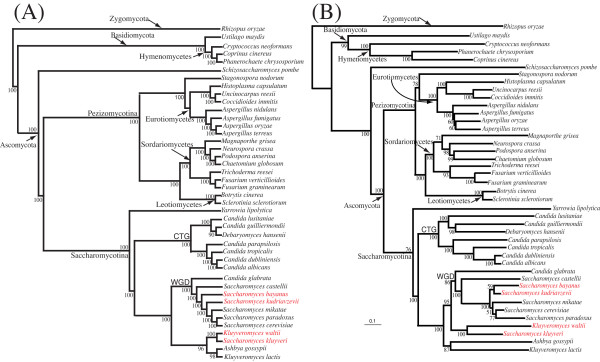
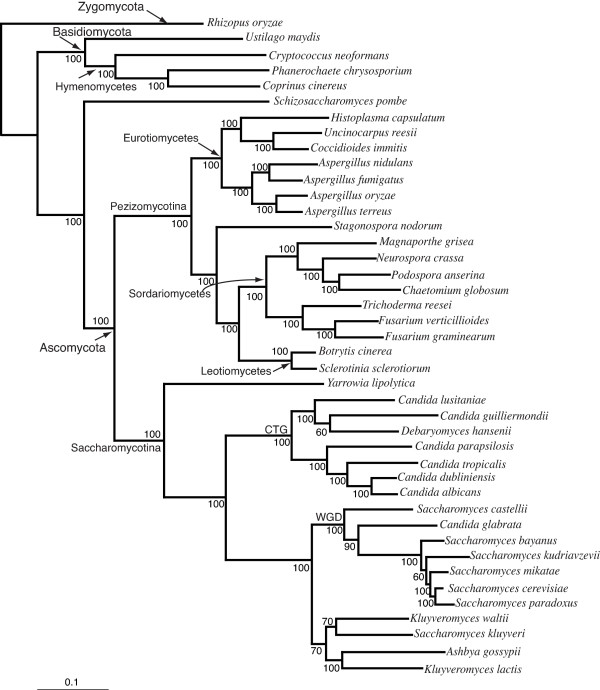
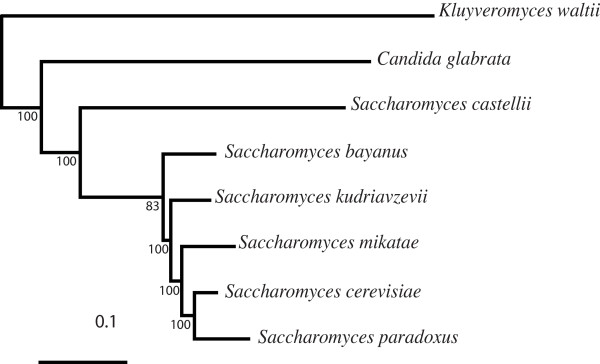
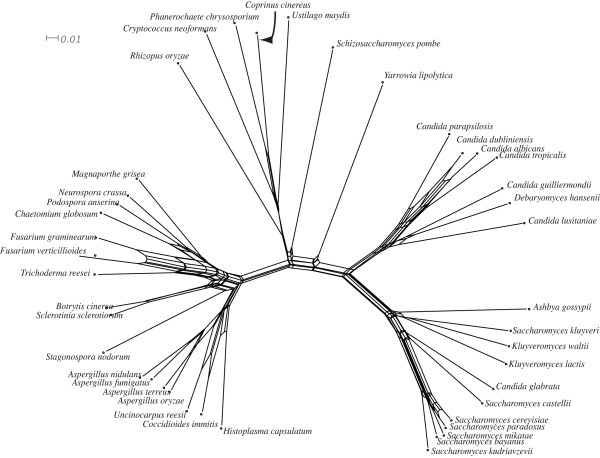
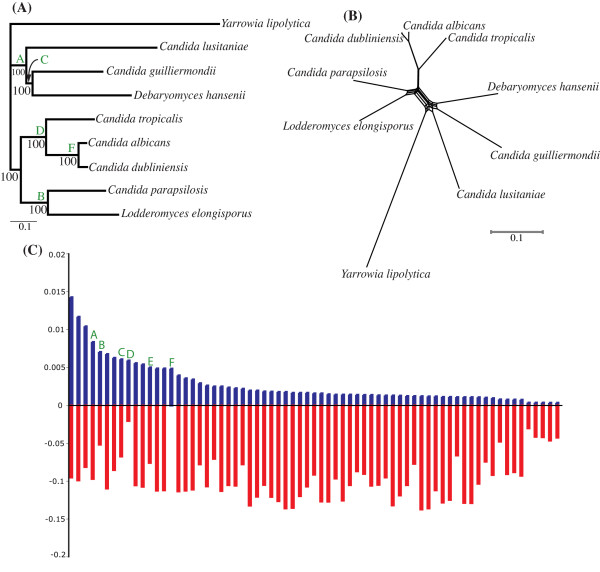
BACKGROUND: To date, most fungal phylogenies have been derived from single gene comparisons, or from concatenated alignments of a small number of genes. The increase in fungal genome sequencing presents an opportunity to reconstruct evolutionary events using entire genomes. As a tool for future comparative, phylogenomic and phylogenetic studies, we used both supertrees and concatenated alignments to infer relationships between 42 species of fungi for which complete genome sequences are available. RESULTS: A dataset of 345,829 genes was extracted from 42 publicly available fungal genomes. Supertree methods were employed to derive phylogenies from 4,805 single gene families. We found that the average consensus supertree method may suffer from long-branch attraction artifacts, while matrix representation with parsimony (MRP) appears to be immune from these. A genome phylogeny was also reconstructed from a concatenated alignment of 153 universally distributed orthologs. Our MRP supertree and concatenated phylogeny are highly congruent. Within the Ascomycota, the sub-phyla Pezizomycotina and Saccharomycotina were resolved. Both phylogenies infer that the Leotiomycetes are the closest sister group to the Sordariomycetes. There is some ambiguity regarding the placement of Stagonospora nodurum, the sole member of the class Dothideomycetes present in the dataset. Within the Saccharomycotina, a monophyletic clade containing organisms that translate CTG as serine instead of leucine is evident. There is also strong support for two groups within the CTG clade, one containing the fully sexual species Candida lusitaniae, Candida guilliermondii and Debaryomyces hansenii, and the second group containing Candida albicans, Candida dubliniensis, Candida tropicalis, Candida parapsilosis and Lodderomyces elongisporus. The second major clade within the Saccharomycotina contains species whose genomes have undergone a whole genome duplication (WGD), and their close relatives. We could not confidently resolve whether Candida glabrata or Saccharomyces castellii lies at the base of the WGD clade. CONCLUSION: We have constructed robust phylogenies for fungi based on whole genome analysis. Overall, our phylogenies provide strong support for the classification of phyla, sub-phyla, classes and orders. We have resolved the relationship of the classes Leotiomyctes and Sordariomycetes, and have identified two classes within the CTG clade of the Saccharomycotina that may correlate with sexual status.
Overview
The claims and statistics of this paper haven’t been checked yet.
Free: it reads the open-access text and checks the first 5 claims that cite a source we can check. Create a free account to check every claim.
Integrity signals
Registry
Cites
Statistics
Figures
Verification
Claims the paper makes
The claims and statistics of this paper haven’t been checked yet.
Free: it reads the open-access text and checks the first 5 claims that cite a source we can check. Create a free account to check every claim.
Claims other papers make about this one
Each is checked against this paper’s own text: does it say what the citing paper says it does?
The source backs part of the claim, not all of it — or backs it for a different population, condition or comparison.
In the citing paper
“N. glabrata is much more closely related to fermentable Saccharomyces cerevisiae than to C. albicans, especially in aspects of its energy metabolism (25).”
From Divergent mitochondrial responses and metabolic signal pathways secure the azole resistance in Crabtree-positive and negative Candida species (2024) · cites this paper as [25]
Experimental — accuracy not yet measuredThe source backs part of the claim, not all of it — or backs it for a different population, condition or comparison.
In the citing paper
“The CTG clade comprises the majority of Candida species and forms a monophyletic group of yeasts that exhibit a genetic code transition, causing the codon CTG to be translated as serine instead of leucine [60–62]”
From Competition assays and physiological experiments of soil and phyllosphere yeasts identify Candida subhashii as a novel antagonist of filamentous fungi (2017) · cites this paper as [60]
Experimental — accuracy not yet measured
Self-check
Percentages, sums and reported differences re-computed from the paper’s own numbers.
The self-check needs the paper’s full text.
Citations
Cites
Gapped BLAST and PSI-BLAST: a new generation of protein database search programs
Altschul, S. (1997) · Nucleic Acids Research · doi:10.1093/nar/25.17.3389 · Cited by 73,302
Thompson, J. D., Higgins, D. G., & Gibson, T. J. (1994) · Nucleic Acids Research · doi:10.1093/nar/22.22.4673 · Cited by 64,617
The neighbor-joining method: a new method for reconstructing phylogenetic trees.
(1987) · Molecular Biology and Evolution · doi:10.1093/oxfordjournals.molbev.a040454 · Cited by 59,715
Improved tools for biological sequence comparison.
Pearson, W. R., & Lipman, D. J. (1988) · Proceedings of the National Academy of Sciences · doi:10.1073/pnas.85.8.2444 · Cited by 11,227 · cited 2×
“Multigene analysis All proteins from the genome sequences were compared with FASTP [79] to find orthologous genes via a best bidirectional strategy.”
MethodSelection of Conserved Blocks from Multiple Alignments for Their Use in Phylogenetic Analysis
Castresana, J. (2000) · Molecular Biology and Evolution · doi:10.1093/oxfordjournals.molbev.a026334 · Cited by 10,508
Genome sequencing in microfabricated high-density picolitre reactors
Margulies, M., Egholm, M., Altman, W. E., Attiya, S., Bader, J. S., Bemben, L. A., Berka, J., Braverman, M. S., Chen, Y.-J., Chen, Z., et al. (2005) · Nature · doi:10.1038/nature03959 · Cited by 7,693
Goffeau, A., Barrell, B. G., Bussey, H., Davis, R. W., Dujon, B., Feldmann, H., Galibert, F., Hoheisel, J. D., Jacq, C., Johnston, M., et al. (1996) · Science · doi:10.1126/science.274.5287.546 · Cited by 4,263
Phylogenetic relationships among ascomycetes: evidence from an RNA polymerse II subunit
Liu, Y. J., Whelen, S., & Hall, B. D. (1999) · Molecular Biology and Evolution · doi:10.1093/oxfordjournals.molbev.a026092 · Cited by 3,751
Korf, I. (2004) · BMC Bioinformatics · doi:10.1186/1471-2105-5-59 · Cited by 3,192
Automated generation of heuristics for biological sequence comparison
Slater, G. S. C., & Birney, E. (2005) · BMC Bioinformatics · doi:10.1186/1471-2105-6-31 · Cited by 2,933
Cited by
Items 401–500 of 567
Computational Methods for Reconstruction and Analysis of Genome-Scale Metabolic Networks
Pitkänen, E. (2010) · Helda - University of Helsinki Institutional Repository · Cited by 4
Conceptual and Empirical Investigations of Eukaryotic Transposable Element Evolution
Elliott, T. A. (2017) · The Atrium (University of Guelph) · doi:10.13140/rg.2.2.16651.49446 · Cited by 4
Phylogenetics and phylogenomics to understand fungal diversityPreprint
Salgado, J. F. M., Quandt, C. A., & Stajich, J. (2023) · Authorea · doi:10.22541/au.167845826.61933731/v1 · Cited by 4
Self-citationLa levure Geotrichum candidum : taxonomie, biodiversité et génome
Morel, G. (2012) · theses.fr (ABES) · doi:10.70675/a6433647z2fa9z4786zbbb4z485ff5211d48 · Cited by 4
Genetic and environmental control of parasexual reproduction in the pathogenic Candida species
Cao, C., Li, T., Hu, T., Chu, H., Perry, A. M., Nobile, C. J., & Huang, G. (2025) · Microbiology and Molecular Biology Reviews · doi:10.1128/mmbr.00002-25 · Cited by 3
Evolution and Genomics of the Pathogenic Candida Species Complex
Butler, G., Lorenz, M., & Gow, N. A. R. (2012) · Wiley eBooks · doi:10.1002/9781118308165.ch21 · Cited by 4
Self-citationEmergence and Evolution of Antifungal Resistance
Edlind, T. D. (2014) · ASM Press eBooks · doi:10.1128/9781555815639.ch25 · Cited by 4
Fitzpatrick, D. A., & Medina, E. M. (2011) · Wiley eBooks · doi:10.1002/9781119976950.ch3 · Cited by 3
Self-citationReconstructing Gapless Ancestral Metabolic Networks
Pitkänen, E., Arvas, M., & Rousu, J. (2013) · Communications in computer and information science · doi:10.1007/978-3-642-29752-6_10 · Cited by 3
ADVANCES IN THE USE OF NEXT-GENERATION SEQUENCE DATA IN PLANT SYSTEMATICS AND EVOLUTION
Soltis, P. S., Burleigh, G., Barbazuk, W. B., Moore, M. J., & Soltis, P. S. (2010) · Acta Horticulturae · doi:10.17660/actahortic.2010.859.23 · Cited by 3
Statistical Null Models for Biological Network Analysis
Kelly, W. P., Thorne, T., & Stumpf, M. P. H. (2009) · IMPERIAL COLLEGE PRESS eBooks · doi:10.1142/9781848164345_0008 · Cited by 3
Distinguishing between cryptic species in the Ceratocystis fimbriata sensu lato species complex
Fourie, A. (2014) · UpSpace Institutional Repository (University of Pretoria) · Cited by 3
Molecular evolution of meiosis genes in fungi
Savelkoul, E. (2013) · doi:10.17077/etd.81rg-oo7i · Cited by 3
(2011) · Elsevier eBooks · doi:10.1016/b978-0-444-52149-1.00187-7 · Cited by 3
Collins, C. (2015) · Maynooth University ePrints and eTheses Archive (Maynooth University) · doi:10.6084/m9.figshare.1499150 · Cited by 3
El‐Kirat‐Chatel, S. (2010) · theses.fr (ABES) · doi:10.70675/dc8fbc35zca1bz4040zb334z8c3a1b5787de · Cited by 3
Jiménez-Nava, R. A., Chávez-Camarillo, G. M., & Cristiani‐Urbina, E. (2026) · Pharmaceuticals · doi:10.3390/ph19030389 · Cited by 3
MINIMUM MUTATION ALGORITHM FOR GAPLESS METABOLIC NETWORK EVOLUTION
Pitkänen, E., Rousu, J., & Arvas, M. (2011) · International Conference on Bioinformatics Models, Methods and Algorithms (BIOINFORMATICS) · doi:10.5220/0003132200280038 · Cited by 2
1 Introduction to Functional Analysis in Yeast
Oliver, S. G. (2007) · Methods in microbiology · doi:10.1016/s0580-9517(06)36001-1 · Cited by 2
Guzmán-González, K. D., Parra-Ortega, B., Martínez-Rivera, M. Á., Hernández‐Rodríguez, C., Pérez, N. O., & Rodríguez-Tovar, A. V. (2013) · African Journal of Microbiology Research · doi:10.5897/ajmr12.1448 · Cited by 2
The Genetic Code of the Candida CTG Clade
Gomes, A. C., Moura, G. R., & Santos, M. A. S. (2014) · ASM Press eBooks · doi:10.1128/9781555817176.ch4 · Cited by 2
Bao, M.-D., Gao, B.-G., Wang, Y., & Wang, G. (2008) · PubMed · Cited by 2
van der Kaaij, R. M., Ram, A. F. J., Schaap, P. J., & Punt, P. J. (2010) · Springer eBooks · doi:10.1007/978-3-642-11458-8_20 · Cited by 2
Evolution of Fungi and Their Respiratory Metabolism
Marcet‐Houben, M., & Gabaldón, T. (2011) · Springer eBooks · doi:10.1007/978-3-642-20763-1_15 · Cited by 2
The centriole in evolution: from motility to mitosis
Smith, A. E. (2013) · Oxford University Research Archive (ORA) (University of Oxford) · doi:10.5287/ora-gpmjpkb7k · Cited by 2
The Genetic Profiles of TIF1 and TIF2 Duplicate Genes
Venturi, V. (2012) · Open Access Victoria University of Wellington | Te Herenga Waka (Figshare) · doi:10.26686/wgtn.16999348.v1 · Cited by 2
Phylogenetic studies of the vesicular fusion machinery
Kienle, N. (2010) · eDiss (Georg-August-Universität Göttingen) · doi:10.53846/goediss-3157 · Cited by 2
Comparative Genomics of Candida Species
Butler, G. (2014) · ASM Press eBooks · doi:10.1128/9781555817176.ch3 · Cited by 1
Self-citationPhylogenetics and Evolution of Virulence in the Kingdom Fungi
Garcia-Solache, M. A., & Casadevall, A. (2012) · Wiley eBooks · doi:10.1002/9781118308165.ch4 · Cited by 1
Morphogenesis in Candida albicans: How to Stay Focused
Bassilana, M., & Follette, P. J. (2011) · Topics in current genetics · doi:10.1007/978-3-642-22916-9_8 · Cited by 1
Predicting protein molecular function
Jordan, M. I., & Engelhardt, B. E. (2007) · Cited by 1
Combinatorial stress response of the fungal pathogen Candida glabrata
Puttnam, M. (2012) · Spiral (Imperial College London) · doi:10.25560/14491 · Cited by 1
A Distance Measure for Building Phylogenetic Trees: A First Approach
Sentí, E. E. P. D. L., Diaz, E., Guardado-Muro, H., Cuellar-Garrido, D., Martinez-Guerra, J. J., Soto, A. T., Torres-Soto, D., & Hernández-Aguirre, A. (2017) · Research in Computing Science · doi:10.13053/rcs-139-1-12 · Cited by 1
Evolutionary-based methods for predicting genotype-phenotype associations in the mammalian genome
Partha, R. (2019) · D-Scholarship@Pitt (University of Pittsburgh) · Cited by 1
Synthetic Biology in the Candida (CTG) Clade
Kasir, D., Besseau, S., Clastre, M., Oudin, A., Hamzé, M., Courdavault, V., Osman, M., & Papon, N. (2022) · Springer eBooks · doi:10.1007/978-3-030-89680-5_12 · Cited by 1
Horizontal Transfer of Non-LTR Retrotransposons
Novikova, O., Fet, V., & Blinov, A. (2012) · Figshare · doi:10.6084/m9.figshare.97987 · Cited by 1
Understanding the biotechnological potential of Ashbya gossypii
Aguiar, T. Q. (2013) · Portuguese National Funding Agency for Science, Research and Technology (RCAAP Project by FCT) · Cited by 1
Cell individuality in adhesin expression of Candida glabrata
Halliwell, S. (2012) · Nottingham ePrints (University of Nottingham) · Cited by 1
Phytochemical and antimicrobial studies on Rhus natalensis
Maina, M. H. (2011) · University of the Western Cape Electronic Theses and Dissertations Repository (University of the Western Cape) · Cited by 1
Microsatellite Evolution in The Yeast Genome - A Genomic Approach
Merkel, A. (2008) · UC Research Repository (University of Canterbury) · doi:10.26021/6176 · Cited by 1
McDonagh, A. (2010) · OpenGrey (Institut de l'Information Scientifique et Technique) · Cited by 1
FAIR approaches applied to unraveling Plant-Pathogen Interactions Data and RNA Processing Evolution
Iglesias, A. R. (2016) · UPM Digital Archive (Technical University of Madrid) · doi:10.20868/upm.thesis.44220 · Cited by 1
Formation de biofilms et sensibilité deCandida sp. isolées du CHU de Tlemcen à l’amphotéricine B
Terki, M. (2015) · Dépôt Institutionnel de lUniversité de Tlemcen · Cited by 1
Genomic Evolution in the Oomycetes
McGowan, J. (2020) · Maynooth University ePrints and eTheses Archive (Maynooth University) · Cited by 1
A tale of two clades: genome evolution of oomycetes and fungi.
McCarthy, C. G. P. (2019) · Maynooth University ePrints and eTheses Archive (Maynooth University) · Cited by 1
Diss, L. (2012) · theses.fr (ABES) · doi:10.70675/1cd5c9a1z9365z4ebfzbe68z33c25212d3a6 · Cited by 1
Temporal and spatial control of fungal filamentous growth in Candida albicans
Silva, P. M. D. O. E. (2018) · theses.fr (ABES) · doi:10.70675/4f17b0e9zafe1z4e0bza690zbd7dd8842d97 · Cited by 1
Heterobasidion - conifer pathosystem
Lundén, K. (2010) · Epsilon Open Archive (Sveriges lantbruksuniversitet biblioteket (Swedish University of Agricultural Sciences)) · Cited by 1
Evolution Of Nonribosomal Peptide Synthetase Proteins Involved In Secondary Metabolism In Fungi
Bushley, K. E. (2009) · eCommons (Cornell University) · Cited by 1
Contact guidance of endodontic pathogens on micro-grooved polymethylmethacrylate discs
Tasmania, R. L. (2012) · Otago University Research Archive (University of Otago) · Cited by 1
Lai, Y. Y. (2012) · Summit (Simon Fraser University)
Fernández‐Fueyo, E. (2014) · LA Referencia (Red Federada de Repositorios Institucionales de Publicaciones Científicas)
A phylogenomic contribution to the eukaryotic tree of life
Burky, F. (2009) · Archive ouverte UNIGE (University of Geneva) · doi:10.13097/archive-ouverte/unige:1845
Chilton, I. J. (2013) · Wolverhampton Intellectual Repository and E-Theses (University of Wolverhampton)
Models and Algorithms for Whole-Genome Evolution and their Use in Phylogenetic Inference
Lin, Y. (2012) · Infoscience (Ecole Polytechnique Fédérale de Lausanne) · doi:10.5075/epfl-thesis-5435
Polynomial supertree methods in phylogenomics: algorithms, simulations and software
Brinkmeyer, M. (2013) · Common Library Network (Der Gemeinsame Bibliotheksverbund)
Fungal phylogenomics.A global analysis of fungal genomes and their evolution
Marcet‐Houben, M. (2010) · Rovira & Virgili repository
Infection related stress adaptations in the secretome and wall proteome of Candida albicans
Sorgo, A. G. (2013) · UvA-DARE (University of Amsterdam)
Martyanov, V., & Gross, R. (2012) · The Open Bioinformatics Journal · doi:10.2174/1875036201206010043
Martyanov, V., & Gross, R. (2013) · PLoS ONE · doi:10.1371/journal.pone.0059851
Caracterización de levaduras de interés en jamón ibérico mediante técnicas de ácidos nucléicos
López-Gracia, Á., & Jesús, M. (2009) · Institutional Repository University of Extremadura (University of Extremadura)
Machado, H. E., Soneji, K., Kulathinal, R. J., & Hofmann, H. A. (2009)
Heilmann, C. J. (2013) · UvA-DARE (University of Amsterdam)
Rutas de glicosilación en Candida albicans: circuitos reguladores y efectos sobre virulencia
Cantero, M. D. P. D. (2010) · Gredos (University of Salamanca) · doi:10.14201/gredos.76428
Saitou, N. (2013) · Computational biology · doi:10.1007/978-1-4471-5304-7_6
BAUER, B. E. (2011) · Electronic Theses of LMU Munich (Ludwig-Maximilians-Universität München) · doi:10.5282/edoc.12795
Molecular mechanisms of sexual development in basidiomycetes: exploring connections with lifestyles
Coelho, M. A. (2011) · Portuguese National Funding Agency for Science, Research and Technology (RCAAP Project by FCT)
The evolution of the Ascomycota new insights from Mesozoic and Cenozoic amber fossils
Beimforde, C. (2013) · eDiss (Georg-August-Universität Göttingen) · doi:10.53846/goediss-3988
Computational prediction of telomerase RNAs in yeast genomes
Zhang, D. (2009)
Biological computation in yeast
Pueyo, C., & Nuria, N. (2014) · Tesis Doctorals en Xarxa (Consorci de Serveis Universitaris de Catalunya)
Gazda - patogén kölcsönhatás vizsgálata Candida fertőzések során
Németh, T. (2014) · SZTE Repository of Dissertations (University of Szeged) · doi:10.14232/phd.2021
Varying Patterns of Mutation: Measuring the Universality of Regional Mutation Rates
Fox, A. K. (2008) · Elements · doi:10.6017/eurj.v4i1.9012
An Evaluation of p-Phenylene Ethynylenes and their Interactions with Pathogenic Microbes
Pappas, H. C. (2016) · UNM’s Digital Repository (University of New Mexico)
Micek, M. (2012) · Loyola eCommons (Loyola University of Chicago)
Saputo, S., & Krysan, D. J. (2014) · UR Research (University of Rochester)
Chromosome Components Important for Genome Stability in Candida albicans and Related Species
Sreekumar, L., Varshney, N., & Sanyal, K. (2017) · Springer eBooks · doi:10.1007/978-3-319-50409-4_12
UNDERSTANDING THE EVOLUTION OF PATHOGENICITY WITHIN GEOSMITHIA
Aggarwal, T. (2016) · University of New Hampshire Scholars Repository (University of New Hampshire at Manchester)
Lin, M. (2016) · ResearchOnline - JCU (James Cook University) · doi:10.25903/a6tc-6583
The molecular basis of programmed cell death in Neurospora crassa
Gonçalves, A. P. D. R. C. (2014) · Portuguese National Funding Agency for Science, Research and Technology (RCAAP Project by FCT) · doi:10.34626/0h7g-5a75
The Roles of Hsp90 and Calcineurin in Antifungal Drug Resistance
Singh, S. (2012) · TSpace (University of Toronto)
Aydın İlinde Termofilik Çevreden İzole Edilen Mayaların Moleküler Tanısı
Bıyık, H. H., Çoban, E. P., Geroğlu, Y., & Kırgız, I. (2017) · Mantar dergisi · doi:10.15318/fungus.2017127496
Assessing the utility of phenylene ethynylenes against Candida species pathogens
Sylejmani, R. (2017) · UNM’s Digital Repository (University of New Mexico)
Anti-Candida activity of the human gut metabolome
Garcia-Rangel, C.-E. (2018) · Corpus Université Laval (Université Laval)
Análise genômica da levedura xilanolítica Pseudozyma brasiliensis GHG001
dos Santos, R. A. C. (2018) · doi:10.47749/t/unicamp.2018.1062655
Félszáraz alföldi homokterületek sötét szeptált endofiton (DSE) gombáinak vizsgálata
Knapp, G. D. (2015) · Eötvös Loránd Tudományegyetem · doi:10.15476/elte.2015.099
Regulatory and self-protection implications ofgliotoxin bisthiomethylation in Aspergillusfumigatus
Dolan, S. K. (2015) · Maynooth University ePrints and eTheses Archive (Maynooth University)
Az antifungális rezisztencia és a virulencia összefüggésének vizsgálata Candida parapsilosis-ban
Papp, C. (2019) · SZTE Repository of Dissertations (University of Szeged) · doi:10.14232/phd.9943
On the phylogeny, detection and behaviour of Clostridial pathogens in the soil
Palmer, J. S. (2019) · Nottingham ePrints (University of Nottingham)
Picking the high hanging fruit : automated ways to annotate awkward genes
hÉigeartaigh, S. Ó. (2012) · Arrow@dit (Dublin Institute of Technology)
Elkelish, A., & Abdel-Azeem, A. M. (2019) · Fungal biology · doi:10.1007/978-3-030-31612-9_3
Identification and application of mating type gene sequences in Ophiostoma
Wilken, P. M. (2009) · UpSpace Institutional Repository (University of Pretoria)
Mitra, S. (2020) · bioRxiv (Cold Spring Harbor Laboratory) · doi:10.1101/2020.10.15.341529
A Syk/CARD9 szignalizáció szerepe a Candida parapsilosis immunológiai felismerésében
Zajta, E. (2020) · SZTE Repository of Dissertations (University of Szeged) · doi:10.14232/phd.10576
Lopes, L. R., Ferreira, R. C., Antoneli, F. M., Bandiera‐Paiva, P., & Briones, M. R. S. (2021) · Genetics and Molecular Research · doi:10.4238/gmr18485
Trk1 influye en el funcionamiento de diversos procesos fisiológicos en Candida glabrata
Caro, G. (2020) · LA Referencia (Red Federada de Repositorios Institucionales de Publicaciones Científicas)
The Molecular Interfaces of Telomerase and Telomere Proteins in Yeast and Humans
Dalby, A. B. (2014) · CU Scholar (University of Colorado Boulder)
Metadata
- Authors
- Fitzpatrick, D. A., Logue, M. E., Stajich, J., & Butler, G.
- Affiliations
- University College Dublin (IE)
- Duke University (US)
- Corresponding author
- David A. Fitzpatrick
- Venue
- BMC Evolutionary Biology
- Published
- 2006
- Volume
- 6
- Issue
- 1
- Pages
- 99
- ISSN
- 1471-2148 (ISSN-L)
- PMC
- PMC1679813
- OpenAlex
- W2095815023
- Semantic Scholar
- 08a67c69d23a2b8b0ba352bc4ae74013b31dffc1
- Cited by
- 475
- References
- 92
- Citations by year
- 2026: 3 · 2025: 2 · 2024: 5 · 2023: 9 · 2022: 6 · 2021: 13 · 2020: 17 · 2019: 16 · 2018: 14 · 2017: 26 · 2016: 14 · 2015: 19 · 2014: 39 · 2013: 31 · 2012: 44
- FWCI
- 15.38
- Type
- journal article
- Language
- en
- Open access
- gold
- doi.org
- Licence
- cc-by
- Locations
- BMC Evolutionary Biology (publishedVersion, cc-by)
- PubMed (publishedVersion)
- Maynooth University ePrints and eTheses Archive (Maynooth University) (acceptedVersion)
- eScholarship (California Digital Library) (submittedVersion, cc-by-nc-sa)
- DOAJ (DOAJ: Directory of Open Access Journals) (submittedVersion)
- Funders
- National Science Foundation
- Wellcome Trust
- Broad Institute
- Irish Research Council for Science, Engineering and Technology
- Science Foundation Ireland
- Irish Research Council
- Irish Centre for High-End Computing
- Topics
- Life Sciences › Biochemistry, Genetics and Molecular Biology › Molecular Biology › Fungal and yeast genetics research
- Life Sciences › Biochemistry, Genetics and Molecular Biology › Molecular Biology › Genomics and Phylogenetic Studies
- Life Sciences › Immunology and Microbiology › Microbiology › Yeasts and Rust Fungi Studies
- Keywords
- fungal phylogeny, supertree, matrix representation with parsimony, concatenated alignment, orthologs, Ascomycota, Pezizomycotina, Saccharomycotina, Leotiomycetes, Sordariomycetes, Dothideomycetes, Candida, whole-genome duplication, long-branch attraction
- MeSH terms
- Ascomycota, Basidiomycota, Fungi, Genes, Fungal, Phylogeny, Sequence Alignment, Genome, Fungal, Databases, Genetic
About these checks
Registry, retraction, Cites and statistics results are computed, not judged, with one exception: a printed reference that no index lists is read once by a model before it counts as a citation error. Claims are extracted by a model and kept only when their quote appears verbatim in the text; each cited source is then checked, with a model’s help, for whether it says what the claim relies on. Those verdicts can be wrong — read the claim’s quote and the cited source before relying on one.
Statistics and arithmetic are recomputed, not judged.
Confidence bands are shown only for fields calibrated on our annotated test set. None is calibrated yet, so no band is shown.
What counts as a claim ›How we measure confidence ›How we check this ›
Are you an author, or do you see a problem with this page? Request a review
Data sources
Bibliographic data: Semantic Scholar, OpenAlex, Crossref.
Contains information from the Semantic Scholar Academic Graph Datasets, made available under the ODC Attribution License (ODC-BY 1.0).
Semantic Scholar’s data is described in: Kinney, R., et al. (2023). The Semantic Scholar Open Data Platform. arXiv:2301.10140.
