

A fungal phylogeny based on 42 complete genomes derived from supertree and combined gene analysis.
Open accessThe DOI matches its Crossref record, with a small difference in title or year; 95 of the 95 references it cites were found in a registry or an index.
Abstract
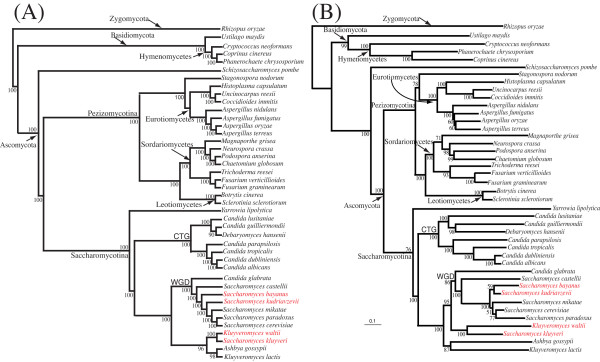
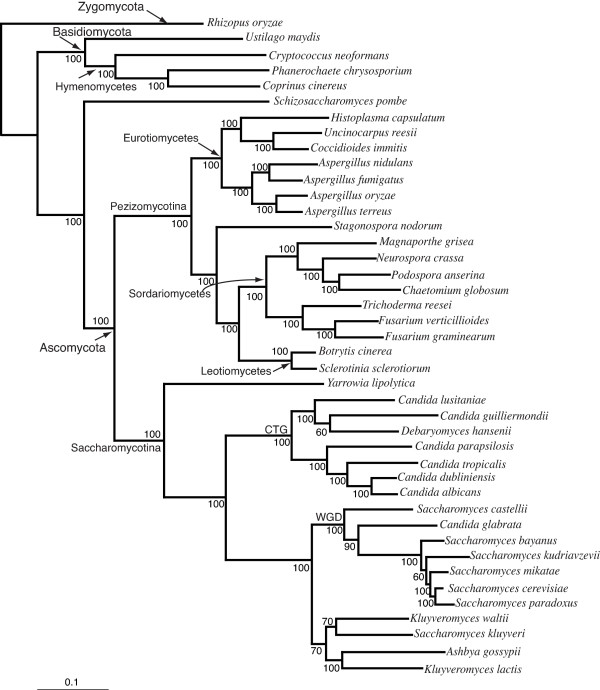
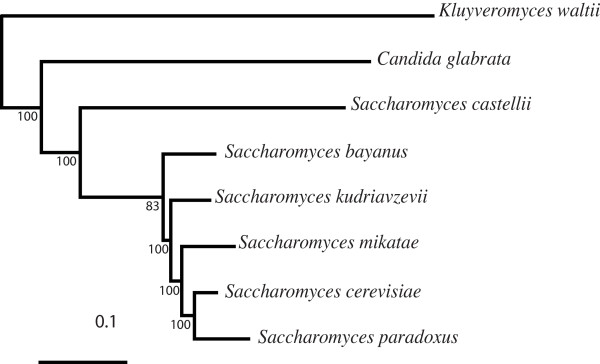
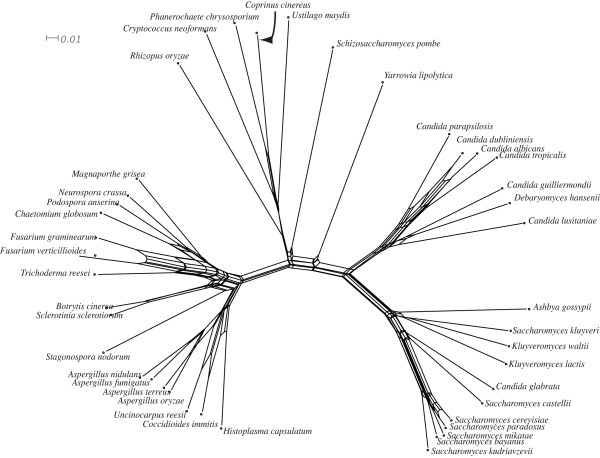
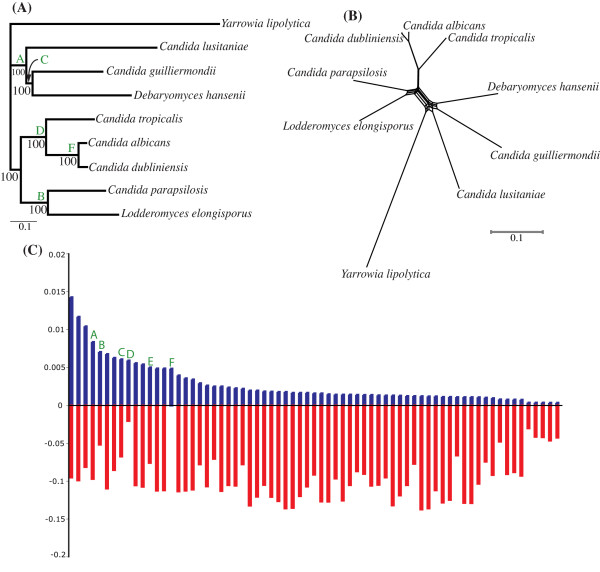
BACKGROUND: To date, most fungal phylogenies have been derived from single gene comparisons, or from concatenated alignments of a small number of genes. The increase in fungal genome sequencing presents an opportunity to reconstruct evolutionary events using entire genomes. As a tool for future comparative, phylogenomic and phylogenetic studies, we used both supertrees and concatenated alignments to infer relationships between 42 species of fungi for which complete genome sequences are available. RESULTS: A dataset of 345,829 genes was extracted from 42 publicly available fungal genomes. Supertree methods were employed to derive phylogenies from 4,805 single gene families. We found that the average consensus supertree method may suffer from long-branch attraction artifacts, while matrix representation with parsimony (MRP) appears to be immune from these. A genome phylogeny was also reconstructed from a concatenated alignment of 153 universally distributed orthologs. Our MRP supertree and concatenated phylogeny are highly congruent. Within the Ascomycota, the sub-phyla Pezizomycotina and Saccharomycotina were resolved. Both phylogenies infer that the Leotiomycetes are the closest sister group to the Sordariomycetes. There is some ambiguity regarding the placement of Stagonospora nodurum, the sole member of the class Dothideomycetes present in the dataset. Within the Saccharomycotina, a monophyletic clade containing organisms that translate CTG as serine instead of leucine is evident. There is also strong support for two groups within the CTG clade, one containing the fully sexual species Candida lusitaniae, Candida guilliermondii and Debaryomyces hansenii, and the second group containing Candida albicans, Candida dubliniensis, Candida tropicalis, Candida parapsilosis and Lodderomyces elongisporus. The second major clade within the Saccharomycotina contains species whose genomes have undergone a whole genome duplication (WGD), and their close relatives. We could not confidently resolve whether Candida glabrata or Saccharomyces castellii lies at the base of the WGD clade. CONCLUSION: We have constructed robust phylogenies for fungi based on whole genome analysis. Overall, our phylogenies provide strong support for the classification of phyla, sub-phyla, classes and orders. We have resolved the relationship of the classes Leotiomyctes and Sordariomycetes, and have identified two classes within the CTG clade of the Saccharomycotina that may correlate with sexual status.
Overview
The claims and statistics of this paper haven’t been checked yet.
Free: it reads the open-access text and checks the first 5 claims that cite a source we can check. Create a free account to check every claim.
Integrity signals
Registry
Cites
Statistics
Figures
Verification
Claims the paper makes
The claims and statistics of this paper haven’t been checked yet.
Free: it reads the open-access text and checks the first 5 claims that cite a source we can check. Create a free account to check every claim.
Claims other papers make about this one
Each is checked against this paper’s own text: does it say what the citing paper says it does?
The source backs part of the claim, not all of it — or backs it for a different population, condition or comparison.
In the citing paper
“N. glabrata is much more closely related to fermentable Saccharomyces cerevisiae than to C. albicans, especially in aspects of its energy metabolism (25).”
From Divergent mitochondrial responses and metabolic signal pathways secure the azole resistance in Crabtree-positive and negative Candida species (2024) · cites this paper as [25]
Experimental — accuracy not yet measuredThe source backs part of the claim, not all of it — or backs it for a different population, condition or comparison.
In the citing paper
“The CTG clade comprises the majority of Candida species and forms a monophyletic group of yeasts that exhibit a genetic code transition, causing the codon CTG to be translated as serine instead of leucine [60–62]”
From Competition assays and physiological experiments of soil and phyllosphere yeasts identify Candida subhashii as a novel antagonist of filamentous fungi (2017) · cites this paper as [60]
Experimental — accuracy not yet measured
Self-check
Percentages, sums and reported differences re-computed from the paper’s own numbers.
The self-check needs the paper’s full text.
Citations
Cites
Gapped BLAST and PSI-BLAST: a new generation of protein database search programs
Altschul, S. (1997) · Nucleic Acids Research · doi:10.1093/nar/25.17.3389 · Cited by 73,302
Thompson, J. D., Higgins, D. G., & Gibson, T. J. (1994) · Nucleic Acids Research · doi:10.1093/nar/22.22.4673 · Cited by 64,617
The neighbor-joining method: a new method for reconstructing phylogenetic trees.
(1987) · Molecular Biology and Evolution · doi:10.1093/oxfordjournals.molbev.a040454 · Cited by 59,715
Improved tools for biological sequence comparison.
Pearson, W. R., & Lipman, D. J. (1988) · Proceedings of the National Academy of Sciences · doi:10.1073/pnas.85.8.2444 · Cited by 11,227 · cited 2×
“Multigene analysis All proteins from the genome sequences were compared with FASTP [79] to find orthologous genes via a best bidirectional strategy.”
MethodSelection of Conserved Blocks from Multiple Alignments for Their Use in Phylogenetic Analysis
Castresana, J. (2000) · Molecular Biology and Evolution · doi:10.1093/oxfordjournals.molbev.a026334 · Cited by 10,508
Genome sequencing in microfabricated high-density picolitre reactors
Margulies, M., Egholm, M., Altman, W. E., Attiya, S., Bader, J. S., Bemben, L. A., Berka, J., Braverman, M. S., Chen, Y.-J., Chen, Z., et al. (2005) · Nature · doi:10.1038/nature03959 · Cited by 7,693
Goffeau, A., Barrell, B. G., Bussey, H., Davis, R. W., Dujon, B., Feldmann, H., Galibert, F., Hoheisel, J. D., Jacq, C., Johnston, M., et al. (1996) · Science · doi:10.1126/science.274.5287.546 · Cited by 4,263
Phylogenetic relationships among ascomycetes: evidence from an RNA polymerse II subunit
Liu, Y. J., Whelen, S., & Hall, B. D. (1999) · Molecular Biology and Evolution · doi:10.1093/oxfordjournals.molbev.a026092 · Cited by 3,751
Korf, I. (2004) · BMC Bioinformatics · doi:10.1186/1471-2105-5-59 · Cited by 3,192
Automated generation of heuristics for biological sequence comparison
Slater, G. S. C., & Birney, E. (2005) · BMC Bioinformatics · doi:10.1186/1471-2105-6-31 · Cited by 2,933
Cited by
Items 501–567 of 567
Candida: A Model Fungus to Study Differentiation, Pathogenesis, and Bioprospecting
Pathan, E. K., & Deshpande, M. V. (2021) · Springer eBooks · doi:10.1007/978-981-16-3307-2_13
Kalapis, D. (2017) · SZTE Repository of Dissertations (University of Szeged) · doi:10.14232/phd.3941
Fungal eicosanoid biosynthesis Influences the virulence of Candida Parapsilosis
Chakraborty, T. (2019) · SZTE Repository of Dissertations (University of Szeged) · doi:10.14232/phd.9952
(2014) · Elsevier eBooks · doi:10.1016/b978-0-12-387731-4.00024-4
Promoter regulation of WOR1 and commitment to the opaque phase in Candida albicans
Conway, T. P., Soll, D. R., Phillips, B. T., Prahlad, V., Moye-Rowley, S., & Malkova, A. (2020) · doi:10.17077/etd.005516
Nishimura, M., Machida, M., & Koike, H. (2008) · KAGAKU TO SEIBUTSU · doi:10.1271/kagakutoseibutsu.46.32
Zhao, P., 余, 知., 庄, 文., 罗, 晶., & 曾, 昭. (2012) · Scientia Sinica Vitae · doi:10.1360/zc2012-42-1-55
Lipid transporters in the morphogenesis of the opportunistic human fungal pathogen Candida albicans
Basante-Bedoya, M. A. (2021) · theses.fr (ABES) · doi:10.70675/13975c9cz5147z4363z8a66z2f914c962072
Yu, P., Fulton, J. C., Hudson, O., Huguet‐Tapia, J. C., & Brawner, J. T. (2023) · Figshare · doi:10.6084/m9.figshare.24234245
Sukted, J., Junsuntonpass, A., Homchan, A., Mongkolsuk, S., Pakotiprapha, D., & Matangkasombut, O. (2025) · Scientific Reports · doi:10.1038/s41598-025-12238-6
Alzahrani, N. S., Aly, M. M., & Amasha, R. (2025) · Pakistan Journal of Life and Social Sciences (PJLSS) · doi:10.57239/pjlss-2025-23.2.00177
Mühlhausen, S., Schmitt, H. D., Plessmann, U., Mienkus, P., Sternisek, P., Perl, T., Weig, M., Urlaub, H., Bader, O., & Kollmar, M. (2021) · Figshare · doi:10.6084/m9.figshare.17125685
Yu, P.-L., Fulton, J. C., Hudson, O., Huguet‐Tapia, J. C., & Brawner, J. T. (2024) · Figshare · doi:10.6084/m9.figshare.26621656
Yu, P.-L., Fulton, J. C., Hudson, O., Huguet‐Tapia, J. C., & Brawner, J. T. (2024) · Figshare · doi:10.6084/m9.figshare.26621659
Mühlhausen, S., Schmitt, H. D., Plessmann, U., Mienkus, P., Sternisek, P., Perl, T., Weig, M., Urlaub, H., Bader, O., & Kollmar, M. (2021) · Figshare · doi:10.6084/m9.figshare.17125700
多環式芳香族化合物の代謝に関与する真菌シトクロムP450の機能ゲノミクス
ノマテンバ, ロ. (2017) · Institutional Repositories DataBase (IRDB) · doi:10.15017/1932018
Zainudin, R. A., Sabri, S., Salleh, A. B., Abu, A., Khairuddin, R. F. R., & Oslan, S. N. (2023) · Figshare · doi:10.6084/m9.figshare.22608397
Yu, P.-L., Fulton, J. C., Hudson, O., Huguet‐Tapia, J. C., & Brawner, J. T. (2024) · Figshare · doi:10.6084/m9.figshare.26621671
Yu, P.-L., Fulton, J. C., Hudson, O., Huguet‐Tapia, J. C., & Brawner, J. T. (2024) · Figshare · doi:10.6084/m9.figshare.26621674
Yu, P.-L., Fulton, J. C., Hudson, O., Huguet‐Tapia, J. C., & Brawner, J. T. (2024) · Figshare · doi:10.6084/m9.figshare.26621662
Mühlhausen, S., Schmitt, H. D., Plessmann, U., Mienkus, P., Sternisek, P., Perl, T., Weig, M., Urlaub, H., Bader, O., & Kollmar, M. (2021) · Figshare · doi:10.6084/m9.figshare.17125691
Yu, P.-L., Fulton, J. C., Hudson, O., Huguet‐Tapia, J. C., & Brawner, J. T. (2024) · Figshare · doi:10.6084/m9.figshare.26621653
Yu, P.-L., Fulton, J. C., Hudson, O., Huguet‐Tapia, J. C., & Brawner, J. T. (2024) · Figshare · doi:10.6084/m9.figshare.26621677
Thielemann, N. (2025) · Online Publication Service of Würzburg University (Würzburg University) · doi:10.25972/opus-40419
Supplement from Genetic basis of priority effects: insights from nectar yeast
Dhami, M. K., Hartwig, T., & Fukami, T. (2016) · Figshare · doi:10.6084/m9.figshare.3860589
Yu, P.-L., Fulton, J. C., Hudson, O., Huguet‐Tapia, J. C., & Brawner, J. T. (2024) · Figshare · doi:10.6084/m9.figshare.26621665
Yu, P.-L., Fulton, J. C., Hudson, O., Huguet‐Tapia, J. C., & Brawner, J. T. (2024) · Figshare · doi:10.6084/m9.figshare.26621650
Yu, P.-L., Fulton, J. C., Hudson, O., Huguet‐Tapia, J. C., & Brawner, J. T. (2024) · Figshare · doi:10.6084/m9.figshare.26621644
Yu, P.-L., Fulton, J. C., Hudson, O., Huguet‐Tapia, J. C., & Brawner, J. T. (2024) · Figshare · doi:10.6084/m9.figshare.24234297
Yu, P.-L., Fulton, J. C., Hudson, O., Huguet‐Tapia, J. C., & Brawner, J. T. (2024) · Figshare · doi:10.6084/m9.figshare.26621647
Yu, P.-L., Fulton, J. C., Hudson, O., Huguet‐Tapia, J. C., & Brawner, J. T. (2024) · Figshare · doi:10.6084/m9.figshare.26621668
Phenotypic response and adaptation of Candida species to boric acid
Salama, O. E. (2021) · Mspace (University of Manitoba)
Timmermans, B. (2021) · Lirias (KU Leuven)
Evolutionary dynamics of Candida albicans in the presence and absence of antifungal drug fluconazole
Sumanarathne, A. (2024) · Mspace (University of Manitoba)
Identification and functional characterisation of a Candida orthopsilosis adhesin
Lombardi, L. (2016) · Electronic Theses and Dissertations Repository (University of Pisa)
FIORENTINI, F. (2018) · Electronic Theses and Dissertations Repository (University of Pisa)
Sánchez, C. I. (2019) · DIGITAL.CSIC (Spanish National Research Council (CSIC))
Chew, S. Y. (2019) · Universiti Putra Malaysia Institutional Repository (Universiti Putra Malaysia)
Bases estructurales de la acción del factor de la iniciación eIF4F
Escamilla Aguilar, M. (2024) · DIGITAL.CSIC (Spanish National Research Council (CSIC))
Ranocchi, B., Pennesi, A., Baglieri, E., & Amicucci, A. (2026) · Fungal Biology · doi:10.1016/j.funbio.2026.101716
Phylogenetic analysis of oral isolates of Candida spp. in Salvador, Bahia, Brazil
Brandão, L. B. D. S. (2024) · LA Referencia (Red Federada de Repositorios Institucionales de Publicaciones Científicas)
Aguiar, T. Q., Coelho, E., & Domingues, L. (2026) · Springer briefs in molecular science · doi:10.1007/978-3-032-12435-7_1
Doe, D., Vu, A., Ham, J. P., & Perlin, M. H. (2026) · Journal of Fungi · doi:10.3390/jof12030206
Analyse biochimique et de culture des facteurs de virulence
Tefiani, I. (2024) · Dépôt Institutionnel de lUniversité de Tlemcen
Sethi, P. (2024) · Mspace (University of Manitoba)
Towards a chronology of life using Lateral Gene Transfers
Davín, A. (2017) · theses.fr (ABES) · doi:10.70675/ac7907fbz1356z461azb759z5770743b3e29
Rôle des petites protéines G de type Arf dans la morphogenèse et la virulence de Candida albicans
Labbaoui, H. (2017) · theses.fr (ABES) · doi:10.70675/a82268dcz2e38z4662z8c8bz5fc4853980cc
Phylogenomic study of the evolutionary history of the Archaea and their link with eukaryogenesis
Aouad, M. (2018) · theses.fr (ABES) · doi:10.70675/f9fbb237z6ebfz42f5zb132zaed46e39783a
Transcriptional networks of the stress responses in the human pathogen Candida glabrata
Thiébaut, A. (2018) · theses.fr (ABES) · doi:10.70675/323c74a8z1ae4z4123za081zd0af3ecf65ae
Bukari, A.-R. A., Sidney, B., & Gerstein, A. C. (2026) · bioRxiv (Cold Spring Harbor Laboratory) · doi:10.64898/2026.04.03.716392
Genomic analysis of Tulasnella spp. associated with Cypripedium macranthos var. rebunense
Kambara, K., Jin, C., Fujino, K., & Shimura, H. (2026) · Mycoscience · doi:10.47371/mycosci.2026.04.002
Инвазивные грибковые инфекции: эпидемиология, экология и микология
Мартынова, А. В., Сидоренко, В., Сидоренко, М. Л., & Аленицкая, М. В. (2026) · doi:10.24866/7444-6180-5
Efficient breakdown of lignocellulose using mixed-microbe populations for bioethanol production.
Murton, J. K., Ricken, J., & Powell, A. (2009) · OSTI OAI (U.S. Department of Energy Office of Scientific and Technical Information) · doi:10.2172/974402
Ribeiro, P. M. (2007) · Americanae (AECID Library)
Autocorrelation Genetic Syntax of Eukaryotic Protein-Coding Sequences
Gladstone, W. A. (2013) · doi:10.14418/wes01.3.13
Evolutionary genetic studies of mating type and silencing in Saccharomyces
Zill, O. A. (2010) · eScholarship (California Digital Library)
Metadata
- Authors
- Fitzpatrick, D. A., Logue, M. E., Stajich, J., & Butler, G.
- Affiliations
- University College Dublin (IE)
- Duke University (US)
- Corresponding author
- David A. Fitzpatrick
- Venue
- BMC Evolutionary Biology
- Published
- 2006
- Volume
- 6
- Issue
- 1
- Pages
- 99
- ISSN
- 1471-2148 (ISSN-L)
- PMC
- PMC1679813
- OpenAlex
- W2095815023
- Semantic Scholar
- 08a67c69d23a2b8b0ba352bc4ae74013b31dffc1
- Cited by
- 475
- References
- 92
- Citations by year
- 2026: 3 · 2025: 2 · 2024: 5 · 2023: 9 · 2022: 6 · 2021: 13 · 2020: 17 · 2019: 16 · 2018: 14 · 2017: 26 · 2016: 14 · 2015: 19 · 2014: 39 · 2013: 31 · 2012: 44
- FWCI
- 15.38
- Type
- journal article
- Language
- en
- Open access
- gold
- doi.org
- Licence
- cc-by
- Locations
- BMC Evolutionary Biology (publishedVersion, cc-by)
- PubMed (publishedVersion)
- Maynooth University ePrints and eTheses Archive (Maynooth University) (acceptedVersion)
- eScholarship (California Digital Library) (submittedVersion, cc-by-nc-sa)
- DOAJ (DOAJ: Directory of Open Access Journals) (submittedVersion)
- Funders
- National Science Foundation
- Wellcome Trust
- Broad Institute
- Irish Research Council for Science, Engineering and Technology
- Science Foundation Ireland
- Irish Research Council
- Irish Centre for High-End Computing
- Topics
- Life Sciences › Biochemistry, Genetics and Molecular Biology › Molecular Biology › Fungal and yeast genetics research
- Life Sciences › Biochemistry, Genetics and Molecular Biology › Molecular Biology › Genomics and Phylogenetic Studies
- Life Sciences › Immunology and Microbiology › Microbiology › Yeasts and Rust Fungi Studies
- Keywords
- fungal phylogeny, supertree, matrix representation with parsimony, concatenated alignment, orthologs, Ascomycota, Pezizomycotina, Saccharomycotina, Leotiomycetes, Sordariomycetes, Dothideomycetes, Candida, whole-genome duplication, long-branch attraction
- MeSH terms
- Ascomycota, Basidiomycota, Fungi, Genes, Fungal, Phylogeny, Sequence Alignment, Genome, Fungal, Databases, Genetic
About these checks
Registry, retraction, Cites and statistics results are computed, not judged, with one exception: a printed reference that no index lists is read once by a model before it counts as a citation error. Claims are extracted by a model and kept only when their quote appears verbatim in the text; each cited source is then checked, with a model’s help, for whether it says what the claim relies on. Those verdicts can be wrong — read the claim’s quote and the cited source before relying on one.
Statistics and arithmetic are recomputed, not judged.
Confidence bands are shown only for fields calibrated on our annotated test set. None is calibrated yet, so no band is shown.
What counts as a claim ›How we measure confidence ›How we check this ›
Are you an author, or do you see a problem with this page? Request a review
Data sources
Bibliographic data: Semantic Scholar, OpenAlex, Crossref.
Contains information from the Semantic Scholar Academic Graph Datasets, made available under the ODC Attribution License (ODC-BY 1.0).
Semantic Scholar’s data is described in: Kinney, R., et al. (2023). The Semantic Scholar Open Data Platform. arXiv:2301.10140.
