

Suppression of long-branch attraction artefacts in the animal phylogeny using a site-heterogeneous model
Open accessThe DOI matches its Crossref record; 57 of the 63 references it cites were found in a registry or an index.
Abstract
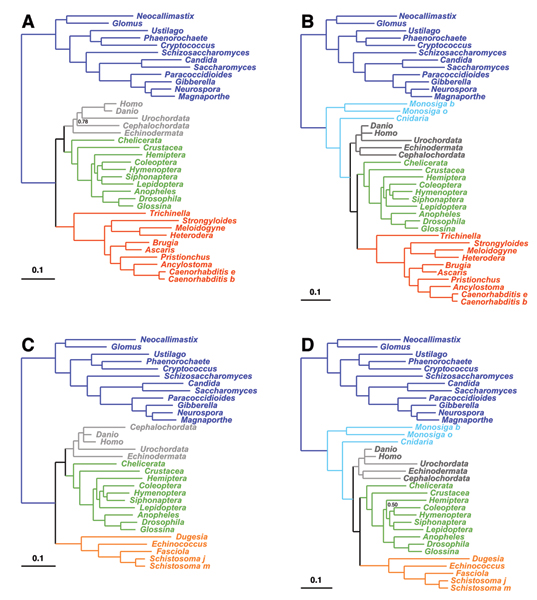
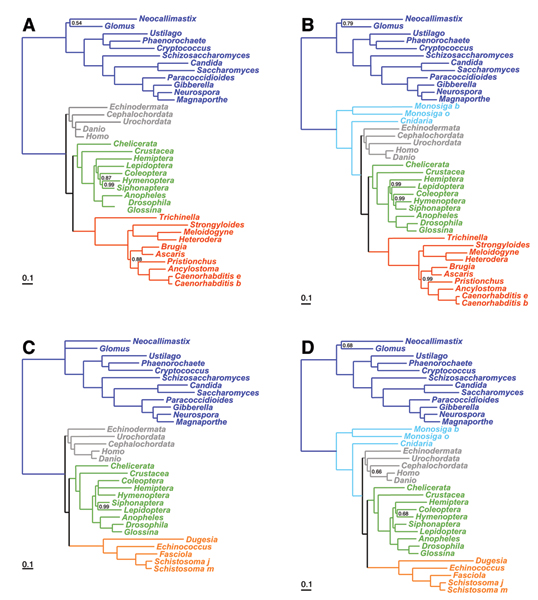
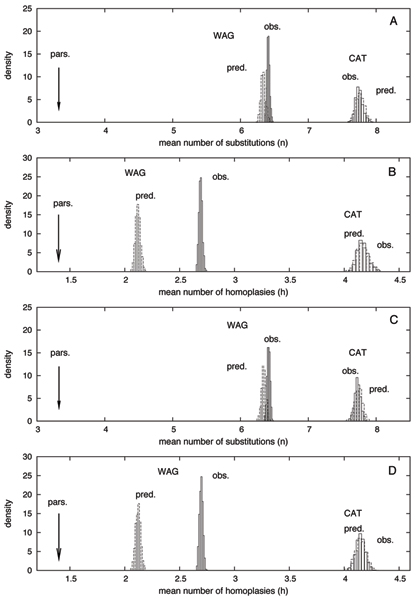
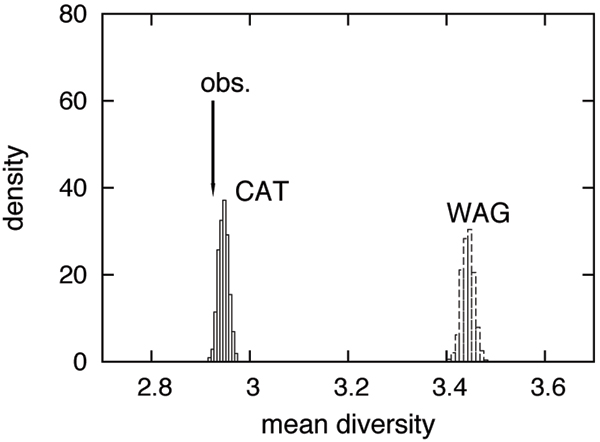
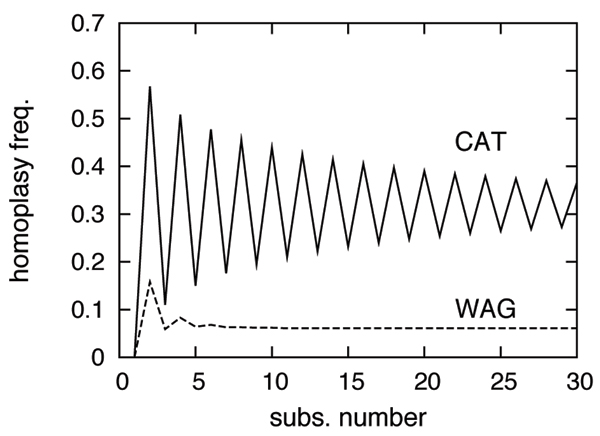
BACKGROUND: Thanks to the large amount of signal contained in genome-wide sequence alignments, phylogenomic analyses are converging towards highly supported trees. However, high statistical support does not imply that the tree is accurate. Systematic errors, such as the Long Branch Attraction (LBA) artefact, can be misleading, in particular when the taxon sampling is poor, or the outgroup is distant. In an otherwise consistent probabilistic framework, systematic errors in genome-wide analyses can be traced back to model mis-specification problems, which suggests that better models of sequence evolution should be devised, that would be more robust to tree reconstruction artefacts, even under the most challenging conditions. METHODS: We focus on a well characterized LBA artefact analyzed in a previous phylogenomic study of the metazoan tree, in which two fast-evolving animal phyla, nematodes and platyhelminths, emerge either at the base of all other Bilateria, or within protostomes, depending on the outgroup. We use this artefactual result as a case study for comparing the robustness of two alternative models: a standard, site-homogeneous model, based on an empirical matrix of amino-acid replacement (WAG), and a site-heterogeneous mixture model (CAT). In parallel, we propose a posterior predictive test, allowing one to measure how well a model acknowledges sequence saturation. RESULTS: Adopting a Bayesian framework, we show that the LBA artefact observed under WAG disappears when the site-heterogeneous model CAT is used. Using cross-validation, we further demonstrate that CAT has a better statistical fit than WAG on this data set. Finally, using our statistical goodness-of-fit test, we show that CAT, but not WAG, correctly accounts for the overall level of saturation, and that this is due to a better estimation of site-specific amino-acid preferences. CONCLUSION: The CAT model appears to be more robust than WAG against LBA artefacts, essentially because it correctly anticipates the high probability of convergences and reversions implied by the small effective size of the amino-acid alphabet at each site of the alignment. More generally, our results provide strong evidence that site-specificities in the substitution process need be accounted for in order to obtain more reliable phylogenetic trees.
Overview
The claims and statistics of this paper haven’t been checked yet.
Free: it reads the open-access text and checks the first 5 claims that cite a source we can check. Create a free account to check every claim.
Integrity signals
Registry
Cites
Statistics
Figures
Verification
Claims the paper makes
The claims and statistics of this paper haven’t been checked yet.
Free: it reads the open-access text and checks the first 5 claims that cite a source we can check. Create a free account to check every claim.
Claims other papers make about this one
Each is checked against this paper’s own text: does it say what the citing paper says it does?
The source backs part of the claim, not all of it — or backs it for a different population, condition or comparison.
In the citing paper
“CAT/CATGTR offers improved resilience to long-branch attraction artefacts (LBA)22 and is almost always better fitting than standard site-homogeneous amino acid substitution models (e.g. WAG)8–10,23–29.”
From Evidence for sponges as sister to all other animals from partitioned phylogenomics with mixture models and recoding (2021) · cites this paper as [22]
Experimental — accuracy not yet measuredThe source backs part of the claim, not all of it — or backs it for a different population, condition or comparison.
In the citing paper
“This is because, by accommodating site-specific biochemical constraints, CAT/CATGTR can better detect saturation (i.e. multiple hidden substitutions)8,20,22, and therefore better identify cases of convergent evolution of identical amino acids in distantly related, fast-evolving species.”
From Evidence for sponges as sister to all other animals from partitioned phylogenomics with mixture models and recoding (2021) · cites this paper as [22]
Experimental — accuracy not yet measuredThe source backs part of the claim, not all of it — or backs it for a different population, condition or comparison.
In the citing paper
“Additional sources of systematic error include poor taxon or character sampling (10,14,15), large amounts of missing data (16), and model misspecification (16,17).”
From Error, signal, and the placement of Ctenophora sister to all other animals (2015) · cites this paper as [17]
Experimental — accuracy not yet measuredThe cited source says what the claim attributes to it.
In the citing paper
“However, protein evolution is not homogeneous.”
From Improved Modeling of Compositional Heterogeneity Supports Sponges as Sister to All Other Animals (2017) · cites this paper as [26]
The cited source says what the claim attributes to it.
In the citing paper
“Previous studies analysing the test datasets used here, but without partitioning, have found support for the accepted topology under a variety of site-heterogeneous models22,56,60.”
From Evidence for sponges as sister to all other animals from partitioned phylogenomics with mixture models and recoding (2021) · cites this paper as [22]
4 more claims about this paper
Create a free account to see every claim other papers make about this one.
Self-check
Percentages, sums and reported differences re-computed from the paper’s own numbers.
The self-check needs the paper’s full text.
Citations
Cites
MRBAYES: Bayesian inference of phylogenetic trees.
Huelsenbeck, J. P., & Ronquist, F. (2001) · Bioinformatics · doi:10.1093/bioinformatics/17.8.754 · Cited by 21,937 · cited 1×
“In the case of WAG, we performed one run with our program, and another one using MrBayes [48].”
Evolutionary trees from DNA sequences: A maximum likelihood approach.
Felsenstein, J. (1981) · Journal of Molecular Evolution · doi:10.1007/bf01734359 · Cited by 14,571 · cited 3×
“The evolutionary process defined by this category is then similar to that proposed by Felsenstein [45], i.e. a Poisson process distributing events across time, so that at each event, a new state (possibly equal to the current one) is drawn at random from the probability profile.”
InfluentialEvolution of Protein Molecules
JUKES, T. H., & CANTOR, C. R. (1969) · Mammalian Protein Metabolism · doi:10.1016/b978-1-4832-3211-9.50009-7 · Cited by 11,032 · cited 1×
“At one extreme, we used the equivalent of the Jukes and Cantor model [ 44 ] for amino-acids, assuming all 20 amino-acid to be equally likely at each site.”
The rapid generation of mutation data matrices from protein sequences
Jones, D. T., Taylor, W. R., & Thornton, J. M. (1992) · Bioinformatics · doi:10.1093/bioinformatics/8.3.275 · Cited by 6,947
(1964) · Mammalian Protein Metabolism · doi:10.1016/b978-1-4832-3210-2.50006-6 · Cited by 3,059
Yang, Z. (1994) · Journal of Molecular Evolution · doi:10.1007/bf00160154 · Cited by 2,960 · cited 3×
“Apart from their specific amino-acid replacement processes, the two models under investigation, CAT and WAG, share the same features, including gamma-distributed rates across sites [25] (see methods).”
Cases in which Parsimony or Compatibility Methods will be Positively Misleading
Felsenstein, J. (1978) · Systematic Biology · doi:10.1093/sysbio/27.4.401 · Cited by 2,896
Whelan, S., & Goldman, N. (2001) · Molecular Biology and Evolution · doi:10.1093/oxfordjournals.molbev.a003851 · Cited by 2,849 · cited 3×
“By Bayes factor evaluation, we have shown previously that CAT generally has a better fit than homogeneous models based on one single empirical substitution matrix, such as WAG [39], JTT [40], or even the most general site-homogeneous and time-reversible model (GTR) [31,41].”
Cellular Scaling Rules for the Brains of Marsupials: Not as “Primitive” as Expected
Dos Santos, S. E., Porfirio, J., da Cunha, F. B., Manger, P. R., Tavares, W., Pessoa, L., Raghanti, M. A., Sherwood, C. C., & Herculano-Houzel, S. (2017) · Brain, Behavior and Evolution · doi:10.1159/000452856 · Cited by 2,642
Markov Chain Sampling Methods for Dirichlet Process Mixture Models
Neal, R. M. (2000) · Journal of Computational and Graphical Statistics · doi:10.1080/10618600.2000.10474879 · Cited by 2,288
Cited by
Items 501–600 of 712
Lin, X., & Song, N. (2023) · Genes · doi:10.3390/genes14081528 · Cited by 6
The Expected Behaviors of Posterior Predictive Tests and Their Unexpected Interpretation
Fabreti, L. G., Coghill, L. M., Thomson, R. C., Höhna, S., & Brown, J. M. (2024) · Molecular Biology and Evolution · doi:10.1093/molbev/msae051 · Cited by 7
Three-dimensional structure model and predicted ATP interaction rewiring of a deviant RNA ligase 2
Moreira, S., Noutahi, E., Lamoureux, G., & Burger, G. (2015) · BMC Structural Biology · doi:10.1186/s12900-015-0046-0 · Cited by 6
Andreeva, A. M., Lamash, N. E., Serebryakova, M. V., & Павловна, Р. И. (2015) · Journal of Ichthyology · doi:10.1134/s003294521505001x · Cited by 6
An, J., Zheng, W., Liang, J., Xi, Q., Chen, R., Jia, J., Lu, X., & Jakovlić, I. (2020) · BMC Genomics · doi:10.1186/s12864-020-07021-y · Cited by 6
Pandey, A., & Braun, E. L. (2021) · Biophysica · doi:10.3390/biophysica1020008 · Cited by 6
Li, Y., Tihelka, E., Leschen, R. A. B., Yu, Y., Ślipiński, A., Pang, H., Huang, D., Kolibáč, J., & Cai, C. (2021) · Journal of Zoological Systematics & Evolutionary Research · doi:10.1111/jzs.12515 · Cited by 8
Hlaka, V., Guilbert, É., Smit, S. J., van Noort, S., Allsopp, E., Langley, J., & ASCH, B. V. (2021) · Insects · doi:10.3390/insects12090830 · Cited by 6
Animal Evolution: Genomes, Fossils, and Trees
Telford, M. J., & Littlewood, D. T. J. (2009) · doi:10.1093/acprof:oso/9780199549429.001.0001 · Cited by 9
The earliest fossil record of the animals and its significance
Budd, G. E. (2009) · Oxford University Press eBooks · doi:10.1093/acprof:oso/9780199549429.003.0001 · Cited by 7
Evolutionary ideas on the nature of aging
Moskalev, A. (2011) · Advances in Gerontology · doi:10.1134/s207905701102010x · Cited by 7
Current Approaches to Phylogenomic Reconstruction
Baurain, D., & Philippe, H. (2010) · Wiley eBooks · doi:10.1002/9780470570418.ch2 · Cited by 8
Self-citationThe Glossina Genome Cluster: Comparative Genomic Analysis of the Vectors of African TrypanosomesPreprint
Attardo, G. M., Abd‐Alla, A. M. M., Acosta-Serrano, Á., Allen, J. E., Bateta, R., Benoit, J. B., Bourtzis, K., Caers, J., Caljon, G., Christensen, M. B., et al. (2019) · bioRxiv (Cold Spring Harbor Laboratory) · doi:10.1101/531749 · Cited by 6
Höhna, S., Lower, S. E., Duchen, P., & Catalán, A. (2021) · bioRxiv (Cold Spring Harbor Laboratory) · doi:10.1101/2021.11.19.469195 · Cited by 6
Copepod phylogenomics supports Canuelloida as a valid order separate from Harpacticoida
Bernot, J. P., Khodami, S., Boyen, J., Troch, M. D., Boxshall, G. A., & Arbizu, P. M. (2025) · Molecular Phylogenetics and Evolution · doi:10.1016/j.ympev.2025.108311 · Cited by 5
Rapid mid-Cretaceous diversification of squid and cuttlefish preceded radiation into coastal niches
Sánchez, G., Fernández‐Álvarez, F. Á., Bernal, A., Heath-Heckman, E., Lami, R., McFall‐Ngai, M., Nishiguchi, M. K., Nyholm, S. V., Simakov, O., Allcock, A. L., et al. (2026) · Nature Ecology & Evolution · doi:10.1038/s41559-026-03009-1 · Cited by 10
Lei, H., Jakovlić, I., Zhou, S., Liu, X., Yan, C., Jin, X., Wang, B., Li, W., Wang, G., & Zhang, D. (2024) · Parasites & Vectors · doi:10.1186/s13071-023-06111-6 · Cited by 10
Hao, C.-L., Wei, N.-W., Liu, Y.-J., Shi, C., Arken, K., & Cheng, Y. (2023) · Parasites & Vectors · doi:10.1186/s13071-023-05692-6 · Cited by 5
Tian, S., Jiang, Y., Lai, Y., Wang, S., Liu, X., & Wang, Y. (2023) · Insects · doi:10.3390/insects14110878 · Cited by 5
Yazaki, E., Harada, R., Isogai, R., Bamba, K., Ishida, K., Inagaki, Y., & Shiratori, T. (2025) · Open Biology · doi:10.1098/rsob.250057 · Cited by 4
Genome-Wide miRNA Seeds Prediction in Archaea
Wang, S., Xu, Y., & Lu, Z. (2014) · Archaea · doi:10.1155/2014/671059 · Cited by 5
Vďačný, P., & Rataj, M. (2017) · Journal of Eukaryotic Microbiology · doi:10.1111/jeu.12396 · Cited by 8
Pairwise diversity and tMRCA as potential markers for HIV infection recency
Moyo, S. M., Wilkinson, E., Vandormael, A. M., Wang, R., Weng, J. F., Kotokwe, K. P., Gaseitsiwe, S., Musonda, R. M., Makhema, J. M., Essex, M., et al. (2017) · Medicine · doi:10.1097/md.0000000000006041 · Cited by 5
tRNA functional signatures classify plastids as late-branching cyanobacteria
Lawrence, T. J., Amrine, K. C. H., Swingley, W. D., & Ardell, D. H. (2019) · BMC Evolutionary Biology · doi:10.1186/s12862-019-1552-7 · Cited by 5
Models of nucleotide substitution
Yang, Z. (2014) · Oxford University Press eBooks · doi:10.1093/acprof:oso/9780199602605.003.0001 · Cited by 4
An estimate of the deepest branches of the tree of life from ancient vertically-evolving genesPreprint
Moody, E. R. R., Mahendrarajah, T., Dombrowski, N., Clark, J., Petitjean, C., Offre, P., Szöllősi, G. J., Spang, A., & Williams, T. A. (2021) · bioRxiv (Cold Spring Harbor Laboratory) · doi:10.1101/2021.01.19.427276 · Cited by 5
Roger, A. J., Kolísko, M., & Simpson, A. G. B. (2012) · Wiley eBooks · doi:10.1002/9781118308165.ch3 · Cited by 6
Letsch, H. O., Vukotić, S., Gottsberger, B., Friedman, A., Wanat, M., Beran, F., Fiedler, K., & Riedel, A. (2024) · Systematic Entomology · doi:10.1111/syen.12635 · Cited by 4
Phylogenomics of enigmatic crustacean y-larvae reveals multiple origins of parasitism in barnacles
Dreyer, N., Bernot, J. P., Olesen, J., Kolbasov, G. A., Høeg, J. T., Machida, R. J., & Chan, B. K. K. (2025) · Current Biology · doi:10.1016/j.cub.2025.06.007 · Cited by 5
Smith, M. L., & Hahn, M. W. (2025) · Systematic Biology · doi:10.1093/sysbio/syaf089 · Cited by 4
Liang, Z., Jun-ru, Z., Dietrich, C. H., Du, Y., & Dai, W. (2024) · Insect Systematics and Diversity · doi:10.1093/isd/ixae026 · Cited by 4
Tsai, F.-Y., Lin, C.-Y., Su, Y., Yu, J., & Kuo, D. (2025) · Molecular Biology and Evolution · doi:10.1093/molbev/msaf072 · Cited by 3
Li, Y., Ruta, R., Huang, D., & Cai, C. (2025) · Journal of Systematics and Evolution · doi:10.1111/jse.13182 · Cited by 4
Belato, F. A., Mello, B., Coates, C. J., Halanych, K. M., Brown, F. D., Morandini, A. C., Leme, J. D. M., Trindade, R. I. F., & Costa-Paiva, E. M. (2023) · Geobiology · doi:10.1111/gbi.12577 · Cited by 5
Highly Conserved Elements and Chromosome Structure Evolution in Mitochondrial Genomes in Ciliates
Gershgorin, R., Gorbunov, K. Y., Zverkov, O. A., Израилевич, Р. Л., Селиверстов, А. В., & Lyubetsky, V. (2017) · Life · doi:10.3390/life7010009 · Cited by 4
Unravelling body plan and axial evolution in the Bilateria with molecular phylogenetic markers
Baguñà, J., Martínez, P., Paps, J., & Riutort, M. (2008) · Cambridge University Press eBooks · doi:10.1017/cbo9780511541582.017 · Cited by 4
A Not-So-Long Introduction to Computational Molecular Evolution
Aris‐Brosou, S., & Rodrigue, N. (2019) · Methods in molecular biology · doi:10.1007/978-1-4939-9074-0_3 · Cited by 3
Peel, A. (2009) · Oxford University Press eBooks · doi:10.1093/acprof:oso/9780199549429.003.0016 · Cited by 4
Reply to: Available data do not rule out Ctenophora as the sister group to all other Metazoa
Redmond, A. K., & McLysaght, A. (2023) · Nature Communications · doi:10.1038/s41467-023-36152-5 · Cited by 4
Yan, B., Dietrich, C. H., Yu, X., Jiang, Y., Dai, R., Du, S., Cai, C., Yang, M., & Zhang, F. (2025) · Journal of Systematics and Evolution · doi:10.1111/jse.13190 · Cited by 3
Letsch, H. O., & Riedel, A. (2025) · Zoological Journal of the Linnean Society · doi:10.1093/zoolinnean/zlaf132 · Cited by 5
Keeley, S. D., Aires, R., Medina, B. A. C., Gómez, C. M. A., López-Delgado, A. C., Delgado, J. P., Knopf, F., Kuraku, S., & Sandoval‐Guzmán, T. (2026) · iScience · doi:10.1016/j.isci.2026.114934 · Cited by 2
A Guide to Phylogenomic Inference
Patané, J. S. L., Martins, J., & Setúbal, J. C. (2024) · Methods in molecular biology · doi:10.1007/978-1-0716-3838-5_11 · Cited by 3
Stochastic Character Mapping: An Under-Exploited Approach to the Study of Molecular Evolution
Laurin-Lemay, S., & Rodrigue, N. (2025) · Journal of Molecular Evolution · doi:10.1007/s00239-025-10257-5 · Cited by 4
Evolution of the Ras Superfamily of GTPases
Rojas, A. M., & Valencia, A. (2014) · Springer eBooks · doi:10.1007/978-3-7091-1806-1_1 · Cited by 5
An, Y., Li, C., Li, J., & Wang, Y. (2022) · Frontiers in Ecology and Evolution · doi:10.3389/fevo.2022.932601 · Cited by 4
Phylogenomics of the family Lachesillidae (Insecta: Psocodea: Psocomorpha)
Manchola, O. F. S., Herrera, S. V., D'alessio, L. M., Aldrete, A. N. G., & Johnson, K. P. (2022) · Systematic Entomology · doi:10.1111/syen.12577 · Cited by 4
Říhová, J. M., Vodička, R., & Hypša, V. (2025) · Applied and Environmental Microbiology · doi:10.1128/aem.00220-25 · Cited by 3
Parameter Identifiability for a Profile Mixture Model of Protein Evolution
Yourdkhani, S., Allman, E. S., & Rhodes, J. A. (2021) · Journal of Computational Biology · doi:10.1089/cmb.2020.0315 · Cited by 3
The Structure of Evolutionary Model Space for Proteins across the Tree of Life
Scolaro, G. E., & Braun, E. L. (2023) · Biology · doi:10.3390/biology12020282 · Cited by 3
Ji, Q., Sun, Y.-N., Lü, L., Zhao, T., & Wu, D. (2023) · Diversity · doi:10.3390/d15050588 · Cited by 3
The origins and evolution of the Ecdysozoa
Telford, M. J., Bourlat, S. J., Economou, A. D., Papillon, D., & Rota‐Stabelli, O. (2009) · Oxford University Press eBooks · doi:10.1093/acprof:oso/9780199549429.003.0008 · Cited by 5
Origins of metazoan body plans: the larval revolution
Raff, R. A. (2009) · Oxford University Press eBooks · doi:10.1093/acprof:oso/9780199549429.003.0005 · Cited by 5
Zhang, D., Zou, H., Zhang, J., Wang, G., & Jakovlić, I. (2020) · bioRxiv (Cold Spring Harbor Laboratory) · doi:10.1101/2020.05.09.085712 · Cited by 3
Multi-Locus Molecular Phylogeny of Solenopsis (Hymenoptera: Formicidae)Preprint
Shreve, S. M., Achury, R., Johnson, K. P., Suarez, A. V., & Gotzek, D. (2020) · bioRxiv (Cold Spring Harbor Laboratory) · doi:10.1101/2020.06.05.136945 · Cited by 3
Extremely reduced supergroup F Wolbachia : transition to obligate insect symbiontsPreprint
Mahmood, S., Nováková, E., Martinů, J., Sychra, O., & Hypša, V. (2021) · bioRxiv (Cold Spring Harbor Laboratory) · doi:10.1101/2021.10.15.464041 · Cited by 3
Redmond, A. K., Gundappa, M. K., Macqueen, D. J., & McLysaght, A. (2022) · bioRxiv (Cold Spring Harbor Laboratory) · doi:10.1101/2022.05.16.492067 · Cited by 3
Kück, P., Wilkinson, M., Romahn, J., Seidel, N. I., Meusemann, K., & Wägele, J. W. (2025) · NAR Genomics and Bioinformatics · doi:10.1093/nargab/lqaf018 · Cited by 3
The COX1 mutation drives structural innovation despite silent tRNA variation in semiaquatic bugs
Zhao, T., Wu, Y., Chen, Z., Tian, L., Duan, Y., Li, H., Cai, W., & Song, F. (2025) · International Journal of Biological Macromolecules · doi:10.1016/j.ijbiomac.2025.148075 · Cited by 3
Deng, J., Zhang, L., Ma, W., Xiao, H., Lu, C., & Huang, X. (2026) · ZooKeys · doi:10.3897/zookeys.1272.178506 · Cited by 2
Phylogenomic mixture models outperform homogeneous and partitioned models
Pisani, D., Giacomelli, M., Szöllősi, G. J., Rossi, M. E., Domènech, M., & Lozano-Fernández, J. (2026) · Molecular Biology and Evolution · doi:10.1093/molbev/msag090 · Cited by 7
Neutral and adaptive protein evolution
Yang, Z. (2014) · Oxford University Press eBooks · doi:10.1093/acprof:oso/9780199602605.003.0011 · Cited by 1
Li, Y., Pollock, D. A., Johnston, M. A., Huang, D., & Cai, C. (2024) · Ecology and Evolution · doi:10.1002/ece3.70615 · Cited by 2
Tamre, E., & Fournier, G. P. (2025) · Applied and Environmental Microbiology · doi:10.1128/aem.01662-24 · Cited by 2
The Kernel of Maximum Agreement Subtrees
Swenson, K. M., Chen, E., Pattengale, N. D., & Sankoff, D. (2012) · IEEE Transactions on Computational Biology and Bioinformatics · doi:10.1109/tcbb.2012.11 · Cited by 2
Reassembling animal evolution: a four-dimensional puzzle
Telford, M. J., Timothy, D. J., & Littlewood, D. T. J. (2009) · Oxford University Press eBooks · doi:10.1093/acprof:oso/9780199549429.003.0018 · Cited by 2
Beldade, P., & Saenko, S. V. (2009) · Oxford University Press eBooks · doi:10.1093/acprof:oso/9780199549429.003.0017 · Cited by 2
Mammalian organogenesis in deep time: tools for teaching and outreach
Sánchez-Villagra, M. R., & Werneburg, I. (2016) · Evolution Education and Outreach · doi:10.1186/s12052-016-0062-y · Cited by 2
QuCo: quartet-based co-estimation of species trees and gene trees
Rabiee, M., & Mirarab, S. (2022) · Bioinformatics · doi:10.1093/bioinformatics/btac265 · Cited by 3
Simulating molecular evolution
Yang, Z. (2014) · Oxford University Press eBooks · doi:10.1093/acprof:oso/9780199602605.003.0012 · Cited by 3
Generalizing rate heterogeneity across sites in statistical phylogenetics
Heaps, S. E., Nye, T. M. W., Boys, R. J., Williams, T. A., Cherlin, S., & Embley, T. M. (2020) · Statistical Modelling · doi:10.1177/1471082x19829937 · Cited by 1
Goremykin, V. V. (2019) · Genome Biology and Evolution · doi:10.1093/gbe/evz167 · Cited by 3
Sánchez, D., Arias, S., Vázquez-Sánchez, M., & Terrazas, T. (2019) · Sustainable development and biodiversity · doi:10.1007/978-3-030-30746-2_11 · Cited by 2
Parallel and Convergent Molecular Evolution
Pollock, D. D., & Pollard, S. T. (2016) · Elsevier eBooks · doi:10.1016/b978-0-12-800049-6.00173-6 · Cited by 2
Pandey, A., & Braun, E. L. (2018) · bioRxiv (Cold Spring Harbor Laboratory) · doi:10.1101/400465 · Cited by 2
Enriching for Orthologs Increases Support for Xenacoelomorpha and Ambulacraria Sister RelationshipPreprint
Mulhair, P. O., McCarthy, C. G. P., Siu-Ting, K., Creevey, C. J., & O’Connell, M. J. (2021) · SSRN Electronic Journal · doi:10.2139/ssrn.3988396 · Cited by 2
Lei, H., Jakovlić, I., Zou, H., & Zhang, D. (2022) · Research Square · doi:10.21203/rs.3.rs-1828162/v1 · Cited by 2
Longevity and environmental temperature modulate mitochondrial DNA evolution in fishesPreprint
Cam, S. L., Mortz, M., & Blier, P. U. (2024) · bioRxiv (Cold Spring Harbor Laboratory) · doi:10.1101/2024.03.07.583929 · Cited by 2
A novel data filtering method resolves the controversy in the phylogeny of the ChondrichthyesPreprint
Huang, J., Hofreiter, M., Noble, L. R., Straube, N., Naylor, G. J. P., & Li, C. (2025) · bioRxiv (Cold Spring Harbor Laboratory) · doi:10.1101/2025.08.19.671162 · Cited by 2
Rooting the deep divergence of land plantsPreprint
Chen, H., & de Vries, J. (2025) · bioRxiv (Cold Spring Harbor Laboratory) · doi:10.1101/2025.11.29.691271 · Cited by 5
Colson-Proch, C. (2009) · theses.fr (ABES) · doi:10.70675/fc88291az3a9bz4fedz8603z126cc825b10c · Cited by 1
Phylogenomics and comparative genomics in ant-eating mammals
Allio, R. (2021) · theses.fr (ABES) · doi:10.70675/0b3fded9z0768z4976z9f7cz8b7e4a9f1114 · Cited by 3
Models of amino acid and codon substitution
Yang, Z. (2014) · Oxford University Press eBooks · doi:10.1093/acprof:oso/9780199602605.003.0002 · Cited by 1
Multilocus phylogeny of the land snail Helix differs substantially from the mitochondrial gene tree
Korábek, O., & Hausdorf, B. (2025) · Molecular Phylogenetics and Evolution · doi:10.1016/j.ympev.2025.108516 · Cited by 2
Molecular clock evidence for an Archean diversification of heme-copper oxygen reductase enzymes
Husain, F., Shang, H., Louca, S., & Fournier, G. P. (2026) · Palaeogeography Palaeoclimatology Palaeoecology · doi:10.1016/j.palaeo.2025.113531 · Cited by 1
Fleming, J. F., & Struck, T. H. (2026) · Systematic Biology · doi:10.1093/sysbio/syag009 · Cited by 1
Molecular clock dating using complex mixture models: applied to ancient symbionts
Wang, S., & Meade, A. (2026) · Molecular Biology and Evolution · doi:10.1093/molbev/msag039 · Cited by 3
Persistent conflict in palaeognath phylogeny revealed by quartet-based and ML analyses
Kück, P., & Suh, A. (2026) · Frontiers in Zoology · doi:10.1186/s12983-026-00599-1 · Cited by 1
Shao, Z., Hu, Y., Yao, L., Si-Long, C. H. E. N., Sun, J.-T., Hong, X., & Xue, X. (2026) · Systematic Entomology · doi:10.1111/syen.70063 · Cited by 1
Gomez, M. S., Lin, Q., Klimpert, N. J., Lam, V. K. Y., Viruel, J., Merckx, V. S. F. T., Rudall, P. J., & Graham, S. W. (2026) · American Journal of Botany · doi:10.1002/ajb2.70267 · Cited by 1
Minelli, A. (2008) · Cambridge University Press eBooks · doi:10.1017/cbo9780511541582.016 · Cited by 1
The Evolution of Fuzzy Proteins
Brocchieri, H. W. L. L. (2013) · Journal of Phylogenetics & Evolutionary Biology · doi:10.4172/2329-9002.1000e102 · Cited by 1
Coalescent theory and species trees
Yang, Z. (2014) · Oxford University Press eBooks · doi:10.1093/acprof:oso/9780199602605.003.0009 · Cited by 1
Mixture Models for Phylogenetic Reconstruction
Prole, E., Le, S. Q., Gascuel, O., & Lartillot, N. (2008) · Cited by 1
Self-citation肖, 静., Fan, L., 吴, 顶., 徐, 雁., 赖, 登., William, F. M., 朱, 瑞., & 张, 传. (2019) · SCIENTIA SINICA Terrae · doi:10.1360/n072018-0187
Jump-Chain Simulation of Markov Substitution Processes Over Phylogenies
Laurin-Lemay, S., Dickson, K., & Rodrigue, N. (2022) · Journal of Molecular Evolution · doi:10.1007/s00239-022-10058-0 · Cited by 1
Zhang, D., Chen, X., Yang, J., Yi, W., Xie, Q., Yang, H., Sweet, M. H., Bu, W., & Li, T. (2024) · Ecology and Evolution · doi:10.1002/ece3.11328 · Cited by 1
Robust resolved phylogeny of hexapods’ four classes
Azar, D. (2024) · Proceedings of the National Academy of Sciences · doi:10.1073/pnas.2418732121 · Cited by 1
Generalizing rate heterogeneity across sites in statistical phylogenetics
Heaps, S. E., Nye, T. M. W., Boys, R. J., Williams, T. A., Cherlin, S., & Embley, T. M. (2019) · Statistical Modelling · doi:10.1177/1471082x18829937 · Cited by 1
Faulkner, J. R., Magee, A. F., Shapiro, B., & Minin, V. N. (2020) · Biometrics · doi:10.1111/biom.13273 · Cited by 1
Metadata
- Authors
- Lartillot, N., Brinkmann, H., & Philippe, H.
- Affiliations
- Centre National de la Recherche Scientifique (FR)
- Canadian Institute for Advanced Research (CA)
- Corresponding author
- Lartillot, Nicolas
- Venue
- BMC Evolutionary Biology
- Published
- 2007
- Volume
- 7
- Issue
- Suppl 1
- Pages
- S4
- ISSN
- 1471-2148 (ISSN-L)
- PMC
- PMC1796613
- OpenAlex
- W2131527832
- Semantic Scholar
- 2c8718808e5a337cdae9a2e2c5f0c093e7a3d2ec
- Cited by
- 705
- References
- 59
- Citations by year
- 2026: 22 · 2025: 33 · 2024: 48 · 2023: 35 · 2022: 45 · 2021: 46 · 2020: 48 · 2019: 37 · 2018: 38 · 2017: 35 · 2016: 25 · 2015: 29 · 2014: 52 · 2013: 22 · 2012: 24
- Type
- conference abstract
- Language
- en
- Open access
- gold
- doi.org
- Licence
- cc-by
- Locations
- BMC Evolutionary Biology (publishedVersion, cc-by)
- Europe PMC (PubMed Central) (publishedVersion, cc-by)
- PubMed Central (publishedVersion, cc-by)
- PubMed (publishedVersion)
- HAL (submittedVersion, cc-by)
- Papyrus : Institutional Repository (Université de Montréal) (submittedVersion, cc-by)
- Funders
- Centre National de la Recherche Scientifique
- Université de Montréal
- Topics
- Life Sciences › Biochemistry, Genetics and Molecular Biology › Molecular Biology › Genomics and Phylogenetic Studies
- Life Sciences › Biochemistry, Genetics and Molecular Biology › Molecular Biology › RNA and protein synthesis mechanisms
- Physical Sciences › Earth and Planetary Sciences › Paleontology › Evolution and Paleontology Studies
- Keywords
- long-branch attraction, cat model, amino acid substitution models, metazoan phylogeny, nematodes, Platyhelminthes
- MeSH terms
- Animals, Models, Genetic, Phylogeny, Polymorphism, Genetic, Evolution, Molecular, Sequence Analysis, Protein
About these checks
Registry, retraction, Cites and statistics results are computed, not judged, with one exception: a printed reference that no index lists is read once by a model before it counts as a citation error. Claims are extracted by a model and kept only when their quote appears verbatim in the text; each cited source is then checked, with a model’s help, for whether it says what the claim relies on. Those verdicts can be wrong — read the claim’s quote and the cited source before relying on one.
Statistics and arithmetic are recomputed, not judged.
Confidence bands are shown only for fields calibrated on our annotated test set. None is calibrated yet, so no band is shown.
What counts as a claim ›How we measure confidence ›How we check this ›
Are you an author, or do you see a problem with this page? Request a review
Data sources
Bibliographic data: Semantic Scholar, OpenAlex, Crossref.
Contains information from the Semantic Scholar Academic Graph Datasets, made available under the ODC Attribution License (ODC-BY 1.0).
Semantic Scholar’s data is described in: Kinney, R., et al. (2023). The Semantic Scholar Open Data Platform. arXiv:2301.10140.
