

Suppression of long-branch attraction artefacts in the animal phylogeny using a site-heterogeneous model
Open accessThe DOI matches its Crossref record; 57 of the 63 references it cites were found in a registry or an index.
Abstract
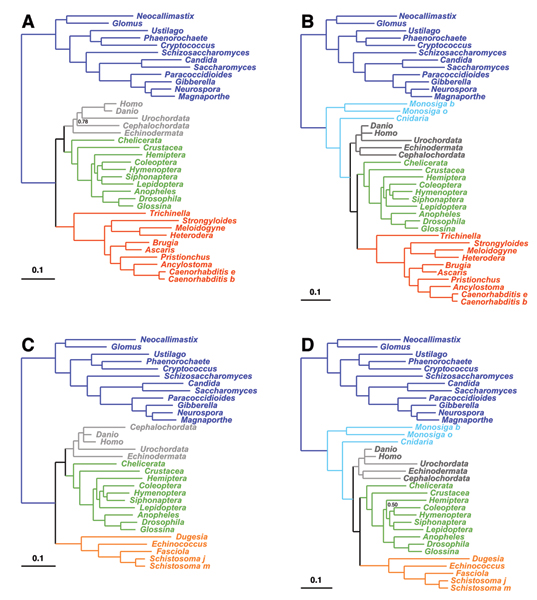
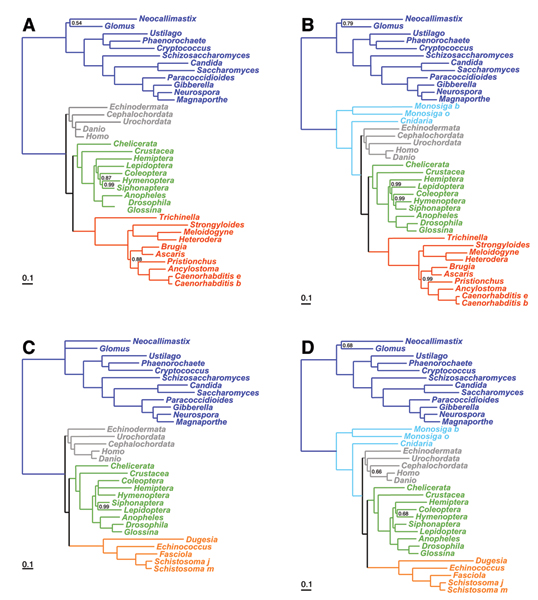
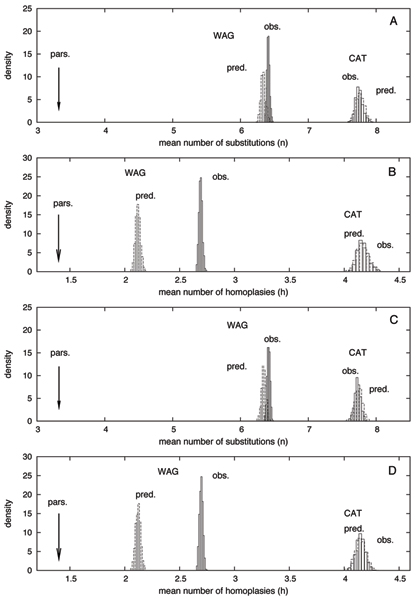
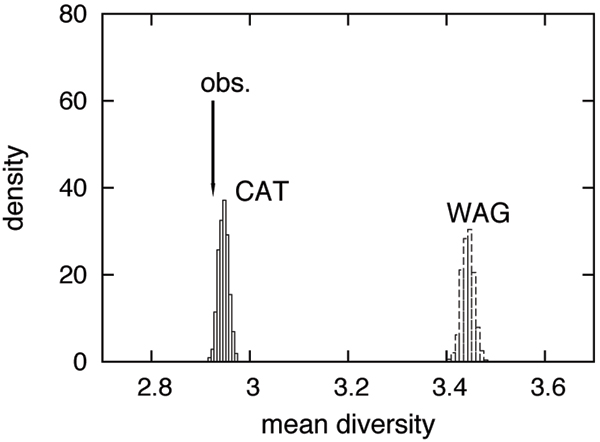
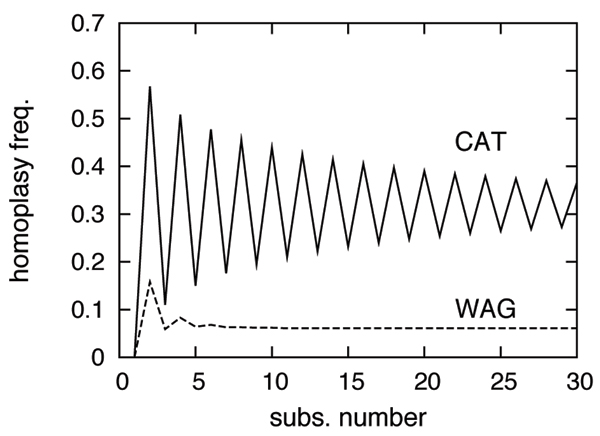
BACKGROUND: Thanks to the large amount of signal contained in genome-wide sequence alignments, phylogenomic analyses are converging towards highly supported trees. However, high statistical support does not imply that the tree is accurate. Systematic errors, such as the Long Branch Attraction (LBA) artefact, can be misleading, in particular when the taxon sampling is poor, or the outgroup is distant. In an otherwise consistent probabilistic framework, systematic errors in genome-wide analyses can be traced back to model mis-specification problems, which suggests that better models of sequence evolution should be devised, that would be more robust to tree reconstruction artefacts, even under the most challenging conditions. METHODS: We focus on a well characterized LBA artefact analyzed in a previous phylogenomic study of the metazoan tree, in which two fast-evolving animal phyla, nematodes and platyhelminths, emerge either at the base of all other Bilateria, or within protostomes, depending on the outgroup. We use this artefactual result as a case study for comparing the robustness of two alternative models: a standard, site-homogeneous model, based on an empirical matrix of amino-acid replacement (WAG), and a site-heterogeneous mixture model (CAT). In parallel, we propose a posterior predictive test, allowing one to measure how well a model acknowledges sequence saturation. RESULTS: Adopting a Bayesian framework, we show that the LBA artefact observed under WAG disappears when the site-heterogeneous model CAT is used. Using cross-validation, we further demonstrate that CAT has a better statistical fit than WAG on this data set. Finally, using our statistical goodness-of-fit test, we show that CAT, but not WAG, correctly accounts for the overall level of saturation, and that this is due to a better estimation of site-specific amino-acid preferences. CONCLUSION: The CAT model appears to be more robust than WAG against LBA artefacts, essentially because it correctly anticipates the high probability of convergences and reversions implied by the small effective size of the amino-acid alphabet at each site of the alignment. More generally, our results provide strong evidence that site-specificities in the substitution process need be accounted for in order to obtain more reliable phylogenetic trees.
Overview
The claims and statistics of this paper haven’t been checked yet.
Free: it reads the open-access text and checks the first 5 claims that cite a source we can check. Create a free account to check every claim.
Integrity signals
Registry
Cites
Statistics
Figures
Verification
Claims the paper makes
The claims and statistics of this paper haven’t been checked yet.
Free: it reads the open-access text and checks the first 5 claims that cite a source we can check. Create a free account to check every claim.
Claims other papers make about this one
Each is checked against this paper’s own text: does it say what the citing paper says it does?
The source backs part of the claim, not all of it — or backs it for a different population, condition or comparison.
In the citing paper
“CAT/CATGTR offers improved resilience to long-branch attraction artefacts (LBA)22 and is almost always better fitting than standard site-homogeneous amino acid substitution models (e.g. WAG)8–10,23–29.”
From Evidence for sponges as sister to all other animals from partitioned phylogenomics with mixture models and recoding (2021) · cites this paper as [22]
Experimental — accuracy not yet measuredThe source backs part of the claim, not all of it — or backs it for a different population, condition or comparison.
In the citing paper
“This is because, by accommodating site-specific biochemical constraints, CAT/CATGTR can better detect saturation (i.e. multiple hidden substitutions)8,20,22, and therefore better identify cases of convergent evolution of identical amino acids in distantly related, fast-evolving species.”
From Evidence for sponges as sister to all other animals from partitioned phylogenomics with mixture models and recoding (2021) · cites this paper as [22]
Experimental — accuracy not yet measuredThe source backs part of the claim, not all of it — or backs it for a different population, condition or comparison.
In the citing paper
“Additional sources of systematic error include poor taxon or character sampling (10,14,15), large amounts of missing data (16), and model misspecification (16,17).”
From Error, signal, and the placement of Ctenophora sister to all other animals (2015) · cites this paper as [17]
Experimental — accuracy not yet measuredThe cited source says what the claim attributes to it.
In the citing paper
“However, protein evolution is not homogeneous.”
From Improved Modeling of Compositional Heterogeneity Supports Sponges as Sister to All Other Animals (2017) · cites this paper as [26]
The cited source says what the claim attributes to it.
In the citing paper
“Previous studies analysing the test datasets used here, but without partitioning, have found support for the accepted topology under a variety of site-heterogeneous models22,56,60.”
From Evidence for sponges as sister to all other animals from partitioned phylogenomics with mixture models and recoding (2021) · cites this paper as [22]
4 more claims about this paper
Create a free account to see every claim other papers make about this one.
Self-check
Percentages, sums and reported differences re-computed from the paper’s own numbers.
The self-check needs the paper’s full text.
Citations
Cites
MRBAYES: Bayesian inference of phylogenetic trees.
Huelsenbeck, J. P., & Ronquist, F. (2001) · Bioinformatics · doi:10.1093/bioinformatics/17.8.754 · Cited by 21,937 · cited 1×
“In the case of WAG, we performed one run with our program, and another one using MrBayes [48].”
Evolutionary trees from DNA sequences: A maximum likelihood approach.
Felsenstein, J. (1981) · Journal of Molecular Evolution · doi:10.1007/bf01734359 · Cited by 14,571 · cited 3×
“The evolutionary process defined by this category is then similar to that proposed by Felsenstein [45], i.e. a Poisson process distributing events across time, so that at each event, a new state (possibly equal to the current one) is drawn at random from the probability profile.”
InfluentialEvolution of Protein Molecules
JUKES, T. H., & CANTOR, C. R. (1969) · Mammalian Protein Metabolism · doi:10.1016/b978-1-4832-3211-9.50009-7 · Cited by 11,032 · cited 1×
“At one extreme, we used the equivalent of the Jukes and Cantor model [ 44 ] for amino-acids, assuming all 20 amino-acid to be equally likely at each site.”
The rapid generation of mutation data matrices from protein sequences
Jones, D. T., Taylor, W. R., & Thornton, J. M. (1992) · Bioinformatics · doi:10.1093/bioinformatics/8.3.275 · Cited by 6,947
(1964) · Mammalian Protein Metabolism · doi:10.1016/b978-1-4832-3210-2.50006-6 · Cited by 3,059
Yang, Z. (1994) · Journal of Molecular Evolution · doi:10.1007/bf00160154 · Cited by 2,960 · cited 3×
“Apart from their specific amino-acid replacement processes, the two models under investigation, CAT and WAG, share the same features, including gamma-distributed rates across sites [25] (see methods).”
Cases in which Parsimony or Compatibility Methods will be Positively Misleading
Felsenstein, J. (1978) · Systematic Biology · doi:10.1093/sysbio/27.4.401 · Cited by 2,896
Whelan, S., & Goldman, N. (2001) · Molecular Biology and Evolution · doi:10.1093/oxfordjournals.molbev.a003851 · Cited by 2,849 · cited 3×
“By Bayes factor evaluation, we have shown previously that CAT generally has a better fit than homogeneous models based on one single empirical substitution matrix, such as WAG [39], JTT [40], or even the most general site-homogeneous and time-reversible model (GTR) [31,41].”
Cellular Scaling Rules for the Brains of Marsupials: Not as “Primitive” as Expected
Dos Santos, S. E., Porfirio, J., da Cunha, F. B., Manger, P. R., Tavares, W., Pessoa, L., Raghanti, M. A., Sherwood, C. C., & Herculano-Houzel, S. (2017) · Brain, Behavior and Evolution · doi:10.1159/000452856 · Cited by 2,642
Markov Chain Sampling Methods for Dirichlet Process Mixture Models
Neal, R. M. (2000) · Journal of Computational and Graphical Statistics · doi:10.1080/10618600.2000.10474879 · Cited by 2,288
Cited by
Items 201–300 of 712
Roure, B., & Philippe, H. (2011) · BMC Evolutionary Biology · doi:10.1186/1471-2148-11-17 · Cited by 64
“The first violation is known to seriously exacerbate LBA artifacts, because the amount of homoplasy is underestimated [31].”
Self-citationStrepsiptera, Phylogenomics and the Long Branch Attraction Problem
Boussau, B., Walton, R. Z., Delgado, J. A., Collantes, F., Beani, L., Stewart, I., Cameron, S. A., Whitfield, J. B., Johnston, J. S., Holland, P. W. H., et al. (2014) · PLoS ONE · doi:10.1371/journal.pone.0107709 · Cited by 65
Orr, R. J. S., Stüken, A., Rundberget, T., Eikrem, W., & Jakobsen, K. S. (2011) · Harmful Algae · doi:10.1016/j.hal.2011.05.003 · Cited by 70
Wang, N., Braun, E. L., & Kimball, R. T. (2011) · Molecular Biology and Evolution · doi:10.1093/molbev/msr230 · Cited by 69
Finding Single Copy Genes Out of Sequenced Genomes for Multilocus Phylogenetics in Non-Model Fungi
Feau, N., Decourcelle, T., Husson, C., Desprez‐Loustau, M., & Dutech, C. (2011) · PLoS ONE · doi:10.1371/journal.pone.0018803 · Cited by 72
Revisiting the phylogeny of microsporidia
Park, E., & Poulin, R. (2021) · International Journal for Parasitology · doi:10.1016/j.ijpara.2021.02.005 · Cited by 68
Arguments Reinforcing the Three-Domain View of Diversified Cellular Life
Nasir, A., Kim, K. M., Cunha, V. D., & Caetano‐Anollés, G. (2016) · Archaea · doi:10.1155/2016/1851865 · Cited by 64
Scalable Empirical Mixture Models That Account for Across-Site Compositional Heterogeneity
Schrempf, D., Lartillot, N., & Szöllősi, G. (2020) · Molecular Biology and Evolution · doi:10.1093/molbev/msaa145 · Cited by 61
Self-citationScalable empirical mixture models that account for across-site compositional heterogeneity
Schrempf, D., Lartillot, N., & Szöllősi, G. (2019) · doi:10.1101/794263 · Cited by 61
Self-citationHeiss, A. A., Kolisko, M., Ekelund, F., Brown, M. W., Roger, A. J., & Simpson, A. G. B. (2018) · Royal Society Open Science · doi:10.1098/rsos.171707 · Cited by 60
Nakov, T., Ruck, E. C., Galachyants, Y., Spaulding, S. A., & Theriot, E. C. (2014) · Phycologia · doi:10.2216/14-002.1 · Cited by 66
Evaluating Model Performance in Evolutionary Biology
Brown, J. M., & Thomson, R. C. (2018) · Annual Review of Ecology Evolution and Systematics · doi:10.1146/annurev-ecolsys-110617-062249 · Cited by 62
Mitochondrial genomes illuminate the evolutionary history of the Western honey bee (Apis mellifera)
Tihelka, E., Cai, C., Pisani, D., & Donoghue, P. C. J. (2020) · Scientific Reports · doi:10.1038/s41598-020-71393-0 · Cited by 83
Rare Coding Sequence Changes are Consistent with Ecdysozoa, not Coelomata
Irimia, M., Maeso, I., Penny, D., Garcia-Fernandez, J., & Roy, S. W. (2007) · Molecular Biology and Evolution · doi:10.1093/molbev/msm105 · Cited by 60
Hedin, M. C., Starrett, J., Akhter, S., Schönhofer, A. L., & Shultz, J. W. (2012) · PLoS ONE · doi:10.1371/journal.pone.0042888 · Cited by 63
The “Naked Coral” Hypothesis Revisited – Evidence for and Against Scleractinian Monophyly
Kitahara, M. V., Lin, M., Forêt, S., Huttley, G. A., Miller, D. J., & Chen, C. A. (2014) · PLoS ONE · doi:10.1371/journal.pone.0094774 · Cited by 67
Kamikawa, R., Tanifuji, G., Kawachi, M., Miyashita, H., Hashimoto, T., & Inagaki, Y. (2015) · Genome Biology and Evolution · doi:10.1093/gbe/evv060 · Cited by 59
Copeland, C. S., Marz, M., Rose, D., Jana Hertel, A., Brindley, P. J., Bermúdez-Santana, C. I., Kehr, S., Attolini, C. S., & Stadler, P. F. (2009) · BMC Genomics · doi:10.1186/1471-2164-10-464 · Cited by 66
Characterization and diversity of phages infecting Aeromonas salmonicida subsp. salmonicida
Vincent, A. T., Paquet, V. E., Bernatchez, A., Tremblay, D. M., Moineau, S., & Charette, S. J. (2017) · Scientific Reports · doi:10.1038/s41598-017-07401-7 · Cited by 61
Phylotranscriptomic evidence for pervasive ancient hybridization among Old World salamanders
Rancilhac, L., Irisarri, I., Angelini, C., Arntzen, J. W., Babik, W., Bossuyt, F., Künzel, S., Lüddecke, T., Pasmans, F., Sanchez, E., et al. (2020) · Molecular Phylogenetics and Evolution · doi:10.1016/j.ympev.2020.106967 · Cited by 68
Self-citationEEF2 Analysis Challenges the Monophyly of Archaeplastida and Chromalveolata
Kim, E., & Graham, L. E. (2008) · PLoS ONE · doi:10.1371/journal.pone.0002621 · Cited by 58
Gene gain facilitated endosymbiotic evolution of Chlamydiae
Dharamshi, J. E., Köstlbacher, S., Schön, M. E., Collingro, A., Ettema, T. J. G., & Horn, M. (2023) · Nature Microbiology · doi:10.1038/s41564-022-01284-9 · Cited by 60
Nadimi, M., Beaudet, D., Forget, L., Hijri, M., & Lang, B. F. (2012) · Molecular Biology and Evolution · doi:10.1093/molbev/mss088 · Cited by 68
Irisarri, I., & Meyer, A. (2016) · Systematic Biology · doi:10.1093/sysbio/syw057 · Cited by 57
Implications of the new eukaryotic systematics for parasitologists
Dacks, J. B., Walker, G., & Field, M. C. (2007) · Parasitology International · doi:10.1016/j.parint.2007.11.004 · Cited by 67
Phylogenetic relationships among superfamilies of Neritimorpha (Mollusca: Gastropoda)
Uribe, J. E., Colgan, D. J., Castro, L. R., Kano, Y., & Zardoya, R. (2016) · Molecular Phylogenetics and Evolution · doi:10.1016/j.ympev.2016.07.021 · Cited by 63
Yang, H., Li, T., Dang, K., & Bu, W. (2018) · BMC Genomics · doi:10.1186/s12864-018-4650-9 · Cited by 72
Zhang, D., Zou, H., Hua, C.-J., Li, W., Mahboob, S., Al‐Ghanim, K. A., Al-Misned, F. A., Jakovlić, I., & Wang, G. (2019) · Genome Biology and Evolution · doi:10.1093/gbe/evz121 · Cited by 58
Howard, R. J., Puttick, M. N., Edgecombe, G. D., & Lozano-Fernández, J. (2020) · Arthropod Structure & Development · doi:10.1016/j.asd.2020.100997 · Cited by 56
Extended phylogeny and a revised generic classification of thePannariaceae(Peltigerales, Ascomycota)
Ekman, S., Wedin, M., Lindblom, L., & Jørgensen, P. M. (2014) · The Lichenologist · doi:10.1017/s002428291400019x · Cited by 61
Howard, R. J., Edgecombe, G. D., David, L., Pisani, D., & Lozano-Fernández, J. (2019) · Organisms Diversity & Evolution · doi:10.1007/s13127-019-00390-7 · Cited by 58
Xiao, M., Brugler, M. R., Broe, M. B., Gusmão, L. C., Daly, M., & Rodríguez, E. (2019) · Scientific Reports · doi:10.1038/s41598-019-54637-6 · Cited by 54
Mwinyi, A., Bailly, X., Bourlat, S. J., Jondelius, U., Littlewood, D. T. J., & Podsiadłowski, L. (2010) · BMC Evolutionary Biology · doi:10.1186/1471-2148-10-309 · Cited by 56
Paiva, T. S., Borges, B. N., Harada, M. L., & da Silva‐Neto, I. D. (2009) · Genetics and Molecular Research · doi:10.4238/vol8-1gmr529 · Cited by 53
Condamine, F. L., Nabholz, B., Clamens, A., Dupuis, J. R., & Sperling, F. A. H. (2018) · Systematic Entomology · doi:10.1111/syen.12284 · Cited by 56
Galindo, L. J., Torruella, G., Moreira, D., Timpano, H., Paskerova, G. G., Смирнов, А. В., Nassonova, E., & López‐García, P. (2018) · Genome Biology and Evolution · doi:10.1093/gbe/evy205 · Cited by 55
Signal Conflicts in the Phylogeny of the Primary Photosynthetic Eukaryotes
Deschamps, P., & Moreira, D. (2009) · Molecular Biology and Evolution · doi:10.1093/molbev/msp189 · Cited by 50
“All our BI analyses were carried out using a site-heterogeneous mixture model (CAT) that copes better with those biases (Lartillot and Philippe 2004; Lartillot et al. 2007; Rodrı́guez-Ezpeleta, Brinkman, Roure, et al. 2007).”
Plastid establishment did not require a chlamydial partner
Domman, D., Horn, M., Embley, T. M., & Williams, T. A. (2015) · Nature Communications · doi:10.1038/ncomms7421 · Cited by 51
Convergent Acquisition of Nonembryonic Development in Styelid Ascidians
Alié, A., Hiebert, L. S., Simion, P., Scelzo, M., Prünster, M. M., Lotito, S., Delsuc, F., Douzery, E., Dantec, C., Lemaire, P., et al. (2018) · Molecular Biology and Evolution · doi:10.1093/molbev/msy068 · Cited by 61
The Genome of Intoshia linei Affirms Orthonectids as Highly Simplified Spiralians
Mikhailov, K. V., Slyusarev, G. S., Nikitin, M. A., Logacheva, M. D., Penin, A. A., Aleoshin, V. V., & Panchin, Y. V. (2016) · Current Biology · doi:10.1016/j.cub.2016.05.007 · Cited by 54
Noda, S., Mantini, C., Meloni, D., Inoue, J.-I., Kitade, O., Viscogliosi, É., & Ohkuma, M. (2012) · PLoS ONE · doi:10.1371/journal.pone.0029938 · Cited by 49
Ancient Origins of Vertebrate-Specific Innate Antiviral Immunity
Mukherjee, K., Korithoski, B., & Kolaczkowski, B. (2013) · Molecular Biology and Evolution · doi:10.1093/molbev/mst184 · Cited by 53
The phylogenetic position of dicyemid mesozoans offers insights into spiralian evolution
Lu, T.-M., Kanda, M., Satoh, N., & Furuya, H. (2017) · Zoological Letters · doi:10.1186/s40851-017-0068-5 · Cited by 52
Prasanna, A. N., Gerber, D., Kijpornyongpan, T., Aime, M. C., Doyle, V. P., & Nagy, L. G. (2019) · Systematic Biology · doi:10.1093/sysbio/syz029 · Cited by 51
Phylogenomic analyses of echinoid diversification prompt a re-evaluation of their fossil record
Koch, N. M., Thompson, J. R., Hiley, A. S., McCowin, M. F., Armstrong, A. F., Coppard, S. E., Aguilera, F., Bronstein, O., Kroh, A., Mooi, R., et al. (2022) · eLife · doi:10.7554/elife.72460 · Cited by 51
Assembling the spiralian tree of life
Giribet, G., Dunn, C. W., Edgecombe, G. D., Hejnol, A., Martindale, M. Q., & Rouse, G. W. (2009) · Animal Evolution · doi:10.1093/acprof:oso/9780199549429.003.0006 · Cited by 46
Vasilikopoulos, A., Balke, M., BEUTEL, R. G., Donath, A., Podsiadłowski, L., Pflug, J. M., Waterhouse, R. M., Meusemann, K., Peters, R. S., Escalona, H. E., et al. (2019) · Molecular Phylogenetics and Evolution · doi:10.1016/j.ympev.2019.02.022 · Cited by 57
Vasilikopoulos, A., Balke, M., Kukowka, S., Pflug, J. M., Martín, S., Meusemann, K., Hendrich, L., Mayer, C., Maddison, D. R., Niehuis, O., et al. (2021) · Systematic Entomology · doi:10.1111/syen.12508 · Cited by 50
Murray, S. A., Wiese, M., Neilan, B. A., Orr, R. J. S., de Salas, M. F., Brett, S., & Hallegraeff, G. M. (2012) · Harmful Algae · doi:10.1016/j.hal.2012.05.001 · Cited by 51
Investigating the Origins of Membrane Phospholipid Biosynthesis Genes Using Outgroup-Free Rooting
Coleman, G. A., Pancost, R. D., & Williams, T. A. (2019) · Genome Biology and Evolution · doi:10.1093/gbe/evz034 · Cited by 47
The rise and fall of the ancient northern pike master sex-determining gene
Pan, Q., Feron, R., Jouanno, E., Darras, H., Herpin, A., Koop, B. F., Rondeau, E. B., Goetz, F. W., Larson, W. A., Bernatchez, L., et al. (2021) · eLife · doi:10.7554/elife.62858 · Cited by 50
The promise and pitfalls of synteny in phylogenomics
Steenwyk, J. L., & King, N. (2024) · PLoS Biology · doi:10.1371/journal.pbio.3002632 · Cited by 59
Sources of Signal in 62 Protein-Coding Nuclear Genes for Higher-Level Phylogenetics of Arthropods
Regier, J. C., & Zwick, A. (2011) · PLoS ONE · doi:10.1371/journal.pone.0023408 · Cited by 46
Lartillot, N. (2023) · Systematic Biology · doi:10.1093/sysbio/syad004 · Cited by 58
Self-citationToward genome-enabled mycology
Hibbett, D. S., Stajich, J., & Spatafora, J. W. (2013) · Mycologia · doi:10.3852/13-196 · Cited by 51
MicroRNAs and metazoan phylogeny: big trees from little genes
Sperling, E. A., & Peterson, K. J. (2009) · Animal Evolution · doi:10.1093/acprof:oso/9780199549429.003.0015 · Cited by 45
Rodrigue, N., Kleinman, C. L., Philippe, H., & Lartillot, N. (2009) · Molecular Biology and Evolution · doi:10.1093/molbev/msp078 · Cited by 57
Self-citationMedina, E. M., Jones, G. W., & Fitzpatrick, D. A. (2011) · Journal of Molecular Evolution · doi:10.1007/s00239-011-9461-4 · Cited by 50
Qu, X., Jin, J., Chaw, S., Li, D.-Z., & Yi, T. (2017) · Scientific Reports · doi:10.1038/srep41005 · Cited by 50
Gene Tree Estimation Error with Ultraconserved Elements: An Empirical Study on Pseudapis Bees
Bossert, S., Murray, E. A., Pauly, A., Chernyshov, K., Brady, S. G., & Danforth, B. N. (2020) · Systematic Biology · doi:10.1093/sysbio/syaa097 · Cited by 49
Douglas, D. A., & Gower, D. J. (2010) · BMC Genomics · doi:10.1186/1471-2164-11-14 · Cited by 44
Whelan, N. V., Kocot, K. M., & Halanych, K. M. (2015) · Integrative and Comparative Biology · doi:10.1093/icb/icv037 · Cited by 43
The mitochondrial genomes of palaeopteran insects and insights into the early insect relationships
Song, N., Li, X., Yin, X., Li, X., Yin, J., & Pan, P. (2019) · Scientific Reports · doi:10.1038/s41598-019-54391-9 · Cited by 46
Cruaud, A., Delvare, G., Nidelet, S., Sauné, L., Ratnasingham, S., Chartois, M., Blaimer, B. B., Gates, M. W., Brady, S. G., Faure, S., et al. (2020) · Cladistics · doi:10.1111/cla.12416 · Cited by 51
DEPP: Deep Learning Enables Extending Species Trees using Single Genes
Jiang, Y., Balaban, M., Zhu, Q., & Mirarab, S. (2022) · Systematic Biology · doi:10.1093/sysbio/syac031 · Cited by 49
Viklund, J., Martijn, J., Ettema, T. J. G., & Andersson, S. G. E. (2013) · PLoS ONE · doi:10.1371/journal.pone.0078858 · Cited by 43
Marginal Likelihoods in Phylogenetics: A Review of Methods and Applications
Oaks, J. R., Cobb, K. A., Minin, V. N., & Leaché, A. D. (2019) · Systematic Biology · doi:10.1093/sysbio/syz003 · Cited by 51
Lafuente, E., Lürig, M., Rövekamp, M., Matthews, B., Buser, C. C., Vorburger, C., & Räsänen, K. (2021) · Frontiers in Ecology and Evolution · doi:10.3389/fevo.2021.748212 · Cited by 51
Fitzpatrick, D. A. (2009) · Journal of Molecular Evolution · doi:10.1007/s00239-009-9198-5 · Cited by 48
Li, T., Hua, J., Wright, A. M., Cui, Y., Xie, Q., Bu, W., & Hillis, D. M. (2014) · BMC Evolutionary Biology · doi:10.1186/1471-2148-14-99 · Cited by 40
PhyloMAd: efficient assessment of phylogenomic model adequacy
Duchêne, D. A., Duchêne, S., & Ho, S. Y. W. (2018) · Bioinformatics · doi:10.1093/bioinformatics/bty103 · Cited by 44
Gillung, J. P., Winterton, S. L., Bayless, K. M., Khouri, Z., Borowiec, M. L., Yeates, D. K., Kimsey, L. S., Misof, B. Y., Shin, S., Zhou, X. Y., et al. (2018) · Molecular Phylogenetics and Evolution · doi:10.1016/j.ympev.2018.08.007 · Cited by 48
Nolan, E. D., Santibáñez‐López, C. E., & Sharma, P. P. (2020) · Development Genes and Evolution · doi:10.1007/s00427-019-00644-6 · Cited by 41
Compositionally Constrained Sites Drive Long-Branch Attraction
Szánthó, L. L., Lartillot, N., Szöllősi, G. J., & Schrempf, D. (2023) · Systematic Biology · doi:10.1093/sysbio/syad013 · Cited by 50
Self-citationInferring Evolution of Fish Proteins: The Globin Case Study
Dettaï, A., di Prisco, G., Lecointre, G., Parisi, E., & Verde, C. (2008) · Methods in enzymology on CD-ROM/Methods in enzymology · doi:10.1016/s0076-6879(08)36030-3 · Cited by 42
Random roots and lineage sorting
Rosenfeld, J., Payne, A., & DeSalle, R. (2012) · Molecular Phylogenetics and Evolution · doi:10.1016/j.ympev.2012.02.029 · Cited by 47
Bloom, J. D. (2014) · Molecular Biology and Evolution · doi:10.1093/molbev/msu220 · Cited by 45
Strugnell, J. M., Hall, N. E., Vecchione, M., Fuchs, D., & Allcock, A. L. (2017) · Molecular Phylogenetics and Evolution · doi:10.1016/j.ympev.2017.01.011 · Cited by 42
Fleas are parasitic scorpionflies
Tihelka, E., Giacomelli, M., Huang, D., Pisani, D., Donoghue, P. C. J., & Cai, C. (2020) · Palaeoentomology · doi:10.11646/palaeoentomology.3.6.16 · Cited by 54
Banguera‐Hinestroza, E., Hayano, A., Crespo, E. A., & Hoelzel, A. R. (2014) · Molecular Phylogenetics and Evolution · doi:10.1016/j.ympev.2014.08.005 · Cited by 40
Lim, C. S., Weinstein, B. N., Roy, S. W., & Brown, C. M. (2021) · Molecular Biology and Evolution · doi:10.1093/molbev/msab094 · Cited by 42
Jakovlić, I., Zou, H., Zhao, X.-M., Zhang, J., Wang, G., & Zhang, D. (2021) · Molecular Phylogenetics and Evolution · doi:10.1016/j.ympev.2021.107288 · Cited by 44
Soares, A. E. R., & Schrago, C. G. (2014) · Journal of Theoretical Biology · doi:10.1016/j.jtbi.2014.09.004 · Cited by 39
Rare Genomic Characters Do Not Support Coelomata: Intron Loss/Gain
Roy, S. W., & Irimia, M. (2008) · Molecular Biology and Evolution · doi:10.1093/molbev/msn035 · Cited by 39
Identifying and addressing methodological incongruence in phylogenomics: A review
Fleming, J. F., Valero‐Gracia, A., & Struck, T. H. (2023) · Evolutionary Applications · doi:10.1111/eva.13565 · Cited by 47
DIAMANT, A., Goren, M., Yokeş, M., Galil, B., Klopman, Y., Huchon, D., Szitenberg, A., & Karhan, S. Ü. (2010) · Diseases of Aquatic Organisms · doi:10.3354/dao02256 · Cited by 40
The mouth, the anus, and the blastopore—open questions about questionable openings
Hejnol, A., & Martindale, M. Q. (2009) · Animal Evolution · doi:10.1093/acprof:oso/9780199549429.003.0004 · Cited by 37
Resolving tricky nodes in the tree of life through amino acid recoding
Giacomelli, M., Rossi, M. E., Lozano-Fernández, J., Feuda, R., & Pisani, D. (2022) · iScience · doi:10.1016/j.isci.2022.105594 · Cited by 44
Illuminating the coevolution of photosynthesis and Bacteria
Nishihara, A., Tsukatani, Y., Azai, C., & Nobu, M. K. (2024) · Proceedings of the National Academy of Sciences · doi:10.1073/pnas.2322120121 · Cited by 42
Large-Scale Parsimony Analysis of Metazoan Indels in Protein-Coding Genes
Belinky, F., Cohen, O., & Huchon, D. (2010) · Molecular Biology and Evolution · doi:10.1093/molbev/msp263 · Cited by 37
Cai, C., Tihelka, E., Pisani, D., & Donoghue, P. C. J. (2020) · Molecular Phylogenetics and Evolution · doi:10.1016/j.ympev.2020.106782 · Cited by 38
Gillespie, J. J., Phan, I. Q. H., Scheib, H., Subramanian, S., Edwards, T. E., Lehman, S. S., Piitulainen, H., Sayeedur Rahman, M., Rennoll-Bankert, K. E., Staker, B. L., et al. (2015) · mBio · doi:10.1128/mbio.01867-15 · Cited by 36
Duchêne, S., Giallonardo, F. D., & Holmes, E. C. (2015) · Molecular Biology and Evolution · doi:10.1093/molbev/msv207 · Cited by 40
Zhou, Y., Brinkmann, H., Rodrigue, N., Lartillot, N., & Philippe, H. (2009) · Molecular Biology and Evolution · doi:10.1093/molbev/msp248 · Cited by 42
Self-citationZou, H., Jakovlić, I., Zhang, D., Hua, C.-J., Chen, R., Li, W., Li, M., & Wang, G. (2020) · Royal Society Open Science · doi:10.1098/rsos.191887 · Cited by 38
Thode, V. A., Lohmann, L. G., & Sanmartín, I. (2020) · Journal of Systematics and Evolution · doi:10.1111/jse.12579 · Cited by 37
Lassalle, F., Dastgheib, S. M. M., Zhao, F. J., Zhang, J., Verbarg, S., Frühling, A., Brinkmann, H., Osborne, T. H., Sikorski, J., Balloux, F., et al. (2020) · Systematic and Applied Microbiology · doi:10.1016/j.syapm.2020.126165 · Cited by 39
Self-citationMitochondrial tRNA Structure, Identity, and Evolution of the Genetic Code
Lang, B. F., Lavrov, D. V., Beck, N., & Steinberg, S. V. (2011) · Springer eBooks · doi:10.1007/978-3-642-22380-8_17 · Cited by 47
Ané, C. (2011) · Genome Biology and Evolution · doi:10.1093/gbe/evr013 · Cited by 35
Evolution of flower shape in Plantago lanceolata
Reardon, W., Fitzpatrick, D. A., Fares, M. A., & Nugent, J. M. (2009) · Plant Molecular Biology · doi:10.1007/s11103-009-9520-z · Cited by 37
Metadata
- Authors
- Lartillot, N., Brinkmann, H., & Philippe, H.
- Affiliations
- Centre National de la Recherche Scientifique (FR)
- Canadian Institute for Advanced Research (CA)
- Corresponding author
- Lartillot, Nicolas
- Venue
- BMC Evolutionary Biology
- Published
- 2007
- Volume
- 7
- Issue
- Suppl 1
- Pages
- S4
- ISSN
- 1471-2148 (ISSN-L)
- PMC
- PMC1796613
- OpenAlex
- W2131527832
- Semantic Scholar
- 2c8718808e5a337cdae9a2e2c5f0c093e7a3d2ec
- Cited by
- 705
- References
- 59
- Citations by year
- 2026: 22 · 2025: 33 · 2024: 48 · 2023: 35 · 2022: 45 · 2021: 46 · 2020: 48 · 2019: 37 · 2018: 38 · 2017: 35 · 2016: 25 · 2015: 29 · 2014: 52 · 2013: 22 · 2012: 24
- Type
- conference abstract
- Language
- en
- Open access
- gold
- doi.org
- Licence
- cc-by
- Locations
- BMC Evolutionary Biology (publishedVersion, cc-by)
- Europe PMC (PubMed Central) (publishedVersion, cc-by)
- PubMed Central (publishedVersion, cc-by)
- PubMed (publishedVersion)
- HAL (submittedVersion, cc-by)
- Papyrus : Institutional Repository (Université de Montréal) (submittedVersion, cc-by)
- Funders
- Centre National de la Recherche Scientifique
- Université de Montréal
- Topics
- Life Sciences › Biochemistry, Genetics and Molecular Biology › Molecular Biology › Genomics and Phylogenetic Studies
- Life Sciences › Biochemistry, Genetics and Molecular Biology › Molecular Biology › RNA and protein synthesis mechanisms
- Physical Sciences › Earth and Planetary Sciences › Paleontology › Evolution and Paleontology Studies
- Keywords
- long-branch attraction, cat model, amino acid substitution models, metazoan phylogeny, nematodes, Platyhelminthes
- MeSH terms
- Animals, Models, Genetic, Phylogeny, Polymorphism, Genetic, Evolution, Molecular, Sequence Analysis, Protein
About these checks
Registry, retraction, Cites and statistics results are computed, not judged, with one exception: a printed reference that no index lists is read once by a model before it counts as a citation error. Claims are extracted by a model and kept only when their quote appears verbatim in the text; each cited source is then checked, with a model’s help, for whether it says what the claim relies on. Those verdicts can be wrong — read the claim’s quote and the cited source before relying on one.
Statistics and arithmetic are recomputed, not judged.
Confidence bands are shown only for fields calibrated on our annotated test set. None is calibrated yet, so no band is shown.
What counts as a claim ›How we measure confidence ›How we check this ›
Are you an author, or do you see a problem with this page? Request a review
Data sources
Bibliographic data: Semantic Scholar, OpenAlex, Crossref.
Contains information from the Semantic Scholar Academic Graph Datasets, made available under the ODC Attribution License (ODC-BY 1.0).
Semantic Scholar’s data is described in: Kinney, R., et al. (2023). The Semantic Scholar Open Data Platform. arXiv:2301.10140.
