

Suppression of long-branch attraction artefacts in the animal phylogeny using a site-heterogeneous model
Open accessThe DOI matches its Crossref record; 57 of the 63 references it cites were found in a registry or an index.
Abstract
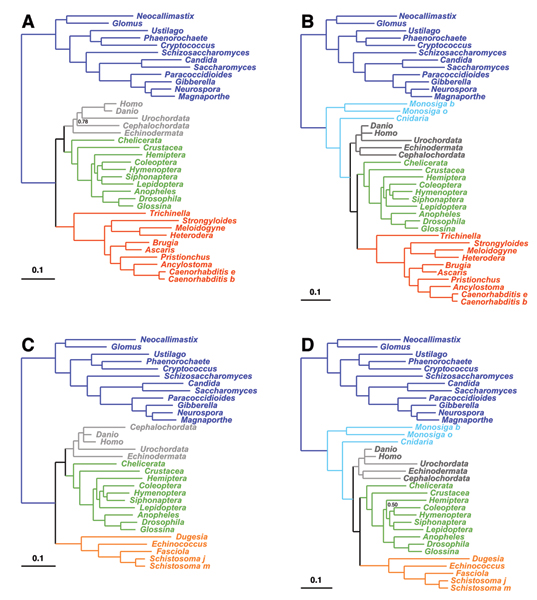
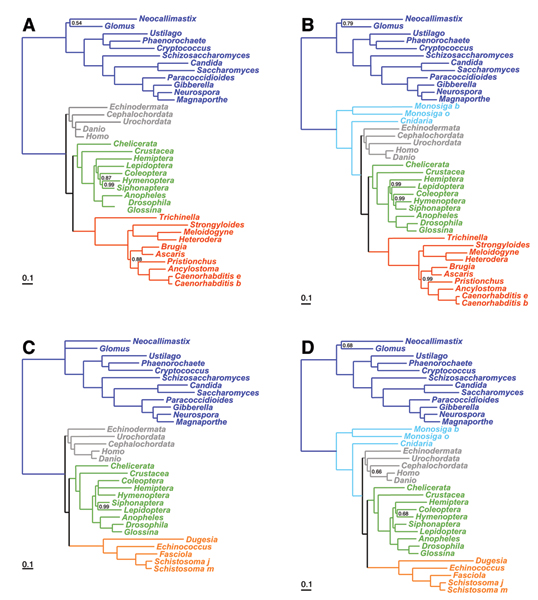
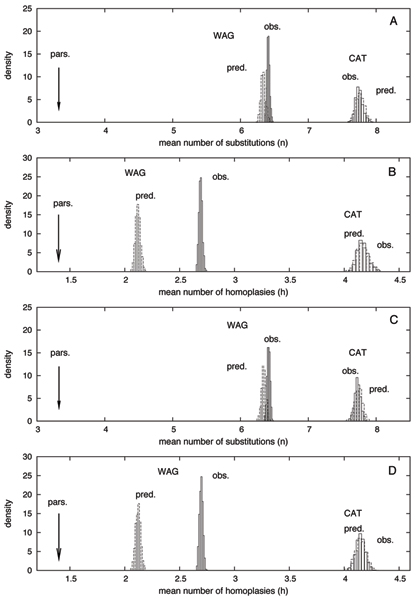
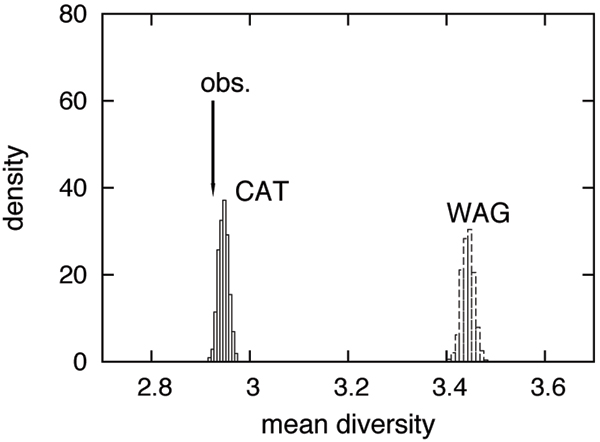
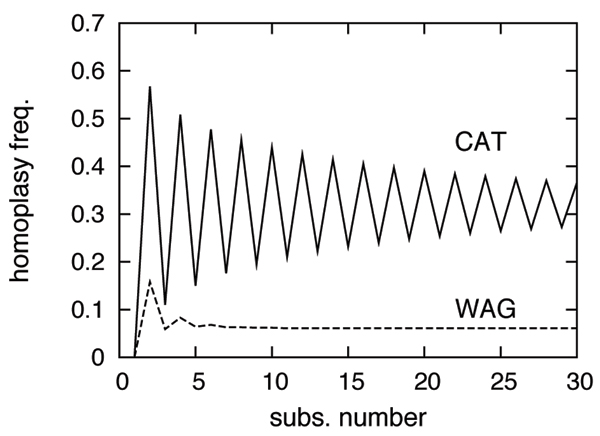
BACKGROUND: Thanks to the large amount of signal contained in genome-wide sequence alignments, phylogenomic analyses are converging towards highly supported trees. However, high statistical support does not imply that the tree is accurate. Systematic errors, such as the Long Branch Attraction (LBA) artefact, can be misleading, in particular when the taxon sampling is poor, or the outgroup is distant. In an otherwise consistent probabilistic framework, systematic errors in genome-wide analyses can be traced back to model mis-specification problems, which suggests that better models of sequence evolution should be devised, that would be more robust to tree reconstruction artefacts, even under the most challenging conditions. METHODS: We focus on a well characterized LBA artefact analyzed in a previous phylogenomic study of the metazoan tree, in which two fast-evolving animal phyla, nematodes and platyhelminths, emerge either at the base of all other Bilateria, or within protostomes, depending on the outgroup. We use this artefactual result as a case study for comparing the robustness of two alternative models: a standard, site-homogeneous model, based on an empirical matrix of amino-acid replacement (WAG), and a site-heterogeneous mixture model (CAT). In parallel, we propose a posterior predictive test, allowing one to measure how well a model acknowledges sequence saturation. RESULTS: Adopting a Bayesian framework, we show that the LBA artefact observed under WAG disappears when the site-heterogeneous model CAT is used. Using cross-validation, we further demonstrate that CAT has a better statistical fit than WAG on this data set. Finally, using our statistical goodness-of-fit test, we show that CAT, but not WAG, correctly accounts for the overall level of saturation, and that this is due to a better estimation of site-specific amino-acid preferences. CONCLUSION: The CAT model appears to be more robust than WAG against LBA artefacts, essentially because it correctly anticipates the high probability of convergences and reversions implied by the small effective size of the amino-acid alphabet at each site of the alignment. More generally, our results provide strong evidence that site-specificities in the substitution process need be accounted for in order to obtain more reliable phylogenetic trees.
Overview
The claims and statistics of this paper haven’t been checked yet.
Free: it reads the open-access text and checks the first 5 claims that cite a source we can check. Create a free account to check every claim.
Integrity signals
Registry
Cites
Statistics
Figures
Verification
Claims the paper makes
The claims and statistics of this paper haven’t been checked yet.
Free: it reads the open-access text and checks the first 5 claims that cite a source we can check. Create a free account to check every claim.
Claims other papers make about this one
Each is checked against this paper’s own text: does it say what the citing paper says it does?
The source backs part of the claim, not all of it — or backs it for a different population, condition or comparison.
In the citing paper
“CAT/CATGTR offers improved resilience to long-branch attraction artefacts (LBA)22 and is almost always better fitting than standard site-homogeneous amino acid substitution models (e.g. WAG)8–10,23–29.”
From Evidence for sponges as sister to all other animals from partitioned phylogenomics with mixture models and recoding (2021) · cites this paper as [22]
Experimental — accuracy not yet measuredThe source backs part of the claim, not all of it — or backs it for a different population, condition or comparison.
In the citing paper
“This is because, by accommodating site-specific biochemical constraints, CAT/CATGTR can better detect saturation (i.e. multiple hidden substitutions)8,20,22, and therefore better identify cases of convergent evolution of identical amino acids in distantly related, fast-evolving species.”
From Evidence for sponges as sister to all other animals from partitioned phylogenomics with mixture models and recoding (2021) · cites this paper as [22]
Experimental — accuracy not yet measuredThe source backs part of the claim, not all of it — or backs it for a different population, condition or comparison.
In the citing paper
“Additional sources of systematic error include poor taxon or character sampling (10,14,15), large amounts of missing data (16), and model misspecification (16,17).”
From Error, signal, and the placement of Ctenophora sister to all other animals (2015) · cites this paper as [17]
Experimental — accuracy not yet measuredThe cited source says what the claim attributes to it.
In the citing paper
“However, protein evolution is not homogeneous.”
From Improved Modeling of Compositional Heterogeneity Supports Sponges as Sister to All Other Animals (2017) · cites this paper as [26]
The cited source says what the claim attributes to it.
In the citing paper
“Previous studies analysing the test datasets used here, but without partitioning, have found support for the accepted topology under a variety of site-heterogeneous models22,56,60.”
From Evidence for sponges as sister to all other animals from partitioned phylogenomics with mixture models and recoding (2021) · cites this paper as [22]
4 more claims about this paper
Create a free account to see every claim other papers make about this one.
Self-check
Percentages, sums and reported differences re-computed from the paper’s own numbers.
The self-check needs the paper’s full text.
Citations
Cites
MRBAYES: Bayesian inference of phylogenetic trees.
Huelsenbeck, J. P., & Ronquist, F. (2001) · Bioinformatics · doi:10.1093/bioinformatics/17.8.754 · Cited by 21,937 · cited 1×
“In the case of WAG, we performed one run with our program, and another one using MrBayes [48].”
Evolutionary trees from DNA sequences: A maximum likelihood approach.
Felsenstein, J. (1981) · Journal of Molecular Evolution · doi:10.1007/bf01734359 · Cited by 14,571 · cited 3×
“The evolutionary process defined by this category is then similar to that proposed by Felsenstein [45], i.e. a Poisson process distributing events across time, so that at each event, a new state (possibly equal to the current one) is drawn at random from the probability profile.”
InfluentialEvolution of Protein Molecules
JUKES, T. H., & CANTOR, C. R. (1969) · Mammalian Protein Metabolism · doi:10.1016/b978-1-4832-3211-9.50009-7 · Cited by 11,032 · cited 1×
“At one extreme, we used the equivalent of the Jukes and Cantor model [ 44 ] for amino-acids, assuming all 20 amino-acid to be equally likely at each site.”
The rapid generation of mutation data matrices from protein sequences
Jones, D. T., Taylor, W. R., & Thornton, J. M. (1992) · Bioinformatics · doi:10.1093/bioinformatics/8.3.275 · Cited by 6,947
(1964) · Mammalian Protein Metabolism · doi:10.1016/b978-1-4832-3210-2.50006-6 · Cited by 3,059
Yang, Z. (1994) · Journal of Molecular Evolution · doi:10.1007/bf00160154 · Cited by 2,960 · cited 3×
“Apart from their specific amino-acid replacement processes, the two models under investigation, CAT and WAG, share the same features, including gamma-distributed rates across sites [25] (see methods).”
Cases in which Parsimony or Compatibility Methods will be Positively Misleading
Felsenstein, J. (1978) · Systematic Biology · doi:10.1093/sysbio/27.4.401 · Cited by 2,896
Whelan, S., & Goldman, N. (2001) · Molecular Biology and Evolution · doi:10.1093/oxfordjournals.molbev.a003851 · Cited by 2,849 · cited 3×
“By Bayes factor evaluation, we have shown previously that CAT generally has a better fit than homogeneous models based on one single empirical substitution matrix, such as WAG [39], JTT [40], or even the most general site-homogeneous and time-reversible model (GTR) [31,41].”
Cellular Scaling Rules for the Brains of Marsupials: Not as “Primitive” as Expected
Dos Santos, S. E., Porfirio, J., da Cunha, F. B., Manger, P. R., Tavares, W., Pessoa, L., Raghanti, M. A., Sherwood, C. C., & Herculano-Houzel, S. (2017) · Brain, Behavior and Evolution · doi:10.1159/000452856 · Cited by 2,642
Markov Chain Sampling Methods for Dirichlet Process Mixture Models
Neal, R. M. (2000) · Journal of Computational and Graphical Statistics · doi:10.1080/10618600.2000.10474879 · Cited by 2,288
Cited by
Items 601–700 of 712
Boore, J. L., & Fuerstenberg, S. I. (2009) · Oxford University Press eBooks · doi:10.1093/acprof:oso/9780199549429.003.0013 · Cited by 1
Implication of HisF from Acinetobacter baumannii in persistence during a pneumonia infectionPreprint
Martínez-Guitián, M., Vázquez-Ucha, J. C., Álvarez-Fraga, L., Conde‐Pérez, K., Vallejo, J. A., Bou, G., Poza, M., & Beceiro, A. (2019) · bioRxiv (Cold Spring Harbor Laboratory) · doi:10.1101/534966 · Cited by 1
Undinarchaeota illuminate the evolution of DPANN archaeaPreprint
Dombrowski, N., Williams, T., Sun, J., Woodcroft, B., Lee, J.-H., Bui, M., Rinke, C., & Spang, A. (2020) · bioRxiv · doi:10.1101/2020.03.05.976373 · Cited by 1
Resolving the origins of membrane phospholipid biosynthesis genes using outgroupfree rootingPreprint
Coleman, G. A., Pancost, R. D., & Williams, T. A. (2018) · bioRxiv (Cold Spring Harbor Laboratory) · doi:10.1101/312991 · Cited by 1
Romero-Ramirez, A., Casas-Sánchez, A., Autheman, D., Duffy, C., Teixeira, M. M., Machado, R. Z., Coombes, J., Flynn, R., Wright, G., & Jackson, A. (2022) · bioRxiv · doi:10.1101/2022.02.16.480502
Yang, Z. (2014) · Oxford University Press eBooks · doi:10.1093/acprof:oso/9780199602605.003.0004 · Cited by 1
The animal in the genome: comparative genomics and evolution
Copley, R. R. (2009) · Oxford University Press eBooks · doi:10.1093/acprof:oso/9780199549429.003.0014 · Cited by 2
Arano-Ansola, J., Galán-Luque, I., Domènech, M., Rico-Martin, L., Moody, E. R. R., Suresh, M., Vaulot, D., del Campo, J., Giacomelli, M., & Lozano-Fernández, J. (2025) · bioRxiv (Cold Spring Harbor Laboratory) · doi:10.64898/2025.12.09.693319 · Cited by 1
Eme, L. (2011) · theses.fr (ABES) · doi:10.70675/f6a87363z8acaz4487z93e0z57bc870cf584 · Cited by 2
Codon-based Models of Evolution and Applications in Mammalian Phylogeny
Schneider, A. (2009) · Repository for Publications and Research Data (ETH Zurich) · doi:10.3929/ethz-a-005842984
A Rigorous Analysis of the Pattern of Intron Conservation Supports the Coelomata Clade of Animals
Zheng, J., Rogozin, I. B., Koonin, E. V., & Przytycka, T. M. (2007) · Lecture notes in computer science · doi:10.1007/978-3-540-74960-8_14
Molecular phylogenetic analyses of Bryozoa, Brachiopoda, and Phoronida
Helmkampf, M. (2009)
Evolution, diversity, and biogeography in pelagic calcifying protists
Liu, H. (2009) · Rutgers University Community Repository (Rutgers University) · doi:10.7282/t32j6c1h · Cited by 1
Molecular approaches to the study of ecdysozoan evolution
Rota‐Stabelli, O. (2010) · UCL Discovery (University College London)
The Molecular Evolution of Snakes as revealed by Mitogenomic Data
Douglas, D. (2008)
D’Angiolella, A. B. (2010) · Americanae (AECID Library)
Heath, T. A. (2008) · Texas ScholarWorks (Texas Digital Library) · Cited by 2
Yang, Z. (2014) · Oxford University Press eBooks · doi:10.1093/acprof:oso/9780199602605.003.0007 · Cited by 1
Comparison of phylogenetic methods and tests on trees
Yang, Z. (2014) · Oxford University Press eBooks · doi:10.1093/acprof:oso/9780199602605.003.0005
Questions of Etiology, Change, Policy, Mating, and Migration
Hertler, S. C. (2016) · Springer eBooks · doi:10.1007/978-3-319-48784-7_5
Diversification of metazoan Kexin-like proprotein convertases: insights from the leech HelobdellaPreprint
Tao, W.-Y., Cheng, Y., Song, M. H., Weisblat, D. A., & Kuo, D. (2019) · bioRxiv (Cold Spring Harbor Laboratory) · doi:10.1101/802215
Xenacoelomorpha flatworms are basal DeuterostomePreprint
Wang, Y. (2020) · Research Square · doi:10.21203/rs.3.rs-64037/v2
Um panorama atual sobre a filogenia de Metazoa: conflitos e concordâncias
Andrade, M. P., Ferreira, F. D. S., de França, T. C., Sampronha, S., Santos, D., Silva, P. K. R., Carrijo, T. F., Nunes, F. R. C., & de Oliveira, O. M. P. (2021) · Revista da Biologia · doi:10.11606/revbio.21.07.10.2021
T-Tree, a new tool for taxonomy-based phylogenetic co-evolution analysis
Goldstein, T. C. (2007)
Mello, B., Kumar, S., & Battistuzzi, F. U. (2021) · Wiley eBooks · doi:10.1002/9780470015902.a0029389
Yang, Z. (2014) · Oxford University Press eBooks · doi:10.1093/acprof:oso/9780199602605.003.0006
Lowe, C. J. (2009) · Oxford University Press eBooks · doi:10.1093/acprof:oso/9780199549429.003.0010
Yang, Z. (2014) · Oxford University Press eBooks · doi:10.1093/acprof:oso/9780199602605.003.0013
Molecular clock and estimation of species divergence times
Yang, Z. (2014) · Oxford University Press eBooks · doi:10.1093/acprof:oso/9780199602605.003.0010
Yang, Z. (2014) · Oxford University Press eBooks · doi:10.1093/acprof:oso/9780199602605.003.0008
Faculty Opinions recommendation of Revisiting metazoan phylogeny with genomic sampling of all phyla.
Clarke, A. (2019) · Faculty Opinions – Post-Publication Peer Review of the Biomedical Literature · doi:10.3410/f.736173820.793562806
Phylogeny reconstruction: overview
Yang, Z. (2014) · Oxford University Press eBooks · doi:10.1093/acprof:oso/9780199602605.003.0003
Robustesse des arbres phylogénétiques
Xi, P.-S., & Mariadassou, M. (2009)
(2009) · Oxford University Press eBooks · doi:10.1093/acprof:oso/9780199549429.002.0004
(2009) · Oxford University Press eBooks · doi:10.1093/acprof:oso/9780199549429.002.0003
(2009) · Oxford University Press eBooks · doi:10.1093/acprof:oso/9780199549429.002.0007
(2009) · Oxford University Press eBooks · doi:10.1093/acprof:oso/9780199549429.002.0008
Um panorama atual sobre a filogenia de Metazoa: conflitos e concordâncias
Andrade, M. P., Ferreira, F. D. S., de França, T. C., Sampronha, S., Santos, D., Silva, P. K. R., Carrijo, T. F., Nunes, F. R. C., & de Oliveira, O. M. P. (2021) · Revista da Biologia · doi:10.11606/issn.1984-5154.v21p1-13
(2014) · Oxford University Press eBooks · doi:10.1093/acprof:oso/9780199602605.002.0005
(2014) · Oxford University Press eBooks · doi:10.1093/acprof:oso/9780199602605.002.0003
(2014) · Oxford University Press eBooks · doi:10.1093/acprof:oso/9780199602605.002.0004
Complex statistical modelling for phylogenetic inference
Susko, E. (2022) · Canadian Journal of Statistics · doi:10.1002/cjs.11741
Tamre, E., & Fournier, G. P. (2022) · Abstracts with programs - Geological Society of America · doi:10.1130/abs/2022am-383485
Fungal phylogeny reconstructed using heterogeneous models reveals new placement of MicrosporidiaPreprint
Medina, I. R., & McInerney, J. O. (2023) · bioRxiv (Cold Spring Harbor Laboratory) · doi:10.1101/2023.06.28.546859
Zou, H., Chen, F.-L., Li, W., Li, M., Lei, H., Zhang, D., Jakovlić, I., & Wang, G. (2022) · Figshare · doi:10.6084/m9.figshare.19793280
Gao, J., Yuan, X., Jakovlić, I., Wu, H., Xiang, C., Xie, M., Song, R., Xie, Z.-G., Wu, Y., & Ou, D.-S. (2023) · Figshare · doi:10.6084/m9.figshare.22615264
Gao, J., Yuan, X.-P., Wu, H., Xiang, C., Xie, M., Song, R., Chen, Z., Wu, Y., & Ou, D.-S. (2022) · Figshare · doi:10.6084/m9.figshare.21366018
The Bayesian Paradigm in Molecular Phylogeny
Rodrigue, N. (2024) · Wiley eBooks · doi:10.1002/9781394284252.ch8
A coevolução dos animais e do oxigênio no Neoproterozóico
Belato, F. A. (2024) · Digital Library of Theses and Dissertations (Universidade de São Paulo) · doi:10.11606/t.41.2024.tde-13062024-144828
Dinotoms possess two evolutionary distinct autophagy-related ubiquitin-like conjugation systems
Yazaki, E., Uehara, T., Sakamoto, H., & Inagaki, Y. (2024) · Protist · doi:10.1016/j.protis.2024.126067
Rimmer, C. O., & Thomas, J. C. (2024) · bioRxiv (Cold Spring Harbor Laboratory) · doi:10.1101/2024.09.30.615834
Nogueira, A. F., Pires, E. S., Oliveira, G., Trevelin, L. C., & Vasconcelos, S. (2024) · Scientific Reports · doi:10.1038/s41598-024-77525-0
Substitution and Partition Models in Phylogenetics
Duchêne, D. A., & Minh, B. Q. (2024) · Elsevier eBooks · doi:10.1016/b978-0-443-15750-9.00064-1
Susko, E. (2024) · Elsevier eBooks · doi:10.1016/b978-0-443-15750-9.00082-3
How to conduct phylogenetic analysis with molecular data
Miettinen, O. (2025) · Elsevier eBooks · doi:10.1016/b978-0-443-21903-0.00006-0
Zhao, M., Kimball, R. T., & Braun, E. L. (2025) · bioRxiv (Cold Spring Harbor Laboratory) · doi:10.1101/2025.06.02.657453
Gao, L., & Grünewald, S. (2025) · bioRxiv (Cold Spring Harbor Laboratory) · doi:10.1101/2025.07.10.664098
Song, N., Liu, X., & Zhao, T. (2026) · Zoologischer Anzeiger · doi:10.1016/j.jcz.2026.05.012
Guo, W., Ding, Z., Fu, X., Fan, H., Sui, J., Li, X., Wei, F., & Zhou, W. (2025) · Heliyon · doi:10.1016/j.heliyon.2025.e44020
New insights into the evolution of Charlie Chaplin worms (Histriobdellidae, Eunicida, Annelida)
Helm, C., Worsaae, K., Kalke, P., & Budaeva, N. E. (2026) · Organisms Diversity & Evolution · doi:10.1007/s13127-026-00705-5
Fu, Y., Du, S., Fang, X., Xu, Z., & Wang, X. (2025) · Insect Systematics and Diversity · doi:10.1093/isd/ixaf056
Phylogeny of Animals: Genomes Have a Lot to Say
Marlétaz, F., & Parco, Y. L. (2010) · Springer eBooks · doi:10.1007/978-90-481-8639-6_4
Additional file 8 of Evolution of myxozoan mitochondrial genomes: insights from myxobolids
Sandberg, T. O. M., Yahalomi, D., Bracha, N., Haddas‐Sasson, M., Pupko, T., Atkinson, S. D., Bartholomew, J. L., Zhang, J. Y., & Huchon, D. (2024) · Figshare · doi:10.6084/m9.figshare.26709710
Lei, H., Jakovlić, I., Zhou, S., Liu, X., Yan, C., Jin, X., Bo, W., Li, W.-X., Wang, G., & Zhang, D. (2024) · Figshare · doi:10.6084/m9.figshare.26674517
Zou, H., Chen, F.-L., Li, W.-X., Li, M., Lei, H., Zhang, D., Jakovlić, I., & Wang, G.-T. (2022) · Figshare · doi:10.6084/m9.figshare.19793286
Hao, C.-L., Wei, N.-W., Liu, Y.-J., Shi, C.-X., Arken, K., & Cheng, Y. (2024) · Figshare · doi:10.6084/m9.figshare.26572291
Additional file 4 of Evolution of myxozoan mitochondrial genomes: insights from myxobolids
Sandberg, T. O. M., Yahalomi, D., Bracha, N., Haddas‐Sasson, M., Pupko, T., Atkinson, S. D., Bartholomew, J. L., Zhang, J. Y., & Huchon, D. (2024) · Figshare · doi:10.6084/m9.figshare.26709698
Additional file 7 of Evolution of myxozoan mitochondrial genomes: insights from myxobolids
Sandberg, T. O. M., Yahalomi, D., Bracha, N., Haddas‐Sasson, M., Pupko, T., Atkinson, S. D., Bartholomew, J. L., Zhang, J. Y., & Huchon, D. (2024) · Figshare · doi:10.6084/m9.figshare.26709707
Additional file 6 of Evolution of myxozoan mitochondrial genomes: insights from myxobolids
Sandberg, T. O. M., Yahalomi, D., Bracha, N., Haddas‐Sasson, M., Pupko, T., Atkinson, S. D., Bartholomew, J. L., Zhang, J. Y., & Huchon, D. (2024) · Figshare · doi:10.6084/m9.figshare.26709704
Zou, H., Chen, F.-L., Li, W.-X., Li, M., Lei, H., Zhang, D., Jakovlić, I., & Wang, G.-T. (2022) · Figshare · doi:10.6084/m9.figshare.19793277
Additional file 1 of Evolution of myxozoan mitochondrial genomes: insights from myxobolids
Sandberg, T. O. M., Yahalomi, D., Bracha, N., Haddas‐Sasson, M., Pupko, T., Atkinson, S. D., Bartholomew, J. L., Zhang, J. Y., & Huchon, D. (2024) · Figshare · doi:10.6084/m9.figshare.25670120
Zou, H., Chen, F.-L., Li, W.-X., Li, M., Lei, H., Zhang, D., Jakovlić, I., & Wang, G.-T. (2022) · Figshare · doi:10.6084/m9.figshare.19793283
Additional file 3 of Evolution of myxozoan mitochondrial genomes: insights from myxobolids
Sandberg, T. O. M., Yahalomi, D., Bracha, N., Haddas‐Sasson, M., Pupko, T., Atkinson, S. D., Bartholomew, J. L., Zhang, J. Y., & Huchon, D. (2024) · Figshare · doi:10.6084/m9.figshare.26709695
Lei, H., Jakovlić, I., Zhou, S., Liu, X., Yan, C., Jin, X., Bo, W., Li, W.-X., Wang, G., & Zhang, D. (2024) · Figshare · doi:10.6084/m9.figshare.26674511
Hao, C.-L., Wei, N.-W., Liu, Y.-J., Shi, C.-X., Arken, K., & Cheng, Y. (2024) · Figshare · doi:10.6084/m9.figshare.26572288
Additional file 2 of Evolution of myxozoan mitochondrial genomes: insights from myxobolids
Sandberg, T. O. M., Yahalomi, D., Bracha, N., Haddas‐Sasson, M., Pupko, T., Atkinson, S. D., Bartholomew, J. L., Zhang, J. Y., & Huchon, D. (2024) · Figshare · doi:10.6084/m9.figshare.25670292
Gao, J.-W., Yuan, X.-P., Jakovlić, I., Wu, H., Xiang, C.-Y., Xie, M., Song, R., Xie, Z.-G., Wu, Y.-A., & Ou, D. (2023) · Figshare · doi:10.6084/m9.figshare.22615258
Lei, H., Jakovlić, I., Zhou, S., Liu, X., Yan, C., Jin, X., Wang, B., Li, W.-X., Wang, G., & Zhang, D. (2024) · Figshare · doi:10.6084/m9.figshare.26674514
Jinwei, G., Yuan, X.-P., Wu, H., Xiang, C.-Y., Xie, M., Song, R., Chen, Z.-Y., Wu, Y.-A., & Ou, D. (2022) · Figshare · doi:10.6084/m9.figshare.21366015
Additional file 5 of Evolution of myxozoan mitochondrial genomes: insights from myxobolids
Sandberg, T. O. M., Yahalomi, D., Bracha, N., Haddas‐Sasson, M., Pupko, T., Atkinson, S. D., Bartholomew, J. L., Zhang, J. Y., & Huchon, D. (2024) · Figshare · doi:10.6084/m9.figshare.26709701
Phylogenomics resolves a congruent noctuoid Tree of Life
WANG, Y.-H., Engel, M. S., & Cai, C. (2025) · Zoological Journal of the Linnean Society · doi:10.1093/zoolinnean/zlaf190
Eskut, K. I., Scott, C., Saraceno, C., Timoshevskiy, V. A., Root, Z. D., & Smith, J. J. (2026) · BMC Genomics · doi:10.1186/s12864-026-13301-w
Kopchak, N., & Marcus, J. M. (2026) · Journal of the Lepidopterists’ Society · doi:10.18473/lepi.80i1.a1
Histoire naturelle des chaetognathes : une énigme zoologique à l'ère moléculaire
Marlétaz, F. (2010) · theses.fr (ABES) · doi:10.70675/c571d613z737cz478fzb1e5zfd353254fc7c
Botero-Castro, F. (2014) · theses.fr (ABES) · doi:10.70675/98efd384zdb06z4edez89c2z7207630ad7aa · Cited by 1
Towards a chronology of life using Lateral Gene Transfers
Davín, A. (2017) · theses.fr (ABES) · doi:10.70675/ac7907fbz1356z461azb759z5770743b3e29
Franco, A. D. (2019) · theses.fr (ABES) · doi:10.70675/9c8d2b6cz53cfz4351za1cbz83d9c20217f1 · Cited by 1
Phylogenomic study of the evolutionary history of the Archaea and their link with eukaryogenesis
Aouad, M. (2018) · theses.fr (ABES) · doi:10.70675/f9fbb237z6ebfz42f5zb132zaed46e39783a
Deep eukaryotic phylogenomics : the holomycota branch
Galindo, L. J. (2020) · theses.fr (ABES) · doi:10.70675/c372f454zda6dz4820zb255z176dd65f68a1
Metadata
- Authors
- Lartillot, N., Brinkmann, H., & Philippe, H.
- Affiliations
- Centre National de la Recherche Scientifique (FR)
- Canadian Institute for Advanced Research (CA)
- Corresponding author
- Lartillot, Nicolas
- Venue
- BMC Evolutionary Biology
- Published
- 2007
- Volume
- 7
- Issue
- Suppl 1
- Pages
- S4
- ISSN
- 1471-2148 (ISSN-L)
- PMC
- PMC1796613
- OpenAlex
- W2131527832
- Semantic Scholar
- 2c8718808e5a337cdae9a2e2c5f0c093e7a3d2ec
- Cited by
- 705
- References
- 59
- Citations by year
- 2026: 22 · 2025: 33 · 2024: 48 · 2023: 35 · 2022: 45 · 2021: 46 · 2020: 48 · 2019: 37 · 2018: 38 · 2017: 35 · 2016: 25 · 2015: 29 · 2014: 52 · 2013: 22 · 2012: 24
- Type
- conference abstract
- Language
- en
- Open access
- gold
- doi.org
- Licence
- cc-by
- Locations
- BMC Evolutionary Biology (publishedVersion, cc-by)
- Europe PMC (PubMed Central) (publishedVersion, cc-by)
- PubMed Central (publishedVersion, cc-by)
- PubMed (publishedVersion)
- HAL (submittedVersion, cc-by)
- Papyrus : Institutional Repository (Université de Montréal) (submittedVersion, cc-by)
- Funders
- Centre National de la Recherche Scientifique
- Université de Montréal
- Topics
- Life Sciences › Biochemistry, Genetics and Molecular Biology › Molecular Biology › Genomics and Phylogenetic Studies
- Life Sciences › Biochemistry, Genetics and Molecular Biology › Molecular Biology › RNA and protein synthesis mechanisms
- Physical Sciences › Earth and Planetary Sciences › Paleontology › Evolution and Paleontology Studies
- Keywords
- long-branch attraction, cat model, amino acid substitution models, metazoan phylogeny, nematodes, Platyhelminthes
- MeSH terms
- Animals, Models, Genetic, Phylogeny, Polymorphism, Genetic, Evolution, Molecular, Sequence Analysis, Protein
About these checks
Registry, retraction, Cites and statistics results are computed, not judged, with one exception: a printed reference that no index lists is read once by a model before it counts as a citation error. Claims are extracted by a model and kept only when their quote appears verbatim in the text; each cited source is then checked, with a model’s help, for whether it says what the claim relies on. Those verdicts can be wrong — read the claim’s quote and the cited source before relying on one.
Statistics and arithmetic are recomputed, not judged.
Confidence bands are shown only for fields calibrated on our annotated test set. None is calibrated yet, so no band is shown.
What counts as a claim ›How we measure confidence ›How we check this ›
Are you an author, or do you see a problem with this page? Request a review
Data sources
Bibliographic data: Semantic Scholar, OpenAlex, Crossref.
Contains information from the Semantic Scholar Academic Graph Datasets, made available under the ODC Attribution License (ODC-BY 1.0).
Semantic Scholar’s data is described in: Kinney, R., et al. (2023). The Semantic Scholar Open Data Platform. arXiv:2301.10140.
