

Suppression of long-branch attraction artefacts in the animal phylogeny using a site-heterogeneous model
Open accessThe DOI matches its Crossref record; 57 of the 63 references it cites were found in a registry or an index.
Abstract
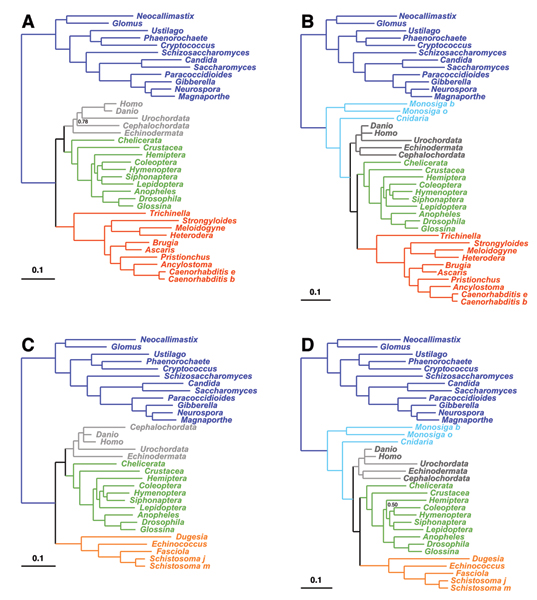
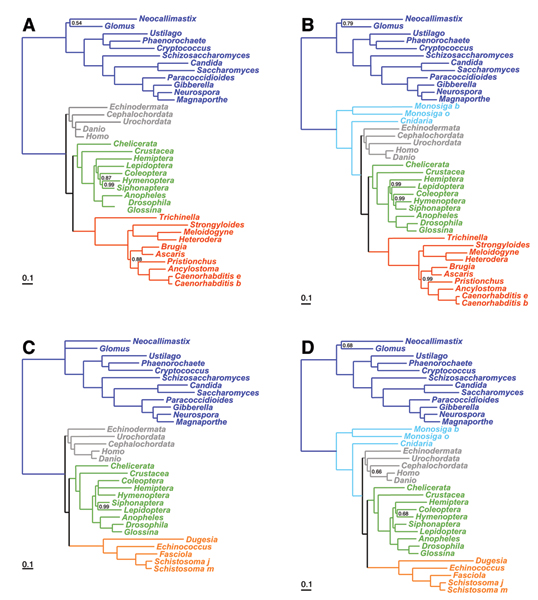
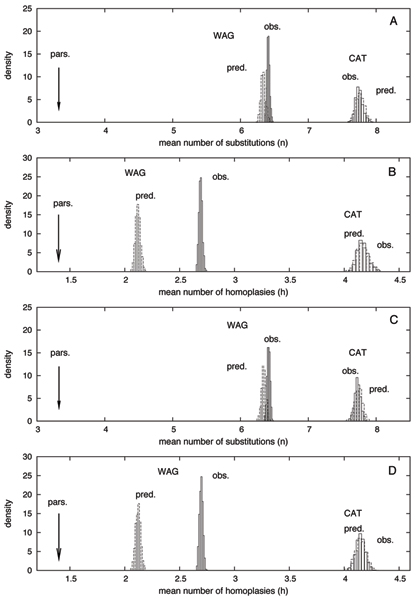
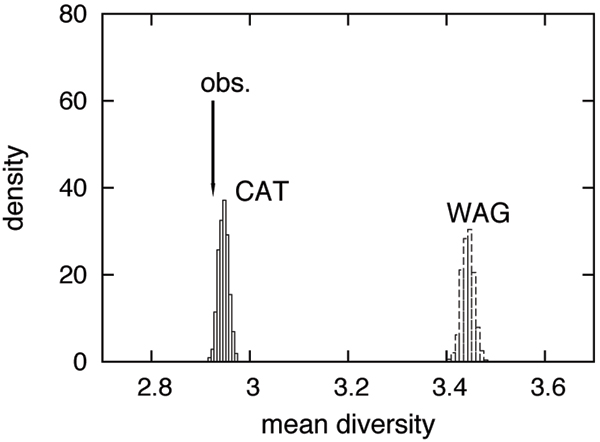
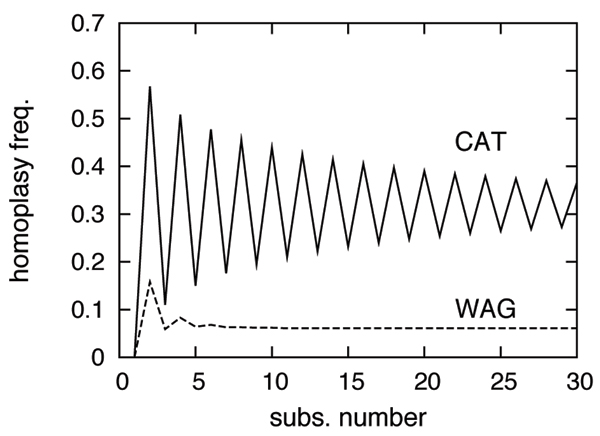
BACKGROUND: Thanks to the large amount of signal contained in genome-wide sequence alignments, phylogenomic analyses are converging towards highly supported trees. However, high statistical support does not imply that the tree is accurate. Systematic errors, such as the Long Branch Attraction (LBA) artefact, can be misleading, in particular when the taxon sampling is poor, or the outgroup is distant. In an otherwise consistent probabilistic framework, systematic errors in genome-wide analyses can be traced back to model mis-specification problems, which suggests that better models of sequence evolution should be devised, that would be more robust to tree reconstruction artefacts, even under the most challenging conditions. METHODS: We focus on a well characterized LBA artefact analyzed in a previous phylogenomic study of the metazoan tree, in which two fast-evolving animal phyla, nematodes and platyhelminths, emerge either at the base of all other Bilateria, or within protostomes, depending on the outgroup. We use this artefactual result as a case study for comparing the robustness of two alternative models: a standard, site-homogeneous model, based on an empirical matrix of amino-acid replacement (WAG), and a site-heterogeneous mixture model (CAT). In parallel, we propose a posterior predictive test, allowing one to measure how well a model acknowledges sequence saturation. RESULTS: Adopting a Bayesian framework, we show that the LBA artefact observed under WAG disappears when the site-heterogeneous model CAT is used. Using cross-validation, we further demonstrate that CAT has a better statistical fit than WAG on this data set. Finally, using our statistical goodness-of-fit test, we show that CAT, but not WAG, correctly accounts for the overall level of saturation, and that this is due to a better estimation of site-specific amino-acid preferences. CONCLUSION: The CAT model appears to be more robust than WAG against LBA artefacts, essentially because it correctly anticipates the high probability of convergences and reversions implied by the small effective size of the amino-acid alphabet at each site of the alignment. More generally, our results provide strong evidence that site-specificities in the substitution process need be accounted for in order to obtain more reliable phylogenetic trees.
Overview
The claims and statistics of this paper haven’t been checked yet.
Free: it reads the open-access text and checks the first 5 claims that cite a source we can check. Create a free account to check every claim.
Integrity signals
Registry
Cites
Statistics
Figures
Verification
Claims the paper makes
The claims and statistics of this paper haven’t been checked yet.
Free: it reads the open-access text and checks the first 5 claims that cite a source we can check. Create a free account to check every claim.
Claims other papers make about this one
Each is checked against this paper’s own text: does it say what the citing paper says it does?
The source backs part of the claim, not all of it — or backs it for a different population, condition or comparison.
In the citing paper
“CAT/CATGTR offers improved resilience to long-branch attraction artefacts (LBA)22 and is almost always better fitting than standard site-homogeneous amino acid substitution models (e.g. WAG)8–10,23–29.”
From Evidence for sponges as sister to all other animals from partitioned phylogenomics with mixture models and recoding (2021) · cites this paper as [22]
Experimental — accuracy not yet measuredThe source backs part of the claim, not all of it — or backs it for a different population, condition or comparison.
In the citing paper
“This is because, by accommodating site-specific biochemical constraints, CAT/CATGTR can better detect saturation (i.e. multiple hidden substitutions)8,20,22, and therefore better identify cases of convergent evolution of identical amino acids in distantly related, fast-evolving species.”
From Evidence for sponges as sister to all other animals from partitioned phylogenomics with mixture models and recoding (2021) · cites this paper as [22]
Experimental — accuracy not yet measuredThe source backs part of the claim, not all of it — or backs it for a different population, condition or comparison.
In the citing paper
“Additional sources of systematic error include poor taxon or character sampling (10,14,15), large amounts of missing data (16), and model misspecification (16,17).”
From Error, signal, and the placement of Ctenophora sister to all other animals (2015) · cites this paper as [17]
Experimental — accuracy not yet measuredThe cited source says what the claim attributes to it.
In the citing paper
“However, protein evolution is not homogeneous.”
From Improved Modeling of Compositional Heterogeneity Supports Sponges as Sister to All Other Animals (2017) · cites this paper as [26]
The cited source says what the claim attributes to it.
In the citing paper
“Previous studies analysing the test datasets used here, but without partitioning, have found support for the accepted topology under a variety of site-heterogeneous models22,56,60.”
From Evidence for sponges as sister to all other animals from partitioned phylogenomics with mixture models and recoding (2021) · cites this paper as [22]
4 more claims about this paper
Create a free account to see every claim other papers make about this one.
Self-check
Percentages, sums and reported differences re-computed from the paper’s own numbers.
The self-check needs the paper’s full text.
Citations
Cites
MRBAYES: Bayesian inference of phylogenetic trees.
Huelsenbeck, J. P., & Ronquist, F. (2001) · Bioinformatics · doi:10.1093/bioinformatics/17.8.754 · Cited by 21,937 · cited 1×
“In the case of WAG, we performed one run with our program, and another one using MrBayes [48].”
Evolutionary trees from DNA sequences: A maximum likelihood approach.
Felsenstein, J. (1981) · Journal of Molecular Evolution · doi:10.1007/bf01734359 · Cited by 14,571 · cited 3×
“The evolutionary process defined by this category is then similar to that proposed by Felsenstein [45], i.e. a Poisson process distributing events across time, so that at each event, a new state (possibly equal to the current one) is drawn at random from the probability profile.”
InfluentialEvolution of Protein Molecules
JUKES, T. H., & CANTOR, C. R. (1969) · Mammalian Protein Metabolism · doi:10.1016/b978-1-4832-3211-9.50009-7 · Cited by 11,032 · cited 1×
“At one extreme, we used the equivalent of the Jukes and Cantor model [ 44 ] for amino-acids, assuming all 20 amino-acid to be equally likely at each site.”
The rapid generation of mutation data matrices from protein sequences
Jones, D. T., Taylor, W. R., & Thornton, J. M. (1992) · Bioinformatics · doi:10.1093/bioinformatics/8.3.275 · Cited by 6,947
(1964) · Mammalian Protein Metabolism · doi:10.1016/b978-1-4832-3210-2.50006-6 · Cited by 3,059
Yang, Z. (1994) · Journal of Molecular Evolution · doi:10.1007/bf00160154 · Cited by 2,960 · cited 3×
“Apart from their specific amino-acid replacement processes, the two models under investigation, CAT and WAG, share the same features, including gamma-distributed rates across sites [25] (see methods).”
Cases in which Parsimony or Compatibility Methods will be Positively Misleading
Felsenstein, J. (1978) · Systematic Biology · doi:10.1093/sysbio/27.4.401 · Cited by 2,896
Whelan, S., & Goldman, N. (2001) · Molecular Biology and Evolution · doi:10.1093/oxfordjournals.molbev.a003851 · Cited by 2,849 · cited 3×
“By Bayes factor evaluation, we have shown previously that CAT generally has a better fit than homogeneous models based on one single empirical substitution matrix, such as WAG [39], JTT [40], or even the most general site-homogeneous and time-reversible model (GTR) [31,41].”
Cellular Scaling Rules for the Brains of Marsupials: Not as “Primitive” as Expected
Dos Santos, S. E., Porfirio, J., da Cunha, F. B., Manger, P. R., Tavares, W., Pessoa, L., Raghanti, M. A., Sherwood, C. C., & Herculano-Houzel, S. (2017) · Brain, Behavior and Evolution · doi:10.1159/000452856 · Cited by 2,642
Markov Chain Sampling Methods for Dirichlet Process Mixture Models
Neal, R. M. (2000) · Journal of Computational and Graphical Statistics · doi:10.1080/10618600.2000.10474879 · Cited by 2,288
Cited by
Items 101–200 of 712
Tsagkogeorga, G., Cahais, V., & Galtier, N. (2012) · Genome Biology and Evolution · doi:10.1093/gbe/evs054 · Cited by 131
Strassert, J. F. H., Jamy, M., Mylnikov, A. P., Tikhonenkov, D. V., & Burki, F. (2019) · Molecular Biology and Evolution · doi:10.1093/molbev/msz012 · Cited by 123
“…genomic data for an ever-increasing diversity of protists (i.e., microbial eukaryotes), and the development of more realistic models of evolution (Lartillot et al. 2007; Quang et al. 2008; Yabuki et al. 2014; Katz 2015; Burki et al. 2016; Brown et al. 2018; Cavalier-Smith et al. 2018; Wang et…”
Helmkampf, M., Bruchhaus, I., & Hausdorf, B. (2008) · Proceedings of the Royal Society B: Biological Sciences · doi:10.1098/rspb.2008.0372 · Cited by 121
Esselstyn, J. A., Oliveros, C. H., Swanson, M. T., & Faircloth, B. C. (2017) · Genome Biology and Evolution · doi:10.1093/gbe/evx168 · Cited by 143
Chen, M.-Y., Liang, D., & Zhang, P. (2015) · Systematic Biology · doi:10.1093/sysbio/syv059 · Cited by 120
The primary divisions of life: a phylogenomic approach employing composition-heterogeneous methods
Foster, P. G., Cox, C. J., & Embley, T. M. (2009) · Philosophical Transactions of the Royal Society B: Biological Sciences · doi:10.1098/rstb.2009.0034 · Cited by 120
A comparative analysis of complete mitochondrial genomes among Hexapoda
Simon, S., & Hadrys, H. (2013) · Molecular Phylogenetics and Evolution · doi:10.1016/j.ympev.2013.03.033 · Cited by 124
Groussin, M., & Gouy, M. (2011) · Molecular Biology and Evolution · doi:10.1093/molbev/msr098 · Cited by 119
“The CAT model has been proven to be less sensitive to long-branch attraction (Lartillot et al. 2007) and confirmed the affinity between Thaumarchaea and Korarchaea.”
BackgroundParatrypanosoma Is a Novel Early-Branching Trypanosomatid
Flegontov, P., Votýpka, J., Skalický, T., Logacheva, M. D., Penin, A. A., Tanifuji, G., Onodera, N. T., Kondrashov, A. S., Volf, P., Archibald, J. M., et al. (2013) · Current Biology · doi:10.1016/j.cub.2013.07.045 · Cited by 126
A cnidarian parasite of salmon (Myxozoa: Henneguya ) lacks a mitochondrial genome
Yahalomi, D., Atkinson, S. D., Neuhof, M., Chang, E. S., Philippe, H., Cartwright, P., Bartholomew, J. L., & Huchon, D. (2020) · Proceedings of the National Academy of Sciences · doi:10.1073/pnas.1909907117 · Cited by 130
Self-citationWang, H.-C., Li, K., Susko, E., & Roger, A. J. (2008) · BMC Evolutionary Biology · doi:10.1186/1471-2148-8-331 · Cited by 110
Hejnol, A., & Lowe, C. J. (2015) · Philosophical Transactions of the Royal Society B: Biological Sciences · doi:10.1098/rstb.2015.0045 · Cited by 109
Genomic support for a moa-tinamou clade and adaptive morphological convergence in flightless ratites
Baker, A. J., Haddrath, O., McPherson, J. D., & Cloutier, A. (2014) · Molecular Biology and Evolution · doi:10.1093/molbev/msu153 · Cited by 108
“Furthermore, translation of protein-coding genes and use of the site-heterogeneous CAT mixture model for UCEs, which is believed to be robust to long-branch attraction (Lartillot et al. 2007), should also safeguard against erroneous inference caused by mutational saturation.”
Schwentner, M., Richter, S., Rogers, D. C., & Giribet, G. (2018) · Proceedings of the Royal Society B Biological Sciences · doi:10.1098/rspb.2018.1524 · Cited by 126
Khan, H., Parks, N., Kozera, C., Curtis, B. A., Parsons, B. J., Bowman, S., & Archibald, J. M. (2007) · Molecular Biology and Evolution · doi:10.1093/molbev/msm101 · Cited by 107
“Bayesian analyses were performed using PhyloBayes with the siteheterogeneous CAT model as described in Lartillot, Brinkmann, and Philippe (2007) using 4 gamma-distributed rate categories.”
MethodVasilikopoulos, A., Misof, B. Y., Meusemann, K., Lieberz, D., Flouri, T., BEUTEL, R. G., Niehuis, O., Wappler, T., Rust, J., Peters, R. S., et al. (2020) · BMC Evolutionary Biology · doi:10.1186/s12862-020-01631-6 · Cited by 122
Lack of support for Deuterostomia prompts reinterpretation of the first Bilateria
Kapli, P., Natsidis, P., Leite, D. J., Fursman, M., Jeffrie, N., Rahman, I. A., Philippe, H., Copley, R. R., & Telford, M. J. (2021) · Science Advances · doi:10.1126/sciadv.abe2741 · Cited by 105
Self-citationParks, D. H., Chaumeil, P.-A., Mussig, A. J., Rinke, C., Chuvochina, M. S., & Hugenholtz, P. (2025) · Nucleic Acids Research · doi:10.1093/nar/gkaf1040 · Cited by 198
To Be or Not to Be a Flatworm: The Acoel Controversy
Egger, B., Steinke, D., Tarui, H., De Mulder, K., Arendt, D., Borgonie, G., Funayama, N., Gschwentner, R., Hartenstein, V., Hobmayer, B., et al. (2009) · PLoS ONE · doi:10.1371/journal.pone.0005502 · Cited by 106
Back in time: a new systematic proposal for the Bilateria
Baguñà, J., Martinez, P., Paps, J., & Riutort, M. (2008) · Philosophical Transactions of the Royal Society B: Biological Sciences · doi:10.1098/rstb.2007.2238 · Cited by 105
Templeton, T. J., Enomoto, S., Chen, W., Huang, C.-G., Lancto, C. A., Abrahamsen, M. S., & Zhu, G. (2009) · Molecular Biology and Evolution · doi:10.1093/molbev/msp226 · Cited by 121
Parasitism and Mutualism in Wolbachia: What the Phylogenomic Trees Can and Cannot Say
Bordenstein, S. R., Paraskevopoulos, C., Hotopp, J. C. D., Sapountzis, P., Lo, N. C., Bandi, C., Tettelin, H., Werren, J. H., & Bourtzis, K. (2008) · Molecular Biology and Evolution · doi:10.1093/molbev/msn243 · Cited by 132
Padamsee, M., Kumar, T. K. A., Riley, R. W., Binder, M., Boyd, A., Calvo, A. M., Furukawa, K., Hesse, C. N., Hohmann, S., James, T. Y., et al. (2012) · Fungal Genetics and Biology · doi:10.1016/j.fgb.2012.01.007 · Cited by 113
Dynamic Evolution of Base Composition: Causes and Consequences in Avian Phylogenomics
Nabholz, B., Kunstner, A., Wang, R., Jarvis, E. D., & Ellegren, H. (2011) · Molecular Biology and Evolution · doi:10.1093/molbev/msr047 · Cited by 103
Liu, Y., Leigh, J., Brinkmann, H., Cushion, M. T., Rodríguez‐Ezpeleta, N., Philippe, H., & Lang, B. F. (2008) · Molecular Biology and Evolution · doi:10.1093/molbev/msn221 · Cited by 124
Self-citationMüller, M., Gräbnitz, F., Barandun, N., Shen, Y., Wendt, F., Steiner, S. N., Severin, Y., Vetterli, S. U., Mondal, M., Prudent, J. R., et al. (2021) · Nature Communications · doi:10.1038/s41467-021-27280-x · Cited by 101
Archaeal “Dark Matter” and the Origin of Eukaryotes
Williams, T. A., & Embley, T. M. (2014) · Genome Biology and Evolution · doi:10.1093/gbe/evu031 · Cited by 100
Dean, P., Sendra, K. M., Williams, T. A., Watson, A., Major, P. F., Nakjang, S., Kozhevnikova, E., Goldberg, A. V., Kunji, E. R. S., Hirt, R. P., et al. (2018) · Nature Communications · doi:10.1038/s41467-018-03923-4 · Cited by 104
Cavalier‐Smith, T., Lewis, R., Chao, E. E. Y., Oates, B. R., & Bass, D. (2009) · Protist · doi:10.1016/j.protis.2009.03.003 · Cited by 100
Ancestral state reconstruction of ontogeny supports a bilaterian affinity for Dickinsonia
Gold, D. A., Runnegar, B., Gehling, J. G., & Jacobs, D. K. (2015) · Evolution & Development · doi:10.1111/ede.12168 · Cited by 99
Jackson, C., Knoll, A. H., Chan, C. X., & Verbruggen, H. (2018) · Scientific Reports · doi:10.1038/s41598-017-18805-w · Cited by 99
Large-Scale Phylogenomic Analyses Indicate a Deep Origin of Primary Plastids within Cyanobacteria
Criscuolo, A., & Gribaldo, S. (2011) · Molecular Biology and Evolution · doi:10.1093/molbev/msr108 · Cited by 97
Liu, L., Xi, Z., & Davis, C. “. (2014) · Molecular Biology and Evolution · doi:10.1093/molbev/msu331 · Cited by 100
Husník, F., Chrudimský, T., & Hypša, V. (2011) · BMC Biology · doi:10.1186/1741-7007-9-87 · Cited by 96
Rooting the tree of life: the phylogenetic jury is still out
Gouy, R., Baurain, D., & Philippe, H. (2015) · Philosophical Transactions of the Royal Society B: Biological Sciences · doi:10.1098/rstb.2014.0329 · Cited by 96
Self-citationWhelan, N. V., & Halanych, K. M. (2016) · Systematic Biology · doi:10.1093/sysbio/syw084 · Cited by 96
An estimate of the deepest branches of the tree of life from ancient vertically evolving genes
Moody, E. R., Mahendrarajah, T. A., Dombrowski, N., Clark, J. W., Petitjean, C., Offre, P., Szöllősi, G. J., Spang, A., & Williams, T. A. (2022) · eLife · doi:10.7554/elife.66695 · Cited by 95
Mitogenomic phylogeny, diversification, and biogeography of South American spiny rats
Fabre, P., Upham, N. S., Emmons, L. H., Justy, F., Leite, Y. L. R., Loss, A. C., Orlando, L., Tilak, M., Patterson, B. D., & Douzery, E. (2016) · Molecular Biology and Evolution · doi:10.1093/molbev/msw261 · Cited by 114
Paps, J., Baguna, J., & Riutort, M. (2009) · Molecular Biology and Evolution · doi:10.1093/molbev/msp150 · Cited by 94
A Mixed Branch Length Model of Heterotachy Improves Phylogenetic Accuracy
Kolaczkowski, B., & Thornton, J. W. (2008) · Molecular Biology and Evolution · doi:10.1093/molbev/msn042 · Cited by 94
Insights into the phylogeny of Hemiptera from increased mitogenomic taxon sampling
Song, N., Zhang, H., & Zhao, T. (2019) · Molecular Phylogenetics and Evolution · doi:10.1016/j.ympev.2019.05.009 · Cited by 109
Handberg-Thorsager, M., & Saló, E. (2007) · Development Genes and Evolution · doi:10.1007/s00427-007-0146-3 · Cited by 93
Substantial Loss of Conserved and Gain of Novel MicroRNA Families in Flatworms
Fromm, B., Worren, M. M., Hahn, C., Hovig, E., & Bachmann, L. (2013) · Molecular Biology and Evolution · doi:10.1093/molbev/mst155 · Cited by 92
Incongruence among different mitochondrial regions: A case study using complete mitogenomes
Meiklejohn, K. A., Danielson, M. J., Faircloth, B. C., Glenn, T. C., Braun, E. L., & Kimball, R. T. (2014) · Molecular Phylogenetics and Evolution · doi:10.1016/j.ympev.2014.06.003 · Cited by 96
Comparative genomic analysis of six Glossina genomes, vectors of African trypanosomes
Attardo, G. M., Abd‐Alla, A. M. M., Acosta-Serrano, Á., Allen, J. E., Bateta, R., Benoit, J. B., Bourtzis, K., Caers, J., Caljon, G., Christensen, M. B., et al. (2019) · Genome biology · doi:10.1186/s13059-019-1768-2 · Cited by 103
The plastid ancestor originated among one of the major cyanobacterial lineages
de Alda, J. A. G. O., Esteban, R., Egaña, M. L. D., & Houmard, J. (2014) · Nature Communications · doi:10.1038/ncomms5937 · Cited by 125
Turmel, M., Otis, C., & Lemieux, C. (2009) · Molecular Biology and Evolution · doi:10.1093/molbev/msp138 · Cited by 98
Molecular phylogeny of Squaliformes and first occurrence of bioluminescence in sharks
Straube, N., Li, C., Claes, J. M., Corrigan, S. L., & Naylor, G. J. P. (2015) · BMC Evolutionary Biology · doi:10.1186/s12862-015-0446-6 · Cited by 96
Lemieux, C., Otis, C., & Turmel, M. (2014) · BMC Genomics · doi:10.1186/1471-2164-15-857 · Cited by 97
Moreira, D., & López‐García, P. (2015) · Philosophical Transactions of the Royal Society B Biological Sciences · doi:10.1098/rstb.2014.0327 · Cited by 95
The immunogenetics of sexual parasitism
Swann, J. B., Holland, S. J., Petersen, M., Pietsch, T. W., & Boehm, T. L. J. (2020) · Science · doi:10.1126/science.aaz9445 · Cited by 87
The mitogenome phylogeny of Adephaga (Coleoptera)
López‐López, A., & Vogler, A. P. (2017) · Molecular Phylogenetics and Evolution · doi:10.1016/j.ympev.2017.06.009 · Cited by 94
Long Branch Attraction Biases in Phylogenetics
Susko, E., & Roger, A. J. (2021) · Systematic Biology · doi:10.1093/sysbio/syab001 · Cited by 86
Paris, M., Pettersson, K., Schubert, M., Bertrand, S., Pongratz, I., Escrivá, H., & Laudet, V. (2008) · BMC Evolutionary Biology · doi:10.1186/1471-2148-8-219 · Cited by 98
Koenen, E. J. M., Kidner, C. A., Souza, É. R. D., Simon, M. F., Iganci, J. R. V., Nicholls, J. A., Brown, G. K., de Queiroz, L. P., Luckow, M., Lewis, G. P., et al. (2020) · American Journal of Botany · doi:10.1002/ajb2.1568 · Cited by 102
Brugler, M. R., Opresko, D. M., & France, S. C. (2013) · Zoological Journal of the Linnean Society · doi:10.1111/zoj.12060 · Cited by 93
Chætognath transcriptome reveals ancestral and unique features among bilaterians
Marlétaz, F., Gilles, A., Caubit, X., Perez, Y., Dossat, C., Samain, S., Gyapay, G., Wincker, P., & Le Parco, Y. (2008) · Genome Biology · doi:10.1186/gb-2008-9-6-r94 · Cited by 86
Nie, R., Breeschoten, T., Timmermans, M. J. T. N., NADEIN, K. S., Xue, H., Bai, M., Huang, Y., Yang, X., & Vogler, A. P. (2017) · Cladistics · doi:10.1111/cla.12196 · Cited by 100
Wang, H.-C., Susko, E., & Roger, A. J. (2019) · Systematic Biology · doi:10.1093/sysbio/syz021 · Cited by 85
Williams, T. A., Embley, T. M., & Heinz, E. (2011) · PLoS ONE · doi:10.1371/journal.pone.0021080 · Cited by 84
A Time line of the Environmental Genetics of the Haptophytes
Liu, H., Aris‐Brosou, S., Probert, I., & de Vargas, C. (2009) · Molecular Biology and Evolution · doi:10.1093/molbev/msp222 · Cited by 100
Le Corguillé, G., Pearson, G., Valente, M., Viegas, C., Gschloessl, B., Corre, E., Bailly, X., Peters, A. F., Jubin, C., Vacherie, B., et al. (2009) · BMC Evolutionary Biology · doi:10.1186/1471-2148-9-253 · Cited by 84
Quantifying Homologous Replacement of Loci between Haloarchaeal Species
Williams, D. F., Gogarten, J. P., & Papke, R. T. (2012) · Genome Biology and Evolution · doi:10.1093/gbe/evs098 · Cited by 94
Mahony, S., Foley, N. M., Biju, S. D., & Teeling, E. C. (2017) · Molecular Biology and Evolution · doi:10.1093/molbev/msw267 · Cited by 109
Major Revisions in Pancrustacean Phylogeny and Evidence of Sensitivity to Taxon Sampling
Bernot, J. P., Owen, C. L., Wolfe, J. M., Meland, K., Olesen, J., & Crandall, K. A. (2023) · Molecular Biology and Evolution · doi:10.1093/molbev/msad175 · Cited by 118
Boussau, B., Guéguen, L., & Gouy, M. (2008) · BMC Evolutionary Biology · doi:10.1186/1471-2148-8-272 · Cited by 83
Demystifying Eukaryote Lateral Gene Transfer (Response to Martin 2017 DOI: 10.1002/bies.201700115)
Leger, M. M., Eme, L., Stairs, C. W., & Roger, A. J. (2018) · BioEssays · doi:10.1002/bies.201700242 · Cited by 81
Evolution of 7SK RNA and Its Protein Partners in Metazoa
Marz, M., Donath, A., Verstraete, N., Nguyen, V. T., Stadler, P. F., & Bensaude, O. (2009) · Molecular Biology and Evolution · doi:10.1093/molbev/msp198 · Cited by 81
The SAR11 Group of Alpha-Proteobacteria Is Not Related to the Origin of Mitochondria
Rodríguez-Ezpeleta, N., & Embley, T. M. (2012) · PLoS ONE · doi:10.1371/journal.pone.0030520 · Cited by 80
Driscoll, T., Gillespie, J. J., Nordberg, E. K., Azad, A. F., & Sobral, B. (2013) · Genome Biology and Evolution · doi:10.1093/gbe/evt036 · Cited by 86
Wang, Y., Wu, H., Rédei, D., Xie, Q., Chen, Y., Chen, P., Dong, Z.-E., Dang, K., Damgaard, J., Štys, P., et al. (2017) · Cladistics · doi:10.1111/cla.12232 · Cited by 89
Bourret, T. B., Choudhury, R. A., Mehl, H. K., Blomquist, C. L., McRoberts, N., & Rizzo, D. M. (2018) · PLoS ONE · doi:10.1371/journal.pone.0192502 · Cited by 90
Detection of Implausible Phylogenetic Inferences Using Posterior Predictive Assessment of Model Fit
Brown, J. M. (2014) · Systematic Biology · doi:10.1093/sysbio/syu002 · Cited by 91
Convergence assessment for Bayesian phylogenetic analysis using MCMC simulation
Fabreti, L. G., & Höhna, S. (2021) · Methods in Ecology and Evolution · doi:10.1111/2041-210x.13727 · Cited by 91
Improving animal phylogenies with genomic data
Telford, M. J., & Copley, R. R. (2011) · Trends in Genetics · doi:10.1016/j.tig.2011.02.003 · Cited by 83
Precipitation is the main axis of tropical plant phylogenetic turnover across space and time
Ringelberg, J. J., Koenen, E. J. M., Sauter, B., Aebli, A., Rando, J. G., Iganci, J. R. V., de Queiroz, L. P., Murphy, D. J., Gaudeul, M., Bruneau, A., et al. (2023) · Science Advances · doi:10.1126/sciadv.ade4954 · Cited by 83
Cavalier‐Smith, T., Chao, E. E. Y., & Lewis, R. (2016) · Molecular Phylogenetics and Evolution · doi:10.1016/j.ympev.2016.03.023 · Cited by 83
Genomic Diversification in Strains of Rickettsia felis Isolated from Different Arthropods
Gillespie, J. J., Driscoll, T., Verhoeve, V. I., Utsuki, T., Husseneder, C., Chouljenko, V. N., Azad, A. F., & Macaluso, K. R. (2014) · Genome Biology and Evolution · doi:10.1093/gbe/evu262 · Cited by 75
Xue, X., Dong, Y., Deng, W., Hong, X., & Shao, R. (2017) · Molecular Phylogenetics and Evolution · doi:10.1016/j.ympev.2017.01.009 · Cited by 73
Mitogenomics of Vetigastropoda: insights into the evolution of pallial symmetry
Uribe, J. E., Kano, Y., Templado, J., & Zardoya, R. (2015) · Zoologica Scripta · doi:10.1111/zsc.12146 · Cited by 77
Lin, F.-J., Liu, Y., Sha, Z., Tsang, L. M., Chu, K. H., Chan, T., Liu, R., & Cui, Z. (2012) · BMC Genomics · doi:10.1186/1471-2164-13-631 · Cited by 79
Ribosomal proteins: Toward a next generation standard for prokaryotic systematics?
Ramulu, H. G., Groussin, M., Talla, E., Planel, R., Daubin, V., & Brochier‐Armanet, C. (2014) · Molecular Phylogenetics and Evolution · doi:10.1016/j.ympev.2014.02.013 · Cited by 76
Uribe, J. E., Irisarri, I., Templado, J., & Zardoya, R. (2018) · Molecular Phylogenetics and Evolution · doi:10.1016/j.ympev.2018.12.019 · Cited by 77
Redmond, A. K., Zou, J., Secombes, C. J., Macqueen, D. J., & Dooley, H. M. (2019) · Frontiers in Immunology · doi:10.3389/fimmu.2019.01558 · Cited by 80
The Comb Jelly Opsins and the Origins of Animal Phototransduction
Feuda, R., Rota-Stabelli, O., Oakley, T. H., & Pisani, D. (2014) · Genome Biology and Evolution · doi:10.1093/gbe/evu154 · Cited by 70
“S2a and b, Supplementary Material online, and fig.”
Conjugate Gibbs Sampling for Bayesian Phylogenetic Models
Lartillot, N. (2006) · Journal of Computational Biology · doi:10.1089/cmb.2006.13.1701 · Cited by 70
Self-citationRedmond, A. K., Casey, D., Gundappa, M. K., Macqueen, D. J., & McLysaght, A. (2023) · Nature Communications · doi:10.1038/s41467-023-38714-z · Cited by 80
Zheng, J., Rogozin, I. B., Koonin, E. V., & Przytycka, T. M. (2007) · Molecular Biology and Evolution · doi:10.1093/molbev/msm207 · Cited by 69
A Practical Guide to Design and Assess a Phylogenomic Study
Lozano-Fernández, J. (2022) · Genome Biology and Evolution · doi:10.1093/gbe/evac129 · Cited by 88
Evidence of recent interkingdom horizontal gene transfer between bacteria and Candida parapsilosis
Fitzpatrick, D. A., Logue, M. E., & Butler, G. (2008) · BMC Evolutionary Biology · doi:10.1186/1471-2148-8-181 · Cited by 69
Animal phylogeny and large-scale sequencing: progress and pitfalls
Brinkmann, H., & Philippe, H. (2008) · Journal of Systematics and Evolution · doi:10.3724/sp.j.1002.2008.08038 · Cited by 69
Self-citationCavalier‐Smith, T., & Chao, E. E. Y. (2020) · PROTOPLASMA · doi:10.1007/s00709-019-01442-7 · Cited by 74
Green-colored Plastids in the Dinoflagellate Genus Lepidodinium are of Core Chlorophyte Origin
Matsumoto, T., Shinozaki, F., Chikuni, T., Yabuki, A., Takishita, K., Kawachi, M., Nakayama, T., Inouye, I., Hashimoto, T., & Inagaki, Y. (2010) · Protist · doi:10.1016/j.protis.2010.07.001 · Cited by 72
Singh, T. R., Tsagkogeorga, G., Delsuc, F., Blanquart, S., Shenkar, N., Loya, Y., Douzery, E. J., & Huchon, D. (2009) · BMC Genomics · doi:10.1186/1471-2164-10-534 · Cited by 68
Extreme halophilic archaea derive from two distinct methanogen Class II lineages
Aouad, M., Taib, N., Oudart, A., Lecocq, M., Gouy, M., & Brochier-Armanet, C. (2018) · Molecular Phylogenetics and Evolution · doi:10.1016/j.ympev.2018.04.011 · Cited by 68
Brindefalk, B., Ettema, T. J. G., Viklund, J., Thollesson, M., & Andersson, S. G. E. (2011) · PLoS ONE · doi:10.1371/journal.pone.0024457 · Cited by 66
Ancestrality and Mosaicism of Giant Viruses Supporting the Definition of the Fourth TRUC of Microbes
Colson, P., Levasseur, A., Scola, B. L., Sharma, V., Nasir, A., Pontarotti, P., Caetano‐Anollés, G., & Raoult, D. (2018) · Frontiers in Microbiology · doi:10.3389/fmicb.2018.02668 · Cited by 67
Saturation and base composition bias explain phylogenomic conflict in Plasmodium
Dávalos, L. M., & Perkins, S. L. (2008) · Genomics · doi:10.1016/j.ygeno.2008.01.006 · Cited by 78
Molecular Evolution of the Helicobacter pylori Vacuolating Toxin Gene vacA
Gangwer, K. A., Shaffer, C. L., Suerbaum, S., Lacy, D. B., Cover, T. L., & Bordenstein, S. R. (2010) · Journal of Bacteriology · doi:10.1128/jb.01081-10 · Cited by 66
The Impact of Paralogy on Phylogenomic Studies – A Case Study on Annelid Relationships
Struck, T. H. (2013) · PLoS ONE · doi:10.1371/journal.pone.0062892 · Cited by 65
Metadata
- Authors
- Lartillot, N., Brinkmann, H., & Philippe, H.
- Affiliations
- Centre National de la Recherche Scientifique (FR)
- Canadian Institute for Advanced Research (CA)
- Corresponding author
- Lartillot, Nicolas
- Venue
- BMC Evolutionary Biology
- Published
- 2007
- Volume
- 7
- Issue
- Suppl 1
- Pages
- S4
- ISSN
- 1471-2148 (ISSN-L)
- PMC
- PMC1796613
- OpenAlex
- W2131527832
- Semantic Scholar
- 2c8718808e5a337cdae9a2e2c5f0c093e7a3d2ec
- Cited by
- 705
- References
- 59
- Citations by year
- 2026: 22 · 2025: 33 · 2024: 48 · 2023: 35 · 2022: 45 · 2021: 46 · 2020: 48 · 2019: 37 · 2018: 38 · 2017: 35 · 2016: 25 · 2015: 29 · 2014: 52 · 2013: 22 · 2012: 24
- Type
- conference abstract
- Language
- en
- Open access
- gold
- doi.org
- Licence
- cc-by
- Locations
- BMC Evolutionary Biology (publishedVersion, cc-by)
- Europe PMC (PubMed Central) (publishedVersion, cc-by)
- PubMed Central (publishedVersion, cc-by)
- PubMed (publishedVersion)
- HAL (submittedVersion, cc-by)
- Papyrus : Institutional Repository (Université de Montréal) (submittedVersion, cc-by)
- Funders
- Centre National de la Recherche Scientifique
- Université de Montréal
- Topics
- Life Sciences › Biochemistry, Genetics and Molecular Biology › Molecular Biology › Genomics and Phylogenetic Studies
- Life Sciences › Biochemistry, Genetics and Molecular Biology › Molecular Biology › RNA and protein synthesis mechanisms
- Physical Sciences › Earth and Planetary Sciences › Paleontology › Evolution and Paleontology Studies
- Keywords
- long-branch attraction, cat model, amino acid substitution models, metazoan phylogeny, nematodes, Platyhelminthes
- MeSH terms
- Animals, Models, Genetic, Phylogeny, Polymorphism, Genetic, Evolution, Molecular, Sequence Analysis, Protein
About these checks
Registry, retraction, Cites and statistics results are computed, not judged, with one exception: a printed reference that no index lists is read once by a model before it counts as a citation error. Claims are extracted by a model and kept only when their quote appears verbatim in the text; each cited source is then checked, with a model’s help, for whether it says what the claim relies on. Those verdicts can be wrong — read the claim’s quote and the cited source before relying on one.
Statistics and arithmetic are recomputed, not judged.
Confidence bands are shown only for fields calibrated on our annotated test set. None is calibrated yet, so no band is shown.
What counts as a claim ›How we measure confidence ›How we check this ›
Are you an author, or do you see a problem with this page? Request a review
Data sources
Bibliographic data: Semantic Scholar, OpenAlex, Crossref.
Contains information from the Semantic Scholar Academic Graph Datasets, made available under the ODC Attribution License (ODC-BY 1.0).
Semantic Scholar’s data is described in: Kinney, R., et al. (2023). The Semantic Scholar Open Data Platform. arXiv:2301.10140.
