

The DOI matches its Crossref record; 49 of the 50 references it cites were found in a registry or an index.
Toxicity of unsaturated fatty acids to the biohydrogenating ruminal bacterium, Butyrivibrio fibrisolvens
Open accessAbstract
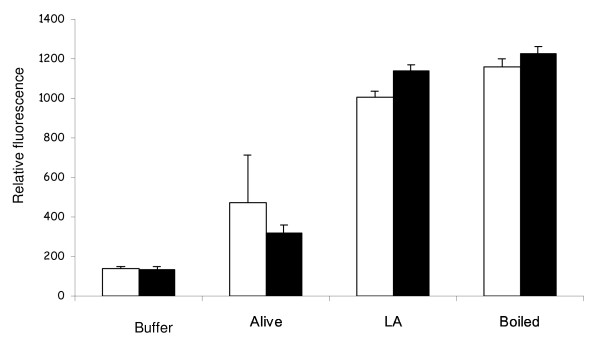
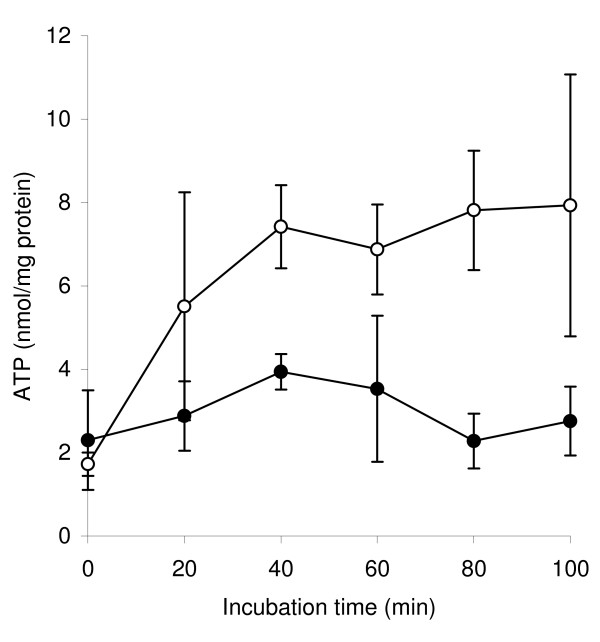
BACKGROUND: Health-promoting polyunsaturated fatty acids (PUFA) are abundant in forages grazed by ruminants and in vegetable and fish oils used as dietary supplements, but only a small proportion of PUFA finds its way into meat and milk, because of biohydrogenation in the rumen. Butyrivibrio fibrisolvens plays a major role in this activity. The aim of this study was to investigate the mechanisms by which PUFA affect the growth of B. fibrisolvens, how PUFA are metabolized and the metabolic response to growth in the presence of PUFA. RESULTS: Linoleic acid (LA; cis-9, cis-12-18:2) and alpha-linolenic acid (LNA; cis-9, cis-12, cis-15-18:3) increased the lag phase of B. fibrisolvens JW11, LNA having the greater effect. Growth was initiated only when the PUFA had been converted to vaccenic acid (VA; trans-11-18:1). The major fish oil fatty acids, eicosapentaenoic acid (EPA; 20:5(n-3)) and docosahexaenoic acid (DHA; 22:6(n-3)), were not metabolized and prevented growth. Cellular integrity, as determined fluorimetrically by propidium iodide (PI) ingression, was affected as much by 18:1 fatty acids, including VA, as 18:2 fatty acids. The methyl esters of LNA, LA, EPA and DHA had no effect on growth or other measurements. The ATP pool decreased by 2/3 when LA was added to growing bacteria, whereas most acyl CoA pools decreased by >96%. CONCLUSIONS: It was concluded that biohydrogenation occurs to enable B. fibrisolvens to survive the bacteriostatic effects of PUFA, and that the toxicity of PUFA is probably mediated via a metabolic effect rather than disruption of membrane integrity.
Overview
The claims and statistics of this paper haven’t been checked yet.
Run the check — free, no account needed. It reads the open-access text and checks the sources it cites.
Integrity signals
Registry
Cites
Statistics
Figures
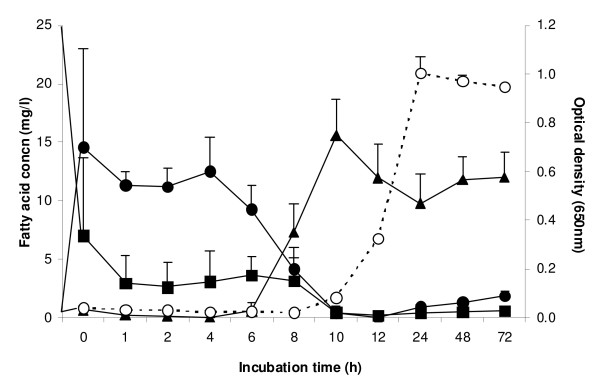
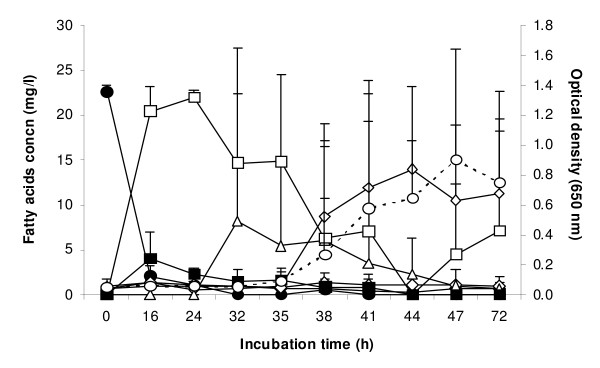
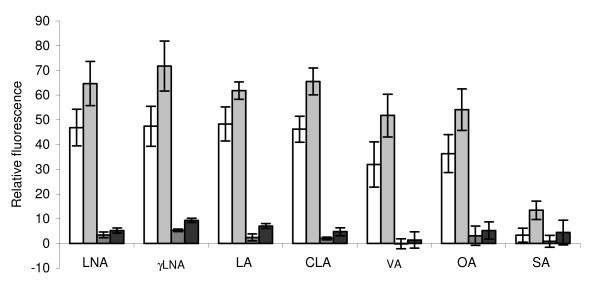
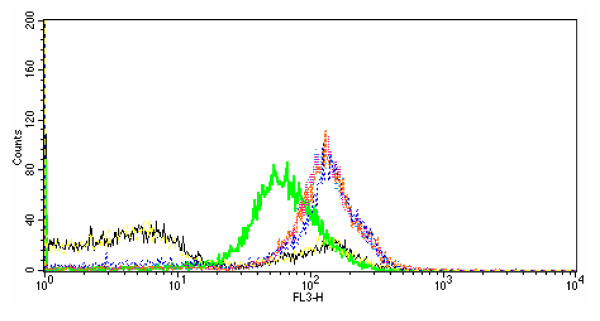
Verification
Claims the paper makes
The claims and statistics of this paper haven’t been checked yet.
Run the check — free, no account needed. It reads the open-access text and checks the sources it cites.
Claims other papers make about this one
Each is checked against this paper’s own text: does it say what the citing paper says it does?
The source backs part of the claim, not all of it — or backs it for a different population, condition or comparison.
In the citing paper
“However, rumen microbiota can detoxify unsaturated FA through the biohydrogenation process to reduce/eliminate the adverse effects on rumen fermentation (121, 124).”
From Phytogenic Additives Can Modulate Rumen Microbiome to Mediate Fermentation Kinetics and Methanogenesis Through Exploiting Diet–Microbe Interaction (2020) · cites this paper as [124]
Experimental — accuracy not yet measured
Self-check
Percentages, sums and reported differences re-computed from the paper’s own numbers.
The self-check needs the paper’s full text.
Citations
Cites
Nicholson, J. K., Lindon, J. C., & Holmes, E. C. (1999) · Xenobiotica · doi:10.1080/004982599238047 · Cited by 3,991
Hobson, P. N., & Stewart, C. S. (1997) · Springer eBooks · doi:10.1007/978-94-009-1453-7 · Cited by 2,159
Owens, F. N., Secrist, D. S., Hill, W. J., & Gill, D. R. (1998) · Journal of Animal Science · doi:10.2527/1998.761275x · Cited by 1,385
Stewart, C. S., Flint, H. J., & Bryant, M. P. (1997) · The Rumen Microbial Ecosystem · doi:10.1007/978-94-009-1453-7_2 · Cited by 772
Keilin's Respiratory Chain Concept and Its Chemiosmotic Consequences
Mitchell, P. (1979) · Science · doi:10.1126/science.388618 · Cited by 738
Harfoot, C. G. (1978) · Progress in Lipid Research · doi:10.1016/0079-6832(78)90004-6 · Cited by 710
Intermediates and Products of the Biohydrogenation of Linoleic Acid by Butyrivibrio fibrisolvens
Kepler, C. R., Hirons, K. P., McNeill, J. J., & Tove, S. B. (1966) · Journal of Biological Chemistry · doi:10.1016/s0021-9258(18)96781-5 · Cited by 693
Metabolism of polyunsaturated fatty acids and their toxicity to the microflora of the rumen
Maia, M. R. G., Chaudhary, L. C., Figueres, L., & Wallace, R. J. (2006) · Antonie van Leeuwenhoek · doi:10.1007/s10482-006-9118-2 · Cited by 530
Self-citationManipulating the fatty acid composition of muscle and adipose tissue in beef cattle
Scollan, N. D., Choi, N., Kurt, E., Fisher, A. V., Enser, M., & Wood, J. D. (2001) · British Journal Of Nutrition · doi:10.1079/bjn2000223 · Cited by 473
Effect of dietary fish oil on biohydrogenation of fatty acids and milk fatty acid content in cows
Shingfield, K. J., Ahvenjärvi, S. A., Toivonen, V., Ärölä, A., Nurmela, K., Huhtanen, P. J., & Griinari, J. M. (2003) · Animal Science · doi:10.1017/s1357729800053765 · Cited by 409
Menotti, A., Kromhout, D., BLACKBURN, H. W., Fidanza, F., Buzina, R., & Nissinen, A. M. (1999) · European Journal of Epidemiology · doi:10.1023/a:1007529206050 · Cited by 377
Harfoot, C. G., & Hazlewood, G. P. (1997) · The Rumen Microbial Ecosystem · doi:10.1007/978-94-009-1453-7_9 · Cited by 322
Conjugated linoleic acid: implications for human health
Whigham, L. D., Cook, M. E., & Atkinson, R. L. (2000) · Pharmacological Research · doi:10.1006/phrs.2000.0735 · Cited by 283
The effects of fatty acids on pure cultures of rumen bacteria
Henderson, C. (1973) · The Journal of Agricultural Science · doi:10.1017/s0021859600058378 · Cited by 283
Bioenergetics: An introduction to the chemiosmotic theory
Nicholls, D. G. (1982) · Medical Entomology and Zoology · Cited by 259
BIOHYDROGENATION OF UNSATURATED FATTY ACIDS BY RUMEN BACTERIA
Polan, C. E., McNeill, J. J., & Tove, S. B. (1964) · Journal of Bacteriology · doi:10.1128/jb.88.4.1056-1064.1964 · Cited by 256
Galbraith, H., Miller, T. B., Paton, A. M., & Thompson, J. K. (1971) · Journal of Applied Bacteriology · doi:10.1111/j.1365-2672.1971.tb01019.x · Cited by 255
Biohydrogenation of Unsaturated Fatty Acids
Rosenfeld, I. S., & Tove, S. B. (1971) · Journal of Biological Chemistry · doi:10.1016/s0021-9258(18)61964-7 · Cited by 248
Ishizaki, K., Larson, T. R., Schauer, N., Fernie, A. R., Graham, I. A., & Leaver, C. J. (2005) · The Plant Cell · doi:10.1105/tpc.105.035162 · Cited by 244
Self-citationTrans unsaturated fatty acids in bacteria
Keweloh, H., & Heipieper, H. J. (1996) · Lipids · doi:10.1007/bf02522611 · Cited by 240
Antimutagenic and some other effects of conjugated linoleic acid
Kritchevsky, D. (2000) · British Journal Of Nutrition · doi:10.1017/s0007114500000581 · Cited by 218
A novel technique for the sensitive quantification of acyl CoA esters from plant tissues
Larson, T. R., & Graham, I. A. (2001) · The Plant Journal · doi:10.1046/j.1365-313x.2001.00929.x · Cited by 210
Self-citationBioenergetics — an Introduction to the Chemiosmotic Theory
Harris, D. (1982) · Biochemical Education · doi:10.1016/0307-4412(82)90097-8 · Cited by 192
Kim, Y. J., Liu, R. H., Bond, D. R., & Russell, J. B. (2000) · Applied and Environmental Microbiology · doi:10.1128/aem.66.12.5226-5230.2000 · Cited by 181
Paillard, D., McKain, N., Chaudhary, L. C., Walker, N. D., Pizette, F., Koppova, I., McEwan, N. R., Kopečný, J., Vercoe, P. E., Louis, P., et al. (2006) · Antonie van Leeuwenhoek · doi:10.1007/s10482-006-9121-7 · Cited by 164
Self-citationKemp, P., White, R. W., & Lander, D. J. (1975) · Journal of General Microbiology · doi:10.1099/00221287-90-1-100 · Cited by 162
Clostridium proteoclasticum: a ruminal bacterium that forms stearic acid from linoleic acid
Wallace, R. J., Chaudhary, L. C., McKain, N., McEwan, N. R., Richardson, A. J., Vercoe, P. E., Walker, N. D., & Paillard, D. (2006) · FEMS Microbiology Letters · doi:10.1111/j.1574-6968.2006.00487.x · Cited by 139
Self-citationFatty acid uncoupling of oxidative phosphorylation in rat liver mitochondria
Rottenberg, H., & Hashimoto, K. (1986) · Biochemistry · doi:10.1021/bi00355a045 · Cited by 135
Influence of fish oil on ruminal biohydrogenation of C18 unsaturated fatty acids
Wąsowska, I., Maia, M. R. G., Niedźwiedzka, K., Czauderna, M., Ribeiro, J. M. C. R., Devillard, E., Shingfield, K. J., & Wallace, R. J. (2006) · British Journal Of Nutrition · doi:10.1079/bjn20061783 · Cited by 129
Self-citationThe Role of Different Species of Bacteria in the Hydrolysis of Protein in the Rumen
Wallace, R. J., & Brammall, M. L. (1985) · Microbiology · doi:10.1099/00221287-131-4-821 · Cited by 128
Self-citationEffect of the Rumen on Dietary Fat
Shorland, F. B., Weenink, R. O., & Johns, A. T. (1955) · Nature · doi:10.1038/1751129a0 · Cited by 125
Metabolism of Long-Chain Fatty Acids in the Rumen
VIVIANI, R. (1970) · Advances in lipid research · doi:10.1016/b978-0-12-024908-4.50013-1 · Cited by 121
Kemp, P., & Lander, D. J. (1984) · Microbiology · doi:10.1099/00221287-130-3-527 · Cited by 120
Lipid Metabolism in the Bacteria
Lennarz, W. J. (1966) · Advances in lipid research · doi:10.1016/b978-1-4831-9940-5.50012-0 · Cited by 113
Moon, C. D., Pacheco, D. M., Kelly, W. J., Leahy, S. C., Li, D., Kopečný, J., & Attwood, G. T. (2008) · INTERNATIONAL JOURNAL OF SYSTEMATIC AND EVOLUTIONARY MICROBIOLOGY · doi:10.1099/ijs.0.65845-0 · Cited by 97
Hughes, P. E., Hunter, W. J., & Tove, S. B. (1982) · Journal of Biological Chemistry · doi:10.1016/s0021-9258(18)34828-2 · Cited by 91
Ultrastructure of Butyrivibrio fibrisolvens: a gram-positive bacterium
Cheng, K.-J., & Costerton, J. W. (1977) · Journal of Bacteriology · doi:10.1128/jb.129.3.1506-1512.1977 · Cited by 82
Regulation of Lipid Metabolism in the Rumen
Jenkins, T. C. (1994) · Journal of Nutrition · doi:10.1093/jn/124.suppl_8.1372s · Cited by 79
The glyceride structure of beef tallows
Banks, A., & Hilditch, T. P. (1931) · Biochemical Journal · doi:10.1042/bj0251168 · Cited by 76
Boynton, Z. L., Bennett, G. N., & Rudolph, F. B. (1994) · Applied and Environmental Microbiology · doi:10.1128/aem.60.1.39-44.1994 · Cited by 68
Offer, N. W., Marsden, M. A., & Phipps, R. H. (2001) · Animal Science · doi:10.1017/s1357729800058501 · Cited by 55
The hydrogenation of somecis- andtrans-octadecenoic acids to stearic acid by a rumenFusocillussp.
Kemp, P., Lander, D. J., & Gunstone, F. D. (1984) · British Journal Of Nutrition · doi:10.1079/bjn19840083 · Cited by 51
Fukuda, S., Furuya, H., Suzuki, Y., Asanuma, N., & Hino, T. (2005) · The Journal of General and Applied Microbiology · doi:10.2323/jgam.51.105 · Cited by 47
Hazlewood, G. P., Kemp, P., Lander, D. J., & DAWSON, R. M. C. (1976) · British Journal Of Nutrition · doi:10.1079/bjn19760034 · Cited by 42
Effect of caprylic, capric and oleic acid on growth of rumen and rabbit caecal bacteria
Marounek, M., Skřivanová, V., & Savka, O. G. (2002) · Journal of Animal and Feed Sciences · doi:10.22358/jafs/67904/2002 · Cited by 35
Hazlewood, G. P., Orpin, C. G., Greenwood, Y., & Black, M. E. (1983) · Applied and Environmental Microbiology · doi:10.1128/aem.45.6.1780-1784.1983 · Cited by 35
Rottenberg, H., & Steiner‐Mordoch, S. (1986) · FEBS Letters · doi:10.1016/0014-5793(86)80708-6 · Cited by 35
ROCHE, C., ALBERTYN, H., Gylswyk, N. O. V., & Kistner, A. (1973) · Journal of General Microbiology · doi:10.1099/00221287-78-2-253 · Cited by 29
White, R. W., Kemp, P., & DAWSON, R. M. C. (1970) · Biochemical Journal · doi:10.1042/bj1160767 · Cited by 23
Research works printed but not linked: 3
- Hungate RE: A roll tube method for cultivation of strict anaerobes. Methods in Microbiology. Edited by: Norris JR, Ribbons DW. 1969, London: Academic Press, 3B: 117-132. full_text.
- Hobson PN: Rumen bacteria. Methods in Microbiology. Edited by: Norris JR, Ribbons DW. 1969, London: Academic Press, 3B: 133-139. full_text.
- Herbert D, Phipps PJ, Strange RE: Chemical analysis of microbial cells. Methods in Microbiology. Edited by: Norris JR, Ribbons DW. 1971, London: Academic Press, 5B: 209-344. full_text.
Cited by
Sorted by citations
The role of microbes in rumen lipolysis and biohydrogenation and their manipulation
Lourenço, M., Ramos-Morales, E., & Wallace, R. J. (2010) · animal · doi:10.1017/s175173111000042x · Cited by 401
Self-citationden Hartigh, L. (2019) · Nutrients · doi:10.3390/nu11020370 · Cited by 371
Zened, A., Combes, S., Cauquil, L., Mariette, J., Klopp, C., Bouchez, O., Meynadier, A., & Enjalbert, F. (2012) · FEMS Microbiology Ecology · doi:10.1111/1574-6941.12011 · Cited by 284
Nutritional enhancement of sheep meat fatty acid profile for human health and wellbeing
Chikwanha, O. C., Vahmani, P., Muchenje, V., Dugan, M. E. R., & Mapiye, C. (2017) · Food Research International · doi:10.1016/j.foodres.2017.05.005 · Cited by 226
Huws, S., Kim, E. J., Lee, M. R. F., Scott, M. B., Tweed, J. K. S., Pinloche, E., Wallace, R. J., & Scollan, N. D. (2011) · Environmental Microbiology · doi:10.1111/j.1462-2920.2011.02452.x · Cited by 212
Self-citation
Metadata
- Authors
- Maia, M. R., Chaudhary, L. C., Bestwick, C. S., Richardson, A. J., McKain, N., Larson, T. R., Graham, I. A., & Wallace, R. J.
- Affiliations
- University of Aberdeen (GB)
- University of York (GB)
- Corresponding author
- Wallace, Robert J
- Venue
- BMC Microbiology
- Published
- 2010-02-18
- Volume
- 10
- Issue
- 1
- Pages
- 52-52
- ISSN
- 1471-2180 (ISSN-L)
- PMC
- PMC2836310
- OpenAlex
- W2162688963
- Cited by
- 298
- References
- 50
- Citations by year
- 2026: 16 · 2025: 16 · 2024: 16 · 2023: 25 · 2022: 21 · 2021: 25 · 2020: 22 · 2019: 21 · 2018: 20 · 2017: 18 · 2016: 21 · 2015: 20 · 2014: 22 · 2013: 11 · 2012: 13
- FWCI
- 23.75
- Type
- journal article
- Language
- en
- Open access
- gold
- doi.org
- Licence
- cc-by
- Locations
- BMC Microbiology (publishedVersion, cc-by)
- PubMed Central (publishedVersion, cc-by)
- PubMed (publishedVersion)
- Aberdeen University Research Archive (Aberdeen University) (submittedVersion)
- DOAJ (DOAJ: Directory of Open Access Journals) (submittedVersion, cc-by-sa)
- Funders
- Scottish Government
- Fundação para a Ciência e a Tecnologia
- Topics
- Life Sciences › Agricultural and Biological Sciences › Animal Science and Zoology › Ruminant Nutrition and Digestive Physiology
- Health Sciences › Nursing › Nutrition and Dietetics › Fatty Acid Research and Health
- Life Sciences › Agricultural and Biological Sciences › Animal Science and Zoology › Meat and Animal Product Quality
- Keywords
- polyunsaturated fatty acids, Butyrivibrio fibrisolvens, biohydrogenation, rumen bacteria, linoleic acid, alpha-linolenic acid, vaccenic acid, eicosapentaenoic acid, docosahexaenoic acid, fish oil, bacterial growth inhibition, membrane integrity, ATP depletion, fatty acid metabolism
- MeSH terms
- Acyl Coenzyme A, Adenosine Triphosphate, Animals, Cell Membrane, Culture Media, Fatty Acids, Unsaturated, Flow Cytometry, Hydrogenation, Sheep, Sodium Lactate, Linoleic Acid, Butyrivibrio, Lipid Metabolism
About these checks
Registry, retraction, Cites and statistics results are computed, not judged, with one exception: a printed reference that no index lists is read once by a model before it counts as a citation error. Claims are extracted by a model and kept only when their quote appears verbatim in the text; each cited source is then checked, with a model’s help, for whether it says what the claim relies on. Those verdicts can be wrong — read the claim’s quote and the cited source before relying on one.
Statistics and arithmetic are recomputed, not judged.
Confidence bands are shown only for fields calibrated on our annotated test set. None is calibrated yet, so no band is shown.
What counts as a claim ›How we measure confidence ›How we check this ›
Are you an author, or do you see a problem with this page? Request a review
