

An audit of sample sizes for pilot and feasibility trials being undertaken in the United Kingdom registered in the United Kingdom Clinical Research Network database
Open accessThe DOI matches its Crossref record; 14 of the 14 references it cites were found in a registry or an index.
Abstract
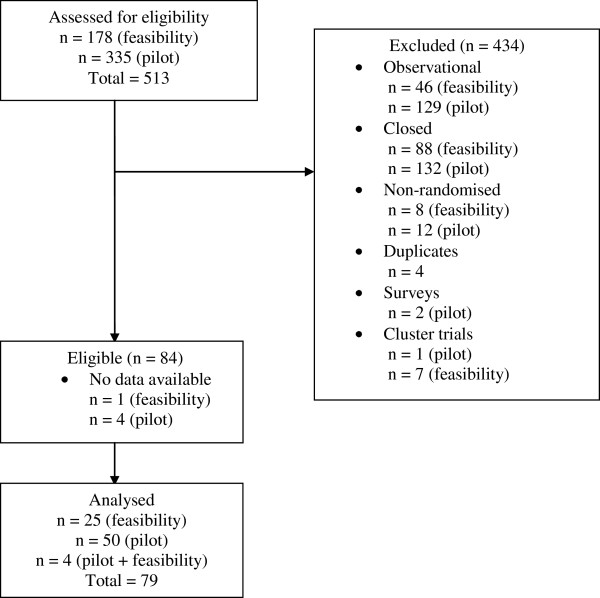
Background: There is little published guidance as to the sample size required for a pilot or feasibility trial despite the fact that a sample size justification is a key element in the design of a trial. A sample size justification should give the minimum number of participants needed in order to meet the objectives of the trial. This paper seeks to describe the target sample sizes set for pilot and feasibility randomised controlled trials, currently running within the United Kingdom. Methods: Data were gathered from the United Kingdom Clinical Research Network (UKCRN) database using the search terms ‘pilot’ and ‘feasibility’. From this search 513 studies were assessed for eligibility of which 79 met the inclusion criteria. Where the data summary on the UKCRN Database was incomplete, data were also gathered from: the International Standardised Randomised Controlled Trial Number (ISRCTN) register; the clinicaltrials.gov website and the website of the funders. For 62 of the trials, it was necessary to contact members of the research team by email to ensure completeness. Results: Of the 79 trials analysed, 50 (63.3%) were labelled as pilot trials, 25 (31.6%) feasibility and 14 were described as both pilot and feasibility trials. The majority had two arms (n = 68, 86.1%) and the two most common endpoints were continuous (n = 45, 57.0%) and dichotomous (n = 31, 39.2%). Pilot trials were found to have a smaller sample size per arm (median = 30, range = 8 to 114 participants) than feasibility trials (median = 36, range = 10 to 300 participants). By type of endpoint, across feasibility and pilot trials, the median sample size per arm was 36 (range = 10 to 300 participants) for trials with a dichotomous endpoint and 30 (range = 8 to 114 participants) for trials with a continuous endpoint. Publicly funded pilot trials appear to be larger than industry funded pilot trials: median sample sizes of 33 (range = 15 to 114 participants) and 25 (range = 8 to 100 participants) respectively. Conclusion: All studies should have a sample size justification. Not all studies however need to have a sample size calculation. For pilot and feasibility trials, while a sample size justification is important, a formal sample size calculation may not be appropriate. The results in this paper describe the observed sample sizes in feasibility and pilot randomised controlled trials on the UKCRN Database.
Overview
The claims and statistics of this paper haven’t been checked yet.
Free: it reads the open-access text and checks the first 5 claims that cite a source we can check. Create a free account to check every claim.
Integrity signals
Registry
Cites
Statistics
Figures
Verification
Claims the paper makes
The claims and statistics of this paper haven’t been checked yet.
Free: it reads the open-access text and checks the first 5 claims that cite a source we can check. Create a free account to check every claim.
Claims other papers make about this one
Each is checked against this paper’s own text: does it say what the citing paper says it does?
The source backs part of the claim, not all of it — or backs it for a different population, condition or comparison.
In the citing paper
“More recently, research has begun to explore the differences between internal and external pilot studies and their contribution to main trials, and the appropriateness of pilot and feasibility studies for estimating the sample size.”
From Role of feasibility and pilot studies in randomised controlled trials: a cross-sectional study (2018) · cites this paper as [12]
Experimental — accuracy not yet measuredThe source backs part of the claim, not all of it — or backs it for a different population, condition or comparison.
In the citing paper
“Current recommendations for sample sizes of pilot/feasibility studies vary, have a single rather than a multi-criterion basis, and do not necessarily link directly to formal progression criteria.”
From Determining sample size for progression criteria for pragmatic pilot RCTs: the hypothesis test strikes back! (2021) · cites this paper as [16]
Experimental — accuracy not yet measuredThe source backs part of the claim, not all of it — or backs it for a different population, condition or comparison.
In the citing paper
“When looking at hybrid human delivered pilot studies, a sample size of 40 is on par with comparable research [105, 106].”
From Personalized machine learning guided intervention for optimizing lifestyle behaviors in depression: a pilot study (2026) · cites this paper as [106]
Experimental — accuracy not yet measuredThe source backs part of the claim, not all of it — or backs it for a different population, condition or comparison.
In the citing paper
“Feasibility studies are not designed to evaluate effects, and there is no definitive approach to estimating their correct sample size [49].”
From Changes in pain, daily occupations, lifestyle, and health following an occupational therapy lifestyle intervention: a secondary analysis from a feasibility study in patients with chronic high-impact pain (2024) · cites this paper as [49]
Experimental — accuracy not yet measuredThe source backs part of the claim, not all of it — or backs it for a different population, condition or comparison.
In the citing paper
“There is no consensus but recommendations vary from 10 to 12 per group through to 60–75 per group depending on the main objective of the study.”
From Determining sample size for progression criteria for pragmatic pilot RCTs: the hypothesis test strikes back! (2021) · cites this paper as [16]
Experimental — accuracy not yet measured
9 more claims about this paper
Create a free account to see every claim other papers make about this one.
Self-check
Percentages, sums and reported differences re-computed from the paper’s own numbers.
The self-check needs the paper’s full text.
Citations
Cites
A tutorial on pilot studies: the what, why and how
Thabane, L., Ma, J., Chu, R., Cheng, J., Ismaila, A., Rios, L. P., Robson, R., Thabane, M., Giangregorio, L., & Goldsmith, C. H. (2010) · BMC Medical Research Methodology · doi:10.1186/1471-2288-10-1 · Cited by 3,384
Sample size of 12 per group rule of thumb for a pilot study
Julious, S. A. (2005) · Pharmaceutical Statistics · doi:10.1002/pst.185 · Cited by 3,068 · cited 6×
“Julious [9] recommends a minimum sample size of 12 per group as a rule of thumb and justifies this based on rationale about feasibility and precision about the mean and variance;”
BackgroundInfluentialSelf-citationDesign and analysis of pilot studies: recommendations for good practice
Lancaster, G. A., Dodd, S., & Williamson, P. R. (2004) · Journal of Evaluation in Clinical Practice · doi:10.1111/j..2002.384.doc.x · Cited by 2,572 · cited 3×
“There is the additional issue that setting the sample size too high may lead to a preventable failure to reach the recruitment target [12].”
BackgroundResultConsiderations in determining sample size for pilot studies
Hertzog, M. A. (2008) · Research in Nursing & Health · doi:10.1002/nur.20247 · Cited by 2,337 · cited 2×
“Hertzog [6] recommends the Julious and Patterson [7] method of using confidence intervals for a given precision constructed around the anticipated value to set the sample size;”
BackgroundMethodWhat is a pilot or feasibility study? A review of current practice and editorial policy
Arain, M., Campbell, M. J., Cooper, C. L., & Lancaster, G. A. (2010) · BMC Medical Research Methodology · doi:10.1186/1471-2288-10-67 · Cited by 1,483 · cited 9×
“[2] concluded that pilot trials are poorly reported and that the authors are often not explicit as to the purpose of their pilot trial.”
BackgroundResultInfluentialSim, J., & Lewis, M. (2012) · Journal of Clinical Epidemiology · doi:10.1016/j.jclinepi.2011.07.011 · Cited by 1,036 · cited 6×
“Continuous 6 43 (15, 60) [10, 60] However, Arain et al.”
BackgroundInfluentialOn the use of a pilot sample for sample size determination
Browne, R. H. (1995) · Statistics in Medicine · doi:10.1002/sim.4780141709 · Cited by 1,007 · cited 2×
“Trial description Pilot 50 30 (20, 45) [8, 114]”
BackgroundRecommendations for Planning Pilot Studies in Clinical and Translational Research
Moore, C. G., Carter, R. E., Nietert, P. J., & Stewart, P. W. (2011) · Clinical and Translational Science · doi:10.1111/j.1752-8062.2011.00347.x · Cited by 661 · cited 2×
“[16] highlighted that it is not unusual for study proposal reviewers to come across a statement such as “No sample size justification is needed because of the pilot nature of the proposed study”, but they state that pilot trials are not exempt from needing a clear rationale for the number of patients to be included.”
BackgroundStatistics and ethics in medical research: III How large a sample?
Altman, D. G. (1980) · BMJ · doi:10.1136/bmj.281.6251.1336 · Cited by 580 · cited 1×
“If a study is too large it may be judged to be unethical as participants may be unnecessarily exposed to risks and burdens [11].”
BackgroundCampbell, M. J., Julious, S. A., & Altman, D. G. (1995) · BMJ · doi:10.1136/bmj.311.7013.1145 · Cited by 476
Self-citation
Research works printed but not linked: 1
- 14. SPSS Inc: Released 2009. PASW statistics for windows, version 18.0. Chicago: SPSS Inc; 2009.
Cited by
Items 901–964 of 964
Villeneuve, M., Piché, J., Busch, A., & Lamontagne, A. (2026) · Frontiers in Rehabilitation Sciences · doi:10.3389/fresc.2026.1661479 · Cited by 1
“Considering participant availability, personal interest in outdoor cycling, and strict eligibility criteria, the small sample size was nonetheless deemed acceptable for feasibility testing (43).”
Acute motor–cognitive responses to a bouldering fatigue protocol in indoor recreational climbers
Wilczyński, B., Nowosad, M., Poniatowski, Ł., Gerwann, S., & Zorena, K. (2026) · Frontiers in Physiology · doi:10.3389/fphys.2026.1712130 · Cited by 1
“This feasibility study aimed to recruit ∼ 30 participants, consistent with pilot guidelines (Billingham et al., 2013; Whitehead et al., 2016).”
Venkatesh, U., Ahmed, A., Grover, A., Bera, O. P., Dixit, A. M., & Joshi, H. S. (2026) · Primary Health Care Research & Development · doi:10.1017/s1463423626100991
“An initial target sample size of 480 participants (30 per slum over two planned survey rounds: 30 × 8 × 2 = 480) was determined based on prior feasibility studies in similar low-resource urban contexts (Billingham et al. , 2013) in order to ensure adequate power for psychometric validationofSWLS.”
Gkofa, V., Godfrey, E. L., & Scott, W. (2026) · Journal of Contextual Behavioral Science · doi:10.1016/j.jcbs.2026.100994
Eberhardt, J., Robb, K. A., Ahmed, F., McConnachie, A., Deidda, M., Murphy, M. K., Ashley, L., Wetherall, K., van der Graaf, P., Mireku, E., et al. (2026) · Research Square · doi:10.21203/rs.3.rs-8316847/v1
Sample size calculations for pilot cluster-randomised controlled trial: a review 2010–2020
Simpson, R. M., Lewis, J., Campbell, M. J., Desoysa, L., Dodd, P. J., Green, D. J., Offorha, B. C., Rombach, I., Walters, S. J., & Julious, S. A. (2026) · Pilot and Feasibility Studies · doi:10.1186/s40814-026-01792-z
“Consistent with previous research [4, 15, 16], the identification of papers was based around a search for the terms ‘pilot’ or ‘feasibility’ in the title and abstract (PubMed) or the title and topic (Web of Science).”
Self-citationEvans, D. R., Lee, K., Blood, K. A., Mawdsley, M., & Dawes, M. G. (2026) · Journal of Community Genetics · doi:10.1007/s12687-026-00869-9
Ghahremani, F., Schabrun, S., Peters, S., Brunton, L., & Unger, J. (2026) · PLoS ONE · doi:10.1371/journal.pone.0345100
Cardol, C. M., de Heer, L. M., Marsman, M., van Rijn, M. M., & Weldam, S. W. M. (2026) · PEC Innovation · doi:10.1016/j.pecinn.2026.100472
“One study recommended that single-groups studies have a median of 36 participants with a range from 10 to 300 [28].”
Gray, B., Kobayashi, S., Bowden, J. L., Hinman, R. S., Bennell, K., Burgess, A. W., Briggs, A. M., Duong, V., Barton, C., French, H., et al. (2026) · Osteoarthritis and Cartilage Open · doi:10.1016/j.ocarto.2026.100787
“The recruitment target was based on an audit study of pilot and feasibility of trials registered in the UK Clinical Research Network database, which indicated a median sample size of 30 was required [35].”
Choi, Y. J., Ha, N.-Y., Kim, A.-R., Kwon, O., Jeong, H., Yuk, H. J., Park, K.-S., Kim, J., Kim, H., & Kim, H. (2026) · Integrative Medicine Research · doi:10.1016/j.imr.2026.101335
“The sample size of 30 participants per group was determined based on pragmatic and feasibility considerations, 27 consistent with the commonly observed sample size in pilot RCTs. 28”
Qi, W., Yu, H., & Wilczyńska, D. M. (2026) · Applied Sciences · doi:10.3390/app16073596 · Cited by 1
Pennington, A., Morgan, K., Hewitt, J., & Daszkiewicz, T. (2026) · Pilot and Feasibility Studies · doi:10.1186/s40814-026-01819-5
Conversation cards for pregnancy: a protocol for a multi-method study
Alberga, A. S., Forouhar, V., Lurye, V., Adamo, K. B., Avery, S., Ball, G. D. C., Farnesi, B., Gaudet, L., Nagpal, T. S., Piccinini‐Vallis, H., et al. (2026) · Pilot and Feasibility Studies · doi:10.1186/s40814-026-01793-y
“Based on previous studies [21, 46, 47, 58], we will aim to recruit ~ 40 pregnant individuals and ~ 15 prenatal care providers to participate in this Step 2 of this research process.”
Soltero, E. G., Partida, M., Mihail, S., Villanueva, L., Lopez, C., Musaad, S. M. A., O’Connor, T. M., REDONDO, M. J., Buman, M. P., & Thompson, D. I. (2026) · JMIR Research Protocols · doi:10.2196/75331
“This sample size is adequate for determining feasibility parameters and generating data on preliminary efficacy [24,25].”
Wyse, R., Sansalone, E., Forbes, E., Zucca, A. C., Moore, H., Chenery, R., Duncan, M. J., Morris, O., Robinson, S., da Silva, P. V., et al. (2026) · doi:10.2196/preprints.98507
Alexa, L.-M., & Andrei, R. U. S. U. (2026) · Journal of Evidence-Based Psychotherapies · doi:10.24193/jebp.2026.1.8
“Following Billingham et al. (2013) recommendations, we estimated an initial sample size of 25 for adequate statistical power (1-β = 0.80) in performed paired samples t-tests for a moderate effect size ( d = 0.50).”
InfluentialSmith, L. L., Olson, L., & Gearing, R. E. (2026) · Research on Social Work Practice · doi:10.1177/10497315261441539
Ko, K. Y., Chan, H. Y.-L., & Kwok, Z. C. M. (2026) · Nursing Research and Practice · doi:10.1155/nrp/9910769 · Cited by 1
“At least 60 participants were required for a pilot study [19].”
Zhang, A., Chen, M., Weaver, A., Francis-Levin, N., Walters, C., Rappaport, A., & Himle, J. A. (2026) · Journal of Psychosocial Oncology · doi:10.1080/07347332.2026.2669385
George, A., Kong, A., Poudel, P., Arora, A., Lau, P. M.-Y., Griffiths, R. D., Masoe, A., Sofronoff, S., Martin, R. E., Akerman, L., et al. (2026) · Frontiers in Oral Health · doi:10.3389/froh.2026.1819829
Conen, R., Hepke, N., Lohscheller, J., Mueller, S., & Tibubos, A. N. (2026) · Cognitive Therapy and Research · doi:10.1007/s10608-026-10752-z
Mindt, M. R., Savin, M. J., Guzman, V. A., Arentoft, A., Barragan, E. V., Cubbellotti, S., Heuer, H. W., Germano, K. K., Rosen, H. J., Cho, S. J., et al. (2026) · medRxiv · doi:10.64898/2026.06.01.26354636
von Bülow, C., Bojesen, S. B., Hagelskjær, V., Nielsen, K. T., & Wæhrens, E. E. (2026) · Pilot and Feasibility Studies · doi:10.1186/s40814-026-01855-1
“In line with established guidance for pilot and feasibility studies [50, 51], no formal sample size calculation was performed, as the study did not aim to estimate effect size or variability for the future Go:OT RCT.”
Minnick, C., Hanley, A. W., & Garland, E. L. (2026) · International Journal of Behavioral Medicine · doi:10.1007/s12529-026-10464-4
Exercise Snacks in Adults Living With Obesity: Protocol for a Randomized Feasibility Trial
McCarthy, S. F., Harness, E., Mulkewich, N., Sandilands, R. E., Marcotte‐Chénard, A., Islam, H., Richards, D. L., Madden, K. M., Singer, J., Jung, M. E., et al. (2026) · JMIR Research Protocols · doi:10.2196/100108
Ayoub, R., Belghith, A., Mlouki, I., Habbachi, W., Skhiri, H., Skhiri, O., Jerbi, B., Bahri, J., Hochlaf, H., Trimech, F., et al. (2026) · European Child & Adolescent Psychiatry · doi:10.1007/s00787-026-03098-0
“In fact, within intervention groups focused on the development of PSC, a smaller sample size has the advantage of easier group management, facilitating flexible con - tent adjustment and offering the possibility of providing individual support when needed [51,52].”
Hung, S., Kramer, S. F., Werden, E., Thijs, V., Campbell, B. C. V., & Brodtmann, A. G. (2026) · Physiotherapy Canada · doi:10.3138/ptc-2024-0088
Amanzai, H., Sidani, S., Kumar, S., Rahman, S., Guruge, S., Gucciardi, E., Lee, C., Ralhan, K., & Joshi, A. (2026) · Women · doi:10.3390/women6030042
“Evidence suggests that a sample size of 36 participants is sufficient for feasibility, descriptive acceptability or pilot studies [37].”
Gerges, A. N. H., Uy, J., Ingram, L., Hillier, S., Bouckley, J., Welsby, E., Serrada, I., Hamilton, T., Chamberlain, S., & Hordacre, B. G. (2026) · Journal of NeuroEngineering and Rehabilitation · doi:10.1186/s12984-026-01952-5
“Trial conduct followed the Consolidated Standards of Reporting Trials (CONSORT) framework extension for randomised pilot and feasibility trials [33].”
Vukušić, I., Milicic, B., Šitum, I., Biloš, J., Blivajs, I., & Radivojević, R. C. (2026) · Medicina · doi:10.3390/medicina62071232
“The sample size of 23 patients is consistent with published guidance on pilot study methodology, which supports the use of smaller samples when the primary aim is to assess feasibility and generate preliminary data rather than to test hypotheses definitively [31–33].”
Pilot study of topical management of folliculitis: clinical outcomes and safety in routine practice
Stefancu, M., Barattini, D. F., Botnaru, I., Vizman, C., Stucchi, L., & Barattini, L. (2026) · Dermatology Reports · doi:10.4081/dr.2026.10810
Oo-puthinan, S., Limpeanchob, N., Pichitsiri, W., Wangteeraprasert, A., Trisat, K., Chumee, S., & Sutheerawattananonda, M. (2026) · Foods · doi:10.3390/foods15132405
“This sample size is consistent with prior recommendations for pilot safety and tolerability trials and will provide sufficient data to identify common adverse events and establish a baseline for future larger-scale efficacy studies [38–40].”
Saidel, S., Robinson, K., Donovan, H., Evans, R., Khatwa, M., & Spector, A. E. (2026) · Menopause The Journal of The North American Menopause Society · doi:10.1097/gme.0000000000002826
Lindner, O. C., Saalmink, G., Dunwoodie, E., & Stark, D. P. (2026) · Research Square · doi:10.21203/rs.3.rs-10163149/v1
Modi, D., Berg, T., Jamula, E., Heddle, N. M., Kim, D., Liaw, P. C., Liu, Y., Parker, M. J., Travis, G., Webert, K. E., et al. (2026) · Pilot and Feasibility Studies · doi:10.21203/rs.3.rs-9906597/v1
Liao, L., Li, Y., He, T., Xiao, Z., Shu, X., Wang, P., Qiu, L., Li, P., Guo, Q., Yuan, Q., et al. (2026) · doi:10.2196/preprints.106359
Pradhan, N., Bhatta, L., Haugan, G., Rishal, P., & Infanti, J. J. (2026) · Journal of Intellectual & Developmental Disability · doi:10.3109/13668250.2026.2688672
Akbari, M., Amini, M., Abolghasemi, J., Azad, A., & Shafizadeh, A. (2026) · Occupational Therapy International · doi:10.1155/oti/2343887
Artificial intelligence-based positive youth development intervention protocol in school settings
Karaman, M. A., & Mahmud, A. (2026) · Frontiers in Psychology · doi:10.3389/fpsyg.2026.1901161
Seabra, P., Sequeira, R., Sequeira, A., Filipe, F., Amaral, P. E., Nunes, I., & Sequeira, C. (2026) · Substance Use & Addiction Journal · doi:10.1177/29767342261465527
El-Gabalawy, R. M., Sabourin, B. C., Tkachuk, G. A., Logan, G. S., Penner, K. E., Shay, B. L., Bilevicius, E., Graff, L. A., Skrabek, R. Q., Senn, J., et al. (2026) · Canadian Journal of Pain · doi:10.1080/24740527.2026.2696248
“The sample size, though appropriate and robust for feasibility and pilot studies, 44 remains small, limiting the statistical power to detect the true effect of the intervention.”
Targeted LVA guided by ultra-high frequency ultrasound and ICG lymphography: A pilot study
Lilja, C., Sørensen, J. A., & Thomsen, J. B. (2026) · JPRAS Open · doi:10.1016/j.jpra.2026.08.032
Jewkes, R. K., Ramsoomar, L., Mahlangu, P., Chirwa, E. D., & Gibbs, A. (2026) · SSM - Mental Health · doi:10.1016/j.ssmmh.2026.100697
“If the sample size per arm was within the range often considered for a feasibility trial (up to 300 per arm), we considered the quality to be lower (Billingham et al., 2013).”
Dawson, S., Ng, L., Gulyani, A., George, S., Loffler, K. A., Xu, Q., & Laver, K. (2026) · Geriatric Nursing · doi:10.1016/j.gerinurse.2026.104269
Hamzavizarghani, N., Ho, J., Zenlea, I. S., O’Neill, M. G., Alberga, A. S., Azar, R., Geller, J., Holt, N. L., Lebel, T. R., Rosychuk, R. J., et al. (2026) · Journal of Pediatric Nursing · doi:10.1016/j.pedn.2026.08.050
Feasibility of a Preoperative e-Nursing Intervention for Older Persons Awaiting Cardiac Surgery
Rodrigues, S. N., Fontes, F. L. S. G., Carvalho, A., & Henriques, H. R. (2026) · Aquichan · doi:10.5294/aqui.2026.26.3.2
“The recruitment goal was approximately 30 participants, consistent with methodological recommendations for feasibility studies, which emphasize small samples sufficient to evaluate processes, resources use, and pre-liminary outcomes (31).”
Chan, K. Y. C., Suen, M., Lin, J. Y., Coulson, S. E., Warusavitarne, J., & Vardy, J. L. (2026) · Cancer Survivorship Research & Care · doi:10.1080/28352610.2026.2731927
Ito, D., Dogan, M., Nambu, M., Nishiyama, T., Sakazaki, J., Sato, T., Watanabe, A., Sato, R., Isogai, N., Yamaguchi, M., et al. (2026) · JMIR Formative Research · doi:10.2196/95768
“We aimed to recruit approximately 20 participants based on published methodological recommendations for pilot and feasibility studies, while also considering the feasibility of recruitment and intervention delivery within our clinical setting [14].”
Βiskanaki, F., Papadopoulos, V., Anastasiou, I. A., Tentolouris, N., VELISSARIOU, I., Pantazi, S. G., Skouras, G., Chaniotis, D. I., Chaniotis, F., Papageorgiou, E. G., et al. (2026) · Sensors · doi:10.3390/s26185941
Woodford, J., Reuther, C., Dun, L. A., Farrand, P. A., Johansen, K., Parent Advisory Board, Richards, D. A., Sampaio, F., Thiblin, E., & von Essén, L. (2026) · BMJ Open · doi:10.1136/bmjopen-2026-124267
Gimeno, M. L., Chazenbalk, G. D., Riggioni, L., Ortega, A., Miranda, L., Valverde, J. A., Molina-Mora, J. A., Rojas, L. G., Vargas, P., Zúñiga, C., et al. (2026) · Cell Transplantation · doi:10.1177/09636897261492438
Ersila, W., Zuhana, N., Chabibah, N., & Khuzaiyah, S. (2026) · Frontiers of Nursing · doi:10.2478/fon-2026-0037
“23 The small sample size was due to difficulties in reaching mothers of stunted children who were avail - able to participate in the research.”
Singh, K., Roy, A., Kondal, D., Nikhare, K., Gandral, M., Patil, S. G., Aithal, K. R., Girish, M. P., Gupta, M. D., Madan, K., et al. (2026) · PLoS Medicine · doi:10.1371/journal.pmed.1004932
Zarcos‐Pedrinaci, I., Ramos‐García, V., Padilla-Ruiz, M., Rivas‐Ruiz, F., Baena, A., Galán, S., Duarte‐Díaz, A., Perestelo‐Pérez, L., Álvarez‐Pérez, Y., Valcárcel‐Nazco, C., et al. (2026) · JMIR Research Protocols · doi:10.2196/87151
“After developing the SerenApp tool, the third phase will evaluate its feasibility, preliminary effectiveness, and cost-effectiveness through a pilot RCT with 2 parallel groups (intervention vs usual care) [40-42].”
Jong, F. C.-D., Jarrar, R., Padela, A. I., Pepler, P. T., Murphy, M. K., McConnachie, A., Sadiq, C., Haider, F., Matthews, A., Marlow, L. A. V., et al. (2026) · Frontiers in Public Health · doi:10.3389/fpubh.2026.1918791
“We aimed to recruit 50 participants to each mode of delivery and at each site, 200 in total, given that sample sizes between 24 and 50 are recommended for feasibility-type studies (37).”
Churchill, S. L., Lansing, J. E., Brellenthin, A. G., Phillips, L. A., Stegemöller, E. L., & Meyer, J. D. (2026) · JMIR Formative Research · doi:10.2196/97392
“Sample size was determined based on available resources, the study timeline, and published recommendations for pilot studies [30,54-56].”
Peniche, P. D. C., Magalhães, J. D. P., Lennon, O. C., Ferreira, J. M. D. S., Polese, J. C., & Faria, C. D. C. D. M. (2026) · Clinical Rehabilitation · doi:10.1177/02692155261493887
Kaboodkhani, R., Babaei, T., Kazemi, T., & Babaei, A. (2026) · Aesthetic Plastic Surgery · doi:10.1007/s00266-026-06349-2
Pranav, M. S., Vydia, G., & Kaluvoya, R. (2026) · Journal of Radiation and Cancer Research · doi:10.4103/jrcr.jrcr_57_26
Wilhelmi, T., Hain, F., Hain, A.-C., Schulz, N., Hueber, A., Simon, D., Kleyer, A., Pfeil, A., Müller‐Ladner, U., Lange, U., et al. (2026) · doi:10.2196/preprints.115325
Andersen, U., Hagelskjær, V., Døssing, A., Gudbergsen, H., Bartholdy, C., Bliddal, H., Bülow, C., & Waehrens, E. E. (2026) · Research Square · doi:10.21203/rs.3.rs-10852891/v1
Toddlers’ preference for social scenes and its relation to later social-communicative skills
Hu, Y., Li, Z., & Yi, L. (2026) · Infant Behavior and Development · doi:10.1016/j.infbeh.2026.102266
Metadata
- Authors
- Billingham, S. A., Whitehead, A. L., & Julious, S. A.
- Affiliations
- University of Sheffield (GB)
- Corresponding author
- Julious, Steven A
- Venue
- BMC Medical Research Methodology
- Published
- 2013-08-20
- Volume
- 13
- Issue
- 1
- Pages
- 104-104
- ISSN
- 1471-2288 (ISSN-L)
- PMC
- PMC3765378
- OpenAlex
- W2027748528
- Semantic Scholar
- 725b8e2a2b7f8a509bf11fd9dc8782de9cb9966f
- Cited by
- 962
- References
- 14
- Citations by year
- 2026: 117 · 2025: 124 · 2024: 132 · 2023: 102 · 2022: 148 · 2021: 98 · 2020: 86 · 2019: 46 · 2018: 44 · 2017: 21 · 2016: 22 · 2015: 14 · 2014: 8
- FWCI
- 11.92
- Type
- journal article
- Language
- en
- Open access
- gold
- doi.org
- Licence
- Locations
- BMC Medical Research Methodology (publishedVersion, cc-by)
- Europe PMC (PubMed Central) (publishedVersion, cc-by)
- PubMed Central (publishedVersion, cc-by)
- PubMed (publishedVersion)
- White Rose Research Online (University of Leeds, The University of Sheffield, University of York) (acceptedVersion)
- ePrints Soton (University of Southampton) (acceptedVersion)
- Topics
- Physical Sciences › Mathematics › Statistics and Probability › Statistical Methods in Clinical Trials
- Social Sciences › Decision Sciences › Statistics, Probability and Uncertainty › Meta-analysis and systematic reviews
- Physical Sciences › Mathematics › Statistics and Probability › Statistical Methods in Epidemiology
- Keywords
- pilot trial, feasibility trial, sample size justification, sample size determination, randomized controlled trials, trial design, funding sources, ClinicalTrials.gov
- MeSH terms
- Feasibility Studies, United Kingdom, Humans, Pilot Projects, Randomized Controlled Trials as Topic, Databases, Factual, Sample Size, Biomedical Research
About these checks
Registry, retraction, Cites and statistics results are computed, not judged, with one exception: a printed reference that no index lists is read once by a model before it counts as a citation error. Claims are extracted by a model and kept only when their quote appears verbatim in the text; each cited source is then checked, with a model’s help, for whether it says what the claim relies on. Those verdicts can be wrong — read the claim’s quote and the cited source before relying on one.
Statistics and arithmetic are recomputed, not judged.
Confidence bands are shown only for fields calibrated on our annotated test set. None is calibrated yet, so no band is shown.
What counts as a claim ›How we measure confidence ›How we check this ›
Are you an author, or do you see a problem with this page? Request a review
Data sources
Bibliographic data: Semantic Scholar, OpenAlex, Crossref.
Contains information from the Semantic Scholar Academic Graph Datasets, made available under the ODC Attribution License (ODC-BY 1.0).
Semantic Scholar’s data is described in: Kinney, R., et al. (2023). The Semantic Scholar Open Data Platform. arXiv:2301.10140.
