

An audit of sample sizes for pilot and feasibility trials being undertaken in the United Kingdom registered in the United Kingdom Clinical Research Network database
Open accessThe DOI matches its Crossref record; 14 of the 14 references it cites were found in a registry or an index.
Abstract
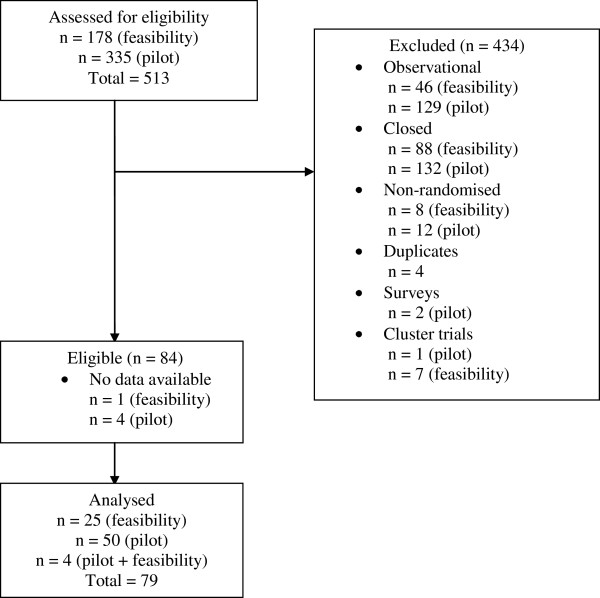
Background: There is little published guidance as to the sample size required for a pilot or feasibility trial despite the fact that a sample size justification is a key element in the design of a trial. A sample size justification should give the minimum number of participants needed in order to meet the objectives of the trial. This paper seeks to describe the target sample sizes set for pilot and feasibility randomised controlled trials, currently running within the United Kingdom. Methods: Data were gathered from the United Kingdom Clinical Research Network (UKCRN) database using the search terms ‘pilot’ and ‘feasibility’. From this search 513 studies were assessed for eligibility of which 79 met the inclusion criteria. Where the data summary on the UKCRN Database was incomplete, data were also gathered from: the International Standardised Randomised Controlled Trial Number (ISRCTN) register; the clinicaltrials.gov website and the website of the funders. For 62 of the trials, it was necessary to contact members of the research team by email to ensure completeness. Results: Of the 79 trials analysed, 50 (63.3%) were labelled as pilot trials, 25 (31.6%) feasibility and 14 were described as both pilot and feasibility trials. The majority had two arms (n = 68, 86.1%) and the two most common endpoints were continuous (n = 45, 57.0%) and dichotomous (n = 31, 39.2%). Pilot trials were found to have a smaller sample size per arm (median = 30, range = 8 to 114 participants) than feasibility trials (median = 36, range = 10 to 300 participants). By type of endpoint, across feasibility and pilot trials, the median sample size per arm was 36 (range = 10 to 300 participants) for trials with a dichotomous endpoint and 30 (range = 8 to 114 participants) for trials with a continuous endpoint. Publicly funded pilot trials appear to be larger than industry funded pilot trials: median sample sizes of 33 (range = 15 to 114 participants) and 25 (range = 8 to 100 participants) respectively. Conclusion: All studies should have a sample size justification. Not all studies however need to have a sample size calculation. For pilot and feasibility trials, while a sample size justification is important, a formal sample size calculation may not be appropriate. The results in this paper describe the observed sample sizes in feasibility and pilot randomised controlled trials on the UKCRN Database.
Overview
The claims and statistics of this paper haven’t been checked yet.
Free: it reads the open-access text and checks the first 5 claims that cite a source we can check. Create a free account to check every claim.
Integrity signals
Registry
Cites
Statistics
Figures
Verification
Claims the paper makes
The claims and statistics of this paper haven’t been checked yet.
Free: it reads the open-access text and checks the first 5 claims that cite a source we can check. Create a free account to check every claim.
Claims other papers make about this one
Each is checked against this paper’s own text: does it say what the citing paper says it does?
The source backs part of the claim, not all of it — or backs it for a different population, condition or comparison.
In the citing paper
“More recently, research has begun to explore the differences between internal and external pilot studies and their contribution to main trials, and the appropriateness of pilot and feasibility studies for estimating the sample size.”
From Role of feasibility and pilot studies in randomised controlled trials: a cross-sectional study (2018) · cites this paper as [12]
Experimental — accuracy not yet measuredThe source backs part of the claim, not all of it — or backs it for a different population, condition or comparison.
In the citing paper
“Current recommendations for sample sizes of pilot/feasibility studies vary, have a single rather than a multi-criterion basis, and do not necessarily link directly to formal progression criteria.”
From Determining sample size for progression criteria for pragmatic pilot RCTs: the hypothesis test strikes back! (2021) · cites this paper as [16]
Experimental — accuracy not yet measuredThe source backs part of the claim, not all of it — or backs it for a different population, condition or comparison.
In the citing paper
“When looking at hybrid human delivered pilot studies, a sample size of 40 is on par with comparable research [105, 106].”
From Personalized machine learning guided intervention for optimizing lifestyle behaviors in depression: a pilot study (2026) · cites this paper as [106]
Experimental — accuracy not yet measuredThe source backs part of the claim, not all of it — or backs it for a different population, condition or comparison.
In the citing paper
“Feasibility studies are not designed to evaluate effects, and there is no definitive approach to estimating their correct sample size [49].”
From Changes in pain, daily occupations, lifestyle, and health following an occupational therapy lifestyle intervention: a secondary analysis from a feasibility study in patients with chronic high-impact pain (2024) · cites this paper as [49]
Experimental — accuracy not yet measuredThe source backs part of the claim, not all of it — or backs it for a different population, condition or comparison.
In the citing paper
“There is no consensus but recommendations vary from 10 to 12 per group through to 60–75 per group depending on the main objective of the study.”
From Determining sample size for progression criteria for pragmatic pilot RCTs: the hypothesis test strikes back! (2021) · cites this paper as [16]
Experimental — accuracy not yet measured
9 more claims about this paper
Create a free account to see every claim other papers make about this one.
Self-check
Percentages, sums and reported differences re-computed from the paper’s own numbers.
The self-check needs the paper’s full text.
Citations
Cites
A tutorial on pilot studies: the what, why and how
Thabane, L., Ma, J., Chu, R., Cheng, J., Ismaila, A., Rios, L. P., Robson, R., Thabane, M., Giangregorio, L., & Goldsmith, C. H. (2010) · BMC Medical Research Methodology · doi:10.1186/1471-2288-10-1 · Cited by 3,384
Sample size of 12 per group rule of thumb for a pilot study
Julious, S. A. (2005) · Pharmaceutical Statistics · doi:10.1002/pst.185 · Cited by 3,068 · cited 6×
“Julious [9] recommends a minimum sample size of 12 per group as a rule of thumb and justifies this based on rationale about feasibility and precision about the mean and variance;”
BackgroundInfluentialSelf-citationDesign and analysis of pilot studies: recommendations for good practice
Lancaster, G. A., Dodd, S., & Williamson, P. R. (2004) · Journal of Evaluation in Clinical Practice · doi:10.1111/j..2002.384.doc.x · Cited by 2,572 · cited 3×
“There is the additional issue that setting the sample size too high may lead to a preventable failure to reach the recruitment target [12].”
BackgroundResultConsiderations in determining sample size for pilot studies
Hertzog, M. A. (2008) · Research in Nursing & Health · doi:10.1002/nur.20247 · Cited by 2,337 · cited 2×
“Hertzog [6] recommends the Julious and Patterson [7] method of using confidence intervals for a given precision constructed around the anticipated value to set the sample size;”
BackgroundMethodWhat is a pilot or feasibility study? A review of current practice and editorial policy
Arain, M., Campbell, M. J., Cooper, C. L., & Lancaster, G. A. (2010) · BMC Medical Research Methodology · doi:10.1186/1471-2288-10-67 · Cited by 1,483 · cited 9×
“[2] concluded that pilot trials are poorly reported and that the authors are often not explicit as to the purpose of their pilot trial.”
BackgroundResultInfluentialSim, J., & Lewis, M. (2012) · Journal of Clinical Epidemiology · doi:10.1016/j.jclinepi.2011.07.011 · Cited by 1,036 · cited 6×
“Continuous 6 43 (15, 60) [10, 60] However, Arain et al.”
BackgroundInfluentialOn the use of a pilot sample for sample size determination
Browne, R. H. (1995) · Statistics in Medicine · doi:10.1002/sim.4780141709 · Cited by 1,007 · cited 2×
“Trial description Pilot 50 30 (20, 45) [8, 114]”
BackgroundRecommendations for Planning Pilot Studies in Clinical and Translational Research
Moore, C. G., Carter, R. E., Nietert, P. J., & Stewart, P. W. (2011) · Clinical and Translational Science · doi:10.1111/j.1752-8062.2011.00347.x · Cited by 661 · cited 2×
“[16] highlighted that it is not unusual for study proposal reviewers to come across a statement such as “No sample size justification is needed because of the pilot nature of the proposed study”, but they state that pilot trials are not exempt from needing a clear rationale for the number of patients to be included.”
BackgroundStatistics and ethics in medical research: III How large a sample?
Altman, D. G. (1980) · BMJ · doi:10.1136/bmj.281.6251.1336 · Cited by 580 · cited 1×
“If a study is too large it may be judged to be unethical as participants may be unnecessarily exposed to risks and burdens [11].”
BackgroundCampbell, M. J., Julious, S. A., & Altman, D. G. (1995) · BMJ · doi:10.1136/bmj.311.7013.1145 · Cited by 476
Self-citation
Research works printed but not linked: 1
- 14. SPSS Inc: Released 2009. PASW statistics for windows, version 18.0. Chicago: SPSS Inc; 2009.
Cited by
Items 101–200 of 964
Ngo, T. T. A., An, G. K., Dao, D. K., Nguyen, N. A., Nguyen, N. Y. V., & Phong, B. H. (2025) · PLoS ONE · doi:10.1371/journal.pone.0323962 · Cited by 75
Hoskins, G., Williams, B., Abhyankar, P., Donnan, P. T., Duncan, E., Pinnock, H., Pol, M. M. V. D., Rauchhaus, P., Taylor, A., & Sheikh, A. (2016) · Trials · doi:10.1186/s13063-016-1684-7 · Cited by 26
“working with asthma-trained nurses in primary care [59] and the published literature [60], we aimed to recruit 80 patients with active asthma from eight practices across”
BackgroundRuseckaite, R., Detering, K. M., Evans, S., Perera, V., Walker, L., Sinclair, C., Clayton, J. M., & Nolte, L. (2017) · BMJ Open · doi:10.1136/bmjopen-2017-018024 · Cited by 21
“Population size While a sample size justification is important for pilot and feasibility trials, a formal sample size calculation may not be appropriate.(30) On the basis of assumptions and findings from previous research, we have chosen a sample of 50 people from each organisation, with an expected total sample size…”
BackgroundMartin-McGill, K. J., Marson, A. G., Smith, C. T., & Jenkinson, M. D. (2017) · Pilot and Feasibility Studies · doi:10.1186/s40814-017-0209-9 · Cited by 23
“[37] demonstrate a median sample size of 30 (range 8–114 participants) for UK pilot studies, whilst Hertzog [38] reports on the statistical adequacy for sample sizes of 10–40, thus further justifying a sample size of 12 for the current trial.”
BackgroundO’Donnell, L. K., Gnjidic, D., Chen, T. F., & Hilmer, S. N. (2019) · Therapeutic Advances in Drug Safety · doi:10.1177/2042098619832471 · Cited by 23
Smart Patch for Skin Temperature: Preliminary Study to Evaluate Psychometrics and Feasibility
Kim, H., Kim, S., Lee, M. G., Rhee, Y., Lee, S., Jeong, Y.-R., Kang, S., Naqi, M., & Hong, S. (2021) · Sensors · doi:10.3390/s21051855 · Cited by 27
“However, compared to the previ us study propose sample size of 30 was considered adequate to meet the objectives of the study and recommend a sample size of 12–30 individuals for feasibility studies [24,29].”
ResultLi, C., Xiong, Y. Y., Muessig, K. E., Tang, W., Huang, H., Mu, T., Tong, X., Yu, J., Yang, Z., Sherer, R. D., et al. (2022) · BMJ Open · doi:10.1136/bmjopen-2021-055899 · Cited by 24
The feasibility of using smartphone apps as treatment components for depressed suicidal outpatients
Nuij, C., van Ballegooijen, W., Beurs, D. P. D., de Winter, R. F. P., Gilissen, R., O’Connor, R. C., Smit, J. H., Kerkhof, A. J. F. M., & Riper, H. M. (2022) · Frontiers in Psychiatry · doi:10.3389/fpsyt.2022.971046 · Cited by 25
“(27) reported a median sample size of 36 participants, with a range of 10–300 participants.”
BackgroundBorkoles, E., Krastins, D., van der Pols, J. C., Sims, P., & Polman, R. C. J. (2022) · Nutrients · doi:10.3390/nu14194214 · Cited by 30
“No power calculation was conducted for this study [26].”
MethodSha, S., Loveys, K., Qualter, P., Shi, H., Krpan, D., & Galizzi, M. M. (2024) · BMC Public Health · doi:10.1186/s12889-024-19153-x · Cited by 28
“Together, studies included 286 participants with individual study sample sizes ranging from 4 to 42 Based on guidance, we classified 86% of these studies as feasibility studies, since they included fewer than 25 participants in total, or fewer than 25 participants per group [44].”
BackgroundDemchenko, I., Rampersad, S. M., Datta, A., Horn, A., Churchill, N. W., Kennedy, S. H., Krishnan, S., Rueda, A., Schweizer, T. A., Griffiths, J. D., et al. (2024) · Frontiers in Neuroscience · doi:10.3389/fnins.2024.1390250 · Cited by 25
Pilot Studies in clinical research
Julious, S. A. (2016) · Statistical Methods in Medical Research · doi:10.1177/0962280216651022 · Cited by 22
“Not all trials need a sample size calculation.(12) This is particularly true for pilot trials.”
Self-citationon behalf of the General Practice Pharmacist (GPP) Study Group, Cardwell, K., Clyne, B., Moriarty, F., Wallace, E., Fahey, T. P., Boland, F., McCullagh, L., Clarke, S., Finnigan, K., et al. (2018) · Pilot and Feasibility Studies · doi:10.1186/s40814-018-0311-7 · Cited by 21
Rezapour, T., Barzegari, M., Sharifi, E., Malmir, N., Ghiasvand, H., Salehi, M., Noroozi, A., & Ekhtiari, H. (2021) · Basic and Clinical Neuroscience Journal · doi:10.32598/bcn.2021.809.3 · Cited by 26
Wong, A. K. C., Wong, F. K. Y., Wong, M. C. S., Chow, K. K. S., Kwan, D. K. S., & Lau, D. Y. S. (2022) · BMC Geriatrics · doi:10.1186/s12877-022-03463-z · Cited by 29
“As a general rule for pilot studies, the minimum number of participants should be set at not less than 30 in each group [33].”
BackgroundWhitehead, P. J., Golding-Day, M. R., Belshaw, S., Dawson, T., James, M., & Walker, M. F. (2018) · BMC Public Health · doi:10.1186/s12889-018-6200-4 · Cited by 26
Evans, H. E. L., Forbes, C. C., Galvao, D. A., Vandelanotte, C., Newton, R. U., Wittert, G., Chambers, S. K., Vincent, A. D., Kichenadasse, G., Brook, N. R., et al. (2021) · Pilot and Feasibility Studies · doi:10.1186/s40814-020-00763-2 · Cited by 22
Learning with older people—Outcomes of a quasi-experimental study
Koskinen, S., Salminen, L., Puukka, P. J., & Leino‐Kilpi, H. (2015) · Nurse Education Today · doi:10.1016/j.nedt.2015.11.018 · Cited by 24
“Moreover, since the LOPP was only being conducted for the first time, there was no complete awareness of how it would go with the older people; we wished to avoid the need to make any unnecessary arrangements concerning nursing schools and particular students (Billingham et al., 2013).”
BackgroundCross, A. J., George, J., Woodward, M. C., Le, V. J., & Elliott, R. A. (2020) · Research in Social and Administrative Pharmacy · doi:10.1016/j.sapharm.2020.01.010 · Cited by 20
Brazil, K., Scott, D. A., Wallace, E., Clarke, M. J., Fahey, T. P., Gillespie, P. H., O’Halloran, P. D., Cardwell, C. R., Carter, G., McGlade, K. J., et al. (2020) · Trials · doi:10.1186/s13063-020-4100-2 · Cited by 24
Holthe, I. L., Rohrer-Baumgartner, N., Svendsen, E. J., Hauger, S. L., Forslund, M. V., Borgen, I. M. H., Øra, H. P., Kleffelgård, I., Strand-Saugnes, A. P., Egeland, J., et al. (2022) · Journal of Clinical Medicine · doi:10.3390/jcm11092564 · Cited by 21
“This is adequate according to the recommendations for optimal sample size in clinical pilot studies [63,64].”
MethodGreene, M. C., Bonz, A. G., Cristobal, M., Vega, C., Andersen, L. S., Angulo, A., Armijos, A., Guevara, M. E., Benavides, L., de la Cruz, A., et al. (2022) · Pilot and Feasibility Studies · doi:10.1186/s40814-022-01085-1 · Cited by 21
“This sample size is comparable to prior feasibility trials of group psychosocial interventions and will enable us to sufficiently pilot the study procedures and evaluate the relevance, acceptability, and feasibility of the intervention and trial design [53, 54].”
MethodKeihanian, T., Zabad, N., Khalaf, M. A., Abdel-Jaber, W., Kim, Y., Jawaid, S. A., Abidi, W. M., Marginean, E. C., & Othman, M. O. (2023) · Gastrointestinal Endoscopy · doi:10.1016/j.gie.2023.04.006 · Cited by 20
Pilot Evaluation of a Functional Pain Assessment Scale
Halm, M. A., Bailey, C., Pierre, J. S., Boutin, N., Rojo, S., Shortt, M., Theobald, L., & Pettycrew, E. (2018) · Clinical Nurse Specialist · doi:10.1097/nur.0000000000000416 · Cited by 21
Lin, L. K., Wang, X., Wang, W., Zhou, X., & Hargreaves, J. (2020) · Antibiotics · doi:10.3390/antibiotics9050212 · Cited by 21
Elsaesser, M., Herpertz, S., Piosczyk, H., Jenkner, C., Hautzinger, M., & Schramm, E. (2022) · BMJ Open · doi:10.1136/bmjopen-2021-057672 · Cited by 19
Papi, E., Chiou, S., & McGregor, A. H. (2020) · BMJ Open · doi:10.1136/bmjopen-2020-039054 · Cited by 21
Factors influencing sleep quality in the intensive care unit: a descriptive pilot study in Korea
Ahn, Y. H., Lee, H. Y., Lee, S., & Lee, J. (2023) · Acute and Critical Care · doi:10.4266/acc.2023.00514 · Cited by 27
“As a pilot study, the sample size was not calculated a priori [18-20].”
Minarini, G., Ford, M., & Esteves, J. E. (2018) · International journal of osteopathic medicine · doi:10.1016/j.ijosm.2018.10.002 · Cited by 21
The use of a synthetic shoulder patch for large and massive rotator cuff tears – a feasibility study
Cowling, P. D., Hackney, R. G., Dube, B., Grainger, A. J., Biglands, J. D., Stanley, M., Song, D., Conaghan, P. G., & Kingsbury, S. R. (2020) · BMC Musculoskeletal Disorders · doi:10.1186/s12891-020-03227-z · Cited by 20
“Muscles were also graded with the Goutallier Classification [42] using the 0–4 grading system.”
MethodPeek, J., Hay, K. E., Hughes, P., Kostellar, A., Kumar, S., Bhikoo, Z., Serginson, J. G., & Marshall, H. (2021) · JMIR Formative Research · doi:10.2196/24976 · Cited by 22
“Assuming less than 20% loss to follow-up, a sample size of 64 would inform our aims of determining feasibility and acceptability [21,22].”
BackgroundMorris, J. H., Kelly, C. J., Toma, M., Kroll, T., Joice, S., Mead, G. E., Donnan, P. T., & Williams, B. (2014) · Trials · doi:10.1186/1745-6215-15-380 · Cited by 21
“between 30 and 36 per arm is adequate for a feasibility trial [55].”
Kioskli, K., Winkley, K., & McCracken, L. M. (2019) · Journal of Contextual Behavioral Science · doi:10.1016/j.jcbs.2019.07.002 · Cited by 18
Wong, W. T., Tan, N. C., Lim, J. E., Allen, J. C., Lee, W. S., Quah, J. H. M., Muthulakshmi, P., Teh, T. A., Lim, S. H., & Malhotra, R. (2021) · Frontiers in Aging Neuroscience · doi:10.3389/fnagi.2021.756891 · Cited by 19
“For feasibility studies, sample size justifications need to be provided but not necessarily a sample size calculation (Billingham et al., 2013).”
BackgroundPromoting Sports Engagement during the COVID-19 Pandemic via Virtual Reality Games
Hanifah, H., Ito, Y., Yao, D. P., Suyama, N., & Inoue, K. (2022) · Occupational Therapy International · doi:10.1155/2022/4824152 · Cited by 27
“A pre-experimental design is often used before conducting the true experiment to examine if the intervention can affect a potential small group [29].”
MethodNielsen, I. H., Piil, K., Tolver, A., Grønbæk, K., Kjeldsen, L., & Jarden, M. (2022) · Supportive Care in Cancer · doi:10.1007/s00520-022-07089-0 · Cited by 20
Davies, K. F., Clarke, S., Martins, R., Rudd, J. R., & Duncan, M. J. (2024) · Psychology of sport and exercise · doi:10.1016/j.psychsport.2024.102636 · Cited by 25
Watkins, J. M., Brunnemer, J. E., Heeter, K. N., Medellin, A. M., Churchill, W. C., Goss, J. M., Hobson, J. M., Werner, N. E., Weaver, R. G., Kercher, V. M. M., et al. (2024) · BMC Public Health · doi:10.1186/s12889-024-19356-2 · Cited by 27
“Additionally, the study’s sample size, while consistent with the typical scale for a feasibility study [48], remains relatively small.”
BackgroundWilson, D. T., Walwyn, R. E., Brown, J., Farrin, A. J., & Brown, S. R. (2016) · Statistical Methods in Medical Research · doi:10.1177/0962280215589507 · Cited by 18
Juniar, D., van Ballegooijen, W., Karyotaki, E., van Schaik, A., Passchier, J., Heber, E., Lehr, D., Sadarjoen, S. S., & Riper, H. M. (2019) · JMIR Research Protocols · doi:10.2196/11493 · Cited by 21
“Due to the aim of our feasibility study, a formal calculation of sample size may not be suitable [55].”
Having Fun Doing Math: Text Messages Promoting Parent Involvement Increased Student Learning
Santana, M., Nussbaum, M., Carmona, R., & Claro, S. (2019) · Journal of Research on Educational Effectiveness · doi:10.1080/19345747.2018.1543374 · Cited by 30
“Billingham, Whitehead, and Julious (2013) state that for pilot trials, “a formal sample size calculation may not be appropriate,” (p.1) because a larger sample size may entail exposing participants to unnecessary risks.”
BackgroundBardus, M., Hamadeh, G. N., Hayek, B., & Kherfan, R. A. (2018) · JMIR Research Protocols · doi:10.2196/resprot.9793 · Cited by 20
Smith, S. G., Ellison, R., Hall, L., Clark, J., Hartley, S., Mason, E., Metherell, J., Olivier, C., Napp, V., Naik, J., et al. (2022) · Pilot and Feasibility Studies · doi:10.1186/s40814-022-00985-6 · Cited by 17
Wang, L., Norman, I., Xiao, T., Li, Y., Li, X., Liu, T., Wang, J., Zeng, L., Zhong, Z., Jian, C., et al. (2024) · European Journal of Psychotraumatology · doi:10.1080/20008066.2023.2299195 · Cited by 17
“These recommendations included that: (1) the sample size should be 10% of the projected sample size for the de fi nitive study that will be informed by the feasibility study; or (2) a sample size of between 24 and 50 may be reasonable in a feasibility study (Billingham et al., 2013).”
BackgroundStephenson, A., García-Constantino, M., MURPHY, M. H., McDonough, S., Nugent, C., & Mair, J. L. (2021) · BMC Public Health · doi:10.1186/s12889-021-11473-6 · Cited by 26
“As this was a feasibility study, a sample size calculation was not necessary [25].”
Gouez, M., Pérol, O., Pérol, M., Caux, C., Ménétrier‐Caux, C., Villard, M., Walzer, T., Delrieu, L., Saintigny, P., Marijnen, P., et al. (2022) · BMJ Open · doi:10.1136/bmjopen-2021-056819 · Cited by 33
Woodford, J., Farrand, P. A., Watkins, E. R., Richards, D. A., & Llewellyn, D. J. (2014) · Trials · doi:10.1186/1745-6215-15-157 · Cited by 20
“As such, we will use the recommended sample size of 30 participants per arm for feasibility studies [56] consistent with the median sample size found in both feasibility and pilot RCTs [57].”
Methodde Paula, T. R., Nemeth, S. K., Kurlansky, P. A., Simon, H. L., Miller, L. K., & Keller, D. S. (2020) · Annals of Surgery · doi:10.1097/sla.0000000000004701 · Cited by 19
“This was based on an estimated rate of achieving 50% of eligible people needed for the full-powered randomized controlled trial (RCT) to test our hypotheses.(20) If feasibility was successful, conversion to a full RCT was planned, with a recruitment goal of 100.”
BackgroundNadal, C., Earley, C., Enrique, Á., Viganò, N., Sas, C., Richards, D., & Doherty, G. J. (2021) · Contemporary Clinical Trials · doi:10.1016/j.cct.2021.106323 · Cited by 19
“Indeed, Teare et al. recommend 35 subjects per group [32] and a review by Billingham et al. [61] found that the median pilot study sample size was 30 per arm for continuous endpoints.”
BackgroundShrestha, S., Blebil, A. Q., Teoh, S. L., Sapkota, S., Bhuvan, K. C., Paudyal, V., & Gan, S. H. (2023) · Journal of Pharmaceutical Policy and Practice · doi:10.1186/s40545-022-00505-0 · Cited by 17
“Sample size Sample size calculation is generally not mandatory for a pilot study [28].”
BackgroundCool, L., Missiaen, J., Vandijck, D. M., Lefebvre, T., Lycke, M., Jonghe, P. J. D., Vergauwe, P. L., Foulon, V., Pottel, H., Debruyne, P. R., et al. (2019) · European Journal of Oncology Nursing · doi:10.1016/j.ejon.2019.03.003 · Cited by 21
Basile, M. J., Andrews, J., Jacome, S. N., Zhang, M., Kozikowski, A., & Hajizadeh, N. (2018) · Journal of Participatory Medicine · doi:10.2196/jopm.9877 · Cited by 24
“We selected the sample size based on other feasibility studies and our experience with recruitment from the outpatient clinics [9].”
Lindner, O. C., Boon, I. S., Joffe, J., & Stark, D. (2020) · European Journal of Cancer Care · doi:10.1111/ecc.13264 · Cited by 17
Mauritz, M. W., van Gaal, B. G. I., Goossens, P. J. J., Jongedijk, R. A., & Vermeulen, H. (2020) · BJPsych Open · doi:10.1192/bjo.2020.124 · Cited by 16
Febvey‐Combes, O., Jobard, É., Rossary, A., Pialoux, V., Foucaut, A.-M., Morelle, M., Delrieu, L., Martin, A., Caldefie‐Chezet, F., Touillaud, M. S., et al. (2021) · Integrative Cancer Therapies · doi:10.1177/1534735420977666 · Cited by 18
Marshall, R., Campbell, E., Ho, F. K. W., Banger, M. S., Ireland, J. L., Rowe, P. J., McAlpine, C. H., McArthur, K., Quinn, T. J., & Gray, S. R. (2021) · Experimental Gerontology · doi:10.1016/j.exger.2021.111496 · Cited by 20
“To inform the design of a future definitive RCT a recruitment target of 60 participants (30 per arm) was set (Billingham et al., 2013).”
BackgroundCaetano, L. C. G., Ada, L., Sant’Anna, R. V., Teixeira‐Salmela, L. F., & Scianni, A. A. (2021) · Topics in Stroke Rehabilitation · doi:10.1080/10749357.2021.1978630 · Cited by 16
de Angel, V., Lewis, S., Munir, S., Matcham, F., Dobson, R., & Hotopf, M. H. (2022) · BMJ Open · doi:10.1136/bmjopen-2021-059258 · Cited by 18
Zhong, J., Brown, S., Serra, M., Shuttleworth, P., Bownes, P. J., Thompson, C., Reed, R., Reeves, K. J., Dubec, M. J., McHugh, D. J., et al. (2022) · BMJ Open · doi:10.1136/bmjopen-2022-068580 · Cited by 16
Papachristou, N., Kartsidis, P. E., Anagnostopoulou, A., Marshall, R., Kotronoulas, G., Collantes, G., Valdivieso, B., Santaballa, A., Conde-Moreno, A. J., Domenech, J. R., et al. (2023) · Seminars in Oncology Nursing · doi:10.1016/j.soncn.2023.151437 · Cited by 19
Kennedy, M., Maddox, R., Mersha, A. G., Chamberlain, C., Segan, C., Clarke, K., Donaldson, B., Roberts-Barker, K., Forster, J., Booth, K., et al. (2024) · Nicotine & Tobacco Research · doi:10.1093/ntr/ntae106 · Cited by 16
Caperchione, C. M., Sabiston, C. M., Stolp, S., Bottorff, J. L., Campbell, K. L., Eves, N. D., Ellard, S. L., Gotay, C. C., Sharp, P., Pullen, T., et al. (2019) · BMC Cancer · doi:10.1186/s12885-019-5470-2 · Cited by 19
Eccles, F. J. R., Craufurd, D., Smith, A. M. S., Davies, R., Glenny, K., Homberger, M., Peeren, S., Rogers, D., Rose, L., Skitt, Z., et al. (2020) · Pilot and Feasibility Studies · doi:10.1186/s40814-020-00631-z · Cited by 21
Wong, A. K. C., Wong, F. K. Y., Jenny Sau Chun, N. G. A. I., Shirley Yu Kan, H. U. N. G., & Li, W. C. (2020) · BMC Geriatrics · doi:10.1186/s12877-020-01722-5 · Cited by 17
Bringmann, H. C., Bringmann, N., Jeitler, M., Brunnhuber, S., Michalsen, A., & Sedlmeier, P. (2021) · Complementary Therapies in Medicine · doi:10.1016/j.ctim.2020.102598 · Cited by 16
Lucas, R., Bernier, K. M., Perry, M., Evans, H., Ramesh, D., Young, E. E., Walsh, S. J., & Starkweather, A. R. (2019) · Research in Nursing & Health · doi:10.1002/nur.21938 · Cited by 24
Gunn, H., Andrade, J., Paul, L., Miller, L., Creanor, S., Stevens, K. N., Green, C., Ewings, P., Barton, A., Berrow, M., et al. (2019) · Health Technology Assessment · doi:10.3310/hta23270 · Cited by 18
A software to prevent delirium in hospitalised older adults: development and feasibility assessment
Álvarez, E., Garrido, M. A., Ponce, D. P., Gaspar Pizarro, V., Córdova, A., Vera, F., Ruiz, R., Fernández, R., Velásquez, J. D., Tobar, E. A., et al. (2019) · Age and Ageing · doi:10.1093/ageing/afz166 · Cited by 16
“Sample size was estimated using recommendations for pilot studies design [18].”
MethodMorris, A. S., Mackintosh, K. A., Dunstan, D., Owen, N., Dempsey, P., Pennington, T., & McNarry, M. A. (2020) · International Journal of Environmental Research and Public Health · doi:10.3390/ijerph17249300 · Cited by 15
Dunphy, E., Button, K., Hamilton, F. L., Williams, J., Spasić, ., & Murray, E. (2021) · BMJ Open Sport & Exercise Medicine · doi:10.1136/bmjsem-2020-001002 · Cited by 18
Mathews, A., Gibbons, N., Harrison, E., Ukoumunne, O. C., & Stallard, P. N. (2022) · Behavioral Sleep Medicine · doi:10.1080/15402002.2022.2063866 · Cited by 22
“This was a pre-post feasibility study so no formal power analysis was undertaken (Billingham et al., 2013).”
BackgroundPandria, N., Petronikolou, V., Lazaridis, A., Karapiperis, C., Kouloumpris, E., Spachos, D., Fachantidis, A., Vasiliou, D., Vlahavas, I. P., & Bamidis, P. D. (2022) · JMIR Research Protocols · doi:10.2196/40189 · Cited by 16
Juniar, D., van Ballegooijen, W., Schulte, M., van Schaik, A., Passchier, J., Heber, E., Lehr, D., Sadarjoen, S., & Riper, H. (2022) · JMIR Formative Research · doi:10.2196/37278 · Cited by 16
Bouwman, E., Hermens, R., Brown, M. C., Araújo‐Soares, V., Blijlevens, N. M. A., Kepák, T., Kepáková, K., Kremer, L. C. M., van den Oever, S. R., van der Pal, H. J. H., et al. (2022) · Pilot and Feasibility Studies · doi:10.1186/s40814-022-01221-x · Cited by 17
Amin, M., Kerr, D. C., Atiase, Y., Samir, M. M., & Driscoll, A. L. (2023) · International Journal of Environmental Research and Public Health · doi:10.3390/ijerph20085518 · Cited by 18
“ple size allowed adequate assessment of study outcomes and an anticipated attrition of approximately 20% [18].”
BackgroundMethodSemrau, M., Gronholm, P. C., Eaton, J., Maulik, P. K., Ayele, B., Bakolis, I., Mendon, G. B., Bhattarai, K., Brohan, E., Cherian, A. V., et al. (2024) · International Journal of Mental Health Systems · doi:10.1186/s13033-024-00649-3 · Cited by 42
Guidetti, S. G. E., Nielsen, K. T., von Bülow, C., Pilegaard, M. S., Klokker, L., & Wæhrens, E. E. (2018) · BMJ Open · doi:10.1136/bmjopen-2017-020812 · Cited by 14
“sample size As this study is a feasibility study, a sample size calculation is not required.(44) 45 However, the sample needs to be representative of the target population and to be large enough to provide information related to the feasibility and the potential outcome of the programme.”
Bergström, A., Borell, L., Meijer, S., & Guidetti, S. G. E. (2019) · BMJ Open · doi:10.1136/bmjopen-2018-025870 · Cited by 21
“Sample size and power considerations As this study is a feasibility study, a sample size calculation is not required.(51) 52 However, the sample should be representative of the target population and be large enough to provide information related to the feasibility and the potential outcome of the programme.”
BackgroundHall, M., Spiers, L., Knox, G., Hinman, R. S., Sumithran, P., & Bennell, K. L. (2021) · Osteoarthritis and Cartilage Open · doi:10.1016/j.ocarto.2021.100174 · Cited by 16
“A formal sample size calculation was not performed, due to this being a pilot study [48,49].”
BackgroundNørskov, K. H., Fridthjof, K. S., Kampmann, P., Dünweber, A., Andersen, C. L., Renaberg, T. P., Schöllkopf, C., Ahmad, S. A., Schou, K., Jensen, C. F., et al. (2021) · Leukemia Research · doi:10.1016/j.leukres.2021.106756 · Cited by 15
(2022) · doi:10.1186/s40814-022-01018-y · Cited by 15
“Sample size As this is a pilot study, a formal sample size calculation was not done [38].”
BackgroundLiu, X., Grace, S. L., Ghisi, G. L. D. M., Shi, W., Shen, C., OH, P. I., & Zhang, Y. (2022) · Health Education Research · doi:10.1093/her/cyac022 · Cited by 18
Corrado, J., Halpin, S. J., Preston, N., Whiteside, D., Tarrant, R., Davison, J., Simms, A. D., O’Connor, R. J., Casson, A. J., & Sivan, M. (2022) · BMJ Open · doi:10.1136/bmjopen-2022-066044 · Cited by 18
Bowers, B. J., Jacobson, N. A., & Krupp, A. E. (2016) · Research in Nursing & Health · doi:10.1002/nur.21752 · Cited by 14
Photorealistic Avatar and Teen Physical Activity: Feasibility and Preliminary Efficacy
Thompson, D. I., Cantu, D., Callender, C. S., Liu, Y., Rajendran, M., Rajendran, M., Zhang, Y., & Deng, Z. (2018) · Games for Health Journal · doi:10.1089/g4h.2017.0103 · Cited by 20
Pasanisi, P., Gariboldi, M., Verderio, P., Signoroni, S., Mancini, A., Rivoltini, L., Milione, M., MASCI, E., Ciniselli, C. M., Bruno, E., et al. (2019) · Integrative Cancer Therapies · doi:10.1177/1534735419846400 · Cited by 17
Hagström, J., Ander, M., Cernvall, M., Ljótsson, B., Wiman, H., von Essén, L., & Woodford, J. (2020) · PeerJ · doi:10.7717/peerj.8714 · Cited by 16
Yusof, B. N. M., Zukiman, W. Z. H. H. W., Zaid, Z. A., Omar, N., Mukhtar, F., Yahya, N. F., Shahar, A. S. M., Hasbullah, F. Y., Yi, R. L. X., Marczewska, A. M., et al. (2020) · Nutrients · doi:10.3390/nu12030813 · Cited by 20
“In this feasibility study, we recruited at least 70% of participants from the primary planned statistical analyses [25].”
Methodfor the Canadian Critical Care Trials Group, Williamson, D. R., Cherifa, S. I., Frenette, A. J., Saavedra‐Mitjans, M., Charbonney, E., Cataford, G., Williams, V., Palacios, J. L., Burry, L. D., et al. (2020) · Pilot and Feasibility Studies · doi:10.1186/s40814-020-00736-5 · Cited by 21
“A total of 30 patients were expected to be recruited in this pilot study [28].”
BackgroundFatkin, T., Moore, S. K., Okst, K., Creedon, T. B., Samawi, F., Fredericksen, A. K., Roll, D., Oxnard, A., Lê Cook, B., & Schuman-Olivier, Z. (2021) · Journal of Substance Abuse Treatment · doi:10.1016/j.jsat.2021.108415 · Cited by 14
Myers, N. D., Lee, S., Bateman, A. G., Prilleltensky, I., Clevenger, K. A., Pfeiffer, K. A., Dietz, S., Prilleltensky, O., McMahon, A., & Brincks, A. M. (2019) · Pilot and Feasibility Studies · doi:10.1186/s40814-019-0455-0 · Cited by 14
“First, the target sample size fits well within the range of sample sizes often observed in pilot and feasibility trials [45].”
BackgroundFarrand, P. A., Woodford, J., Coumoundouros, C., & Svedin, F. (2020) · The Cognitive Behaviour Therapist · doi:10.1017/s1754470x20000239 · Cited by 17
“The recommended sample size of 30 participants per arm for pilot RCTs was used (Browne, 1995), consistent with the median sample size found in pilot RCTs (Billingham et al ., 2013).”
InfluentialGjone, H., Burns, G., Teasdale, T. L., Pham, T., Khan, S. A., & Hattingh, L. (2022) · International Journal of Clinical Pharmacy · doi:10.1007/s11096-022-01436-1 · Cited by 15
“However, in accordance with the literature on sample sizes for exploratory studies and to obtain data that is approximately normally distributed, the aim was to observe at least 40 discharges [22, 23].”
ResultPitt, E., Cashion, C., Rumble, S., & Bradford, N. (2023) · Seminars in Oncology Nursing · doi:10.1016/j.soncn.2023.151434 · Cited by 14
Use of virtual reality in preoperative education of cardiac surgery patients – A feasibility study
van Rijn, M. M., de Heer, L. M., Nieuwenhuis-Wendt, J., van der Kaaij, N. P., Moolenaar, E. G. E., van der Ham, D. H., der Plank, L. V., Westland, H., & Weldam, S. W. M. (2024) · Patient Education and Counseling · doi:10.1016/j.pec.2024.108394 · Cited by 19
“Another study describes for a feasibility study with two arms, 25 participants per arm are advised [19].”
BackgroundBurns, E. E., Hunter, L., Rodd, Z., Macleod, M. R., & Smith, L. A. (2018) · Midwifery · doi:10.1016/j.midw.2018.10.004 · Cited by 19
Nørskov, K. H., Overgaard, D., Boesen, J., Struer, A., El-Azem, S. E. W. D., Tolver, A., Lomborg, K. E., Kjeldsen, L., & Jarden, M. (2020) · Supportive Care in Cancer · doi:10.1007/s00520-020-05819-w · Cited by 14
Near-falls in Singapore community-dwelling older adults: a feasibility study
Soh, S. L.-H., Tan, C.-W., Lane, J. V., Yeh, T., & Soon, B. (2021) · Pilot and Feasibility Studies · doi:10.1186/s40814-020-00748-1 · Cited by 14
Ke, J. X. C., George, R. B., Wozney, L., & Munro, A. (2021) · Canadian Journal of Anesthesia/Journal canadien d anesthésie · doi:10.1007/s12630-020-01907-x · Cited by 15
Grootven, B. V., Jeuris, A., Jonckers, M., Devriendt, E., de Casterlé, B. D., Dubois, C., Fagard, K., Herregods, M., Hornikx, M., Meuris, B., et al. (2022) · BMC Geriatrics · doi:10.1186/s12877-022-03051-1 · Cited by 20
“(2013) on the sample sizes of pilot studies [19].”
Background
Metadata
- Authors
- Billingham, S. A., Whitehead, A. L., & Julious, S. A.
- Affiliations
- University of Sheffield (GB)
- Corresponding author
- Julious, Steven A
- Venue
- BMC Medical Research Methodology
- Published
- 2013-08-20
- Volume
- 13
- Issue
- 1
- Pages
- 104-104
- ISSN
- 1471-2288 (ISSN-L)
- PMC
- PMC3765378
- OpenAlex
- W2027748528
- Semantic Scholar
- 725b8e2a2b7f8a509bf11fd9dc8782de9cb9966f
- Cited by
- 962
- References
- 14
- Citations by year
- 2026: 117 · 2025: 124 · 2024: 132 · 2023: 102 · 2022: 148 · 2021: 98 · 2020: 86 · 2019: 46 · 2018: 44 · 2017: 21 · 2016: 22 · 2015: 14 · 2014: 8
- FWCI
- 11.92
- Type
- journal article
- Language
- en
- Open access
- gold
- doi.org
- Licence
- Locations
- BMC Medical Research Methodology (publishedVersion, cc-by)
- Europe PMC (PubMed Central) (publishedVersion, cc-by)
- PubMed Central (publishedVersion, cc-by)
- PubMed (publishedVersion)
- White Rose Research Online (University of Leeds, The University of Sheffield, University of York) (acceptedVersion)
- ePrints Soton (University of Southampton) (acceptedVersion)
- Topics
- Physical Sciences › Mathematics › Statistics and Probability › Statistical Methods in Clinical Trials
- Social Sciences › Decision Sciences › Statistics, Probability and Uncertainty › Meta-analysis and systematic reviews
- Physical Sciences › Mathematics › Statistics and Probability › Statistical Methods in Epidemiology
- Keywords
- pilot trial, feasibility trial, sample size justification, sample size determination, randomized controlled trials, trial design, funding sources, ClinicalTrials.gov
- MeSH terms
- Feasibility Studies, United Kingdom, Humans, Pilot Projects, Randomized Controlled Trials as Topic, Databases, Factual, Sample Size, Biomedical Research
About these checks
Registry, retraction, Cites and statistics results are computed, not judged, with one exception: a printed reference that no index lists is read once by a model before it counts as a citation error. Claims are extracted by a model and kept only when their quote appears verbatim in the text; each cited source is then checked, with a model’s help, for whether it says what the claim relies on. Those verdicts can be wrong — read the claim’s quote and the cited source before relying on one.
Statistics and arithmetic are recomputed, not judged.
Confidence bands are shown only for fields calibrated on our annotated test set. None is calibrated yet, so no band is shown.
What counts as a claim ›How we measure confidence ›How we check this ›
Are you an author, or do you see a problem with this page? Request a review
Data sources
Bibliographic data: Semantic Scholar, OpenAlex, Crossref.
Contains information from the Semantic Scholar Academic Graph Datasets, made available under the ODC Attribution License (ODC-BY 1.0).
Semantic Scholar’s data is described in: Kinney, R., et al. (2023). The Semantic Scholar Open Data Platform. arXiv:2301.10140.
