

An audit of sample sizes for pilot and feasibility trials being undertaken in the United Kingdom registered in the United Kingdom Clinical Research Network database
Open accessThe DOI matches its Crossref record; 14 of the 14 references it cites were found in a registry or an index.
Abstract
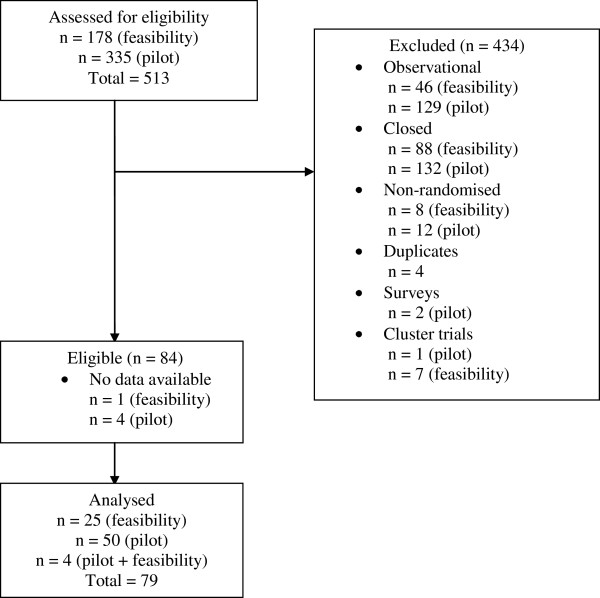
Background: There is little published guidance as to the sample size required for a pilot or feasibility trial despite the fact that a sample size justification is a key element in the design of a trial. A sample size justification should give the minimum number of participants needed in order to meet the objectives of the trial. This paper seeks to describe the target sample sizes set for pilot and feasibility randomised controlled trials, currently running within the United Kingdom. Methods: Data were gathered from the United Kingdom Clinical Research Network (UKCRN) database using the search terms ‘pilot’ and ‘feasibility’. From this search 513 studies were assessed for eligibility of which 79 met the inclusion criteria. Where the data summary on the UKCRN Database was incomplete, data were also gathered from: the International Standardised Randomised Controlled Trial Number (ISRCTN) register; the clinicaltrials.gov website and the website of the funders. For 62 of the trials, it was necessary to contact members of the research team by email to ensure completeness. Results: Of the 79 trials analysed, 50 (63.3%) were labelled as pilot trials, 25 (31.6%) feasibility and 14 were described as both pilot and feasibility trials. The majority had two arms (n = 68, 86.1%) and the two most common endpoints were continuous (n = 45, 57.0%) and dichotomous (n = 31, 39.2%). Pilot trials were found to have a smaller sample size per arm (median = 30, range = 8 to 114 participants) than feasibility trials (median = 36, range = 10 to 300 participants). By type of endpoint, across feasibility and pilot trials, the median sample size per arm was 36 (range = 10 to 300 participants) for trials with a dichotomous endpoint and 30 (range = 8 to 114 participants) for trials with a continuous endpoint. Publicly funded pilot trials appear to be larger than industry funded pilot trials: median sample sizes of 33 (range = 15 to 114 participants) and 25 (range = 8 to 100 participants) respectively. Conclusion: All studies should have a sample size justification. Not all studies however need to have a sample size calculation. For pilot and feasibility trials, while a sample size justification is important, a formal sample size calculation may not be appropriate. The results in this paper describe the observed sample sizes in feasibility and pilot randomised controlled trials on the UKCRN Database.
Overview
The claims and statistics of this paper haven’t been checked yet.
Free: it reads the open-access text and checks the first 5 claims that cite a source we can check. Create a free account to check every claim.
Integrity signals
Registry
Cites
Statistics
Figures
Verification
Claims the paper makes
The claims and statistics of this paper haven’t been checked yet.
Free: it reads the open-access text and checks the first 5 claims that cite a source we can check. Create a free account to check every claim.
Claims other papers make about this one
Each is checked against this paper’s own text: does it say what the citing paper says it does?
The source backs part of the claim, not all of it — or backs it for a different population, condition or comparison.
In the citing paper
“More recently, research has begun to explore the differences between internal and external pilot studies and their contribution to main trials, and the appropriateness of pilot and feasibility studies for estimating the sample size.”
From Role of feasibility and pilot studies in randomised controlled trials: a cross-sectional study (2018) · cites this paper as [12]
Experimental — accuracy not yet measuredThe source backs part of the claim, not all of it — or backs it for a different population, condition or comparison.
In the citing paper
“Current recommendations for sample sizes of pilot/feasibility studies vary, have a single rather than a multi-criterion basis, and do not necessarily link directly to formal progression criteria.”
From Determining sample size for progression criteria for pragmatic pilot RCTs: the hypothesis test strikes back! (2021) · cites this paper as [16]
Experimental — accuracy not yet measuredThe source backs part of the claim, not all of it — or backs it for a different population, condition or comparison.
In the citing paper
“When looking at hybrid human delivered pilot studies, a sample size of 40 is on par with comparable research [105, 106].”
From Personalized machine learning guided intervention for optimizing lifestyle behaviors in depression: a pilot study (2026) · cites this paper as [106]
Experimental — accuracy not yet measuredThe source backs part of the claim, not all of it — or backs it for a different population, condition or comparison.
In the citing paper
“Feasibility studies are not designed to evaluate effects, and there is no definitive approach to estimating their correct sample size [49].”
From Changes in pain, daily occupations, lifestyle, and health following an occupational therapy lifestyle intervention: a secondary analysis from a feasibility study in patients with chronic high-impact pain (2024) · cites this paper as [49]
Experimental — accuracy not yet measuredThe source backs part of the claim, not all of it — or backs it for a different population, condition or comparison.
In the citing paper
“There is no consensus but recommendations vary from 10 to 12 per group through to 60–75 per group depending on the main objective of the study.”
From Determining sample size for progression criteria for pragmatic pilot RCTs: the hypothesis test strikes back! (2021) · cites this paper as [16]
Experimental — accuracy not yet measured
9 more claims about this paper
Create a free account to see every claim other papers make about this one.
Self-check
Percentages, sums and reported differences re-computed from the paper’s own numbers.
The self-check needs the paper’s full text.
Citations
Cites
A tutorial on pilot studies: the what, why and how
Thabane, L., Ma, J., Chu, R., Cheng, J., Ismaila, A., Rios, L. P., Robson, R., Thabane, M., Giangregorio, L., & Goldsmith, C. H. (2010) · BMC Medical Research Methodology · doi:10.1186/1471-2288-10-1 · Cited by 3,384
Sample size of 12 per group rule of thumb for a pilot study
Julious, S. A. (2005) · Pharmaceutical Statistics · doi:10.1002/pst.185 · Cited by 3,068 · cited 6×
“Julious [9] recommends a minimum sample size of 12 per group as a rule of thumb and justifies this based on rationale about feasibility and precision about the mean and variance;”
BackgroundInfluentialSelf-citationDesign and analysis of pilot studies: recommendations for good practice
Lancaster, G. A., Dodd, S., & Williamson, P. R. (2004) · Journal of Evaluation in Clinical Practice · doi:10.1111/j..2002.384.doc.x · Cited by 2,572 · cited 3×
“There is the additional issue that setting the sample size too high may lead to a preventable failure to reach the recruitment target [12].”
BackgroundResultConsiderations in determining sample size for pilot studies
Hertzog, M. A. (2008) · Research in Nursing & Health · doi:10.1002/nur.20247 · Cited by 2,337 · cited 2×
“Hertzog [6] recommends the Julious and Patterson [7] method of using confidence intervals for a given precision constructed around the anticipated value to set the sample size;”
BackgroundMethodWhat is a pilot or feasibility study? A review of current practice and editorial policy
Arain, M., Campbell, M. J., Cooper, C. L., & Lancaster, G. A. (2010) · BMC Medical Research Methodology · doi:10.1186/1471-2288-10-67 · Cited by 1,483 · cited 9×
“[2] concluded that pilot trials are poorly reported and that the authors are often not explicit as to the purpose of their pilot trial.”
BackgroundResultInfluentialSim, J., & Lewis, M. (2012) · Journal of Clinical Epidemiology · doi:10.1016/j.jclinepi.2011.07.011 · Cited by 1,036 · cited 6×
“Continuous 6 43 (15, 60) [10, 60] However, Arain et al.”
BackgroundInfluentialOn the use of a pilot sample for sample size determination
Browne, R. H. (1995) · Statistics in Medicine · doi:10.1002/sim.4780141709 · Cited by 1,007 · cited 2×
“Trial description Pilot 50 30 (20, 45) [8, 114]”
BackgroundRecommendations for Planning Pilot Studies in Clinical and Translational Research
Moore, C. G., Carter, R. E., Nietert, P. J., & Stewart, P. W. (2011) · Clinical and Translational Science · doi:10.1111/j.1752-8062.2011.00347.x · Cited by 661 · cited 2×
“[16] highlighted that it is not unusual for study proposal reviewers to come across a statement such as “No sample size justification is needed because of the pilot nature of the proposed study”, but they state that pilot trials are not exempt from needing a clear rationale for the number of patients to be included.”
BackgroundStatistics and ethics in medical research: III How large a sample?
Altman, D. G. (1980) · BMJ · doi:10.1136/bmj.281.6251.1336 · Cited by 580 · cited 1×
“If a study is too large it may be judged to be unethical as participants may be unnecessarily exposed to risks and burdens [11].”
BackgroundCampbell, M. J., Julious, S. A., & Altman, D. G. (1995) · BMJ · doi:10.1136/bmj.311.7013.1145 · Cited by 476
Self-citation
Research works printed but not linked: 1
- 14. SPSS Inc: Released 2009. PASW statistics for windows, version 18.0. Chicago: SPSS Inc; 2009.
Cited by
Items 701–800 of 964
Bardus, M., Hamadeh, G., Hayek, B., & Kherfan, R. A. (2018) · doi:10.2196/preprints.9793.a
Ng, P. E. M., Nicholas, S. O., Wee, S. L., Yau, T. Y., Chan, A., Chng, I., Yap, L. K. P., & Ng, T. P. (2020) · Research Square · doi:10.21203/rs.3.rs-44051/v1
“Sample size was calculated based on the recommendation by Billingham on the minimum number of participants required for a pilot trial (13).”
MethodRegüeiferos, J. C. C., Luna, T. B., Brooks, S. C. A., Rodríguez, M. P., Matamoros, L. Z., Rodríguez, B. L., Fernández, A. P., Bello, J. L. G., Pedrón, A. M., González, M. M., et al. (2022) · Research Square · doi:10.21203/rs.3.rs-1619753/v1
Development of Modified Cognitive Behaviour Therapy in Sri Lanka: a feasibility studyPreprint
Rodrigo, A., Minas, H., Newton, R., & de Zoysa, P. (2022) · Research Square · doi:10.21203/rs.3.rs-1803510/v1
Petrella, L., Nunes, S. G., Perdigão, F., Gomes, M. A. C., Santos, M. J., Pinto, C., Morgado, M., Travassos, A., Santos, J. B., & Caixinha, M. (2022) · Pilot and Feasibility Studies · doi:10.1186/s40814-022-01173-2
“20 per arm) was considered adequate for this study [30].”
MethodPreferences for sleep tip information
Torsein, A. S. (2025) · doi:10.32920/ryerson.14668446
Preferences for sleep tip information
Torsein, A. S. (2022) · doi:10.32920/ryerson.14668446.v1
McCarter, K. L., Lum, A., Damianidou, D., Bailey, K. A., Cassel, S., Unwin, K., Beck, A. K., Kelly, P. J., Argent, A., Deane, F. P., et al. (2022) · Research Square · doi:10.21203/rs.3.rs-2250527/v1
Joyce, K. M., Rioux, C., MacKinnon, A., Katz, L. Y., Reynolds, K., Kelly, L. E., Klassen, T. P., Afifi, T. O., Mushquash, A. R., Clement, F. M., et al. (2022) · Research Square · doi:10.21203/rs.3.rs-2235864/v1
Umaefulam, V. O., Wilson, M. K., Boucher, M. C., Brent, M. H., Dogba, M. J., Drescher, O., Grimshaw, J., Ivers, N. M., Lawrenson, J. G., Lorencatto, F., et al. (2023) · Research Square · doi:10.21203/rs.3.rs-2201966/v1
The Feasibility of Screening for Sleep Problems in Early Childhood Education Programs
Whitney, K., Felt, B. T., Collins-Anderson, A., & Bonuck, K. A. (2023) · Behavioral Sleep Medicine · doi:10.1080/15402002.2023.2177294
“This sample size is typical for feasibility studies (Billingham et al., 2013; Russell et al., 2020).”
BackgroundGeerling, B. (2023) · University of Twente Research Information · doi:10.3990/1.9789464693157
Patton, M., Carlson, L. E., Noel, M. E., Palermo, T. M., Forster, V. J., Cho, S., & Schulte, F. (2023) · JMIR Research Protocols · doi:10.2196/45804 · Cited by 3
“Based on an audit of sample sizes of combined feasibility and pilot trials in similar populations, median sample sizes ranged from 30 to 36 [28].”
Ulrich, J. D., Rechberger, P., Bachmann, J., Herner, A., von Figura, G., Lahmer, T., Phillip, V., Mayr, U., Haller, B., Jesinghaus, M., et al. (2023) · Digestion · doi:10.1159/000530642
Zedan, Y., Knaggs, R., Cooper, D. J., Kurien, T., Walsh, D. A., Auer, D. P., & Scammell, B. E. (2023) · BMJ Open · doi:10.1136/bmjopen-2023-072138 · Cited by 1
A pragmatic approach to mobile attention bias modification in a clinical setting
Zhang, M. W. (2023) · DR-NTU (Nanyang Technological University) · doi:10.32657/10356/170488
The Development of An Application for Learning How To Use Combined Hormonal Contraceptive Pills
Pansuwan, K., & Klankhajhon, S. (2023) · Jurnal Keperawatan Soedirman · doi:10.20884/1.jks.2023.18.3.9304
“The respondents used combined hormonal contraceptive pills and had no experience using combined hormonal contraceptive pills in the urban community of Phitsanulok, Thailand (Billingham et al., 2013).”
BackgroundLindsay, S., Kosareva, P., Thomson, N., & Stinson, J. (2023) · JMIR Formative Research · doi:10.2196/48609
Wright, B., Aylward, J., Allsop, S., Lennox, A., Faulkner, N., & Bragge, P. (2024) · PEC Innovation · doi:10.1016/j.pecinn.2024.100257
“Nonetheless, the sample size of 20 is consistent with recommendations to include between 12 and 30 participants per arm in feasibility studies [11,12], and with common practices in registered feasibility studies [13].”
MethodKosalakood, P. (2018) · Chulalongkorn Medical Journal · doi:10.58837/chula.cmj.62.4.5
“Grade 0 5 5 Grade 1 2 4 Grade 2 2 0 Grade 3 0 0 Not applicable 3 3 (Excluded) Total 9 (12) 9 (12)”
BackgroundIdnay, B., Liu, J., Fang, Y., Hernández, A., Kaw, S., Etwaru, A., Padilla, J. J., Ramírez, S., Marder, K. S., Weng, C., et al. (2024) · Journal of the American Medical Informatics Association · doi:10.1093/jamia/ocae032 · Cited by 2
Crozier, A., Cocks, M. S., Hesketh, K. L., Miller, G., McGregor, G., Thomas, L., & Jones, H. (2024) · BMJ Open · doi:10.1136/bmjopen-2023-076734 · Cited by 1
Anderson, L. K. (2023) · MOspace Institutional Repository (University of Missouri) · doi:10.32469/10355/98741
Dogaru, D. E., Roșu, S. M., Barattini, D. F., Guadagna, S., Barattini, L., & Andor, B. (2024) · JMIR Research Protocols · doi:10.2196/13642
“For feasibility and pilot trials, it is important to justify the sample size; however, a formal calculation may not always be necessary [34] and is often not reported.”
BackgroundMcErlean, S., Broughan, J., McCombe, G., Fawsitt, R., Cullen, W., & Gallagher, J. (2024) · Primary Health Care Research & Development · doi:10.1017/s1463423623000622
“As this was a pilot study, a formal sample size was not calculated (Billingham et al ., 2013).”
Muyambi, K., Walsh, S., Dettwiller, P. Y., Tan, K. L., Dennis, S., Bressington, D. T., Gray, R. J., McCall, A., & Jones, M. (2024) · BMJ Open · doi:10.1136/bmjopen-2023-080245
James, K. A. (2023) · Digital Repository Service (Northeastern University) · doi:10.17760/d20649819
Eftekhari, H., Pearce, G., Staniszewska, S. H., & Seers, K. (2024) · Research Square · doi:10.21203/rs.3.rs-4305285/v1
Mohammadi, S., Erlander, B., Cathcart, H. F., Robillard, J. M., Whitehurst, D. G. T., Pauly, E., Pagé, B., Sauvageau, S., & Miller, W. C. (2024) · medRxiv · doi:10.1101/2024.06.09.24308666
“Suggested sample sizes for a feasibility RCT range from 12-30 per experimental group (28,29).”
BackgroundWalsh, S., Muyambi, K., Dennis, S., Hutchinson, S., Turnbull, T., Tan, K. L., Dettwiller, P. Y., Bressington, D. T., Gray, R. J., Howard, L., et al. (2024) · PLoS ONE · doi:10.1371/journal.pone.0304767 · Cited by 1
Home-Based Shi’s Knee Daoyin Exercise for Knee Osteoarthritis: A Randomized Controlled Pilot Trial
Xu, K., Zhang, J., Ma, W., Wang, Y., Chen, B., Gao, N., Pang, J., & Zhan, H. (2024) · Journal of Pain Research · doi:10.2147/jpr.s469176
Taloyan, M., Kornevs, M., Timm, L., Alinaghizadeh, H., Teriö, M., Bjälevik-Chronan, S., Meijer, S., & Guidetti, S. G. E. (2024) · Archives of Gerontology and Geriatrics Plus · doi:10.1016/j.aggp.2024.100083 · Cited by 3
Nordbye‐Nielsen, K., Wright, F. V., Rahbek, O., Møller‐Madsen, B., & Maribo, T. (2024) · Developmental Neurorehabilitation · doi:10.1080/17518423.2024.2410180
“36 This also aligned with the number of children that the first author felt, when designing the group-based motor skills intervention, was ideal from a child interaction and resource standpoint to run the program that all children would attend together.”
Castrejón-Mejía, E. Y., Cantillo-Negrete, J., Carrillo-Mora, P. U., Ortega‐Robles, E., Arias-Carrión, Ó., Gaitán-González, M. J., & Carino-Escobar, R. I. (2024) · IEEE Access · doi:10.1109/access.2024.3487488
“However, a sample of 10 or less patients has been stated as adequate for feasibility studies [50].”
BackgroundMori, Y., Watanabe, R., Saito, K., Mitani, M., Yamamoto, M., Okabe, M., Itou, T., & 南出, 光. (2024) · Journal of Physical Therapy Science · doi:10.1589/jpts.36.782
“The number of participants was within the range of previous feasibility studies 17) .”
Niman, S., Mustikasari, M., Daulima, N. H. C., & Gayatri, D. (2024) · Frontiers of Nursing · doi:10.2478/fon-2024-0048 · Cited by 1
Fitzhugh, C., Jones, H., Foweather, L., Lip, G. Y. H., Gupta, D., Mills, M. T., & Buckley, B. J. R. (2025) · BMJ Open · doi:10.1136/bmjopen-2024-088460
Soltero, E. G., Partida, M., Mihail, S., Villanueva, L., Lopez, C., Musaad, S. M. A., Connor, T. O. A., REDONDO, M. J., Buman, M. P., & Debbe, T. (2025) · SSRN Electronic Journal · doi:10.2139/ssrn.5124511
Prieto‐Moreno, R., Mora‐Traverso, M., Moreno-Ramírez, M. P., Ayuso, D. M. R., Martín‐Martín, L., & Ariza‐Vega, P. (2025) · BMC Medical Education · doi:10.1186/s12909-025-06963-9
“Based on previous studies reporting the feasibility of online educational tools [47, 48], we did not calculate a formal sample size for this feasibility study [49].”
Web-based psychoeducational intervention for bereaved parents
Grossoehme, D. H., Friebert, S. E., Hendricks‐Ferguson, V. L., Jenkins, R., Richner, G. J., Carst, N., Schmidt, S., Duellman, L., Schoemann, A. M., & Dias, N. (2025) · International Journal of Palliative Nursing · doi:10.12968/ijpn.2023.0057
Wissing, M., Skovlund, P. C., Drysdale, S., Amidi, A., Zachariae, R. H., Laurberg, T., & Borgquist, S. (2025) · Pilot and Feasibility Studies · doi:10.1186/s40814-025-01621-9
“However, the total sample size of 21 participants is consistent with feasibility study guidelines, which emphasize that smaller sample sizes are appropriate when assessing process-related outcomes rather than effect sizes [44].”
Motivation and attitude of BSEd-Science major students of Divine Word College of San Jose
Balmes, A. L. E., Valera, J. S., Galay-Limos, J. A., & Lazaro, N. J. (2025) · International Journal of Research Studies in Educational Technology · doi:10.5861/ijrset.2025.25007
Torres-Cortés, B., Leiva, L., Vaccarezza, S., Canenguez, K. M., & Zavala‐Villalón, G. (2025) · American Journal of Sexuality Education · doi:10.1080/15546128.2025.2499040
“Concerning the number of participants, as this is an acceptability and feasibility study, statistical power calculations are not required, and various sample definition strategies can be applied (Billingham et al., 2013; Feeley et al., 2009; Leon et al., 2011).”
Cely, J., Doria, C. M., Dazzarola, M. P., Farre, A. D. C., Martinez, A., Camargo, D., Sanabria, M., Vesga, J. I., Ricardo, S., Lindholm, B., et al. (2025) · Peritoneal Dialysis International · doi:10.1177/08968608251339578 · Cited by 1
Sandström, L., Kaunonen, M., Huhtala, H., & Aho, A. L. (2025) · Journal of Advanced Nursing · doi:10.1111/jan.17073 · Cited by 1
“Thus, the aim was to recruit 16 participants within 12 months, in accordance with guidelines for pilot and feasibility studies that recommend sample sizes of 12 to 24 participants (Billingham et al. 2013).”
Al-Ebrahim, S. Q., Ouweini, A. E., Boura, F., Tayyem, H. M. A., Diab, R., Osman, O., Awwad, N., Tobeh, M., Salame, F. A. L., Jabi, S. A. L., et al. (2025) · Exploratory Research in Clinical and Social Pharmacy · doi:10.1016/j.rcsop.2025.100620
Kuhlmann, M., Obisesan, O., McGinnis, L., & Otey, T. (2025) · CIN Computers Informatics Nursing · doi:10.1097/cin.0000000000001337 · Cited by 1
MacKenzie, N. E., Rana, R., Isaac, L., Tyrrell, J., & Ruskin, D. A. (2025) · Healthcare · doi:10.3390/healthcare13131527 · Cited by 1
“The present sample size of 24 is aligned with the recommended sample size for feasibility research [26].”
Bruun, M. K., Djurtoft, C., Rahbek, O., Rathleff, M. S., & Riel, H. (2025) · Musculoskeletal Science and Practice · doi:10.1016/j.msksp.2025.103373
Holmqvist, M., Ros, A., Thor, J., & Johansson, L. (2025) · Pilot and Feasibility Studies · doi:10.1186/s40814-025-01661-1
“Additionally, a British audit of 79 pilot and feasibility studies reported a median sample size of 30 participants per arm (range 8 to 300) [18], further supporting the appropriateness of the selected number.”
Green, Z., Towriss, C., Ashton, J. J., Beattie, R. M., Evans, A., Wahid, A., & Edwards, M. O. (2025) · Journal of Pediatric Gastroenterology and Nutrition · doi:10.1002/jpn3.70159 · Cited by 1
“29 Green traf fi c light criteria were achieved for all the included ultrasound parameters suggesting that it is possible to reliably visualise the selected markers within a paediatric cohort.”
Hu, J., Mion, L. C., Tan, A., Bartle‐Haring, S., Miller, C. K., & Joseph, J. J. (2025) · Contemporary Clinical Trials · doi:10.1016/j.cct.2025.108029
“Our proposed sample size is in the upper range for feasibility studies [35].”
Jensen, R. K., Hartvigsen, L., Schiøttz‐Christensen, B., Christensen, H. W., & Hartvigsen, J. (2025) · Pilot and Feasibility Studies · doi:10.1186/s40814-025-01687-5
“Accordingly, the sample size was determined prag-matically, considering available resources, expected recruitment rates, and the capacity of participating clinics [36, 37].”
Linhares, S. M., D’Aquila, M., Schultz, K. S., & Mongiu, A. K. (2025) · medRxiv · doi:10.1101/2025.08.01.25332599
Snowdon, N., Ratan, Z. A., Olcoń, K., Destry, P., & Allan, J. (2025) · BMC Health Services Research · doi:10.1186/s12913-025-13135-4
“While sample size calculation is crucial for any study, achieving adequate power through formal calculations can be challenging [43].”
Wu, N., Rajasegeran, D. D., Aloweni, F. B. A. B., Ang, S. Y., & Heslop, K. (2026) · Games for Health Journal · doi:10.1177/2161783x251370423 · Cited by 1
“19,20”
Опросник соматической оценки симптомов стресса: первичная психометрическая валидация (II этап)Preprint
Дубинская, А., & Yurova, O. V. (2025) · doi:10.24108/preprints-3113715
Sato, M., Mutai, H., Kitamori, C., Seike, Y., Takano, A., Sakuma, H., Yokoyama, R., Iwanami, J., & Sagari, A. (2025) · Cureus · doi:10.7759/cureus.92318 · Cited by 1
“As this was a pilot study, a formal sample size calculation was not performed [13].”
An Intergenerational Storytelling Program in Medical Education: A Mixed-Methods EvaluationPreprint
Ryhanych, A. N., Banh, H., Young, J. O., Jaiswal, S., Mishra, J., & Shapiro, D. N. (2025) · Research Square · doi:10.21203/rs.3.rs-7255538/v1
Calderón, L. M. P., King, G. A., Labbé, A., Lui, T., Maltais, D. B., Mérette, C., Moffet, H., & McPherson, A. C. (2025) · Developmental Neurorehabilitation · doi:10.1080/17518423.2025.2541830
“42,49 Both sets of success criteria were of equal importance (see Table 1).”
Criseno, S., Topping, A. E., & Karavitaki, N. (2025) · NIHR Open Research · doi:10.3310/nihropenres.14030.1
Al-Jayyousi, R., Jan, R. K., Giddey, A. D., Stanley, A., Parambath, A. N., Mirza, F., Radhakrishnan, R., Atiomo, W., & Hodgman, C. T. (2025) · JMIR Research Protocols · doi:10.2196/66202
“The proposed sample size in our study is also consistent with the findings from a study on the target sample sizes set for pilot and feasibility randomized controlled trials in the United Kingdom [28].”
Agnese, M., Cottone, R., Forte, C., Scardina, A., Navarra, G. A., Buttitta, D., Tabacchi, G., & Bellafiore, M. (2025) · Journal of Bodywork and Movement Therapies · doi:10.1016/j.jbmt.2025.10.012 · Cited by 1
Curry, J., Pearson, M., Short, C. E., Vandelanotte, C., Evans, H. E. L., Lind, M., & Forbes, C. C. (2026) · Supportive Care in Cancer · doi:10.1007/s00520-026-10858-w
Elses, K. H., Bjerklin, K., Roos‐Jansåker, A., & Sonesson, M. (2025) · Clinical and Experimental Dental Research · doi:10.1002/cre2.70233
“However, there seems to be no consensus about the sample size in pilot trials and between 8 and 114 subject per arm has been reported (Billingham et al. 2013).”
Yazd, S. M. M., Keramati, M. R., Ghalerudkhani, M. G., Shahriarirad, R., Parsa, A., & Keshvari, A. (2025) · Health Science Reports · doi:10.1002/hsr2.71351
Robinson, O. C., Boland, E. G., Day, F., Fallon, M., Farrin, A. J., Flemming, K., Girvan, S., Hartup, S. M., Hurlow, A., Meads, D. M., et al. (2025) · Pilot and Feasibility Studies · doi:10.1186/s40814-025-01714-5
“Allowing for 30% loss to follow-up and rounding to allow balanced recruitment across clusters, a total sample size of 180 participants (90 participants per arm; 15 patients per cluster) will be sufficient [32, 33].”
Cantos, V. D., Orozco, H., Batina, I., Sanchez, N., Rangel, E., Sullivan, P. S., Camacho-González, A., & Siegler, A. J. (2025) · JMIR Formative Research · doi:10.2196/74208
“A sample size of 25 to 35 participants offers enough precision to judge acceptability and usability and gather information for planning a future clinical trial [26].”
Wang, L., Rangan, A., Chen, J., Hekler, E. B., & Allman-Farinelli, M. A. (2025) · European Journal of Clinical Nutrition · doi:10.1038/s41430-025-01674-2
“Participants were randomized in a 1:1 ratio by a researcher (JC) using a randomization website, Sealed Envelope [29], to one of two study phase sequences: fi xed interval EMA surveys for four days (phase 1) followed by personalized schedule EMA surveys for four days (phase 2), or vice versa (Fig.”
Yoshikane, T., Yamasaki, T., Uchimura, M., Kambara, M., & Hayashi, K. (2025) · Operative Neurosurgery · doi:10.1227/ons.0000000000001847
Kamarajah, S. K., Dhesi, J. K., Khunti, K., Nirantharakumar, K., Hughes, C., Yeung, J., Ahuja, S., Morton, D. G., & Bhangu, A. A. (2025) · BMJ Open · doi:10.1136/bmjopen-2025-109010
“22 The qualitative interviews will be completed with clinicians delivering the intervention and the participants receiving it.”
You, J., Khan, Z., Swaroop, R., Sun, Y., Velayudhan, L., & Aarsland, D. (2025) · PLoS ONE · doi:10.1371/journal.pone.0336583 · Cited by 1
“Sophie [45] concluded that while a sample size justification is important for pilot and feasibility trials, a formal sample size calculation may not always be appropriate.”
Atrial fibrillation and primary care prevention and rehabilitation – a feasibility study
Elnegaard, C. M., Pedersen, M. K., Zwisler, A., Borregaard, B., Eilsø, J. F., Sommer, T., Tveskov, C., Hendriks, J., Brandes, A., & Risom, S. S. (2025) · Pilot and Feasibility Studies · doi:10.1186/s40814-025-01724-3
“According to Billingham et al., the median sample size per arm reported in feasibility studies are 36 (IQR: 25–50) [46].”
Nielsen, S. S., Christensen, J. R., Tang, L. H., Simonÿ, C., Skejø, S. D., & Skou, S. T. (2025) · Journal of Bodywork and Movement Therapies · doi:10.1016/j.jbmt.2025.09.028
Bresser, S. E., de Heer, L. M., Kan, I., Ramjankhan, F. Z., van der Meer, M. G., & Weldam, S. W. M. (2025) · PEC Innovation · doi:10.1016/j.pecinn.2025.100450 · Cited by 1
“Following recommendations in the literature, we aimed for a sample size of 12 — 30 participants, prioritizing the upper limit of this range to achieve the most comprehensive and representative sample possible [26-28].”
Ahmed, M., Krupa Patalay, A., Adusumilli, A. K., Mukka, K., & Fernandez, J. (2025) · International Journal of Gynecology & Obstetrics · doi:10.1002/ijgo.70754
“Reiterating this, Billingham et al. 12 in a systematic review on sample sizes of pilot study, observed the me - dian sample size as 30 in the UKCRN database.”
Mirza, L., O'Dwyer, J. L., Fargin, M., Fylan, B., Edwards, Z., Tomlinson, J., Rauf, M. A., Quinn, C., & Powell, C. (2025) · Pilot and Feasibility Studies · doi:10.1186/s40814-025-01739-w
“Given this is a non-randomised feasibility study, a formal sample size calculation is not needed [50]; however, statisticians at a clinical trials unit were consulted for advice.”
O’Sullivan, I. C., Crossley, K. M., Kamper, S. J., van Middelkoop, M., Vicenzino, B., Smith, M. M. F., Menz, H. B., Smith, A. J., Tucker, K. J., O'Leary, K. T., et al. (2020) · Figshare · doi:10.6084/m9.figshare.12752155
Additional file 2 of Guidance for conducting feasibility and pilot studies for implementation trials
Pearson, N., Naylor, P.-J., Ashe, M. C., Fernandez, M., Yoong, S. L., & Wolfenden, L. (2020) · Figshare · doi:10.6084/m9.figshare.13173941
Evans, H. E. L., Forbes, C. C., Galvão, D. A., Vandelanotte, C., Newton, R. U., Wittert, G., Chambers, S. K., Vincent, A. D., Kichenadasse, G., Brook, N. R., et al. (2021) · Figshare · doi:10.6084/m9.figshare.13558815
Mercier, M.-P., Blanchette, V., Cantin, V., & Brousseau‐Foley, M. (2021) · Figshare · doi:10.6084/m9.figshare.14411818
Farmer, N., Powell‐Wiley, T. M., Middleton, K. R., Roberson, B. D., Flynn, S. L., Brooks, A. T., Kazmi, N., Mitchell, V. M., Collins, B. S., Hingst, R. G., et al. (2020) · Figshare · doi:10.6084/m9.figshare.13115175
Grootven, B. V., Jeuris, A., Jonckers, M., Devriendt, E., de Casterlé, B. D., Dubois, C., Fagard, K., Herregods, M.-C., Hornikx, M., Meuris, B., et al. (2022) · Figshare · doi:10.6084/m9.figshare.19695602
Kimber, M., Vanstone, M. G., Dimitropoulos, G., Collin‐Vézina, D., & Stewart, D. (2022) · Figshare · doi:10.6084/m9.figshare.20221924
Kusec, A., Murphy, F. C., Peers, P. V., Bennett, R., Carmona-Cejudo, E., Korbacz, A., Lawrence, C., Cameron, E., Bateman, A., Watson, P., et al. (2024) · Figshare · doi:10.6084/m9.figshare.24580440
Casey, D., Gallagher, N., Devane, D., Woods, B. T., Murphy, K., Smyth, S., Newell, J., Murphy, A. W., Clarke, C. L., Foley, T., et al. (2020) · Figshare · doi:10.6084/m9.figshare.13245362
Ritchie, L. A., Penson, P. E., Akpan, A., Lip, G. Y. H., & Lane, D. A. (2024) · Figshare · doi:10.6084/m9.figshare.25010471
Waid, J., Tomfohrde, O., & Kutzler, C. (2022) · Figshare · doi:10.6084/m9.figshare.21427664
Wellmann, I. A., Ayala, L. F., Rodríguez, J. J., Guetterman, T. C., Irazola, V., Palacios, E., Huffman, M. D., Rohloff, P., Heisler, M., Ramírez‐Zea, M., et al. (2024) · Figshare · doi:10.6084/m9.figshare.26665828
Sha, S., Loveys, K., Qualter, P., Shi, H., Krpan, D., & Galizzi, M. M. (2024) · Figshare · doi:10.6084/m9.figshare.26744636
Bugge, S. J., Henriksen, D. P., Damkier, P., Rahbek, M. T., Schousboe, K., Rothmann, M. J., Poulsen, M. K., Hansen, C., Nagarajah, S., Jensen, P. B., et al. (2024) · Figshare · doi:10.6084/m9.figshare.26734359
Juul, L., Pallesen, K. J., Bjerggaard, M., Nielsen, C., & Fjorback, L. O. (2020) · Figshare · doi:10.6084/m9.figshare.12051492
Lewis, M., Bromley, K., Sutton, C., McCray, G., Myers, H. L., & Lancaster, G. A. (2021) · Figshare · doi:10.6084/m9.figshare.13710841
Additional file 1 of Near-falls in Singapore community-dwelling older adults: a feasibility study
Soh, S. L.-H., Tan, C.-W., Lane, J. V., Yeh, T.-T., & Soon, B. (2021) · Figshare · doi:10.6084/m9.figshare.13565693
Jakobsen, T. L., Thorborg, K., Fisker, J., Kallemose, T., & Bandholm, T. (2022) · Figshare · doi:10.6084/m9.figshare.21269162
Skovbjerg, S., Birk, D., Bruggisser, S., Wolf, A. L. A., & Fjorback, L. O. (2021) · Figshare · doi:10.6084/m9.figshare.14728544
Geagea, D., Griffin, B. R., Kimble, R. M., Polito, V., Terhune, D. B., & Tyack, Z. F. (2022) · Figshare · doi:10.6084/m9.figshare.19336049
Mercier, M.-P., Blanchette, V., Cantin, V., & Brousseau‐Foley, M. (2021) · Figshare · doi:10.6084/m9.figshare.14411827
Metadata
- Authors
- Billingham, S. A., Whitehead, A. L., & Julious, S. A.
- Affiliations
- University of Sheffield (GB)
- Corresponding author
- Julious, Steven A
- Venue
- BMC Medical Research Methodology
- Published
- 2013-08-20
- Volume
- 13
- Issue
- 1
- Pages
- 104-104
- ISSN
- 1471-2288 (ISSN-L)
- PMC
- PMC3765378
- OpenAlex
- W2027748528
- Semantic Scholar
- 725b8e2a2b7f8a509bf11fd9dc8782de9cb9966f
- Cited by
- 962
- References
- 14
- Citations by year
- 2026: 117 · 2025: 124 · 2024: 132 · 2023: 102 · 2022: 148 · 2021: 98 · 2020: 86 · 2019: 46 · 2018: 44 · 2017: 21 · 2016: 22 · 2015: 14 · 2014: 8
- FWCI
- 11.92
- Type
- journal article
- Language
- en
- Open access
- gold
- doi.org
- Licence
- Locations
- BMC Medical Research Methodology (publishedVersion, cc-by)
- Europe PMC (PubMed Central) (publishedVersion, cc-by)
- PubMed Central (publishedVersion, cc-by)
- PubMed (publishedVersion)
- White Rose Research Online (University of Leeds, The University of Sheffield, University of York) (acceptedVersion)
- ePrints Soton (University of Southampton) (acceptedVersion)
- Topics
- Physical Sciences › Mathematics › Statistics and Probability › Statistical Methods in Clinical Trials
- Social Sciences › Decision Sciences › Statistics, Probability and Uncertainty › Meta-analysis and systematic reviews
- Physical Sciences › Mathematics › Statistics and Probability › Statistical Methods in Epidemiology
- Keywords
- pilot trial, feasibility trial, sample size justification, sample size determination, randomized controlled trials, trial design, funding sources, ClinicalTrials.gov
- MeSH terms
- Feasibility Studies, United Kingdom, Humans, Pilot Projects, Randomized Controlled Trials as Topic, Databases, Factual, Sample Size, Biomedical Research
About these checks
Registry, retraction, Cites and statistics results are computed, not judged, with one exception: a printed reference that no index lists is read once by a model before it counts as a citation error. Claims are extracted by a model and kept only when their quote appears verbatim in the text; each cited source is then checked, with a model’s help, for whether it says what the claim relies on. Those verdicts can be wrong — read the claim’s quote and the cited source before relying on one.
Statistics and arithmetic are recomputed, not judged.
Confidence bands are shown only for fields calibrated on our annotated test set. None is calibrated yet, so no band is shown.
What counts as a claim ›How we measure confidence ›How we check this ›
Are you an author, or do you see a problem with this page? Request a review
Data sources
Bibliographic data: Semantic Scholar, OpenAlex, Crossref.
Contains information from the Semantic Scholar Academic Graph Datasets, made available under the ODC Attribution License (ODC-BY 1.0).
Semantic Scholar’s data is described in: Kinney, R., et al. (2023). The Semantic Scholar Open Data Platform. arXiv:2301.10140.
