

An audit of sample sizes for pilot and feasibility trials being undertaken in the United Kingdom registered in the United Kingdom Clinical Research Network database
Open accessThe DOI matches its Crossref record; 14 of the 14 references it cites were found in a registry or an index.
Abstract
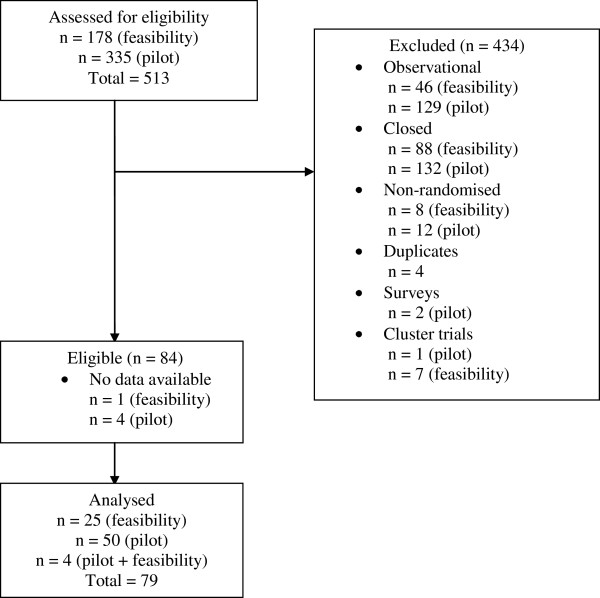
Background: There is little published guidance as to the sample size required for a pilot or feasibility trial despite the fact that a sample size justification is a key element in the design of a trial. A sample size justification should give the minimum number of participants needed in order to meet the objectives of the trial. This paper seeks to describe the target sample sizes set for pilot and feasibility randomised controlled trials, currently running within the United Kingdom. Methods: Data were gathered from the United Kingdom Clinical Research Network (UKCRN) database using the search terms ‘pilot’ and ‘feasibility’. From this search 513 studies were assessed for eligibility of which 79 met the inclusion criteria. Where the data summary on the UKCRN Database was incomplete, data were also gathered from: the International Standardised Randomised Controlled Trial Number (ISRCTN) register; the clinicaltrials.gov website and the website of the funders. For 62 of the trials, it was necessary to contact members of the research team by email to ensure completeness. Results: Of the 79 trials analysed, 50 (63.3%) were labelled as pilot trials, 25 (31.6%) feasibility and 14 were described as both pilot and feasibility trials. The majority had two arms (n = 68, 86.1%) and the two most common endpoints were continuous (n = 45, 57.0%) and dichotomous (n = 31, 39.2%). Pilot trials were found to have a smaller sample size per arm (median = 30, range = 8 to 114 participants) than feasibility trials (median = 36, range = 10 to 300 participants). By type of endpoint, across feasibility and pilot trials, the median sample size per arm was 36 (range = 10 to 300 participants) for trials with a dichotomous endpoint and 30 (range = 8 to 114 participants) for trials with a continuous endpoint. Publicly funded pilot trials appear to be larger than industry funded pilot trials: median sample sizes of 33 (range = 15 to 114 participants) and 25 (range = 8 to 100 participants) respectively. Conclusion: All studies should have a sample size justification. Not all studies however need to have a sample size calculation. For pilot and feasibility trials, while a sample size justification is important, a formal sample size calculation may not be appropriate. The results in this paper describe the observed sample sizes in feasibility and pilot randomised controlled trials on the UKCRN Database.
Overview
The claims and statistics of this paper haven’t been checked yet.
Free: it reads the open-access text and checks the first 5 claims that cite a source we can check. Create a free account to check every claim.
Integrity signals
Registry
Cites
Statistics
Figures
Verification
Claims the paper makes
The claims and statistics of this paper haven’t been checked yet.
Free: it reads the open-access text and checks the first 5 claims that cite a source we can check. Create a free account to check every claim.
Claims other papers make about this one
Each is checked against this paper’s own text: does it say what the citing paper says it does?
The source backs part of the claim, not all of it — or backs it for a different population, condition or comparison.
In the citing paper
“More recently, research has begun to explore the differences between internal and external pilot studies and their contribution to main trials, and the appropriateness of pilot and feasibility studies for estimating the sample size.”
From Role of feasibility and pilot studies in randomised controlled trials: a cross-sectional study (2018) · cites this paper as [12]
Experimental — accuracy not yet measuredThe source backs part of the claim, not all of it — or backs it for a different population, condition or comparison.
In the citing paper
“Current recommendations for sample sizes of pilot/feasibility studies vary, have a single rather than a multi-criterion basis, and do not necessarily link directly to formal progression criteria.”
From Determining sample size for progression criteria for pragmatic pilot RCTs: the hypothesis test strikes back! (2021) · cites this paper as [16]
Experimental — accuracy not yet measuredThe source backs part of the claim, not all of it — or backs it for a different population, condition or comparison.
In the citing paper
“When looking at hybrid human delivered pilot studies, a sample size of 40 is on par with comparable research [105, 106].”
From Personalized machine learning guided intervention for optimizing lifestyle behaviors in depression: a pilot study (2026) · cites this paper as [106]
Experimental — accuracy not yet measuredThe source backs part of the claim, not all of it — or backs it for a different population, condition or comparison.
In the citing paper
“Feasibility studies are not designed to evaluate effects, and there is no definitive approach to estimating their correct sample size [49].”
From Changes in pain, daily occupations, lifestyle, and health following an occupational therapy lifestyle intervention: a secondary analysis from a feasibility study in patients with chronic high-impact pain (2024) · cites this paper as [49]
Experimental — accuracy not yet measuredThe source backs part of the claim, not all of it — or backs it for a different population, condition or comparison.
In the citing paper
“There is no consensus but recommendations vary from 10 to 12 per group through to 60–75 per group depending on the main objective of the study.”
From Determining sample size for progression criteria for pragmatic pilot RCTs: the hypothesis test strikes back! (2021) · cites this paper as [16]
Experimental — accuracy not yet measured
9 more claims about this paper
Create a free account to see every claim other papers make about this one.
Self-check
Percentages, sums and reported differences re-computed from the paper’s own numbers.
The self-check needs the paper’s full text.
Citations
Cites
A tutorial on pilot studies: the what, why and how
Thabane, L., Ma, J., Chu, R., Cheng, J., Ismaila, A., Rios, L. P., Robson, R., Thabane, M., Giangregorio, L., & Goldsmith, C. H. (2010) · BMC Medical Research Methodology · doi:10.1186/1471-2288-10-1 · Cited by 3,384
Sample size of 12 per group rule of thumb for a pilot study
Julious, S. A. (2005) · Pharmaceutical Statistics · doi:10.1002/pst.185 · Cited by 3,068 · cited 6×
“Julious [9] recommends a minimum sample size of 12 per group as a rule of thumb and justifies this based on rationale about feasibility and precision about the mean and variance;”
BackgroundInfluentialSelf-citationDesign and analysis of pilot studies: recommendations for good practice
Lancaster, G. A., Dodd, S., & Williamson, P. R. (2004) · Journal of Evaluation in Clinical Practice · doi:10.1111/j..2002.384.doc.x · Cited by 2,572 · cited 3×
“There is the additional issue that setting the sample size too high may lead to a preventable failure to reach the recruitment target [12].”
BackgroundResultConsiderations in determining sample size for pilot studies
Hertzog, M. A. (2008) · Research in Nursing & Health · doi:10.1002/nur.20247 · Cited by 2,337 · cited 2×
“Hertzog [6] recommends the Julious and Patterson [7] method of using confidence intervals for a given precision constructed around the anticipated value to set the sample size;”
BackgroundMethodWhat is a pilot or feasibility study? A review of current practice and editorial policy
Arain, M., Campbell, M. J., Cooper, C. L., & Lancaster, G. A. (2010) · BMC Medical Research Methodology · doi:10.1186/1471-2288-10-67 · Cited by 1,483 · cited 9×
“[2] concluded that pilot trials are poorly reported and that the authors are often not explicit as to the purpose of their pilot trial.”
BackgroundResultInfluentialSim, J., & Lewis, M. (2012) · Journal of Clinical Epidemiology · doi:10.1016/j.jclinepi.2011.07.011 · Cited by 1,036 · cited 6×
“Continuous 6 43 (15, 60) [10, 60] However, Arain et al.”
BackgroundInfluentialOn the use of a pilot sample for sample size determination
Browne, R. H. (1995) · Statistics in Medicine · doi:10.1002/sim.4780141709 · Cited by 1,007 · cited 2×
“Trial description Pilot 50 30 (20, 45) [8, 114]”
BackgroundRecommendations for Planning Pilot Studies in Clinical and Translational Research
Moore, C. G., Carter, R. E., Nietert, P. J., & Stewart, P. W. (2011) · Clinical and Translational Science · doi:10.1111/j.1752-8062.2011.00347.x · Cited by 661 · cited 2×
“[16] highlighted that it is not unusual for study proposal reviewers to come across a statement such as “No sample size justification is needed because of the pilot nature of the proposed study”, but they state that pilot trials are not exempt from needing a clear rationale for the number of patients to be included.”
BackgroundStatistics and ethics in medical research: III How large a sample?
Altman, D. G. (1980) · BMJ · doi:10.1136/bmj.281.6251.1336 · Cited by 580 · cited 1×
“If a study is too large it may be judged to be unethical as participants may be unnecessarily exposed to risks and burdens [11].”
BackgroundCampbell, M. J., Julious, S. A., & Altman, D. G. (1995) · BMJ · doi:10.1136/bmj.311.7013.1145 · Cited by 476
Self-citation
Research works printed but not linked: 1
- 14. SPSS Inc: Released 2009. PASW statistics for windows, version 18.0. Chicago: SPSS Inc; 2009.
Cited by
Items 601–700 of 963
Huang, J., Yang, S., Xie, Z., Guo, B., Lan, Y., Li, Y., Jiang, Y., Forman, L. S., Lunze, K., Liang, B., et al. (2025) · AIDS and Behavior · doi:10.1007/s10461-025-04823-7 · Cited by 1
“Our sample size was chosen to provide a sufficient basis to evaluate feasibility and accept - ability and exceeds the median sample size estimates from a review of other pilot studies with dichotomous outcomes [21].”
Whitmore, C., Mangialardi, N., Saiva, A., Cafazzo, J. A., McQuire, T., Mytkolli, L., John, A. S., Senior, P. A., Sherifali, D., Strudwick, G., et al. (2025) · Digital Health · doi:10.1177/20552076251365134 · Cited by 1
Al‐Jabr, H., Castle, D. J., Thompson, D. R., Windle, K., Belcher, J., Valenzuela, M. M. D. I., Helliwell, T., & Ski, C. F. (2025) · Health Expectations · doi:10.1111/hex.70399 · Cited by 1
“Recommendations for sample size are mostly cited at 30 – 35 participants per group for pilot and feasibility studies [57 – 60].”
O’Donnell, R., Howell, R. M., Henderson, T., Sinclair, L., Mather, K., McMeekin, N., & Semple, S. E. (2025) · BMJ Open · doi:10.1136/bmjopen-2025-107161 · Cited by 3
“34 We have also considered the relatively homogenous nature of our sample in terms of deprivation and ethnicity, our intention to conduct qualitative interviews with low and high adherers, resources and costs.”
Smith, M., Jones, A., Zormati, P., Brady, L., Clark, A., Kamal, A., Karawalli, F., Khan, S., Mengoni, S. E., Mir, G., et al. (2025) · Pilot and Feasibility Studies · doi:10.1186/s40814-025-01691-9 · Cited by 5
“The sample size is also in line with those for feasibility studies audited in the UK [60].”
Tassone, V. K., Quesnel, D. A., Parkington, K. B., Rueda, A., Martin, J., Lee, G. H., Teixeira, A., deJonge, M. L., Lou, W. Y. W., Wiljer, D., et al. (2025) · PLoS ONE · doi:10.1371/journal.pone.0330848 · Cited by 2
“While this sample size is appropriate for evaluating feasibility [50], the division of participants into small groups may introduce heterogeneity.”
Jong, F. C.-D., Walker, E., Corlett, H., Hardarce, C., Soulsby, E., Arnott, B., Franks, K., Ling, J., Stephenson, J., & Azevedo, L. B. (2025) · Pilot and Feasibility Studies · doi:10.1186/s40814-025-01699-1 · Cited by 3
“Informed by evidence indicating a median sample size of 36 per arm (range 10 to 300) in UK feasibility trials [20], we adopted a pragmatic approach, aiming for a sample size of 120 adolescents per school (i.e. 360 in total).”
InfluentialWright, F. V., Ryan, J. L., & Hung, R. (2025) · Disability and Rehabilitation · doi:10.1080/09638288.2025.2543176 · Cited by 2
“A sample of 24 participants was considered sufficient to achieve the feasibility study process evaluation and effect size estimation goals [36,37].”
Ebert, C., Vogel, M., Gensichen, J., Reif, H., Junker, L., Grögor, L., Padberg, F., Falkai, P., Ehring, T. W., Hasan, A., et al. (2026) · BMC Family Practice · doi:10.1186/s12875-026-03377-4 · Cited by 1
“Notably, no consensus exists on sample size requirements for pilot studies [79], and the achieved patient number aligns with other clinical pilot studies reporting median sample sizes of 30–36 per arm [80].”
Mohammadi, S., Erlander, B., Cathcart, H. F., Robillard, J. M., Whitehurst, D. G., Pauly, E., Pagé, B., Sauvageau, S., & Miller, W. C. (2025) · JMIR Research Protocols · doi:10.2196/67709 · Cited by 1
Lee, S., Lahoda, K., Myers, N. D., Horowitz, A., Freeland, M., Einav, E., Buckingham-Schutt, L., & Welk, G. J. (2025) · BMC Public Health · doi:10.1186/s12889-025-24763-0 · Cited by 1
“A recruitment target of 30 participants was set based on pilot trial guidelines, study needs, and prior comparable trials [52, 55].”
Linhares, S. M., D’Aquila, M., Schultz, K. S., & Mongiu, A. K. (2025) · PLoS ONE · doi:10.1371/journal.pone.0329883 · Cited by 1
Billias, N., Pouliopoulou, D. V., Lawson, A., D’Alessandro, V., Bryant, D., Peters, S., Rushton, A., Miller, E., Brunton, L. K., McGuire, S., et al. (2025) · BMJ Open · doi:10.1136/bmjopen-2025-102112 · Cited by 1
Goldberg, M., Eisenkolb, V. M., Aftahy, A. K., Negwer, C., Meyer, H. S., Gempt, J., Meyer, B., & Wagner, A. (2025) · Digital Health · doi:10.1177/20552076251384604 · Cited by 1
Nyman, A., Larsson, E., & Isaksson, G. (2025) · Scandinavian Journal of Occupational Therapy · doi:10.1080/11038128.2025.2590725 · Cited by 1
“A sample size calculation is not needed for an early-stage feasibility study [50,51].”
Hughes, A. M., Tyson, G., Moss-Morris, R. E., McGuinness, S., Fawson, S., Chalder, T., & Hirsch, C. R. (2025) · Behaviour Research and Therapy · doi:10.1016/j.brat.2025.104917 · Cited by 1
Young, S. D., & Hanley, A. W. (2025) · European Journal of Investigation in Health Psychology and Education · doi:10.3390/ejihpe15120239 · Cited by 1
“The target sample size for this pilot study (i.e., n = 30 per arm) was informed by published recommendations (Teresi et al., 2022; Whitehead et al., 2016) and an audit of prior pilot and feasibility trials (Billingham et al., 2013).”
Adams, E. L., Savidge, M., Reesor-Oyer, L. M., Draper, C. L., Steeves, E. A., Bean, M. K., Figueroa, R., Stephenson, K., Weaver, R. G., Armstrong, B., et al. (2025) · Pilot and Feasibility Studies · doi:10.1186/s40814-025-01732-3 · Cited by 1
“A sample size of 91 caregivers was deemed adequate to evaluate the primary feasibility and acceptability outcomes (e.g., recruitment, utilization, and retention metrics; utility and acceptability measures) and exceeds the typical sample size of pilot studies [57, 58].”
Kusec, A., Hobden, G., Wright-Hughes, A. M., & Demeyere, N. (2026) · BMJ Open · doi:10.1136/bmjopen-2026-116566 · Cited by 1
Keleman, A., Bounds, M., Mundo, W., Gomez-Picazo, J., Mealer, M., Linnebur, S. A., Ferozan, B., Dunn, J., Stevens-Lapsley, J., & Goldberg, E. (2025) · Frontiers in Public Health · doi:10.3389/fpubh.2025.1720938 · Cited by 1
Nordentoft, S., Guldager, R., Pappot, H., Mathiesen, T. I., Tolver, A., & Piil, K. (2026) · JMIR Research Protocols · doi:10.2196/81948 · Cited by 1
“A sample size of approximately 30 participants is recommended for feasibility trials [37].”
Liu, Z., Li, Y. S., Fang, Y., Wang, H., Wu, T., Liu, S., Yang, Y., Qin, Y., Tao, X., Mao, J., et al. (2026) · Frontiers in Neurology · doi:10.3389/fneur.2025.1737297 · Cited by 2
Hastings, O., Brown, B. J., Prentice, K.-M., Babbage, C. M., Davies, E. B., Kilgariff, J., Murphy, T. L., McGarry, G., Guo, B., Greenhalgh, C., et al. (2026) · BMJ Open · doi:10.1136/bmjopen-2025-110121 · Cited by 1
Battisti, N., Verrengia, M. G., Pagnoni, M., SOMMELLA, N., Mellone, S., Orlandi, S., & Cersosimo, A. (2026) · Frontiers in Rehabilitation Sciences · doi:10.3389/fresc.2025.1719215 · Cited by 1
Wang, Y., Xie, Y., Fang, Y., Sui, B., Yuan, X., Chen, Y., & Zhang, Y. (2026) · Frontiers in Oncology · doi:10.3389/fonc.2026.1718170 · Cited by 1
Hargraves, F., Firth, J., George, E., MacMillan, F., Garrido, S., Sherman, K. A., Eathorne, A., & Armour, M. (2026) · BMC Psychiatry · doi:10.1186/s12888-026-07904-6 · Cited by 3
Virtual Reality–Based Avatar Intervention for Eating Disorders: Mixed Methods Feasibility Study
Hansen, N. S., Ries, E. S., Rasmussen, K., Cardi, V., Christensen, A. B., Hjorthøj, C. R., Micali, N., Ward, T., & Glenthøj, L. B. (2026) · JMIR Formative Research · doi:10.2196/88445 · Cited by 1
“The small sample size is typical of feasibility studies [31,49], and while it enabled qualitative exploration, it limits generalizability and likely inflates effect sizes.”
Masuadi, E., Mohammad, A., Hosani, S. A., Koornneef, E. J., & Nauman, J. (2026) · Frontiers in Sports and Active Living · doi:10.3389/fspor.2026.1726817 · Cited by 2
Budman, J. R., & Bourke‐Taylor, H. M. (2026) · Frontiers in Global Women s Health · doi:10.3389/fgwh.2026.1726319 · Cited by 1
Reis, D. J., Armstrong, A. E., Miller, C. N., Postolache, T. T., Forster, J. E., Brenner, L. A., & Bahraini, N. H. (2026) · Journal of Head Trauma Rehabilitation · doi:10.1097/htr.0000000000001170 · Cited by 1
Almeida, B., & Cunha, C. (2026) · PLoS ONE · doi:10.1371/journal.pone.0345792 · Cited by 1
Goh, S. S. L., Ramdzan, S. N., Tan, K. M., Tan, M. P., & Pauline, S. M. L. (2026) · Health Care Management Review · doi:10.1097/hmr.0000000000000482 · Cited by 2
Huang, S., Chen, H., Ouyang, C., Han, H., Luo, Y., Wen, W., Liu, L., & Xiao, L. (2026) · Frontiers in Neurology · doi:10.3389/fneur.2026.1807577 · Cited by 1
“The enrolled sample represents all consecutive eligible inpatients during the study period and exceeds the minimum threshold of 12–30 participants recommended for pilot studies (27, 28).”
Optimal duration of urethral catheterization in ThuLEP: A randomized prospective pilot study
Luque, M. Á. G., Campanario‐Pérez, R., Curbelo-Ascanio, N. M., Salido, E. A., García‐Sánchez, C., & Medina-López, R. A. (2026) · The French Journal of Urology · doi:10.1016/j.fjurol.2026.103172 · Cited by 1
Nisa, A., Siddiqui, S., & Ametaj, A. (2026) · BMC Psychiatry · doi:10.1186/s12888-026-08345-x · Cited by 1
Kiernan, A., Boland, F., Moneley, D. S., Doyle, F., & Harkin, D. W. (2023) · Pilot and Feasibility Studies · doi:10.1186/s40814-023-01336-9 · Cited by 1
“Sample size As this is a pilot study, a formal sample size calculation was not performed [36].”
BackgroundTranscutaneous electrical nerve inhibition using medium frequency alternating current
Maris, S., Brands, M., Lenskens, D., Braeken, G., Kemnitz, S., Vanhove, H., Laughlin, M. M., Meesen, R., Brône, B., & Stessel, B. (2022) · Scientific Reports · doi:10.1038/s41598-022-18974-3 · Cited by 2
Collective Action for Wellness in the Malaysian Workplace: Protocol for a Feasibility Study
Thai, Y. C., McCaffrey, T. A., Ramadas, A., Chandrasekara, D., Koh, S. G. M., Choi, T. S. T., Malini, H., Xie, J., Olivier, P. L., Zain, A. Z. M., et al. (2022) · JMIR Research Protocols · doi:10.2196/39238 · Cited by 3
“This is a conservative sample size for a feasibility study and is comparable to many other feasibility and pilot studies, given the lack of consensus on the best methods to calculate sample size for a feasibility study [34].”
ResultShort-term recovery after NovaSure® endometrial ablation: a prospective cohort study
Reinders, I. M. A., van de Kar, M. R. D., Geomini, P. M. A. J., Leemans, J. C., Maas, J. W. M., & Bongers, M. Y. (2022) · Facts Views and Vision in ObGyn · doi:10.52054/fvvo.14.4.042 · Cited by 1
“The justification for this sample size is based on rationale about feasibility and literature about pilot and feasibility trials (Billingham et al., 2013).”
MethodPoint-of-care verification of blood culture volume in neonates: a feasibility trial
Romańska, J., Wawrzoniak, T., Hołowaty, D., Mazanowska, N., & Krajewski, P. (2023) · PubMed Central · doi:10.34763/jmotherandchild.20232701.d-22-00063 · Cited by 4
“This value is larger than median study sample sizes observed in pilot and feasibility trials [14].”
ResultUmaefulam, V. O., Wilson, M. K., Boucher, M. C., Brent, M. H., Dogba, M. J., Drescher, O., Grimshaw, J., Ivers, N. M., Lawrenson, J. G., Lorencatto, F., et al. (2023) · Pilot and Feasibility Studies · doi:10.1186/s40814-023-01372-5 · Cited by 1
“…the attendance to the program itself, and our estimated sample size for patient recruitment aligns with sample sizes observed in other feasibility pilot studies (between 10 and 300 individuals) [38] and aligns with published recommendations regarding sample size for feasibility studies [39].”
ResultMakedonov, I., Kahn, S. R., Abdulrehman, J., Schulman, S., Delluc, A., Gross, P. L., & Galanaud, J. ‐. (2023) · BMJ Open · doi:10.1136/bmjopen-2022-064715 · Cited by 1
“39 Another factor that may influence the required sample size is the temporal effect on frequency of PTS.”
BackgroundCantillo-Negrete, J., Carino-Escobar, R. I., & Yao, W. (2023) · Journal of Medical Devices · doi:10.1115/1.4064198 · Cited by 1
Kiernan, A., Boland, F., Naughton, P. A., Moneley, D. S., Doyle, F., & Harkin, D. W. (2024) · Annals of Vascular Surgery · doi:10.1016/j.avsg.2024.02.030 · Cited by 3
Τσεκούρα, Μ., Matzaroglou, C., Xergia, S. A., Dionyssiotis, Y., Tsepis, E., Sakellari, V., & Billis, E. V. (2024) · Journal of Frailty Sarcopenia and Falls · doi:10.22540/jfsf-09-089 · Cited by 2
“This study was a feasibility study, so no formal power calculation was conducted 24 .”
BackgroundWhitney, D. G., Oliverio, A. L., Kreschmer, J. M., Bolde, S., Hurvitz, E. A., & Wong, K. K. (2024) · Frontiers in Medicine · doi:10.3389/fmed.2024.1295104 · Cited by 1
InspireGBs – Inspiratory muscle training in people with Guillain‐Barré syndrome: A feasibility study
Almeida, M. P., Winck, J. C., & Marques, A. S. P. D. D. (2024) · PM&R · doi:10.1002/pmrj.13251 · Cited by 2
Buono, R., Pérol, O., Djebali, M., Borja, M., Abadie, A., Morisset, S., Michallet, A., Fléchon, A., Boyle, H. J., Nicolas‐Virelizier, E., et al. (2025) · Frontiers in Medicine · doi:10.3389/fmed.2025.1469930 · Cited by 1
Morgan, B. N., Windle, G., & Lamers, C. (2025) · Pilot and Feasibility Studies · doi:10.1186/s40814-025-01639-z · Cited by 1
“While a sample size calculation is not required for a feasibility study, it is important to justify the size [17].”
Zwanenburg, L. C., van der Lee, M. L., Koldenhof, J. J., van der Stap, J., Suijkerbuijk, K. P. M., & Schellekens, M. P. J. (2025) · Current Oncology · doi:10.3390/curroncol32050284 · Cited by 2
“Following the recommendation of sample sizes of at least 30 participants in feasibility studies and a median sample size of 43 participants in publicly funded feasibility studies, we aimed to include at least 43 participants in our study [20].”
Andersen, F. T., Petersen, J., Kaspersen, A. E., Pedersen, M. V., Singer, G., Madsen, M. H. A., Lund, M. A. V., Hasenkam, J. M., & Lading, T. (2025) · Surgical Endoscopy · doi:10.1007/s00464-025-11905-z · Cited by 2
“Consequently, the sample size was determined based on findings from a pilot study and a comprehensive review on sample size considerations in feasibility and pilot studies [33].”
Smith, A., Rogan, H., & Logan, D. E. (2025) · Clinical Journal of Pain · doi:10.1097/ajp.0000000000001321 · Cited by 1
FACTORS ASSOCIATED WITH SELF-CARE OF HEART FAILURE PATIENTS 4-6 WEEKS POST DISCHARGE
Lagerlof, T. (2014) · OhioLink ETD Center (Ohio Library and Information Network) · Cited by 1
Patel, D. I., Gallegos, A. M., Sheikh, B., Vardeman, S., & Liss, M. A. (2020) · Contemporary Clinical Trials Communications · doi:10.1016/j.conctc.2020.100659 · Cited by 2
Mercier, M., Blanchette, V., Cantin, V., & Brousseau‐Foley, M. (2021) · Journal of Foot and Ankle Research · doi:10.1186/s13047-021-00467-7 · Cited by 1
“No minimal sample size calculation was done because of the nature of the study but a threshold between 40 to 60 patients was targeted according to the previous work on sample size for feasibility study that suggest a range of 10 to 300 participants with a median of 38 [30].”
MethodEarlix, K., Shive, N., & Coats, H. (2021) · Journal of Clinical Nursing · doi:10.1111/jocn.16055 · Cited by 1
Maier, T., Peirce, P., Baird, L., Whitehouse, S. L., Slater, N. K. H., & Beardsall, K. (2022) · PLoS ONE · doi:10.1371/journal.pone.0264747 · Cited by 1
Othman, N. Y. H., Raj, N. B., Naing, N. N., Mahadeva Rao, U. S., Nawawi, E. A., Zhen, L. W., & Zain, A. M. (2022) · Research Journal of Pharmacy and Technology · doi:10.52711/0974-360x.2022.00308 · Cited by 1
Kaye, S. S., Lewandowski, A., Dunne, M., Bowman, J., & Archer, V. (2022) · Pilot and Feasibility Studies · doi:10.1186/s40814-022-01068-2 · Cited by 1
“3) [29] and is consistent with the median intended sample size of 30 participants per arm in registered pilot and feasibility trials [30].”
BackgroundRiquin, É., Sandnes, R., Bacro, F., Vinay, A., Miljkovitch, R., Rouger, V., Rakotonjanahary, J., Gascoin-Lachambre, G., & Muller, J. (2022) · Frontiers in Pediatrics · doi:10.3389/fped.2022.896103 · Cited by 1
“This aligns with the desired sample sizes recommended for pilot studies reported in the literature (33, 34).”
BackgroundRegüeiferos, J. C. C., Luna, T. B., Brooks, S. C. A., Rodríguez, M. P., Matamoros, L. Z., Rodríguez, B. L., Fernández, A. P., Bello, J. L. G., Pedrón, A. M., González, M. M., et al. (2022) · Translational Medicine Communications · doi:10.1186/s41231-022-00127-3 · Cited by 4
“In contrast, several researchers suggest N ≥ 30 [23].”
ResultMayer, K. P., Palakshappa, J. A., Peltan, I. D., Andrew, J. S., Gundel, S. J., Ringwood, N. J., McKeehan, J. D., Hope, A. A., Rogers, A. J., Biehl, M., et al. (2022) · Pilot and Feasibility Studies · doi:10.1186/s40814-022-01151-8 · Cited by 1
“Sample sizes for pilot and feasibility studies “should be representative of the target study population,” [27] and in general, there are limited evidence to justify sample size of feasibility studies [26].”
BackgroundBright Light Therapy for Cancer-related Fatigue in a Palliative Care Unit: A Feasibility Study
Tang, J. H., Wing, Y. K., Chan, J. W. Y., & Lo, R. S. K. (2022) · Journal of Pain and Symptom Management · doi:10.1016/j.jpainsymman.2022.10.008 · Cited by 1
Equilibrium coordination tests among children: A feasibility study
Sharma, N., & Samuel, A. J. (2022) · Advances in Rehabilitation · doi:10.5114/areh.2022.121224 · Cited by 3
“Although a feasibility trial requires minimum sample size between 50 and 100 [8,9], the present study screened 300 subjects.”
BackgroundRosenthal, J. L., Hoyt-Austin, A. E., Ketchersid, A., Sanders, A., Harper, T. A., Tancredi, D. J., Young, H. M., Romano, P. S., & Marcin, J. P. (2023) · Pilot and Feasibility Studies · doi:10.1186/s40814-023-01292-4 · Cited by 2
Impact of clinical note format on diagnostic accuracy and efficiency
Payton, E. M., Graber, M. L., Bachiashvili, V., Mehta, T. S., Dissanayake, P. I., & Berner, E. S. (2023) · Health Information Management Journal · doi:10.1177/18333583231151979 · Cited by 3
“However, all of the CIs include an OR of 1, which means that the evidence of an association between accuracy of diagnosis and note format is insuf fi cient, even from a pilot study point of view (Billingham et al., 2013).”
Malik, H. A., Wood, D., Stone, O. D., Gough, A. T., Taylor, G. T., KNAPP, K. M., Heggs, D., & Appelboam, A. (2023) · Emergency Medicine Journal · doi:10.1136/emermed-2023-213279 · Cited by 1
“Overall recruitment was slightly lower than we had predicted due to lower numbers at the Queen’s site but similar to other feasibility trials 13 and at a level that could support a definitive trial in the UK, given the number of research active EDs and the frequency of wrist fractures.”
ResultVainre, M., Dalgleish, T., Watson, P., Haag, C., Dercon, Q., Galante, J., & Hitchcock, C. (2024) · BMJ Mental Health · doi:10.1136/bmjment-2023-300885 · Cited by 4
“47 This sample size is standard for feasibility trials in the UK 48 and provides enough data to evaluate procedural uncertainties and acceptability and to provide a range of effect size estimates on our primary outcome.”
BackgroundWilde, N., Foxcroft, D., & Davies, E. (2025) · Advances in Mental Health · doi:10.1080/18387357.2025.2523005 · Cited by 1
Health-enhancing participation in girls and women with Rett syndrome - a balancing act
Stahlhut, M. (2018) · Lund University Publications (Lund University) · Cited by 3
Online structured education for people newly diagnosed with type 2 diabetes
Poduval, S. (2019) · UCL Discovery (University College London) · Cited by 1
Wallace, N. M. (2017) · The Research Repository @ WVU (West Virginia University) · doi:10.33915/etd.6892 · Cited by 1
Pandria, N., Petronikolou, V., Lazaridis, A., Karapiperis, C., Kouloumpris, E., Spachos, D., Fachantidis, A., Vasileiou, D., Vlahavas, I. P., & Bamidis, P. D. (2022) · doi:10.2196/preprints.40189 · Cited by 1
Kusec, A., Murphy, F. C., Peers, P. V., Bennett, R., Carmona, E., Korbacz, A., Lawrence, C., Cameron, E., Bateman, A., Watson, P., et al. (2023) · doi:10.31234/osf.io/m6twj · Cited by 1
Vainre, M., Dalgleish, T., Watson, P., Haag, C., Dercon, Q., Galante, J., & Hitchcock, C. (2023) · doi:10.31234/osf.io/wamkn · Cited by 1
Andor1, B.-C., Barattini2, D. F., Guadagna3, S., Barattini4, L., & Rosu1, S. (2024) · doi:10.17504/protocols.io.n2bvj35o5lk5/v2 · Cited by 1
SKILLTRAIN ABS v1Preprint
Zlámal, J., Barbu, C., Baglo, M. C., Hagen, H.-M. D., & Heyn, L. (2025) · doi:10.17504/protocols.io.dm6gpd8mdgzp/v1
Power, V. (2014) · University of Limerick Institutional Repository (University of Limerick) · doi:10.34961/7848
Knox, A. F., & Bryant, A. R. (2016) · Journal of the American Podiatric Medical Association · doi:10.7547/14-137
Sharma, B. (2014) · TSpace (University of Toronto)
Measuring Sustainable Service Quality of Malaysian Water and Sewerage Companies: A Pilot Study
Salleh, A., Yusof, S. M., & Othman, N. (2017) · Journal of Business and Social Review in Emerging Economies · doi:10.26710/jbsee.v3i1.25 · Cited by 1
How school management committees monitor the implementation of universal primary education in Uganda
Mugabe, R. (2018) · UpSpace Institutional Repository (University of Pretoria) · Cited by 2
Smith, E. (2019) · cIRcle (University of British Columbia) · doi:10.14288/1.0378852
“was not appropriate to determine sample size based on calculations from the primary clinical outcome.(156,157) We initially proposed a sample size of 32 to ensure sufficient numbers to address feasibility outcomes and ensure precision of estimated means and variance for treatment related outcomes.”
MethodKetogenic Diets as an Adjuvant Therapy for Patients with Glioblastoma
Martin-Mcgill, K. (2019) · University of Liverpool · doi:10.17638/03052121
Bell, I. (2019) · Minerva Access (University of Melbourne)
Pilot Studies in Clinical Research
Whitehead, A. L., & Julious, S. A. (2020) · Wiley eBooks · doi:10.1002/9781118445112.stat08205 · Cited by 2
Self-citationChoosing the Target Difference (“effect size”) for a Randomised Controlled Trial - DELTA2 GuidancePreprint
Cook, J. A., Julious, S. A., Sones, W. R., Hampson, L. V., Hewitt, C. E., Berlin, J. A., Ashby, D., Emsley, R., Fergusson, D. A., Walters, S. J., et al. (2018) · Preprints.org · doi:10.20944/preprints201808.0521.v1 · Cited by 1
Self-citationEffect of head teachers’ partnerships collaboration on inclusive education implementation
Shiwani, D. I. (2021) · The Journal of Quality in Education · doi:10.37870/joqie.v11i17.252 · Cited by 2
Foot, H., Beyene, K. A., Horne, R., Fingleton, J., Harrison, J., & Chan, A. H. Y. (2021) · Research Square · doi:10.21203/rs.3.pex-1506/v1
Wilson, E. (2018) · SSRN Electronic Journal · doi:10.2139/ssrn.3152328
Shiwani, D. I., Akala, W. J., Kalai, J. M., & Gatumu, J. C. (2021) · Jurnal Educative Journal of Educational Studies · doi:10.30983/educative.v6i1.4289
Hynes, L., Murphy, A. W., Hart, N. D., Kirwan, C., Mulligan, S., Leathem, C. S., McQuillan, L., Maxwell, M., Carr, E., Walkin, S., et al. (2021) · medRxiv · doi:10.1101/2021.09.16.21263674
Schröder, F. F. (2020) · doi:10.3990/1.9789036551199
“The number of eight patie ts w s chosen since it has been found to be the inimum number of subjects to be included i both public and indus ry-fund d explorative pilot and feasibility trials (135).”
BackgroundInfluentialElsaeßer, M., Herpertz, S. C., Piosczyk, H., Jenkner, C., Hautzinger, M., & Schramm, E. (2021) · doi:10.31234/osf.io/6qxdw
Brennan, C., Adams, K., Saikaly, R., Lichtenstein, S., Spavor, J., Penney, S. R., Simpson, S., & Kidd, S. A. (2022) · Journal of Forensic Psychiatry and Psychology · doi:10.1080/14789949.2022.2046133
“Considering available resources and guidance on sample sizes adequate for feasibility studies (Billingham et al., 2013), the intended sample size was 24 patient participants.”
BackgroundInfluentialBardus, M., Hamadeh, G., Hayek, B., & Kherfan, R. A. (2018) · doi:10.2196/preprints.9793.a
Metadata
- Authors
- Billingham, S. A., Whitehead, A. L., & Julious, S. A.
- Affiliations
- University of Sheffield (GB)
- Corresponding author
- Julious, Steven A
- Venue
- BMC Medical Research Methodology
- Published
- 2013-08-20
- Volume
- 13
- Issue
- 1
- Pages
- 104-104
- ISSN
- 1471-2288 (ISSN-L)
- PMC
- PMC3765378
- OpenAlex
- W2027748528
- Semantic Scholar
- 725b8e2a2b7f8a509bf11fd9dc8782de9cb9966f
- Cited by
- 962
- References
- 14
- Citations by year
- 2026: 117 · 2025: 124 · 2024: 132 · 2023: 102 · 2022: 148 · 2021: 98 · 2020: 86 · 2019: 46 · 2018: 44 · 2017: 21 · 2016: 22 · 2015: 14 · 2014: 8
- FWCI
- 11.92
- Type
- journal article
- Language
- en
- Open access
- gold
- doi.org
- Licence
- Locations
- BMC Medical Research Methodology (publishedVersion, cc-by)
- Europe PMC (PubMed Central) (publishedVersion, cc-by)
- PubMed Central (publishedVersion, cc-by)
- PubMed (publishedVersion)
- White Rose Research Online (University of Leeds, The University of Sheffield, University of York) (acceptedVersion)
- ePrints Soton (University of Southampton) (acceptedVersion)
- Topics
- Physical Sciences › Mathematics › Statistics and Probability › Statistical Methods in Clinical Trials
- Social Sciences › Decision Sciences › Statistics, Probability and Uncertainty › Meta-analysis and systematic reviews
- Physical Sciences › Mathematics › Statistics and Probability › Statistical Methods in Epidemiology
- Keywords
- pilot trial, feasibility trial, sample size justification, sample size determination, randomized controlled trials, trial design, funding sources, ClinicalTrials.gov
- MeSH terms
- Feasibility Studies, United Kingdom, Humans, Pilot Projects, Randomized Controlled Trials as Topic, Databases, Factual, Sample Size, Biomedical Research
About these checks
Registry, retraction, Cites and statistics results are computed, not judged, with one exception: a printed reference that no index lists is read once by a model before it counts as a citation error. Claims are extracted by a model and kept only when their quote appears verbatim in the text; each cited source is then checked, with a model’s help, for whether it says what the claim relies on. Those verdicts can be wrong — read the claim’s quote and the cited source before relying on one.
Statistics and arithmetic are recomputed, not judged.
Confidence bands are shown only for fields calibrated on our annotated test set. None is calibrated yet, so no band is shown.
What counts as a claim ›How we measure confidence ›How we check this ›
Are you an author, or do you see a problem with this page? Request a review
Data sources
Bibliographic data: Semantic Scholar, OpenAlex, Crossref.
Contains information from the Semantic Scholar Academic Graph Datasets, made available under the ODC Attribution License (ODC-BY 1.0).
Semantic Scholar’s data is described in: Kinney, R., et al. (2023). The Semantic Scholar Open Data Platform. arXiv:2301.10140.
