

The Four-Dimensional Symptom Questionnaire (4DSQ): a validation study of a multidimensional self-report questionnaire to assess distress, depression, anxiety and somatization
Open accessThe DOI matches its Crossref record; 53 of the 54 references it cites were found in a registry or an index.
Abstract
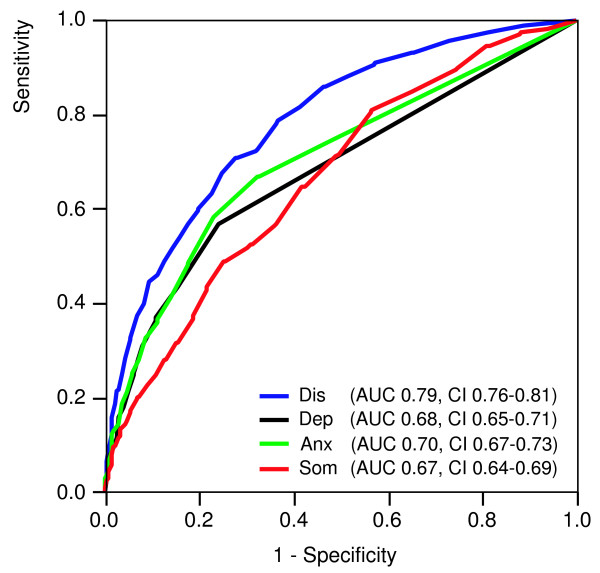
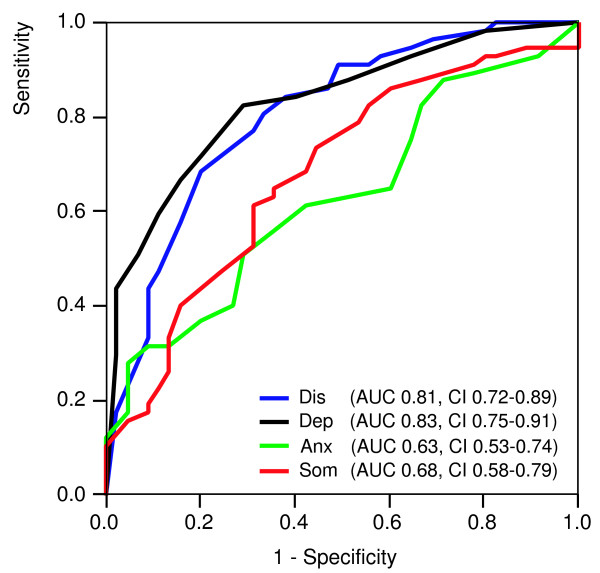
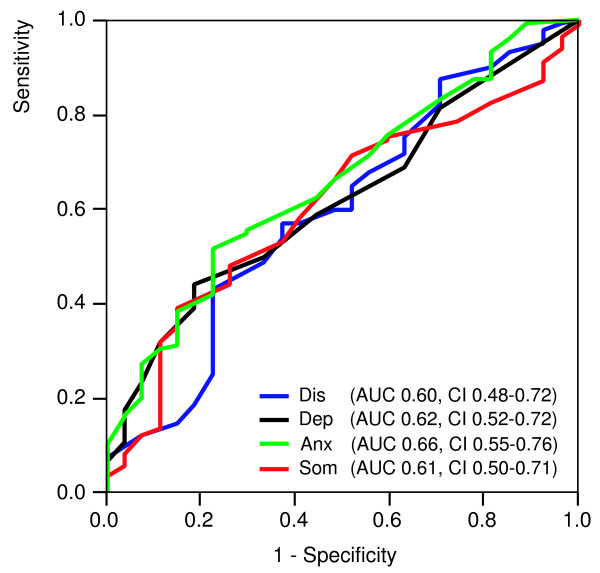
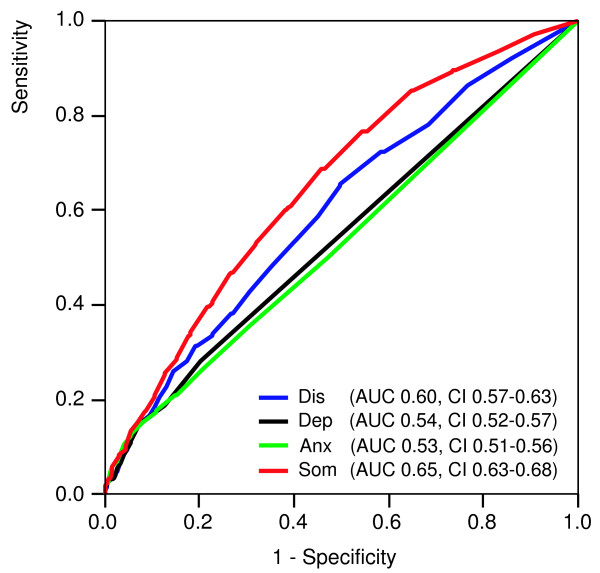
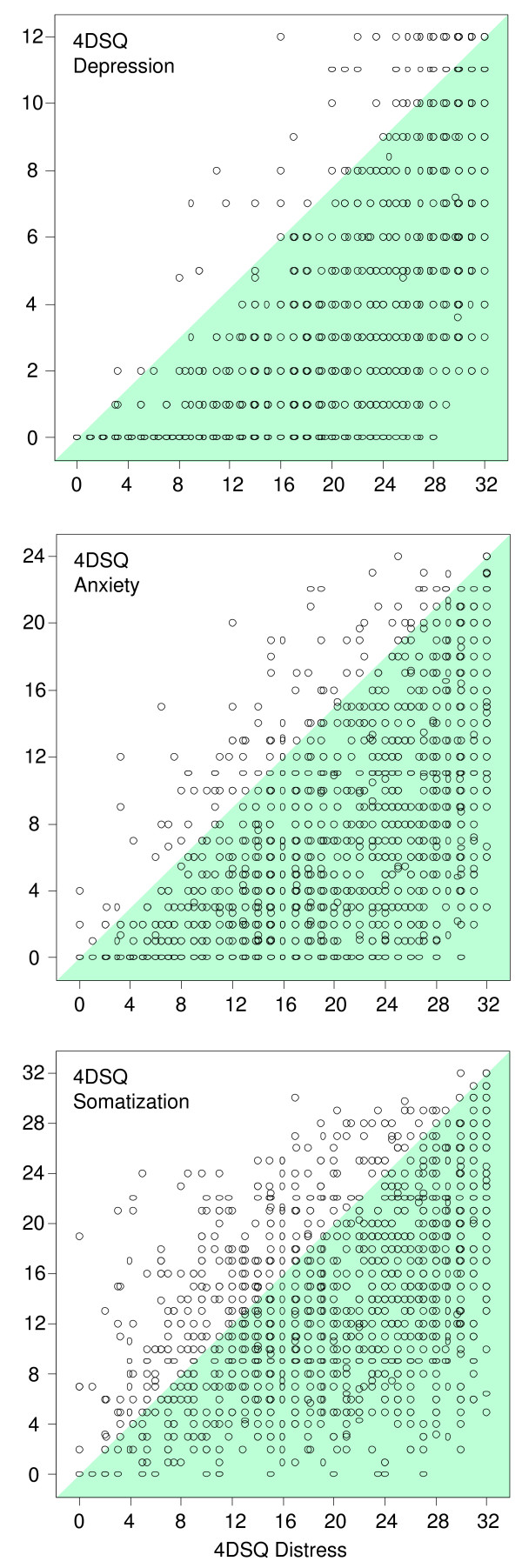
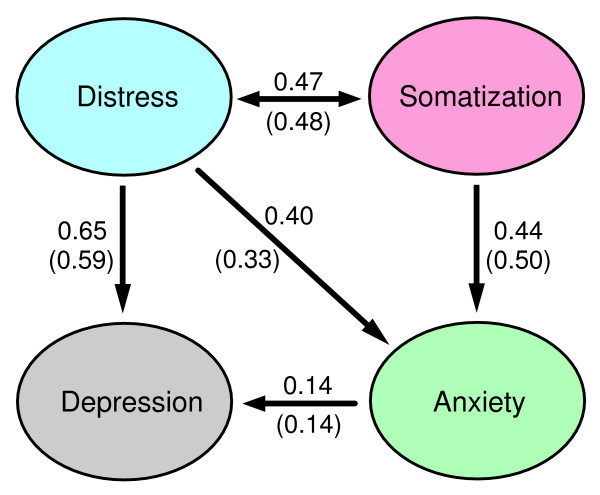
BACKGROUND: The Four-Dimensional Symptom Questionnaire (4DSQ) is a self-report questionnaire that has been developed in primary care to distinguish non-specific general distress from depression, anxiety and somatization. The purpose of this paper is to evaluate its criterion and construct validity. METHODS: Data from 10 different primary care studies have been used. Criterion validity was assessed by comparing the 4DSQ scores with clinical diagnoses, the GPs' diagnosis of any psychosocial problem for Distress, standardised psychiatric diagnoses for Depression and Anxiety, and GPs' suspicion of somatization for Somatization. ROC analyses and logistic regression analyses were used to examine the associations. Construct validity was evaluated by investigating the inter-correlations between the scales, the factorial structure, the associations with other symptom questionnaires, and the associations with stress, personality and social functioning. The factorial structure of the 4DSQ was assessed through confirmatory factor analysis (CFA). The associations with other questionnaires were assessed with Pearson correlations and regression analyses. RESULTS: Regarding criterion validity, the Distress scale was associated with any psychosocial diagnosis (area under the ROC curve [AUC] 0.79), the Depression scale was associated with major depression (AUC = 0.83), the Anxiety scale was associated with anxiety disorder (AUC = 0.66), and the Somatization scale was associated with the GPs' suspicion of somatization (AUC = 0.65). Regarding the construct validity, the 4DSQ scales appeared to have considerable inter-correlations (r = 0.35-0.71). However, 30-40% of the variance of each scale was unique for that scale. CFA confirmed the 4-factor structure with a comparative fit index (CFI) of 0.92. The 4DSQ scales correlated with most other questionnaires measuring corresponding constructs. However, the 4DSQ Distress scale appeared to correlate with some other depression scales more than the 4DSQ Depression scale. Measures of stress (i.e. life events, psychosocial problems, and work stress) were mainly associated with Distress, while Distress, in turn, was mainly associated with psychosocial dysfunctioning, including sick leave. CONCLUSION: The 4DSQ seems to be a valid self-report questionnaire to measure distress, depression, anxiety and somatization in primary care patients. The 4DSQ Distress scale appears to measure the most general, most common, expression of psychological problems.
Overview
The claims and statistics of this paper haven’t been checked yet.
Free: it reads the open-access text and checks the first 5 claims that cite a source we can check. Create a free account to check every claim.
Integrity signals
Registry
Cites
Statistics
Figures
Verification
Claims the paper makes
The claims and statistics of this paper haven’t been checked yet.
Free: it reads the open-access text and checks the first 5 claims that cite a source we can check. Create a free account to check every claim.
Self-check
Percentages, sums and reported differences re-computed from the paper’s own numbers.
The self-check needs the paper’s full text.
Citations
Cites
Diagnostic and Statistical Manual of Mental Disorders
Williams, J. B. W., & First, M. (2013) · Encyclopedia of Social Work · doi:10.1093/acrefore/9780199975839.013.104 · Cited by 109,519
The Hospital Anxiety and Depression Scale
Zigmond, A. S., & Snaith, R. P. (1983) · Acta Psychiatrica Scandinavica · doi:10.1111/j.1600-0447.1983.tb09716.x · Cited by 47,139
An inventory for measuring depression
BECK, A. T. (1961) · Archives of General Psychiatry · doi:10.1001/archpsyc.1961.01710120031004 · Cited by 38,032
(1970) · Cited by 24,983
Depression and quality of life in older persons: A review
Sivertsen, H., Bjørkløf, G. H., Engedal, K., Selbæk, G., & Helvik, A.-S. (2015) · Dementia and Geriatric Cognitive Disorders · doi:10.1159/000437299 · Cited by 14,152
A self-rating depression scale
ZUNG, W. W. K. (1965) · Archives of General Psychiatry · doi:10.1001/archpsyc.1965.01720310065008 · Cited by 9,813
EQS : structural equations program manual
Bentler, P. M. (1989) · Medical Entomology and Zoology · Cited by 9,669
Cognitive Therapy for Depression: (675542012-001)
(2012) · PsycEXTRA Dataset · doi:10.1037/e675542012-001 · Cited by 9,663
Pearlin, L. I., & Schooler, C. (1978) · Journal of Health and Social Behavior · doi:10.2307/2136319 · Cited by 7,791 · cited 3×
“Study F included the Neuroticism scale of the NEO Five Factor Inventory (NEO-FFI) [46], studies B and C a measure of mastery [47], and study H a measure of trait anxiety [41].”
MethodScoville, W. B. (1949) · Journal of neurosurgery · doi:10.3171/jns.1949.6.1.0065 · Cited by 7,381
Research works printed but not linked: 14
- Terluin B De Vierdimensionale Klachtenlijst (4DKL). Een vragenlijst voor het meten van distress, depressie, angst en somatisatie [The Four-Dimensional Symptom Questionnaire (4DSQ). A questionnaire to measure distress, depression, anxiety, and somatization] Huisarts Wet 1996 39 538 547
- Terluin B Overspanning onderbouwd. Een onderzoek naar de diagnose surmenage in de huisartspraktijk [Nervous breakdown substantiated. A study of the general practitioner's diagnosis of surmenage] 1994 Utrecht, Universiteit Utrecht
- Terluin B Gill K Winnubst JAM Hoe zien huisartsen surmenage? [General practitioners' perception of "nervous breakdown"] Huisarts Wet 1992 35 311 315
- Romeijnders ACM Vriezen JA Van der Klink JJL Hulshof CTJ Terluin B Flikweert S Baart PC Landelijke Eerstelijns Samenwerkings Afspraak Overspanning [National Primary Care Collaboration Agreement on Nervous Breakdown] Huisarts Wet 2005 48 20 23
- Bentler P Wu E EQS for Windows user's guide 1995 Encino, Multivariate Software
- Dijkstra P Van Praag HM and Rooymans HGM De zelfbeoordelingsschaal voor depressie van Zung [The self-rating depression scale of Zung] Stemming en ontstemming Theorie en praktijk bij de diagnostiek van depressies 1974 Amsterdam, Erven Bohn 98 120
- Beck AT Steer RA Beck Anxiety Inventory manual 1993 2nd San Antonio TX, Psychological Corporation
- Van der Ploeg HM Defares PB Spielberger CD Handleiding bij de Zelf-Beoordelings Vragenlijst (ZBV) Een Nederlandstalige bewerking van de Spielberger State-Trait Anxiety Inventory STAI-DY [Manual of the Self-Assessment Questionnaire A Dutch adaptation of the Spielberger State-Trait Anxiety Inventory STAI-DY] 1980 Lisse, Swets & Zeitlinger
- Hosman CMH Psychosociale problematiek en hulpzoeken. Een sociaal-epidemiologische studie ten behoeve van de preventieve geestelijke gezondheidszorg [Psychosocial problems and seeking help. A socio-epidemiological study for the preventive mental health care] 1983 Nijmegen, Katholieke Universiteit Nijmegen
- Ormel J Moeite met leven of een moeilijk leven. Een vervolgonderzoek naar de invloed van psychosociale belasting op het welbevinden van driehonderd Nederlanders [A troublesome life, or trouble with living. A follow-up study of the influence of psycosocial stress on the well-being of threehundred Dutch inhabitants] 1980 Groningen, Rijksuniversiteit Groningen
- Hoekstra HA Ormel J De Fruyt F De NEO-PI-R/NEO-FFI; Big Five persoonlijkheidsvragenlijsten Handleiding [Manual of the Dutch version of the NEO-PI-R/NEO-FFI] 1996 Lisse, Swets en Zeitlinger
- Costa PT McCrae RR Revised NEO Personality Inventory (NEO-PI-R) and NEO Five Factor Inventory (NEO-FFI): professional manual 1992 Odessa FL, Psychological Assessment Resources
- Van der Zee KL Sanderman R Het meten van de gezondheidstoestand met de RAND-36 Een handleiding [Measuring the health status with the RAND-36 A manual] 1993 Groningen, Noordelijk Centrum voor Gezondheidsvraagstukken
- Terluin B Factoranalyse van drie klachtenlijsten [Factor analysis of three symptom questionnaires] Tijdschrift voor psychosomatische fysiotherapie 1999 4 25 31
Cited by
Items 401–470 of 470
Validering van een prognostisch model voor de duur van verzuim bij psychische klachten
Norder, G., Roelen, C. A. M., van der Klink, J., Bültmann, U., Sluiter, J. K., & Nieuwenhuijsen, K. (2016) · Tijdschrift voor bedrijfs- en verzekeringsgeneeskunde · doi:10.1007/s12498-016-0178-6
The application of alpha EEG training in healthy participants
Dekker, M. K. J. (2014) · Research portal (Tilburg University) · Cited by 1
A view beyond the horizon: a prospective cohort study on mental health and long-term disability
Cornelius, L. R. (2013) · University of Groningen research database (University of Groningen / Centre for Information Technology) · Cited by 5
Delporte, F., Bombeke, K., & Bastiaens, H. (2017) · Huisarts Nu · doi:10.1007/s40954-017-0007-x
Pedersen, E. R., Kandrack, R., Danz, M., Motala, A., Booth, M. J., Larkin, J., & Hempel, S. (2018) · Rand health quarterly · doi:10.7249/rhq-09-01-06
van der Horst, H. E., & van Balkom, A. J. L. M. (2018) · Bohn Stafleu van Loghum eBooks · doi:10.1007/978-90-368-2174-2_9
The association between hearing ability and psychosocial health before the age of 70 years
Nachtegaal, J., Jh, S., Smits, C., Bezemer, P. D., Beek, J. V., & Festen, J. M. (2009) · Pure Amsterdam UMC
Mayevskaya, M. V., Ma, M., Герович, Б. А., Lunkov, V. D., & Ivashkin, V. T. (2019) · Russian Journal of Gastroenterology Hepatology Coloproctology · doi:10.22416/1382-4376-2019-29-4-50-59
Cognities en percepties van chronisch zieke werkenden
de Wit, M., Wind, H., Frings‐Dresen, M. H. W., Snippen, N. C., Hulshof, C. T. J., & de Boer, A. G. E. M. (2020) · Tijdschrift voor bedrijfs- en verzekeringsgeneeskunde · doi:10.1007/s12498-020-0763-6
Somatoform disorders: diseases of the civilization
Иванович, К. И. (2020) · Vestnik nevrologii psihiatrii i nejrohirurgii (Bulletin of Neurology Psychiatry and Neurosurgery) · doi:10.33920/med-01-2002-03
ODNOS AFEKTIVNOG TEMPERAMENTA SA DIMENZIJAMA MENTALNOG ZDRAVLJA
Vlajić, D. (2020) · Godišnjak Studijske grupe za psihologiju · doi:10.46630/gpsi.17.2020.03
Strategy for finding occupational health survey participants at risk of long-term sickness absence
Roelen, C. A. M., van Hoffen, M. F. A., Twisk, J. W. R., & Heymans, M. W. (2020) · European Journal of Public Health · doi:10.1093/eurpub/ckaa246
Zant, M. A., Nazzal, Z. A. S., Qaddoumi, L., Abdallah, R. A. M., Maraqa, B. N., & Najjar, K. A. (2021) · Current Psychology · doi:10.1007/s12144-021-02107-6
“In terms of construct validity, its scales have significant inter-correlations (r = .35–.71), and the confirmatory factor analysis confirmed the 4-factor structure with a comparative fit index (CFI) of .92 (Terluin et al., 2006, 2016).”
BackgroundMethodClinimetrics of Fibromyalgia Syndrome
Sarzi‐Puttini, P., Giorgi, V., Farah, S., & Salaffi, F. (2021) · Springer eBooks · doi:10.1007/978-3-030-78638-0_18
Validiteit van de 4DKL bij mensen met een migratieachtergrond
Terluin, B., & van Marwijk, H. (2021) · Huisarts en Wetenschap · doi:10.1007/s12445-021-1241-9
“De Vierdimensionale Klachtenlijst (4DKL) is een vragenlijst die in de huisartsenpraktijk veel 65 wordt gebruikt door huisartsen en POH’s GGZ om psychische klachten in kaart te brengen (1, 2).”
BackgroundSelf-citationLouvardi, M., Pelekasis, P., Bacopoulou, F., Vlachakis, D. P., Chrousos, G. P., & Darviri, C. (2021) · EMBnet journal · doi:10.14806/ej.26.1.972 · Cited by 1
“This instrument includes four different subscales, measuring distress, depression, anxiety and somatisation (Terluin et al., 2006).”
MethodUnexplained symptoms in primary care: an integrated physical and psychological approach
van Westrienen, P. E. (2021) · Utrecht University Repository (Utrecht University) · doi:10.33540/97
Soziale Ungleichheit von Multimorbidität im höheren Lebensalter
Schäfer, I. (2014)
Reedijk, M. (2022) · Utrecht University Repository (Utrecht University) · doi:10.33540/1114
Dijkstra‐Kersten, S. M. A., Sitnikova, K., Terluin, B., Penninx, B. W. J. H., Twisk, J. W. R., van Marwijk, H., van der Horst, H., & van der Wouden, J. C. (2017) · Journal of Psychosomatic Research · doi:10.1016/j.jpsychores.2017.03.231
Self-citationNazzal, Z. A. S., Maraqa, B. N., Zant, M. A., Qaddoumi, L., & Abdallah, R. A. M. (2020) · Research Square · doi:10.21203/rs.3.rs-123167/v1
Михайлович, Л. П. (2020) · Психологические исследования · doi:10.54359/ps.v13i72.183
Legal aid and clients with multiple problems: a first screening at the Dutch Legal Services Counter
Lamkaddem, M., Tonnon, S. C., Keesen, M. C., Verboon, E. M., Eijkman, Q. A. M., & van der Veen, G. (2022) · International Journal of the Legal Profession · doi:10.1080/09695958.2022.2074424 · Cited by 2
“The measurement of experienced stress was based on the stress-related part of the 4DSQ-questionnaire, a validated questionnaire to measure symptoms of stress in clients of general practitioners (Terluin et al., 2006).”
MethodOpanković, A., Latas, M. B., Ristić, I., Jerotić, S., Bukumirić, Z., Lalović, N., & Milovanović, S. (2021) · Engrami · doi:10.5937/engrami43-36920
“If we consider the effect of the pandemic as a global stressor on the mental dysfunction of population through the model of the impact of stress on mental health[9], we can assume that the high levels of stress, anxiety and depression can occur as a result of exhaustion of personal regulatory mechanisms, and also due…”
BackgroundThe Effectiveness of Add-on Treatment with Nutraceutical
Ivashkin, V. T., Ma, M., Poluektova, E. A., Shifrin, O. S., Герович, Б. А., Rupchev, G. E., Alekseev, A. A., Poluektov, Y. M., Mamieva, Z. A., Kovaleva, A. L., et al. (2022) · Russian Journal of Gastroenterology Hepatology Coloproctology · doi:10.22416/1382-4376-2022-32-2-35-44
Indicators of the psycho-emotional status of adolescents khakassia with different online behavior
Evert, L. S., Grishkevich, N. Y., Kostyuchenko, Y. R., & Алексеевна, Б. С. (2023) · V M BEKHTEREV REVIEW OF PSYCHIATRY AND MEDICAL PSYCHOLOGY · doi:10.31363/2313-7053-2023-635
Covid-19 Pandemic Effects At Students
Badulescu, A. L. (2023) · European Proceedings of Educational Sciences · doi:10.15405/epes.23045.32
Gao, Q., Antfolk, J., & Santtila, P. O. (2023) · Evolutionary Psychology · doi:10.1177/14747049231179151 · Cited by 1
“Mental distress was assessed through a combination of a translated version of the Four-Dimensional Symptom Questionnaire (α= .99; 4DSQ, Terluin et al., 2006), the General Anxiety Disorder-7 (α= .94; GAD-7, Spitzer et al., 2006) that was translated into Chinese by He et al. (2010), and the Patient…”
MethodResultInfluentialFrom surviving to living after a stroke
Wibbels-Pancras, F. (2021) · International Journal of Haptonomy and Haptotherapy · doi:10.61370/ampf9526
Shafiq, B., Iqbal, H., & Ali, A. (2024) · Journal of Emergency Management · doi:10.5055/jem.0806 · Cited by 1
Electro-tranquilization in the relief of pre-nosological forms of psychosomatic disorders
Darenskiĭ, I. D. (2024) · Vestnik nevrologii psihiatrii i nejrohirurgii (Bulletin of Neurology Psychiatry and Neurosurgery) · doi:10.33920/med-01-2405-02
Pelvic floor dysfunction in women after hysterectomy: from prevalence to treatment
Vermeulen, C. K. M. (2024) · Research Publications (Maastricht University) · doi:10.26481/dis.20241204cv
Pizga, A., Kordoutis, P., Alshamari, M., Delis, D., Linardatou, V., Brouskeli, V., Routsi, C., Magira, E. E., Vasileiadis, I., Rovina, N., et al. (2025) · Electronic Journal of General Medicine · doi:10.29333/ejgm/16370
“To assess stress and depression, we employed Terluin ’ s Dutch self-report scale [26], specifically designed for evaluating common psychological symptoms in primary care patients.”
Trieu, C., van Leeuwenstijn, M. S. S. A., Schlüter, L., Ebenau, J. L., Verberk, I. M. W., Sikkes, S. A. M., Verfaillie, S. C. J., van de Giessen, E., Teunissen, C. E., van der Flier, W. M., et al. (2025) · Frontiers in Psychiatry · doi:10.3389/fpsyt.2025.1572174
Bowers, H. M., Chew-Graham, C. A., Santer, M., van Marwijk, H., Terluin, B., Kendrick, T., Little, P. S., Moore, M. V., Mistry, M., Smith, D., et al. (2025) · British Journal of General Practice · doi:10.3399/bjgp.2024.0820 · Cited by 1
Self-citationHaptotherapy for trauma-related symptoms: description of a case history
Klabbers, G. A. (2025) · International Journal of Haptonomy and Haptotherapy · doi:10.61370/batx9525
Li, J., Kaltiainen, J., & Hakanen, J. (2024) · Figshare · doi:10.6084/m9.figshare.25495215
Tingulstad, A., Meneses-Echavez, J. F., Evensen, L. H., Bjerk, M., & Berg, R. C. (2022) · Figshare · doi:10.6084/m9.figshare.20968158
Suijkerbuijk, Y. B., Schaafsma, F. G., Jansen, L. P., Audhoe, S. S., Lammerts, L., Anema, J. R., & Nieuwenhuijsen, K. (2024) · Figshare · doi:10.6084/m9.figshare.26651208
Additional file 1 of A Persian validation of the burnout assessment tool
Kalani, S., Esfahani, M. D., & Khanlari, P. (2024) · Figshare · doi:10.6084/m9.figshare.26265040
Jansen, L. A., van Wier, M. F., Vernimmen, F. P. J., Goderie, T. P. M., van de Berg, R., Lemke, U., Lissenberg-Witte, B. I., & Kramer, S. E. (2024) · Figshare · doi:10.6084/m9.figshare.26690093
Lehmann, M., Pohontsch, N. J., Zimmermann, T. P., Scherer, M., & Löwe, B. (2021) · Figshare · doi:10.6084/m9.figshare.14361716
Suijkerbuijk, Y. B., Schaafsma, F. G., Jansen, L. P., Audhoe, S. S., Lammerts, L., Anema, J. R., & Nieuwenhuijsen, K. (2024) · Figshare · doi:10.6084/m9.figshare.24770707
Suijkerbuijk, Y. B., Schaafsma, F. G., Jansen, L. P., Audhoe, S. S., Lammerts, L., Anema, J. R., & Nieuwenhuijsen, K. (2024) · Figshare · doi:10.6084/m9.figshare.26651211
Suijkerbuijk, Y. B., Schaafsma, F. G., Jansen, L. P., Audhoe, S. S., Lammerts, L., Anema, J. R., & Nieuwenhuijsen, K. (2023) · Figshare · doi:10.6084/m9.figshare.24770469
Lettinga, H., van Oostrom, S. H., Zijlstra, H. P., Anema, J. R., & Proper, K. I. (2024) · Figshare · doi:10.6084/m9.figshare.26816170
Physical Activity and Psychological Well-being in Gym Exercisers During COVID-19 Lockdowns
Skampardoni, S., Angeli, M., Krommidas, C., Hassandra, M., Galanis, E., & Theodorakis, Y. (2025) · International Journal of Physical Education Fitness and Sports · doi:10.54392/ijpefs2544
Volder, J. D., Enzlin, P., & Prekatsounaki, S. (2025) · Journal of Homosexuality · doi:10.1080/00918369.2025.2610505
“The 4DKL has proven to be a highly reliable and invariant instrument, with α = .82 to .92 for depression, and α = .79 to .88 for anxiety (Terluin et al., 2006, 2016; see also Terluin et al., 2019).”
Li, G., He, J., Ying, Y., Yu, F., & Santtila, P. (2026) · Archives of Sexual Behavior · doi:10.1007/s10508-025-03352-7
Oelhafen, S., Crezelius, L., Trachsel, M., & Monteverde, S. (2026) · Journal of Health Psychology · doi:10.1177/13591053261433239 · Cited by 2
Physiological and hormonal stress response during blood donation in healthy voluntary donors
Gayathri, A. M., Gupta, D., Thaliath, G. P., & Abhilash, R. (2026) · Asian Journal of Transfusion Science · doi:10.4103/ajts.ajts_50_24
“[3] The commonly seen stress reactions include multiple psychological stress reactions, [4] such as increased levels of arousal, anxiety, fear, or tension [5,6] as well as physiological or hormonal stress reactions, such as increased cortisol excretion, a decrease in heart rate variability.”
Odgers, S., Bourke‐Taylor, H. M., Leo, M., Bhopti, A., & Tirlea, L. (2026) · Australian Occupational Therapy Journal · doi:10.1111/1440-1630.70095
Correction of autonomic nervous system disorders: results from an observational study
Skipetrova, L. A., Cheremin, R. A., & Savinkova, I. G. (2026) · S S Korsakov Journal of Neurology and Psychiatry · doi:10.17116/jnevro202612605157
Feasibility of diagnosing major depressive disorder with a panel of serum and urine biomarkers
Jentsch, M., Burger, H., Meddens, M. B. M., van Belkum, S. M., Penninx, B. W. J. H., Meddens, M. J. M., & Schoevers, R. A. (2026) · BJPsych Open · doi:10.1192/bjo.2026.11044
“…the use of self-report questionnaires and enhancing GPs ’ confidence in the ability to detect depressive symptoms can improve MDD recognition, 9,10 it is likely that cases will still be missed because of the heterogenous nature of MDD. 11 14 Single biomarkers are not suitable for diagnosis…”
Self-citationHughes, S. F., Pincus, T., Geraghty, A. W. A., Chew-Graham, C. A., Stuart, B., Little, P. S., Moore, M. V., & Birkinshaw, H. (2026) · British Journal of Pain · doi:10.1177/20494637261464804 · Cited by 1
Polenko, V. V. (2026) · Futurity Medicine. · doi:10.57125/fem.2026.06.30.06
Comparing the Burnout Assessment Tool and the Sydney Burnout Measure with one another and depression
Camara, A. M., & Parker, G. B. (2026) · Journal of Health Psychology · doi:10.1177/13591053261464389
Amanat, T. (2025) · Pakistan Journal of Mental Health · doi:10.67785/pjmh.1.22 · Cited by 3
“Four-Dimensional Symptom Questionnaire is quite reliable, and the alpha coefficients are 0.84-0.94 (Terluin, 2021).”
InfluentialFinnes, A., Johansson, M., Bernhardtz, R., & Öst, L. (2026) · BMC Psychology · doi:10.1186/s40359-026-05648-2
“…Beck Anxiety Inventory [26], three the Hospital Anxiety and Depression Scale–Anxiety [27], two the Four-Dimensional Symptom Questionnaire–Anxiety [28], two the Depression Anxiety Stress Scale–Anxiety [29], one the Symptom Checklist-90–Anxiety [30], and one the Generalized Anxiety Disorder-7 [31].”
van Doeveren, E. E. M., de Smalen, A. W., Schelvis, R. M. C., Beekman, A. T. F., Anema, J. R., & Juurlink, T. T. (2026) · BMJ Open · doi:10.1136/bmjopen-2026-116576
“29 31 The figure was created by EEMvD using Lucidchart.”
Praktijkondersteuner huisarts en eerstelijns psycholoog
Koenraad, A. C. M., & Wassink, B. M. W. (2026) · doi:10.1007/978-90-368-3246-5_39
Verdaasdonk, S. W. T., van Wier, M. F., Goderie, T. P. M., & Kramer, S. E. (2026) · Ear and Hearing · doi:10.1097/aud.0000000000001899
Cherry, J. C., Davidson, A., Love, J. J., Weaver, M. D., Quan, S. F., Barger, L. K., & Kunorozva, L. (2026) · Translational Journal of the American College of Sports Medicine · doi:10.1249/tjx.0000000000000394
(2011) · Amsterdam UMC (VU Amsterdam) - Institutional Repository · Cited by 1,209
Metadata
- Authors
- Terluin, B., van Marwijk, H. W., Adèr, H. J., de Vet, H. C., Penninx, B. W., Hermens, M. L., van Boeijen, C. A., van Balkom, A. J., van der Klink, J. J., & Stalman, W. A.
- Affiliations
- Amsterdam Public Health (NL)
- Amsterdam UMC Location Vrije Universiteit Amsterdam (NL)
- Corresponding author
- Terluin, Berend
- Venue
- BMC Psychiatry
- Published
- 2006-08-22
- Volume
- 6
- Issue
- 1
- Pages
- 34-34
- ISSN
- 1471-244X (ISSN-L)
- PMC
- PMC1590008
- OpenAlex
- W2115145758
- Cited by
- 469
- References
- 54
- Citations by year
- 2026: 16 · 2025: 10 · 2024: 25 · 2023: 30 · 2022: 32 · 2021: 36 · 2020: 27 · 2019: 21 · 2018: 26 · 2017: 42 · 2016: 37 · 2015: 35 · 2014: 24 · 2013: 22 · 2012: 18
- FWCI
- 15.95
- Type
- journal article
- Language
- en
- Open access
- gold
- doi.org
- Licence
- cc-by
- creativecommons.org/licenses/by/2.0 (tdm)
- Locations
- BMC Psychiatry (publishedVersion, cc-by)
- Europe PMC (PubMed Central) (publishedVersion, cc-by)
- PubMed (publishedVersion)
- Pure Amsterdam UMC (publishedVersion, other-oa)
- Amsterdam UMC (VU Amsterdam) - Institutional Repository (publishedVersion, other-oa)
- VU Research Portal (publishedVersion, other-oa)
- Data Archiving and Networked Services (DANS) (submittedVersion, other-oa)
- Digital Academic REpository of VU University Amsterdam (Vrije Universiteit Amsterdam) (submittedVersion)
- UvA-DARE (University of Amsterdam) (submittedVersion, cc-by)
- DOAJ (DOAJ: Directory of Open Access Journals) (submittedVersion)
- Data Archiving and Networked Services (DANS) (submittedVersion)
- Funders
- ZonMw (22000113)
- Nederlandse Organisatie voor Wetenschappelijk Onderzoek
- Topics
- Social Sciences › Psychology › Experimental and Cognitive Psychology › Anxiety, Depression, Psychometrics, Treatment, Cognitive Processes
- Health Sciences › Medicine › Psychiatry and Mental health › Psychosomatic Disorders and Their Treatments
- Social Sciences › Decision Sciences › Management Science and Operations Research › Psychometric Methodologies and Testing
- Keywords
- Four-Dimensional Symptom Questionnaire, distress, depression, anxiety, somatization, psychosomatic symptoms, primary care, questionnaire validation, criterion validity, construct validity, psychosocial problems, sick leave, occupational stress, life events, psychosocial functioning, self-report questionnaire, factor structure, psychometric properties, general practitioner diagnosis, social functioning
- MeSH terms
- Anxiety, Depression, Family Practice, Humans, Psychiatric Status Rating Scales, Surveys and Questionnaires, Somatoform Disorders, Stress, Psychological, Reproducibility of Results
About these checks
Registry, retraction, Cites and statistics results are computed, not judged, with one exception: a printed reference that no index lists is read once by a model before it counts as a citation error. Claims are extracted by a model and kept only when their quote appears verbatim in the text; each cited source is then checked, with a model’s help, for whether it says what the claim relies on. Those verdicts can be wrong — read the claim’s quote and the cited source before relying on one.
Statistics and arithmetic are recomputed, not judged.
Confidence bands are shown only for fields calibrated on our annotated test set. None is calibrated yet, so no band is shown.
What counts as a claim ›How we measure confidence ›How we check this ›
Are you an author, or do you see a problem with this page? Request a review
Data sources
Bibliographic data: Semantic Scholar, OpenAlex, Crossref.
Contains information from the Semantic Scholar Academic Graph Datasets, made available under the ODC Attribution License (ODC-BY 1.0).
Semantic Scholar’s data is described in: Kinney, R., et al. (2023). The Semantic Scholar Open Data Platform. arXiv:2301.10140.
