

Are healthcare workers’ intentions to vaccinate related to their knowledge, beliefs and attitudes? a systematic review
Open accessThe DOI matches its Crossref record; 77 of the 78 references it cites were found in a registry or an index.
Abstract
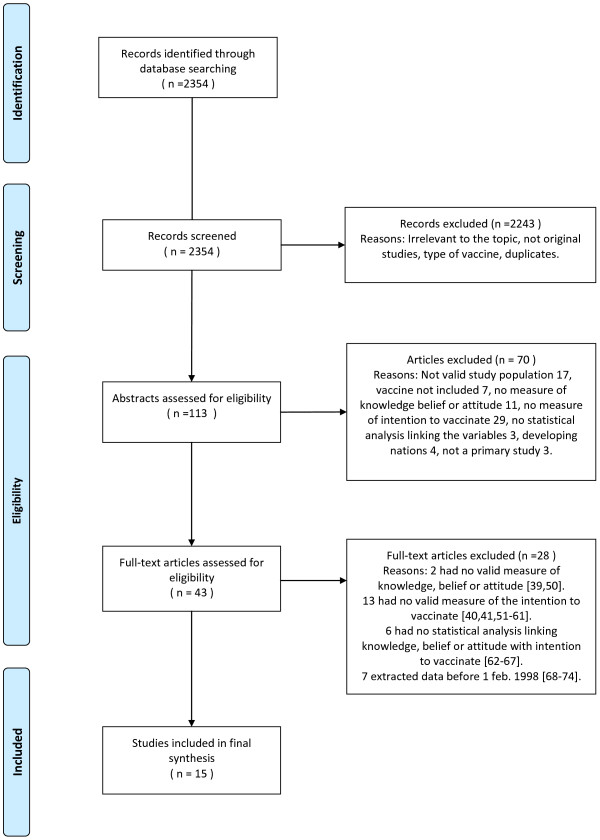
Background: The Summit of Independent European Vaccination Experts (SIEVE) recommended in 2007 that efforts be made to improve healthcare workers’ knowledge and beliefs about vaccines, and their attitudes towards them, to increase vaccination coverage. The aim of the study was to compile and analyze the areas of disagreement in the existing evidence about the relationship between healthcare workers’ knowledge, beliefs and attitudes about vaccines and their intentions to vaccinate the populations they serve. Methods: We conducted a systematic search in four electronic databases for studies published in any of seven different languages between February 1998 and June 2009. We included studies conducted in developed countries that used statistical methods to relate or associate the variables included in our research question. Two independent reviewers verified that the studies met the inclusion criteria, assessed the quality of the studies and extracted their relevant characteristics. The data were descriptively analyzed. Results: Of the 2354 references identified in the initial search, 15 studies met the inclusion criteria. The diversity in the study designs and in the methods used to measure the variables made it impossible to integrate the results, and each study had to be assessed individually. All the studies found an association in the direction postulated by the SIEVE experts: among healthcare workers, higher awareness, beliefs that are more aligned with scientific evidence and more favorable attitudes toward vaccination were associated with greater intentions to vaccinate. All the studies included were cross-sectional; thus, no causal relationship between the variables was established. Conclusion: The results suggest that interventions aimed at improving healthcare workers’ knowledge, beliefs and attitudes about vaccines should be encouraged, and their impact on vaccination coverage should be assessed.
Overview
The claims and statistics of this paper haven’t been checked yet.
Free: it reads the open-access text and checks the first 5 claims that cite a source we can check. Create a free account to check every claim.
Integrity signals
Registry
Cites
Statistics
Figures
Verification
Claims the paper makes
The claims and statistics of this paper haven’t been checked yet.
Free: it reads the open-access text and checks the first 5 claims that cite a source we can check. Create a free account to check every claim.
Claims other papers make about this one
Each is checked against this paper’s own text: does it say what the citing paper says it does?
The source backs part of the claim, not all of it — or backs it for a different population, condition or comparison.
In the citing paper
“The methodological quality of the studies was assessed using the Newcastle-Ottawa Scale, based on criteria related to selection and comparability between cohorts and related to study outcomes. The methodological quality of the cross-sectional studies was performed using the adapted Newcastle Ottawa for cross-sectional studies [20]. The evaluation was performed in pairs, by four reviewers and dis”
From The associations between screen time and mental health in adolescents: a systematic review (2023) · cites this paper as [20]
Experimental — accuracy not yet measuredThe cited source says what the claim attributes to it.
In the citing paper
“The NOS classification has been used in similar systematic reviews (Herzog et al., 2013; Moore et al., 2021).”
From Parental stress and mental health outcomes following very preterm birth: A systematic review of recent findings (2024) · cites this paper as Herzog et al., 2013
The cited source says what the claim attributes to it.
In the citing paper
“The present review uses the adapted Newcastle-Ottawa Scale for crosssectional studies (Herzog et al., 2013) to critically evaluate the risk of bias in the included studies.”
From Parental stress and mental health outcomes following very preterm birth: A systematic review of recent findings (2024) · cites this paper as Herzog et al., 2013
The cited source says what the claim attributes to it.
In the citing paper
“We used the Newcastle-Ottawa validated tool for the evaluation of internal validity of longitudinal studies (NOS) 32 and the adapted version for cross-sectional studies.33”
From Defining risk factors associated with difficult peripheral venous Cannulation: A systematic review and meta-analysis (2020) · cites this paper as [33]
The cited source says what the claim attributes to it.
In the citing paper
“All eligible studies were assessed for quality using an adapted version of the Newcastle-Ottawa quality assessment scale for cross-sectional studies, which was used to score the risk of bias for each study [29].”
From Problematic Social Media Use in Adolescents and Young Adults: Systematic Review and Meta-analysis. (2022) · cites this paper as [29]
1 more claim about this paper
Create a free account to see every claim other papers make about this one.
Self-check
Percentages, sums and reported differences re-computed from the paper’s own numbers.
The self-check needs the paper’s full text.
Citations
Cites
1 retracted
Wakefield, A., Murch, S., Anthony, A., Linnell, J., Casson, D., Malik, M., Berelowitz, M., Dhillon, A., Thomson, M., Harvey, P., et al. (1998) · The Lancet · doi:10.1016/s0140-6736(97)11096-0 · Cited by 3,006
RetractedDermyshi, E., Wang, Y., Yan, C., Hong, W., Qiu, G., Gong, X., & Zhang, T. (2017) · Neonatology · doi:10.1159/000454668 · Cited by 24,451
Meta-analysis of Observational Studies in Epidemiology<SUBTITLE>A Proposal for Reporting</SUBTITLE>
Stroup, D. F. (2000) · JAMA · doi:10.1001/jama.283.15.2008 · Cited by 20,623
Stang, A. (2010) · European Journal of Epidemiology · doi:10.1007/s10654-010-9491-z · Cited by 17,396 · cited 1×
“The tools used to determine the risk of bias and the quality of the studies included were based on the Newcastle-Ottawa scales, which are widely used for observational studies [37].”
MethodTen great public health achievements--United States, 1900-1999.
(1999) · PubMed · Cited by 662
Do Parents Understand Immunizations? A National Telephone Survey
Gellin, B. G., Maibach, E. W., Marcuse, E. K., & for the National Network for Immunization Information Steering Committee∥ (2000) · Pediatrics · doi:10.1542/peds.106.5.1097 · Cited by 512
Meta-analysis of Observational Studies in Epidemiology
Stroup, D. F., Berlin, J. A., Morton, S. C., Olkin, I., Williamson, G. D., Rennie, D., Moher, D., Becker, B. J., Sipe, T. A., & Thacker, S. B. (2000) · Cited by 473
Mills, E., Jadad, A. R., Ross, C., & Wilson, K. (2005) · Journal of Clinical Epidemiology · doi:10.1016/j.jclinepi.2005.09.002 · Cited by 374 · cited 2×
“It ́s also interesting to highlight that the knowledge, beliefs and attitude themes explored in the HCW in the included studies, do not differ from the barriers towards vaccination explored in the general population [6].”
BackgroundSmallpox: The Triumph over the Most Terrible of the Ministers of Death
Barquet, N., & Domingo, P. (1997) · Annals of Internal Medicine · doi:10.7326/0003-4819-127-8_part_1-199710150-00010 · Cited by 263
Factors influencing pandemic influenza vaccination of healthcare workers—A systematic review
Prematunge, C., Corace, K., McCarthy, A., Nair, R. C., Pugsley, R., & Garber, G. (2012) · Vaccine · doi:10.1016/j.vaccine.2012.05.018 · Cited by 186 · cited 1×
“Even HCW (healthcare workers) have low vaccine coverage, as is the case with the influenza vaccine, due to various factors, including knowledge about the disease, knowledge about the vaccine or past beliefs and past attitudes (related to influenza vaccination in previous seasons) [10,11].”
Background
Research works printed but not linked: 3
- Schmitt HJ Booy R Aston R Van Damme P Schumacher RF Campins M Rodrigo C Heikkinen T Weil-Oliver C Finn A Olcen P Fedson D Peltola H How to optimise the coverage rates of infant and adult immunisation in Europe BMC Med 2007 5 11 10.1186/1741-7015-5-11 17535430 PMC1903356 · DOI · Paper page
- Rivera JA Lo que Sócrates le diría a Woody Allen 2008 Madrid: Espasa Calpe
- World economic and social survey 2006 Diverging Growth and Development 2006 New York: United Nations Publications
Cited by
Items 201–300 of 1,001
Shukla, V. V., & Shah, R. C. (2018) · The Indian Journal of Pediatrics · doi:10.1007/s12098-017-2555-2 · Cited by 73
“Availability of vaccines [9] and awareness of healthcare providers [10] about vaccine-preventable diseases are the biggest barriers identified in developing countries.”
BackgroundGamboa Madeira, S., Fernandes, C., Paiva, T., Santos Moreira, C., & Caldeira, D. (2021) · International Journal of Environmental Research and Public Health · doi:10.3390/ijerph18136738 · Cited by 69
“The total NOS score for each included study is presented in Table 1.”
MethodInfluentialGarcía, L. F., Merchán, A., Phillips-Silver, J., & Daza, M. T. (2021) · Frontiers in Psychology · doi:10.3389/fpsyg.2021.687337 · Cited by 94
The association between non-alcoholic fatty liver disease and atrial fibrillation: A meta-analysis
Wijarnpreecha, K., Boonpheng, B., Thongprayoon, C., Jaruvongvanich, V., & Ungprasert, P. (2017) · Clinics and Research in Hepatology and Gastroenterology · doi:10.1016/j.clinre.2017.08.001 · Cited by 78
Binmoammar, T. A., Hassounah, S., Alsaad, S. M., Rawaf, S., & Majeed, A. (2016) · JRSM Open · doi:10.1177/2054270415622602 · Cited by 77
“Full critical appraisal was done for each study, by using Newcastle Ottawa quality assessment tool for cohort studies; checklists were adapted to be applied for cross-sectional studies.(28) Items reviewed included representativeness of the sample; sample size; response rate; validity of measurement tool, if validated…”
MethodBi, Y., Wang, J., Li, M., Zhou, J., & Sun, X. (2019) · Diabetes/Metabolism Research and Reviews · doi:10.1002/dmrr.3142 · Cited by 85
“) by modified Newcastle‐ Ottawa quality assessment (NOS) scale for cross‐sectional studies.(24) The NOS consisted of three major components, including participants selection (four stars), inter‐study comparability (two stars), and outcome assessment (three stars; Table 3).”
MethodVestibular Function in Children with Neurodevelopmental Disorders: A Systematic Review
Hecke, R. V., Danneels, M., Dhooge, I. J. M., Waelvelde, H. V., Wiersema, R., Deconinck, F. J. A., & Maes, L. (2019) · Journal of Autism and Developmental Disorders · doi:10.1007/s10803-019-04059-0 · Cited by 86
Bhatia, D., Lega, I. C., Wu, W., & Lipscombe, L. L. (2020) · Diabetologia · doi:10.1007/s00125-019-04995-7 · Cited by 56
“A modified NOS was used for crosssectional studies [60].”
Biomarkers of the ageing immune system and their association with frailty – A systematic review
Tran Van Hoi, E., De Glas, N. A., Portielje, J. E. A., Van Heemst, D., Van Den Bos, F., Jochems, S. P., & Mooijaart, S. P. (2023) · Experimental Gerontology · doi:10.1016/j.exger.2023.112163 · Cited by 69
“Study quality was assessed by three authors (NdG, SPM, ETVH) using the Newcastle-Ottawa Scale (NOS) adapted for cross-sectional studies (Herzog et al., 2013).”
Wu, P.-Y., Chen, K., & Tsai, W.-C. (2020) · Advances in Nutrition · doi:10.1093/advances/nmaa116 · Cited by 76
“The Newcastle-Ottawa Scale (NOS) for cohort studies (31) and cross-sectional studies (32) and Joanna Briggs Institute (JBI) Critical Appraisal Checklists for randomized controlled trials (RCTs) and quasi-experimental studies were used for the quality assessment of the included studies (33).”
BackgroundMethodVirtual preoperative assessment in surgical patients: A systematic review and meta-analysis
Zhang, K., Rashid-Kolvear, M., Waseem, R., Englesakis, M. F., & Chung, F. F. (2021) · Journal of Clinical Anesthesia · doi:10.1016/j.jclinane.2021.110540 · Cited by 71
“The NOS quality assessment forms were used to appraise cohort and crosssectional studies [17,18].”
MethodMocini, E., Cammarota, C., Frigerio, F., Muzzioli, L., Piciocchi, C., Lacalaprice, D., Buccolini, F., Donini, L. M., & Pinto, A. (2023) · Nutrients · doi:10.3390/nu15020302 · Cited by 87
“The methodological quality of the included studies was assessed by means of the Appraisal tool for Cross-Sectional Studies (AXIS) [19] and the Newcastle–Ottawa Scale (NOS) on cross-sectional studies [20].”
MethodSarcopenia and risk of nonalcoholic fatty liver disease: A meta-analysis
Wijarnpreecha, K., Panjawatanan, P., Thongprayoon, C., Jaruvongvanich, V., & Ungprasert, P. (2018) · Saudi Journal of Gastroenterology · doi:10.4103/sjg.sjg_237_17 · Cited by 72
“[20]”
Kronenburg, A., van den Berg, E., van Schooneveld, M. M. J., Braun, K. P. J., Calvière, L., van der Zwan, A., & Klijn, C. J. M. (2018) · Journal of Stroke · doi:10.5853/jos.2018.01550 · Cited by 71
“…†This scale has been adapted by the authors from the Newcastle-Ottawa Quality Assessment Scale for cohort studies1 and the scale developed by Herzog et al. (2013)2 to perform a quality assessment of cross-sectional studies for the systematic review: ‘Cognitive functions in children and…”
MethodAssociation between sarcopenia and hepatic encephalopathy: A systematic review and meta-analysis
Wijarnpreecha, K., Werlang, M. E., Panjawatanan, P., Kröner, P. T., Cheungpasitporn, W., Lukens, F., Pungpapong, S., & Ungprasert, P. (2019) · Annals of Hepatology · doi:10.1016/j.aohep.2019.06.007 · Cited by 70
Systemic inflammatory markers in neck pain: A systematic review with meta‐analysis
Farrell, S. F., de Zoete, R. M. J., Cabot, P. J., & Sterling, M. M. (2020) · European Journal of Pain · doi:10.1002/ejp.1630 · Cited by 77
“Methodologic quality and risk of bias of included studies were assessed using the Newcastle–Ottawa Scale (NOS) modified for cross-sectional studies (Herzog et al., 2013).”
BackgroundMethodInternet addiction in Gulf countries: A systematic review and meta-analysis
Al-Khani, A. M., Saquib, J., Rajab, A. M., Khalifa, M. A., Almazrou, A., & Saquib, N. (2021) · Journal of Behavioral Addictions · doi:10.1556/2006.2021.00057 · Cited by 63
Alexandre, L., Tsilegeridis-Legeris, T., & Lam, S. (2021) · Gastroenterology · doi:10.1053/j.gastro.2021.12.270 · Cited by 75
The sleep phenotype of Borderline Personality Disorder: A systematic review and meta-analysis
Winsper, C., Tang, N. K. Y., Marwaha, S., Lereya, S. T., Gibbs, M., Thompson, A. D., & Singh, S. P. (2016) · Neuroscience & Biobehavioral Reviews · doi:10.1016/j.neubiorev.2016.12.008 · Cited by 81
“We used the adapted scale by Herzog et al. (2013) for cross sectional studies, covering the similar domains of selection (maximum of 5 stars); comparability (maximum of 2 stars); and outcome (maximum of 3 stars).”
Lower limb muscle synergies during walking after stroke: a systematic review
Criekinge, T. V., Vermeulen, J., Wagemans, K., Schröder, J., Embrechts, E., Truijen, S., Hallemans, A., & Saeys, W. (2019) · Disability and Rehabilitation · doi:10.1080/09638288.2019.1578421 · Cited by 76
Yuan, R., Zhang, C., Li, Q., Ji, M., & He, N. (2021) · Gynecologic Oncology · doi:10.1016/j.ygyno.2021.06.008 · Cited by 89
Is bruxism associated with temporomandibular joint disorders? A systematic review and meta-analysis
Mortazavi, N., Tabatabaei, A., Mohammadi, M., & Rajabi, A. (2023) · Evidence-Based Dentistry · doi:10.1038/s41432-023-00911-6 · Cited by 85
Self-Esteem and Risk Behaviours in Adolescents: A Systematic Review
Martínez-Casanova, E., Jurado, M. D. M. M., & Fuentes, M. D. C. P. (2024) · Behavioral Sciences · doi:10.3390/bs14060432 · Cited by 98
Maternal depression and inflammation during pregnancy
Lahti‐Pulkkinen, M., Girchenko, P. V., Robinson, R., Lehto, S. M., Toffol, E., Heinonen, K., Reynolds, R. M., Kajantie, E., Laivuori, H. M., Villa, P., et al. (2019) · Psychological Medicine · doi:10.1017/s0033291719001909 · Cited by 77
“Online Supplementary Table ST2 provides further details of the NOS assessment and criteria for cross-sectional (Herzog et al., 2013; Anthony and Lin, 2018) and online Supplementary Table ST3 for cohort studies (Wells et al.”
BackgroundMethodInfluentialAyano, G., Solomon, M., Tsegay, L., Yohannes, K., & Abraha, M. (2020) · Psychiatric Quarterly · doi:10.1007/s11126-020-09746-1 · Cited by 69
Siddiqi, A., Rajaram, A., & Miller, S. P. (2018) · Archives of Disease in Childhood · doi:10.1136/archdischild-2017-314301 · Cited by 78
Factors associated with hypertension in Pakistan: A systematic review and meta-analysis
Riaz, M. A., Shah, G., Asif, M., Shah, A. F., Adhikari, K., & Abu-Shaheen, A. K. (2021) · PLoS ONE · doi:10.1371/journal.pone.0246085 · Cited by 101
“We assessed the quality of the included studies using the MNOQS [26,78], and only included studies where the BP was measured by a trained person and the JNC-VII guidelines [67] were used to diagnose hypertension.”
MethodInfluentialAl‐Jafar, R., Themeli, M. Z., Zaman, S., Akbar, S., Lhoste, V. P. F., Khamliche, A., Elliott, P., Tsilidis, K. K., & Dehghan, A. (2021) · Journal of the American Heart Association · doi:10.1161/jaha.120.021560 · Cited by 82
Prescribed safer opioid supply: A scoping review of the evidence
Ledlie, S., Garg, R., Cheng, C., Kolla, G., Antoniou, T., Bouck, Z., & Gomes, T. (2024) · International Journal of Drug Policy · doi:10.1016/j.drugpo.2024.104339 · Cited by 68
Weng, S.-E., Huang, Y.-W., Tseng, Y.-C., Peng, H.-R., Lai, H., Akishita, M., Arai, H., Hsiao, F., & Chen, L.-K. (2024) · Archives of Gerontology and Geriatrics · doi:10.1016/j.archger.2024.105596 · Cited by 80
Chokesuwattanaskul, R., Thongprayoon, C., Tanawuttiwat, T., Kaewput, W., Pachariyanon, P., & Cheungpasitporn, W. (2018) · Pacing and Clinical Electrophysiology · doi:10.1111/pace.13331 · Cited by 74
Associations of sleep quality with incident atrial fibrillation: a meta‐analysis
Chokesuwattanaskul, R., Thongprayoon, C., Sharma, K., Congrete, S., Tanawuttiwat, T., & Cheungpasitporn, W. (2018) · Internal Medicine Journal · doi:10.1111/imj.13764 · Cited by 65
Tekalign, T., & Teshome, M. (2022) · PLoS ONE · doi:10.1371/journal.pone.0267571 · Cited by 73
“Studies that scored five and more on the NOS were included [24].”
BackgroundPutowski, Z., Rachfalska, N., Majewska, K., Megger, K., & Krzych, Ł. J. (2023) · Anaesthesiology Intensive Therapy · doi:10.5114/ait.2023.130831 · Cited by 99
“A modification of NOS was introduced to assess the quality of cross-sectional studies [18].”
MethodDietary intake and diabetic retinopathy: A systematic review
Wong, M. Y. Z., Man, R. E. K., Fenwick, E., Gupta, P., Li, L., van Dam, R. M., Chong, M. F., & Lamoureux, E. L. (2018) · PLoS ONE · doi:10.1371/journal.pone.0186582 · Cited by 82
Palmieri, S., Mansueto, G., Scaini, S., Caselli, G., Sapuppo, W., Spada, M. M., Sassaroli, S., & Ruggiero, G. M. (2021) · Journal of Clinical Medicine · doi:10.3390/jcm10112448 · Cited by 77
“) using the Newcastle Ottawa scale for case–control studies and its adapted form for cross-sectional studies [49,50].”
MethodRomero-Robles, M. A., Ccami‐Bernal, F., Ortiz‐Benique, Z. N., Pinto-Ruiz, D. F., Benites-Zapata, V. A., & Patiño, D. C. (2022) · BMC Nutrition · doi:10.1186/s40795-022-00549-0 · Cited by 69
Poor Sleep and Risk of Falls in Community-Dwelling Older Adults: A Systematic Review
Min, Y., & Slattum, P. W. (2016) · Journal of Applied Gerontology · doi:10.1177/0733464816681149 · Cited by 73
Samsudin, E. Z., Isahak, M., & Rampal, S. (2018) · European Journal of Work and Organizational Psychology · doi:10.1080/1359432x.2018.1502171 · Cited by 83
“The NOS published by Herzog et al. (2013) were adapted for this study in two areas: 1) For ascertainment of exposure, we have assigned two stars for validated measurement tool, one star for non-validated measurement tool that is available or described, and no star for no description of the…”
MethodHorner‐Johnson, W., MOE, E. L., Stoner, R. C., Klein, K. A., Edelman, A. B., Eden, K., Andresen, E. M., Caughey, A. B., & Guise, J. (2018) · Disability and health journal · doi:10.1016/j.dhjo.2018.11.006 · Cited by 77
Wijarnpreecha, K., Lou, S. M., Watthanasuntorn, K., Kröner, P. T., Cheungpasitporn, W., Lukens, F., Pungpapong, S., Keaveny, A. P., & Ungprasert, P. (2019) · European Journal of Gastroenterology & Hepatology · doi:10.1097/meg.0000000000001541 · Cited by 71
Peng, M., Xing, J., Tang, X., Wu, Q., Wei, D., & Ran, M. (2022) · International Journal of Environmental Research and Public Health · doi:10.3390/ijerph19031862 · Cited by 73
“Supplementary Materials: The following supporting information can be downloaded at: https: //www.mdpi.com/article/10.3390/ijerph19031862/s1, Table S1: Newcastle-Ottawa Scale (NOS) Adapted for Cross-sectional Studies; Table S2: Results of Quality Assessment for the Included Studies; Table S3.”
BackgroundMethodInfluentialFood insecurity and low CD4 count among HIV-infected people: a systematic review and meta-analysis
Aibibula, W., Cox, J., Hamelin, A.-M., Mamiya, H., Klein, M. B., & Brassard, P. (2016) · AIDS Care · doi:10.1080/09540121.2016.1191613 · Cited by 65
“Adaptation was based on work by Herzog et al. (2013) with slight modification so that the adapted version has 9 stars maximum rather than 10 stars.”
MethodLee, S. C., Phillips, M. R., Bellinge, J. W., Stone, J., Wylie, E. J., & Schultz, C. J. (2020) · PLoS ONE · doi:10.1371/journal.pone.0236598 · Cited by 70
“We have attempted to overcome this by modifying a standardised method used to appraise cohort and case control studies and which has been used in previous systematic reviews [76], but this approach requires validation.”
MethodEbadi, M., Ip, S., Bhanji, R. A., & Montaño‐Loza, A. J. (2021) · Nutrients · doi:10.3390/nu13093042 · Cited by 67
Giannetta, N., Villa, G., Bonetti, L., Dionisi, S., Pozza, A., Rolandi, S., Rosa, D., & Manara, D. F. (2022) · International Journal of Environmental Research and Public Health · doi:10.3390/ijerph191710640 · Cited by 70
“quality”; a study with a score of 7–8 was considered to be of “good quality”; a study with a score of 5–6 was considered to be of “satisfactory quality”; and a study with a score of less than 5 was considered to be of “unsatisfactory quality” [42].”
BackgroundMethodHyperuricaemia and risk of nonalcoholic fatty liver disease: A meta‐analysis
Wijarnpreecha, K., Panjawatanan, P., Lekuthai, N., Thongprayoon, C., Cheungpasitporn, W., & Ungprasert, P. (2016) · Liver International · doi:10.1111/liv.13329 · Cited by 67
Wickersham, A., Leightley, D., Archer, M., & Fear, N. T. (2020) · Journal of Adolescence · doi:10.1016/j.adolescence.2020.01.007 · Cited by 74
“, 2012) and a version of the scale adapted for cross-sectional studies (Herzog et al., 2013).”
BackgroundKnowledge, Attitude and Behaviours towards Recommended Vaccinations among Healthcare Workers
Torre, G. L., Scalingi, S., Garruto, V., Siclari, M., Chiarini, M., & Mannocci, A. (2017) · Healthcare · doi:10.3390/healthcare5010013 · Cited by 63
“Systematic reviews show that higher awareness and evidence-based beliefs of HCWs toward vaccination are associated with greater intentions to vaccinate [32], and in that case the role of vaccine education is crucial to avoid communication barriers [33].”
BackgroundSkeie, M. S., Gil, E. G., Cetrelli, L., Rosén, A., Fischer, J., Åstrøm, A. N., Luukko, K., Shi, X., Feuerherm, A. J., Sen, A., et al. (2019) · BMC Oral Health · doi:10.1186/s12903-019-0965-4 · Cited by 71
“[75] and further modified in support of this systematic review Additional file 3: Table S3.”
BackgroundMethodInfluentialPana, A., Sourtzi, P., Kalokairinou, A., Pastroudis, A., Chatzopoulos, S.-T., & Velonaki, V. S. (2020) · European Geriatric Medicine · doi:10.1007/s41999-020-00399-8 · Cited by 69
Insan, N., Weke, A., Rankin, J. M., & Forrest, S. (2022) · BMC Pregnancy and Childbirth · doi:10.1186/s12884-022-04642-x · Cited by 82
“For the primarily quantitative studies included in this review, there are no CASP checklists for cross-sectional studies, therefore, the Newcastle–Ottawa Scale (NOS) adapted for cross-sectional studies which assesses information bias, selection bias and confounding bias was used to assess quality (see Additional File…”
BackgroundSulaiman, S. K., Musa, M. S., Tsiga-Ahmed, F. I., Dayyab, F. M., Sulaiman, A. K., & Bako, A. T. (2022) · PLoS ONE · doi:10.1371/journal.pone.0278224 · Cited by 67
“Two authors (SKS and MSM) independently reviewed all included studies to assess their methodological quality using an adapted version of the Newcastle-Ottawa Scale (NOS) [10].”
MethodInfluentialHospital Services to Improve Nutritional Intake and Reduce Food Waste: A Systematic Review
Rinninella, E., Raoul, P. C., Maccauro, V., Cintoni, M., Cambieri, A., Fiore, A., Zega, M., Gasbarrini, A., & Mele, M. C. (2023) · Nutrients · doi:10.3390/nu15020310 · Cited by 79
“The Newcastle-Ottawa Scale (NOS) for cohort studies [16] and its version adapted for cross-sectional studies [17] assesses the quality and risk of bias of observational studies.”
MethodSurveying willingness toward SARS-CoV-2 vaccination of healthcare workers in Italy
Giuseppe, G. D., Pelullo, C. P., Polla, G. D., Montemurro, M. V., Napolitano, F., Pavía, M., & Angelillo, I. F. (2021) · Expert Review of Vaccines · doi:10.1080/14760584.2021.1922081 · Cited by 62
Desire Thinking across addictive behaviours: A systematic review and meta-analysis
Mansueto, G., Martino, F., Palmieri, S., Scaini, S., Ruggiero, G. M., Sassaroli, S., & Caselli, G. (2019) · Addictive Behaviors · doi:10.1016/j.addbeh.2019.06.007 · Cited by 67
Gupta, P., Lança, C., Gan, A. T. L., Soh, P., Thakur, S., Tao, Y., Neelam, K., Man, R. E. K., Fenwick, E., & Lamoureux, E. L. (2019) · Scientific Reports · doi:10.1038/s41598-019-49162-5 · Cited by 74
Lifestyle and sociodemographic risk factors for gastroschisis: a systematic review and meta-analysis
Baldacci, S., Santoro, M. C., Coi, A., Mezzasalma, L., Bianchi, F., & Pierini, A. (2020) · Archives of Disease in Childhood · doi:10.1136/archdischild-2019-318412 · Cited by 69
Park, J. Y., Howren, A. M., Zusman, E. Z., Esdaile, J. M., & Vera, M. A. D. (2020) · BMC Rheumatology · doi:10.1186/s41927-019-0111-6 · Cited by 66
Lee, H., Lee, J. H., Koh, S., & Park, H. (2020) · Journal of the American Academy of Dermatology · doi:10.1016/j.jaad.2020.05.130 · Cited by 66
Sexual Dysfunction in Schizophrenia: A Systematic Review and Meta-Analysis
Korchia, T., Achour, V., Faugère, M., Albeash, A., Yon, D. K., Boyer, L., & Fond, G. B. (2023) · JAMA Psychiatry · doi:10.1001/jamapsychiatry.2023.2696 · Cited by 79
Rheumatoid arthritis and the risk of dementia: A systematic review and meta-analysis
Ungprasert, P., Wijarnpreecha, K., & Thongprayoon, C. (2016) · Neurology India · doi:10.4103/0028-3886.173623 · Cited by 65
Wijarnpreecha, K., Thongprayoon, C., Panjawatanan, P., Manatsathit, W., Jaruvongvanich, V., & Ungprasert, P. (2017) · Journal of Clinical Gastroenterology · doi:10.1097/mcg.0000000000000784 · Cited by 69
Zusman, E. Z., Howren, A. M., Park, J. Y. E., Dutz, J. P., & Vera, M. A. D. (2020) · Seminars in Arthritis and Rheumatism · doi:10.1016/j.semarthrit.2020.02.001 · Cited by 65
Stigma of eating disorders and recovery‐related outcomes: A systematic review
Foran, A., O'Donnell, A. T., & Muldoon, O. T. (2020) · European Eating Disorders Review · doi:10.1002/erv.2735 · Cited by 59
A systematic review of risk factors associated with depression and anxiety in cancer patients
Ikhile, D., Ford, E., Glass, D., Gremesty, G., & van Marwijk, H. (2024) · PLOS ONE · doi:10.1371/journal.pone.0296892 · Cited by 59
“For the cross-sectional studies, we used the modified Newcastle-Ottawa Scale by Herzog et al. [26].”
MethodProton pump inhibitors and risk of dementia
Wijarnpreecha, K., Thongprayoon, C., Panjawatanan, P., & Ungprasert, P. (2016) · Annals of Translational Medicine · doi:10.21037/atm.2016.06.14 · Cited by 60
“was used for cross-sectional study (13).”
Cordero, M. J. A., Lasserrot-Cuadrado, A., Mur-Villar, N., Ríos, X. A. L., Rivero-Blanco, T., & Pérez-Castillo, Í. M. (2020) · Midwifery · doi:10.1016/j.midw.2020.102707 · Cited by 72
Precarious employment and associated health and social consequences; a systematic review
Jaydarifard, S., Smith, S. S., Mann, D., Rossa, K. R., Salehi, E. N., Srinivasan, A. G., & Soleimanloo, S. S. (2023) · Australian and New Zealand Journal of Public Health · doi:10.1016/j.anzjph.2023.100074 · Cited by 73
Lawler, T., Parlato, L., & Andersen, S. W. (2024) · Frontiers in Oncology · doi:10.3389/fonc.2024.1349572 · Cited by 69
Sulaiman, S. K., Tsiga-Ahmed, F. I., Musa, M. S., Makama, B. T., Sulaiman, A. K., & Bako, A. T. (2024) · Communications Medicine · doi:10.1038/s43856-024-00564-1 · Cited by 64
Ni, R., Su, H., Burnett, R. T., Guo, Y., & Cheng, Y. (2024) · One Earth · doi:10.1016/j.oneear.2024.09.022 · Cited by 76
Hepatitis C virus infection and risk of Parkinson’s disease: a systematic review and meta-analysis
Wijarnpreecha, K., Chesdachai, S., Jaruvongvanich, V., & Ungprasert, P. (2018) · European Journal of Gastroenterology & Hepatology · doi:10.1097/meg.0000000000000991 · Cited by 57
dos Reis, F. J. J., Guimarães, F. R. J., Nogueira, L. A. C., Meziat‐Filho, N., Sanchez, T. A., & Wideman, T. H. (2018) · Physiotherapy Theory and Practice · doi:10.1080/09593985.2018.1455122 · Cited by 71
“The risk of bias was evaluated using the Newcastle– Ottawa scale for case-control studies and an adapted form of the Newcastle–Ottawa cohort scale for cross-sectional studies (Herzog et al, 2013).”
MethodZinc and atopic dermatitis: a systematic review and meta‐analysis
Gray, N. A., Dhana, A. V., Stein, D. J., & Khumalo, N. P. (2019) · Journal of the European Academy of Dermatology and Venereology · doi:10.1111/jdv.15524 · Cited by 60
Substance use disorders in Saudi Arabia: a scoping review
Saquib, N., Rajab, A. M., Saquib, J., & AlMazrou, A. (2020) · Substance Abuse Treatment Prevention and Policy · doi:10.1186/s13011-020-00285-3 · Cited by 59
Hao, G., Zhu, B., li, Y., Wang, P., Li, L., & Hou, L. (2020) · Sleep Medicine · doi:10.1016/j.sleep.2020.08.032 · Cited by 62
Intake of ultra-processed foods and sleep-related outcomes: A systematic review and meta-analysis
Delpino, F. M., Figueiredo, L. M., Flores, T. R., Silveira, E. A., Silva dos Santos, F., Werneck, A. O., Louzada, M. L. D. C., Arcêncio, R. A., & Nunes, B. P. (2023) · Nutrition · doi:10.1016/j.nut.2022.111908 · Cited by 58
Sugawara, N., Yasui‐Furukori, N., Fukushima, A., & Shimoda, K. (2021) · Vaccines · doi:10.3390/vaccines9111295 · Cited by 59
“Healthcare workers are considered an important source of information on vaccination for the general population [11,12], and medical students with a positive attitude toward vaccines might encourage widespread vaccination [9].”
BackgroundBullying and Health Related Quality of Life among Adolescents—A Systematic Review
Dubey, V. P., Kievišienė, J., Rauckiene-Michealsson, A., Norkienė, S., Razbadauskas, A., & Agostinis‐Sobrinho, C. (2022) · Children · doi:10.3390/children9060766 · Cited by 65
“For critical appraisal and to limit bias, each included study was independently examined, and a modified version of the Newcastle Ottawa cohort scale was employed for cross-sectional research (Supplementary File S1) [20].”
MethodInfluentialDomínguez-Antuña, E., Diz, J. C., Suárez-Iglesias, D., & Pérez, C. A. (2022) · International Urogynecology Journal · doi:10.1007/s00192-022-05244-z · Cited by 56
“Moreover, the quality of the included studies was evaluated as good, fair or poor based on thresholds described previously [17], using the Newcastle–Ottawa Scale adapted for cross-sectional studies [18].”
MethodMahardawi, B., Jiaranuchart, S., Damrongsirirat, N., Arunjaroensuk, S., Mattheos, N., Somboonsavatdee, A., & Pimkhaokham, A. (2023) · Scientific Reports · doi:10.1038/s41598-023-30890-8 · Cited by 70
MacIsaac, M. B., Bugeja, L. C., & Jelinek, G. A. (2016) · Australian and New Zealand Journal of Public Health · doi:10.1111/1753-6405.12594 · Cited by 74
The relationship between body mass index and preeclampsia: A systematic review and meta-analysis
Motedayen, M., Rafiei, M., Rezaei–Tavirani, M., Sayehmiri, K., & Dousti, M. (2019) · International Journal of Reproductive BioMedicine (IJRM) · doi:10.18502/ijrm.v17i7.4857 · Cited by 83
“In this case, three subsets of the groups (four questions), group comparability (one question), and exposure or outcome (two questions) are examined (14), this tool is usually used for Validity assessment and is a reliable instrument with a long history of reliability (15).”
MethodNguyen, M., Nguyen, V. H., & Kim, J. H. (2021) · International Journal of Environmental Research and Public Health · doi:10.3390/ijerph18073791 · Cited by 58
“[27] and the NOS for cohort studies [26] were applied to evaluate the ROB of cross-sectional and cohort studies, respectively.”
MethodSandnes, R., Le Floch, M., Riquin, E., Nocus, I., Müller, J. B., & Bacro, F. (2024) · Journal of Affective Disorders · doi:10.1016/j.jad.2024.03.154 · Cited by 57
Graham, F. F., Finn, N., White, P., Hales, S., & Baker, M. G. (2022) · International Journal of Environmental Research and Public Health · doi:10.3390/ijerph19031907 · Cited by 65
“Study quality was classified according the study score into poor (0–3), moderate (4–6) and high (7–9) [39,40].”
MethodFanelli, G., Mota, N. R., Salas‐Salvadó, J., Bulló, M., Fernández‐Aranda, F., Camacho‐Barcia, L., Testa, G., Jiménez‐Múrcia, S., Bertaina‐Anglade, V., Franke, B., et al. (2022) · Neuroscience & Biobehavioral Reviews · doi:10.1016/j.neubiorev.2022.104927 · Cited by 62
“The Newcastle-Ottawa Scale (NOS) for cohort studies (Wells et al., 2000) and its version adapted for cross-sectional studies (Herzog et al., 2013) were used to assess the quality and risk of bias of each included study (longitudinal or cross-sectional, respectively) by two independent reviewers (GF and NRM) (Herzog et…”
InfluentialFood insecurity and binge eating: A systematic review and meta‐analysis
Abene, J., Tong, J., Minuk, J., Lindenfeldar, G., Chen, Y., & Chao, A. M. (2023) · International Journal of Eating Disorders · doi:10.1002/eat.23956 · Cited by 64
Obesity paradox in older sarcopenic adults ― a delay in aging: A systematic review and meta-analysis
Eitmann, S., Mátrai, P., Hegyi, P. J., Balaskó, M., Erőss, B. M., Dorogi, K., & Pétervári, E. (2023) · Ageing Research Reviews · doi:10.1016/j.arr.2023.102164 · Cited by 66
Sá-Pinto, A. C., Rego, T. M., Marques, L. S., Martins, C. C., Ramos‐Jorge, M. L., & Ramos‐Jorge, J. (2018) · European Archives of Paediatric Dentistry · doi:10.1007/s40368-018-0333-0 · Cited by 71
“1 3 for the evaluation of cross-sectional studies (Herzog et al. 2013) (Table 2).”
BackgroundPolyphenol-rich foods and risk of gestational diabetes: a systematic review and meta-analysis
Pham, N. M., Vuong, V., & Lee, A. H. (2018) · European Journal of Clinical Nutrition · doi:10.1038/s41430-018-0218-7 · Cited by 64
Agrawal, M., Shah, S. C., Patel, A. V., Pinotti, R., Colombel, J., & Burisch, J. M. (2019) · Journal of Autoimmunity · doi:10.1016/j.jaut.2019.07.002 · Cited by 65
Zheng, C., Feng, J., Huang, Y., & Wong, S. H. (2021) · Health & Place · doi:10.1016/j.healthplace.2021.102546 · Cited by 67
Theodorakopoulou, M. P., Alexandrou, M. E., Bakaloudi, D. R., Pitsiou, G., Stanopoulos, I., Kontakiotis, T., & Boutou, A. (2021) · ERJ Open Research · doi:10.1183/23120541.00983-2020 · Cited by 64
“…the quality of the eligible studies was performed by the two reviewers (MT, DB) according to the Newcastle – Ottawa scale (NOS), a tool developed for quality assessment of nonrandomised studies, with a different scale corresponding to every study ’ s design (cohort or case – control studies) [20].”
Dietary Intake and Nutritional Status among Refugees in Host Countries: A Systematic Review
Khuri, J., Wang, Y., Holden, K., Fly, A. D., Mbogori, T. N., Mueller, S., Kandiah, J., & Zhang, M. (2022) · Advances in Nutrition · doi:10.1093/advances/nmac051 · Cited by 62
Ma, X., Biaggi, A., Sacchi, C., Lawrence, A. J., Chen, P., Pollard, R., Matter, M., Mackes, N. K., Hazelgrove, K. M., Morgan, C., et al. (2022) · Psychological Medicine · doi:10.1017/s0033291722001775 · Cited by 60
“A score ⩾ 7 indicates a good quality study and scores 5 – 6 indicate a satisfactory quality study (Herzog et al., 2013).”
The use of antidepressants is linked to bone loss: A systematic review and metanalysis
Mercurio, M., de Filippis, R., Spina, G., Fazio, P. D., Segura‐Garcìa, C., Galasso, O., & Gasparini, G. (2022) · Orthopedic Reviews · doi:10.52965/001c.38564 · Cited by 66
Pan, X., Han, Y., Zou, T., Zhu, G., Xu, K., Zheng, J., Zheng, M., & Cheng, X. (2018) · Digestive Diseases · doi:10.1159/000491015 · Cited by 56
de Stegge, B. M. A., Tak, L. M., Rosmalen, J. G. M., & Voshaar, R. C. O. (2018) · Journal of Psychosomatic Research · doi:10.1016/j.jpsychores.2018.10.002 · Cited by 69
Metadata
- Authors
- Herzog, R., Álvarez-Pasquin, M. J., Díaz, C., Del Barrio, J. L., Estrada, J. M., & Gil, Á.
- Affiliations
- Madrid Health Service (ES)
- Agencia Laín Entralgo (ES)
- Venue
- BMC Public Health
- Published
- 2013-02-19
- Volume
- 13
- Issue
- 1
- Pages
- 154-154
- ISSN
- 1471-2458 (ISSN-L)
- PMC
- PMC3602084
- OpenAlex
- W1987319584
- Semantic Scholar
- fd7bd1060c48f806bd3030e5d6061719ad5ad04b
- Cited by
- 1,652
- References
- 78
- Citations by year
- 2026: 131 · 2025: 178 · 2024: 236 · 2023: 188 · 2022: 198 · 2021: 210 · 2020: 137 · 2019: 119 · 2018: 99 · 2017: 76 · 2016: 46 · 2015: 22 · 2014: 10
- FWCI
- 4.49
- Type
- journal article
- Language
- en
- Open access
- gold
- doi.org
- Licence
- Locations
- BMC Public Health (publishedVersion, cc-by)
- Europe PMC (PubMed Central) (publishedVersion, cc-by)
- PubMed Central (publishedVersion, cc-by)
- PubMed (publishedVersion)
- Topics
- Social Sciences › Health › Vaccine Coverage and Hesitancy
- Health Sciences › Medicine › Emergency Medicine › Intramuscular injections and effects
- Health Sciences › Health Professions › General Health Professions › Health Policy Implementation Science
- Keywords
- healthcare workers, vaccination intention, vaccine knowledge, vaccine beliefs, vaccine attitudes, vaccine hesitancy, vaccination coverage
- MeSH terms
- Attitude of Health Personnel, Health Personnel, Humans, Health Knowledge, Attitudes, Practice, Vaccination, Intention
About these checks
Registry, retraction, Cites and statistics results are computed, not judged, with one exception: a printed reference that no index lists is read once by a model before it counts as a citation error. Claims are extracted by a model and kept only when their quote appears verbatim in the text; each cited source is then checked, with a model’s help, for whether it says what the claim relies on. Those verdicts can be wrong — read the claim’s quote and the cited source before relying on one.
Statistics and arithmetic are recomputed, not judged.
Confidence bands are shown only for fields calibrated on our annotated test set. None is calibrated yet, so no band is shown.
What counts as a claim ›How we measure confidence ›How we check this ›
Are you an author, or do you see a problem with this page? Request a review
Data sources
Bibliographic data: Semantic Scholar, OpenAlex, Crossref.
Contains information from the Semantic Scholar Academic Graph Datasets, made available under the ODC Attribution License (ODC-BY 1.0).
Semantic Scholar’s data is described in: Kinney, R., et al. (2023). The Semantic Scholar Open Data Platform. arXiv:2301.10140.
