

Effectiveness of home visiting programs on child outcomes: a systematic review
Open accessThe DOI matches its Crossref record; 35 of the 37 references it cites were found in a registry or an index.
Abstract
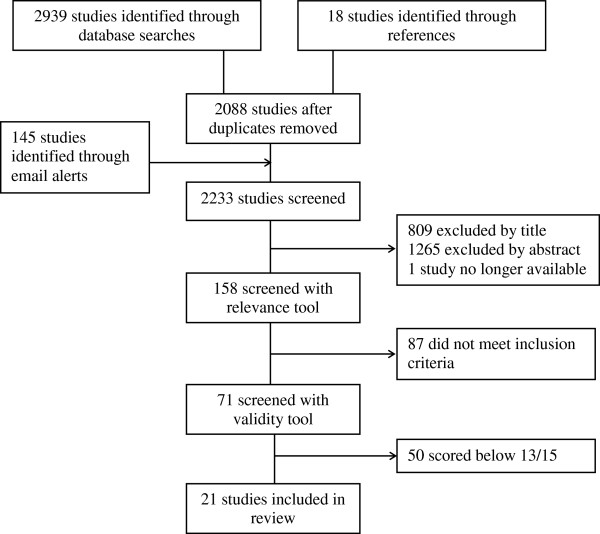
BACKGROUND: The effectiveness of paraprofessional home-visitations on improving the circumstances of disadvantaged families is unclear. The purpose of this paper is to systematically review the effectiveness of paraprofessional home-visiting programs on developmental and health outcomes of young children from disadvantaged families. METHODS: A comprehensive search of electronic databases (e.g., CINAHL PLUS, Cochrane, EMBASE, MEDLINE) from 1990 through May 2012 was supplemented by reference lists to search for relevant studies. Through the use of reliable tools, studies were assessed in duplicate. English language studies of paraprofessional home-visiting programs assessing specific outcomes for children (0-6 years) from disadvantaged families were eligible for inclusion in the review. Data extraction included the characteristics of the participants, intervention, outcomes and quality of the studies. RESULTS: Studies that scored 13 or greater out of a total of 15 on the validity tool (n = 21) are the focus of this review. All studies are randomized controlled trials and most were conducted in the United States. Significant improvements to the development and health of young children as a result of a home-visiting program are noted for particular groups. These include: (a) prevention of child abuse in some cases, particularly when the intervention is initiated prenatally; (b) developmental benefits in relation to cognition and problem behaviours, and less consistently with language skills; and (c) reduced incidence of low birth weights and health problems in older children, and increased incidence of appropriate weight gain in early childhood. However, overall home-visiting programs are limited in improving the lives of socially high-risk children who live in disadvantaged families. CONCLUSIONS: Home visitation by paraprofessionals is an intervention that holds promise for socially high-risk families with young children. Initiating the intervention prenatally and increasing the number of visits improves development and health outcomes for particular groups of children. Future studies should consider what dose of the intervention is most beneficial and address retention issues.
Overview
The claims and statistics of this paper haven’t been checked yet.
Free: it reads the open-access text and checks the first 5 claims that cite a source we can check. Create a free account to check every claim.
Integrity signals
Registry
Cites
Statistics
Figures
Verification
Claims the paper makes
The claims and statistics of this paper haven’t been checked yet.
Free: it reads the open-access text and checks the first 5 claims that cite a source we can check. Create a free account to check every claim.
Self-check
Percentages, sums and reported differences re-computed from the paper’s own numbers.
The self-check needs the paper’s full text.
Citations
Cites
Encyclopedia on Early Childhood Development
Munakata, Y., Michaelson, L., Barker, J. E., & Chevalier, N. (2013) · Cited by 825
Sweet, M. A., & Appelbaum, M. I. (2004) · Child Development · doi:10.1111/j.1467-8624.2004.00750.x · Cited by 798
Grantham-McGregor, S. M., Powell, C. A., Walker, S. P., & Himes, J. H. (1991) · The Lancet · doi:10.1016/0140-6736(91)90001-6 · Cited by 685
Support for breastfeeding mothers
Britton, C., McCormick, F. M., Renfrew, M. J., Wade, A., & King, S. E. (2007) · Cochrane Database of Systematic Reviews · doi:10.1002/14651858.cd001141.pub3 · Cited by 567
Programs for parents of infants and toddlers: recent evidence from randomized trials
Olds, D. L., Sadler, L., & Kitzman, H. (2007) · Journal of Child Psychology and Psychiatry · doi:10.1111/j.1469-7610.2006.01702.x · Cited by 548 · cited 1×
“There are a number of systematic reviews and metaanalyses that explore the effectiveness of HV programs with disadvantaged families [4-7], many of which focus on the prevention of child maltreatment [8-10].”
BackgroundMacLeod, J., & Nelson, G. (2000) · Child Abuse & Neglect · doi:10.1016/s0145-2134(00)00178-2 · Cited by 394
Jorde, R., Sneve, M., Torjesen, P. A., Figenschau, Y., Hansen, J.-B., & Grimnes, G. (2010) · Nutrition Journal · doi:10.1186/1475-2891-9-1 · Cited by 323
Randomized trial of a statewide home visiting program: impact in preventing child abuse and neglect
Duggan, A., McFarlane, E., Fuddy, L., Burrell, L., Higman, S. M., Windham, A., & Sia, C. (2004) · Child Abuse & Neglect · doi:10.1016/j.chiabu.2003.08.007 · Cited by 300
Elkan, Kendrick, Hewitt, Robinson, Tolley, Blair, Dewey, Williams, & Brummell (2000) · Health Technology Assessment · doi:10.3310/hta4130 · Cited by 297 · cited 1×
“There are a number of systematic reviews and metaanalyses that explore the effectiveness of HV programs with disadvantaged families [4-7], many of which focus on the prevention of child maltreatment [8-10].”
BackgroundNair, P., Schuler, M. E., Black, M. M., Kettinger, L., & Harrington, D. (2003) · Child Abuse & Neglect · doi:10.1016/s0145-2134(03)00169-8 · Cited by 285
Research works printed but not linked: 1
- Necoechea DM Children at-risk for poor school readiness: The effect of an early intervention home visiting program on children and parents [dissertation] 2007 Riverside: University of California
Cited by
Items 101–200 of 391
Hubel, G. S., Schreier, A., Wilcox, B. L., Flood, M. F., & Hansen, D. J. (2016) · Infants & Young Children · doi:10.1097/iyc.0000000000000078 · Cited by 21
Rodriguez, C. M., Silvia, P. J., Gonzalez, S., & Christl, M.-E. (2018) · Child Maltreatment · doi:10.1177/1077559518767571 · Cited by 23
Alves, C. R. L., Seibel, B. L., Gaspardo, C. M., Altafim, E. R. P., & Linhares, M. B. M. (2024) · Psychosocial Intervention · doi:10.5093/pi2024a7 · Cited by 21
“However, as pointed out by Peacock et al. (2013), although home-visiting programs delivered by trained nonprofessionals improved child development and health outcomes, they frequently did not significantly impact high-risk children from disadvantaged families with complex problems.”
Mental health of children and young people in the WHO Europe region
Tarasenko, A., Josy, G., Minnis, H., Hall, J., Danese, A., Lau, J. Y. F., Cortese, S., Stringaris, A. K., Redlich, C., & Ougrin, D. (2025) · The Lancet Regional Health - Europe · doi:10.1016/j.lanepe.2025.101459 · Cited by 46
“73,74 Comprehensive policies for the regulation of alternative delivery methods are essential, in particular in relation to the ethical implications of the use of machine learning and non-specialists in healthcare delivery.”
Do home visiting programmes improve children's language development? A systematic review
Henwood, T., Channon, S., Penny, H., Robling, M., & Waters, C. S. (2020) · International Journal of Nursing Studies · doi:10.1016/j.ijnurstu.2020.103610 · Cited by 32
School Readiness Among Children Born Preterm in Manitoba, Canada
Louis, D., Oberoi, S., Ricci, M. F., Pylypjuk, C. L., Alvaro, R. E., Seshia, M. M. K., de Cabo, C., Moddemann, D. M., Lix, L. M., Garland, A., et al. (2022) · Archives of Pediatrics and Adolescent Medicine · doi:10.1001/jamapediatrics.2022.2758 · Cited by 22
Empowering vulnerable parents through a family mentoring program
Ayton, D., & Joss, N. (2015) · Australian Journal of Primary Health · doi:10.1071/py14174 · Cited by 17
Rodriguez, C. M., & Wittig, S. M. O. (2018) · Journal of Applied Developmental Psychology · doi:10.1016/j.appdev.2018.11.001 · Cited by 19
Postpartum Mental Health Promotion: Perspectives from Mothers and Home Visitors
Chartier, M., Attawar, D., Volk, J. S., Cooper, M., Quddus, F., & McCarthy, J. (2015) · Public Health Nursing · doi:10.1111/phn.12205 · Cited by 22
Rotheram‐Borus, M. J., le Roux, K., le Roux, I. M., Christodoulou, J., Laurenzi, C. A., Mbewu, N., & Tomlinson, M. (2017) · Trials · doi:10.1186/s13063-017-2074-5 · Cited by 18
Silva, A. N., Marques, E. S., Peres, M. F. T., & Azeredo, C. M. (2019) · Cadernos de Saúde Pública · doi:10.1590/0102-311x00195118 · Cited by 29
“14 47,2 (46,0-48,3) 50,1 (49,0-51,2) 52,4 (51,3-53,6)”
Supporting children and youth during the COVID-19 pandemic and beyond: A rights-centred approach
Suleman, S., Ratnani, Y., Stockley, K., Jetty, R., Smart, K., Bennett, S., Gander, S., & Loock, C. (2020) · Paediatrics & Child Health · doi:10.1093/pch/pxaa086 · Cited by 16
“Many Canadian families who experience marginalization, such as those new to Canada with limited social support networks and single parents, depend on home visitation programs to provide mental health and social support during early childhood, adolescence, and resettlement (Article 22, 30) (1,5).”
BackgroundErdemir, E. (2022) · Journal of Child and Family Studies · doi:10.1007/s10826-021-02197-7 · Cited by 22
“…with language development) (Leung et al., 2020), psychomotor development (i.e., improved eye-hand coordination, pencil control, hand-craft skills) (Peacock et al., 2013), and selfcare development (i.e., increased autonomy and selfsufficiency in health, nutrition and hygiene routines) (Bekman and…”
BackgroundInfluentialDoyle, O., Glanaghy, E. M., O’Farrelly, C., & Tremblay, R. E. (2016) · PLoS ONE · doi:10.1371/journal.pone.0156397 · Cited by 18
“A systematic review of HVPs identified some significant positive effects for problem behaviors; yet this finding was based on only three studies [24].”
ResultValades, J., Murray, L., Bozicevic, L., Pascalis, L. D., Barindelli, F., Meglioli, A., & Cooper, P. (2021) · Infant Mental Health Journal · doi:10.1002/imhj.21917 · Cited by 17
Ethier, K. L. (2022) · Child and Adolescent Social Work Journal · doi:10.1007/s10560-022-00846-4 · Cited by 23
Staal, I. I. E., van Stel, H. F., Hermanns, J. M. A., & Schrijvers, G. (2015) · Preventive Medicine · doi:10.1016/j.ypmed.2015.09.003 · Cited by 17
Efevbera, Y., McCoy, D. C., Wuermli, A. J., & Betancourt, T. S. (2016) · Children & Society · doi:10.1111/chso.12169 · Cited by 17
Universal Early Home Visiting: A Strategy for Reaching All Postpartum Women
Handler, A. S., Zimmermann, K., Dominik, B., & Garland, C. E. (2019) · Maternal and Child Health Journal · doi:10.1007/s10995-019-02794-5 · Cited by 23
Revisiting the use of adverse childhood experience screening in healthcare settings
Danese, A., Asmussen, K., MacLeod, J. G., Meehan, A. J., Sears, J., Slopen, N. B., Smith, P. A., & Sweeney, A. (2024) · Nature Reviews Psychology · doi:10.1038/s44159-024-00362-5 · Cited by 18
“These interventions include (but are not limited to) parenting programmes, such as Triple P 115,116 ; home visiting programmes, such as the Family Nurse Partnership 117,118 ; and primary care-based programmes, such as Safe Environment for Every Kid 119 .”
Kliem, S., Sandner, M., Lohmann, A., Sierau, S., Dähne, V., Klein, A. M., & Jungmann, T. (2018) · Trials · doi:10.1186/s13063-018-2707-3 · Cited by 19
Short, K., Eadie, P. A., & Kemp, L. (2020) · International Journal of Language & Communication Disorders · doi:10.1111/1460-6984.12573 · Cited by 16
Pay-for-Performance and Veteran Care in the VHA and the Community: a Systematic Review
Kondo, K. K., Wyse, J. J. B., Mendelson, A., Beard, G., Freeman, M., Low, A., & Kansagara, D. L. (2018) · Journal of General Internal Medicine · doi:10.1007/s11606-018-4444-4 · Cited by 16
Campbell, K., MacKinnon, K., Dobbins, M., Borek, N. V., & Jack, S. M. (2019) · BMC Nursing · doi:10.1186/s12912-019-0341-3 · Cited by 21
Brennan, B., Stavas, N., & Scribano, P. V. (2020) · Elsevier eBooks · doi:10.1016/b978-0-12-816065-7.00012-4 · Cited by 15
Relations among home visit quality, parent-child interactions, and children’s outcomes
Hughes‐Belding, K., Peterson, C. A., Jeon, H., Huber, L., Conteh, H. D., & Plagge, A. D. (2022) · Children and Youth Services Review · doi:10.1016/j.childyouth.2022.106637 · Cited by 15
Exploring Fathers’ Engagement With Home Visiting: The Tennessee Dad Project
Stolz, H. E., LaGraff, M. R., Mullican, K. N., Connor, L. A., Green, M. J., & Clouthier, S. (2020) · Families in Society The Journal of Contemporary Social Services · doi:10.1177/1044389420901640 · Cited by 15
Diet and Oral Health Coaching Methods and Models for the Independent Elderly
Αντωνιάδου, Μ., & Varzakas, T. H. (2020) · Applied Sciences · doi:10.3390/app10114021 · Cited by 18
Heterogeneity among adolescent mothers and home visiting program outcomes
Mistry, J., Easterbrooks, M. A., Fauth, R. C., Raskin, M., Jacobs, F., & Goldberg, J. (2016) · Children and Youth Services Review · doi:10.1016/j.childyouth.2016.04.002 · Cited by 15
“Indeed, it has been documented that effects of home visiting programs may be dependent on exposure to risk factors, including depression, history of child maltreatment, and income variations, though findings vary in terms of whether mothers with more risks benefited more – or less – from home visiting than mothers fac…”
BackgroundPrimary Care and Home Visiting Utilization Patterns among At-Risk Infants
Goyal, N. K., Folger, A. T., Sucharew, H. J., Brown, C. L., Hall, E. S., Ginkel, J. B. V., & Ammerman, R. T. (2018) · The Journal of Pediatrics · doi:10.1016/j.jpeds.2018.03.012 · Cited by 16
Marshall, J. T., Birriel, P. C., Baker, E., Olson, L., Agu, N. C., & Estefan, L. F. (2018) · Infant Mental Health Journal · doi:10.1002/imhj.21737 · Cited by 14
Burström, B., Mellblom, J., Marttila, A., Kulane, A., Martin, H. M., Lindberg, L., & Burström, K. (2020) · Acta Paediatrica · doi:10.1111/apa.15176 · Cited by 13
Snow, P. C. (2020) · Perspectives of the ASHA Special Interest Groups · doi:10.1044/2020_persp-20-00120 · Cited by 19
Barboza, M., Marttila, A., Burström, B., & Kulane, A. (2022) · BMC Public Health · doi:10.1186/s12889-022-13492-3 · Cited by 25
A Community-Based Home Visitation Program's Impact on Birth Outcomes
Guo, Y., Pimentel, P. S., Lessard, J., Rousseau, J., Lee, J., Bojorquez, Y., Silva, M., & Olshansky, E. F. (2015) · MCN The American Journal of Maternal/Child Nursing · doi:10.1097/nmc.0000000000000203 · Cited by 13
“…found paraprofessional home visitors had a relatively consistent effect on improving psychomotor and cognitive development and reducing child behavior problems, but no effect on language development, physical health, and hospitalizations (Peacock, Konrad, Watson, Nickel, & Muhajarine, 2013).”
Can Early Intervention Have a Sustained Effect on Human Capital?
Doyle, O. (2022) · The Journal of Human Resources · doi:10.3368/jhr.0321-11557r1 · Cited by 13
“…development, behavioral problems, family economic self-sufficiency, and positive parenting practices (Sweet and Appelbaum 2004; Filene et al. 2013; Peacock et al. 2013), but these effects tend to be short lived (Burger 2010; Peacock et al. 2013), and few studies continue into middle childhood.”
The Effect of Dads Matter–HV on Father Engagement in Home Visiting Services
Bellamy, J. L., Banman, A., Harty, J. S., Mirque-Morales, S., Jaccard, J. J., & Guterman, N. B. (2022) · Prevention Science · doi:10.1007/s11121-022-01451-8 · Cited by 14
“Perinatal home visiting programs are typically designed to address the diverse needs of disadvantaged, socially isolated, or historically underserved families at risk for poor outcomes (Peacock et al., 2013).”
BackgroundBuilding brains, forging futures
Rushton, F. E., & Kraft, C. A. (2014) · International Journal of Pediatrics and Adolescent Medicine · doi:10.1016/j.ijpam.2014.09.006 · Cited by 12
Guastaferro, K. M., & Lutzker, J. R. (2016) · Child maltreatment solutions network · doi:10.1007/978-3-319-40920-7_9 · Cited by 13
Oh, S., DiNitto, D. M., & Kim, Y. (2018) · Addictive Behaviors · doi:10.1016/j.addbeh.2018.06.014 · Cited by 13
Les interventions à domicile en Protection maternelle et infantile. Résultats d’une étude nationale
Saïas, T., Clavel, C., Dugravier, R., Bonnard, A., & Bodard, J. (2018) · Santé Publique · doi:10.3917/spub.185.0477 · Cited by 12
Ruiz‐Casares, M., Lilley, S., Thombs, B. D., Platt, R. W., Scott, S. C., Isdijoso, W., Hermanus, E., Andrina, M., & Mayo, N. E. (2019) · BMJ Open · doi:10.1136/bmjopen-2018-021751 · Cited by 13
“Similarly, systematic reviews of home visiting programmes, including those delivered by paraprofessionals to disadvantaged families, have found them effective in preventing child abuse and increasing positive parenting.(28) 31 However, hybrid interventions that combine parenting group-based programmes with home visits…”
BackgroundA Community Health Worker Home Visit Program: Facilitators and Barriers of Program Implementation
Menser, T. L., Swoboda, C. M., Sieck, C. J., Hefner, J. L., Huerta, T. R., & McAlearney, A. S. (2020) · Journal of Health Care for the Poor and Underserved · doi:10.1353/hpu.2020.0028 · Cited by 17
Ndze, V. N., Jaca, A., & Wiysonge, C. S. (2019) · Human Vaccines & Immunotherapeutics · doi:10.1080/21645515.2019.1623998 · Cited by 12
Cibralic, S., Wu, W. T., Ahinkorah, B. O., Lam‐Cassettari, C., Woolfenden, S. R., Kohlhoff, J. R., Grace, R., Kemp, L., Johnson, P., Murphy, E., et al. (2025) · BMC Pediatrics · doi:10.1186/s12887-025-05580-1 · Cited by 19
“The available reviews on high-risk families, however, have tended to focus on individual risk factors (e.g., child abuse or parental mental health) [22, 23], are limited to one country [11], or are outdated [22, 23].”
When Hospitals Join the Community: Practical Considerations and Ethical Frameworks
Skinner, D., Gardner, W. E., & Kelleher, K. J. (2016) · Journal of Health Care for the Poor and Underserved · doi:10.1353/hpu.2016.0141 · Cited by 11
Yeşilkaya, E., Best, P., Byrne, B., & Marshall, G. (2019) · Child Care in Practice · doi:10.1080/13575279.2019.1664988 · Cited by 12
“Additionally, Peacock et al. (2013) argue that interventions which include home visits should be tailored to meet the participants’ needs to prevent unintended outcomes.”
BackgroundThe Multiphase Optimization Strategy (MOST) in Child Maltreatment Prevention Research
Guastaferro, K., Strayhorn, J. C., & Collins, L. M. (2021) · Journal of Child and Family Studies · doi:10.1007/s10826-021-02062-7 · Cited by 13
“The effectiveness of home visiting programs varies (Avellar & Supplee, 2013; Chaffin, 2004; Euser et al., 2015; Filene et al., 2015; Peacock et al., 2013; Sweet & Appelbaum, 2004; van der Put et al., 2018).”
BackgroundGonzalez, S., Rodriguez, C. M., & Paine, E. (2022) · Journal of Child and Family Studies · doi:10.1007/s10826-022-02232-1 · Cited by 16
“Many child abuse prevention programs target young adults’ transition to parenthood during the perinatal period (Chartier et al. 2017; Duggan et al. 2004; Peacock et al. 2013), consistent with a pro-active child abuse prevention stance (Eckenrode 2011).”
BackgroundFamilies First Home Visiting programme reduces population-level child health and social inequities
Chartier, M., Nickel, N. C., Chateau, D. G., Enns, J. E., Isaac, M., Katz, A., Sarkar, J., Burland, E., Taylor, C. R., & Brownell, M. D. (2017) · Journal of Epidemiology & Community Health · doi:10.1136/jech-2017-209321 · Cited by 14
Low birthweight in second children after nurse home visiting
Holland, M. L., Groth, S. W., Smith, J. A. V. D. L., Meng, Y., & Kitzman, H. J. (2018) · Journal of Perinatology · doi:10.1038/s41372-018-0222-8 · Cited by 11
Zivot, C., Dewey, C. E., Brockington, M., Nwebube, C., Asfour, G., Vattikonda, N., Bell, D., Srinivasan, S., & Little, M. (2022) · AIMS Public Health · doi:10.3934/publichealth.2022036 · Cited by 12
“More broadly, this study contributes to the limited body of literature that examines the efficacy and impact of parent-centered home visiting interventions [68] with refugee populations during resettlement amid the COVID-19 pandemic [69].”
BackgroundThe Developmental Evidence Base
Farrington, D. P. (2021) · Wiley eBooks · doi:10.1002/9781394260669.ch12 · Cited by 13
Mekhail, K. T., Burström, B., Marttila, A., Wångdahl, J. M., & Lindberg, L. (2023) · Journal of Pediatric Health Care · doi:10.1016/j.pedhc.2023.01.005 · Cited by 11
Association of maternal risk factors with infant maltreatment: an administrative data cohort study
Smith, J., Guttmann, A., Kopp, A., Vandermorris, A., Shouldice, M., & Harron, K. L. (2023) · Archives of Disease in Childhood · doi:10.1136/archdischild-2022-325239 · Cited by 12
Kurillo, G., Ofli, F., Marcoe, J., Gorman, P., Jimison, H. B., Pavel, M., & Bajcsy, R. K. (2015) · Lecture notes in computer science · doi:10.1007/978-3-319-20913-5_10 · Cited by 8
Early Steps to School Success (ESSS): Examining Pathways Linking Home Visiting and Language Outcomes
Iruka, I. U., Brown, D. S., Jerald, J., & Blitch, K. A. (2017) · Child & Youth Care Forum · doi:10.1007/s10566-017-9430-1 · Cited by 11
Campion, J. (2018) · Springer eBooks · doi:10.1007/978-3-319-70554-5_31 · Cited by 10
Waterman, E. A., Edwards, K. M., Makoni, E. I., Siller, L., Murphy, S. B., & Wagman, J. A. (2020) · Violence Against Women · doi:10.1177/1077801220917448 · Cited by 12
“This concept reflects research on home visiting parenting programs, which have been found effective for a variety of outcomes, such as child abuse prevention (Peacock et al., 2013).”
BackgroundImproving neurodevelopment in Zika-exposed children: A randomized controlled trial
Waechter, R. L., Burgen, K. S., Punch, B., Evans, R., Blackmon, K., Noel, T. P., Fernandes, M., & Landon, B. (2022) · PLoS neglected tropical diseases · doi:10.1371/journal.pntd.0010263 · Cited by 12
“The findings of our study are consistent with previous reports investigating the impact of home-visiting early childhood interventions including those involving children born to low-income families [47–54], children with or at risk of developmental delays [30,31,48,50,52,53,55–58], and children with other health condi…”
BackgroundResultExperiences of housing insecurity among participants of an early childhood intervention programme
Turnbull, H. R. H., Loptson, K., & Muhajarine, N. (2013) · Child Care Health and Development · doi:10.1111/cch.12091 · Cited by 9
Self-citationThe quick and easy Mongolian Rapid Baby Scale shows good concurrent validity and sensitivity
Dagvadorj, A., Takehara, K., Bavuusuren, B., Morisaki, N., Gochoo, S., & Mori, R. (2014) · Acta Paediatrica · doi:10.1111/apa.12884 · Cited by 11
Roberti, E., Giacchero, R., Grumi, S., Biasucci, G., Cuzzani, L., Decembrino, L., Magnani, M. L., Motta, M., Nacinovich, R., Pisoni, C., et al. (2022) · Maternal and Child Health Journal · doi:10.1007/s10995-022-03540-0 · Cited by 8
“Moreover, a review of 21 relevant studies outlined significant improvements to the development and health of young children as a result of home-visiting (Peacock et al., 2013).”
BackgroundGuterman, N. B., Bellamy, J. L., Banman, A., Harty, J. S., Jaccard, J. J., & Mirque-Morales, S. (2023) · Child Abuse & Neglect · doi:10.1016/j.chiabu.2023.106315 · Cited by 9
Attachment Theory and Sexual Offending: Making the Connection
Grady, M. D., & Yoder, J. R. (2024) · Current Psychiatry Reports · doi:10.1007/s11920-024-01488-2 · Cited by 18
“This model has been widely tested, with evidence finding significant links between early childhood adversity and problem sexual behaviors, but these relationships were explained in full or in part by caregiver attachment disruptions, trauma symptoms, and regulation problems [28, 58, 69–73].”
Yue, A., Cui, M., Yang, Z., Shi, Y., Guo, C., & Song, Q. (2022) · Journal of Asian Economics · doi:10.1016/j.asieco.2022.101580 · Cited by 8
Dewi, N. U., Khomsan, A., Dwiriani, C. M., Riyadi, H., Ekayanti, I., Hartini, D. A., Bohari, B., Aiman, U., Nurulfuadi, N., & Fadjriyah, R. N. (2023) · Contemporary Clinical Trials Communications · doi:10.1016/j.conctc.2023.101185 · Cited by 15
“The concept of the home visit was initiated and applied in community-based interventions in the mother and children group [20].”
BackgroundMethodMcAullay, D. R., McAuley, K., Marriott, R., Pearson, G., Jacoby, P. A., Ferguson, C., Geelhoed, E. A., Coffin, J., Green, C., Sibosado, S., et al. (2016) · Trials · doi:10.1186/s13063-016-1206-7 · Cited by 11
“New models of early infant primary care provision (for example, home visiting models, family-centered primary health care, and educational interventions) have been extensively evaluated and are highly efficacious in improving child health and developmental outcomes in Australia and internationally [18–22].”
BackgroundCost savings of developmental screenings: Evidence from a nationwide program
Halla, M., Pruckner, G. J., & Schober, T. (2016) · Journal of Health Economics · doi:10.1016/j.jhealeco.2016.06.011 · Cited by 11
Design and evaluation of the StartingTogether App for home visits in preventive child health care
Henkemans, O. B., Keij, M., Grootjen, M., Kamphuis, M., & Dijkshoorn, A. (2018) · BMC Nursing · doi:10.1186/s12912-018-0310-2 · Cited by 11
van Adrichem, D. S., Huijbregts, S. C. J., van der Heijden, K. B., van Goozen, S. H. M., & Swaab, H. (2020) · Child Neuropsychology · doi:10.1080/09297049.2020.1769582 · Cited by 12
“been reported that better child outcomes are achieved when interventions are started as early as possible, preferably during pregnancy (Peacock et al., 2013; Rothbart, 2007; Tremblay, 2010).”
BackgroundTomlinson, M., Hunt, X., Watt, K., Naicker, S. N., & Richter, L. (2020) · Vulnerable Children and Youth Studies · doi:10.1080/17450128.2020.1786204 · Cited by 8
Sianes, A., Simpson, I. C., & Ibáñez-Alfonso, J. A. (2021) · Systematic Reviews · doi:10.1186/s13643-021-01738-x · Cited by 10
“These reviews have focused on different aspects, including parent-centred interventions [42], interventions designed around home-visits [43], home-based programs [44], programs focusing on improving nutrition [28], and interventions centred on a specific cognitive domain; for instance, language stimulation [45].”
BackgroundArbour, M., Fico, P., Atwood, S., & Sege, R. D. (2022) · Academic Pediatrics · doi:10.1016/j.acap.2022.06.013 · Cited by 8
Impact evaluation of positive deviance hearth in Migori county, Kenya
Anino, O., Were, G., & Khamasi, J. (2015) · African Journal of Food Agriculture Nutrition and Development · doi:10.18697/ajfand.72.15395 · Cited by 13
Cartes‐Velásquez, R., Araya, C., Flores, R., Machuca, L. H. L., Castillo, F., & Bustos, A. (2017) · BMJ Open · doi:10.1136/bmjopen-2016-011819 · Cited by 14
Hsieh, Y., Liao, H., Jeng, S., Tseng, M., Schiariti, V., Tsai, M.-Y., & Sun, S.-C. (2020) · Physical Therapy · doi:10.1093/ptj/pzaa033 · Cited by 8
Younas, F., & Gutman, L. M. (2024) · Trauma Violence & Abuse · doi:10.1177/15248380241305572 · Cited by 8
“Han and Oh (2022) systematically reviewed the evidence and found home visiting to be effective in CM prevention and reduction and Peacock et al. (2013) found effectiveness for this component especially when it begins in the prenatal period.”
Guastaferro, K., Miller, K., Shanley, J. R., Whitaker, D. J., McGilly, K., & Lutzker, J. R. (2016) · Family & Community Health · doi:10.1097/fch.0000000000000129 · Cited by 8
“Implementation evolved in 2 ways: (1) coaching was provided to parent educators who delivered PATSCH and (2) structured session guides were created such that fidelity for each model is maintained.”
InfluentialEnns, J. E., Chartier, M., Nickel, N. C., Chateau, D. G., Campbell, R., Phillips-Beck, W., Sarkar, J., Burland, E., Lee, J. B., Katz, A., et al. (2019) · BMJ Open · doi:10.1136/bmjopen-2019-030386 · Cited by 7
“Studies from the past two decades show that home visiting improves pregnancy and birth outcomes, reduces instances of child injury or maltreatment,(3) 4 6 and supports children’s development at school entry.(3) 5 Our recent work evaluating the Families First Home Visiting (FFHV) programme, which provides home visiting…”
BackgroundEconomic evaluation methods used in home‐visiting interventions: A systematic search and review
Bailey, C., Skouteris, H., Morris, H., O’Donnell, R., Hill, B., & Ademi, Z. (2021) · Health & Social Care in the Community · doi:10.1111/hsc.13349 · Cited by 11
Kanda, K., Blythe, S. L., Grace, R., Elcombe, E. L., & Kemp, L. (2022) · BMC Health Services Research · doi:10.1186/s12913-022-08759-9 · Cited by 13
Using a Technological Augmentation to Enhance Parent-Infant Interactions With Parents at Risk
Guastaferro, K. M., Lutzker, J. R., & Graham, M. L. (2016) · Child & Family Behavior Therapy · doi:10.1080/07317107.2016.1135698 · Cited by 7
“Home visiting programs are effective in reducing child maltreatment, specifically with those families at high-risk (Peacock, Konrad, Watson, Nickel, & Muhajarine, 2013).”
BackgroundPatterns of goal attainment among young mothers in a home visiting program
Raskin, M., Easterbrooks, M. A., Fauth, R. C., Jacobs, F. H., Fosse, N. E., Goldberg, J. L., & Mistry, J. (2017) · Applied Developmental Science · doi:10.1080/10888691.2017.1357475 · Cited by 6
Lakind, D., Cua, G., Mehta, T. G., Rusch, D. B., & Atkins, M. S. (2019) · Journal of Clinical Child & Adolescent Psychology · doi:10.1080/15374416.2019.1689823 · Cited by 9
Barton, J. L., Naemi, P., Biggs, J., Garstka, T. A., & Ball, T. C. (2020) · Children and Youth Services Review · doi:10.1016/j.childyouth.2020.105495 · Cited by 8
Smallegange, E. S., Hermanns, J. M. A., & Oort, F. J. (2016) · Children and Youth Services Review · doi:10.1016/j.childyouth.2016.07.009 · Cited by 8
“These issues might need to be addressed before secondary support related to improvement of child development can be tackled (Peacock et al., 2013).”
BackgroundInfluentialAvelar, D., Hull, D. M., & Middlemiss, W. (2023) · Frontiers in Psychology · doi:10.3389/fpsyg.2023.1245893 · Cited by 11
Mekhail, K. T., Burström, B., Marttila, A., Wångdahl, J. M., & Lindberg, L. (2024) · Scandinavian Journal of Caring Sciences · doi:10.1111/scs.13292 · Cited by 7
Kiamanesh, P., Olafsen, K. S., & Drozd, F. (2018) · Child & Family Social Work · doi:10.1111/cfs.12447 · Cited by 7
“/journal/cfs few studies of HV programs relevant for CPS have emphasized parent–child interaction, most focus on child abuse and neglect or crime prevention and relapse among adolescents (Austin, Macgowan, & Wagner, 2005; Peacock et al., 2013; Woolfenden, Williams, & Peat, 2001).”
Backgroundvan Adrichem, D. S., Huijbregts, S. C. J., van der Heijden, K. B., van Goozen, S. H. M., & Swaab, H. (2019) · Social Development · doi:10.1111/sode.12422 · Cited by 10
Sylvestre, A. (2020) · Perspectives of the ASHA Special Interest Groups · doi:10.1044/2020_persp-20-00116 · Cited by 6
Baggett, K. M., Davis, B., Olwit, C., & Feil, E. G. (2023) · Frontiers in Digital Health · doi:10.3389/fdgth.2023.1211651 · Cited by 7
Maluleke, N. P., & Khoza‐Shangase, K. (2023) · Discover Health Systems · doi:10.1007/s44250-023-00033-x · Cited by 8
“Furthermore, these home visits would allow HCPs to tailor their approach to service delivery, and increase caregiver participation [63, 64].”
BackgroundDesmond, C., Watt, K., Jensen, S. K. G., Simmons, E. C., Murray, S. M., Farrar, J., Placencio‐Castro, M., Sezibera, V., Rawlings, L. B., Wilson, B., et al. (2023) · PLOS Global Public Health · doi:10.1371/journal.pgph.0002473 · Cited by 7
“Home-visiting interventions have emerged as a promising means to intervene in the lives of very young children and their families [10, 11].”
BackgroundIndicadores de atraso no desenvolvimento em crianças de creche advindas de famílias de baixa renda
Teixeira, M. C. T. V., Alckmin-Carvalho, F., Emerich, D. R., Cevallos, P. V., & Paula, C. S. (2018) · Estudos e Pesquisas em Psicologia · doi:10.12957/epp.2017.37701 · Cited by 32
Federal Investments in Evidence‐Based Early Childhood Home Visiting: A Multiple Streams Analysis
Barton, J. L. (2016) · Poverty & Public Policy · doi:10.1002/pop4.142 · Cited by 6
The First 2,000 Days and Child Skills: Evidence from a Randomized Experiment of Home VisitingPreprint
Doyle, O. (2017) · RePEc: Research Papers in Economics · Cited by 6
Koopmans, E., Provencher, L., Irving, L., & Sanders, C. (2022) · Research Involvement and Engagement · doi:10.1186/s40900-022-00391-5 · Cited by 5
A comparison of virtual versus in-person delivery of SafeCare on parent and implementation outcomes
Self-Brown, S., Watson, A., Fong, K., Espeleta, H. C., Bullinger, L. R., Whitaker, D. J., Recinos, M., Ogrodnick, M. M., Olwit, C., & Cotner, M. A. (2024) · Child Abuse & Neglect · doi:10.1016/j.chiabu.2024.106951 · Cited by 5
Metadata
- Authors
- Peacock, S., Konrad, S., Watson, E., Nickel, D., & Muhajarine, N.
- Affiliations
- University of Saskatchewan (CA)
- Corresponding author
- Peacock, Shelley
- Venue
- BMC Public Health
- Published
- 2013-01-09
- Volume
- 13
- Issue
- 1
- Pages
- 17-17
- ISSN
- 1471-2458 (ISSN-L)
- PMC
- PMC3546846
- OpenAlex
- W2102101140
- Cited by
- 392
- References
- 37
- Citations by year
- 2026: 20 · 2025: 20 · 2024: 26 · 2023: 34 · 2022: 45 · 2021: 26 · 2020: 43 · 2019: 27 · 2018: 43 · 2017: 23 · 2016: 31 · 2015: 28 · 2014: 19 · 2013: 6
- FWCI
- 3.37
- Type
- journal article
- Language
- en
- Open access
- gold
- doi.org
- Licence
- cc-by
- creativecommons.org/licenses/by/2.0 (tdm)
- Locations
- BMC Public Health (publishedVersion, cc-by)
- Europe PMC (PubMed Central) (publishedVersion, cc-by)
- PubMed Central (publishedVersion, cc-by)
- PubMed (publishedVersion)
- HARVEST (University of Saskatchewan) (submittedVersion)
- DOAJ (DOAJ: Directory of Open Access Journals) (submittedVersion)
- Topics
- Health Sciences › Medicine › Pediatrics, Perinatology and Child Health › Child and Adolescent Health
- Health Sciences › Medicine › Pediatrics, Perinatology and Child Health › Maternal and Neonatal Healthcare
- Health Sciences › Nursing › Nutrition and Dietetics › Child Nutrition and Water Access
- Keywords
- home visits, disadvantaged families, child development, child health outcomes, child abuse prevention, prenatal intervention, low birth weight, cognitive development, behavioral problems, language skills, intervention dosage, intervention retention
- MeSH terms
- Child, Child, Preschool, House Calls, Humans, Infant, Program Evaluation, Randomized Controlled Trials as Topic, Outcome Assessment, Health Care, Vulnerable Populations
About these checks
Registry, retraction, Cites and statistics results are computed, not judged, with one exception: a printed reference that no index lists is read once by a model before it counts as a citation error. Claims are extracted by a model and kept only when their quote appears verbatim in the text; each cited source is then checked, with a model’s help, for whether it says what the claim relies on. Those verdicts can be wrong — read the claim’s quote and the cited source before relying on one.
Statistics and arithmetic are recomputed, not judged.
Confidence bands are shown only for fields calibrated on our annotated test set. None is calibrated yet, so no band is shown.
What counts as a claim ›How we measure confidence ›How we check this ›
Are you an author, or do you see a problem with this page? Request a review
Data sources
Bibliographic data: Semantic Scholar, OpenAlex, Crossref.
Contains information from the Semantic Scholar Academic Graph Datasets, made available under the ODC Attribution License (ODC-BY 1.0).
Semantic Scholar’s data is described in: Kinney, R., et al. (2023). The Semantic Scholar Open Data Platform. arXiv:2301.10140.
