

Falls in young, middle-aged and older community dwelling adults: perceived cause, environmental factors and injury
Open accessThe DOI matches its Crossref record; 41 of the 41 references it cites were found in a registry or an index.
Abstract
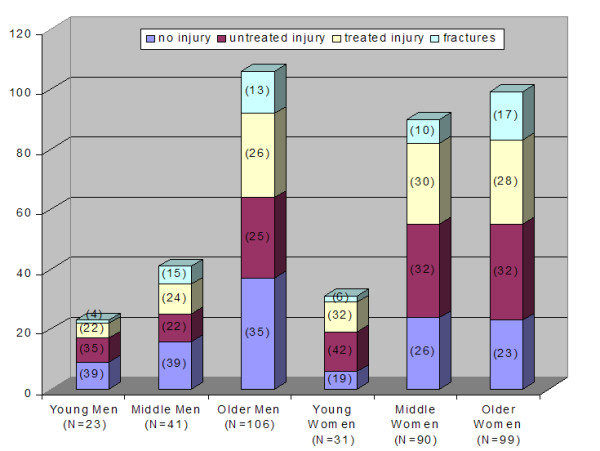
Background: Falls in older people have been characterized extensively in the literature, however little has been reported regarding falls in middle-aged and younger adults. The objective of this paper is to describe the perceived cause, environmental influences and resultant injuries of falls in 1497 young (20–45 years), middle-aged (46–65 years) and older (> 65 years) men and women from the Baltimore Longitudinal Study on Aging. Methods: A descriptive study where participants completed a fall history questionnaire describing the circumstances surrounding falls in the previous two years. Results: The reporting of falls increased with age from 18% in young, to 21% in middle-aged and 35% in older adults, with higher rates in women than men. Ambulation was cited as the cause of the fall most frequently in all gender and age groups. Our population reported a higher percentage of injuries (70.5%) than previous studies. The young group reported injuries most frequently to wrist/hand, knees and ankles; the middle-aged to their knees and the older group to their head and knees. Women reported a higher percentage of injuries in all age groups. Conclusion: This is the first study to compare falls in young, middle and older aged men and women. Significant differences were found between the three age groups with respect to number of falls, activities engaged in prior to falling, perceived causes of the fall and where they fell.
Overview
The claims and statistics of this paper haven’t been checked yet.
Free: it reads the open-access text and checks the first 5 claims that cite a source we can check. Create a free account to check every claim.
Integrity signals
Registry
Cites
Statistics
Figures
Verification
Claims the paper makes
The claims and statistics of this paper haven’t been checked yet.
Free: it reads the open-access text and checks the first 5 claims that cite a source we can check. Create a free account to check every claim.
Self-check
Percentages, sums and reported differences re-computed from the paper’s own numbers.
The self-check needs the paper’s full text.
Citations
Cites
1 retracted
Interventions for preventing falls in elderly people
Gillespie, L. D., Gillespie, W. J., Robertson, M. C., Lamb, S. E., Cumming, R. G., & Rowe, B. H. (2003) · The Cochrane Database of Systematic Reviews · doi:10.1002/14651858.cd000340 · Cited by 1,422
RetractedThe CES-D Scale: A Self-Report Depression Scale for Research in the General Population
Radloff, L. S. (1977) · Applied Psychological Measurement · doi:10.1177/014662167700100306 · Cited by 53,267
Sensitivity and False Alarm Rate of a Fall Sensor in Long-Term Fall Detection in the Elderly
Kangas, M., Korpelainen, R., Vikman, I., Nyberg, L., & Jämsä, T. (2015) · Gerontology · doi:10.1159/000362720 · Cited by 18,909
Risk Factors for Falls among Elderly Persons Living in the Community
Tinetti, M. E., Speechley, M., & Ginter, S. F. (1988) · New England Journal of Medicine · doi:10.1056/nejm198812293192604 · Cited by 6,509 · cited 3×
“Tinetti et al [32] found in a prospective study that 24% of the falls in community dwelling older aged persons resulted in serious injury and 6 percent had fractures.”
BackgroundResultThe cochrane database of systematic reviews
Geddes, J. (1996) · Journal of Psychosomatic Research · doi:10.1016/s0022-3999(96)90063-x · Cited by 5,989
Verbrugge, L. M., & Jette, A. M. (1994) · Social Science & Medicine · doi:10.1016/0277-9536(94)90294-1 · Cited by 3,310 · cited 1×
“In older people, falls are a risk factor for disability and frailty, and exacerbate the disablement process [3,4].”
BackgroundThe Cochrane Database of Systematic Reviews
Handoll, H. H. (2004) · The British Journal of Hand Therapy · doi:10.1177/175899830400900201 · Cited by 1,513
FALLS BY ELDERLY PEOPLE AT HOME: PREVALENCE AND ASSOCIATED FACTORS
BLAKE, A. J., MORGAN, K., BENDALL, M. J., DALLOSSO, H., EBRAHIM, S. B. J., ARIE, T. H. D., FENTEM, P. H., & BASSEY, E. J. (1988) · Age and Ageing · doi:10.1093/ageing/17.6.365 · Cited by 1,261 · cited 1×
“Most older fallers reported tripping as the cause for their fall [18,23], with a large percentage unable to give any reason in a one year retrospective study [24].”
BackgroundCAMPBELL, A. J., BORRIE, M. J., SPEARS, G. F., JACKSON, S. L., BROWN, J. S., & FITZGERALD, J. L. (1990) · Age and Ageing · doi:10.1093/ageing/19.2.136 · Cited by 803 · cited 2×
“Campbell et al [17] found in a prospective study of participants (over 69 years) from a rural setting no gender difference in fall rate; however men were more likely to fall outside and at more intense levels of activity.”
BackgroundResultFactors Associated with Falls in the Elderly: A Community Study
Prudham, D., & Evans, J. G. (1981) · Age and Ageing · doi:10.1093/ageing/10.3.141 · Cited by 803 · cited 2×
“Most older fallers reported tripping as the cause for their fall [18,23], with a large percentage unable to give any reason in a one year retrospective study [24].”
Background
Research works printed but not linked: 2
- 26. Adler-Traines M Falls in the senior population. Physical Therapy Forum 1994 9 14 17
- 38. Metter EJ Yim-Chipless PK Musiol R Talbot LA Balance Training: Preventing Falls in Older Adults The American Journal of Medicine and Sports 2003 5 94 99
Cited by
Items 301–400 of 691
Laatar, R., Waer, F. B., Rebai, H., & Sahli, S. (2021) · Behavioural Brain Research · doi:10.1016/j.bbr.2021.113437 · Cited by 12
Borrelli, J. R., Zabukovec, J. R., Jones, S., Junod, C. A., & Maki, B. E. (2019) · Experimental Gerontology · doi:10.1016/j.exger.2019.110676 · Cited by 11
Shafizadeh, M., Manson, J., Fowler‐Davis, S., Ali, K., Lowe, A. C., Stevenson, J. A., Parvinpour, S., & Davids, K. (2020) · Journal of Aging and Physical Activity · doi:10.1123/japa.2019-0395 · Cited by 11
Singh, I., Edwards, C., & Anwar, A. (2018) · Geriatrics · doi:10.3390/geriatrics3010009 · Cited by 11
“One-third of older adults over 65 years and half of older people above 80 years in the community could experience one fall in a year [3,4].”
BackgroundPiergiovanni, S., & Terrier, P. (2024) · Sensors · doi:10.3390/s24237427 · Cited by 10
Shiao, C., Tang, P., Wei, Y., Tseng, W. I., & Lin, T. (2022) · Journal of NeuroEngineering and Rehabilitation · doi:10.1186/s12984-022-01042-2 · Cited by 12
del Castillo, L. A. E., González-Bustos, J. B., Olivares, L. A. F., Esparza, S. D., Hernández, N. C., & Ponce, A. J. V. (2022) · Ciencias de la actividad física · doi:10.29035/rcaf.23.especial_ihmn.2 · Cited by 14
Tissot, J. T., & Vergara, L. G. L. (2023) · Ambiente Construído · doi:10.1590/s1678-86212023000300674 · Cited by 10
McCrum, C. L., Eysel-Gosepath, K., Epro, G., Meijer, K., Savelberg, H. H. C. M., Brüggemann, G., & Karamanidis, K. (2016) · Journal of Applied Biomechanics · doi:10.1123/jab.2016-0004 · Cited by 10
Yamaguchi, T., Shibata, K., Wada, H., Kakehi, H., & Hokkirigawa, K. (2021) · Scientific Reports · doi:10.1038/s41598-021-91683-5 · Cited by 10
Kool, B., Ameratunga, S. N., Lee, M., Robinson, E., Crengle, S. M., & Jackson, R. (2010) · Australian and New Zealand Journal of Public Health · doi:10.1111/j.1753-6405.2010.00475.x · Cited by 10
Swanenburg, J., Bäbler, E., Adelsberger, R., Straumann, D., & de Bruin, E. D. (2017) · PLoS ONE · doi:10.1371/journal.pone.0189037 · Cited by 10
Souayah, N. (2013) · InTech eBooks · doi:10.5772/56421 · Cited by 10
Schiek, S., Hildebrandt, K., Zube, O., & Bertsche, T. (2019) · European Journal of Clinical Pharmacology · doi:10.1007/s00228-019-02628-x · Cited by 10
Effects of a rhythmic and choreographic program in obese and overweight participants.
García, C. M., Pablos, A., Carnide, F., Martín, M., & Abella, C. P. (2014) · PubMed · doi:10.3305/nh.2014.30.3.7365 · Cited by 9
Blank, L. J., Agarwal, P., Kwon, C., & Jetté, N. (2023) · Seizure · doi:10.1016/j.seizure.2023.05.006 · Cited by 9
Shah, S., Avery, A. J., Bailey, R., Bell, B., Coulson, N., Luke, R., McLaughlin, J., & Logan, P. (2024) · Disability and Rehabilitation · doi:10.1080/09638288.2024.2376346 · Cited by 9
“While falling is increasingly reported by middle aged women, the same is not the case for men [42]. even when compared to stroke patients (73% have one fall per year [43]), our study findings implied adults with cP fall far more often. the data demonstrates how devastating falling and the fear of…”
Hip Strength, Change of Direction, and Falls in Recreational Pickleball Players
Myers, B., & Hanks, J. E. (2024) · International Journal of Sports Physical Therapy · doi:10.26603/001c.122490 · Cited by 9
Do Older Adults Select Appropriate Motor Strategies in a Stepping-Down Paradigm?
Kluft, N., Bruijn, S. M., van Dieën, J. H., & Pijnappels, M. A. G. M. (2018) · Frontiers in Physiology · doi:10.3389/fphys.2018.01419 · Cited by 10
“Compared to young adults–with a fall incidence of 18 percent (Talbot et al., 2005)–older adults seem either vulnerable or reckless human beings, which puts into question older adults’ ability to adapt their movement behavior to their actual physical abilities.”
BackgroundGait asymmetry assessment for older adults by measuring circular gait speed
Ichihashi, N., Ikezoe, T., Sato, S., & Ibuki, S. (2019) · Geriatrics and gerontology international/Geriatrics & gerontology international · doi:10.1111/ggi.13691 · Cited by 9
Twiddy, H., Wilson, P. B., Swain, D. P., Branch, J. D., Morrison, S., & Reynolds, L. J. (2023) · Aging Clinical and Experimental Research · doi:10.1007/s40520-023-02344-8 · Cited by 9
“While the burden of falls in the elderly is widely known, less population-based research has targeted adults < 65 years of age [3].”
BackgroundHallal, C. Z., Marques, N. R., Castro, A., Spinoso, D. H., Rossi, D. M., Navega, M. T., Silva, J. A. M. G., & Gonçalves, M. (2013) · Motriz Revista de Educação Física · doi:10.1590/s1980-65742013000100014 · Cited by 9
Role of musculoskeletal disorders in falls of postmenopausal women
Afrin, N., Honkanen, R., Koivumaa-Honkanen, H. T., Sund, R., Rikkonen, T., Williams, L. J., & Kröger, H. (2018) · Osteoporosis International · doi:10.1007/s00198-018-4631-5 · Cited by 9
The impact of incline and speed of treadmill on ankle muscle activity in middle-aged adults
Mohammadi, R., & Phadke, C. P. (2016) · Journal of Bodywork and Movement Therapies · doi:10.1016/j.jbmt.2016.07.007 · Cited by 9
Karvonen-Gutierrez, C. A., Ylitalo, K. R., & Peng, M. Q. (2020) · Archives of Gerontology and Geriatrics · doi:10.1016/j.archger.2020.104206 · Cited by 10
“, 2016) and fall injuries (Ylitalo & Karvonen-Gutierrez, 2016; Talbot et al., 2005) among mid-life adults is comparable to that among older adults, particularly among women, and the annual incidence of falls triples during the 25 years spanning the mid-life period (Peeters et al.”
BackgroundResultRisk of Falls in adults 45–64 years old in the United States
Amiri, A., Dong, X., & Frith, K. H. (2022) · Public Health Nursing · doi:10.1111/phn.13116 · Cited by 8
Waer, F. B., Chaari, F., Fendri, T., Laatar, R., Rebai, H., & Sahli, S. (2024) · Journal of Women & Aging · doi:10.1080/08952841.2024.2325195 · Cited by 8
“…problem in middle-aged women’s health, representing the third leading cause of unintentional injury deaths among those aged between 45 and 64 years (Mack et al., 2013), with the highest prevalence of falls in women aged between 51 and 60 years compared to other age groups (Talbot et al., 2005).”
BackgroundSlips, trips and falls at a chemical manufacturing company
Swaen, G. M. H., Burns, C. J., Collins, J. J., Bodner, K. M., Dizor, J. F., Craun, B. A., & Bonner, E. M. (2014) · Occupational Medicine · doi:10.1093/occmed/kqt160 · Cited by 10
Wang, M., Wu, F., Callisaya, M. L., Jones, G., & Winzenberg, T. M. (2021) · The Journals of Gerontology Series A · doi:10.1093/gerona/glab122 · Cited by 8
Open globe injuries in geriatric population in Iran: characteristics and outcomes
Zamani, M., Fotouhi, A., Naderan, M., & Soleimani, M. (2021) · International Journal of Ophthalmology · doi:10.18240/ijo.2021.08.16 · Cited by 8
Tynan, A., Pighills, A., White, W., Eden, A., & Mickan, S. M. (2022) · Australian Occupational Therapy Journal · doi:10.1111/1440-1630.12849 · Cited by 10
Hong, W., Kumar, N. A., Patrick, S., Moon, S., & Hur, P. (2023) · IEEE Robotics and Automation Letters · doi:10.1109/lra.2023.3256927 · Cited by 8
“amputee patients have limited mobility and dexterity in their daily lives, leaving them vulnerable to falls and injuries [1], [2], [3].”
BackgroundTrampisch, U. S., Petrovic, A., Daubert, D., & Wirth, R. (2023) · European Geriatric Medicine · doi:10.1007/s41999-023-00807-9 · Cited by 8
Senkoro, E., Mbabazi, P., Banturaki, G., Naikoba, S., & Castelnuovo, B. (2024) · Frontiers in Public Health · doi:10.3389/fpubh.2024.1306151 · Cited by 8
Singh, I. (2015) · International Archives of Nursing and Health Care · doi:10.23937/2469-5823/1510007 · Cited by 8
Aging Affects Lower Limb Joint Moments and Muscle Responses to a Split-Belt Treadmill Perturbation
Yoo, D., An, J., Seo, K.-H., & Lee, B.-C. (2021) · Frontiers in Sports and Active Living · doi:10.3389/fspor.2021.683039 · Cited by 9
Young Adults Use Whole-Body Feedback to Perceive Small Locomotor Disturbances
Liss, D. J., Carey, H. D., & Allen, J. L. (2022) · Human Movement Science · doi:10.1016/j.humov.2023.103084 · Cited by 8
Classification and Decision-Theoretic Framework for Detecting and Reporting Unseen Falls
Khan, S. S. (2016) · UWSpace (University of Waterloo) · doi:10.13140/rg.2.2.34981.29929 · Cited by 13
Caban-Martinez, A. J., Courtney, T. K., Chang, W.-R., Lombardi, D. A., Huang, Y.-H., Brennan, M. J., Perry, M. J., Katz, J. N., & Verma, S. K. (2014) · PLoS ONE · doi:10.1371/journal.pone.0110248 · Cited by 7
“, in a qualitative study with young/middle-aged adults also noted that younger women reported a higher percentage of injuries resulting from falls when compared to any other age group [15].”
Zhang, C., Zhang, R., Baker, J. S., Hagger, M. S., & Hamilton, K. (2022) · Ageing and Society · doi:10.1017/s0144686x22001209 · Cited by 7
“…older adults in Hong Kong (Zhang et al ., 2019; Hu et al ., 2020) and female older adults have higher fall-related injuries than other age groups (Talbot et al ., 2005) and show more fear of falling as compared to male older adults (Denkinger et al ., 2015; Chippendale and Lee, 2018), future…”
A Process Evaluation of a Fall Prevention Intervention Using the RE-AIM Framework
Somerville, E. K., Yan, Y., & Stark, S. L. (2023) · OTJR Occupational Therapy Journal of Research · doi:10.1177/15394492231182398 · Cited by 7
“Over half of falls occur in the home, and about one third of falls are associated with environmental hazards (Nachreiner et al., 2007; Talbot et al., 2005).”
BackgroundBaranes, G., Hayek, R., Gutman, I., Frenkel‐Toledo, S., & Springer, S. (2024) · Aging Clinical and Experimental Research · doi:10.1007/s40520-024-02868-7 · Cited by 7
Gashaw, M., & Admass, B. A. (2021) · Advances in Orthopedics · doi:10.1155/2021/6686068 · Cited by 7
Abe, D., Motoyama, K., Tashiro, T., Saito, A., & Horiuchi, M. (2022) · Journal of PHYSIOLOGICAL ANTHROPOLOGY · doi:10.1186/s40101-022-00298-w · Cited by 7
“By contrast, it has been reported that middle-aged [6, 37] and young [6, 37, 38] adults also fall in their daily lives.”
ResultA Hybrid Swing-Assistive Electro-Hydrostatic Bionic Knee Design
Puliti, M., Tessari, F., Galluzzi, R., Traverso, S., Tonoli, A., Michieli, L. D., & Laffranchi, M. (2022) · IEEE/RAS-EMBS International Conference on Biomedical Robotics and Biomechatronics (BioRob) · doi:10.1109/biorob52689.2022.9925422 · Cited by 7
Baba, T., Watanabe, M., Ogihara, H., Handa, S., Sasamoto, K., Okada, S., Okuizumi, H., & Kimura, T. (2023) · Journal of Physical Therapy Science · doi:10.1589/jpts.35.265 · Cited by 7
Mengste, Y. L., Belete, G. T., Eticha, B. L., & Zeleke, T. C. (2023) · Ethiopian Journal of Health Sciences · doi:10.4314/ejhs.v33i2.11 · Cited by 7
Miura, Y., Yoshimoto, K., & Shinya, M. (2023) · Frontiers in Sports and Active Living · doi:10.3389/fspor.2023.1130332 · Cited by 7
Chen, Y., Jin, C., Tang, H., Yu, J., Wang, Y., Chen, S., Miao, W., Zhang, S., & Wang, X. (2024) · Frontiers in Bioengineering and Biotechnology · doi:10.3389/fbioe.2024.1353270 · Cited by 10
“However, older adults are at a high risk of falling whilst performing common daily tasks, such as walking, changing posture or initiating steps in different environments (Talbot et al., 2005).”
BackgroundThe effects of initial movement dynamics on human responses to postural perturbations
Murnaghan, C. D., & Robinovitch, S. N. (2013) · Human Movement Science · doi:10.1016/j.humov.2013.07.002 · Cited by 7
Southard, V., Dave, A., & Douris, P. C. (2010) · Journal of Primary Care & Community Health · doi:10.1177/2150131910380921 · Cited by 7
‘Cryptogenic Drop Attacks’ revisited: evidence of overlap with functional neurological disorder
Hoeritzauer, I., Carson, A. J., & Stone, J. (2018) · Journal of Neurology Neurosurgery & Psychiatry · doi:10.1136/jnnp-2017-317396 · Cited by 8
Waer, F. B., Laatar, R., Jouira, G., Lahiani, M., Rebai, H., & Sahli, S. (2023) · Health Care For Women International · doi:10.1080/07399332.2023.2219991 · Cited by 7
“Indeed, the percentage of women ages 51–60 who fell was higher than any other age groups (Talbot et al., 2005).”
BackgroundMorat, T., Kröger, D., & Mechling, H. (2013) · European Review of Aging and Physical Activity · doi:10.1007/s11556-013-0121-0 · Cited by 7
“TheMSOT integrated different ground surfaces that simulated different locations and tasks were reported with high incidences of falls in previous studies [4, 20, 32].”
BackgroundWellmon, R. (2011) · Journal of Geriatric Physical Therapy · doi:10.1519/jpt.0b013e31822ad40b · Cited by 9
Heijnen, M., & Rietdyk, S. (2017) · Experimental Brain Research · doi:10.1007/s00221-017-5117-y · Cited by 7
“Trips are a common cause of falls across all ages (Berg et al. 1997; Talbot et al. 2005; Heijnen and Rietdyk 2016), where inappropriate foot placement and foot elevation (Chou and Draganich 1998; Patla and Greig 2006; Heijnen et al.”
BackgroundHenriksen, M., Alkjær, T., Raffalt, P. C., Jørgensen, L., Bartholdy, C. R., Hansen, S. H., & Bliddal, H. (2018) · Pain Medicine · doi:10.1093/pm/pny286 · Cited by 9
Falls and balance confidence in persons with and without injection-related venous ulcers.
Pieper, B., Templin, T. N., Goldberg, A., DiNardo, E., & Wells, M. (2013) · Journal of Addiction Medicine · doi:10.1097/adm.0b013e31827ea882 · Cited by 6
“This was more than double the rate for middle-aged adults reported by others (Talbot et al., 2005) and also markedly higher for multiple falls (Rubenstein, 2006; Hadjistavropoulos et al., 2011).”
ResultLinkages of quality of life with falls and injuries among older people in India
Pal, A. K., & Pal, S. K. (2025) · Scientific Reports · doi:10.1038/s41598-025-29486-1 · Cited by 6
Cramer, H., Sibbritt, D. W., Adams, J., & Lauche, R. (2015) · Maturitas · doi:10.1016/j.maturitas.2015.10.010 · Cited by 6
Wende, M. E., Lohman, M. C., Friedman, D. B., McLain, A. C., LaMonte, M. J., Whitsel, E. A., Shadyab, A. H., García, L., Chrisinger, B. W., Pan, K., et al. (2023) · Women s Health Issues · doi:10.1016/j.whi.2023.03.009 · Cited by 7
King, S. T., Eveld, M. E., Zelik, K. E., & Goldfarb, M. T. (2024) · Journal of NeuroEngineering and Rehabilitation · doi:10.1186/s12984-024-01402-0 · Cited by 6
Impact of Classical Music Listening on Cognitive and Functional Performances in Middle-Aged Women
Waer, F. B., Alexe, D. I., Alexe, C. I., Eken, Ö., Păun, L. I., & Sahli, S. (2024) · Applied Sciences · doi:10.3390/app14156779 · Cited by 7
Thomsen, M. J., Liston, M. B., Christensen, M. G., Vestergaard, P., & Hirata, R. P. (2021) · Injury Prevention · doi:10.1136/injuryprev-2021-044224 · Cited by 8
Yuan, J., Bai, X., Driscoll, B., Liu, M., Huang, H., & Feng, J. (2022) · Applied Ergonomics · doi:10.1016/j.apergo.2022.103804 · Cited by 8
Sargın, S., Guler, N., Şahin, N. Y., & Aslan, A. (2022) · Nigerian Journal of Clinical Practice · doi:10.4103/njcp.njcp_1856_21 · Cited by 6
Dizziness, Falls, and Hearing Loss in Adults Living With Sickle Cell Disease
Nelson, D. M., Bennett, D. M., Lehman, M. E., & Okonji, A. I. (2022) · American Journal of Audiology · doi:10.1044/2022_aja-22-00059 · Cited by 6
Frailty in mid-life predicts outcome following trauma
Slagel, I. C., Hatcher, V. H., Romanowski, K. S. S., Skeete, D. A., & Galet, C. (2022) · European Journal of Trauma and Emergency Surgery · doi:10.1007/s00068-022-02145-0 · Cited by 6
“There is a need for more research to identify fall risks and effective prevention strategies in midlife adults [5].”
BackgroundLee, B.-C., Choi, J., Ahn, J., & Martin, B. J. (2023) · Frontiers in Human Neuroscience · doi:10.3389/fnhum.2023.1236065 · Cited by 6
“Regardless of age, slips and trips account for the majority of unintentional falls while walking (Talbot et al., 2005; Heijnen and Rietdyk, 2016).”
BackgroundDíaz-Cañestro, C., Sehgal, A., Pentz, B. A., & Montero, D. (2021) · European Journal of Preventive Cardiology · doi:10.1093/eurjpc/zwab223 · Cited by 6
Merrill, R. M., & Ashton, M. K. (2023) · Journal of Occupational Health · doi:10.1002/1348-9585.12387 · Cited by 6
Joo, H. H., Huang, E. Y., Schoo, D., Ward, B., & Chen, J. X. (2023) · Otolaryngology Head & Neck Surgery · doi:10.1002/ohn.593 · Cited by 6
Voß, M., Zieschang, T., Schmidt, L., Hackbarth, M., Koschate, J., & Stuckenschneider, T. (2024) · PLoS ONE · doi:10.1371/journal.pone.0305067 · Cited by 6
Types of falls and strategies for maintaining stability on an unstable surface
Błażkiewicz, M., Wiszomirska, I., Kaczmarczyk, K., & Wit, A. (2018) · Medycyna Pracy · doi:10.13075/mp.5893.00639 · Cited by 6
Does misjudgement in a stepping down paradigm predict falls in an older population?
Kluft, N., Bruijn, S. M., Weijer, R. H. A., van Dieën, J. H., & Pijnappels, M. A. G. M. (2019) · Royal Society Open Science · doi:10.1098/rsos.190786 · Cited by 6
Gao, S., Wang, C., Zhu, J., Mai, J., & Wang, Q. (2019) · IEEE Workshop on Advanced Robotics and its Social Impacts (ARSO) · doi:10.1109/arso46408.2019.8948743 · Cited by 6
“Persistent issues among those with transfemoral amputation include a drastic increase in frequency of falls [1], [2], secondary injuries associated to unnatural gait, and decreased locomotion speed.”
BackgroundNeal, S. R., Wood, A. D., Ablett, A. D., Gregory, J. S., Guillot, J., Macdonald, H. M., Reid, D. M., & Myint, P. K. (2020) · Therapeutic Advances in Drug Safety · doi:10.1177/2042098620929852 · Cited by 7
Villumsen, S., Grarup, B., Christensen, S. W., Palsson, T. S., & Hirata, R. P. (2020) · BMC Geriatrics · doi:10.1186/s12877-020-01535-6 · Cited by 7
“Intrinsic risk factors such as poor balance or gait impairment are particularly common causes to ‘slip and trip’ which may result in accidental falls among older adults [9, 22, 24, 25].”
BackgroundSions, J. M., Donohoe, M., Beisheim, E. H., Shank, T. M., & Nichols, L. R. (2021) · International Journal of Rare Diseases & Disorders · doi:10.23937/2643-4571/1710035 · Cited by 6
“Increased age has been associated with a greater risk of falling and multiple falls among adults aged 18 years and older [21,29], but in our sample with AMC, younger (not older) age emerged as a factor associated with multiple falls in the past year.”
BackgroundResultInfluentialKinematic characteristics of gait in middle-aged adults during level walking
Wu, Y. R., Wang, Y.-Z., Xiao, F., & Gu, D.-Y. (2014) · Annual International Conference of the IEEE Engineering in Medicine and Biology Society (EMBC) · doi:10.1109/embc.2014.6945218 · Cited by 6
“physiological changes that begin to alter postural stability, along with lower levels of physical activity [5].”
BackgroundGandawidura, R. G. G., & Ikeda, Y. (2024) · British Journal of Visual Impairment · doi:10.1177/02646196241226836 · Cited by 5
“According to Talbot et al. (2005), VI, vestibular reflexes, age, muscle strength, and fear of falling (FOF) were significant risk factors for fall-related injuries.”
A reliable and efficient adaptive Bayesian method to assess static lower limb position sense
Wood, J. M., Morton, S. M., & Kim, H. E. (2023) · Journal of Neuroscience Methods · doi:10.1016/j.jneumeth.2023.109875 · Cited by 5
“closer in context to when falls most often occur: during weight bearing activities like walking and transfers (Talbot et al., 2005).”
Whitten, J., O’Leary, B., Graham, D., Grocke-Dewey, M., Riley, J., Harper, D., & Tarabochia, D. S. (2024) · Gerontology and Geriatric Medicine · doi:10.1177/23337214241246843 · Cited by 5
“Yet, most older adults fall because of unexpected losses of balance such as slips, trips, or stumbles (Blake et al., 1988; Luukinen et al., 2000; Talbot et al., 2005).”
BackgroundAN ANALYSIS OF THE ACCURACY OF WEARABLE SENSORS FOR DISTINGUISHING THE CAUSE OF FALLS
Aziz, O. (2009) · Summit (Simon Fraser University) · Cited by 5
Association between urinary urgency and falls among rural dwelling older women
Park, J., Lee, K., & Lee, K. (2019) · Journal of Advanced Nursing · doi:10.1111/jan.14284 · Cited by 7
Utilizing the “One Health” Model to Study Human Aging in Urban Environments
Peterson, J., Howell, B. M., & Hahn, M. B. (2022) · Gerontology and Geriatric Medicine · doi:10.1177/23337214221116946 · Cited by 5
“Indeed, research shows that unintentional falls are the leading cause of fatal and nonfatal injuries among older Alaskans (Alaska Department of Health and Social Services, 2013), which often contribute to hospitalization and early mortality (Talbot et al., 2005).”
BackgroundHayek, R., Saad, O., & Springer, S. (2023) · Healthcare · doi:10.3390/healthcare11071040 · Cited by 5
“Evidence suggests that impairments in balance and locomotion are widespread in MA [3,4], and that falls related to slips and trips are common in this population [5].”
BackgroundHong, W., & Huang, H. (2023) · International Conference on Rehabilitation Robotics · doi:10.1109/icorr58425.2023.10304689 · Cited by 5
Lee, Y.-J., Alexander, N. B., Pompeii, L. A., NYQUIST, L. V., & Madigan, M. L. (2024) · Journal of the American Geriatrics Society · doi:10.1111/jgs.19148 · Cited by 5
“2,6,9,26 We are aware of only one study that described attempts to regain balance and avoid a fall in the real world such as reported here (13).”
Greco, G., Poli, L., Gabriele, M., Aidar, F. J., Fischetti, F., Patti, A., & Cataldi, S. (2024) · Sport Sciences for Health · doi:10.1007/s11332-024-01259-9 · Cited by 5
“In contrast to studies on the elderly population, subjects over the age of 65, little attention is given to fall risk factors in young and middle-aged adults [7].”
Sex Differences in Soleus Strength May Predispose Middle Age Women to Falls
Chimera, N. J., & MANAL, K. T. (2012) · The Journal of Strength and Conditioning Research · doi:10.1519/jsc.0b013e31827f522c · Cited by 5
“However, there is approximately a 5% increase in the number of falls that resulted in fracture and about a 15% increase in the overall percentage of falls in elderly compared with middle age adults (32).”
BackgroundResultInfluentialEffects of Different Taping Pressures of Wrist Taping Using Rigid Tape on Grip Strength Exertion
Takahashi, K., & Demura, S. (2014) · American Journal of Medical Sciences and Medicine · doi:10.12691/ajmsm-2-6-2 · Cited by 5
“Not only athletes but also many people in the general population develop injuries of the wrist joint [2].”
BackgroundArena, S. L., Garman, C. M. R., Nussbaum, M. A., & Madigan, M. L. (2017) · Applied Ergonomics · doi:10.1016/j.apergo.2017.02.010 · Cited by 5
Feasibility of Assessing Falls Risk and Promoting Falls Prevention in Beauty Salons
Arandia, G., Hargrove, J. L., Shubert, T. E., Bangdiwala, S. I., & Linnan, L. A. (2017) · The Journal of Primary Prevention · doi:10.1007/s10935-017-0486-3 · Cited by 5
Predicting Use of Outdoor Fall Prevention Strategies: Considerations for Prevention Practices
Chippendale, T. L. (2018) · Journal of Applied Gerontology · doi:10.1177/0733464817751199 · Cited by 5
Chang, M., Lin, C.-L., Wu, T.-M., Chu, M.-C., Huang, T., & Chen, H. (2013) · Complementary Medicine Research · doi:10.1159/000355842 · Cited by 5
Du, Y. N., Roberts, P., & Xu, Q. (2016) · Journal of Holistic Nursing · doi:10.1177/0898010116636972 · Cited by 5
Peripheral Neuropathy - Advances in Diagnostic and Therapeutic Approaches
Hayat, G. R. (2012) · InTech eBooks · doi:10.5772/1276 · Cited by 5
Meikle, A. W., & Molitch, M. E. (2007) · Yearbook of Endocrinology · doi:10.1016/s0084-3741(08)70210-5 · Cited by 5
Avaliação do risco de quedas em idosos na comunidade
Schiaveto, F. V. (2008) · Digital Library of Theses and Dissertations (Universidade de São Paulo) · doi:10.11606/d.22.2008.tde-19122008-153736 · Cited by 5
Metadata
- Authors
- Talbot, L. A., Musiol, R. J., Witham, E. K., & Metter, E. J.
- Affiliations
- Uniformed Services University of the Health Sciences (US)
- Holy Cross Hospital (US)
- Henry M. Jackson Foundation (US)
- National Institutes of Health (US)
- Corresponding author
- Talbot, Laura A
- ORCID
- Talbot, Laura A
- Venue
- BMC Public Health
- Published
- 2005-08-18
- Volume
- 5
- Issue
- 1
- Pages
- 86-86
- ISSN
- 1471-2458 (ISSN-L)
- PMC
- PMC1208908
- OpenAlex
- W2118856586
- Cited by
- 654
- References
- 41
- Citations by year
- 2026: 27 · 2025: 48 · 2024: 54 · 2023: 43 · 2022: 55 · 2021: 57 · 2020: 56 · 2019: 44 · 2018: 37 · 2017: 29 · 2016: 35 · 2015: 28 · 2014: 29 · 2013: 20 · 2012: 20
- FWCI
- 17.37
- Type
- journal article
- Language
- en
- Open access
- gold
- doi.org
- Licence
- Locations
- BMC Public Health (publishedVersion, cc-by)
- PubMed Central (publishedVersion, cc-by)
- PubMed (publishedVersion)
- DOAJ (DOAJ: Directory of Open Access Journals) (submittedVersion, cc-by-sa)
- Funders
- Johns Hopkins University
- National Institutes of Health
- National Institute on Aging
- Topics
- Health Sciences › Health Professions › Physical Therapy, Sports Therapy and Rehabilitation › Balance, Gait, and Falls Prevention
- Health Sciences › Medicine › Public Health, Environmental and Occupational Health › Injury Epidemiology and Prevention
- Health Sciences › Medicine › Surgery › Hip and Femur Fractures
- Keywords
- falls, fall-related injuries, environmental factors, age differences, young adults, middle-aged adults, older adults, ambulation, sex differences, wrist injuries, knee injury, traumatic brain injury, community-dwelling adults
- MeSH terms
- Accidental Falls, Activities of Daily Living, Adult, Aged, Aged, 80 and over, Cross-Sectional Studies, District of Columbia, Female, Humans, Longitudinal Studies, Male, Middle Aged, Surveys and Questionnaires, Wounds and Injuries, Baltimore, Age Distribution, Sex Distribution, Risk Assessment
About these checks
Registry, retraction, Cites and statistics results are computed, not judged, with one exception: a printed reference that no index lists is read once by a model before it counts as a citation error. Claims are extracted by a model and kept only when their quote appears verbatim in the text; each cited source is then checked, with a model’s help, for whether it says what the claim relies on. Those verdicts can be wrong — read the claim’s quote and the cited source before relying on one.
Statistics and arithmetic are recomputed, not judged.
Confidence bands are shown only for fields calibrated on our annotated test set. None is calibrated yet, so no band is shown.
What counts as a claim ›How we measure confidence ›How we check this ›
Are you an author, or do you see a problem with this page? Request a review
Data sources
Bibliographic data: Semantic Scholar, OpenAlex, Crossref.
Contains information from the Semantic Scholar Academic Graph Datasets, made available under the ODC Attribution License (ODC-BY 1.0).
Semantic Scholar’s data is described in: Kinney, R., et al. (2023). The Semantic Scholar Open Data Platform. arXiv:2301.10140.
