

Overweight and obesity in urban Africa: A problem of the rich or the poor?
Open accessThe DOI matches its Crossref record; 47 of the 47 references it cites were found in a registry or an index.
Abstract
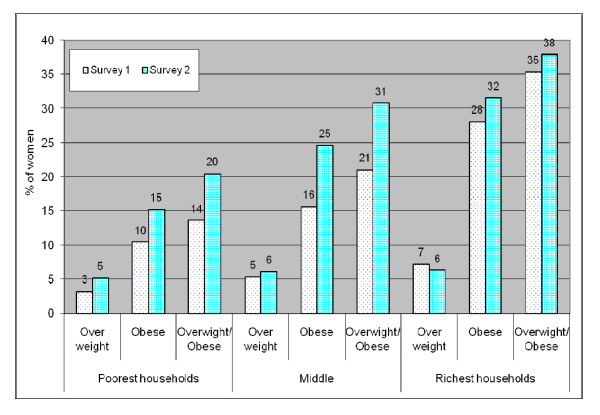
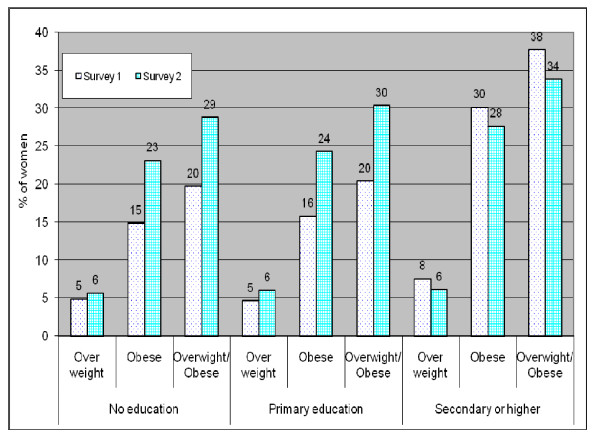
BACKGROUND: Obesity is a well recognized risk factor for various chronic diseases such as cardiovascular diseases, hypertension, and type 2 diabetes mellitus. The aim of this study was to shed light on the patterns of overweight and obesity in sub-Saharan Africa, with special interest in differences between the urban poor and the urban non-poor. The specific goals were to describe trends in overweight and obesity among urban women; and examine how these trends vary by education and household wealth. METHODS: The paper used Demographic and Health Surveys data from seven African countries where two surveys had been carried out with an interval of at least 10 years between them. Among the countries studied, the earliest survey took place in 1992 and the latest in 2005. The dependent variable was body mass index coded as: Not overweight/obese; Overweight; Obese. The key covariates were time lapse between the two surveys; woman's education; and household wealth. Control variables included working status, age, marital status, parity, and country. Multivariate ordered logistic regression in the context of the partial proportional odds model was used. RESULTS: Descriptive results showed that the prevalence of urban overweight/obesity increased by nearly 35% during the period covered. The increase was higher among the poorest (+50%) than among the richest (+7%). Importantly, there was an increase of 45-50% among the non-educated and primary-educated women, compared to a drop of 10% among women with secondary education or higher. In the multivariate analysis, the odds ratio of the variable time lapse was 1.05 (p < 0.01), indicating that the prevalence of overweight/obesity increased by about 5% per year on average in the countries in the study. While the rate of change in urban overweight/obesity did not significantly differ between the poor and the rich, it was substantially higher among the non-educated women than among their educated counterparts. CONCLUSION: Overweight and obesity are on the rise in Africa and might take epidemic proportions in the near future. Like several other public health challenges, overweight and obesity should be tackled and prevented early as envisioned in the WHO Global strategy on diet, physical activity and health.
Overview
The claims and statistics of this paper haven’t been checked yet.
Free: it reads the open-access text and checks the first 5 claims that cite a source we can check. Create a free account to check every claim.
Integrity signals
Registry
Cites
Statistics
Figures
Verification
Claims the paper makes
The claims and statistics of this paper haven’t been checked yet.
Free: it reads the open-access text and checks the first 5 claims that cite a source we can check. Create a free account to check every claim.
Claims other papers make about this one
Each is checked against this paper’s own text: does it say what the citing paper says it does?
In the citing paper
“African families are classified as families that include multiple caregivers [13] such as grandparents and other extended family members (aunts, uncles, brothers, and sisters)”
From Digital Health Technologies for Maternal and Child Health in Africa and Other Low- and Middle-Income Countries: Cross-disciplinary Scoping Review With Stakeholder Consultation (2023) · doi:10.2196/42161 · cites this paper as [13]
Self-check
Percentages, sums and reported differences re-computed from the paper’s own numbers.
The self-check needs the paper’s full text.
Citations
Cites
Lopez, A. D., Mathers, C. D., Ezzati, M., Jamison, D. T., & Murray, C. J. (2006) · The Lancet · doi:10.1016/s0140-6736(06)68770-9 · Cited by 5,630
Filmer, D., & Pritchett, L. H. (2001) · Demography · doi:10.1353/dem.2001.0003 · Cited by 5,238
Filmer, D., & Pritchett, L. H. (2001) · Demography · doi:10.2307/3088292 · Cited by 2,972
Global Burden of Disease and Risk Factors
(2006) · World Bank, Washington, DC eBooks · doi:10.1596/978-0-8213-6262-4 · Cited by 2,605
Global strategy on diet, physical activity and health
Samuelson, G. (2004) · Food & Nutrition Research · doi:10.3402/fnr.v48i2.1503 · Cited by 2,319
Generalized Ordered Logit/Partial Proportional Odds Models for Ordinal Dependent Variables
Williams, R. (2006) · The Stata Journal: Promoting communications on statistics and Stata · doi:10.1177/1536867x0600600104 · Cited by 2,118
Global strategy on diet, physical activity and health
Samuelson, G. (2004) · Scandinavian Journal of Nutrition · doi:10.1080/11026480410034349 · Cited by 1,720
Preventing chronic diseases: a vital investment
Vita-Finzi, L., & Who, G. E. (2005) · Cited by 1,679
The nutrition transition: worldwide obesity dynamics and their determinants
Popkin, B. M., & Gordon-Larsen, P. (2004) · International Journal of Obesity · doi:10.1038/sj.ijo.0802804 · Cited by 1,538 · cited 1×
“With increasing urbanization, there might be a shift of the obesity burden to sections of the poor urban population who may not have the knowledge or financial resources to adopt healthier lifestyles [28-30].”
BackgroundCohen, B. (2004) · World Development · doi:10.1016/j.worlddev.2003.04.008 · Cited by 846
Research works printed but not linked: 3
- United Nations: World Urbanization Prospectus: The 2005 Revision. New York: United Nations, Department of Economic and Social Affairs, Population Division; 2006.
- UNFPA: The State of the World Population 1996. Changing Places: Population, Development and the Urban Poor. New York: United Nations; 1996.
- UN: United Nations Millennium Declaration. Fifty-fifth Ses- sion of the United Nations General Assembly. New York: United Nations; 2000.
Cited by
Items 401–434 of 434
Who is chronically obese in Indonesia? The role of individual preferences
Ismail, A., & Nuryakin, C. (2023) · Journal of Biosocial Science · doi:10.1017/s0021932023000214
Were, J. M., Kyeremeh, E., Annor, B. O. H., Campbell, M. K., & Stranges, S. (2024) · Ecology of Food and Nutrition · doi:10.1080/03670244.2024.2373227
“…as exposure variables (Kandala, Stranges, and Kazembe 2014; Madise and Letamo 2017; Ntenda and Kazambwe 2019; Were, Stranges, and Creed 2020; Ziraba, Fotso, and Ochako 2009): Age groups; number of children the respondent had given birth to (0,1,2,3,4,5 and 6+); breast-feeding status (never…”
Exploring the Knowledge Levels of Bankers on Health Risks of Overweight and ObesityPreprint
Jonathan, J. W. A., Baba, S., Kezia, E. K., Abambila, S., Gyan, C., & Chinenye, I. O. (2024) · Research Square · doi:10.21203/rs.3.rs-4853654/v1
Bockarie, T., Shanker, A., Jalloh, M. B., Kamara, A. M., Odland, M. L., Wurie, H. R., Ansumana, R., Lamin, J. M., Witham, M. D., Oyebode, O. O., et al. (2024) · medRxiv · doi:10.1101/2024.10.30.24316415
Spatial Variations and Cultural Explanations to Obesity in Ghana
Asubonteng, A. (2019) · University of North Texas Digital Library (University of North Texas) · doi:10.12794/metadc1538645
Sarr, S. A., Ndour, M. A., Dieng, M., Bassène, H., Ndiaye, M., Diouf, O. B. K., Nassour, H., Gadji, F. K., Diembou, M., Sow, D., et al. (2025) · Open Journal of Internal Medicine · doi:10.4236/ojim.2025.152016
Shafrin, S. F., & Taki, M. A. T. (2025) · medRxiv · doi:10.1101/2025.08.24.25334328
“[ Abrha, Shiferaw, & Ahmed, 2016] [Ziraba, Fotso, & Ochako, 2009] [Eriksen, Rosthøj, Burr, & Holtermann, 2015].”
Nguedjo, M. W., Mounpou, J., Mouafo, H. T., Nanhah, J. V. K., Ngondi, J. L., & Oben, J. E. (2025) · Human Nutrition & Metabolism · doi:10.1016/j.hnm.2025.200350
Keino, S. (2014) · Research Publications (Maastricht University) · doi:10.26481/dis.20141001sk · Cited by 1
Lazo-Porras, M., Liu, H., Miranda, J. J., Moore, G., Burri, M., Chappuis, F., Perel, P., & Beran, D. (2021) · Figshare · doi:10.6084/m9.figshare.16576089
Lazo-Porras, M., Liu, H., Miranda, J. J., Moore, G., Burri, M., Chappuis, F., Perel, P., & Beran, D. (2021) · Figshare · doi:10.6084/m9.figshare.16576095
Long, K. Z., Beckmann, J., Lang, C., Seelig, H., Nqweniso, S., Probst-Hensch, N., Müller, I., Pühse, U., Steinmann, P., du Randt, R., et al. (2022) · Figshare · doi:10.6084/m9.figshare.19076349
Waltsgott, L., Adedeji, A., & Buchcik, J. (2024) · Figshare · doi:10.6084/m9.figshare.26982109
Long, K. Z., Beckmann, J., Lang, C., Seelig, H., Nqweniso, S., Probst-Hensch, N., Müller, I., Pühse, U., Steinmann, P., du Randt, R., et al. (2022) · Figshare · doi:10.6084/m9.figshare.19076352
Shibre, G., Zegeye, B. H., Woldeamanuiel, G. G., Negash, W., Lemma, G., & Taderegew, M. M. (2021) · Figshare · doi:10.6084/m9.figshare.15047637
Lazo-Porras, M., Liu, H., Miranda, J. J., Moore, G., Burri, M., Chappuis, F., Perel, P., & Beran, D. (2021) · Figshare · doi:10.6084/m9.figshare.16576092
Atsu, P., Mohammed, A., Adu, C., Aboagye, R. G., Ahinkorah, B. O., & Seidu, A.-A. (2024) · Figshare · doi:10.6084/m9.figshare.25560888
The Nexus of Chemicals and Cancer: Environmental Toxicants and Lifestyle Effects Unveiled
Perolla, A. (2025) · Springer eBooks · doi:10.1007/978-981-95-0575-3_12
Chisanga, M. M., Ng’ambi, W. F., Mutasha, S., Chigere, A., & Zyambo, C. M. (2026) · International Journal of Noncommunicable Diseases · doi:10.4103/jncd.jncd_192_25
Lanou, H., Savadogo, B., & Zeba, A. N. (2026) · Food and Nutrition Sciences · doi:10.4236/fns.2026.177038
Asosega, K. A., Aidoo, E. N., Adebanji, A., & Owusu‐Dabo, E. (2026) · Global Health · doi:10.1155/ghe3/3074676
“Ad-ditionally Ad-ditionally, many SSA countries have documented a link between higher OW/OB risk and urbanisation [21, 58, 68, 69].”
Yasudomi, A., Mankhaka-Banda, A., Khomba, M. M., & Miyoshi, M. (2026) · Tropical Medicine and Health · doi:10.1186/s41182-026-01044-z
“These covariates were selected a priori based on previous studies [43–45].”
Ratshilivha, Z. L., Muluvhu, D. T. C., Jacobs, S., & Mahopo, T. C. (2026) · African Journal of Primary Health Care & Family Medicine · doi:10.4102/phcfm.v18i1.5292
“13 These findings contradict those of Wirnitzer et al., 12 who reported that most schoolteachers consuming a mixed diet had a higher BMI.”
López‐Guerra, C. (2026) · Oxford University Press eBooks · doi:10.1093/9780198981619.003.0002
Equal Subjection: What Justice Demands of Political Leaders
López‐Guerra, C. (2026) · doi:10.1093/9780198981619.001.0001
López‐Guerra, C. (2026) · Oxford University Press eBooks · doi:10.1093/9780198981619.003.0004
López‐Guerra, C. (2026) · Oxford University Press eBooks · doi:10.1093/9780198981619.002.0005
López‐Guerra, C. (2026) · Oxford University Press eBooks · doi:10.1093/9780198981619.003.0007
López‐Guerra, C. (2026) · Oxford University Press eBooks · doi:10.1093/9780198981619.003.0005
López‐Guerra, C. (2026) · Oxford University Press eBooks · doi:10.1093/9780198981619.003.0006
López‐Guerra, C. (2026) · Oxford University Press eBooks · doi:10.1093/9780198981619.003.0001
López‐Guerra, C. (2026) · Oxford University Press eBooks · doi:10.1093/9780198981619.002.0002
López‐Guerra, C. (2026) · Oxford University Press eBooks · doi:10.1093/9780198981619.003.0003
Metadata
- Authors
- Ziraba, A. K., Fotso, J. C., & Ochako, R.
- Affiliations
- African Population and Health Research Center (KE)
- Corresponding author
- Ziraba, Abdhalah K
- Venue
- BMC Public Health
- Published
- 2009-12
- Volume
- 9
- Issue
- 1
- Pages
- 465-465
- ISSN
- 1471-2458 (ISSN-L)
- PMC
- PMC2803188
- OpenAlex
- W1989483002
- Cited by
- 433
- References
- 47
- Citations by year
- 2026: 21 · 2025: 11 · 2024: 18 · 2023: 28 · 2022: 28 · 2021: 38 · 2020: 26 · 2019: 34 · 2018: 28 · 2017: 32 · 2016: 31 · 2015: 43 · 2014: 26 · 2013: 24 · 2012: 24
- FWCI
- 14.79
- Type
- journal article
- Language
- en
- Open access
- gold
- doi.org
- Licence
- cc-by
- creativecommons.org/licenses/by/2.0 (tdm)
- Locations
- BMC Public Health (publishedVersion, cc-by)
- PubMed Central (publishedVersion, cc-by)
- PubMed (publishedVersion)
- LSHTM Research Online (London School of Hygiene and Tropical Medicine) (acceptedVersion)
- DOAJ (DOAJ: Directory of Open Access Journals) (submittedVersion)
- Funders
- London School of Hygiene and Tropical Medicine
- African Population and Health Research Center
- Topics
- Health Sciences › Medicine › Public Health, Environmental and Occupational Health › Obesity, Physical Activity, Diet
- Health Sciences › Nursing › Nutrition and Dietetics › Nutrition, Health and Food Behavior
- Health Sciences › Medicine › Endocrinology, Diabetes and Metabolism › Diabetes, Cardiovascular Risks, and Lipoproteins
- Keywords
- overweight, obesity, urban women, sub-Saharan Africa, household wealth, educational attainment, body mass index trends, urban poverty, chronic disease risk factors
- MeSH terms
- Africa, Educational Status, Employment, Female, Humans, Income, Male, Obesity, Urban Health, Prevalence, Multivariate Analysis, Logistic Models, Overweight
About these checks
Registry, retraction, Cites and statistics results are computed, not judged, with one exception: a printed reference that no index lists is read once by a model before it counts as a citation error. Claims are extracted by a model and kept only when their quote appears verbatim in the text; each cited source is then checked, with a model’s help, for whether it says what the claim relies on. Those verdicts can be wrong — read the claim’s quote and the cited source before relying on one.
Statistics and arithmetic are recomputed, not judged.
Confidence bands are shown only for fields calibrated on our annotated test set. None is calibrated yet, so no band is shown.
What counts as a claim ›How we measure confidence ›How we check this ›
Are you an author, or do you see a problem with this page? Request a review
Data sources
Bibliographic data: Semantic Scholar, OpenAlex, Crossref.
Contains information from the Semantic Scholar Academic Graph Datasets, made available under the ODC Attribution License (ODC-BY 1.0).
Semantic Scholar’s data is described in: Kinney, R., et al. (2023). The Semantic Scholar Open Data Platform. arXiv:2301.10140.
