

The DOI matches its Crossref record; 50 of the 51 references it cites were found in a registry or an index.
Small nucleolar RNA signatures as biomarkers for non-small-cell lung cancer
Open accessAbstract
Background: Non-small-cell lung cancer (NSCLC) is the leading cause of cancer death. Early detection of NSCLC will improve its outcome. The current techniques for NSCLC early detection are either invasive or have low accuracy. Molecular analyses of clinical specimens present promising diagnostic approaches. Non-coding RNAs (ncRNAs) play an important role in tumorigenesis and could be developed as biomarkers for cancer. Here we aimed to develop small nucleolar RNAs (snoRNAs), a common class of ncRNAs, as biomarkers for NSCLC early detection. The study comprised three phases: (1) profiling snoRNA signatures in 22 NSCLC tissues and matched noncancerous lung tissues by GeneChip Array, (2) validating expressions of the signatures by RT-qPCR in the tissues, and (3) evaluating plasma expressions of the snoRNAs in 37 NSCLC patients, 26 patients with chronic obstructive pulmonary disease (COPD), and 22 healthy subjects. Results: In the surgical tissues, six snoRNAs were identified, which were overexpressed in all tumour tissues compared with their normal counterparts. The overexpressions of the genes in tumors were confirmed by RT-qPCR. The snoRNAs were stably present and reliably detectable in plasma. Of the six genes, three (SNORD33, SNORD66 and SNORD76) displayed higher plasma expressions in NSCLC patients compared with the cancer-free individuals (All < 0.01). The use of the three genes produced 81.1% sensitivity and 95.8% specificity in distinguishing NSCLC patients from both normal and COPD subjects. The plasma snoRNA expressions were not associated with stages and histological types of NSCLC (All > 0.05). Conclusions: The identified snoRNAs provide potential markers for NSCLC early detection.
Overview
The claims and statistics of this paper haven’t been checked yet.
Run the check — free, no account needed. It reads the open-access text and checks the sources it cites.
Integrity signals
Registry
Cites
Statistics
Figures
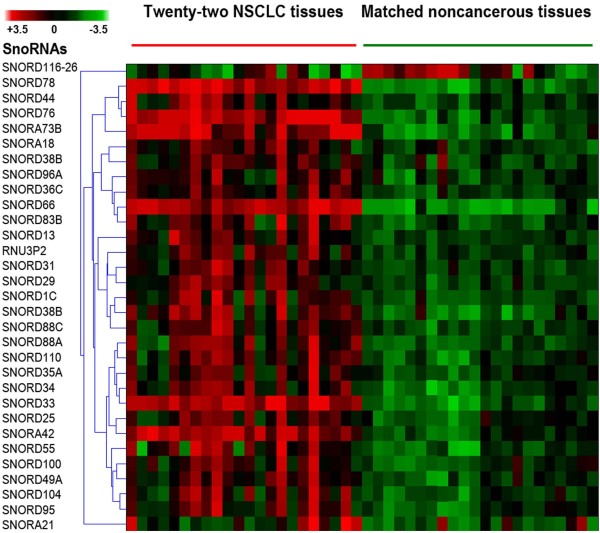
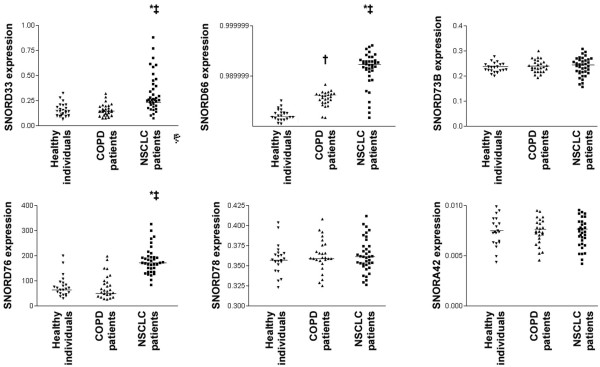
Verification
Claims the paper makes
The claims and statistics of this paper haven’t been checked yet.
Run the check — free, no account needed. It reads the open-access text and checks the sources it cites.
Claims other papers make about this one
Each is checked against this paper’s own text: does it say what the citing paper says it does?
The source backs part of the claim, not all of it — or backs it for a different population, condition or comparison.
In the citing paper
“Although it has been reiterated in recent publications, (Cavaillé, 2017; Chung et al., 2020; Deogharia and Majumder, 2018), there is evidence that malignant cells of lung cancer tissue in primary cultures and lung cancer cell lines express members of SNORD115 cluster, in addition to many other SNORDs and SNORAs (Gao et al., 2014; Liao et al., 2010; Mourksi et al., 2020).”
From Small nucleolar RNAs in plasma extracellular vesicles and their discriminatory power as diagnostic biomarkers of Alzheimer's disease (2021) · cites this paper as Liao et al., 2010
Experimental — accuracy not yet measured
Self-check
Percentages, sums and reported differences re-computed from the paper’s own numbers.
The self-check needs the paper’s full text.
Citations
Cites
MicroRNA expression profiles classify human cancers
Lü, J., Getz, G. A., Miska, E. A., Alvarez-Saavedra, E., Lamb, J., Peck, D., Sweet-Cordero, A., Ebert, B. L., Mak, R. H., Ferrando, A. A., et al. (2005) · Nature · doi:10.1038/nature03702 · Cited by 9,637
Unique microRNA molecular profiles in lung cancer diagnosis and prognosis
Yanaihara, N., Caplen, N., Bowman, E., Seike, M., Kumamoto, K., Yi, M., Stephens, R. M., Okamoto, A., Yokota, J., Tanaka, T., et al. (2006) · Cancer Cell · doi:10.1016/j.ccr.2006.01.025 · Cited by 3,023
Pathology and genetics of tumours of the lung , pleura, thymus and heart
Travis, W. D. (2004) · Cited by 1,955
MicroRNA Pathways in Flies and Worms
Ambros, V. (2003) · Cell · doi:10.1016/s0092-8674(03)00428-8 · Cited by 1,218
Genes specifically expressed at growth arrest of mammalian cells
Schneider, C., King, R. M., & Philipson, L. (1988) · Cell · doi:10.1016/s0092-8674(88)91065-3 · Cited by 989
A Human snoRNA with MicroRNA-Like Functions
Ender, C., Krek, A., Friedländer, M. R., Beitzinger, M., Weinmann, L., Chen, W., Pfeffer, S., Rajewsky, N., & Meister, G. (2008) · Molecular Cell · doi:10.1016/j.molcel.2008.10.017 · Cited by 883
Salivary microRNA: Discovery, Characterization, and Clinical Utility for Oral Cancer Detection
Park, N. J., Zhou, H., Elashoff, D. A., Henson, B. S., Kastratović, D. A., Abemayor, E., & Wong, D. T. (2009) · Clinical Cancer Research · doi:10.1158/1078-0432.ccr-09-0736 · Cited by 857
Kiss (2002) · doi:10.1016/s0092-8674(02)00718-3 · Cited by 816
Hu, Z., Chen, X., Zhao, Y., Tian, T., Jin, G., Shu, Y., Chen, Y., Xu, L., Zen, K., Zhang, C., et al. (2010) · Journal of Clinical Oncology · doi:10.1200/jco.2009.24.9342 · Cited by 798
GAS5, a non-protein-coding RNA, controls apoptosis and is downregulated in breast cancer
Mourtada‐Maarabouni, M., Pickard, M. R., Hedge, V. L., Farzaneh, F., & Williams, G. T. (2008) · Oncogene · doi:10.1038/onc.2008.373 · Cited by 776
Research works printed but not linked: 1
- Colby TV, Noguchi M, Henschke C: Pathology and Genetics, Tumours of the Lung, Pleura, Thymus and Heart. Adenocarcinoma. Edited by: Travis WD, Brambilla E, Muller-Hermelink HK. 2005, 35-44. Lyon, France: IARC Press,
Cited by
Sorted by citations
Non-coding RNAs in human disease
Esteller, M. (2011) · Nature Reviews Genetics · doi:10.1038/nrg3074 · Cited by 4,825
The functional role of long non-coding RNA in human carcinomas
Gibb, E. A., Brown, C. J., & Lam, W. L. (2011) · Molecular Cancer · doi:10.1186/1476-4598-10-38 · Cited by 1,632
Sloan, K. E., Warda, A. S., Sharma, S., Entian, K.-D., Lafontaine, D. L. J., & Bohnsack, M. T. (2017) · RNA Biology · doi:10.1080/15476286.2016.1259781 · Cited by 707
Small non-coding RNA and cancer
Romano, G., Veneziano, D., Acunzo, M., & Croce, C. M. (2017) · Carcinogenesis · doi:10.1093/carcin/bgx026 · Cited by 427
Are snoRNAs and snoRNA host genes new players in cancer?
Williams, G. T., & Farzaneh, F. (2012) · Nature reviews. Cancer · doi:10.1038/nrc3195 · Cited by 363
Anderson, B. R., Muramatsu, H., Jha, B. K., Silverman, R. H., Weissman, D., & Kariko, K. (2011) · Nucleic Acids Research · doi:10.1093/nar/gkr586 · Cited by 356
Long non-coding RNA GAS5 regulates apoptosis in prostate cancer cell lines
Pickard, M. R., Mourtada‐Maarabouni, M., & Williams, G. T. (2013) · Biochimica et Biophysica Acta (BBA) - Molecular Basis of Disease · doi:10.1016/j.bbadis.2013.05.005 · Cited by 335
Quantitative profiling of pseudouridylation dynamics in native RNAs with nanopore sequencing
Begik, O., Lucas, M. C., Pryszcz, L. P., Ramírez, J. M., Medina, R., Milenkovic, I., Cruciani, S., Liu, H., Vieira, H. G. S., Sas‐Chen, A., et al. (2021) · Nature Biotechnology · doi:10.1038/s41587-021-00915-6 · Cited by 307
Novel classes of non-coding RNAs and cancer
Šáňa, J., Vychytilova‐Faltejskova, P., Svoboda, M., & Slabý, O. (2012) · Journal of Translational Medicine · doi:10.1186/1479-5876-10-103 · Cited by 314
Small Nucleolar RNAs: Insight Into Their Function in Cancer
Liang, J., Wen, J., Huang, Z., Chen, X., Zhang, B., & Chu, L. (2019) · Frontiers in Oncology · doi:10.3389/fonc.2019.00587 · Cited by 266
Noncoding RNAs in eukaryotic ribosome biogenesis and function
Lafontaine, D. L. J. (2015) · Nature Structural & Molecular Biology · doi:10.1038/nsmb.2939 · Cited by 285
Small nucleolar RNA 42 acts as an oncogene in lung tumorigenesis
Mei, Y.-P., Liao, J.-P., Shen, J., Yu, L., Liu, B.-L., Liu, L., Li, R. Y., Ji, L., Dorsey, S. G., Jiang, Z.-R., et al. (2011) · Oncogene · doi:10.1038/onc.2011.449 · Cited by 268
Self-citationStable RNA nanoparticles as potential new generation drugs for cancer therapy
Shu, Y., Pi, F., Sharma, A. K., Rajabi, M., Haque, F., Shu, D., Leggas, M. L., Evers, B. M., & Guo, P. (2013) · Advanced Drug Delivery Reviews · doi:10.1016/j.addr.2013.11.006 · Cited by 247
Role of non-coding RNAs and RNA modifiers in cancer therapy resistance
Zhang, X., Xie, K., Zhou, H., Wu, Y., Li, C., Liu, Y., Liu, Z., Xu, Q., Liu, S., Xiao, D., et al. (2020) · Molecular Cancer · doi:10.1186/s12943-020-01171-z · Cited by 241
Self-citationDiverse human extracellular RNAs are widely detected in human plasma
Freedman, J. E., Gerstein, M., Mick, E., Rozowsky, J., Levy, D., Kitchen, R., Das, S., Shah, R., Danielson, K., Beaulieu, L., et al. (2016) · Nature Communications · doi:10.1038/ncomms11106 · Cited by 202
Noncoding RNAs in Extracellular Fluids as Cancer Biomarkers: The New Frontier of Liquid Biopsies
Pardini, B., Sabo, A. A., Birolo, G., & Calin, G. A. (2019) · Cancers · doi:10.3390/cancers11081170 · Cited by 204
Beyond microRNA – Novel RNAs derived from small non-coding RNA and their implication in cancer
Martens‐Uzunova, E. S., Olvedy, M., & Jenster, G. W. (2013) · Cancer Letters · doi:10.1016/j.canlet.2012.11.058 · Cited by 191
The validity of circulating microRNAs in oncology: Five years of challenges and contradictions
Jarry, J., Schadendorf, D., Greenwood, C. M. T., Spatz, A., & van Kempen, L. C. L. T. (2014) · Molecular Oncology · doi:10.1016/j.molonc.2014.02.009 · Cited by 163
RNA Biomarkers: Frontier of Precision Medicine for Cancer
Xi, X., Li, T., Huang, Y., Sun, J., Zhu, Y., Yang, Y., & Lu, Z. J. (2017) · Non-Coding RNA · doi:10.3390/ncrna3010009 · Cited by 163
Small nucleolar RNAs in cancer
Mannoor, K., Liao, J., & Jiang, F. (2012) · Biochimica et Biophysica Acta (BBA) - Reviews on Cancer · doi:10.1016/j.bbcan.2012.03.005 · Cited by 161
Self-citationCurrent Achievements and Applications of Transcriptomics in Personalized Cancer Medicine
Supplitt, S., Karpiński, P., Sasiadek, M. M., & Łaczmańska, I. (2021) · International Journal of Molecular Sciences · doi:10.3390/ijms22031422 · Cited by 166
Regulatory role of small nucleolar RNAs in human diseases
Stepanov, G. A., Filippova, J. A., Komissarov, A. B., Kuligina, E. V., Richter, V. A., & Semenov, D. V. (2015) · BioMed Research International · doi:10.1155/2015/206849 · Cited by 154
Circulating RNAs as new biomarkers for detecting pancreatic cancer
Kishikawa, T. (2015) · World Journal of Gastroenterology · doi:10.3748/wjg.v21.i28.8527 · Cited by 157
McMahon, M. E., Contreras, A., & Ruggero, D. (2014) · Wiley Interdisciplinary Reviews - RNA · doi:10.1002/wrna.1266 · Cited by 154
The Function of Non-Coding RNAs in Lung Cancer Tumorigenesis
Braicu, C., Zimța, A., Haranguș, A., Iurca, I., Irimie, A., Coza, O. F., & Berindan‐Neagoe, I. (2019) · Cancers · doi:10.3390/cancers11050605 · Cited by 151
Baraniskin, A., Nöpel‐Dünnebacke, S., Ahrens, M., Jensen, S. G., Zöllner, H., Maghnouj, A., Wos, A., Mayerle, J. V., Munding, J. B., Kost, D., et al. (2012) · International Journal of Cancer · doi:10.1002/ijc.27791 · Cited by 148
Clinical significance of SNORA42 as an oncogene and a prognostic biomarker in colorectal cancer
Okugawa, Y., Toiyama, Y., Toden, S., Mitoma, H., Nagasaka, T., Tanaka, K., Inoue, Y., Kusunoki, M., Boland, C. R., & Goel, A. (2015) · Gut · doi:10.1136/gutjnl-2015-309359 · Cited by 144
Noncoding RNAs in cancer and cancer stem cells
Huang, T., Alvarez, A. A., Hu, B., & Cheng, S. (2013) · 癌症:英文版 · doi:10.5732/cjc.013.10170 · Cited by 143
Non-coding RNAs: the riddle of the transcriptome and their perspectives in cancer
Diamantopoulos, M. A., Tsiakanikas, P., & Scorilas, A. (2018) · Annals of Translational Medicine · doi:10.21037/atm.2018.06.10 · Cited by 139
Circulating biomarkers to monitor cancer progression and treatment
Rapisuwon, S., Vietsch, E. E., & Wellstein, A. (2016) · Computational and Structural Biotechnology Journal · doi:10.1016/j.csbj.2016.05.004 · Cited by 143
The circulating transcriptome as a source of cancer liquid biopsy biomarkers
Solé, C., Arnaiz, E., Manterola, L., Otaegui, D., & Lawrie, C. H. (2019) · Seminars in Cancer Biology · doi:10.1016/j.semcancer.2019.01.003 · Cited by 136
CHANG, L., Li, C., Lan, T., Wu, L., Yuan, Y., Liu, Q., & Liu, Z. (2015) · Molecular Medicine Reports · doi:10.3892/mmr.2015.4716 · Cited by 123
Self-citationZhao, L., Guo, H., Zhou, B., Feng, J. B., Li, Y., Han, T., Liu, L., Li, L., Zhang, S., Liu, Y., et al. (2016) · Oncogene · doi:10.1038/onc.2016.110 · Cited by 122
RetractedChen, Z., Chen, X., Chen, P., Yu, S., Nie, F., Lu, B., Zhang, T., Zhou, Y., Chen, Q., Wei, C., et al. (2017) · Cell Death and Disease · doi:10.1038/cddis.2017.484 · Cited by 120
The potential of circulating cell-free RNA as a cancer biomarker: challenges and opportunities
Zaporozhchenko, I. A., Ponomaryova, A. A., RYKOVA, E. Y., & Laktionov, P. P. (2018) · Expert Review of Molecular Diagnostics · doi:10.1080/14737159.2018.1425143 · Cited by 123
Mechanisms Contributing to the Comorbidity of COPD and Lung Cancer
Forder, A., Zhuang, R., Souza, V. G. P., Brockley, L. J., Pewarchuk, M. E., Telkar, N., Stewart, G. L., Benard, K., Marshall, E. A., Reis, P. P., et al. (2023) · International Journal of Molecular Sciences · doi:10.3390/ijms24032859 · Cited by 116
Small nucleolar RNA 113–1 suppresses tumorigenesis in hepatocellular carcinoma
Xu, G., Yang, F., Ding, C., Zhao, L., Ren, H., Zhao, P., Wang, W., & Qi, Z. (2014) · Molecular Cancer · doi:10.1186/1476-4598-13-216 · Cited by 114
Circulating pancreatic cancer exosomal RNA s for detection of pancreatic cancer
Kitagawa, T., Taniuchi, K., Tsuboi, M., Sakaguchi, M., Kohsaki, T., Okabayashi, T., & Saibara, T. (2018) · Molecular Oncology · doi:10.1002/1878-0261.12398 · Cited by 112
Liquid biopsy for therapy monitoring in early-stage non-small cell lung cancer
Nagasaka, M., Uddin, M. H., Hallak, M. N. A., Rahman, S. B., Balasubramanian, S. K., Sukari, A. W., & Azmi, A. S. (2021) · Molecular Cancer · doi:10.1186/s12943-021-01371-1 · Cited by 116
Srivastava, A., & Creek, D. J. (2018) · PROTEOMICS · doi:10.1002/pmic.201700448 · Cited by 113
Small nucleolar RNA signatures of lung tumor-initiating cells
Mannoor, K., Shen, J., Liao, J., Liu, Z., & Jiang, F. (2014) · Molecular Cancer · doi:10.1186/1476-4598-13-104 · Cited by 104
Self-citationLoss of ribosomal RNA modification causes developmental defects in zebrafish
Higa‐Nakamine, S., Suzuki, T., Uechi, T., Chakraborty, A., Nakajima, Y., Nakamura, M., Hirano, N., Suzuki, T., & Kenmochi, N. (2011) · Nucleic Acids Research · doi:10.1093/nar/gkr700 · Cited by 102
Gao, L., Ma, J., Mannoor, K., Guarnera, M. A., Shetty, A., Zhan, M., Xing, L., Stass, S. A., & Jiang, F. (2015) · International Journal of Cancer · doi:10.1002/ijc.29169 · Cited by 100
Self-citationAfonso, M. B., Rodrigues, P. M., Simão, A. L., & Castro, R. E. (2016) · Journal of Clinical Medicine · doi:10.3390/jcm5030030 · Cited by 99
nRC: non-coding RNA Classifier based on structural features
Fiannaca, A., Rosa, M. L., Paglia, L. L., Rizzo, R., & Urso, A. M. (2017) · BioData Mining · doi:10.1186/s13040-017-0148-2 · Cited by 101
Noncoding RNAs as Novel Biomarkers in Prostate Cancer
Rönnau, C., Verhaegh, G. W. C. T., Velez, M. V. L., & Schalken, J. A. (2014) · BioMed Research International · doi:10.1155/2014/591703 · Cited by 105
Small nucleolar RNA 78 promotes the tumorigenesis in non-small cell lung cancer
Zheng, D., Zhang, J., Ni, J., Luo, J., Wang, J., Tang, L., Zhang, L., Wang, L., Xu, J., Su, B., et al. (2015) · Journal of Experimental & Clinical Cancer Research · doi:10.1186/s13046-015-0170-5 · Cited by 98
Falaleeva, M., Welden, J. R., Duncan, M. J., & Stamm, S. (2017) · BioEssays · doi:10.1002/bies.201600264 · Cited by 105
SNORD126 promotes HCC and CRC cell growth by activating the PI3K–AKT pathway through FGFR2
Fang, X.-L., Yang, D., Luo, H., Wu, S., Dong, W., Xiao, J., Yuan, S., Ni, A., Zhang, K.-J., Liu, X., et al. (2016) · Journal of Molecular Cell Biology · doi:10.1093/jmcb/mjw048 · Cited by 96
Yang, B. Y., Xu, B., Zhao, H., Wang, Y., Zhang, J., Li, C., Wu, Q., Cao, Y., Li, Y., & Cao, F. (2018) · Molecular Medicine Reports · doi:10.3892/mmr.2018.9024 · Cited by 91
Yoshida, K., Toden, S., Weng, W., Shigeyasu, K., Miyoshi, J., Turner, J., Nagasaka, T., Ma, Y., Takayama, T., Fujiwara, T., et al. (2017) · EBioMedicine · doi:10.1016/j.ebiom.2017.07.009 · Cited by 91
Fernández‐Mercado, M., Manterola, L., Larrea, E., Goicoechea, I., Arestin, M., Armesto, M., Otaegui, D., & Lawrie, C. H. (2015) · Journal of Cellular and Molecular Medicine · doi:10.1111/jcmm.12625 · Cited by 89
Small nucleolar RNAs functioning and potential roles in cancer
Thorenoor, N., & Slabý, O. (2014) · Tumor Biology · doi:10.1007/s13277-014-2818-8 · Cited by 88
Zou, A. E., Ku, J., Honda, T. K., Yu, V., Kuo, S. Z., Zheng, H., Xuan, Y., Saad, M. A., Hinton, A. C., Brumund, K. T., et al. (2015) · RNA · doi:10.1261/rna.049262.114 · Cited by 85
Noncoding RNAs in the development, diagnosis, and prognosis of colorectal cancer
Weng, M., Wu, D., Yang, C., Peng, H., Wang, G., Wang, T., & Li, X. (2016) · Translational research · doi:10.1016/j.trsl.2016.10.001 · Cited by 86
Martens‐Uzunova, E. S., Hoogstrate, Y., Kalsbeek, A. M. F., Pigmans, B., den Berg, M. S. V., Dits, N. F. J., Nielsen, S. J., Baker, A., Visakorpi, T., Bangma, C. H., et al. (2015) · Oncotarget · doi:10.18632/oncotarget.4172 · Cited by 84
Current and future biomarkers for pancreatic adenocarcinoma
Loosen, S. H., Neumann, U. P., Trautwein, C., Roderburg, C., & Luedde, T. (2017) · Tumor Biology · doi:10.1177/1010428317692231 · Cited by 81
An Overview of MicroRNAs as Biomarkers of ALS
Joilin, G., Leigh, P. N., Newbury, S. F., & Hafezparast, M. (2019) · Frontiers in Neurology · doi:10.3389/fneur.2019.00186 · Cited by 77
SnoRNA in Cancer Progression, Metastasis and Immunotherapy Response
van der Werf, J., Chin, C. V., & Fleming, N. I. (2021) · Biology · doi:10.3390/biology10080809 · Cited by 77
Hydrogel Nanoarchitectonics: An Evolving Paradigm for Ultrasensitive Biosensing
Nishat, Z. S., Hossain, T., Islam, M. N., Phan, H., Wahab, M. A., Moni, M. A., Salomón, C., Amin, M. A., Sina, A. A. I., Hossain, M. S. A., et al. (2022) · Small · doi:10.1002/smll.202107571 · Cited by 75
Krell, J., Frampton, A. E., Mirnezami, R., Harding, V., de Giorgio, A., Roca-Alonso, L., Cohen, P., Ottaviani, S., Colombo, T., Jacob, J., et al. (2014) · PLoS ONE · doi:10.1371/journal.pone.0098561 · Cited by 75
Zhu, Y., Wang, S., Xi, X., Zhang, M., Liu, X., Tang, W., Cai, P., Xing, S., Bao, P., Jin, Y., et al. (2020) · Theranostics · doi:10.7150/thno.48206 · Cited by 76
Krishnan, P., Ghosh, S., Wang, B., Heyns, M., Graham, K., Mackey, J. R., Kovalchuk, O., & Damaraju, S. (2016) · PLoS ONE · doi:10.1371/journal.pone.0162622 · Cited by 75
Calore, F., Lovat, F., & Garofalo, M. (2013) · International Journal of Molecular Sciences · doi:10.3390/ijms140817085 · Cited by 71
The cellular landscape of mid‐size noncoding RNA
Boivin, V., Faucher‐Giguère, L., Scott, M. S., & Elela, S. A. (2019) · Wiley Interdisciplinary Reviews - RNA · doi:10.1002/wrna.1530 · Cited by 70
Splicing factor SF3B1 promotes endometrial cancer progression via regulating KSR2 RNA maturation
Popli, P., Richters, M. M., Chadchan, S. B., Kim, T. H., Tycksen, E., Griffith, O. L., Thaker, P. H., Griffith, M., & Kommagani, R. (2020) · Cell Death and Disease · doi:10.1038/s41419-020-03055-y · Cited by 69
Analysis of small nucleolar RNAs in sputum for lung cancer diagnosis
Su, J., Liao, J., Gao, L., Shen, J., Guarnera, M. A., Zhan, M., Fang, H., Stass, S. A., & Jiang, F. (2015) · Oncotarget · doi:10.18632/oncotarget.4219 · Cited by 71
Self-citationSNORD76, a box C/D snoRNA, acts as a tumor suppressor in glioblastoma
Chen, L., Han, L., Wei, J., Zhang, K., Shi, Z., Duan, R., Li, S., Zhou, X., Pu, P., Zhang, J., et al. (2015) · Scientific Reports · doi:10.1038/srep08588 · Cited by 66
Wu, L., Zheng, J., Chen, P., Liu, Q., & Yuan, Y. (2017) · Biomedicine & Pharmacotherapy · doi:10.1016/j.biopha.2017.04.014 · Cited by 66
Non-coding RNAs: Emerging from the discovery to therapeutic applications
Baptista, B., Riscado, M., Queiroz, J. A., Pichon, C., & de Sousa, F. P. (2021) · Biochemical Pharmacology · doi:10.1016/j.bcp.2021.114469 · Cited by 64
snoRNAs offer novel insight and promising perspectives for lung Cancer understanding and management
Mourksi, N.-E.-H., Morin, C., Fenouil, T., Diaz, J.-J., & Marcel, V. (2020) · Cells · doi:10.3390/cells9030541 · Cited by 62
Wang, K., Wang, S., Zhang, Y., Xie, L., Song, X., & Song, X. (2022) · Cell Death and Differentiation · doi:10.1038/s41418-022-01087-9 · Cited by 67
The Oviductal Extracellular Vesicles’ RNA Cargo Regulates the Bovine Embryonic Transcriptome
Bauersachs, S., Mermillod, P., & Almiñana, C. (2020) · International Journal of Molecular Sciences · doi:10.3390/ijms21041303 · Cited by 60
High-grade glioma in very young children: a rare and particular patient population
El‐Ayadi, M., Ansari, M., Sturm, D., Gielen, G. H., Warmuth‐Metz, M., Kramm, C. M., & von Bueren, A. O. (2017) · Oncotarget · doi:10.18632/oncotarget.18478 · Cited by 62
Buchhaupt, M., Sharma, S., Kellner, S. M., Oswald, S., Paetzold, M., Peifer, C., Watzinger, P., Schrader, J., Helm, M., & Entian, K. (2014) · PLoS ONE · doi:10.1371/journal.pone.0089640 · Cited by 62
Structure Prediction: New Insights into Decrypting Long Noncoding RNAs
Yan, K. H., Arfat, Y., Li, D., Zhao, F., Chen, Z., Yin, C., Sun, Y., Hu, L., Yang, T., & Qian, A. (2016) · International Journal of Molecular Sciences · doi:10.3390/ijms17010132 · Cited by 59
Guide snoRNAs: Drivers or Passengers in Human Disease?
Deogharia, M., & Majumder, M. (2018) · Biology · doi:10.3390/biology8010001 · Cited by 61
Identification of a potential non-coding RNA biomarker signature for amyotrophic lateral sclerosis
Joilin, G., Gray, E., Thompson, A. G., Bobeva, Y., Talbot, K., Weishaupt, J. H., Ludolph, A. C., Malaspina, A., Leigh, P. N., Newbury, S. F., et al. (2020) · Brain Communications · doi:10.1093/braincomms/fcaa053 · Cited by 59
Precision Oncology, Signaling, and Anticancer Agents in Cancer Therapeutics
Advani, D., Sharma, S., Kumari, S., Ambasta, R. K., & Kumar, P. (2021) · Anti-Cancer Agents in Medicinal Chemistry · doi:10.2174/1871520621666210308101029 · Cited by 63
Small non-coding RNA deregulation in endometrial carcinogenesis
Ravo, M., Cordella, A., Rinaldi, A., Bruno, G., Alexandrova, E., Saggese, P., Nassa, G., Giurato, G., Tarallo, R., Marchese, G., et al. (2015) · Oncotarget · doi:10.18632/oncotarget.2911 · Cited by 55
Serum non-coding RNAs as biomarkers for osteoarthritis progression after ACL injury
Zhang, L., Yang, M., Marks, P., White, L. M., Hurtig, M., Mi, Q., Divine, G., & Gibson, G. (2012) · Osteoarthritis and Cartilage · doi:10.1016/j.joca.2012.08.016 · Cited by 58
snoRNAs are a novel class of biologically relevant Myc targets
Herter, E. K., Stauch, M., Gallant, M., Wolf, E., Raabe, T., & Gallant, P. (2015) · BMC Biology · doi:10.1186/s12915-015-0132-6 · Cited by 50
Serum snoRNAs as biomarkers for joint ageing and post traumatic osteoarthritis
Steinbusch, M. M. F., Fang, Y., Milner, P. I., Clegg, P. D., Young, D. A., Welting, T. J. M., & Peffers, M. J. (2017) · Scientific Reports · doi:10.1038/srep43558 · Cited by 52
Huang, T., Ji, Y., Hu, D., Chen, B., Zhang, H., Li, C., Chen, G., Luο, X., Zheng, X., & Lin, X. (2016) · Oncotarget · doi:10.18632/oncotarget.13167 · Cited by 51
Zhao, Y., Yan, Y., Ma, R., Lv, X., Zhang, L., Wang, J., Zhu, W., Zhao, L., Jiang, L., Zhao, L., et al. (2020) · Journal of Cellular and Molecular Medicine · doi:10.1111/jcmm.14886 · Cited by 47
Molecular functions and therapeutic applications of exosomal noncoding RNAs in cancer
Liu, Q., He, Y., & Xu, W. (2022) · Experimental & Molecular Medicine · doi:10.1038/s12276-022-00744-w · Cited by 50
Fitz, N. F., Wang, J., Kamboh, M. I., Koldamova, R., & Lefterov, I. (2021) · Neurobiology of Disease · doi:10.1016/j.nbd.2021.105481 · Cited by 49
“…et al., 2020; Deogharia and Majumder, 2018), there is evidence that malignant cells of lung cancer tissue in primary cultures and lung cancer cell lines express members of SNORD115 cluster, in addition to many other SNORDs and SNORAs (Gao et al., 2014; Liao et al., 2010; Mourksi et al., 2020).”
The emerging role of snoRNAs in human disease
Zhang, X., Wang, C., Xia, S., Xiao, F., Peng, J., Gao, Y., Yu, F., Wang, C., & Chen, X. (2022) · Genes & Diseases · doi:10.1016/j.gendis.2022.11.018 · Cited by 49
Small RNA Expression Profiling by High-Throughput Sequencing: Implications of Enzymatic Manipulation
Zhuang, F., Fuchs, R. T., & Robb, G. B. (2012) · Journal of Nucleic Acids · doi:10.1155/2012/360358 · Cited by 51
Mills, J. D., van Vliet, E. A., Chen, B. J., Janitz, M., Anink, J. J., Baayen, J. C., Idema, S., Devore, S., Friedman, D., Diehl, B., et al. (2020) · Neurobiology of Disease · doi:10.1016/j.nbd.2019.104612 · Cited by 48
Small non-coding RNA biomarkers in sputum for lung cancer diagnosis
Su, Y. Y., Guarnera, M. A., Fang, H., & Jiang, F. (2016) · Molecular Cancer · doi:10.1186/s12943-016-0520-8 · Cited by 48
Self-citationA panel of noncoding RNAs in non–small‐cell lung cancer
Bagheri, A., Khorshid, H. R. K., Tavallaie, M., Mowla, S. J., Sherafatian, M., Rashidi, M., Zargari, M., Boroujeni, M. E., & Hosseini, S. M. (2018) · Journal of Cellular Biochemistry · doi:10.1002/jcb.28111 · Cited by 46
Role of epigenetics in carcinogenesis: Recent advancements in anticancer therapy
Hussain, S., Tulsyan, S., Dar, S. A., Sisodiya, S., Abiha, U., Kumar, R., Mishra, B. N., & Haque, S. (2021) · Seminars in Cancer Biology · doi:10.1016/j.semcancer.2021.06.023 · Cited by 48
Targeting Epigenetics in Lung CancerPreprint
Chao, Y. L., & Pecot, C. V. (2020) · Cold Spring Harbor Perspectives in Medicine · doi:10.1101/cshperspect.a038000 · Cited by 49
Sun, Z., Huang, Q.-L., Yang, Y. R., Li, S.-H., Lv, H., Zhang, Y., Lin, H., & Lin, N. (2022) · Briefings in Bioinformatics · doi:10.1093/bib/bbac240 · Cited by 46
Karimpour, M., Gavgani, R. R., Maydanchi, M., Rajabi, A., Azizi, F., & Saber, A. (2021) · Biomedicine & Pharmacotherapy · doi:10.1016/j.biopha.2021.112190 · Cited by 46
The role of OncoSnoRNAs and Ribosomal RNA 2’-O-methylation in Cancer
Barros‐Silva, D., Klavert, J., Jenster, G. W., Jerónimo, C., Lafontaine, D. L. J., & Martens‐Uzunova, E. S. (2021) · RNA Biology · doi:10.1080/15476286.2021.1991167 · Cited by 46
Jha, P., Agrawal, R., Pathak, P., Kumar, A., Purkait, S., Mallik, S., Suri, V., Chand Sharma, M., Gupta, D., Suri, A., et al. (2015) · International Journal of Cancer · doi:10.1002/ijc.29610 · Cited by 44
Yang, W., Zhang, K., Li, L., Ma, K., Hong, B., Gong, Y., & Gong, K. (2020) · Aging · doi:10.18632/aging.102894 · Cited by 45
COMPSRA: a COMprehensive Platform for Small RNA-Seq data Analysis
Li, J., Kho, A. T., Chase, R., Pantano, L., Farnam, L., Amr, S. S., & Tantisira, K. G. (2020) · Scientific Reports · doi:10.1038/s41598-020-61495-0 · Cited by 43
Metadata
- Authors
- Liao, J., Yu, L., Mei, Y., Guarnera, M., Shen, J., Li, R., Liu, Z., & Jiang, F.
- Affiliations
- University of Maryland, Baltimore (US)
- Corresponding author
- Jiang, Feng
- Venue
- Molecular Cancer
- Published
- 2010-07-27
- Volume
- 9
- Issue
- 1
- Pages
- 198-198
- ISSN
- 1476-4598 (ISSN-L)
- PMC
- PMC2919450
- OpenAlex
- W2120920586
- Cited by
- 293
- References
- 51
- Citations by year
- 2026: 8 · 2025: 18 · 2024: 25 · 2023: 15 · 2022: 22 · 2021: 28 · 2020: 14 · 2019: 17 · 2018: 23 · 2017: 24 · 2016: 19 · 2015: 23 · 2014: 20 · 2013: 11 · 2012: 17
- FWCI
- 3.72
- Type
- journal article
- Language
- en
- Open access
- gold
- doi.org
- Licence
- cc-by
- Locations
- Molecular Cancer (publishedVersion, cc-by)
- Europe PMC (PubMed Central) (publishedVersion, cc-by)
- PubMed Central (publishedVersion, cc-by)
- PubMed (publishedVersion)
- DOAJ (DOAJ: Directory of Open Access Journals) (submittedVersion)
- Funders
- Flight Attendant Medical Research Institute
- National Institutes of Health (5k12rr023250-05)
- National Cancer Institute (CA137742, R21CA135382, R03CA133956, CA135382, R03CA137742, CA-133956)
- National Center for Research Resources (K12-RR023250)
- Topics
- Life Sciences › Biochemistry, Genetics and Molecular Biology › Cancer Research › Cancer-related molecular mechanisms research
- Health Sciences › Medicine › Oncology › Lung Cancer Research Studies
- Life Sciences › Biochemistry, Genetics and Molecular Biology › Cancer Research › MicroRNA in disease regulation
- Keywords
- non-small cell lung cancer, small nucleolar RNA, tumor markers, early cancer detection, plasma biomarkers, non-coding RNA, chronic obstructive pulmonary disease, gene expression profiling
- MeSH terms
- Carcinoma, Non-Small-Cell Lung, Humans, Lung Neoplasms, RNA, Small Nuclear, Biomarkers, Tumor, Case-Control Studies, Reverse Transcriptase Polymerase Chain Reaction
About these checks
Registry, retraction, Cites and statistics results are computed, not judged, with one exception: a printed reference that no index lists is read once by a model before it counts as a citation error. Claims are extracted by a model and kept only when their quote appears verbatim in the text; each cited source is then checked, with a model’s help, for whether it says what the claim relies on. Those verdicts can be wrong — read the claim’s quote and the cited source before relying on one.
Statistics and arithmetic are recomputed, not judged.
Confidence bands are shown only for fields calibrated on our annotated test set. None is calibrated yet, so no band is shown.
What counts as a claim ›How we measure confidence ›How we check this ›
Are you an author, or do you see a problem with this page? Request a review
