

Systematic review of the health benefits of physical activity and fitness in school-aged children and youth
Open accessThe DOI matches its Crossref record; 114 of the 116 references it cites were found in a registry or an index; none of the 128 sources its claims cite is checked for support yet.
Abstract
BACKGROUND: The purpose was to: 1) perform a systematic review of studies examining the relation between physical activity, fitness, and health in school-aged children and youth, and 2) make recommendations based on the findings. METHODS: The systematic review was limited to 7 health indicators: high blood cholesterol, high blood pressure, the metabolic syndrome, obesity, low bone density, depression, and injuries. Literature searches were conducted using predefined keywords in 6 key databases. A total of 11,088 potential papers were identified. The abstracts and full-text articles of potentially relevant papers were screened to determine eligibility. Data was abstracted for 113 outcomes from the 86 eligible papers. The evidence was graded for each health outcome using established criteria based on the quantity and quality of studies and strength of effect. The volume, intensity, and type of physical activity were considered. RESULTS: Physical activity was associated with numerous health benefits. The dose-response relations observed in observational studies indicate that the more physical activity, the greater the health benefit. Results from experimental studies indicate that even modest amounts of physical activity can have health benefits in high-risk youngsters (e.g., obese). To achieve substantive health benefits, the physical activity should be of at least a moderate intensity. Vigorous intensity activities may provide even greater benefit. Aerobic-based activities had the greatest health benefit, other than for bone health, in which case high-impact weight bearing activities were required. CONCLUSION: The following recommendations were made: 1) Children and youth 5-17 years of age should accumulate an average of at least 60 minutes per day and up to several hours of at least moderate intensity physical activity. Some of the health benefits can be achieved through an average of 30 minutes per day. [Level 2, Grade A]. 2) More vigorous intensity activities should be incorporated or added when possible, including activities that strengthen muscle and bone [Level 3, Grade B]. 3) Aerobic activities should make up the majority of the physical activity. Muscle and bone strengthening activities should be incorporated on at least 3 days of the week [Level 2, Grade A].
Overview
CoChat Summary
TL;DR
This systematic review found physical activity is associated with numerous health benefits in school-aged children and youth, with observational dose-response evidence suggesting more activity yields greater benefit. It recommends an average of at least 60 minutes per day of at least moderate activity, with some benefits achievable at 30 minutes per day, plus added vigorous and muscle/bone-strengthening activities.
Key findings
- From 11,088 unique citations, 86 eligible papers yielded 113 outcomes across 7 health indicators. Physical activity was associated with benefits; observational studies showed dose-response relations, and experimental studies indicated even modest activity can benefit high-risk youngsters (e.g., obese).
- Metabolic syndrome: summary odds ratio for least active vs most active was 1.68 (95% CI 1.22–2.31) in 3 self-report studies; least fit vs most fit was 6.79 (95% CI 5.11–9.03) in 4 fitness studies. Obesity: median odds ratio was 1.33 for self-reported activity and 3.79 for objective measures. Cholesterol: unfit girls were 1.89 (1.12–3.17) times and unfit boys 3.68 (2.55–5.31) times more likely to have hypercholesterolemia than moderately/high fit peers.
- Recommendations: children and youth 5–17 years should accumulate an average of at least 60 minutes per day and up to several hours of at least moderate intensity activity; some health benefits can be achieved through an average of 30 minutes per day [Level 2, Grade A]. More vigorous activities should be incorporated when possible, including muscle- and bone-strengthening activities [Level 3, Grade B]; aerobic activities should make up the majority, with muscle and bone strengthening on at least 3 days per week [Level 2, Grade A].
- Bone: as little as 10 minutes of moderate-to-high impact activities on as little as 2 or 3 days per week can have a modest effect on bone mineral density when combined with general weight-bearing aerobic activities. Injuries: all 3 included studies reported higher injury rates in active children/youth and clear dose-response relations; vigorous sports risk estimates were high.
Methods
- Systematic review limited to 7 health indicators: high blood cholesterol, high blood pressure, metabolic syndrome, obesity, low bone density, depression, and injuries. Searches used predefined keywords in 6 databases (MEDLINE, EMBASE, CINAHL, PsycINFO, Evidence-Based Medicine Reviews, SPORTDiscus) to January 2008, limited to human participants, English language, and ages 5–17 years.
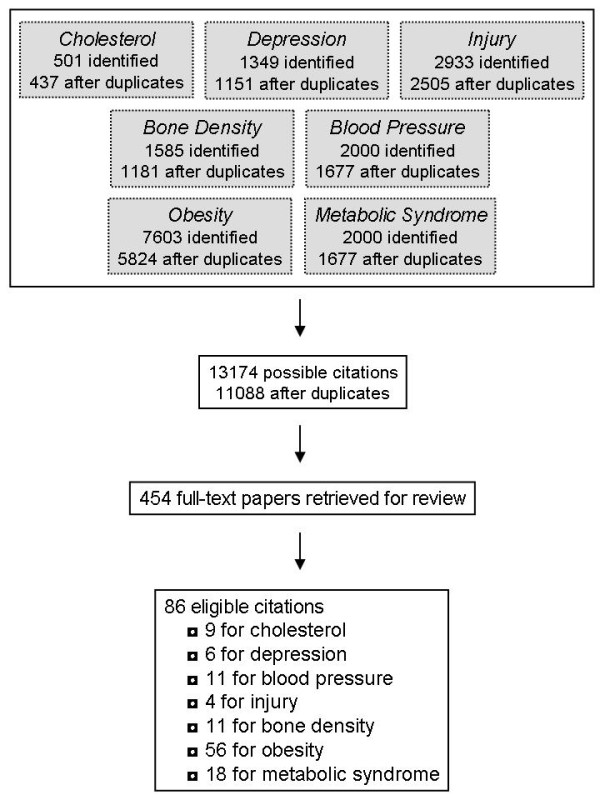
- After duplicates, 11,088 unique citations were screened; 454 full-text articles were reviewed; 86 unique citations met eligibility and 113 outcomes were abstracted. Observational studies had to report dichotomous outcomes; intervention studies were excluded if they included dietary or other behavioral components that could independently affect outcomes.
- Evidence was graded using pre-specified criteria based on quantity/quality of studies and strength of effect; meta-analyses were performed when at least 4 studies were available. RCT quality was assessed with the Downs and Black checklist, and effect sizes used Cohen’s d and ratio-score criteria.
Limitations
- Stated: unpublished and non-English studies were excluded, no extensive cross-referencing of reference lists was performed, the review was limited to 7 health outcomes, and many observational studies were excluded because they did not report dichotomous outcomes; these may have biased results and recommendations.
- Stated RCT limitations: samples were small and non-representative, statistical power was often lacking, adverse events were rarely reported, dropout details were limited, and intent-to-treat analyses were not performed; therefore Level 2 was the highest level assignable to any recommendation.
- Evident from the text: the nature of dose-response relations (linear vs curvilinear) often remained unclear, and the moderating effects of age and sex were not systematically addressed across outcomes.
Model-written summary. Check it against the paper before relying on it.
Integrity signals
Registry
Cites
Statistics
Figures
Verification
Claims the paper makes
0 Valid · 0 Not valid · 42 Not checked · 127 Own results and interpretations
A result the paper reports from its own data — it cites no other source for it, so there is none to check. The quote shows it is in the paper.
In the paper
“Results from experimental studies indicate that even modest amounts of physical activity can have health benefits in high-risk youngsters (e.g., obese).”
§ Systematic review of the health benefits of physical activity and fitness in school-aged children and youth > Abstract > Results
hedgedstates a cause- Asserted: passes — The authors put it forward as true.
- Checkable: passes — It can be checked against evidence.
- Load-bearing: passes — The paper’s conclusions depend on it.
- Based: passes — The paper gives a reason why it holds.
A result the paper reports from its own data — it cites no other source for it, so there is none to check. The quote shows it is in the paper.
In the paper
“Physical activity was associated with numerous health benefits.”
§ Systematic review of the health benefits of physical activity and fitness in school-aged children and youth > Abstract > Results
plainstates an association- Asserted: passes — The authors put it forward as true.
- Checkable: passes — It can be checked against evidence.
- Load-bearing: passes — The paper’s conclusions depend on it.
- Based: passes — The paper gives a reason why it holds.
A result the paper states — it cites no source for it, so there is none to check. The quote shows it is in the paper.
In the paper
“Aerobic-based activities had the greatest health benefit, other than for bone health, in which case high-impact weight bearing activities were required.”
§ Systematic review of the health benefits of physical activity and fitness in school-aged children and youth > Abstract > Results
plainstates an association- Asserted: passes — The authors put it forward as true.
- Checkable: passes — It can be checked against evidence.
- Load-bearing: passes — The paper’s conclusions depend on it.
- Based: passes — The paper gives a reason why it holds.
A result the paper reports from its own data — it cites no other source for it, so there is none to check. The quote shows it is in the paper.
In the paper
“The dose-response relations observed in observational studies indicate that the more physical activity, the greater the health benefit.”
§ Systematic review of the health benefits of physical activity and fitness in school-aged children and youth > Abstract > Results
hedgedstates an association- Asserted: passes — The authors put it forward as true.
- Checkable: passes — It can be checked against evidence.
- Load-bearing: passes — The paper’s conclusions depend on it.
- Based: passes — The paper gives a reason why it holds.
None of the sources cited for this claim have been checked yet.
In the paper
“The results indicated that unfit girls, defined as the lowest 20% fit, were 1.89 (95% confidence interval: 1.12-3.17) times more likely to have hypercholesterolemia and 1.03 (0.74-1.43) times more likely to have a low HDL-cholesterol by comparison to moderately and high fit girls.”
§ Systematic review of the health benefits of physical activity and fitness in school-aged children and youth > Results > Cholesterol and blood lipids
hedgedstates an associationn = 3,110- Asserted: passes — The authors put it forward as true.
- Checkable: passes — It can be checked against evidence.
- Load-bearing: passes — The paper’s conclusions depend on it.
- Based: passes — The paper gives a reason why it holds.
103 more claims
Create a free account to see all 169 claims and every source verdict.
- Probably not a substantial claim. 26
- The quote only partly states this claim. 2
- It may state two separate claims as one. 37
Claims other papers make about this one
Each is checked against this paper’s own text: does it say what the citing paper says it does?
The source backs part of the claim, not all of it — or backs it for a different population, condition or comparison.
In the citing paper
“Research indicates that those who are physically active show or report better overall physical and mental health, a higher level of fitness and a lower level of obesity than their sedentary or physically inactive counterparts1–4”
From Physical activity and health in Chinese children and adolescents: expert consensus statement (2020) (2020) · cites this paper as [2]
Experimental — accuracy not yet measuredThe cited source says what the claim attributes to it.
In the citing paper
“The association with overweight/obesity tends to be stronger when moderate to vigorous-intensity physical activities are performed.2”
From Physical activity and health in Chinese children and adolescents: expert consensus statement (2020) (2020) · cites this paper as [2]
The cited source says what the claim attributes to it.
In the citing paper
“Among physical activity interventions, the effects of physical activity independent of dietary changes on measures indicative of weight reduction (eg, BMI, total fat, abdominal fat) tend to be in the small range.2”
From Physical activity and health in Chinese children and adolescents: expert consensus statement (2020) (2020) · cites this paper as [2]
The cited source says what the claim attributes to it.
In the citing paper
“In general, as the level of physical activity increases, the likelihood of injury increases.2”
From Physical activity and health in Chinese children and adolescents: expert consensus statement (2020) (2020) · cites this paper as [2]
The cited source says what the claim attributes to it.
In the citing paper
“Systematic reviews have shown that physical activity (PA) is associated with greater mental health, 6 and a reduced risk of mental ill-health, specifically depression and anxiety.7,8”
From Domain-Specific Physical Activity and Mental Health: A Meta-analysis (2017) · cites this paper as [8]
2 more claims about this paper
Create a free account to see every claim other papers make about this one.
Self-check
Percentages, sums and reported differences re-computed from the paper’s own numbers.
Each contradiction between two passages listed here was confirmed by an independent check.
Rated major: it would touch a result — a value a result rests on, reported and recomputed p-values on opposite sides of the significance level, two passages that conflict with no sign which is right, or a cited work retracted before this paper was published.
In the paper
§ Systematic review of the health benefits of physical activity and fitness in school-aged children and youth > Discussion > Recommendations based on systematic review
“More vigorous intensity activities should be incorporated or added when possible, including activities that strengthen muscle and bone. [Level 3, Grade B].”
§ Systematic review of the health benefits of physical activity and fitness in school-aged children and youth > Discussion > Recommendations based on systematic review
“This recommendation was given a lower grade (Grade C) because of the potential increase in injury risk associated with more vigorous intensity activities and sports.”
Rated minor: it would not touch a result — a value no result rests on, a p-value that stays on the same side of the significance level, or a conflict that is clerical, resolved elsewhere in the paper, or outside its own findings.
In the paper
§ Systematic review of the health benefits of physical activity and fitness in school-aged children and youth > Results > Metabolic syndrome
“Sixteen articles examining the metabolic syndrome met the inclusion criteria.”
§ Systematic review of the health benefits of physical activity and fitness in school-aged children and youth > Results > Metabolic syndrome
“Eight of the 17 identified studies were observational in nature”
Rated minor: it would not touch a result — a value no result rests on, a p-value that stays on the same side of the significance level, or a conflict that is clerical, resolved elsewhere in the paper, or outside its own findings.
In the paper
“A total of 31 observational studies (24 cross-sectional, 3 prospective cohort, 2 case-control, 1 mixed) were retrieved”
§ Systematic review of the health benefits of physical activity and fitness in school-aged children and youth > Results > Overweight and obesity
Reported 31 · recomputed 30
Rated minor: it would not touch a result — a value no result rests on, a p-value that stays on the same side of the significance level, or a conflict that is clerical, resolved elsewhere in the paper, or outside its own findings.
In the paper
“437 citations were identified for cholesterol, 1151 for depression, 2505 for injury, 1181 for bone density, 1677 for blood pressure, 5824 for obesity, and 1677 for the metabolic syndrome. Thus, the grand total was 13174.”
§ Systematic review of the health benefits of physical activity and fitness in school-aged children and youth > Results > Literature review
Reported 13174 · recomputed 14452
Citations
Cites
Downs, S. H., & Black, N. (1998) · Journal of Epidemiology and Community Health · doi:10.1136/jech.52.6.377 · Cited by 8,252
Evidence Based Physical Activity for School-age Youth
Strong, W. B., Malina, R. M., Blimkie, C. J. R., Daniels, S. R., Dishman, R. K., Gutin, B., Hergenroeder, A. C., Must, A., Nixon, P. A., Pivarnik, J. M., et al. (2005) · The Journal of Pediatrics · doi:10.1016/j.jpeds.2005.01.055 · Cited by 4,222
Systematic Reviews: Synthesis of Best Evidence for Clinical Decisions
Cook, D. J., Mulrow, C. D., & Haynes, R. B. (1997) · Annals of Internal Medicine · doi:10.7326/0003-4819-126-5-199703010-00006 · Cited by 2,184
Andersen, L. B., Harro, M., Sardinha, L. B., Froberg, K., Ekelund, U., Brage, S., & Anderssen, S. A. (2006) · The Lancet · doi:10.1016/s0140-6736(06)69075-2 · Cited by 1,473
Lau, D. C. W., Douketis, J. D., Morrison, K. M., Hramiak, I. M., Sharma, A. M., Ur, E., & Panel, F. M. O. T. O. C. C. P. G. E. (2007) · Canadian Medical Association Journal · doi:10.1503/cmaj.061409 · Cited by 1,154
Paterson, D. H., & Warburton, D. E. (2010) · International Journal of Behavioral Nutrition and Physical Activity · doi:10.1186/1479-5868-7-38 · Cited by 953
A systematic review of the evidence for Canada's Physical Activity Guidelines for Adults
Warburton, D. E., Charlesworth, S., Ivey, A., Nettlefold, L., & Bredin, S. S. (2010) · International Journal of Behavioral Nutrition and Physical Activity · doi:10.1186/1479-5868-7-39 · Cited by 902 · cited 1×
“This report was part of a much larger project around Canada's physical activity guidelines, and comparable systematic reviews for adults [ 10 ] and older adults [11] have also been published in the journal.”
A meta-regression to examine the relationship between aerobic fitness and cognitive performance
Etnier, J. L., Nowell, P. M., Landers, D. M., & Sibley, B. A. (2006) · Brain Research Reviews · doi:10.1016/j.brainresrev.2006.01.002 · Cited by 749
Is the Canadian childhood obesity epidemic related to physical inactivity?
Tremblay, M. S., & Willms, J. D. (2003) · International Journal of Obesity · doi:10.1038/sj.ijo.0802376 · Cited by 517
Nassis, G. P., Papantakou, K., Skenderi, K., Triandafillopoulou, M., Kavouras, S. A., Yannakoulia, M., Chrousos, G. P., & Sidossis, L. S. (2005) · Metabolism · doi:10.1016/j.metabol.2005.05.013 · Cited by 469
Research works printed but not linked: 1
- Petitti DB Meta-Analysis, Decision Analysis, and Cost-Effective Analysis 1994 New York, NY: Oxford University Press
Cited by
Items 2,901–3,000 of 4,834
der Looven, R. V., Vos, E. D., Vandekerckhove, K., Coomans, I., Laureys, G., & Dhooge, C. (2022) · European Journal of Cancer Care · doi:10.1111/ecc.13761 · Cited by 6
Karaca, A., & Demirci, N. (2019) · Turkish Journal of Sports Medicine · doi:10.5152/tjsm.2019.140 · Cited by 9
Physical activity, physical condition and quality of life in schoolchildren
Uribe, S. C., Arista-Huaco, M. J., Díaz, I. Á. E., & Alcoser, S. D. I. (2021) · Winter Conferences of Sports Science · doi:10.14198/jhse.2021.16.proc3.14 · Cited by 7
Neighbourhood Safety and Outdoor Play Activities among Urban Children in Shah Alam, Malaysia
Ilmi, H. S., Gheda, M. L. M., & Yusof, N. A. (2018) · IOP Conference Series Materials Science and Engineering · doi:10.1088/1757-899x/401/1/012031 · Cited by 4
Hülya, T. U. N. A., GÜRPINAR, B., Tuz, K., Gürgen, E. T., & İlçin, N. (2021) · Mehmet Akif Ersoy Üniversitesi Sosyal Bilimler Enstitüsü Dergisi · doi:10.20875/makusobed.878726 · Cited by 4
Frimpong, J. B., Agyei, M., Apaak, D., Ansah, E. W., & True, L. K. (2022) · Children · doi:10.3390/children9111715 · Cited by 6
Lin, Y.-C., Chen, J., Bevan, N., O’Brien, K., Strong, C., Tsai, M., Fung, X. C. C., Chen, J., Lin, I., Latner, J. D., et al. (2024) · BMC Psychology · doi:10.1186/s40359-024-01870-y · Cited by 4
“The benefits of physical activity engagement have been well documented: physical activity is one of the most cost-effective methods to improve general health and prevent physical health conditions [1, 2] as well as chronic diseases, such as overweight (or obesity) and cardiovascular disease [3, 4].”
BackgroundTso, I. T. H., Law, J. C. L., & Wong, T. W. L. (2021) · Perceptual and Motor Skills · doi:10.1177/00315125211050629 · Cited by 4
Köster, P., Hohmann, A., Niessner, C., & Siener, M. (2021) · Children · doi:10.3390/children8111046 · Cited by 9
Physical Activity during Full-Day and Half-Day Kindergarten
Talley, L., Cook, R., Naylor, P.-J., et al. (2012) · Northwest Journal of Teacher Education · doi:10.15760/nwjte.2012.10.1.14 · Cited by 4
Bogantes, C. Á. (2016) · Revista Ensayos Pedagógicos · doi:10.15359/rep.11-1.8 · Cited by 8
Evidence of impact underpinning Life Education Programs
Dix, K., Ahmed, S. K., Carslake, T., & Sniedze-Gregory, S. (2021) · ACEReSearch Repository (Australian Council for Educational Research) · doi:10.37517/978-1-74286-643-7 · Cited by 5
Radman, I., Sorić, M., & Mišigoj‐Duraković, M. (2021) · Sensors · doi:10.3390/s21061986 · Cited by 4
Biological Markers of Cognition in Exercise: A Mini Review
Gowsi, K., Pal, G. K., & Subramanian, K. (2019) · International Journal of Clinical and Experimental Physiology · doi:10.5530/ijcep.2019.6.3.22 · Cited by 3
An evaluation of the ‘bottom-up’ implementation of the Active at school! programme in Quebec, Canada
Gosselin, V., Robitaille, N., & Laberge, S. (2022) · Health Promotion International · doi:10.1093/heapro/daac095 · Cited by 5
Paediatric physical activity and health: Moving towards a measure of quality
Clark, C. C. T., & Barnes, C. M. (2018) · Baltic Journal of Health and Physical Activity · doi:10.29359/bjhpa.10.4.01 · Cited by 4
The Effect of a physical activity program on fitness perception of 9 to 11-year-old schoolchildren
Reyes-Amigo, T. R., Sepúlveda-Figueroa, F., Cristi‐Montero, C., Bezerra, A. B. G., Freitas, L., Hurtado, J., Páez‐Herrera, J., Beltrán, H. C., Zavala-Jara, M., Ibarra-Mora, J., et al. (2023) · Cultura Ciencia y Deporte · doi:10.12800/ccd.v18i58.2061 · Cited by 5
Teber, S., Sağlam, M., Ertuğrul, İ., Vardar‐Yağlı, N., Cakmak-Onal, A., Kutukcu, E. C., Inal-Ince, D., Arıkan, H., & Karagöz, T. (2020) · Pediatric Cardiology · doi:10.1007/s00246-020-02384-1 · Cited by 6
Zhao, Z., Sarkhani, S., Sarkhani, M., & Imani, N. (2022) · International Journal of Sport and Exercise Psychology · doi:10.1080/1612197x.2022.2109186 · Cited by 5
“A systematic review (2010) including three experimental studies found signi fi cant improvement in at least one depressive symptom in children and adolescents in response to a modest exercise (60 – 90 min per week) lasting 8 – 12 consecutive weeks (Janssen & LeBlanc, 2010).”
BackgroundParental physical activity support for parents of children with disabilities in Saudi Arabia
Alhumaid, M. M. (2024) · Heliyon · doi:10.1016/j.heliyon.2024.e29351 · Cited by 6
Carton, A., Barbry, A., Coquart, J. B., Ovigneur, H., Amoura, C., & Orosz, G. (2021) · Frontiers in Psychology · doi:10.3389/fpsyg.2021.738343 · Cited by 6
Perceptions of Canadian Indigenous teachers and students on movement integration in the classroom
Kerpan, S., Humbert, M. L., & Abonyi, S. (2019) · The Australian Journal of Indigenous Education · doi:10.1017/jie.2019.1 · Cited by 6
Choi, S. J., Hung, P.-Y., Liu, M. Z., Dempsey, W., Newman, M., & Klasnja, P. (2025) · Journal of Medical Internet Research · doi:10.2196/75792 · Cited by 7
Levi, S., & Baron‐Epel, O. (2024) · Journal of Adolescent Research · doi:10.1177/07435584241231438 · Cited by 7
Seggern, M. J. V., Schenkelberg, M. A., Rogers, A. E., Kellstedt, D. K., High, R., Welk, G. J., Rosenkranz, R. R., & Dzewaltowski, D. A. (2025) · PLoS ONE · doi:10.1371/journal.pone.0324560 · Cited by 4
“Regular PA is linked to significant health benefits in children and adolescents, including improved mental health and academic performance and reduced risk of obesity, cancer, and other chronic diseases [2,3].”
Patterns of Active Travel and Physical Activity among Adolescents in Israel
Levi, S., Baron‐Epel, O., Tesler, R., & Harel‐Fisch, Y. (2022) · International Journal of Environmental Research and Public Health · doi:10.3390/ijerph192114115 · Cited by 5
Niźnikowska, E. A., Bergier, J., Bergier, B., Bergier, M., Ӑcs, P., & Junger, J. (2019) · Roczniki Państwowego Zakładu Higieny · doi:10.32394/rpzh.2019.0065 · Cited by 4
Pohybová aktivita a sportovní preference adolescentek
Neuls, F., & Frömel, K. (2016) · doi:10.5507/ftk.16.24450902 · Cited by 9
Brown, D. M. Y., Summerville, B., Fairclough, S. J., Mielke, G. I., & Tyler, R. (2024) · Journal of Physical Activity and Health · doi:10.1123/jpah.2023-0360 · Cited by 6
Budzynski‐Seymour, E., Jones, M. A., & Steele, J. (2021) · Communications in Kinesiology · doi:10.51224/cik.v1i2.28 · Cited by 4
A Survey on Wellness and Its Predictors Amongst Fiji High School Students
Odrovakavula, L., Mohammadnezhad, M., & Khan, S. (2021) · Frontiers in Public Health · doi:10.3389/fpubh.2021.671197 · Cited by 5
Huppertz, C., Bartels, M., van Beijsterveldt, C. E. M., Willemsen, G. A. H. M., Hudziak, J. J., & de Geus, E. J. C. (2015) · Obesity Science & Practice · doi:10.1002/osp4.2 · Cited by 6
Hagger, M. S., Laukkanen, A., Hirvensalo, M. H., Tammelin, T., & Hankonen, N. E. (2018) · PsyArXiv (OSF Preprints) · doi:10.31234/osf.io/mp3yr · Cited by 5
Simón-Piqueras, J. Á., González‐Cutre, D., & López, L. M. G. (2024) · Journal of Teaching in Physical Education · doi:10.1123/jtpe.2023-0107 · Cited by 7
Exploring Children’s Physical Activity Behaviours According to Location: A Mixed-Methods Case Study
Khawaja, I., Woodfield, L., Collins, P., Benkwitz, A., & Nevill, A. M. (2019) · Sports · doi:10.3390/sports7110240 · Cited by 9
Bingham, D. D., Daly-Smith, A., Seims, A., Hall, J., Eddy, L. H., Helme, Z. E., & Barber, S. (2023) · JMIR Research Protocols · doi:10.2196/43619 · Cited by 8
“Daily physical activity, particularly of moderate-to-vigorous intensity, is very beneficial for the physical, emotional, and social development of young people [1,2], and is preventive for the early onset of diseases and disorders [3-5].”
Sulla-Torres, J. A., Vidal-Espinoza, R., Llanque, C. A., Gamboa, A. C., Carnero, M. Z., Cossio‐Bolaños, M., & Gómez‐Campos, R. (2023) · Children · doi:10.3390/children10060915 · Cited by 6
Physical Activity, Aerobic Fitness and Academic Achievement
Marques, A., Hillman, C. H., & Sardinha, L. B. (2018) · InTech eBooks · doi:10.5772/intechopen.71284 · Cited by 6
Zhu, X., Lin, J., Cai, F., & Yan, Y. (2025) · BMC Public Health · doi:10.1186/s12889-025-22859-1 · Cited by 13
“Sports participation has a crucial role in improving university students’physical fitness, with frequency, intensity, and type of participation being significant contributors [12, 13].”
Multi-Dimensional Interacting Constraints on Physical Activity Behaviours in the Finnish Population
Karjalainen, A., Liukkonen, J., Kokko, S. P., & Jaakkola, T. T. (2016) · Sports Medicine · doi:10.1007/s40279-016-0550-9 · Cited by 4
“It has been well-documented that physical activity has many positive effects on individuals’ health, well-being and cognition [1-2].”
BackgroundWang, W., Huang, C. X., Shen, Y., Cheng, J., & Wang, L. (2025) · Digital Health · doi:10.1177/20552076251374249 · Cited by 11
Test-retest reliability of survey items on ownership and use of physical activity trackers
Ng, K., Baďura, P., Dzielska, A., Kokko, S. P., Woods, C. B., & Hamřík, Z. (2019) · Acta Gymnica · doi:10.5507/ag.2019.001 · Cited by 4
Gámez-Calvo, L., Gamonales, J. M., León, K. F., & Muñoz-Jiménez, J. (2021) · MHSALUD Revista en Ciencias del Movimiento Humano y Salud · doi:10.15359/mhs.19-1.6 · Cited by 5
Christensen, J. H., Ljungmann, C. K., Pawlowski, C. S., Johnsen, H. R., Olsen, N. S., Hulgård, M., Bauman, A. E., & Klinker, C. D. (2022) · International Journal of Environmental Research and Public Health · doi:10.3390/ijerph192215271 · Cited by 6
Feng, Y., Chen, C., Liu, Y., & Li, S. (2025) · Frontiers in Public Health · doi:10.3389/fpubh.2024.1507066 · Cited by 10
Zhou, X., Ahmad, N. S., Khairani, A. Z., & Chen, Y. (2024) · Environment and Social Psychology · doi:10.54517/esp.v9i6.2509 · Cited by 5
“Indeed, regular participation in physical activity is widely regarded as an effective measure for preventing various health risk factors [16,17] .”
BackgroundNoel-London, K., Shacham, E., Ortiz, K. S., & BeLue, R. (2024) · Journal of Athletic Training · doi:10.4085/1062-6050-0372.23 · Cited by 5
Kolb, S., Burchartz, A., Klos, L., Jekauc, D., Niessner, C., & Wöll, A. (2025) · BMC Public Health · doi:10.1186/s12889-025-21684-w · Cited by 9
Moin, M., Farhan, Z., Naqvi, S. K., Lassi, Z. S., & Das, J. K. (2026) · Journal of Global Health · doi:10.7189/jogh.16.04112 · Cited by 11
“Adolescence is a period where individuals undergo significant physical, emotional, and cognitive changes [ 1 ].”
Wang, Y., Wang, Q., Dong, X., Yang, J., Cai, K., Chen, D., & Chen, A. (2025) · Scientific Reports · doi:10.1038/s41598-025-25718-6 · Cited by 9
Menstrual disorders and comorbidities in girls involved in ballet and sports (literature review)
Rustyanova, D. R., Kazakova, A. V., Александрович, Ж. В., Uvarova, E. V., & Anufrieva-Dzhioeva, M. U. (2022) · Pediatric and Adolescent Reproductive Health · doi:10.33029/1816-2134-2022-18-4-37-48 · Cited by 4
Ha, A. S. C., Hoi-Sze, C., Kim-Wai, R., & Yau-Yin, J. (2014) · Cited by 4
Uadia, P. O., Nwokolo, C., Rumwensodia, K. O., Arainru, A. E., Agwubike, E. O., & Akpata, C. B. N. (2017) · Tropical Journal of Pharmaceutical Research · doi:10.4314/tjpr.v16i1.33 · Cited by 6
Foreign-trained doctors and nurses
OECD (2017) · Health at a glance · doi:10.1787/health_glance-2017-59-en · Cited by 5
Characteristics of Canadian Youth Adhering to Physical Activity and Screen Time Recommendations
Fitzpatrick, C., Burkhalter, R., & Asbridge, M. (2019) · The Journal of School Nursing · doi:10.1177/1059840519881185 · Cited by 9
Killian, C. M. (2026) · Journal of Physical Education Recreation & Dance · doi:10.1080/07303084.2025.2579458 · Cited by 4
“…participation, the general and steady erosion of physical education and physical activity opportunities directly threaten the physical health (Janssen & LeBlanc, 2010), mental health (Biddle et al., 2019), and academic achievement (Trudeau & Shephard, 2008; Muntaner-Mas et al., 2024) of…”
Food Insecurity, Dietary Intakes, and Eating Behaviors in a Convenience Sample of Toronto Youth
Dubelt-Moroz, A., Warner, M., Heal, B., Khalesi, S., Wegener, J., de Zepetnek, J. O. T., Lee, J. J., Polecrone, T., El-Sarraj, J., Holmgren, E., et al. (2022) · Children · doi:10.3390/children9081119 · Cited by 6
Santi, M. D., Zangara, G., Baldelli, G., & Brandi, G. (2020) · PubMed · doi:10.7416/ai.2020.2374 · Cited by 3
Wojtyła-Buciora, P., Bołdowski, T., Wojtyła, C., Żukiewicz-Sobczak, W., Juszczak, K., Łabędzka-Gardy, M., Wojtyła, A., & Krauss, H. (2017) · Journal of Health Inequalities · doi:10.5114/jhi.2017.69169 · Cited by 8
Yun, J.-S., Lee, G.-I., & Kim, B.-R. (2023) · Healthcare · doi:10.3390/healthcare12010040 · Cited by 6
“Physical activity has been shown to positively impact health and well-being by preventing conditions such as obesity, heart disease, high blood pressure, diabetes, depression, and various other health problems [3,4].”
BackgroundLegarra‐Gorgoñon, G., García‐Alonso, Y., Ramírez‐Vélez, R., Alonso-Martínez, L., Izquierdo, M., & Alonso-Martínez, A. M. (2025) · JMIR Serious Games · doi:10.2196/60185 · Cited by 7
“Physical activity (PA) is essential for early childhood development [1] and positively impacts skeletal growth [2], metabolism [3], and cardiovascular health [4].”
Moschos, G., Pollatou, E., Kambas, A., & Bekiari, A. (2023) · Body Movement and Dance in Psychotherapy · doi:10.1080/17432979.2023.2227890 · Cited by 8
Ringing the bell for quality P.E.: What are the realities of remote physical education?
Kovacs, V. A., Csányi, T., Blagus, R., Brandes, M., Starc, G., Rocha, P. M., Scheuer, C., & Okely, A. D. (2022) · European Journal of Public Health · doi:10.1093/eurpub/ckac082 · Cited by 5
de la Uz, C. M., Burch, A. E., Gunderson, B. D., Koehler, J. L., & Sears, S. F. (2017) · Pacing and Clinical Electrophysiology · doi:10.1111/pace.13197 · Cited by 4
Aguilar-Farías, N., Miranda-Marquez, S., Toledo-Vargas, M., & Chandía-Poblete, D. (2021) · Cadernos de Saúde Pública · doi:10.1590/0102-311x00240620 · Cited by 5
Kramer-Kostecka, E. N., Folk, A. L., Friend, S. E., Coan, B., Kne, L., Beaudette, J., Barr‐Anderson, D. J., & Fulkerson, J. A. (2022) · Preventive Medicine Reports · doi:10.1016/j.pmedr.2022.102066 · Cited by 7
Beden Eğitimi Motivasyon Ölçeği’nin Türkçe’ye Uyarlanması: Geçerlik ve Güvenirlik Çalışması
AKBULUT, V., & Öncü, E. (2023) · Sportive · doi:10.53025/sportive.1311231 · Cited by 6
Chulvi‐Medrano, I., Thomas, E., & Padua, E. (2022) · International Journal of Environmental Research and Public Health · doi:10.3390/ijerph19116475 · Cited by 5
‘Life in the age of screens’: parent perspectives on a 24‐h no screen‐time challenge
Peláez, S., Alexander, S., Roberge, J., Henderson, M., Bigras, J., & Barnett, T. A. (2016) · Clinical Obesity · doi:10.1111/cob.12150 · Cited by 5
Figueiredo, P. R. P., Mancini, M. C., & Brandão, M. B. (2018) · Movimento (Porto Alegre) · doi:10.22456/1982-8918.79926 · Cited by 5
Sortwell, A., Forte, P. M., Ramírez‐Campillo, R., Trimble, K., Steel, K. A., O’Brien, K. M., Neiva, H. P., Marinho, D. A., & Ferraz, R. M. P. (2022) · International Journal of Kinesiology and Sports Science · doi:10.7575/aiac.ijkss.v.10n.4p.34 · Cited by 8
Valtonen, J. O., Kyhälä, A.-L., & Reunamo, J. (2021) · Journal of Physical Education and Sport · doi:10.7752/jpes.2021.03197 · Cited by 8
Cowley, E. S., Watson, P. M., Paterson, C. A., Wagenmakers, A. J. M., Thompson, A., Belton, S., Thijssen, D. H. J., & Foweather, L. (2024) · BMC Public Health · doi:10.1186/s12889-024-19664-7 · Cited by 6
“Despite the overwhelming evidence supporting the physical [1], psychological [2], and social benefits of PA [3], approximately 80% of teenage girls in the United Kingdom (UK) and Ireland do not meet the World Health Organisation minimum PA participation guidelines of an average of 60 min daily…”
BackgroundMeyer, M. R. U., Prochnow, T. M., Ylitalo, K. R., et al. (2022) · Journal of Healthy Eating and Active Living · doi:10.51250/jheal.v2i3.41 · Cited by 4
“Physical activity (PA) is related to many health benefits including reduced risk of obesity, diabetes, and other chronic diseases (Janssen & LeBlanc, 2010).”
Carcelén‐Fraile, M. D. C., Aibar‐Almazán, A., & Hita‐Contreras, F. (2025) · Applied Sciences · doi:10.3390/app15179572 · Cited by 12
OECD (2017) · Health at a glance · doi:10.1787/health_glance-2017-76-en · Cited by 5
How acute affect dynamics impact longitudinal changes in physical activity among children
Dunton, G. F., Wang, W., Intille, S. S., Dzubur, E., Ponnada, A., & Hedeker, D. (2022) · Journal of Behavioral Medicine · doi:10.1007/s10865-022-00282-w · Cited by 7
Dunton, G. F., O’Connor, S. G., Belcher, B. R., Maher, J. P., & Schembre, S. M. (2018) · Frontiers in Public Health · doi:10.3389/fpubh.2018.00198 · Cited by 7
Philippe, C. (2019) · Archives of Sports Medicine · doi:10.36959/987/244 · Cited by 4
Comparison of the virtual reality and mobile games regarding physiological load
Biçer, B., & Löklüoğlu, B. (2025) · Frontiers in Physiology · doi:10.3389/fphys.2025.1556434 · Cited by 5
Rico-González, M., Gómez‐Carmona, C. D., González-Devesa, D., Ardigò, L. P., & Moreno-Villanueva, A. (2025) · Nutrients · doi:10.3390/nu17172878 · Cited by 9
“In a recent systematic review of 86 papers investigating the relationship between PA and health-related outcomes in schoolchildren, there were beneficial effects on many aspects of health, such as enhanced bone density, cardiovascular function, and lower obesity risk [3].”
Saemoh, F., Jeadeng, M., Suwankhong, D., Chinnasee, C., & Nadzalan, A. M. (2022) · Pedagogy of Physical Culture and Sports · doi:10.15561/26649837.2022.0605 · Cited by 5
Longitudinal effects of evidence-based physical education in Maltese children
Fenech, A., Chockalingam, N., Formosa, C., & Gatt, A. (2021) · Child and Adolescent Obesity · doi:10.1080/2574254x.2021.1915041 · Cited by 4
Effect of Peer Education on Physical Activity and Nutrition among Iranian Adolescents
Damghanian, A., Sharietpanahi, G., Khieltash, A., & Barahimi, H. (2019) · Asian Journal of Social Health and Behavior · doi:10.4103/shb.shb_8_19 · Cited by 4
Association of Physical Activity and Cardiometabolic Risk in Children 3–12 Years
Vanderloo, L. M., Maguire, J. L., Dai, D. W. H., Parkin, P. C., Borkhoff, C. M., Tremblay, M. S., Anderson, L. N., Birken, C. S., & _, _. (2020) · Journal of Physical Activity and Health · doi:10.1123/jpah.2020-0028 · Cited by 5
Poethko‐Müller, C., & Krug, S. (2014) · Journal of Public Health · doi:10.1007/s10389-013-0607-2 · Cited by 5
Effects of Parental Involvement on the Participation of Students in Sports
Nazeer, M. T., Atta, H., & Wahid, A. U. H. (2021) · Sir Syed Journal of Education & Social Research (SJESR) · doi:10.36902/sjesr-vol4-iss1-2021(440-447 · Cited by 5
Ohtaka, M., Saito, M., & Ito, Y. (2024) · Journal of Rural Medicine · doi:10.2185/jrm.2023-051 · Cited by 9
Health-Related Fitness Levels among Title I Elementary School Students
Ha, T., Moon, J., Dauenhauer, B. D., Krause, J. M., McMullen, J. M., & Gaudreault, K. L. (2021) · International Journal of Environmental Research and Public Health · doi:10.3390/ijerph18157778 · Cited by 7
A Profile of Active Transportation in Colorado Public Schools, 2014–2015
Behrens, T. K., Osman, R., Whitney, P., Carpenter, D. M., Tucker, E., Field, J. E., & Kelly, C. M. (2016) · Journal of Community Health · doi:10.1007/s10900-016-0237-z · Cited by 4
Caperchione, C. M., Hargreaves, N., Sabiston, C. M., Berg, S., Kowalski, K. C., & Ferguson, L. J. (2020) · JMIR Research Protocols · doi:10.2196/15302 · Cited by 5
Bahram, M. E., Akkasheh, G., & Akkasheh, N. (2014) · Nursing and Midwifery Studies · doi:10.17795/nmsjournal10911 · Cited by 6
“In the last 50 years, epidemiological studies have shown that lack of movement and low physical preparation in children and teenagers have been related to deaths, cardiovascular diseases, and diabetes in adulthood (10, 11), whereas those physically active are less exposed to diseases and survive longer.”
BackgroundNi, J., Cheng, M., Zhang, R., & Ya, W. (2024) · Physiology & Behavior · doi:10.1016/j.physbeh.2024.114750 · Cited by 11
Development of a physical literacy consensus statement for Chile: study protocol
Cárcamo-Oyarzún, J., Gutiérrez, C. R., Alvear, L. H., Delgado‐Floody, P., Ferbol, C., Díaz-Alvarado, M., Cumilef-Bustamante, P., Martínez-López, N., Guarda-Saavedra, P., Candia-Cabrera, P., et al. (2025) · Frontiers in Public Health · doi:10.3389/fpubh.2025.1554070 · Cited by 7
Objective Measurement of Physical Activity Attributed to a Park-Based Afterschool Program
Booth, J. V., Messiah, S. E., Hansen, E., Nardi, M. I., Hawver, E., Patel, H. H., Kling, H. E., Okeke, D., & D’Agostino, E. (2021) · Journal of Physical Activity and Health · doi:10.1123/jpah.2020-0162 · Cited by 5
Physical activity in the lifestyl of the adult and senior population in the Czech Republic
Pelclová, J. (2015) · doi:10.5507/ftk.15.24448060 · Cited by 8
Kulp, A. J., & Zhu, X. (2021) · Journal of Teaching in Physical Education · doi:10.1123/jtpe.2021-0058 · Cited by 4
Metadata
- Authors
- Janssen, I., & LeBlanc, A. G.
- Affiliations
- Queen's University (CA)
- Corresponding author
- Janssen, Ian
- Venue
- International Journal of Behavioral Nutrition and Physical Activity
- Published
- 2010
- Volume
- 7
- Issue
- 1
- Pages
- 40
- ISSN
- 1479-5868 (ISSN-L)
- PMC
- PMC2885312
- OpenAlex
- W2145702257
- Semantic Scholar
- ef8d55efd11b9d5e4a4814b6a38ff3d60d820d37
- Cited by
- 4,829
- References
- 116
- Citations by year
- 2026: 185 · 2025: 257 · 2024: 310 · 2023: 304 · 2022: 371 · 2021: 451 · 2020: 459 · 2019: 401 · 2018: 387 · 2017: 490 · 2016: 302 · 2015: 280 · 2014: 250 · 2013: 191 · 2012: 109
- FWCI
- 12.18
- Type
- journal article
- Language
- en
- Open access
- gold
- doi.org
- Licence
- cc-by
- Locations
- International Journal of Behavioral Nutrition and Physical Activity (publishedVersion, cc-by)
- PubMed Central (publishedVersion, cc-by)
- PubMed (publishedVersion)
- DOAJ (DOAJ: Directory of Open Access Journals) (submittedVersion, cc-by-sa)
- Funders
- Public Health Agency of Canada
- Public Health Agency
- Topics
- Health Sciences › Medicine › Public Health, Environmental and Occupational Health › Physical Activity and Health
- Health Sciences › Medicine › Public Health, Environmental and Occupational Health › Obesity, Physical Activity, Diet
- Social Sciences › Life-span and Life-course Studies › Recreational Sport and Physical Activity
- Keywords
- physical activity, physical fitness, school-aged children, youth, health benefits, serum cholesterol, blood pressure, metabolic syndrome, childhood obesity, bone mineral density, depression, injuries, dose-response relationship, aerobic exercise, physical activity guidelines
About these checks
Registry, retraction, Cites and statistics results are computed, not judged, with one exception: a printed reference that no index lists is read once by a model before it counts as a citation error. Claims are extracted by a model and kept only when their quote appears verbatim in the text; each cited source is then checked, with a model’s help, for whether it says what the claim relies on. Those verdicts can be wrong — read the claim’s quote and the cited source before relying on one.
A language model drew the claims from the paper on 2026-10-10, under version 3 of the claim definition (model deepseek-v4.1-flash, prompt extract-v3).
A second model labelled each claim on 2026-10-10 (model jev-1.13-20260917, definition revision gold-guideline-v0.2).
Statistics and arithmetic are recomputed, not judged.
Confidence bands are shown only for fields calibrated on our annotated test set. None is calibrated yet, so no band is shown.
What counts as a claim ›How we measure confidence ›How we check this ›
Are you an author, or do you see a problem with this page? Request a review
Data sources
Bibliographic data: Semantic Scholar, OpenAlex, Crossref.
Contains information from the Semantic Scholar Academic Graph Datasets, made available under the ODC Attribution License (ODC-BY 1.0).
Semantic Scholar’s data is described in: Kinney, R., et al. (2023). The Semantic Scholar Open Data Platform. arXiv:2301.10140.
