

Systematic review of the health benefits of physical activity and fitness in school-aged children and youth
Open accessThe DOI matches its Crossref record; 114 of the 116 references it cites were found in a registry or an index; none of the 128 sources its claims cite is checked for support yet.
Abstract
BACKGROUND: The purpose was to: 1) perform a systematic review of studies examining the relation between physical activity, fitness, and health in school-aged children and youth, and 2) make recommendations based on the findings. METHODS: The systematic review was limited to 7 health indicators: high blood cholesterol, high blood pressure, the metabolic syndrome, obesity, low bone density, depression, and injuries. Literature searches were conducted using predefined keywords in 6 key databases. A total of 11,088 potential papers were identified. The abstracts and full-text articles of potentially relevant papers were screened to determine eligibility. Data was abstracted for 113 outcomes from the 86 eligible papers. The evidence was graded for each health outcome using established criteria based on the quantity and quality of studies and strength of effect. The volume, intensity, and type of physical activity were considered. RESULTS: Physical activity was associated with numerous health benefits. The dose-response relations observed in observational studies indicate that the more physical activity, the greater the health benefit. Results from experimental studies indicate that even modest amounts of physical activity can have health benefits in high-risk youngsters (e.g., obese). To achieve substantive health benefits, the physical activity should be of at least a moderate intensity. Vigorous intensity activities may provide even greater benefit. Aerobic-based activities had the greatest health benefit, other than for bone health, in which case high-impact weight bearing activities were required. CONCLUSION: The following recommendations were made: 1) Children and youth 5-17 years of age should accumulate an average of at least 60 minutes per day and up to several hours of at least moderate intensity physical activity. Some of the health benefits can be achieved through an average of 30 minutes per day. [Level 2, Grade A]. 2) More vigorous intensity activities should be incorporated or added when possible, including activities that strengthen muscle and bone [Level 3, Grade B]. 3) Aerobic activities should make up the majority of the physical activity. Muscle and bone strengthening activities should be incorporated on at least 3 days of the week [Level 2, Grade A].
Overview
CoChat Summary
TL;DR
This systematic review found physical activity is associated with numerous health benefits in school-aged children and youth, with observational dose-response evidence suggesting more activity yields greater benefit. It recommends an average of at least 60 minutes per day of at least moderate activity, with some benefits achievable at 30 minutes per day, plus added vigorous and muscle/bone-strengthening activities.
Key findings
- From 11,088 unique citations, 86 eligible papers yielded 113 outcomes across 7 health indicators. Physical activity was associated with benefits; observational studies showed dose-response relations, and experimental studies indicated even modest activity can benefit high-risk youngsters (e.g., obese).
- Metabolic syndrome: summary odds ratio for least active vs most active was 1.68 (95% CI 1.22–2.31) in 3 self-report studies; least fit vs most fit was 6.79 (95% CI 5.11–9.03) in 4 fitness studies. Obesity: median odds ratio was 1.33 for self-reported activity and 3.79 for objective measures. Cholesterol: unfit girls were 1.89 (1.12–3.17) times and unfit boys 3.68 (2.55–5.31) times more likely to have hypercholesterolemia than moderately/high fit peers.
- Recommendations: children and youth 5–17 years should accumulate an average of at least 60 minutes per day and up to several hours of at least moderate intensity activity; some health benefits can be achieved through an average of 30 minutes per day [Level 2, Grade A]. More vigorous activities should be incorporated when possible, including muscle- and bone-strengthening activities [Level 3, Grade B]; aerobic activities should make up the majority, with muscle and bone strengthening on at least 3 days per week [Level 2, Grade A].
- Bone: as little as 10 minutes of moderate-to-high impact activities on as little as 2 or 3 days per week can have a modest effect on bone mineral density when combined with general weight-bearing aerobic activities. Injuries: all 3 included studies reported higher injury rates in active children/youth and clear dose-response relations; vigorous sports risk estimates were high.
Methods
- Systematic review limited to 7 health indicators: high blood cholesterol, high blood pressure, metabolic syndrome, obesity, low bone density, depression, and injuries. Searches used predefined keywords in 6 databases (MEDLINE, EMBASE, CINAHL, PsycINFO, Evidence-Based Medicine Reviews, SPORTDiscus) to January 2008, limited to human participants, English language, and ages 5–17 years.
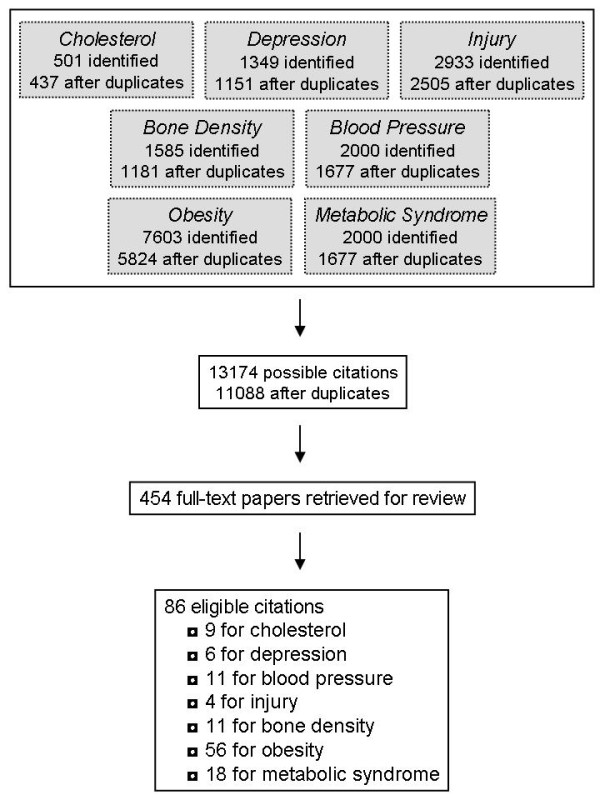
- After duplicates, 11,088 unique citations were screened; 454 full-text articles were reviewed; 86 unique citations met eligibility and 113 outcomes were abstracted. Observational studies had to report dichotomous outcomes; intervention studies were excluded if they included dietary or other behavioral components that could independently affect outcomes.
- Evidence was graded using pre-specified criteria based on quantity/quality of studies and strength of effect; meta-analyses were performed when at least 4 studies were available. RCT quality was assessed with the Downs and Black checklist, and effect sizes used Cohen’s d and ratio-score criteria.
Limitations
- Stated: unpublished and non-English studies were excluded, no extensive cross-referencing of reference lists was performed, the review was limited to 7 health outcomes, and many observational studies were excluded because they did not report dichotomous outcomes; these may have biased results and recommendations.
- Stated RCT limitations: samples were small and non-representative, statistical power was often lacking, adverse events were rarely reported, dropout details were limited, and intent-to-treat analyses were not performed; therefore Level 2 was the highest level assignable to any recommendation.
- Evident from the text: the nature of dose-response relations (linear vs curvilinear) often remained unclear, and the moderating effects of age and sex were not systematically addressed across outcomes.
Model-written summary. Check it against the paper before relying on it.
Integrity signals
Registry
Cites
Statistics
Figures
Verification
Claims the paper makes
0 Valid · 0 Not valid · 42 Not checked · 127 Own results and interpretations
A result the paper reports from its own data — it cites no other source for it, so there is none to check. The quote shows it is in the paper.
In the paper
“Results from experimental studies indicate that even modest amounts of physical activity can have health benefits in high-risk youngsters (e.g., obese).”
§ Systematic review of the health benefits of physical activity and fitness in school-aged children and youth > Abstract > Results
hedgedstates a cause- Asserted: passes — The authors put it forward as true.
- Checkable: passes — It can be checked against evidence.
- Load-bearing: passes — The paper’s conclusions depend on it.
- Based: passes — The paper gives a reason why it holds.
A result the paper reports from its own data — it cites no other source for it, so there is none to check. The quote shows it is in the paper.
In the paper
“Physical activity was associated with numerous health benefits.”
§ Systematic review of the health benefits of physical activity and fitness in school-aged children and youth > Abstract > Results
plainstates an association- Asserted: passes — The authors put it forward as true.
- Checkable: passes — It can be checked against evidence.
- Load-bearing: passes — The paper’s conclusions depend on it.
- Based: passes — The paper gives a reason why it holds.
A result the paper states — it cites no source for it, so there is none to check. The quote shows it is in the paper.
In the paper
“Aerobic-based activities had the greatest health benefit, other than for bone health, in which case high-impact weight bearing activities were required.”
§ Systematic review of the health benefits of physical activity and fitness in school-aged children and youth > Abstract > Results
plainstates an association- Asserted: passes — The authors put it forward as true.
- Checkable: passes — It can be checked against evidence.
- Load-bearing: passes — The paper’s conclusions depend on it.
- Based: passes — The paper gives a reason why it holds.
A result the paper reports from its own data — it cites no other source for it, so there is none to check. The quote shows it is in the paper.
In the paper
“The dose-response relations observed in observational studies indicate that the more physical activity, the greater the health benefit.”
§ Systematic review of the health benefits of physical activity and fitness in school-aged children and youth > Abstract > Results
hedgedstates an association- Asserted: passes — The authors put it forward as true.
- Checkable: passes — It can be checked against evidence.
- Load-bearing: passes — The paper’s conclusions depend on it.
- Based: passes — The paper gives a reason why it holds.
None of the sources cited for this claim have been checked yet.
In the paper
“The results indicated that unfit girls, defined as the lowest 20% fit, were 1.89 (95% confidence interval: 1.12-3.17) times more likely to have hypercholesterolemia and 1.03 (0.74-1.43) times more likely to have a low HDL-cholesterol by comparison to moderately and high fit girls.”
§ Systematic review of the health benefits of physical activity and fitness in school-aged children and youth > Results > Cholesterol and blood lipids
hedgedstates an associationn = 3,110- Asserted: passes — The authors put it forward as true.
- Checkable: passes — It can be checked against evidence.
- Load-bearing: passes — The paper’s conclusions depend on it.
- Based: passes — The paper gives a reason why it holds.
103 more claims
Create a free account to see all 169 claims and every source verdict.
- Probably not a substantial claim. 26
- The quote only partly states this claim. 2
- It may state two separate claims as one. 37
Claims other papers make about this one
Each is checked against this paper’s own text: does it say what the citing paper says it does?
The source backs part of the claim, not all of it — or backs it for a different population, condition or comparison.
In the citing paper
“Research indicates that those who are physically active show or report better overall physical and mental health, a higher level of fitness and a lower level of obesity than their sedentary or physically inactive counterparts1–4”
From Physical activity and health in Chinese children and adolescents: expert consensus statement (2020) (2020) · cites this paper as [2]
Experimental — accuracy not yet measuredThe cited source says what the claim attributes to it.
In the citing paper
“The association with overweight/obesity tends to be stronger when moderate to vigorous-intensity physical activities are performed.2”
From Physical activity and health in Chinese children and adolescents: expert consensus statement (2020) (2020) · cites this paper as [2]
The cited source says what the claim attributes to it.
In the citing paper
“Among physical activity interventions, the effects of physical activity independent of dietary changes on measures indicative of weight reduction (eg, BMI, total fat, abdominal fat) tend to be in the small range.2”
From Physical activity and health in Chinese children and adolescents: expert consensus statement (2020) (2020) · cites this paper as [2]
The cited source says what the claim attributes to it.
In the citing paper
“In general, as the level of physical activity increases, the likelihood of injury increases.2”
From Physical activity and health in Chinese children and adolescents: expert consensus statement (2020) (2020) · cites this paper as [2]
The cited source says what the claim attributes to it.
In the citing paper
“Systematic reviews have shown that physical activity (PA) is associated with greater mental health, 6 and a reduced risk of mental ill-health, specifically depression and anxiety.7,8”
From Domain-Specific Physical Activity and Mental Health: A Meta-analysis (2017) · cites this paper as [8]
2 more claims about this paper
Create a free account to see every claim other papers make about this one.
Self-check
Percentages, sums and reported differences re-computed from the paper’s own numbers.
Each contradiction between two passages listed here was confirmed by an independent check.
Rated major: it would touch a result — a value a result rests on, reported and recomputed p-values on opposite sides of the significance level, two passages that conflict with no sign which is right, or a cited work retracted before this paper was published.
In the paper
§ Systematic review of the health benefits of physical activity and fitness in school-aged children and youth > Discussion > Recommendations based on systematic review
“More vigorous intensity activities should be incorporated or added when possible, including activities that strengthen muscle and bone. [Level 3, Grade B].”
§ Systematic review of the health benefits of physical activity and fitness in school-aged children and youth > Discussion > Recommendations based on systematic review
“This recommendation was given a lower grade (Grade C) because of the potential increase in injury risk associated with more vigorous intensity activities and sports.”
Rated minor: it would not touch a result — a value no result rests on, a p-value that stays on the same side of the significance level, or a conflict that is clerical, resolved elsewhere in the paper, or outside its own findings.
In the paper
§ Systematic review of the health benefits of physical activity and fitness in school-aged children and youth > Results > Metabolic syndrome
“Sixteen articles examining the metabolic syndrome met the inclusion criteria.”
§ Systematic review of the health benefits of physical activity and fitness in school-aged children and youth > Results > Metabolic syndrome
“Eight of the 17 identified studies were observational in nature”
Rated minor: it would not touch a result — a value no result rests on, a p-value that stays on the same side of the significance level, or a conflict that is clerical, resolved elsewhere in the paper, or outside its own findings.
In the paper
“A total of 31 observational studies (24 cross-sectional, 3 prospective cohort, 2 case-control, 1 mixed) were retrieved”
§ Systematic review of the health benefits of physical activity and fitness in school-aged children and youth > Results > Overweight and obesity
Reported 31 · recomputed 30
Rated minor: it would not touch a result — a value no result rests on, a p-value that stays on the same side of the significance level, or a conflict that is clerical, resolved elsewhere in the paper, or outside its own findings.
In the paper
“437 citations were identified for cholesterol, 1151 for depression, 2505 for injury, 1181 for bone density, 1677 for blood pressure, 5824 for obesity, and 1677 for the metabolic syndrome. Thus, the grand total was 13174.”
§ Systematic review of the health benefits of physical activity and fitness in school-aged children and youth > Results > Literature review
Reported 13174 · recomputed 14452
Citations
Cites
Downs, S. H., & Black, N. (1998) · Journal of Epidemiology and Community Health · doi:10.1136/jech.52.6.377 · Cited by 8,252
Evidence Based Physical Activity for School-age Youth
Strong, W. B., Malina, R. M., Blimkie, C. J. R., Daniels, S. R., Dishman, R. K., Gutin, B., Hergenroeder, A. C., Must, A., Nixon, P. A., Pivarnik, J. M., et al. (2005) · The Journal of Pediatrics · doi:10.1016/j.jpeds.2005.01.055 · Cited by 4,222
Systematic Reviews: Synthesis of Best Evidence for Clinical Decisions
Cook, D. J., Mulrow, C. D., & Haynes, R. B. (1997) · Annals of Internal Medicine · doi:10.7326/0003-4819-126-5-199703010-00006 · Cited by 2,184
Andersen, L. B., Harro, M., Sardinha, L. B., Froberg, K., Ekelund, U., Brage, S., & Anderssen, S. A. (2006) · The Lancet · doi:10.1016/s0140-6736(06)69075-2 · Cited by 1,473
Lau, D. C. W., Douketis, J. D., Morrison, K. M., Hramiak, I. M., Sharma, A. M., Ur, E., & Panel, F. M. O. T. O. C. C. P. G. E. (2007) · Canadian Medical Association Journal · doi:10.1503/cmaj.061409 · Cited by 1,154
Paterson, D. H., & Warburton, D. E. (2010) · International Journal of Behavioral Nutrition and Physical Activity · doi:10.1186/1479-5868-7-38 · Cited by 953
A systematic review of the evidence for Canada's Physical Activity Guidelines for Adults
Warburton, D. E., Charlesworth, S., Ivey, A., Nettlefold, L., & Bredin, S. S. (2010) · International Journal of Behavioral Nutrition and Physical Activity · doi:10.1186/1479-5868-7-39 · Cited by 902 · cited 1×
“This report was part of a much larger project around Canada's physical activity guidelines, and comparable systematic reviews for adults [ 10 ] and older adults [11] have also been published in the journal.”
A meta-regression to examine the relationship between aerobic fitness and cognitive performance
Etnier, J. L., Nowell, P. M., Landers, D. M., & Sibley, B. A. (2006) · Brain Research Reviews · doi:10.1016/j.brainresrev.2006.01.002 · Cited by 749
Is the Canadian childhood obesity epidemic related to physical inactivity?
Tremblay, M. S., & Willms, J. D. (2003) · International Journal of Obesity · doi:10.1038/sj.ijo.0802376 · Cited by 517
Nassis, G. P., Papantakou, K., Skenderi, K., Triandafillopoulou, M., Kavouras, S. A., Yannakoulia, M., Chrousos, G. P., & Sidossis, L. S. (2005) · Metabolism · doi:10.1016/j.metabol.2005.05.013 · Cited by 469
Research works printed but not linked: 1
- Petitti DB Meta-Analysis, Decision Analysis, and Cost-Effective Analysis 1994 New York, NY: Oxford University Press
Cited by
Items 3,201–3,300 of 4,834
Sweeney, A. M., Wilson, D. K., Pate, R. R., Horn, M. L. V., McIver, K. L., & Dowda, M. C. (2021) · Journal of Behavioral Medicine · doi:10.1007/s10865-021-00213-1 · Cited by 3
Association between Sedentary Lifestyle and Quality of Life among Young Adults
Rizwan, M., Alam, M. M., Akhtar, W., Inam, F., Yaseen, F., Alam, S., & Burhan, M. (2024) · Journal of Health and Rehabilitation Research · doi:10.61919/jhrr.v4i1.491 · Cited by 3
Abrori, F. M., Lavicza, Z., & Anđić, B. (2023) · Studies in Comics · doi:10.1386/stic_00111_1 · Cited by 2
Riley, N., Leahy, A. A., Eather, N., Verswijveren, S. J. J. M., & Lander, N. (2025) · Pilot and Feasibility Studies · doi:10.21203/rs.3.rs-3714149/v1 · Cited by 7
Social determinants of health and youth sports
Coleman, N. J., & Callender, S. S. (2023) · Elsevier eBooks · doi:10.1016/b978-0-323-99992-2.00077-3 · Cited by 2
Younus, A. Q. (2021) · Annals of the Romanian Society for Cell Biology · Cited by 2
Roditeljski pritisak i kvaliteta života mladih sportaša
Glibo, I., & Barić, R. (2017) · Hrvatska revija za rehabilitacijska istraživanja · doi:10.31299/hrri.53.1.1 · Cited by 2
Hermida, C., Chillón, P., Andrade, J., Barranco-Ruíz, Y., Campos-Garzón, P., Palma-Leal, X., Quezada, A., Villa‐González, E., Orellana, D., & Huertas-Delgado, F. J. (2024) · International Journal of Environmental Health Research · doi:10.1080/09603123.2024.2358478 · Cited by 2
“…for children who actively commute to school, such as a higher cardiorespiratory fitness (Hsieh et al. 2014), lower rates of overweight and obesity (Janssen and Leblanc 2010), improved academic achievement (Bunketorp Käll et al. 2015), and a better mental health status, self-esteem and…”
Cho, D., & Lee, J. (2021) · Current Psychology · doi:10.1007/s12144-020-01265-3 · Cited by 6
Santos, J., Petrica, J., Serrano, J., Batista, M., Honório, S., Lercas, A. J., & Maia, L. A. C. R. (2020) · Retos · doi:10.47197/retos.v37i37.71533 · Cited by 9
Sport participation in Scotland: quantifying the benefits
Davies, L. E. (2019) · SHURA (Sheffield Hallam University Research Archive) (Sheffield Hallam University) · Cited by 2
Frazer, H., & Giles, A. R. (2023) · International Journal of Circumpolar Health · doi:10.1080/22423982.2023.2276983 · Cited by 5
“Youth involvement in sport and traditional games has been linked to numerous physical and psychosocial benefits Janssen and LeBlanc [18] found that Canadian school-aged children and youth (aged 5–17 years old) experienced reduced obesity risk, improved metabolic profiles, and increased muscular…”
BackgroundImpact of Attitude Towards Physical Activity and Exercise on Academic Performance of School Students
Iqbal, Y., Habib, M. B., & Adeeb, M. A. (2020) · THE SKY-International Journal of Physical Education and Sports Sciences (IJPESS) · doi:10.51846/the-sky.v4i1.819 · Cited by 3
Effects of Extra-curricular Physical Activity Programs on High-school Girls: A Systematic ReviewPreprint
Houle, L.-M., Gilbert, J., Paiement, K., Ayotte, A., & Mathieu, M.-E. (2020) · medRxiv · doi:10.1101/2020.04.25.20079780 · Cited by 3
Ataxia - Practice Essentials and Interventions
Ambrosi, P. B. (2023) · IntechOpen eBooks · doi:10.5772/intechopen.104147 · Cited by 2
Kain, J., Ortega, A., Garmendia, M. L., Corvalán, C., Marambio, P., Rojas, J., Muñoz, C., & Leyton, B. D. (2020) · Health Education & Behavior · doi:10.1177/1090198120912189 · Cited by 3
Lisowski, P., Kantanista, A., & Bronikowski, M. (2022) · Children · doi:10.3390/children9060882 · Cited by 4
Physical Activity Predicts Better Lung Function in Children and Adolescents
Balbinot, F., & Gerbase, M. W. (2024) · Pediatric Exercise Science · doi:10.1123/pes.2024-0034 · Cited by 4
Connelly, G. H. (2010) · QSpace (Queen's University Library) · Cited by 3
Thorén, A.-K. H., & Nordbø, E. C. A. (2020) · Plan · doi:10.18261/issn1504-3045-2020-02-05 · Cited by 2
Reynolds, K. A., Haycraft, E., & Plateau, C. R. (2024) · International Journal of Adolescence and Youth · doi:10.1080/02673843.2024.2371397 · Cited by 2
“Physical activity has many health benefits, such as supporting cardio-metabolic and bone health, and enhancing mental wellbeing and body satisfaction (e.g. Biddle & Asare, 2011; Fernández-Bustos et al., 2019; Janssen & LeBlanc, 2010).”
Slimi, O., Souissi, M. A., Marsigliante, S., Bădicu, G., Vveinhardt, J., & Muscella, A. (2025) · Children · doi:10.3390/children12091262 · Cited by 3
“Our results are in line with previous studies that have shown that personalized and motivating physical activity programs allow for more effective weight regulation in adolescents with overweight or obesity [62–65].”
Healthy life years at age 65, European countries, 2015 (or nearest year)
(2017) · Health at a glance · doi:10.1787/health_glance-2017-graph191-en · Cited by 2
Wang, Q., Lam, L. T.-M., Lin, H., Yang, W., Ying, F., & Li, Y. (2025) · Frontiers in Public Health · doi:10.3389/fpubh.2025.1611496 · Cited by 4
To, Q. G., Gallegos, D., Dung, D. V., et al. (2019) · Sports Medicine and Health Science · doi:10.1016/j.smhs.2019.08.001 · Cited by 2
Heart rate as an indicator for exercise prescription for normal, overweight, and obese adolescents
Gomes, K. B., Perez, A. J., Carletti, L., & Marques, A. (2016) · Motriz Revista de Educação Física · doi:10.1590/s1980-6574201600020004 · Cited by 5
Rathod, V. J. (2021) · Archives of Medicine and Health Sciences · doi:10.4103/amhs.amhs_257_20 · Cited by 2
Rodrigues, D., Machado‐Rodrigues, A. M., Gama, A., Silva, R., Nogueira, H. G. D. S. M., & Padez, C. M. P. (2023) · American Journal of Human Biology · doi:10.1002/ajhb.23902 · Cited by 3
Tilga, H., Kalajas-Tilga, H., Hein, V., & Koka, A. (2023) · PsyArXiv (OSF Preprints) · doi:10.31234/osf.io/uy9sm · Cited by 3
Comparison of Measured and Observed Exercise Fidelity during a Neuromuscular Training Warm-Up
Benson, L. C., Räisänen, A. M., Sidhu, S. S., & Emery, C. A. (2022) · Biomechanics · doi:10.3390/biomechanics2030029 · Cited by 2
Yamakita, M., Ando, D., Sugita, H., Akiyama, Y., Sato, M., Yokomichi, H., Yamaguchi, K., & Yamagata, Z. (2021) · International Journal of Environmental Research and Public Health · doi:10.3390/ijerph18073351 · Cited by 2
DIET AND PHYSICAL ACTIVITY AS A UNIVERSAL FOUNDATION FOR CHILDHOOD DEVELOPMENT AND LIFELONG HEALTH
Leitão, R. (2018) · Society Register · doi:10.14746/sr.2018.2.2.07 · Cited by 3
Physical Activity Participation among Adolescent Boys with Autism Spectrum Disorder
Jachyra, P. (2020) · TSpace (University of Toronto) · doi:10.13140/rg.2.2.29816.81920 · Cited by 5
Subjective School Experience and Well-Being during the COVID-19 Pandemic
Fernandez-Urbano, R., Salza, G., & Samuel, R. (2025) · Journal of Happiness Studies · doi:10.1007/s10902-024-00839-3 · Cited by 3
“In contrast, pro - social peer interactions (Martin & Huebner, 2007 ), a healthy diet (Piko, 2006 ), and regular physical exercise (Mangerud et al., 2014 ; Janssen & LeBlanc, 2010 ) have been positively linked with subjective well-being.”
Health experience outcomes of a health promotion project for middle school pupils in Sweden
Lindström, P. N., Khalaf, A., & Bringsén, Å. (2021) · Children & Society · doi:10.1111/chso.12484 · Cited by 4
Coppola, A. M., Hancock, D. J., Allan, V., Vierimaa, M., & Côté, J. (2018) · Qualitative Research in Sport Exercise and Health · doi:10.1080/2159676x.2018.1445660 · Cited by 5
Consumption of vegetables, fruits, physical activity, and sedentary behaviors in Thai adolescents
Eiamudomkan, M., Sirirassamee, T., & Sirirassamee, B. (2014) · Journal of Medicine and Health Sciences · Cited by 3
Kebugaran Jasmani Siswa Pria SMAN 1 Lubuk Sikaping Kabupaten Pasaman
Hadi, F. W., Aziz, I., Adnan, A., & Mariati, S. (2023) · JOLMA · doi:10.31851/jolma.v3i1.11848 · Cited by 1
Física), G. D. I. E. (. F. Y. P. D. L. A., & Abarca-Sos, A. (2022) · Universidad de Zaragoza eBooks · doi:10.26754/uz.978-84-18321-37-5 · Cited by 6
Ahmad, N., Hasan, S., Goel, R. K., & Chaudhary, L. (2016) · International Journal of Research in Medical Sciences · doi:10.18203/2320-6012.ijrms20161777 · Cited by 3
Bustos, J. G. F., Cuesta-Valera, P., & Zamorano-García, D. (2024) · Journal of Physical Education Recreation & Dance · doi:10.1080/07303084.2024.2308247 · Cited by 2
“…of physical activity (PA) in the different health dimensions (physical, cognitive, social; Álvarez-Bueno et al., 2017; Fitzgerald et al., 2012; Janssen & LeBlanc, 2010), together with increasingly sedentary lifestyles and the prevalence of obesity (Guthold et al., 2020), as well as the rise…”
BackgroundQi, J., Xu, W., Wang, L., et al. (2020) · Journal of Visual Impairment & Blindness · doi:10.1177/0145482x20954005 · Cited by 2
Larsen, K. (2015) · TSpace (University of Toronto) · Cited by 4
Lahti, A., Rosengren, B. E., Dencker, M., Nilsson, J., & Karlsson, M. K. (2019) · BMJ Open Sport & Exercise Medicine · doi:10.1136/bmjsem-2019-000597 · Cited by 3
Ha, A. S. C., Cheng, J. S.-C., Chan, C. H. S., Jiang, G., Yang, Y., & Ng, J. Y. Y. (2022) · BMJ Open · doi:10.1136/bmjopen-2021-060448 · Cited by 3
Tambalis, K. D., Arnaoutis, G., & Sidossis, L. S. (2022) · European Journal of Physical Education and Sport Science · doi:10.46827/ejpe.v7i6.4116 · Cited by 3
Adapted Physical Education in the Special Education Process
McNamara, S. W. T., & Pan, C. (2021) · IGI Global eBooks · doi:10.4018/978-1-6684-3670-7.ch010 · Cited by 2
Radisavljević-Janić, S., Lazarević, L. B., Lazarevic, D. A., & Milanović, I. (2020) · Fizicka kultura · doi:10.5937/fizkul2002000r · Cited by 3
Hälsofrämjande äventyr med naturen som distraktion
Mårtensson, F. (2012) · Socialmedicinsk tidskrift · doi:10.62607/smt.v89i3.43520 · Cited by 2
Schmidt, S., Sell, S., & Wöll, A. (2022) · Interactive Journal of Medical Research · doi:10.2196/25886 · Cited by 3
Dou, L., Chen, H., Xia, Y., & Lu, E. (2025) · Frontiers in Public Health · doi:10.3389/fpubh.2025.1566561 · Cited by 3
“Physical activity (PA) is associated with well-documented benefits for physical, social, and mental health (1) such as altering body composition, enhancing cardiovascular function, lowering blood pressure, and alleviating symptoms of depression, anxiety, and poor self-concept (2).”
Path preference analysis of youth physical health policy tools
Wang, M., Yang, K., Zhang, L., Wang, J., & Zheng, Y. (2025) · BMC Public Health · doi:10.1186/s12889-025-25384-3 · Cited by 2
“Academic pressures, spatial constraints associated with urbanization, limited participation in sports, and weak enforcement of existing policies may impede improvements in youth health outcomes [9, 10].”
Merrigan, J. J., Gallo, S., Fields, J. B., Mehlenbeck, R., & Jones, M. T. (2020) · International journal of exercise science · doi:10.70252/koni3658 · Cited by 3
Kennedy, S. G., Murray, S., Guagliano, J. M., Lloyd, R. S., Lubans, D. R., Smith, J., Eather, N., & Bennie, A. (2024) · International Journal of Sports Science & Coaching · doi:10.1177/17479541241295289 · Cited by 5
DANCE CONTRIBUTION TO IMPROVING PHYSICAL ACTIVITY AND HEALTH
Svobodová, L. (2017) · Cited by 2
School Travel Planning in Canada: A Holistic Examination of Program Impact on Active School Travel
Mammen, G. (2016) · TSpace (University of Toronto) · Cited by 7
Identification of School Physical Activity Leader Competencies Using Concept Mapping
Illg, K. M. (2014) · The Research Repository @ WVU (West Virginia University) · doi:10.33915/etd.267 · Cited by 2
Giles, L., Pearson, N., Lamont, H., Grady, A., & Yoong, S. L. (2024) · Health Promotion Journal of Australia · doi:10.1002/hpja.920 · Cited by 2
A new view on the quality of Jacík's test
Cuberek, R., Jakubec, A., Hůlka, K., et al. (2012) · Acta Gymnica · doi:10.5507/ag.2012.010 · Cited by 2
Beneficis de l'activitat física per a la salut en la infància i l'adolescència
Mónaco, M., Moya, J. C. S., Violán, M., Schack, M., & Terrades, M. C. (2013) · Pediatria catalana: butlletí de la Societat Catalana de Pediatria · Cited by 4
Sport socialisation and the role of the school
Pot, J. N. (2014) · Digital Academic REpository of VU University Amsterdam (Vrije Universiteit Amsterdam) · Cited by 4
Causal Impact of Physical Activity on Child Health and DevelopmentPreprint
Nguyen, H. T., Christian, H. E., Le, H., Connelly, L. B., Zubrick, S. R., & Mitrou, F. (2022) · SSRN Electronic Journal · doi:10.2139/ssrn.4131017 · Cited by 2
Vitale, F. M., Wieprecht, J., Baethmann, M., Gomes, D., Tengler, A., Riley, R., Shamas, S., Müller, M., Mandilaras, G., Manai, S. K., et al. (2025) · Children · doi:10.3390/children12080993 · Cited by 4
“It has been consistently shown that lower levels of physical activity correlate notably with overweight and obesity, but also with higher markers of CVD, such as higher blood pressure, higher levels of cholesterol, and lower levels of high-density lipoprotein cholesterol [30,31].”
Ruf, K., Badran, A., Siauw, C., Haubitz, I., Schlegel, P., Hebestreit, H. U., Härtel, C., & Wiegering, V. A. (2021) · Molecular and Cellular Pediatrics · doi:10.1186/s40348-021-00127-7 · Cited by 2
Jagomast, T., Mohr, T., Axt, P. N., Mortensen, K., Brinkmann, F., Weckmann, M., Ring, G., Reppel, M., Drömann, D., & Franzen, K. F. (2023) · Journal of Functional Morphology and Kinesiology · doi:10.3390/jfmk8030101 · Cited by 6
Hartikainen, J., Haapala, E. A., Sääkslahti, A., Poikkeus, A., & Finni, T. J. (2022) · International Journal of Environmental Research and Public Health · doi:10.3390/ijerph19138185 · Cited by 4
Tiemann, M. (2021) · Springer Reference Pflege, Therapie, Gesundheit · doi:10.1007/978-3-662-62426-5_76 · Cited by 3
Cortés, J. A. G., Villalva-Sánchez, Á. F., & Bernal, J. (2015) · Anuario de Psicología/The UB Journal of Psychology · Cited by 6
Stoepker, P., Biber, D., & McMullen, J. M. (2023) · Journal of Teaching in Physical Education · doi:10.1123/jtpe.2022-0240 · Cited by 2
Mo, X., & Zhao, W. (2025) · Frontiers in Psychology · doi:10.3389/fpsyg.2025.1614888 · Cited by 3
Rola rodziców we wspieraniu nastoletnich dzieci w podejmowaniu aktywności fizycznej
Tabak, I. (2015) · Pediatria Polska · doi:10.1016/j.pepo.2015.11.002 · Cited by 2
An exploration of young children's motivational processes within physical education
Fitton Davies, K. (2021) · Liverpool John Moores University · doi:10.24377/ljmu.t.00014409 · Cited by 4
Exercise by playing active video gaming in overweight and obese children.
Huang, H.-H., Cook, L., Harrison, J., et al. (2017) · doi:10.35841/physical-therapy.1000107 · Cited by 2
Impact of the COVID-19 lockdown in the United Kingdom on adolescent’s time use (CONTRAST study)
Pokhilenko, I., Frew, E., Murphy, M., & Pallan, M. (2025) · PLOS ONE · doi:10.1371/journal.pone.0310597 · Cited by 2
de Oliveira, N. M., Iniesta, R. R., Vlachopoulos, D., BARKER, A. R., Matias, C. N., Gonçalves, E. M., Haapala, E. A., & Lakka, T. A. (2025) · Nutrition · doi:10.1016/j.nut.2025.113035 · Cited by 3
Narciso, P. H., Morano, A. E. V. A., Agostinete, R. R., Werneck, A. O., Giannopoulos, A. J., Bell, M., Antunes, B. M., Lira, F. S., Fernandes, R. A., & Klentrou, P. (2025) · European Journal of Applied Physiology · doi:10.1007/s00421-025-05851-w · Cited by 4
“…low-grade inflammation and cardiometabolic risk factors, such as metabolic syndrome and overweight/obesity, as well as future chronic diseases, such as cardiovascular disease and osteoporosis later in life (Janssen and Leblanc 2010; Hen-son et al. 2013; Werneck et al. 2020; Perry et al. 2023).”
How Does Physical Activity Affect the Quality of Life of University Students
Gür, F., & Ayan, V. (2024) · İnternational Journal of Contemporary Educational Studies(IntJCES) · doi:10.61087/intjces.2025.18 · Cited by 3
Energy Expenditure Calculation with Physical Activity Recognition Using Genetic Algorithms
Anand, Y., & Joby, P. P. (2019) · Lecture notes in computational vision and biomechanics · doi:10.1007/978-3-030-00665-5_52 · Cited by 2
Alghadier, M., Basuodan, R., Gmmash, A., & Albesher, R. A. (2025) · Life · doi:10.3390/life15010091 · Cited by 2
“Promoting physical fitness early in life is critical to sustaining an active lifestyle and preventing adverse health outcomes [8,9].”
Renko, E., Knittle, K. P., Palsola, M., et al. (2019) · doi:10.31219/osf.io/e24dc · Cited by 2
Burford, K., Salvo, D., Kohl, H. W., Ganzar, L. A., Bauer, C., Reséndiz, E., Zhang, Y., & Hoelscher, D. M. (2025) · Journal of Physical Activity and Health · doi:10.1123/jpah.2025-0010 · Cited by 2
Lousen, I., Johnstone, A., Schipperijn, J., Traynor, O., McCrorie, P., & Pawlowski, C. S. (2025) · Mental Health & Prevention · doi:10.1016/j.mhp.2025.200460 · Cited by 6
Polet, J. J., Lintunen, T., Schneider, J., et al. (2020) · doi:10.31219/osf.io/y2rfj · Cited by 2
Tiemann, M. (2020) · Springer Reference Pflege, Therapie, Gesundheit · doi:10.1007/978-3-662-55793-8_76-1 · Cited by 2
Matteucci, I., & Corsi, M. (2024) · Scientific Reports · doi:10.1038/s41598-024-60548-y · Cited by 5
Tani, G. (2021) · Revista Brasileira de Educação Física e Esporte · doi:10.11606/issn.1981-4690.v35i4p239-250 · Cited by 10
Questionnaire development and validation for adolescent social media sports content production
Du, M., & Wang, X. (2025) · Scientific Reports · doi:10.1038/s41598-025-29737-1 · Cited by 2
Xie, Q., Fan, X. L., Wang, X., Peng, X. H., Zhang, Y., & Zhang, W. (2026) · Cities · doi:10.1016/j.cities.2026.106971 · Cited by 3
LEVEL OF PHYSICAL ACTIVITY IN ELDERLY POPULATION OF RAWALPINDI- ISLAMABAD
Pakistan, L. F. R. R., Sohail, R., Bhutta, A. H., Asif, N., & Ain, Q. U. (2018) · The Rehabilitation Journal · doi:10.52567/trj.v2i02.30 · Cited by 2
Miñano, M. J. C., García, E. F., Rico, E. R., & Ángel, J. B. (2013) · Cited by 5
Multicultural Intersection With Disabilities
Brown, S. L., Schiro‐Geist, C., Krolik, P., Cai, J., Tippireddy, J. R., Davis, A. L., White, J. M., & Nandiki, S. (2023) · Advances in psychology, mental health, and behavioral studies (APMHBS) book series · doi:10.4018/978-1-6684-6155-6.ch005 · Cited by 2
Aslam, S., & Bin, S. Y. (2025) · Frontiers in Sports and Active Living · doi:10.3389/fspor.2025.1518884 · Cited by 6
Parchem, B., Poquiz, J. L., Rahm-Knigge, R. L., et al. (2024) · Clinical Practice in Pediatric Psychology · doi:10.1037/cpp0000518 · Cited by 2
Pasno, A. (2024) · Sportis Scientific Journal of School Sport Physical Education and Psychomotricity · doi:10.17979/sportis.2024.10.3.11083 · Cited by 3
“Numerous studies suggest that regular physical activity for school-aged children is a good way to establish benefits for physical health (Janssen et al., 2010).”
BackgroundGroup dynamics and mental health in organized youth sports
Vella, S. A., Liddle, S. K., Vierimaa, M., & Evans, M. B. (2020) · Elsevier eBooks · doi:10.1016/b978-0-12-816336-8.00016-0 · Cited by 2
Health expenditure in relation to GDP
OECD (2017) · Health at a glance · doi:10.1787/health_glance-2017-45-en · Cited by 2
Investigating the Impact of Food Rewards on Children’s Motivation to Participate in Sport
Shwed, A., Bruner, B., Law, B., & Bruner, M. W. (2023) · Children · doi:10.3390/children10030432 · Cited by 4
Moon, R. C., Cunningham, S. A., & Gazmararian, J. A. (2020) · Journal of School Health · doi:10.1111/josh.12936 · Cited by 3
Life expectancy by sex and education level
OECD (2017) · Health at a glance · doi:10.1787/health_glance-2017-7-en · Cited by 7
School-based physical activity and good practices in Europe
Castro, L. S. N., Svastisalee, C., Mendes, R., Fontaine, O., & Breda, J. (2019) · Health Problems of Civilization · doi:10.5114/hpc.2018.80226 · Cited by 2
Metadata
- Authors
- Janssen, I., & LeBlanc, A. G.
- Affiliations
- Queen's University (CA)
- Corresponding author
- Janssen, Ian
- Venue
- International Journal of Behavioral Nutrition and Physical Activity
- Published
- 2010
- Volume
- 7
- Issue
- 1
- Pages
- 40
- ISSN
- 1479-5868 (ISSN-L)
- PMC
- PMC2885312
- OpenAlex
- W2145702257
- Semantic Scholar
- ef8d55efd11b9d5e4a4814b6a38ff3d60d820d37
- Cited by
- 4,829
- References
- 116
- Citations by year
- 2026: 185 · 2025: 257 · 2024: 310 · 2023: 304 · 2022: 371 · 2021: 451 · 2020: 459 · 2019: 401 · 2018: 387 · 2017: 490 · 2016: 302 · 2015: 280 · 2014: 250 · 2013: 191 · 2012: 109
- FWCI
- 12.18
- Type
- journal article
- Language
- en
- Open access
- gold
- doi.org
- Licence
- cc-by
- Locations
- International Journal of Behavioral Nutrition and Physical Activity (publishedVersion, cc-by)
- PubMed Central (publishedVersion, cc-by)
- PubMed (publishedVersion)
- DOAJ (DOAJ: Directory of Open Access Journals) (submittedVersion, cc-by-sa)
- Funders
- Public Health Agency of Canada
- Public Health Agency
- Topics
- Health Sciences › Medicine › Public Health, Environmental and Occupational Health › Physical Activity and Health
- Health Sciences › Medicine › Public Health, Environmental and Occupational Health › Obesity, Physical Activity, Diet
- Social Sciences › Life-span and Life-course Studies › Recreational Sport and Physical Activity
- Keywords
- physical activity, physical fitness, school-aged children, youth, health benefits, serum cholesterol, blood pressure, metabolic syndrome, childhood obesity, bone mineral density, depression, injuries, dose-response relationship, aerobic exercise, physical activity guidelines
About these checks
Registry, retraction, Cites and statistics results are computed, not judged, with one exception: a printed reference that no index lists is read once by a model before it counts as a citation error. Claims are extracted by a model and kept only when their quote appears verbatim in the text; each cited source is then checked, with a model’s help, for whether it says what the claim relies on. Those verdicts can be wrong — read the claim’s quote and the cited source before relying on one.
A language model drew the claims from the paper on 2026-10-10, under version 3 of the claim definition (model deepseek-v4.1-flash, prompt extract-v3).
A second model labelled each claim on 2026-10-10 (model jev-1.13-20260917, definition revision gold-guideline-v0.2).
Statistics and arithmetic are recomputed, not judged.
Confidence bands are shown only for fields calibrated on our annotated test set. None is calibrated yet, so no band is shown.
What counts as a claim ›How we measure confidence ›How we check this ›
Are you an author, or do you see a problem with this page? Request a review
Data sources
Bibliographic data: Semantic Scholar, OpenAlex, Crossref.
Contains information from the Semantic Scholar Academic Graph Datasets, made available under the ODC Attribution License (ODC-BY 1.0).
Semantic Scholar’s data is described in: Kinney, R., et al. (2023). The Semantic Scholar Open Data Platform. arXiv:2301.10140.
