

Systematic review of the health benefits of physical activity and fitness in school-aged children and youth
Open accessThe DOI matches its Crossref record; 114 of the 116 references it cites were found in a registry or an index; none of the 128 sources its claims cite is checked for support yet.
Abstract
BACKGROUND: The purpose was to: 1) perform a systematic review of studies examining the relation between physical activity, fitness, and health in school-aged children and youth, and 2) make recommendations based on the findings. METHODS: The systematic review was limited to 7 health indicators: high blood cholesterol, high blood pressure, the metabolic syndrome, obesity, low bone density, depression, and injuries. Literature searches were conducted using predefined keywords in 6 key databases. A total of 11,088 potential papers were identified. The abstracts and full-text articles of potentially relevant papers were screened to determine eligibility. Data was abstracted for 113 outcomes from the 86 eligible papers. The evidence was graded for each health outcome using established criteria based on the quantity and quality of studies and strength of effect. The volume, intensity, and type of physical activity were considered. RESULTS: Physical activity was associated with numerous health benefits. The dose-response relations observed in observational studies indicate that the more physical activity, the greater the health benefit. Results from experimental studies indicate that even modest amounts of physical activity can have health benefits in high-risk youngsters (e.g., obese). To achieve substantive health benefits, the physical activity should be of at least a moderate intensity. Vigorous intensity activities may provide even greater benefit. Aerobic-based activities had the greatest health benefit, other than for bone health, in which case high-impact weight bearing activities were required. CONCLUSION: The following recommendations were made: 1) Children and youth 5-17 years of age should accumulate an average of at least 60 minutes per day and up to several hours of at least moderate intensity physical activity. Some of the health benefits can be achieved through an average of 30 minutes per day. [Level 2, Grade A]. 2) More vigorous intensity activities should be incorporated or added when possible, including activities that strengthen muscle and bone [Level 3, Grade B]. 3) Aerobic activities should make up the majority of the physical activity. Muscle and bone strengthening activities should be incorporated on at least 3 days of the week [Level 2, Grade A].
Overview
CoChat Summary
TL;DR
This systematic review found physical activity is associated with numerous health benefits in school-aged children and youth, with observational dose-response evidence suggesting more activity yields greater benefit. It recommends an average of at least 60 minutes per day of at least moderate activity, with some benefits achievable at 30 minutes per day, plus added vigorous and muscle/bone-strengthening activities.
Key findings
- From 11,088 unique citations, 86 eligible papers yielded 113 outcomes across 7 health indicators. Physical activity was associated with benefits; observational studies showed dose-response relations, and experimental studies indicated even modest activity can benefit high-risk youngsters (e.g., obese).
- Metabolic syndrome: summary odds ratio for least active vs most active was 1.68 (95% CI 1.22–2.31) in 3 self-report studies; least fit vs most fit was 6.79 (95% CI 5.11–9.03) in 4 fitness studies. Obesity: median odds ratio was 1.33 for self-reported activity and 3.79 for objective measures. Cholesterol: unfit girls were 1.89 (1.12–3.17) times and unfit boys 3.68 (2.55–5.31) times more likely to have hypercholesterolemia than moderately/high fit peers.
- Recommendations: children and youth 5–17 years should accumulate an average of at least 60 minutes per day and up to several hours of at least moderate intensity activity; some health benefits can be achieved through an average of 30 minutes per day [Level 2, Grade A]. More vigorous activities should be incorporated when possible, including muscle- and bone-strengthening activities [Level 3, Grade B]; aerobic activities should make up the majority, with muscle and bone strengthening on at least 3 days per week [Level 2, Grade A].
- Bone: as little as 10 minutes of moderate-to-high impact activities on as little as 2 or 3 days per week can have a modest effect on bone mineral density when combined with general weight-bearing aerobic activities. Injuries: all 3 included studies reported higher injury rates in active children/youth and clear dose-response relations; vigorous sports risk estimates were high.
Methods
- Systematic review limited to 7 health indicators: high blood cholesterol, high blood pressure, metabolic syndrome, obesity, low bone density, depression, and injuries. Searches used predefined keywords in 6 databases (MEDLINE, EMBASE, CINAHL, PsycINFO, Evidence-Based Medicine Reviews, SPORTDiscus) to January 2008, limited to human participants, English language, and ages 5–17 years.
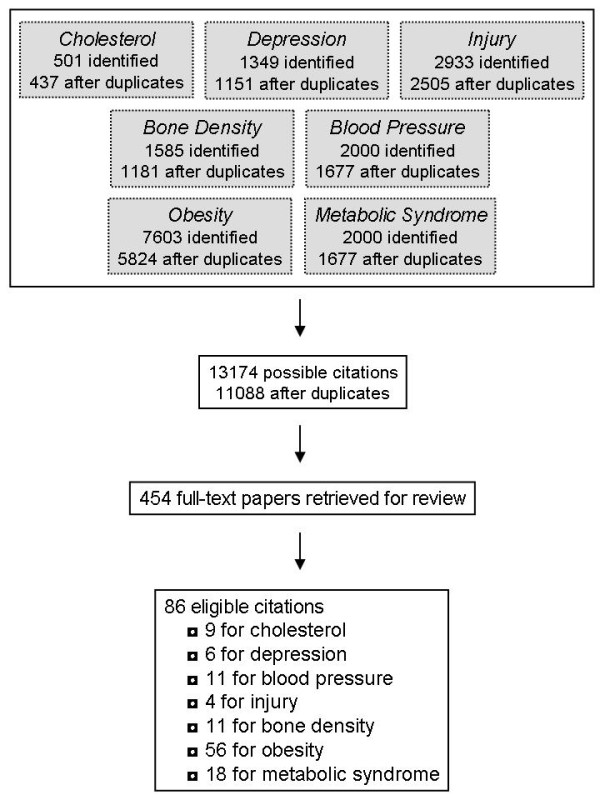
- After duplicates, 11,088 unique citations were screened; 454 full-text articles were reviewed; 86 unique citations met eligibility and 113 outcomes were abstracted. Observational studies had to report dichotomous outcomes; intervention studies were excluded if they included dietary or other behavioral components that could independently affect outcomes.
- Evidence was graded using pre-specified criteria based on quantity/quality of studies and strength of effect; meta-analyses were performed when at least 4 studies were available. RCT quality was assessed with the Downs and Black checklist, and effect sizes used Cohen’s d and ratio-score criteria.
Limitations
- Stated: unpublished and non-English studies were excluded, no extensive cross-referencing of reference lists was performed, the review was limited to 7 health outcomes, and many observational studies were excluded because they did not report dichotomous outcomes; these may have biased results and recommendations.
- Stated RCT limitations: samples were small and non-representative, statistical power was often lacking, adverse events were rarely reported, dropout details were limited, and intent-to-treat analyses were not performed; therefore Level 2 was the highest level assignable to any recommendation.
- Evident from the text: the nature of dose-response relations (linear vs curvilinear) often remained unclear, and the moderating effects of age and sex were not systematically addressed across outcomes.
Model-written summary. Check it against the paper before relying on it.
Integrity signals
Registry
Cites
Statistics
Figures
Verification
Claims the paper makes
0 Valid · 0 Not valid · 42 Not checked · 127 Own results and interpretations
A result the paper reports from its own data — it cites no other source for it, so there is none to check. The quote shows it is in the paper.
In the paper
“Results from experimental studies indicate that even modest amounts of physical activity can have health benefits in high-risk youngsters (e.g., obese).”
§ Systematic review of the health benefits of physical activity and fitness in school-aged children and youth > Abstract > Results
hedgedstates a cause- Asserted: passes — The authors put it forward as true.
- Checkable: passes — It can be checked against evidence.
- Load-bearing: passes — The paper’s conclusions depend on it.
- Based: passes — The paper gives a reason why it holds.
A result the paper reports from its own data — it cites no other source for it, so there is none to check. The quote shows it is in the paper.
In the paper
“Physical activity was associated with numerous health benefits.”
§ Systematic review of the health benefits of physical activity and fitness in school-aged children and youth > Abstract > Results
plainstates an association- Asserted: passes — The authors put it forward as true.
- Checkable: passes — It can be checked against evidence.
- Load-bearing: passes — The paper’s conclusions depend on it.
- Based: passes — The paper gives a reason why it holds.
A result the paper states — it cites no source for it, so there is none to check. The quote shows it is in the paper.
In the paper
“Aerobic-based activities had the greatest health benefit, other than for bone health, in which case high-impact weight bearing activities were required.”
§ Systematic review of the health benefits of physical activity and fitness in school-aged children and youth > Abstract > Results
plainstates an association- Asserted: passes — The authors put it forward as true.
- Checkable: passes — It can be checked against evidence.
- Load-bearing: passes — The paper’s conclusions depend on it.
- Based: passes — The paper gives a reason why it holds.
A result the paper reports from its own data — it cites no other source for it, so there is none to check. The quote shows it is in the paper.
In the paper
“The dose-response relations observed in observational studies indicate that the more physical activity, the greater the health benefit.”
§ Systematic review of the health benefits of physical activity and fitness in school-aged children and youth > Abstract > Results
hedgedstates an association- Asserted: passes — The authors put it forward as true.
- Checkable: passes — It can be checked against evidence.
- Load-bearing: passes — The paper’s conclusions depend on it.
- Based: passes — The paper gives a reason why it holds.
None of the sources cited for this claim have been checked yet.
In the paper
“The results indicated that unfit girls, defined as the lowest 20% fit, were 1.89 (95% confidence interval: 1.12-3.17) times more likely to have hypercholesterolemia and 1.03 (0.74-1.43) times more likely to have a low HDL-cholesterol by comparison to moderately and high fit girls.”
§ Systematic review of the health benefits of physical activity and fitness in school-aged children and youth > Results > Cholesterol and blood lipids
hedgedstates an associationn = 3,110- Asserted: passes — The authors put it forward as true.
- Checkable: passes — It can be checked against evidence.
- Load-bearing: passes — The paper’s conclusions depend on it.
- Based: passes — The paper gives a reason why it holds.
103 more claims
Create a free account to see all 169 claims and every source verdict.
- Probably not a substantial claim. 26
- The quote only partly states this claim. 2
- It may state two separate claims as one. 37
Claims other papers make about this one
Each is checked against this paper’s own text: does it say what the citing paper says it does?
The source backs part of the claim, not all of it — or backs it for a different population, condition or comparison.
In the citing paper
“Research indicates that those who are physically active show or report better overall physical and mental health, a higher level of fitness and a lower level of obesity than their sedentary or physically inactive counterparts1–4”
From Physical activity and health in Chinese children and adolescents: expert consensus statement (2020) (2020) · cites this paper as [2]
Experimental — accuracy not yet measuredThe cited source says what the claim attributes to it.
In the citing paper
“The association with overweight/obesity tends to be stronger when moderate to vigorous-intensity physical activities are performed.2”
From Physical activity and health in Chinese children and adolescents: expert consensus statement (2020) (2020) · cites this paper as [2]
The cited source says what the claim attributes to it.
In the citing paper
“Among physical activity interventions, the effects of physical activity independent of dietary changes on measures indicative of weight reduction (eg, BMI, total fat, abdominal fat) tend to be in the small range.2”
From Physical activity and health in Chinese children and adolescents: expert consensus statement (2020) (2020) · cites this paper as [2]
The cited source says what the claim attributes to it.
In the citing paper
“In general, as the level of physical activity increases, the likelihood of injury increases.2”
From Physical activity and health in Chinese children and adolescents: expert consensus statement (2020) (2020) · cites this paper as [2]
The cited source says what the claim attributes to it.
In the citing paper
“Systematic reviews have shown that physical activity (PA) is associated with greater mental health, 6 and a reduced risk of mental ill-health, specifically depression and anxiety.7,8”
From Domain-Specific Physical Activity and Mental Health: A Meta-analysis (2017) · cites this paper as [8]
2 more claims about this paper
Create a free account to see every claim other papers make about this one.
Self-check
Percentages, sums and reported differences re-computed from the paper’s own numbers.
Each contradiction between two passages listed here was confirmed by an independent check.
Rated major: it would touch a result — a value a result rests on, reported and recomputed p-values on opposite sides of the significance level, two passages that conflict with no sign which is right, or a cited work retracted before this paper was published.
In the paper
§ Systematic review of the health benefits of physical activity and fitness in school-aged children and youth > Discussion > Recommendations based on systematic review
“More vigorous intensity activities should be incorporated or added when possible, including activities that strengthen muscle and bone. [Level 3, Grade B].”
§ Systematic review of the health benefits of physical activity and fitness in school-aged children and youth > Discussion > Recommendations based on systematic review
“This recommendation was given a lower grade (Grade C) because of the potential increase in injury risk associated with more vigorous intensity activities and sports.”
Rated minor: it would not touch a result — a value no result rests on, a p-value that stays on the same side of the significance level, or a conflict that is clerical, resolved elsewhere in the paper, or outside its own findings.
In the paper
§ Systematic review of the health benefits of physical activity and fitness in school-aged children and youth > Results > Metabolic syndrome
“Sixteen articles examining the metabolic syndrome met the inclusion criteria.”
§ Systematic review of the health benefits of physical activity and fitness in school-aged children and youth > Results > Metabolic syndrome
“Eight of the 17 identified studies were observational in nature”
Rated minor: it would not touch a result — a value no result rests on, a p-value that stays on the same side of the significance level, or a conflict that is clerical, resolved elsewhere in the paper, or outside its own findings.
In the paper
“A total of 31 observational studies (24 cross-sectional, 3 prospective cohort, 2 case-control, 1 mixed) were retrieved”
§ Systematic review of the health benefits of physical activity and fitness in school-aged children and youth > Results > Overweight and obesity
Reported 31 · recomputed 30
Rated minor: it would not touch a result — a value no result rests on, a p-value that stays on the same side of the significance level, or a conflict that is clerical, resolved elsewhere in the paper, or outside its own findings.
In the paper
“437 citations were identified for cholesterol, 1151 for depression, 2505 for injury, 1181 for bone density, 1677 for blood pressure, 5824 for obesity, and 1677 for the metabolic syndrome. Thus, the grand total was 13174.”
§ Systematic review of the health benefits of physical activity and fitness in school-aged children and youth > Results > Literature review
Reported 13174 · recomputed 14452
Citations
Cites
Downs, S. H., & Black, N. (1998) · Journal of Epidemiology and Community Health · doi:10.1136/jech.52.6.377 · Cited by 8,252
Evidence Based Physical Activity for School-age Youth
Strong, W. B., Malina, R. M., Blimkie, C. J. R., Daniels, S. R., Dishman, R. K., Gutin, B., Hergenroeder, A. C., Must, A., Nixon, P. A., Pivarnik, J. M., et al. (2005) · The Journal of Pediatrics · doi:10.1016/j.jpeds.2005.01.055 · Cited by 4,222
Systematic Reviews: Synthesis of Best Evidence for Clinical Decisions
Cook, D. J., Mulrow, C. D., & Haynes, R. B. (1997) · Annals of Internal Medicine · doi:10.7326/0003-4819-126-5-199703010-00006 · Cited by 2,184
Andersen, L. B., Harro, M., Sardinha, L. B., Froberg, K., Ekelund, U., Brage, S., & Anderssen, S. A. (2006) · The Lancet · doi:10.1016/s0140-6736(06)69075-2 · Cited by 1,473
Lau, D. C. W., Douketis, J. D., Morrison, K. M., Hramiak, I. M., Sharma, A. M., Ur, E., & Panel, F. M. O. T. O. C. C. P. G. E. (2007) · Canadian Medical Association Journal · doi:10.1503/cmaj.061409 · Cited by 1,154
Paterson, D. H., & Warburton, D. E. (2010) · International Journal of Behavioral Nutrition and Physical Activity · doi:10.1186/1479-5868-7-38 · Cited by 953
A systematic review of the evidence for Canada's Physical Activity Guidelines for Adults
Warburton, D. E., Charlesworth, S., Ivey, A., Nettlefold, L., & Bredin, S. S. (2010) · International Journal of Behavioral Nutrition and Physical Activity · doi:10.1186/1479-5868-7-39 · Cited by 902 · cited 1×
“This report was part of a much larger project around Canada's physical activity guidelines, and comparable systematic reviews for adults [ 10 ] and older adults [11] have also been published in the journal.”
A meta-regression to examine the relationship between aerobic fitness and cognitive performance
Etnier, J. L., Nowell, P. M., Landers, D. M., & Sibley, B. A. (2006) · Brain Research Reviews · doi:10.1016/j.brainresrev.2006.01.002 · Cited by 749
Is the Canadian childhood obesity epidemic related to physical inactivity?
Tremblay, M. S., & Willms, J. D. (2003) · International Journal of Obesity · doi:10.1038/sj.ijo.0802376 · Cited by 517
Nassis, G. P., Papantakou, K., Skenderi, K., Triandafillopoulou, M., Kavouras, S. A., Yannakoulia, M., Chrousos, G. P., & Sidossis, L. S. (2005) · Metabolism · doi:10.1016/j.metabol.2005.05.013 · Cited by 469
Research works printed but not linked: 1
- Petitti DB Meta-Analysis, Decision Analysis, and Cost-Effective Analysis 1994 New York, NY: Oxford University Press
Cited by
Items 3,301–3,400 of 4,834
Kwon, S., Bai, Y., Kim, Y., Burns, R. D., Brusseau, T., & Byun, W. (2025) · Preventive medicine reports · doi:10.1016/j.pmedr.2025.103095 · Cited by 3
“Regular physical activity (PA) in adolescents improves bone mineral density, muscular strength, cardiovascular function, and mental health and reduces the prevalence of obesity (Janssen and Leblanc, 2010; Mark and Janssen, 2011).”
Martínez-Merino, N., Langarika-Rocafort, A., Lopetegi, J. J. S., & Perurena, B. A. (2021) · Retos · doi:10.47197/retos.v43i0.90255 · Cited by 3
Health-related quality of life level in terms of sports age and weekly training frequency
Karaman, M. E. (2021) · African Educational Research Journal · doi:10.30918/aerj.92.21.058 · Cited by 2
Jeevitha, D., Olickal, J. J., Ulaganeethi, R., Singh, A., Ramesh, R., & Chinnakali, P. (2020) · International Journal of Adolescent Medicine and Health · doi:10.1515/ijamh-2019-0148 · Cited by 4
Controversies Surrounding Exercise in Genetic Cardiomyopathies
Atteya, G. A., & Lampert, R. J. (2018) · Heart Failure Clinics · doi:10.1016/j.hfc.2017.12.008 · Cited by 2
Health and Health-Related Behaviours Among Young People in the Northwest Territories
Freeman, J., & Briand, P. (2012) · Cited by 2
Primary school playgrounds: a holistic approach to fun, health, and safety
Ayda, N. K., Özdemir, S., Güneyli, A., & Vaiz, O. (2025) · Humanities and Social Sciences Communications · doi:10.1057/s41599-025-04542-3 · Cited by 2
“Literature highlighting the signi fi cance of physical activity for children ’ s physical and mental health (Strong et al. 2005; Janssen and LeBlanc 2010) aligns with teachers ’ belief (38.24”
InfluentialLämmle, C., Wartha, O., Kobel, S., Wirt, T., Kelso, A., Kutzner, C., & Steinacker, J. M. (2017) · Health · doi:10.4236/health.2017.93037 · Cited by 2
French, S. A., Fan, Y., Kunin‐Batson, A., Berge, J. M., Kohli, N., Lamm, R., & Sherwood, N. E. (2021) · The Journal of Pediatrics X · doi:10.1016/j.ympdx.2021.100066 · Cited by 5
Jeckell, A. S., Brett, B. L., Totten, D. J., & Solomon, G. S. (2018) · Applied Neuropsychology Child · doi:10.1080/21622965.2017.1421464 · Cited by 4
Schmidt, E. M. (2019) · Digital Repository Service (Northeastern University) · doi:10.17760/d20321701 · Cited by 3
RETRACTED: Research on children's personalized sports in the environment of smart wearable devices
Zhou, W., & Zhang, M. (2020) · Microprocessors and Microsystems · doi:10.1016/j.micpro.2020.103758 · Cited by 2
RetractedFactores asociados a la inactividad física en personas adultas de Barranquilla (Colombia)
Pinillos-Patiño, Y., Beltrán, Y. H., Claros, J. A. V., Palacio, D. S., Quiróz, E. C., & Picalúa, C. R. (2014) · DOAJ (DOAJ: Directory of Open Access Journals) · Cited by 2
Pohybová aktivita, sedavé chování a obezita rodičů a jejich dětí
Sigmund, E., & Sigmundová, D. (2021) · doi:10.5507/ftk.21.24458472 · Cited by 3
Ehlen, S., Henning, L., Rehaag, R., & Dreiskämper, D. (2022) · Prävention und Gesundheitsförderung · doi:10.1007/s11553-022-00992-8 · Cited by 2
García-Vicencio, S., Ratel, S., Chalchat, É., Peñailillo, L., Kluka, V., Fourot, A.-V., Coudeyre, E., & Martin, V. (2023) · Advances in experimental medicine and biology · doi:10.1007/5584_2023_782 · Cited by 2
Mandyuk, A. (2019) · Слобожанський науково-спортивний вісник · doi:10.15391/snsv.2019-3.007 · Cited by 2
Al-Shoaibi, A. A. A., Helmer, C. K., Ganson, K. T., Testa, A. M., Lavender, J. M., Dooley, E. E., Gabriel, K. P., Kiss, O., Baker, F. C., & Nagata, J. M. (2025) · International Journal of Obesity · doi:10.1038/s41366-025-01980-6 · Cited by 5
Kaar, C., Frühauf, A., & Kopp, M. (2025) · BMC Sports Science Medicine and Rehabilitation · doi:10.1186/s13102-025-01417-7 · Cited by 2
Mataruna-Dos-Santos, L. J., Shibini, M. A. H. M. S. A. A. A., Milla, J. C., et al. (2020) · Preprints.org · doi:10.20944/preprints202011.0035.v1 · Cited by 2
Health Status and Behaviors of Greeks and Americans
Naquin, M. R., Jones, J., Gillan, W., Zannis, M., Georgiadou, I., Cormier, C., & Friley, J. (2018) · Athens Journal of Sports · doi:10.30958/ajspo.5.1.1 · Cited by 2
The TACL Model: A Framework for Safeguarding Children with a Disability in Sport
Rhind, D. J. A., & McDermott, J. (2020) · Social Sciences · doi:10.3390/socsci9040048 · Cited by 4
OECD (2017) · Health at a glance · doi:10.1787/health_glance-2017-57-en · Cited by 2
Drozdowska, A., Jendrusch, G., Platen, P., Lücke, T., Kersting, M., & Sinningen, K. (2022) · Mind Brain and Education · doi:10.1111/mbe.12321 · Cited by 2
Salussolia, A., Lenzi, J., Montalti, M., Rallo, F., Paternò, M., Agosta, M., Resi, D., Stillo, M., Guaraldi, F., Gori, D., et al. (2022) · Children · doi:10.3390/children9121950 · Cited by 4
Pham, V. H., Rokita, A., Cichy, I., Wawrzyniak, S., & Bronikowski, M. (2023) · Frontiers in Public Health · doi:10.3389/fpubh.2023.978479 · Cited by 7
The Effect of Physical Activity on Attention Indicators of Schoolchildren
Polevoy, G. G. (2022) · Annals of Applied Sport Science · doi:10.52547/aassjournal.1149 · Cited by 2
Factors Associated with Children’s Physical Activity During Youth Soccer Practices
Shull, E. R., McIver, K. L., McLain, A. C., Monsma, E. V., & Pate, R. R. (2023) · Research Quarterly for Exercise and Sport · doi:10.1080/02701367.2023.2225563 · Cited by 2
“These include improvements in fitness, cardiometabolic risk profile, bone health, and weight status (Eime et al., 2013; Janssen & LeBlanc, 2010; Piercy et al., 2018).”
BackgroundInterpersonal violence against children in sport in the Italian context: prevalence research
Ferracuti, S., Barchielli, B., Hartill, M., & Simonetti, D. (2024) · MALTRATTAMENTO E ABUSO ALL INFANZIA · doi:10.3280/mal2023-003002 · Cited by 2
The assessment of physical activity
Hildebrand, M., & Ekelund, U. (2017) · Oxford University Press eBooks · doi:10.1093/med/9780198757672.003.0021 · Cited by 13
Chandía-Poblete, D., Cortínez-O’Ryan, A., Ulloa, C., & Aguilar-Farías, N. (2019) · Retos · doi:10.47197/retos.v0i35.65096 · Cited by 3
OECD (2017) · Health at a glance · doi:10.1787/health_glance-2017-56-en · Cited by 4
OECD (2017) · Health at a glance · doi:10.1787/health_glance-2017-68-en · Cited by 4
Programa de Actividad Física Extracurricular en Adolescentes con Sobrepeso u Obesidad
Tortosa-Martínez, M., Madrona, P. G., Vicedo, J. C. P., & Jordán, O. R. C. (2025) · Revista Latinoamericana de Ciencias Sociales Niñez y Juventud · doi:10.11600/1692715x.14139190315 · Cited by 4
Cardiorespiratory fitness, grip strength and depression symptoms: A Mendelian Randomization study
Vincent, J., Pereira, S. M. P., Maddock, J., Williams, D. M., Hamer, M., Roiser, J. P., & Taylor, A. E. (2026) · Journal of Affective Disorders · doi:10.1016/j.jad.2026.121437 · Cited by 3
What fits me? Procurement of adapted tricycle for activity and participation
Gjessing, B., & Jahnsen, R. B. (2021) · Disability and Rehabilitation Assistive Technology · doi:10.1080/17483107.2021.1931967 · Cited by 4
“Children, youth and adults benefit from regular physical activity [1 – 4].”
BackgroundNível de intensidade nas aulas de educação física do ensino fundamental
Vian, F., Pedretti, A., Mello, J. B., Silva, N. S., da Silva, L. P., & Gaya, A. C. A. (2019) · Pensar a Prática · doi:10.5216/rpp.v22.50582 · Cited by 6
ERGENLİK ÖNCESİ ERKEK ÇOCUKLARDA FİZİKSEL AKTİVİTE DÜZEYİNİN 6 DAKİKA YÜRÜME TESTİ İLE İLİŞKİSİ
Ünver, E., & Cinemre, A. (2018) · Spor Bilimleri Dergisi · doi:10.17644/sbd.310533 · Cited by 4
Sepahvand, H., Leskošek, B., Meh, K., Besal, S., & Jurak, G. (2025) · Education Sciences · doi:10.3390/educsci15040466 · Cited by 28
“Physical activity (PA) among school-aged children and adolescents enhances physical fitness, academic performance, and cognitive skills (Chacón-Cuberos et al., 2020; Janssen & LeBlanc, 2010; Poitras et al., 2016).”
Physical Education Within a Comprehensive School Physical Activity Program
Lorenz, K. A. (2018) · Texas ScholarWorks (Texas Digital Library) · doi:10.15781/t2k931r4s · Cited by 4
OECD (2017) · Health at a glance · doi:10.1787/health_glance-2017-62-en · Cited by 4
Influence of physical activity on electrodermal response
Valli*, M. N., Sudha, S., & Kalpana, R. (2019) · CRC Press eBooks · doi:10.1201/9781003001614-3 · Cited by 2
The Effect of Motive Participations towards Physical Activity Levels in Education Students
Kamal, A. A., & Zulkifli, A. F. (2019) · International Journal of Academic Research in Business and Social Sciences · doi:10.6007/ijarbss/v9-i13/6257 · Cited by 2
McPherson, A. C., Oake, M., & Stinson, J. (2019) · Disability and Rehabilitation · doi:10.1080/09638288.2018.1530804 · Cited by 6
Early introduction of exercise prevents insulin resistance in postnatal overfed rats
Fischer, S. V., Appel, M. H., Naliwaiko, K., Pagliosa, D. D., Araújo, D. N., Capote, A. E., Oliveira, B. A. C., & Fernandes, L. C. (2022) · Brazilian Journal of Medical and Biological Research · doi:10.1590/1414-431x2022e11987 · Cited by 2
Differences in Sitting Time by Club Sports Participation among Austrian Youth
Greier, K., Drenowatz, C. J., Ruedl, G., Ostermann, E., Haas, E., & Greier, C. (2024) · Youth · doi:10.3390/youth4030072 · Cited by 3
Bayır, A. G., & Alban, Z. H. (2020) · Journal of Food Science and Nutrition Therapy · doi:10.17352/jfsnt.000018 · Cited by 3
Simpson, C. E. M., Virgara, R., Curtis, R., Crisp, M., Licari, S., Foley, B. C., & Maher, C. A. (2024) · BMC Public Health · doi:10.1186/s12889-024-20830-0 · Cited by 2
Milenković, D., Radonjić, J., Nikić, N., & Zubić, I. (2024) · Physical Education Theory and Methodology · doi:10.17309/tmfv.2024.1.11 · Cited by 10
“The connection between the level of physical activity and quality of life in children and adolescents is the subject of many studies (Janssen & LeBlanc, 2010; Tremblay et al., 2011; Wu et al., 2017; Wunsch et al., 2021).”
BackgroundThe Effects of a School-Based Physical Education Course on Seventh Grade Academic Achievement
Beasley, G. A. (2020) · Digital Commons (Liberty University) · Cited by 2
Chen, Y., Ma, J., Li, J., & Zang, Y. (2026) · Frontiers in Public Health · doi:10.3389/fpubh.2026.1740134 · Cited by 3
“It moderately alleviates anxiety symptoms (5), reduces non-communicable diseases (6), and improvements in cardiovascular health were positively associated with improvements in mental well-being (7–9).”
Bird, M., Barnett, T. A., Fuller, D., Chinerman, D., Mathieu, M.-E., & Datta, G. D. (2023) · BMC Public Health · doi:10.1186/s12889-023-16889-w · Cited by 3
“Although meeting the guidelines provides the most health benefits, even modest amounts of PA are associated with improved health outcomes [3].”
BackgroundBaniasadi, T. M., Ranjbari, S., Mofrad, S. K., & Dana, A. (2022) · Biomedical Human Kinetics · doi:10.2478/bhk-2022-0031 · Cited by 5
Aslam, S., Bin, S. Y., & Zhao, C. (2025) · Frontiers in Psychology · doi:10.3389/fpsyg.2025.1664027 · Cited by 8
“Research indicates that high-quality physical education programs lead to increased student engagement (Hastie and Siedentop, 2006; Janssen and LeBlanc, 2010), better mood regulation, and enhanced skill acquisition (Siedentop and Van der Mars, 2022; Magee, 2013).”
Przysucha, E. (2017) · Global Journal of Intellectual & Developmental Disabilities · doi:10.19080/gjidd.2017.02.555597 · Cited by 3
Shaheen, A. A. M., Masoud, A. E., & Algabbani, M. F. (2023) · International Journal of Physiotherapy · doi:10.15621/ijphy/2023/v10i2/1320 · Cited by 3
Barbry, A., Carton, A., Coquart, J. B., Ovigneur, H., Amoura, C., Nuytens, W., & Orosz, G. (2021) · Frontiers in Psychology · doi:10.3389/fpsyg.2021.735189 · Cited by 3
Information Gain-Based Enhanced Classification Techniques
Abdullah, E. F., Al-Joda, A. A., & Alasadi, S. A. (2021) · Lecture notes in networks and systems · doi:10.1007/978-981-16-0666-3_40 · Cited by 2
Early and current physical activity: Cross-sectional associations with overweight among adults
Coledam, D. H. C. (2019) · Journal of preventive medicine and hygiene · doi:10.15167/2421-4248/jpmh2019.60.4.1265 · Cited by 2
Ge, Y., Chen, Y., Zhang, Y., Hu, Y., Jiang, F., Lü, X., & Wu, C. (2024) · Scientific Reports · doi:10.1038/s41598-024-69951-x · Cited by 2
Greier, K., Ruedl, G., & Riechelmann, H. (2017) · B&G Bewegungstherapie und Gesundheitssport · doi:10.1055/s-0043-120632 · Cited by 19
Zhan, X., Kuang, Z., Wang, Y., Li, X., Zeng, Y., & Zhong, Y. (2025) · Developmental Neurorehabilitation · doi:10.1080/17518423.2025.2535704 · Cited by 2
Lazaridis, A., Syrmpas, I., Tsatalas, T., Κrommidas, C., & Digelidis, N. M. (2023) · Journal of Functional Morphology and Kinesiology · doi:10.3390/jfmk8020055 · Cited by 2
Genetics of physical activity and physical fitness
Schutte, N. M., Bartels, M., & de Geus, E. J. C. (2017) · Oxford University Press eBooks · doi:10.1093/med/9780198757672.003.0020 · Cited by 7
Scholz, L., Schulze, J., & Ohlendorf, D. (2019) · Manuelle Medizin · doi:10.1007/s00337-019-0544-4 · Cited by 4
Ladwig, M. A., Sciamanna, C., Luzier, G., Blaker, J. M., Agans, J. P., & Visek, A. J. (2023) · Pilot and Feasibility Studies · doi:10.1186/s40814-023-01350-x · Cited by 4
Identifying moderators of physical literacy interventions using meta-regression
Ng, J. Y. Y., Fung, Y., Sum, R. K. W., Chan, C. H. S., He, Q., Peng, B., Jiang, S., Carl, J., Barnett, L. M., & Ha, A. S. (2025) · Psychology of sport and exercise · doi:10.1016/j.psychsport.2025.102848 · Cited by 6
de Souza, R. D. S. F., Costa, S. N. D. O., & Souza‐Menezes, J. (2025) · Educação (UFSM) · doi:10.5902/1984644486904 · Cited by 4
Heidelberger, L., & Smith, C. (2016) · Journal of Hunger & Environmental Nutrition · doi:10.1080/19320248.2016.1227745 · Cited by 2
Zhao, H., Chen, H., Luo, Y., & Xiao, M. (2024) · Journal of Public Health · doi:10.1007/s10389-024-02316-w · Cited by 2
Traa, A. C., Sir, Ö., Frazer, S. W. T., Bon, B. V. D. K.-V., Blatter, B. M., & Tan, E. C. T. H. (2022) · Children · doi:10.3390/children9030325 · Cited by 2
Changes in frontal lobe size with age. A CT study in children.
Hiraiwa, M., Nonaka, C., Sekiyama, M., Mishima, M., Kobayashi, M., Abe, T., Fujii, R., & Yasukochi, H. (1986) · PubMed · Cited by 2
da Costa, B. G. G., Lopes, M. V. V., Pizani, J., & da Silva, K. S. (2020) · journal of physical education · doi:10.4025/jphyseduc.v31i1.3132 · Cited by 3
Stage, A., Fromberg, E. B., Elsborg, P., Kristensen, M. R., Mikkelsen, S., Bølling, M., Aadahl, M., & Stahlhut, M. (2026) · European Journal of Pediatrics · doi:10.1007/s00431-025-06679-4 · Cited by 3
Vásquez, F., Salazar, G., Vasquez, S., & Torres, J. (2025) · Nutrients · doi:10.3390/nu17010182 · Cited by 5
“Evidence suggests that even moderate levels of physical activity can have significant health benefits [20].”
Radanović, D., Marinković, D., Mačak, D., Milić, Z., Popović, B., Pantović, M., & Madić, D. M. (2025) · Children · doi:10.3390/children12121590 · Cited by 14
“This particular phase, characterised by regular PA and attaining motor competence, is linked to numerous health-related benefits [5,6].”
Developing a policy brief on physical activity promotion for children and adolescents
Messing, S., Gelius, P. C., Abu‐Omar, K., Marzi, I., Beck, F., Geidl, W., Grüne, E., Tcymbal, A., Reimers, A. K., & Pfeifer, K. (2023) · Frontiers in Public Health · doi:10.3389/fpubh.2023.1215746 · Cited by 4
“It includes (1) PA recommendations, (2) national prevalence rates, (3) recommendations for PA promotion, and data on national (4) routine practices, (5) good practice projects and (6) policies.”
BackgroundMethodInfluentialSánchez López, M., & Martínez Vizcaíno, V. (2021) · Divulgatio · doi:10.18239/divulga_2021.12.00 · Cited by 2
A light in the dark: How children make sense of COVID ‐19
Libenstein, J., Larivière‐Bastien, D., Dupont, D., Aubuchon, O., Herba, C. M., & Beauchamp, M. H. (2023) · Journal of Community & Applied Social Psychology · doi:10.1002/casp.2678 · Cited by 3
Sehn, A. P., Tornquist, D., Tornquist, L., Brazo‐Sayavera, J., & Reuter, C. P. (2021) · Environmental Health and Preventive Medicine · doi:10.1186/s12199-021-01012-5 · Cited by 3
Fasan, E., Tight, M., & Evdorides, H. T. (2021) · Sustainability · doi:10.3390/su132212400 · Cited by 4
Palmeira, A. L., Jelsma, J. G. M., Sousa‐Sá, E., Pereira, S., Videira‐Silva, A., Condello, G., MacDonncha, C., Ribeiro, J. C., & Gebremariam, M. K. (2024) · Journal of Sports Sciences · doi:10.1080/02640414.2024.2422200 · Cited by 5
“…as sedentary, light, moderate and vigorous physical activity, are paramount for children as they contribute to their holistic development, encompassing physical, mental, and social wellbeing, regardless of gender, socio-economic status, or culture (Janssen & Leblanc, 2010; Leung et al., 2012).”
Mwakalebela, F. S., Minja, E. G., Mwalugelo, Y. A., Killel, E., Rajab, R. K., Mollel, G. J., Mponzi, W. P., Masanja, H., Okumu, F. O., Lang, C., et al. (2025) · Frontiers in Public Health · doi:10.3389/fpubh.2025.1552215 · Cited by 5
All Work and No Play: The Importance of Extracurricular Activities in the Development of Children
Roopesh, B. N. (2018) · Springer eBooks · doi:10.1007/978-981-13-0077-6_15 · Cited by 4
Kroshus, E., Moore, A., Steiner, M. K., Nieto, C., McCleery, J., Turner, K., Garrett, K., & Tandon, P. S. (2024) · Journal of School Health · doi:10.1111/josh.13479 · Cited by 4
Children’s Neighborhoods: Places of Play or Spaces of Fear?
Witten, K., & Carroll, P. (2016) · Springer eBooks · doi:10.1007/978-981-287-044-5_25 · Cited by 2
Hypertension in children with intellectual disabilities: a population not to be overseen
Wyszyńska, J., Łuszczki, E., Seeman, T., Simonetti, G. D., Nyankovska, О. S., Wójcik, M., Kozioł-Kozakowska, A., Peletidi, A., Mazur, A., Pitti, J. Á., et al. (2025) · Journal of Hypertension · doi:10.1097/hjh.0000000000004052 · Cited by 2
Andermo, S., Rydberg, H., & Norman, Å. (2021) · BMC Public Health · doi:10.1186/s12889-021-11537-7 · Cited by 6
Tsuk, S., Lidor, R., Arnon, M., & Narkis, M. (2026) · Frontiers in Sports and Active Living · doi:10.3389/fspor.2026.1713275 · Cited by 3
Karácsony, I., & Hideg, G. (2025) · Scientific Reports · doi:10.1038/s41598-025-12686-0 · Cited by 3
Bae, M.-H. (2022) · Iranian Journal of Public Health · doi:10.18502/ijph.v51i10.10984 · Cited by 2
A Multidimensional Investigation Into the Predictors of Physical Activity in Canadian Adolescents
Spurr, S., Bally, J. M. G., Trinder, K. M., & Williamson, L. E. (2016) · Journal of Holistic Nursing · doi:10.1177/0898010115625504 · Cited by 5
Kennedy, S. G., Lubans, D. R., Smith, J. J., Verdonschot, A., & Lloyd, R. S. (2025) · Strength and conditioning journal · doi:10.1519/ssc.0000000000000952 · Cited by 3
What Young Children Identify as the Outcomes of their Participation in Sport and Physical Activity
Cope, E., Bailey, R. P., Parnell, D., & Kirk, B. (2018) · Health Behavior and Policy Review · doi:10.14485/hbpr.5.1.11 · Cited by 6
Djuričić, G., Milojkovic, D., Mijucic, J., Dučić, S., Bukva, B., Radulović, M., Rajović, N., Milčanović, P., & Milic, N. M. (2022) · Medicina · doi:10.3390/medicina58081107 · Cited by 2
Milne, N., Leong, G. M., & Hing, W. A. (2020) · International Journal of Environmental Research and Public Health · doi:10.3390/ijerph17030995 · Cited by 2
White, R. L. (2016) · Research Bank (Australian Catholic University) · doi:10.4226/66/5a9cd78cb0bdc · Cited by 2
Management of sports-related and recreational knee Injuries in children: surgical aspects
Mahmood, T., Khan, W. A., Iqbal, J., Mehdi, S. K., Talat, H., & Grady, P. O. (2021) · Pakistan Journal of Medical and Health Sciences · doi:10.53350/pjmhs211582460 · Cited by 1
Alqaisi, R. S., Al-Qerem, W. A., Al-zu’bi, B., Al-Tah, B., Daher, M., Alfreahat, M. I., Mousa, N. A., Jankhout, S., Atrooz, A. O., & Eberhardt, J. (2025) · Children · doi:10.3390/children12091199 · Cited by 2
“Physical activity was positively associated with Physical QoL, echoing earlier findings that regular movement supports better physical functioning, cardiovascular health, and reduced physiological stress in adolescents [29,30].”
Egészségtudatos magatartás alakulása a sport függvényében
Kovács, K. E., & Nagy, B. E. (2017) · Educatio · doi:10.1556/2063.26.2017.4.11 · Cited by 2
Metadata
- Authors
- Janssen, I., & LeBlanc, A. G.
- Affiliations
- Queen's University (CA)
- Corresponding author
- Janssen, Ian
- Venue
- International Journal of Behavioral Nutrition and Physical Activity
- Published
- 2010
- Volume
- 7
- Issue
- 1
- Pages
- 40
- ISSN
- 1479-5868 (ISSN-L)
- PMC
- PMC2885312
- OpenAlex
- W2145702257
- Semantic Scholar
- ef8d55efd11b9d5e4a4814b6a38ff3d60d820d37
- Cited by
- 4,829
- References
- 116
- Citations by year
- 2026: 185 · 2025: 257 · 2024: 310 · 2023: 304 · 2022: 371 · 2021: 451 · 2020: 459 · 2019: 401 · 2018: 387 · 2017: 490 · 2016: 302 · 2015: 280 · 2014: 250 · 2013: 191 · 2012: 109
- FWCI
- 12.18
- Type
- journal article
- Language
- en
- Open access
- gold
- doi.org
- Licence
- cc-by
- Locations
- International Journal of Behavioral Nutrition and Physical Activity (publishedVersion, cc-by)
- PubMed Central (publishedVersion, cc-by)
- PubMed (publishedVersion)
- DOAJ (DOAJ: Directory of Open Access Journals) (submittedVersion, cc-by-sa)
- Funders
- Public Health Agency of Canada
- Public Health Agency
- Topics
- Health Sciences › Medicine › Public Health, Environmental and Occupational Health › Physical Activity and Health
- Health Sciences › Medicine › Public Health, Environmental and Occupational Health › Obesity, Physical Activity, Diet
- Social Sciences › Life-span and Life-course Studies › Recreational Sport and Physical Activity
- Keywords
- physical activity, physical fitness, school-aged children, youth, health benefits, serum cholesterol, blood pressure, metabolic syndrome, childhood obesity, bone mineral density, depression, injuries, dose-response relationship, aerobic exercise, physical activity guidelines
About these checks
Registry, retraction, Cites and statistics results are computed, not judged, with one exception: a printed reference that no index lists is read once by a model before it counts as a citation error. Claims are extracted by a model and kept only when their quote appears verbatim in the text; each cited source is then checked, with a model’s help, for whether it says what the claim relies on. Those verdicts can be wrong — read the claim’s quote and the cited source before relying on one.
A language model drew the claims from the paper on 2026-10-10, under version 3 of the claim definition (model deepseek-v4.1-flash, prompt extract-v3).
A second model labelled each claim on 2026-10-10 (model jev-1.13-20260917, definition revision gold-guideline-v0.2).
Statistics and arithmetic are recomputed, not judged.
Confidence bands are shown only for fields calibrated on our annotated test set. None is calibrated yet, so no band is shown.
What counts as a claim ›How we measure confidence ›How we check this ›
Are you an author, or do you see a problem with this page? Request a review
Data sources
Bibliographic data: Semantic Scholar, OpenAlex, Crossref.
Contains information from the Semantic Scholar Academic Graph Datasets, made available under the ODC Attribution License (ODC-BY 1.0).
Semantic Scholar’s data is described in: Kinney, R., et al. (2023). The Semantic Scholar Open Data Platform. arXiv:2301.10140.
