

Systematic review of the health benefits of physical activity and fitness in school-aged children and youth
Open accessThe DOI matches its Crossref record; 114 of the 116 references it cites were found in a registry or an index; none of the 128 sources its claims cite is checked for support yet.
Abstract
BACKGROUND: The purpose was to: 1) perform a systematic review of studies examining the relation between physical activity, fitness, and health in school-aged children and youth, and 2) make recommendations based on the findings. METHODS: The systematic review was limited to 7 health indicators: high blood cholesterol, high blood pressure, the metabolic syndrome, obesity, low bone density, depression, and injuries. Literature searches were conducted using predefined keywords in 6 key databases. A total of 11,088 potential papers were identified. The abstracts and full-text articles of potentially relevant papers were screened to determine eligibility. Data was abstracted for 113 outcomes from the 86 eligible papers. The evidence was graded for each health outcome using established criteria based on the quantity and quality of studies and strength of effect. The volume, intensity, and type of physical activity were considered. RESULTS: Physical activity was associated with numerous health benefits. The dose-response relations observed in observational studies indicate that the more physical activity, the greater the health benefit. Results from experimental studies indicate that even modest amounts of physical activity can have health benefits in high-risk youngsters (e.g., obese). To achieve substantive health benefits, the physical activity should be of at least a moderate intensity. Vigorous intensity activities may provide even greater benefit. Aerobic-based activities had the greatest health benefit, other than for bone health, in which case high-impact weight bearing activities were required. CONCLUSION: The following recommendations were made: 1) Children and youth 5-17 years of age should accumulate an average of at least 60 minutes per day and up to several hours of at least moderate intensity physical activity. Some of the health benefits can be achieved through an average of 30 minutes per day. [Level 2, Grade A]. 2) More vigorous intensity activities should be incorporated or added when possible, including activities that strengthen muscle and bone [Level 3, Grade B]. 3) Aerobic activities should make up the majority of the physical activity. Muscle and bone strengthening activities should be incorporated on at least 3 days of the week [Level 2, Grade A].
Overview
CoChat Summary
TL;DR
This systematic review found physical activity is associated with numerous health benefits in school-aged children and youth, with observational dose-response evidence suggesting more activity yields greater benefit. It recommends an average of at least 60 minutes per day of at least moderate activity, with some benefits achievable at 30 minutes per day, plus added vigorous and muscle/bone-strengthening activities.
Key findings
- From 11,088 unique citations, 86 eligible papers yielded 113 outcomes across 7 health indicators. Physical activity was associated with benefits; observational studies showed dose-response relations, and experimental studies indicated even modest activity can benefit high-risk youngsters (e.g., obese).
- Metabolic syndrome: summary odds ratio for least active vs most active was 1.68 (95% CI 1.22–2.31) in 3 self-report studies; least fit vs most fit was 6.79 (95% CI 5.11–9.03) in 4 fitness studies. Obesity: median odds ratio was 1.33 for self-reported activity and 3.79 for objective measures. Cholesterol: unfit girls were 1.89 (1.12–3.17) times and unfit boys 3.68 (2.55–5.31) times more likely to have hypercholesterolemia than moderately/high fit peers.
- Recommendations: children and youth 5–17 years should accumulate an average of at least 60 minutes per day and up to several hours of at least moderate intensity activity; some health benefits can be achieved through an average of 30 minutes per day [Level 2, Grade A]. More vigorous activities should be incorporated when possible, including muscle- and bone-strengthening activities [Level 3, Grade B]; aerobic activities should make up the majority, with muscle and bone strengthening on at least 3 days per week [Level 2, Grade A].
- Bone: as little as 10 minutes of moderate-to-high impact activities on as little as 2 or 3 days per week can have a modest effect on bone mineral density when combined with general weight-bearing aerobic activities. Injuries: all 3 included studies reported higher injury rates in active children/youth and clear dose-response relations; vigorous sports risk estimates were high.
Methods
- Systematic review limited to 7 health indicators: high blood cholesterol, high blood pressure, metabolic syndrome, obesity, low bone density, depression, and injuries. Searches used predefined keywords in 6 databases (MEDLINE, EMBASE, CINAHL, PsycINFO, Evidence-Based Medicine Reviews, SPORTDiscus) to January 2008, limited to human participants, English language, and ages 5–17 years.
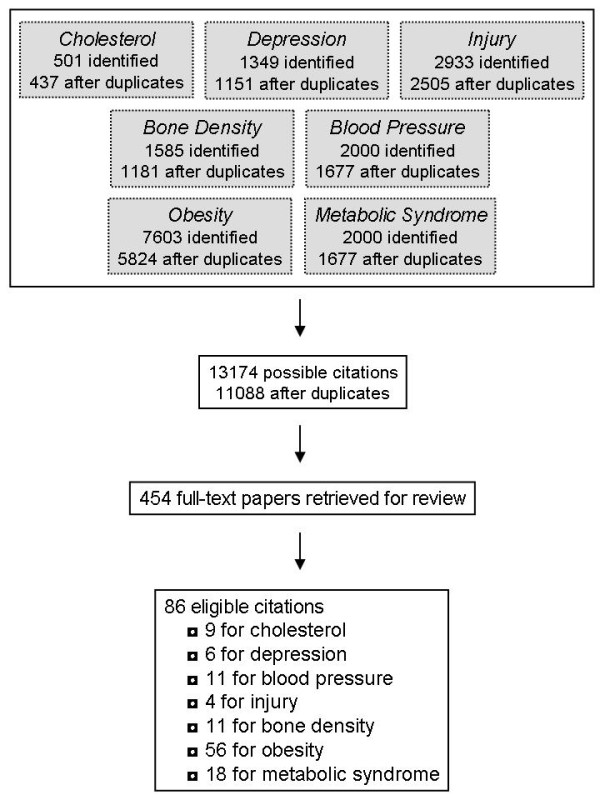
- After duplicates, 11,088 unique citations were screened; 454 full-text articles were reviewed; 86 unique citations met eligibility and 113 outcomes were abstracted. Observational studies had to report dichotomous outcomes; intervention studies were excluded if they included dietary or other behavioral components that could independently affect outcomes.
- Evidence was graded using pre-specified criteria based on quantity/quality of studies and strength of effect; meta-analyses were performed when at least 4 studies were available. RCT quality was assessed with the Downs and Black checklist, and effect sizes used Cohen’s d and ratio-score criteria.
Limitations
- Stated: unpublished and non-English studies were excluded, no extensive cross-referencing of reference lists was performed, the review was limited to 7 health outcomes, and many observational studies were excluded because they did not report dichotomous outcomes; these may have biased results and recommendations.
- Stated RCT limitations: samples were small and non-representative, statistical power was often lacking, adverse events were rarely reported, dropout details were limited, and intent-to-treat analyses were not performed; therefore Level 2 was the highest level assignable to any recommendation.
- Evident from the text: the nature of dose-response relations (linear vs curvilinear) often remained unclear, and the moderating effects of age and sex were not systematically addressed across outcomes.
Model-written summary. Check it against the paper before relying on it.
Integrity signals
Registry
Cites
Statistics
Figures
Verification
Claims the paper makes
0 Valid · 0 Not valid · 42 Not checked · 127 Own results and interpretations
A result the paper reports from its own data — it cites no other source for it, so there is none to check. The quote shows it is in the paper.
In the paper
“Results from experimental studies indicate that even modest amounts of physical activity can have health benefits in high-risk youngsters (e.g., obese).”
§ Systematic review of the health benefits of physical activity and fitness in school-aged children and youth > Abstract > Results
hedgedstates a cause- Asserted: passes — The authors put it forward as true.
- Checkable: passes — It can be checked against evidence.
- Load-bearing: passes — The paper’s conclusions depend on it.
- Based: passes — The paper gives a reason why it holds.
A result the paper reports from its own data — it cites no other source for it, so there is none to check. The quote shows it is in the paper.
In the paper
“Physical activity was associated with numerous health benefits.”
§ Systematic review of the health benefits of physical activity and fitness in school-aged children and youth > Abstract > Results
plainstates an association- Asserted: passes — The authors put it forward as true.
- Checkable: passes — It can be checked against evidence.
- Load-bearing: passes — The paper’s conclusions depend on it.
- Based: passes — The paper gives a reason why it holds.
A result the paper states — it cites no source for it, so there is none to check. The quote shows it is in the paper.
In the paper
“Aerobic-based activities had the greatest health benefit, other than for bone health, in which case high-impact weight bearing activities were required.”
§ Systematic review of the health benefits of physical activity and fitness in school-aged children and youth > Abstract > Results
plainstates an association- Asserted: passes — The authors put it forward as true.
- Checkable: passes — It can be checked against evidence.
- Load-bearing: passes — The paper’s conclusions depend on it.
- Based: passes — The paper gives a reason why it holds.
A result the paper reports from its own data — it cites no other source for it, so there is none to check. The quote shows it is in the paper.
In the paper
“The dose-response relations observed in observational studies indicate that the more physical activity, the greater the health benefit.”
§ Systematic review of the health benefits of physical activity and fitness in school-aged children and youth > Abstract > Results
hedgedstates an association- Asserted: passes — The authors put it forward as true.
- Checkable: passes — It can be checked against evidence.
- Load-bearing: passes — The paper’s conclusions depend on it.
- Based: passes — The paper gives a reason why it holds.
None of the sources cited for this claim have been checked yet.
In the paper
“The results indicated that unfit girls, defined as the lowest 20% fit, were 1.89 (95% confidence interval: 1.12-3.17) times more likely to have hypercholesterolemia and 1.03 (0.74-1.43) times more likely to have a low HDL-cholesterol by comparison to moderately and high fit girls.”
§ Systematic review of the health benefits of physical activity and fitness in school-aged children and youth > Results > Cholesterol and blood lipids
hedgedstates an associationn = 3,110- Asserted: passes — The authors put it forward as true.
- Checkable: passes — It can be checked against evidence.
- Load-bearing: passes — The paper’s conclusions depend on it.
- Based: passes — The paper gives a reason why it holds.
103 more claims
Create a free account to see all 169 claims and every source verdict.
- Probably not a substantial claim. 26
- The quote only partly states this claim. 2
- It may state two separate claims as one. 37
Claims other papers make about this one
Each is checked against this paper’s own text: does it say what the citing paper says it does?
The source backs part of the claim, not all of it — or backs it for a different population, condition or comparison.
In the citing paper
“Research indicates that those who are physically active show or report better overall physical and mental health, a higher level of fitness and a lower level of obesity than their sedentary or physically inactive counterparts1–4”
From Physical activity and health in Chinese children and adolescents: expert consensus statement (2020) (2020) · cites this paper as [2]
Experimental — accuracy not yet measuredThe cited source says what the claim attributes to it.
In the citing paper
“The association with overweight/obesity tends to be stronger when moderate to vigorous-intensity physical activities are performed.2”
From Physical activity and health in Chinese children and adolescents: expert consensus statement (2020) (2020) · cites this paper as [2]
The cited source says what the claim attributes to it.
In the citing paper
“Among physical activity interventions, the effects of physical activity independent of dietary changes on measures indicative of weight reduction (eg, BMI, total fat, abdominal fat) tend to be in the small range.2”
From Physical activity and health in Chinese children and adolescents: expert consensus statement (2020) (2020) · cites this paper as [2]
The cited source says what the claim attributes to it.
In the citing paper
“In general, as the level of physical activity increases, the likelihood of injury increases.2”
From Physical activity and health in Chinese children and adolescents: expert consensus statement (2020) (2020) · cites this paper as [2]
The cited source says what the claim attributes to it.
In the citing paper
“Systematic reviews have shown that physical activity (PA) is associated with greater mental health, 6 and a reduced risk of mental ill-health, specifically depression and anxiety.7,8”
From Domain-Specific Physical Activity and Mental Health: A Meta-analysis (2017) · cites this paper as [8]
2 more claims about this paper
Create a free account to see every claim other papers make about this one.
Self-check
Percentages, sums and reported differences re-computed from the paper’s own numbers.
Each contradiction between two passages listed here was confirmed by an independent check.
Rated major: it would touch a result — a value a result rests on, reported and recomputed p-values on opposite sides of the significance level, two passages that conflict with no sign which is right, or a cited work retracted before this paper was published.
In the paper
§ Systematic review of the health benefits of physical activity and fitness in school-aged children and youth > Discussion > Recommendations based on systematic review
“More vigorous intensity activities should be incorporated or added when possible, including activities that strengthen muscle and bone. [Level 3, Grade B].”
§ Systematic review of the health benefits of physical activity and fitness in school-aged children and youth > Discussion > Recommendations based on systematic review
“This recommendation was given a lower grade (Grade C) because of the potential increase in injury risk associated with more vigorous intensity activities and sports.”
Rated minor: it would not touch a result — a value no result rests on, a p-value that stays on the same side of the significance level, or a conflict that is clerical, resolved elsewhere in the paper, or outside its own findings.
In the paper
§ Systematic review of the health benefits of physical activity and fitness in school-aged children and youth > Results > Metabolic syndrome
“Sixteen articles examining the metabolic syndrome met the inclusion criteria.”
§ Systematic review of the health benefits of physical activity and fitness in school-aged children and youth > Results > Metabolic syndrome
“Eight of the 17 identified studies were observational in nature”
Rated minor: it would not touch a result — a value no result rests on, a p-value that stays on the same side of the significance level, or a conflict that is clerical, resolved elsewhere in the paper, or outside its own findings.
In the paper
“A total of 31 observational studies (24 cross-sectional, 3 prospective cohort, 2 case-control, 1 mixed) were retrieved”
§ Systematic review of the health benefits of physical activity and fitness in school-aged children and youth > Results > Overweight and obesity
Reported 31 · recomputed 30
Rated minor: it would not touch a result — a value no result rests on, a p-value that stays on the same side of the significance level, or a conflict that is clerical, resolved elsewhere in the paper, or outside its own findings.
In the paper
“437 citations were identified for cholesterol, 1151 for depression, 2505 for injury, 1181 for bone density, 1677 for blood pressure, 5824 for obesity, and 1677 for the metabolic syndrome. Thus, the grand total was 13174.”
§ Systematic review of the health benefits of physical activity and fitness in school-aged children and youth > Results > Literature review
Reported 13174 · recomputed 14452
Citations
Cites
Downs, S. H., & Black, N. (1998) · Journal of Epidemiology and Community Health · doi:10.1136/jech.52.6.377 · Cited by 8,252
Evidence Based Physical Activity for School-age Youth
Strong, W. B., Malina, R. M., Blimkie, C. J. R., Daniels, S. R., Dishman, R. K., Gutin, B., Hergenroeder, A. C., Must, A., Nixon, P. A., Pivarnik, J. M., et al. (2005) · The Journal of Pediatrics · doi:10.1016/j.jpeds.2005.01.055 · Cited by 4,222
Systematic Reviews: Synthesis of Best Evidence for Clinical Decisions
Cook, D. J., Mulrow, C. D., & Haynes, R. B. (1997) · Annals of Internal Medicine · doi:10.7326/0003-4819-126-5-199703010-00006 · Cited by 2,184
Andersen, L. B., Harro, M., Sardinha, L. B., Froberg, K., Ekelund, U., Brage, S., & Anderssen, S. A. (2006) · The Lancet · doi:10.1016/s0140-6736(06)69075-2 · Cited by 1,473
Lau, D. C. W., Douketis, J. D., Morrison, K. M., Hramiak, I. M., Sharma, A. M., Ur, E., & Panel, F. M. O. T. O. C. C. P. G. E. (2007) · Canadian Medical Association Journal · doi:10.1503/cmaj.061409 · Cited by 1,154
Paterson, D. H., & Warburton, D. E. (2010) · International Journal of Behavioral Nutrition and Physical Activity · doi:10.1186/1479-5868-7-38 · Cited by 953
A systematic review of the evidence for Canada's Physical Activity Guidelines for Adults
Warburton, D. E., Charlesworth, S., Ivey, A., Nettlefold, L., & Bredin, S. S. (2010) · International Journal of Behavioral Nutrition and Physical Activity · doi:10.1186/1479-5868-7-39 · Cited by 902 · cited 1×
“This report was part of a much larger project around Canada's physical activity guidelines, and comparable systematic reviews for adults [ 10 ] and older adults [11] have also been published in the journal.”
A meta-regression to examine the relationship between aerobic fitness and cognitive performance
Etnier, J. L., Nowell, P. M., Landers, D. M., & Sibley, B. A. (2006) · Brain Research Reviews · doi:10.1016/j.brainresrev.2006.01.002 · Cited by 749
Is the Canadian childhood obesity epidemic related to physical inactivity?
Tremblay, M. S., & Willms, J. D. (2003) · International Journal of Obesity · doi:10.1038/sj.ijo.0802376 · Cited by 517
Nassis, G. P., Papantakou, K., Skenderi, K., Triandafillopoulou, M., Kavouras, S. A., Yannakoulia, M., Chrousos, G. P., & Sidossis, L. S. (2005) · Metabolism · doi:10.1016/j.metabol.2005.05.013 · Cited by 469
Research works printed but not linked: 1
- Petitti DB Meta-Analysis, Decision Analysis, and Cost-Effective Analysis 1994 New York, NY: Oxford University Press
Cited by
Items 3,501–3,600 of 4,834
Physical Activity in Adolescents with respect to Movement Quality and Quantity
Weedon, B. D. (2020) · Radar (Oxford Brookes University) · doi:10.24384/381r-t238 · Cited by 3
Rivers, R. (2018) · cIRcle (University of British Columbia) · doi:10.14288/1.0363061 · Cited by 2
Beemer, L. R., Eisman, A. B., Templin, T., Robinson, L. E., Miller, A. L., Tackett, W., Marenus, M. W., & Hasson, R. E. (2025) · Journal of Teaching in Physical Education · doi:10.1123/jtpe.2024-0017 · Cited by 1
Halim, N. K., Willing, I. W., Eime, R., Hassett, L. M., & Owen, K. (2025) · JSAMS Plus · doi:10.1016/j.jsampl.2025.100116 · Cited by 1
“Physical activity is associated with numerous physical and mental health benefits in children and adolescents [1,2].”
Artymiak, P., Żegleń, M., & Kryst, Ł. (2024) · American Journal of Human Biology · doi:10.1002/ajhb.24182 · Cited by 1
“…levels of physical activity promote many health benefits and have an impact on the cardio-metabolic system, motor development, emotional regulation, mood, and maintaining a healthy body weight in children and adolescents (Janssen and Leblanc 2010; Galluccio et al. 2021; Neville et al. 2022).”
Esgiyayla, S., Şendil, A. M., Öngören, B., Doğan, Z., Dinç, F. Ç., Gündoğdu, E., & Canlı, U. (2025) · Uluslararası Türk Spor ve Egzersiz Psikolojisi Dergisi · doi:10.55376/ijtsep.1682791 · Cited by 1
Effects of School-Based Physical Activity Promotion and Dietary Awareness in Obese Children
Raval, N., & Soni, M. (2022) · International Journal of Health Sciences and Research · doi:10.52403/ijhsr.20221007
Advancing Healthcare Predictions: Harnessing Machine Learning for Accurate Health Index Prognosis
Bhaskar, P., Burramsetty, V. S. R. K., Pinnaka, B., Kalapala, B. T., & Tanguturi, V. S. S. K. (2024) · International Journal of Innovative Science and Research Technology (IJISRT) · doi:10.38124/ijisrt/ijisrt24apr709 · Cited by 2
Comparison of physical activity using questionnaire and accelerometer in 4th grade children
Sasayama, K., & Adachi, M. (2019) · 体力科學 · doi:10.7600/jspfsm.68.91 · Cited by 2
ASTHMA CARE FOR CHILDREN AND ADOLESCENTS
Jonsson, M. (2015) · Figshare · Cited by 2
Impact of the COVID-19 Pandemic on Children’s Physical Activity As Perceived by Their Parents
Haidar, H. W., Kalash, A. R., Alshamsi, F. A., Alzaabi, N. N., & Hussein, A. (2025) · Cureus · doi:10.7759/cureus.80703 · Cited by 4
“Conversely, an active lifestyle is associated with numerous health benefits, such as improved physical and emotional health, better stress management, and a stronger immune system [10,12-16].”
Mota, J. A. P. S., Duncan, M. J., de Barros, M. V. G., Júnior, J. F., Ribeiro, J. C., Carvalho, J., Pizarro, A. I. N., & Santos, M. P. (2017) · Revista Brasileira de Atividade Física & Saúde · doi:10.12820/rbafs.v.22n3p242-250 · Cited by 1
Lojdová, M., Kvintová, J., Štěrbová, D., & Krol, P. (2021) · Tělesná kultura · doi:10.5507/tk.2021.008 · Cited by 1
Children’s Neighborhoods: Places of Play or Spaces of Fear?
Witten, K., & Carroll, P. (2015) · Springer eBooks · doi:10.1007/978-981-4585-90-3_25-1 · Cited by 1
The permission for walking to school: An analysis from a gender perspective
Herrador‐Colmenero, M., Estévez-Piñeiro, P., Saucedo‐Araujo, R. G., Aranda-Balboa, M. J., & Girela‐Rejón, M. J. (2022) · Journal of Movement & Health · doi:10.5027/jmh-vol19-issue2(2022)art165 · Cited by 1
Ho, R. S. T., Huang, Y., Lo, H.-Y., Liu, K. K., & Wong, S. H. (2022) · Asia Pacific Journal of Public Health · doi:10.1177/10105395221103377 · Cited by 2
Bélanger‐Gravel, A., Lottinville, S., Beaurivage, D., Laferté, M., Therrien, F., & Gauvin, L. I. (2017) · Public Health · doi:10.1016/j.puhe.2017.10.002 · Cited by 2
Åkerlund, I. (2024) · Linköping University medical dissertations · doi:10.3384/9789180753753 · Cited by 2
Bowling, A. B., Staiano, A. E., Hatfield, D. P., Daly, T., Sabelli, R. A., Slavet, J., Bandini, L. G., Curtin, C., Nauta, P., Kennedy, W., et al. (2024) · International Journal of Developmental Disabilities · doi:10.1080/20473869.2024.2431605 · Cited by 1
ÇİL, E., & Eser, E. (2026) · American Journal of Health Promotion · doi:10.1177/08901171261418238 · Cited by 1
Owen, K. B., Foley, B. C., Reece, L. J., Bellew, W., & Bauman, A. E. (2025) · International Journal of Behavioral Nutrition and Physical Activity · doi:10.1186/s12966-025-01763-2 · Cited by 1
“Physical activity in children and adolescents is associated with improved physical, mental and cognitive health benefits [1].”
Tyler, R. (2015) · Advances in Obesity Weight Management & Control · doi:10.15406/aowmc.2016.03.00072 · Cited by 1
Lang, R. B., Liu, T., & Ledbetter‐Cho, K. (2017) · Springer eBooks · doi:10.1007/978-1-4614-6435-8_102189-1 · Cited by 2
Physical Activity Stations: Opportunities for Teachers and Students during the School Day
Herbert, P. C., & Whitney, E. A. (2018) · Strategies · doi:10.1080/08924562.2018.1491712 · Cited by 1
Acebes-Sánchez, J. (2019) · UPM Digital Archive (Technical University of Madrid) · doi:10.20868/upm.thesis.57777 · Cited by 2
Motivational Predictors of Schoolchildren’s Moods in a Recess Intervention
Mendez‐Giménez, A., & García-Rodríguez, I. (2024) · Journal of Teaching in Physical Education · doi:10.1123/jtpe.2023-0121 · Cited by 3
THE RELATIONSHIP BETWEEN PHYSICAL ACTIVITY AND QUALITY OF LIFE AMONG ELEMENTARY SCHOOL STUDENTS
Subagja, R. (2026) · Exercise and Quality of Life · doi:10.31382/20260605
Barrenetxea-García, J., Ortuondo, J., & Mendez‐Giménez, A. (2024) · Retos · doi:10.47197/retos.v54.103550 · Cited by 8
de Souza, M. C., Bento-Torres, N. V. O., Bento‐Torres, J., & da Silva, L. M. (2024) · Revista Exitus · doi:10.24065/re.v14i1.2584 · Cited by 3
Excess mortality from schizophrenia, 2014
Wernlund, A. G., & Aagaard, J. (2017) · Health at a glance · doi:10.1787/health_glance-2017-graph96-en · Cited by 1
Sociodemographic and socioeconomic inequalities in physical activity among Slovenian youth
Kirbiš, A., Krajnc, M. T., & Musil, B. (2014) · Slovenian Nursing Review · doi:10.14528/snr.2014.48.4.36 · Cited by 1
OECD (2017) · Health at a glance · doi:10.1787/health_glance-2017-70-en · Cited by 4
Physical Activity for Weight Management
Isaacs, S. D. (2018) · Springer eBooks · doi:10.1007/978-3-319-95655-8_20 · Cited by 3
Pahmeier, I. (2019) · Grundlagen von Sport und Sportwissenschaft · doi:10.1007/978-3-662-53384-0_13-1 · Cited by 23
Rivera, E., Deforche, B. I., Loh, V. H. Y., Timperio, A. F., & Veitch, J. (2026) · Health Promotion International · doi:10.1093/heapro/daag027 · Cited by 2
Çocuk Oyun Alanlarının Farklı Değişkenler Açısından Değerlendirmesi Üzerine Bir Alan Çalışması
Öcal, T., Metin, S. N., & Çar, B. (2022) · Gaziantep Üniversitesi Spor Bilimleri Dergisi · doi:10.31680/gaunjss.1074597 · Cited by 3
The Effectiveness of Impact of Physical Activity on the Thinking Indicators of School Children
Polevoy, G. G. (2022) · The Open Public Health Journal · doi:10.2174/18749445-v15-e221208-2022-138 · Cited by 2
Wentz, E. E., Conklin, A., Martin, K. S., et al. (2023) · Pediatric Physical Therapy · doi:10.1097/pep.0000000000001067 · Cited by 1
“12-14 There is a need for physical therapy interventions that effectively augment motor development and PA levels.”
BackgroundReck, H. B., Porto, F. E., Nunes, J. H. C., Locatelli, J. C., Costa, C. E., & Lopes, W. A. (2024) · Conexões · doi:10.20396/conex.v22i00.8674684 · Cited by 3
Slekiene, J., Chidziwisano, K., & Tilley, E. (2024) · BMC Psychology · doi:10.1186/s40359-024-01562-7 · Cited by 4
“At the same time, the health benefits of physical activity in school-aged children and youth are well established [25].”
BackgroundBriceño, G., Prieto, M. A., Povea, C., Moreno, Z., Céspedes, J., & Tong, K.-W. (2019) · Cogent Education · doi:10.1080/2331186x.2019.1565068 · Cited by 2
Zhou, Y., Youyou, W., & Tolmie, A. K. (2025) · Cognitive Development · doi:10.1016/j.cogdev.2025.101640 · Cited by 3
Arfa, S., Solvang, P. K., Berg, B., & Jahnsen, R. B. (2020) · Scandinavian Journal of Occupational Therapy · doi:10.1080/11038128.2020.1856183 · Cited by 1
Community use of school grounds outside of school hours
Lin, E.-Y. J., Witten, K., Carroll, P., & Parker, K. (2024) · Kōtuitui New Zealand Journal of Social Sciences Online · doi:10.1080/1177083x.2024.2369269 · Cited by 2
“Physical activity in childhood is essential for healthy development and wellbeing, with e ff ects tracking from childhood through into later life (Telama et al. 2005; Janssen and LeBlanc 2010; Poitras et al. 2016; Bull et al. 2020; World Health Organization 2022).”
Baharuddin, S. H., Herdiansyah, H., Mahendra, A., et al. (2026) · Edu Sportivo/Edu Sportivo · doi:10.25299/esijope.2026.vol7(2).19682 · Cited by 1
The Impact of Physical Activity at School on the Nutritional Behavior of Overweight Children
Ługowska, K., Baczewska, B., Trafiałek, J., & Kolanowski, W. (2025) · Nutrients · doi:10.3390/nu17243905 · Cited by 2
“At the same time, they confirm the observations of Janssen and LeBlanc [51] that the relationship between physical activity and obesity reduction may be moderate and require longer follow-up.”
Vindiš, J., Pelclová, J., & Pechová, J. (2020) · Tělesná kultura · doi:10.5507/tk.2019.009 · Cited by 1
Udeskole—Pupils’ Physical Activity and Gender Perspectives
Mygind, E. (2022) · Springer eBooks · doi:10.1007/978-3-031-04108-2_7 · Cited by 4
Jarnig, G., & Kerbl, R. (2023) · Preprints.org · doi:10.20944/preprints202309.1857.v1
Moral Identity Questionnaire (MIQ): Adaptation and Psychometric Properties in Spanish Population
Alabèrnia-Segura, M., Gallardo‐Pujol, D., & Feixas, G. (2023) · Acción Psicológica · doi:10.5944/ap.20.1.39151 · Cited by 6
Holt, R. P. F. (2015) · doi:10.13021/mars/4423 · Cited by 1
Tu, T. T., Cuong, D. N., & Ha, T. (2024) · Pedagogy of Physical Culture and Sports · doi:10.15561/26649837.2024.0508 · Cited by 2
“They help children and adolescents enhance their physical fitness, learn important social norms, improve memory, develop self-discipline, and experience mental revitalization [9, 10, 11, 12, 13, 14].”
BackgroundA Descriptive Study on Body Composition and Physical Activity Among Adolescent Esports Players
Onishchenko, D., Bolshakov, V., Bravyy, Y. R., Kirsanov, A., Baltin, M. E., & Savin, D. (2025) · Journal of Electronic Gaming and Esports · doi:10.1123/jege.2023-0043 · Cited by 1
Lopes, V. P., & Sá, C. (2021) · Cuadernos de Psicología del Deporte · doi:10.6018/cpd.407181 · Cited by 4
Developing ACTIVE SCHOOL—The Design Process for Two School-Based Physical Activity Interventions
Jeppesen, L. S., Bugge, A., Smedegaard, S., Wienecke, J., & Melcher, J. N. S. (2024) · Translational Journal of the American College of Sports Medicine · doi:10.1249/tjx.0000000000000251 · Cited by 2
Physical Activity, Exercise, and Fitness
OH, P. I., Cotie, L. M., & Vanzella, L. M. (2023) · Autism and child psychopathology series · doi:10.1007/978-3-031-19964-6_46 · Cited by 1
Johansen, J.-M., Mandelid, M. B., Reinboth, M. S., Resaland, G. K., & Bratland‐Sanda, S. (2026) · Research Quarterly for Exercise and Sport · doi:10.1080/02701367.2025.2599881 · Cited by 2
“Regular engagement in PA is associated with several physical, mental-and social-health benefits, as well as academic achievements (Aubert et al., 2018; Biddle & Asare, 2011; Donnelly et al., 2016; Janssen & Leblanc, 2010; Pesce et al., 2016; Poitras et al., 2016).”
Relación entre el nivel de condición física y la inteligencia del alumnado de Educación Infantil
Zamorano-García, D., Bustos, J. G. F., Simón-Piqueras, J. Á., Madrona, P. G., & González-Martínez, R. (2023) · Revista Iberoamericana de Ciencias de la Actividad Física y el Deporte · doi:10.24310/riccafd.2023.v12i2.17417 · Cited by 4
Drenowatz, C. J., & Greier, K. (2023) · MDPI eBooks · doi:10.3390/books978-3-0365-7048-8 · Cited by 2
The Impact of Physical Activity on Academic Performance: A Comprehensive Analysis
Delito, E. M. S. (2023) · International Journal of Advanced Research in Science Communication and Technology · doi:10.48175/ijarsct-11941 · Cited by 3
Hung, W.-C., Lin, C.-P., & Chen, H.-H. (2025) · International Journal of Educational Research · doi:10.1016/j.ijer.2025.102679 · Cited by 4
TIPOS E QUANTIDADES DE ATIVIDADES FÍSICAS PRATICADAS POR ADOLESCENTES DO SUL DO BRASIL
Lopes, M. V. V., da Silva, K. S., Bertuol, C., da Silva, J. A., & Nahas, M. V. (2018) · Pensar a Prática · doi:10.5216/rpp.v21i3.45850 · Cited by 3
Motor Ability in Active and Less Active Students Aged 12-13 in the Mekong Delta, Vietnam
Dao, C. T. (2025) · Polish Journal of Sport and Tourism · doi:10.2478/pjst-2025-0003 · Cited by 2
Stress Urinary Incontinence in Young Female Athletes- From Prevalence to Treatment- A Review
Bansal, S., & Anand, P. C. (2024) · International Research Journal of Multidisciplinary Scope · doi:10.47857/irjms.2024.v05i02.0681 · Cited by 1
Leisure‐time physical activity and cardiometabolic risk among children and adolescents
Cárdenas, L. M. C., Burguete-García, A. I., Estrada-Velasco, B. I., et al. (2015) · Jornal de Pediatria (Versão em Português) · doi:10.1016/j.jpedp.2015.01.004 · Cited by 1
Pinheiro, L. E. (2013) · Digital Library of Theses and Dissertations (Universidade de São Paulo) · doi:10.11606/d.22.2013.tde-03062016-103514 · Cited by 1
Petro-Petro, J., Arango-Paternina, C. M., & Villada, F. A. P. (2026) · Research Quarterly for Exercise and Sport · doi:10.1080/02701367.2026.2623652 · Cited by 1
“The protective role of PA in adolescent health is widely recognized, as it reduces the risk of developing non-communicable diseases such as hypertension, metabolic syndrome, and obesity, among others (Janssen & LeBlanc, 2010).”
Physical exercise behavior characteristics and influencing factors of police officersPreprint
Feng, Y., & Wang, D. (2023) · Research Square · doi:10.21203/rs.3.rs-2902209/v1 · Cited by 1
Examination of structured physical activity on students with special needs
Sparano, A. (2015) · Rowan Digitals Works (Rowan University) · Cited by 1
Physical Activity, Exercise and Sports in Young Cancer Patients
Götte, M., Kesting, S., & Boos, J. (2020) · Springer eBooks · doi:10.1007/978-3-030-49140-6_38 · Cited by 1
Guerra, P. H. D. A. (2013) · Digital Library of Theses and Dissertations (Universidade de São Paulo) · doi:10.11606/t.5.2013.tde-07082013-141844 · Cited by 1
Romero, A. (2012) · Digital Library of Theses and Dissertations (Universidade de São Paulo) · doi:10.11606/t.6.2012.tde-19042012-165525 · Cited by 2
castillo, N. S. C., Nizama, J. L. R., Chalco, O. R. M., Montenegro, J. S., Valdiviezo, Y. G., Livia, D. P. R., Huertas, J. G. P., Chávez-Díaz, J. M., & Morán, R. C. D. (2024) · Retos · doi:10.47197/retos.v59.108313 · Cited by 3
Al-Hazzaa, H. M., AlMarzooqi, M. A., Alsukait, R. F., AlAhmed, R. S., Rakić, S., Çetinkaya, V., Evenson, K. R., & Alqahtani, S. A. (2024) · Frontiers in Built Environment · doi:10.3389/fbuil.2024.1426705 · Cited by 3
Becker, C., Schmidt, S., Neuberger, E. W. I., Kirsch, P., Simon, P. D., & Dettweiler, U. (2018) · Preprints.org · doi:10.20944/preprints201804.0182.v1 · Cited by 1
Melloni, M. A. S., San-Martin, J. E. S., Barbeta, C. J. D. O., Gonçalves, E. M., & Guerra‐Júnior, G. (2024) · Revista Contemporânea · doi:10.56083/rcv4n6-211 · Cited by 1
Klemedtson, A., Börjesson, A., Hertting, K., Kristén, L., & Sjögren, L. (2023) · Physical Activity and Health · doi:10.5334/paah.273 · Cited by 2
Dharmayat, S., & Bandmaster, M. (2018) · International Journal of Physiotherapy and Research · doi:10.16965/ijpr.2018.158
Kleszczewska, D. W., Siedlecka, J., & Mazur, J. (2019) · Pediatria Polska · doi:10.5114/polp.2019.83739 · Cited by 1
Hip fracture surgery initiation after admission to hospital, 2005 and 2015 (or nearest year)
(2017) · Health at a glance · doi:10.1787/health_glance-2017-graph88-en · Cited by 1
Jabbour, G., Tremblay, A., Henderson, M., & Mathieu, M.-E. (2017) · Biology of Sport · doi:10.5114/biolsport.2017.63736 · Cited by 1
Population coverage for health care
OECD (2017) · Health at a glance · doi:10.1787/health_glance-2017-24-en · Cited by 1
Emm-Collison, L., Standage, M., Gillison, F., & Curran, T. (2024) · Journal of Sport and Exercise Psychology · doi:10.1123/jsep.2017-0293 · Cited by 3
Tıngaz, E. O., Hazar, M., Baydar, H. Ö., Gökyürek, B., & Çakıroğlu, T. (2018) · International Journal of Higher Education · doi:10.5430/ijhe.v7n3p163 · Cited by 1
“La actividad física, el ejercicio y el deporte en niños y adolescentes”.
Duarte, R. A. (2018) · Revista Salud Bosque · doi:10.18270/rsb.v8i1.2380 · Cited by 1
Sun, Q., Zhang, D., & Ren, T. (2025) · BMC Public Health · doi:10.1186/s12889-025-24543-w · Cited by 1
“Children and adolescent movement behaviours were individually linked to various physical outcomes [13], such as adiposity [14–16].”
Rickwood, G. (2012) · Scholarship@Western (Western University) · Cited by 1
Johnson, A. M., Kroshus, E., & Tandon, P. S. (2021) · BMC Public Health · doi:10.1186/s12889-021-12024-9 · Cited by 3
de Baranda, P. S., Visiedo, A., Ruiz-Díaz, A., Romera-García, F., Cejudo, A., Sánchez-Jiménez, R. M., Velázquez, F., Martínez-González, L., Saura, E., Sajardo, R. B., et al. (2023) · JUMP · doi:10.17561/jump.n6.3
Breast cancer incidence in women, 2012
(2017) · Health at a glance · doi:10.1787/health_glance-2017-graph26-en · Cited by 1
Health, Fitness, Lifestyle and Physical Competency of School Children in Wales
Tyler, R. (2018) · Cronfa (Swansea University) · doi:10.23889/suthesis.50798 · Cited by 1
Vieira, V. D. S., Aguiar, S. D. C., Campos, M. C., Fontanela, L. C., Canever, J. B., Hauck, M., Arcêncio, L., Cáceres, V. D. M., Schneider, I. J. C., & Vieira, D. S. R. (2024) · Pediatric Exercise Science · doi:10.1123/pes.2023-0120 · Cited by 2
Determinants of objectively measured physical activity in rural East Timorese children
Spencer, P. R., Sanders, K. A., & Judge, D. S. (2019) · American Journal of Human Biology · doi:10.1002/ajhb.23247 · Cited by 1
Lawrenz, W. (2021) · Springer eBooks · doi:10.1007/978-3-662-61588-1_28 · Cited by 1
OECD (2017) · Health at a glance · doi:10.1787/health_glance-2017-38-en · Cited by 1
FUNdamental Integrative Training for Elementary School Students: Animals in Motion
Bruno, L. E., & Faigenbaum, A. D. (2019) · Journal of Physical Education Recreation & Dance · doi:10.1080/07303084.2019.1614772 · Cited by 1
Akter, M. M., & Hossain, M. J. (2023) · Research Square · doi:10.21203/rs.3.rs-3207448/v1 · Cited by 1
Tishukaj, F., Shalaj, I., Gjaka, M., Wessner, B., & Tschan, H. (2021) · Advances in Physical Education · doi:10.4236/ape.2021.111005 · Cited by 3
Metadata
- Authors
- Janssen, I., & LeBlanc, A. G.
- Affiliations
- Queen's University (CA)
- Corresponding author
- Janssen, Ian
- Venue
- International Journal of Behavioral Nutrition and Physical Activity
- Published
- 2010
- Volume
- 7
- Issue
- 1
- Pages
- 40
- ISSN
- 1479-5868 (ISSN-L)
- PMC
- PMC2885312
- OpenAlex
- W2145702257
- Semantic Scholar
- ef8d55efd11b9d5e4a4814b6a38ff3d60d820d37
- Cited by
- 4,829
- References
- 116
- Citations by year
- 2026: 185 · 2025: 257 · 2024: 310 · 2023: 304 · 2022: 371 · 2021: 451 · 2020: 459 · 2019: 401 · 2018: 387 · 2017: 490 · 2016: 302 · 2015: 280 · 2014: 250 · 2013: 191 · 2012: 109
- FWCI
- 12.18
- Type
- journal article
- Language
- en
- Open access
- gold
- doi.org
- Licence
- cc-by
- Locations
- International Journal of Behavioral Nutrition and Physical Activity (publishedVersion, cc-by)
- PubMed Central (publishedVersion, cc-by)
- PubMed (publishedVersion)
- DOAJ (DOAJ: Directory of Open Access Journals) (submittedVersion, cc-by-sa)
- Funders
- Public Health Agency of Canada
- Public Health Agency
- Topics
- Health Sciences › Medicine › Public Health, Environmental and Occupational Health › Physical Activity and Health
- Health Sciences › Medicine › Public Health, Environmental and Occupational Health › Obesity, Physical Activity, Diet
- Social Sciences › Life-span and Life-course Studies › Recreational Sport and Physical Activity
- Keywords
- physical activity, physical fitness, school-aged children, youth, health benefits, serum cholesterol, blood pressure, metabolic syndrome, childhood obesity, bone mineral density, depression, injuries, dose-response relationship, aerobic exercise, physical activity guidelines
About these checks
Registry, retraction, Cites and statistics results are computed, not judged, with one exception: a printed reference that no index lists is read once by a model before it counts as a citation error. Claims are extracted by a model and kept only when their quote appears verbatim in the text; each cited source is then checked, with a model’s help, for whether it says what the claim relies on. Those verdicts can be wrong — read the claim’s quote and the cited source before relying on one.
A language model drew the claims from the paper on 2026-10-10, under version 3 of the claim definition (model deepseek-v4.1-flash, prompt extract-v3).
A second model labelled each claim on 2026-10-10 (model jev-1.13-20260917, definition revision gold-guideline-v0.2).
Statistics and arithmetic are recomputed, not judged.
Confidence bands are shown only for fields calibrated on our annotated test set. None is calibrated yet, so no band is shown.
What counts as a claim ›How we measure confidence ›How we check this ›
Are you an author, or do you see a problem with this page? Request a review
Data sources
Bibliographic data: Semantic Scholar, OpenAlex, Crossref.
Contains information from the Semantic Scholar Academic Graph Datasets, made available under the ODC Attribution License (ODC-BY 1.0).
Semantic Scholar’s data is described in: Kinney, R., et al. (2023). The Semantic Scholar Open Data Platform. arXiv:2301.10140.
