

Systematic review of the health benefits of physical activity and fitness in school-aged children and youth
Open accessThe DOI matches its Crossref record; 114 of the 116 references it cites were found in a registry or an index; none of the 128 sources its claims cite is checked for support yet.
Abstract
BACKGROUND: The purpose was to: 1) perform a systematic review of studies examining the relation between physical activity, fitness, and health in school-aged children and youth, and 2) make recommendations based on the findings. METHODS: The systematic review was limited to 7 health indicators: high blood cholesterol, high blood pressure, the metabolic syndrome, obesity, low bone density, depression, and injuries. Literature searches were conducted using predefined keywords in 6 key databases. A total of 11,088 potential papers were identified. The abstracts and full-text articles of potentially relevant papers were screened to determine eligibility. Data was abstracted for 113 outcomes from the 86 eligible papers. The evidence was graded for each health outcome using established criteria based on the quantity and quality of studies and strength of effect. The volume, intensity, and type of physical activity were considered. RESULTS: Physical activity was associated with numerous health benefits. The dose-response relations observed in observational studies indicate that the more physical activity, the greater the health benefit. Results from experimental studies indicate that even modest amounts of physical activity can have health benefits in high-risk youngsters (e.g., obese). To achieve substantive health benefits, the physical activity should be of at least a moderate intensity. Vigorous intensity activities may provide even greater benefit. Aerobic-based activities had the greatest health benefit, other than for bone health, in which case high-impact weight bearing activities were required. CONCLUSION: The following recommendations were made: 1) Children and youth 5-17 years of age should accumulate an average of at least 60 minutes per day and up to several hours of at least moderate intensity physical activity. Some of the health benefits can be achieved through an average of 30 minutes per day. [Level 2, Grade A]. 2) More vigorous intensity activities should be incorporated or added when possible, including activities that strengthen muscle and bone [Level 3, Grade B]. 3) Aerobic activities should make up the majority of the physical activity. Muscle and bone strengthening activities should be incorporated on at least 3 days of the week [Level 2, Grade A].
Overview
CoChat Summary
TL;DR
This systematic review found physical activity is associated with numerous health benefits in school-aged children and youth, with observational dose-response evidence suggesting more activity yields greater benefit. It recommends an average of at least 60 minutes per day of at least moderate activity, with some benefits achievable at 30 minutes per day, plus added vigorous and muscle/bone-strengthening activities.
Key findings
- From 11,088 unique citations, 86 eligible papers yielded 113 outcomes across 7 health indicators. Physical activity was associated with benefits; observational studies showed dose-response relations, and experimental studies indicated even modest activity can benefit high-risk youngsters (e.g., obese).
- Metabolic syndrome: summary odds ratio for least active vs most active was 1.68 (95% CI 1.22–2.31) in 3 self-report studies; least fit vs most fit was 6.79 (95% CI 5.11–9.03) in 4 fitness studies. Obesity: median odds ratio was 1.33 for self-reported activity and 3.79 for objective measures. Cholesterol: unfit girls were 1.89 (1.12–3.17) times and unfit boys 3.68 (2.55–5.31) times more likely to have hypercholesterolemia than moderately/high fit peers.
- Recommendations: children and youth 5–17 years should accumulate an average of at least 60 minutes per day and up to several hours of at least moderate intensity activity; some health benefits can be achieved through an average of 30 minutes per day [Level 2, Grade A]. More vigorous activities should be incorporated when possible, including muscle- and bone-strengthening activities [Level 3, Grade B]; aerobic activities should make up the majority, with muscle and bone strengthening on at least 3 days per week [Level 2, Grade A].
- Bone: as little as 10 minutes of moderate-to-high impact activities on as little as 2 or 3 days per week can have a modest effect on bone mineral density when combined with general weight-bearing aerobic activities. Injuries: all 3 included studies reported higher injury rates in active children/youth and clear dose-response relations; vigorous sports risk estimates were high.
Methods
- Systematic review limited to 7 health indicators: high blood cholesterol, high blood pressure, metabolic syndrome, obesity, low bone density, depression, and injuries. Searches used predefined keywords in 6 databases (MEDLINE, EMBASE, CINAHL, PsycINFO, Evidence-Based Medicine Reviews, SPORTDiscus) to January 2008, limited to human participants, English language, and ages 5–17 years.
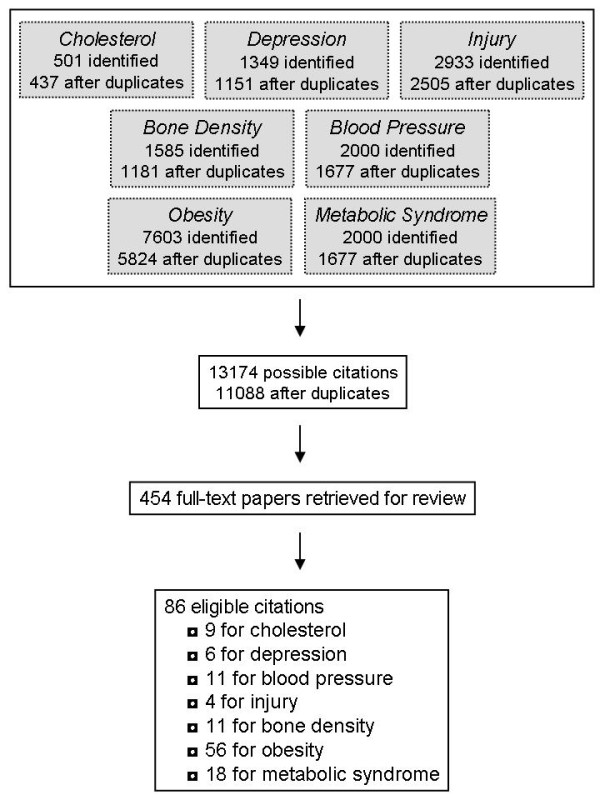
- After duplicates, 11,088 unique citations were screened; 454 full-text articles were reviewed; 86 unique citations met eligibility and 113 outcomes were abstracted. Observational studies had to report dichotomous outcomes; intervention studies were excluded if they included dietary or other behavioral components that could independently affect outcomes.
- Evidence was graded using pre-specified criteria based on quantity/quality of studies and strength of effect; meta-analyses were performed when at least 4 studies were available. RCT quality was assessed with the Downs and Black checklist, and effect sizes used Cohen’s d and ratio-score criteria.
Limitations
- Stated: unpublished and non-English studies were excluded, no extensive cross-referencing of reference lists was performed, the review was limited to 7 health outcomes, and many observational studies were excluded because they did not report dichotomous outcomes; these may have biased results and recommendations.
- Stated RCT limitations: samples were small and non-representative, statistical power was often lacking, adverse events were rarely reported, dropout details were limited, and intent-to-treat analyses were not performed; therefore Level 2 was the highest level assignable to any recommendation.
- Evident from the text: the nature of dose-response relations (linear vs curvilinear) often remained unclear, and the moderating effects of age and sex were not systematically addressed across outcomes.
Model-written summary. Check it against the paper before relying on it.
Integrity signals
Registry
Cites
Statistics
Figures
Verification
Claims the paper makes
0 Valid · 0 Not valid · 42 Not checked · 127 Own results and interpretations
A result the paper reports from its own data — it cites no other source for it, so there is none to check. The quote shows it is in the paper.
In the paper
“Results from experimental studies indicate that even modest amounts of physical activity can have health benefits in high-risk youngsters (e.g., obese).”
§ Systematic review of the health benefits of physical activity and fitness in school-aged children and youth > Abstract > Results
hedgedstates a cause- Asserted: passes — The authors put it forward as true.
- Checkable: passes — It can be checked against evidence.
- Load-bearing: passes — The paper’s conclusions depend on it.
- Based: passes — The paper gives a reason why it holds.
A result the paper reports from its own data — it cites no other source for it, so there is none to check. The quote shows it is in the paper.
In the paper
“Physical activity was associated with numerous health benefits.”
§ Systematic review of the health benefits of physical activity and fitness in school-aged children and youth > Abstract > Results
plainstates an association- Asserted: passes — The authors put it forward as true.
- Checkable: passes — It can be checked against evidence.
- Load-bearing: passes — The paper’s conclusions depend on it.
- Based: passes — The paper gives a reason why it holds.
A result the paper states — it cites no source for it, so there is none to check. The quote shows it is in the paper.
In the paper
“Aerobic-based activities had the greatest health benefit, other than for bone health, in which case high-impact weight bearing activities were required.”
§ Systematic review of the health benefits of physical activity and fitness in school-aged children and youth > Abstract > Results
plainstates an association- Asserted: passes — The authors put it forward as true.
- Checkable: passes — It can be checked against evidence.
- Load-bearing: passes — The paper’s conclusions depend on it.
- Based: passes — The paper gives a reason why it holds.
A result the paper reports from its own data — it cites no other source for it, so there is none to check. The quote shows it is in the paper.
In the paper
“The dose-response relations observed in observational studies indicate that the more physical activity, the greater the health benefit.”
§ Systematic review of the health benefits of physical activity and fitness in school-aged children and youth > Abstract > Results
hedgedstates an association- Asserted: passes — The authors put it forward as true.
- Checkable: passes — It can be checked against evidence.
- Load-bearing: passes — The paper’s conclusions depend on it.
- Based: passes — The paper gives a reason why it holds.
None of the sources cited for this claim have been checked yet.
In the paper
“The results indicated that unfit girls, defined as the lowest 20% fit, were 1.89 (95% confidence interval: 1.12-3.17) times more likely to have hypercholesterolemia and 1.03 (0.74-1.43) times more likely to have a low HDL-cholesterol by comparison to moderately and high fit girls.”
§ Systematic review of the health benefits of physical activity and fitness in school-aged children and youth > Results > Cholesterol and blood lipids
hedgedstates an associationn = 3,110- Asserted: passes — The authors put it forward as true.
- Checkable: passes — It can be checked against evidence.
- Load-bearing: passes — The paper’s conclusions depend on it.
- Based: passes — The paper gives a reason why it holds.
103 more claims
Create a free account to see all 169 claims and every source verdict.
- Probably not a substantial claim. 26
- The quote only partly states this claim. 2
- It may state two separate claims as one. 37
Claims other papers make about this one
Each is checked against this paper’s own text: does it say what the citing paper says it does?
The source backs part of the claim, not all of it — or backs it for a different population, condition or comparison.
In the citing paper
“Research indicates that those who are physically active show or report better overall physical and mental health, a higher level of fitness and a lower level of obesity than their sedentary or physically inactive counterparts1–4”
From Physical activity and health in Chinese children and adolescents: expert consensus statement (2020) (2020) · cites this paper as [2]
Experimental — accuracy not yet measuredThe cited source says what the claim attributes to it.
In the citing paper
“The association with overweight/obesity tends to be stronger when moderate to vigorous-intensity physical activities are performed.2”
From Physical activity and health in Chinese children and adolescents: expert consensus statement (2020) (2020) · cites this paper as [2]
The cited source says what the claim attributes to it.
In the citing paper
“Among physical activity interventions, the effects of physical activity independent of dietary changes on measures indicative of weight reduction (eg, BMI, total fat, abdominal fat) tend to be in the small range.2”
From Physical activity and health in Chinese children and adolescents: expert consensus statement (2020) (2020) · cites this paper as [2]
The cited source says what the claim attributes to it.
In the citing paper
“In general, as the level of physical activity increases, the likelihood of injury increases.2”
From Physical activity and health in Chinese children and adolescents: expert consensus statement (2020) (2020) · cites this paper as [2]
The cited source says what the claim attributes to it.
In the citing paper
“Systematic reviews have shown that physical activity (PA) is associated with greater mental health, 6 and a reduced risk of mental ill-health, specifically depression and anxiety.7,8”
From Domain-Specific Physical Activity and Mental Health: A Meta-analysis (2017) · cites this paper as [8]
2 more claims about this paper
Create a free account to see every claim other papers make about this one.
Self-check
Percentages, sums and reported differences re-computed from the paper’s own numbers.
Each contradiction between two passages listed here was confirmed by an independent check.
Rated major: it would touch a result — a value a result rests on, reported and recomputed p-values on opposite sides of the significance level, two passages that conflict with no sign which is right, or a cited work retracted before this paper was published.
In the paper
§ Systematic review of the health benefits of physical activity and fitness in school-aged children and youth > Discussion > Recommendations based on systematic review
“More vigorous intensity activities should be incorporated or added when possible, including activities that strengthen muscle and bone. [Level 3, Grade B].”
§ Systematic review of the health benefits of physical activity and fitness in school-aged children and youth > Discussion > Recommendations based on systematic review
“This recommendation was given a lower grade (Grade C) because of the potential increase in injury risk associated with more vigorous intensity activities and sports.”
Rated minor: it would not touch a result — a value no result rests on, a p-value that stays on the same side of the significance level, or a conflict that is clerical, resolved elsewhere in the paper, or outside its own findings.
In the paper
§ Systematic review of the health benefits of physical activity and fitness in school-aged children and youth > Results > Metabolic syndrome
“Sixteen articles examining the metabolic syndrome met the inclusion criteria.”
§ Systematic review of the health benefits of physical activity and fitness in school-aged children and youth > Results > Metabolic syndrome
“Eight of the 17 identified studies were observational in nature”
Rated minor: it would not touch a result — a value no result rests on, a p-value that stays on the same side of the significance level, or a conflict that is clerical, resolved elsewhere in the paper, or outside its own findings.
In the paper
“A total of 31 observational studies (24 cross-sectional, 3 prospective cohort, 2 case-control, 1 mixed) were retrieved”
§ Systematic review of the health benefits of physical activity and fitness in school-aged children and youth > Results > Overweight and obesity
Reported 31 · recomputed 30
Rated minor: it would not touch a result — a value no result rests on, a p-value that stays on the same side of the significance level, or a conflict that is clerical, resolved elsewhere in the paper, or outside its own findings.
In the paper
“437 citations were identified for cholesterol, 1151 for depression, 2505 for injury, 1181 for bone density, 1677 for blood pressure, 5824 for obesity, and 1677 for the metabolic syndrome. Thus, the grand total was 13174.”
§ Systematic review of the health benefits of physical activity and fitness in school-aged children and youth > Results > Literature review
Reported 13174 · recomputed 14452
Citations
Cites
Downs, S. H., & Black, N. (1998) · Journal of Epidemiology and Community Health · doi:10.1136/jech.52.6.377 · Cited by 8,252
Evidence Based Physical Activity for School-age Youth
Strong, W. B., Malina, R. M., Blimkie, C. J. R., Daniels, S. R., Dishman, R. K., Gutin, B., Hergenroeder, A. C., Must, A., Nixon, P. A., Pivarnik, J. M., et al. (2005) · The Journal of Pediatrics · doi:10.1016/j.jpeds.2005.01.055 · Cited by 4,222
Systematic Reviews: Synthesis of Best Evidence for Clinical Decisions
Cook, D. J., Mulrow, C. D., & Haynes, R. B. (1997) · Annals of Internal Medicine · doi:10.7326/0003-4819-126-5-199703010-00006 · Cited by 2,184
Andersen, L. B., Harro, M., Sardinha, L. B., Froberg, K., Ekelund, U., Brage, S., & Anderssen, S. A. (2006) · The Lancet · doi:10.1016/s0140-6736(06)69075-2 · Cited by 1,473
Lau, D. C. W., Douketis, J. D., Morrison, K. M., Hramiak, I. M., Sharma, A. M., Ur, E., & Panel, F. M. O. T. O. C. C. P. G. E. (2007) · Canadian Medical Association Journal · doi:10.1503/cmaj.061409 · Cited by 1,154
Paterson, D. H., & Warburton, D. E. (2010) · International Journal of Behavioral Nutrition and Physical Activity · doi:10.1186/1479-5868-7-38 · Cited by 953
A systematic review of the evidence for Canada's Physical Activity Guidelines for Adults
Warburton, D. E., Charlesworth, S., Ivey, A., Nettlefold, L., & Bredin, S. S. (2010) · International Journal of Behavioral Nutrition and Physical Activity · doi:10.1186/1479-5868-7-39 · Cited by 902 · cited 1×
“This report was part of a much larger project around Canada's physical activity guidelines, and comparable systematic reviews for adults [ 10 ] and older adults [11] have also been published in the journal.”
A meta-regression to examine the relationship between aerobic fitness and cognitive performance
Etnier, J. L., Nowell, P. M., Landers, D. M., & Sibley, B. A. (2006) · Brain Research Reviews · doi:10.1016/j.brainresrev.2006.01.002 · Cited by 749
Is the Canadian childhood obesity epidemic related to physical inactivity?
Tremblay, M. S., & Willms, J. D. (2003) · International Journal of Obesity · doi:10.1038/sj.ijo.0802376 · Cited by 517
Nassis, G. P., Papantakou, K., Skenderi, K., Triandafillopoulou, M., Kavouras, S. A., Yannakoulia, M., Chrousos, G. P., & Sidossis, L. S. (2005) · Metabolism · doi:10.1016/j.metabol.2005.05.013 · Cited by 469
Research works printed but not linked: 1
- Petitti DB Meta-Analysis, Decision Analysis, and Cost-Effective Analysis 1994 New York, NY: Oxford University Press
Cited by
Items 3,901–4,000 of 4,834
A PRÁTICA DE MUSCULAÇÃO POR PESSOAS COM OSTEOPOROSE: UM ESTUDO DE REVISÃO
dos PASSOS, A. G., Loureiro, W., & SOEIRO, L. B. (2022) · doi:10.48209/978-65-89949-14-8
Effects of an 8-Week Physical Education Training Program on Physical Fitness in U17–U18 Students
Valiyev, Y., Aliyev, S., Tagiyev, A., Huseynova, K., HASANOV, T., & Aliyev, N. (2026) · Physical Education Theory and Methodology · doi:10.17309/tmfv.2026.3.08
OS EFEITOS DA ATIVIDADE FÍSICA REGULAR NA GESTAÇÃO
AVANCINI, M. L. D. S., & Loureiro, W. (2022) · doi:10.48209/978-65-89949-16-8
Mosha, M., Kasagama, E., Ayieko, P., Todd, J., Msuya, S. E., Grosskurth, H., & Filteau, S. (2021) · AAS Open Research · doi:10.12688/aasopenres.13118.4 · Cited by 1
Eddolls, W. T. B. (2018) · Cronfa (Swansea University) · doi:10.23889/suthesis.48137
Perceived Benefits and Barriers to Participation in Exercise among Jordanian University Students
Hamdan, K. M. (2020) · Al-Balqa Journal for Research & Studies · doi:10.35875/1105-023-995-010
Optimization of Lung Vital Capacity to Improve Athlete Fitness
Munadi, M., Suhanda, R., Zulkarnain, Z., et al. (2024) · Journal Of Social Research · doi:10.55324/josr.v3i4.1988
“Sports are part of physical activity carried out, aiming at the formation of body muscle or physical that is carried out regularly and periodically (Ruegsegger &; Booth, 2018; (Janssen & LeBlanc, 2010)).”
BackgroundDworska, K., & Romaneczko, J. (2023) · Psychologia Rozwojowa · doi:10.4467/20843879pr.22.024.18083
Epidemiology of Primary Hypertension in Children
Redwine, K. M. (2017) · Springer eBooks · doi:10.1007/978-3-319-31420-4_46-1 · Cited by 1
Sport participation levels among New York City’s kids remain low months after the COVID-19 pandemic
Jeong, Y., Salunga, A., Karamitopoulos, M. S., & Carter, C. W. (2024) · Discover Public Health · doi:10.1186/s12982-024-00312-9
Exploring Infant Physical Activity Using a Population-based Network Analysis ApproachPreprint
Thelagathoti, R. K., Chaudhary, P., Knarr, B. A., et al. (2023) · Research Square · doi:10.21203/rs.3.rs-3272703/v1
SELECTED DAILY REGIME ACTIVITIES AMONG ADOLESCENT GIRLS - TROJAN HORSE OF GESTATIONAL OBESITY?
Bašková, M., Kopčáková, J., & Baška, T. (2017) · Central European Journal of Nursing and Midwifery · doi:10.15452/cejnm.2017.08.0020
Ability of a Game-Based Intervention to Promote Physical Activity in
Children, M., Haua-Navarro, K., Irene, M.-L. L., Rodrigo, R.-A., Bertha, P.-L. A., Pérez‐Rodríguez, M., & Guillermo, M.-M. (2013)
Turner, R. (2017) · TSpace (University of Toronto)
EFFECT OF SUDARSHAN KRIYA YOGA ON PHYSIOLOGICAL VARIABLES IN MEDICAL STUDENTS
Ahmad, N., Goel, R. K., & Chaudhary, L. (2014)
Haidar, L. A., Heredia, N. I., Springer, A. E., & Hoelscher, D. M. (2025) · Family & Community Health · doi:10.1097/fch.0000000000000444 · Cited by 1
Le bien-être des élèves : Aperçu
OECD (2018) · Programme international pour le suivi des acquis des élèves · doi:10.1787/9789264288850-5-fr · Cited by 2
The Association Between Physical Activity and Carotid Intima-Media Thickness in Children
Darvesh, N. (2014) · ERA: Education and Research Archive (University of Alberta) · doi:10.7939/r3b27pz1m
Cidade ativa: considerações sobre a cidade saudável
Gallo, D. L. L. (2025) · Cadernos Metrópole · doi:10.1590/2236-9996.2025-6363255-pt
Monacis, D., Pascali, G., Annoscia, S., & Colella, D. (2024) · Studia Universitatis Babeş-Bolyai Educatio Artis Gymnasticae · doi:10.24193/subbeag.68(4).31
The Limits of AI-Driven Mobility Data in Children’s Leisure Research
Han, J., & Hipp, J. A. (2026) · Leisure Sciences · doi:10.1080/01490400.2026.2710239
“…of research also suggests that playground quality and design are associated with children’s moderate-to-vigorous physical activity (MVPA) levels, an important health indicator (Cohen et al., 2023; Gustat et al., 2023; Janssen & Leblanc, 2010; U.S. Department of Health and Human Services, 2018).”
PHYSICAL ACTIVITY IN ADOLESCENTS: APPLICATION OF CONSTRUCTS FROM THE TRANSTHEORETICAL MODEL
Schoenfield, K. C. (2014) · Research Exchange (Washington State University) · Cited by 1
Maternal Self-Efficacy and the Relation with Children’s Dietary Behaviors in the Digital Era
Zambetti, E., Crepaldi, M., Orgiu, F., Brivio, F., Colombi, M., Ince, A., Palestini, P., Cazzaniga, E., & Greco, A. (2025) · Dietetics · doi:10.3390/dietetics5010001 · Cited by 1
“Along with that, regular physical activity has been shown to play a crucial role in maintaining a healthy lifestyle, both physically [30] and mentally [31,32].”
Akıllıoğlu, O. (2025) · Göbeklitepe eğitim ve spor bilimleri dergisi.
Jordán, C., Pastor-Vicedo, J., Madrona, P. G., & Chuliá, M. Á. T. (2014)
Developing Dance Sport Model for Children Aged 7-12
Liu, Q. (2025) · International Journal of Sociologies and Anthropologies Science Reviews · doi:10.60027/ijsasr.2025.5735
A gyerekek egészsége és a humán tőke
Kollányi, Z. K., & Sándor, J. (2026) · Educatio · doi:10.1556/2063.2025.00025
Certificació de l'aptitud esportiva en l'edat pediàtrica
Cuixart, D. B. I., Mónaco, M., Violán, M., Bellver, M., Porcar, C., & Calvo, M. (2014) · Pediatria catalana: butlletí de la Societat Catalana de Pediatria
Genç Futbolcularda Uzun Vadeli Atletik Gelişim
Ünver, D. (2024) · Özgür Yayınları eBooks · doi:10.58830/ozgur.pub636.c2797 · Cited by 1
Evidence and Implementation of Physical Activity and Exercise
Jáuregui-Ulloa, E. E., & Lopez-Taylor, J. R. (2019) · Springer eBooks · doi:10.1007/978-3-030-11815-0_31
Calahorro-Cañada, F. (2016) · Apunts Educación Física y Deportes
Lee, J., Golloher, A., & Chang, S. H. (2023) · Journal of Physical Education Recreation & Dance · doi:10.1080/07303084.2022.2136883
PERFIL TENSIONAL EM INDIVÍDUOS UNIVERSITÁRIOS QUE PRATICAM DESPORTO VERSUS SEDENTÁRIOS
Conceição, B. R., Rodrigues, A. F. P., & Coelho, P. M. D. S. C. (2026) · Revista de Geopolítica · doi:10.56238/revgeov17n4-134
Miros, J., & Maltais, D. B. (2013)
Leukaemia incidence in children aged 0-14, 2012
(2017) · Health at a glance · doi:10.1787/health_glance-2017-graph104-en
Building Social Equity and Well-Being Through Physical Education and Sport
Echague, E. T., Aseron, D., Hilario, J. C., Lacupanto, J. O., Lubis, F. T., & Santiago, A. L. P. (2026) · IGI Global eBooks · doi:10.4018/979-8-3373-9430-5.ch010
Gli abusi sui minorenni nello sport: prevalenza, tipologie e direttive Europee
Fontanesi, L., Planzo, O., & Cosi, G. (2024) · MALTRATTAMENTO E ABUSO ALL INFANZIA · doi:10.3280/mal2023-003003
Epidemiologie körperlich-sportlicher Aktivität
Mewes, N. (2015) · Elsevier eBooks · doi:10.1016/b978-3-437-24255-7.00002-5 · Cited by 1
Cavalcanti, L. M. L. G., da Silva, A. O., Soares, F. C., et al. (2020) · Revista Brasileira de Ciências da Saúde · doi:10.22478/ufpb.2317-6032.2020v24nsupl.2.48169
ÖZATİK, Y., & Gök, U. (2022) · Journal of Advanced Education Studies · doi:10.48166/ejaes.1214508 · Cited by 1
Salihan, S., Yaacob, A., Goh, J. H., Hafidz, H. A., & Ramlan, S. R. S. (2024) · Lecture notes in bioengineering · doi:10.1007/978-981-97-4186-1_13
Finelli, C. (2013) · Journal of Obesity & Weight loss Therapy · doi:10.4172/2165-7904.1000183
How do youth perspectives on physical activity differ across childhood?
Mailey, E. L., Montney, J. L., Talley, M., Sanders, C., Garcia, J., Stephens, S., & Dlugonski, D. (2022) · Leisure Studies · doi:10.1080/02614367.2022.2157468 · Cited by 3
“…which is concerning because inactive youth are deprived of the many benefits of physical activity, including improved cardiometabolic and bone health, improved cognitive function, and reduced risk of depression (Janssen & LeBlanc, 2010; USDHHS U.S. Department of Health and Human Services, 2018).”
BackgroundDiscovering the essence of a microadventure
Young, R. (2018) · UVic’s Research and Learning Repository (University of Victoria)
Kortekaas, K. H. (2025) · Cities and nature · doi:10.1007/978-3-031-76890-3_18
Zhang, Y., Burford, K. G., Pérez, A., Lanza, K., Salvo, D., Baker, B. A., & Hoelscher, D. M. (2025) · Preventive Medicine Reports · doi:10.1016/j.pmedr.2025.103328
“Youth who engage in higher intensity and amounts of physical activity experience improved cardiometabolic health, bone health, cardiorespiratory fitness, and adiposity status, among other health benefits (Janssen and LeBlanc, 2010).”
Hill, K. (2015) · ACSMʼs Health & Fitness Journal · doi:10.1249/fit.0000000000000106
Niños Sanos, Familia Sana: Lesson Plans, Year 1, Focus on Family Foods
Kaiser, L. L., Aguilera, A., Silva, J., Horowitz, M., Lamp, C. L., Johns, M., Espinoza, D. M., Byrnes, M., Ontai, L., & Rios, D. I. (2019) · doi:10.3733/ucanr.8583
Derigny, T. (2022) · theses.fr (ABES) · doi:10.70675/4daa0e77zefbfz4270zbbf5zc0a7c77b96d8 · Cited by 7
Salas-Gómez, D., Denche-Zamorano, Á. M., Chimento‐Díaz, S., & My works are correct, B. M. I. A. A. I. S. R. L. M. T. I. D. A.-M. (2026) · Child Indicators Research · doi:10.1007/s12187-026-10393-4 · Cited by 1
“Scientific evidence suggests that reg - ular participation in PA during childhood and adolescence is associated with multiple benefits for both physical and psychological health (Janssen & LeBlanc, 2010 ).”
Prescribed medicines skipped due to cost, 2016 (or nearest year)
(2017) · Health at a glance · doi:10.1787/health_glance-2017-graph56-en
Share of foreign-trained doctors, 2015 (or nearest year)
(2017) · Health at a glance · doi:10.1787/health_glance-2017-graph146-en
Rectal cancer five-year net survival, 2000-04 and 2010-14
(2017) · Health at a glance · doi:10.1787/health_glance-2017-graph102-en
Karácsony, I., & Hideg, G. (2024) · Research Square · doi:10.21203/rs.3.rs-5353185/v1
Development and Implementation of A School-Based Physical Activity Intervention
Davidson, M. (2016) · Griffith Research Online · doi:10.25904/1912/60
Objectively measured sedentary behaviour, physical activity and health in adolescent females
Dowd, K. (2012) · University of Limerick Institutional Repository (University of Limerick) · doi:10.34961/7228
Psychosocial mechanisms underpinning motivation in youth sports participants
Curran, T. (2013) · White Rose eTheses Online (University of Leeds, The University of Sheffield, University of York)
Educational Psychology: An International Journal of Experimental Educational Psychology
Leptokaridou, E. T., Vlachopoulos, S. P., & Papaioannou, A. G. (2014)
Remuneration of hospital nurses, ratio to average wage, 2015 (or nearest year)
(2017) · Health at a glance · doi:10.1787/health_glance-2017-graph143-en
Engaging children and young people in physical activity
Lewis, K. (2015) · University of Huddersfield Repository (University of Huddersfield) · Cited by 1
Kujach, S., Olek, R. A., & Laskowski, R. (2025) · Advances in neurobiology · doi:10.1007/978-981-95-0066-6_13
Cañada, F. C., Torres‐Luque, G., Fernández, I. L., & Carnero, E. Á. (2014)
Foreign body left in during procedure, 2015 (or nearest year)
(2017) · Health at a glance · doi:10.1787/health_glance-2017-graph89-en
A educação física e a prevenção da obesidade infantil no ensino fundamental II
Brandão, D. C., Paula, A. L. D., Romcy, D. M. L., Silva, N. H. D., & Soares, S. L. (2019) · Conhecimento & Diversidade · doi:10.18316/rcd.v10i22.4748
Physical Activities Associated with Overweight and Obesity among University Students in Jeddah
Qahwaji, D. M., Elkholy, T., Kensarah, E., Al-Amoudi, S., & Al-Sharif, S. (2015) · Egyptian Journal of Chemistry and Environmental Health · doi:10.21608/ejceh.2015.253716
Polo-Recuero, B. (2021) · UPM Digital Archive (Technical University of Madrid) · doi:10.20868/upm.thesis.66468 · Cited by 1
The association between physical activity during preschool hours and early numeracy
Stalchenko, N., Vanhala, A., Korhonen, J., & Pirjo Aunio, A. (2023) · Journal of Early Childhood Education Research · doi:10.58955/jecer.127930 · Cited by 5
“Early childhood is a crucial period for the development of skills linked to academic achievements (Duncan et al., 2007) and both physical and mental well-being (Janssen & LeBlanc, 2010).”
BackgroundOjukwu, C. P., Judith, O. C., Onyekwelu, A. I., Eleje, C. U., Ekowa, J. L., & Fatai, K. E. (2026) · PLoS ONE · doi:10.1371/journal.pone.0351523
“Parents often act as “choice architects” by determining the value placed on active play, allocating time for participation, facilitating access to recreational opportunities, and investing resources in extracurricular activities [1,11].”
Tao, F., Zhang, Y., Wu, X., Wang, Q., Zong, Q., Wang, R., & Li, T. (2020) · Research Square · doi:10.21203/rs.3.rs-80576/v1 · Cited by 1
Cardwell, F. S. (2019) · UWSpace (University of Waterloo)
de Ferranti, S. D., Teng, J. E., Arslanian, S. A., Atz, A. M., Brothers, J. A., Cartoski, M. J., Freemon, D., Magge, S. N., Mahle, W. T., Mietus‐Snyder, M., et al. (2025) · American Heart Journal · doi:10.1016/j.ahj.2025.107327 · Cited by 2
How to beat the ‘freshman five’ weight gain
Barbour‐Tuck, E. (2018) · doi:10.64628/aam.hc4ghgq94
Coordenação motora como preditora da aptidão física de meninos pré-púberes
Luz, L. G. D. O., Neto, G. D. A. M., Luz, T. D. D., et al. (2019) · LA Referencia (Red Federada de Repositorios Institucionales de Publicaciones Científicas) · doi:10.1590/1980-0037.2019v21e56205
Hussain, I., MacLeod, J., Dunn, F., Bickel, P. E., Abreu, M., McNulty, N., Lingvay, I., Kermani, A., & Abreu, M. (2020) · American Diabetes Association eBooks · doi:10.2337/9781580406314.ch03
Spence, J. C., Faulkner, G., Lee, E., Berry, T. R., Cameron, C., Deshpande, S., Latimer‐Cheung, A. E., Rhodes, R. E., & Tremblay, M. S. (2018) · Promotion de la santé et prévention des maladies chroniques au Canada · doi:10.24095/hpcdp.38.4.04f
Living Well With Type 1 Diabetes in Middle School: A Student‐Centered Perspective
Joing, I., Marais, G., Huchez, A., Lespagnol, É., & Heyman, E. (2026) · Psychology in the Schools · doi:10.1002/pits.70172 · Cited by 1
Borner, K. B. (2013) · KU ScholarWorks (The University of Kansas)
Impact of Exercise on Depression, Anxiety, and Self-Esteem Among AdolescentsPreprint
Tomar, D. A. (2026) · Research Square · doi:10.21203/rs.3.rs-10572984/v1
Prevalence of dementia across all OECD countries by age group, 2017
(2017) · Health at a glance · doi:10.1787/health_glance-2017-graph196-en · Cited by 1
Acar, E. A., ERBAŞ, Y. H., Apaydın, S., & Tarhan, Z. (2025) · Afet ve Risk Dergisi · doi:10.35341/afet.1526097 · Cited by 1
Editorial: Ser professor com a ajuda de Nietzsche (1)
dos Santos, J. A. R. (2018) · Revista Portuguesa de Ciências do Desporto · doi:10.5628/rpcd.18.02.09
Pressão arterial elevada e agregação de fatores de risco em adolescentes: um estudo multicêntrico
de Moraes, A. C. F. (2014) · Digital Library of Theses and Dissertations (Universidade de São Paulo) · doi:10.11606/t.5.2018.tde-18042018-084856
Leão, M., Jerónimo, A. M., Calado, R., Galo, E., Galhardo, J., Neves, J. F., Sousa, M., Carvalho, I., Andrada, M., Santos, M., et al. (2025) · Research Square · doi:10.21203/rs.3.rs-6991234/v1
Healthy lifestyles among adults
OECD (2017) · Health at a glance · doi:10.1787/health_glance-2017-19-en
Hartono, R. E., Kandarina, B. I., & Helmyati, S. (2016) · Jurnal Gizi dan Dietetik Indonesia (Indonesian Journal of Nutrition and Dietetics) · doi:10.21927/ijnd.2015.3(3).139-148
Annamayra, A., Ramli, R. S., & Nur, L. (2022) · Jurnal MAENPO Jurnal Pendidikan Jasmani Kesehatan dan Rekreasi · doi:10.35194/jm.v12i2.2732 · Cited by 6
The Effect of Increased Physical Activity on Academic Performance
Willis, L. M. (2019) · UKnowledge (University of Kentucky) · doi:10.13023/etd.2019.072
Metadata
- Authors
- Janssen, I., & LeBlanc, A. G.
- Affiliations
- Queen's University (CA)
- Corresponding author
- Janssen, Ian
- Venue
- International Journal of Behavioral Nutrition and Physical Activity
- Published
- 2010
- Volume
- 7
- Issue
- 1
- Pages
- 40
- ISSN
- 1479-5868 (ISSN-L)
- PMC
- PMC2885312
- OpenAlex
- W2145702257
- Semantic Scholar
- ef8d55efd11b9d5e4a4814b6a38ff3d60d820d37
- Cited by
- 4,829
- References
- 116
- Citations by year
- 2026: 185 · 2025: 257 · 2024: 310 · 2023: 304 · 2022: 371 · 2021: 451 · 2020: 459 · 2019: 401 · 2018: 387 · 2017: 490 · 2016: 302 · 2015: 280 · 2014: 250 · 2013: 191 · 2012: 109
- FWCI
- 12.18
- Type
- journal article
- Language
- en
- Open access
- gold
- doi.org
- Licence
- cc-by
- Locations
- International Journal of Behavioral Nutrition and Physical Activity (publishedVersion, cc-by)
- PubMed Central (publishedVersion, cc-by)
- PubMed (publishedVersion)
- DOAJ (DOAJ: Directory of Open Access Journals) (submittedVersion, cc-by-sa)
- Funders
- Public Health Agency of Canada
- Public Health Agency
- Topics
- Health Sciences › Medicine › Public Health, Environmental and Occupational Health › Physical Activity and Health
- Health Sciences › Medicine › Public Health, Environmental and Occupational Health › Obesity, Physical Activity, Diet
- Social Sciences › Life-span and Life-course Studies › Recreational Sport and Physical Activity
- Keywords
- physical activity, physical fitness, school-aged children, youth, health benefits, serum cholesterol, blood pressure, metabolic syndrome, childhood obesity, bone mineral density, depression, injuries, dose-response relationship, aerobic exercise, physical activity guidelines
About these checks
Registry, retraction, Cites and statistics results are computed, not judged, with one exception: a printed reference that no index lists is read once by a model before it counts as a citation error. Claims are extracted by a model and kept only when their quote appears verbatim in the text; each cited source is then checked, with a model’s help, for whether it says what the claim relies on. Those verdicts can be wrong — read the claim’s quote and the cited source before relying on one.
A language model drew the claims from the paper on 2026-10-10, under version 3 of the claim definition (model deepseek-v4.1-flash, prompt extract-v3).
A second model labelled each claim on 2026-10-10 (model jev-1.13-20260917, definition revision gold-guideline-v0.2).
Statistics and arithmetic are recomputed, not judged.
Confidence bands are shown only for fields calibrated on our annotated test set. None is calibrated yet, so no band is shown.
What counts as a claim ›How we measure confidence ›How we check this ›
Are you an author, or do you see a problem with this page? Request a review
Data sources
Bibliographic data: Semantic Scholar, OpenAlex, Crossref.
Contains information from the Semantic Scholar Academic Graph Datasets, made available under the ODC Attribution License (ODC-BY 1.0).
Semantic Scholar’s data is described in: Kinney, R., et al. (2023). The Semantic Scholar Open Data Platform. arXiv:2301.10140.
