

The DOI matches its Crossref record; 2 of the 2 references it cites were found in a registry or an index.
MicroRNA-503 inhibits the G1/S transition by downregulating cyclin D3 and E2F3 in hepatocellular carcinoma
Abstract
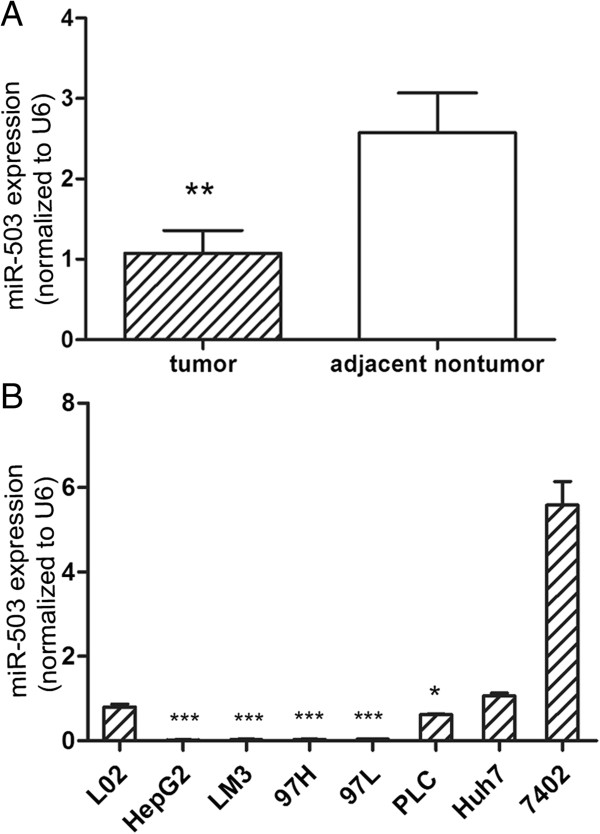
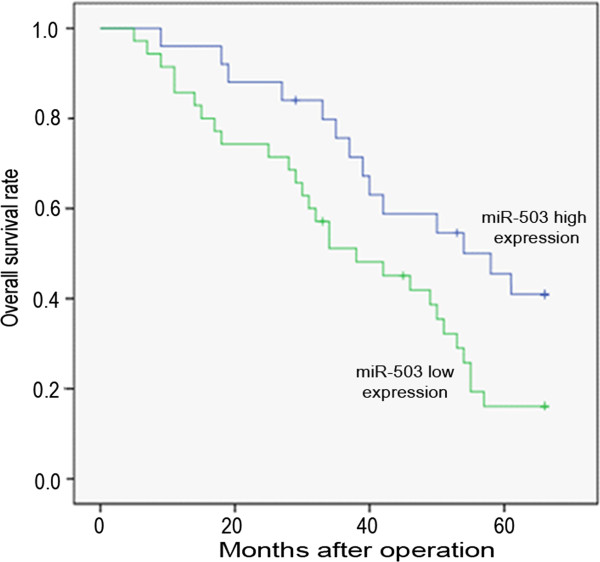
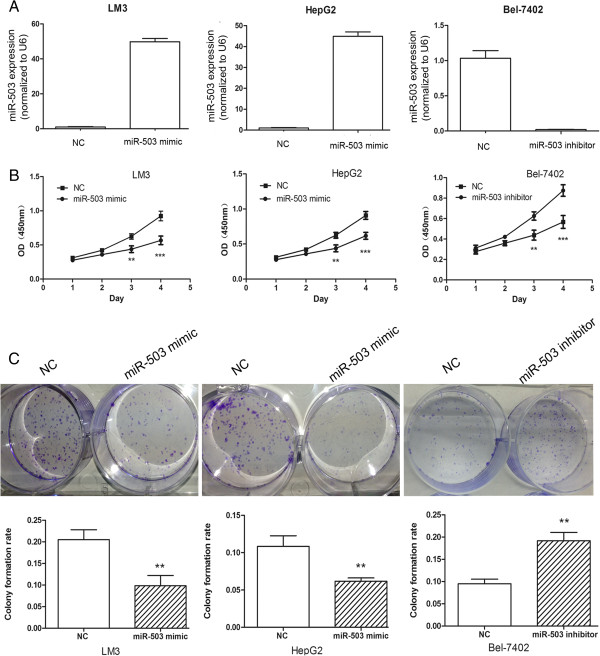
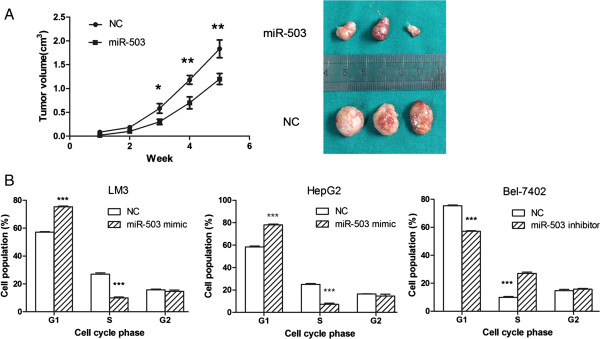
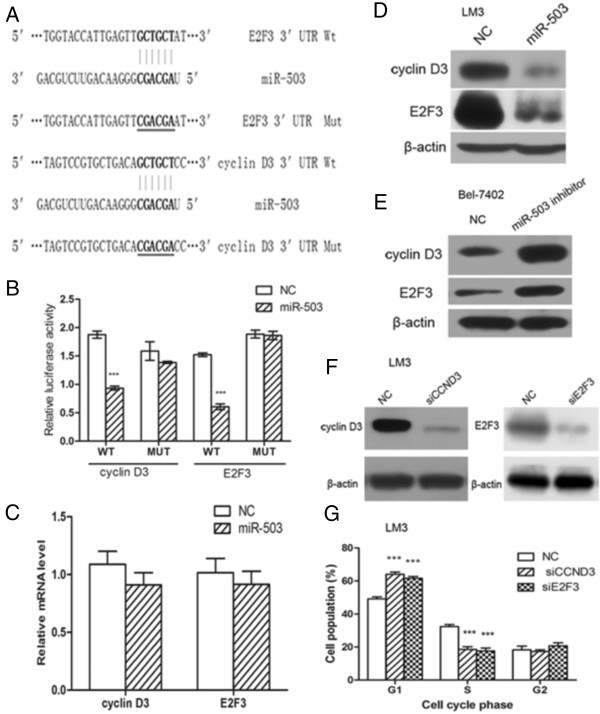
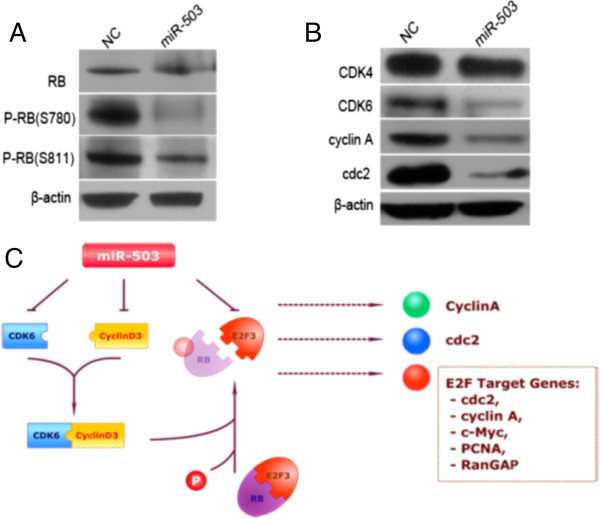
Background: Increasing evidence indicates that deregulation of microRNAs (miRNAs) is involved in tumorigenesis. Downregulation of microRNA-503 has been observed in various types of diseases, including cancer. However, the biological function of miR-503 in hepatocellular carcinoma (HCC) is still largely unknown. In this study we aimed to elucidate the prognostic implications of miR-503 in HCC and its pathophysiologic role. Methods: Quantitative reverse transcriptase polymerase chain reaction was used to evaluate miR-503 expression in HCC tissues and cell lines. Western blotting was performed to evaluate the expression of the miR-503 target genes. In vivo and in vitro assays were performed to evaluate the function of miR-503 in HCC. Luciferase reporter assay was employed to validate the miR-503 target genes. Results: miR-503 was frequently downregulated in HCC cell lines and tissues. Low expression levels of miR-503 were associated with enhanced malignant potential such as portal vein tumor thrombi, histologic grade, TNM stage, AFP level and poor prognosis. Multivariate analysis indicated that miR-503 downregulation was significantly associated with worse overall survival of HCC patients. Functional studies showed miR-503 suppressed the proliferation of HCC cells by induction of G1 phase arrest through Rb-E2F signaling pathways, and thus may function as a tumor suppressor. Further investigation characterized two cell cycle-related molecules, cyclin D3 and E2F3, as the direct miR-503 targets. Conclusion: Our data highlight an important role for miR-503 in cell cycle regulation and in the molecular etiology of HCC, and implicate the potential application of miR-503 in prognosis prediction and miRNA-based HCC therapy.
Overview
The claims and statistics of this paper haven’t been checked yet.
Run the check — free, no account needed. It reads the open-access text and checks the sources it cites.
Integrity signals
Registry
Cites
Statistics
Figures
Verification
Claims the paper makes
The claims and statistics of this paper haven’t been checked yet.
Run the check — free, no account needed. It reads the open-access text and checks the sources it cites.
Claims other papers make about this one
Each is checked against this paper’s own text: does it say what the citing paper says it does?
In the citing paper
“Several studies demonstrated the feasibility of EV-mediated transfer of specific microRNAs in the modulation of the tumor microenvironment and, consequently, its effect on the tumor growth, progression, and response to standard treatment modalities in breast cancer,224,225 hepatocellular carcinomas,226,227 and lung cancer cells in vitro.228,229,230”
From MiR-128-3p – a gray eminence of the human central nervous system (2024) · cites this paper as [226]
Self-check
Percentages, sums and reported differences re-computed from the paper’s own numbers.
The self-check needs the paper’s full text.
Citations
Cites
A brain-specific microRNA regulates dendritic spine development
Schratt, G. M., Tuebing, F., Nigh, E. A., Kane, C. G., Sabatini, M. E., Kiebler, M., & Greenberg, M. E. (2006) · Nature · doi:10.1038/nature04367 · Cited by 1,786
Caporali, A., Meloni, M., Völlenkle, C., Bonci, D., Sala-Newby, G. B., Addis, R., Spinetti, G., Losa, S., Masson, R., Baker, A. H., et al. (2011) · Circulation · doi:10.1161/circulationaha.110.952325 · Cited by 397
Research works printed but not linked: 30
- Parkin DM, Bray F, Ferlay J, Pisani P: Global cancer statistics, 2002. CA Cancer J Clin. 2005, 55: 74-108. 10.3322/canjclin.55.2.74. · DOI
- Aravalli RN, Steer CJ, Cressman EN: Molecular mechanisms of hepatocellular carcinoma. Hepatology. 2008, 48: 2047-2063. 10.1002/hep.22580. · DOI
- El-Serag HB, Rudolph KL: Hepatocellular carcinoma: epidemiology and molecular carcinogenesis. Gastroenterology. 2007, 132: 2557-2576. 10.1053/j.gastro.2007.04.061. · DOI
- Calin GA, Croce CM: MicroRNA signatures in human cancers. Nat Rev Cancer. 2006, 6: 857-866. 10.1038/nrc1997. · DOI
- Esquela-Kerscher A, Slack FJ: Oncomirs - microRNAs with a role in cancer. Nat Rev Cancer. 2006, 6: 259-269. · DOI · Paper page
- Ambros V: The functions of animal microRNAs. Nature. 2004, 431: 350-355. 10.1038/nature02871. · DOI · Paper page
- Bartel DP: MicroRNAs: genomics, biogenesis, mechanism, and function. Cell. 2004, 116: 281-297. 10.1016/S0092-8674(04)00045-5. · DOI
- Lewis BP, Burge CB, Bartel DP: Conserved seed pairing, often flanked by adenosines, indicates that thousands of human genes are microRNA targets. Cell. 2005, 120: 15-20. 10.1016/j.cell.2004.12.035. · DOI · Paper page
- Brennecke J, Hipfner DR, Stark A, Russell RB, Cohen SM: Bantam encodes a developmentally regulated microRNA that controls cell proliferation and regulates the proapoptotic gene hid in Drosophila. Cell. 2003, 113: 25-36. 10.1016/S0092-8674(03)00231-9. · DOI · Paper page
- Chen CZ, Li L, Lodish HF, Bartel DP: MicroRNAs modulate hematopoietic lineage differentiation. Science. 2004, 303: 83-86. 10.1126/science.1091903. · DOI · Paper page
- Su H, Yang JR, Xu T, Huang J, Xu L, Yuan Y, Zhuang SM: MicroRNA-101, down-regulated in hepatocellular carcinoma, promotes apoptosis and suppresses tumorigenicity. Cancer Res. 2009, 69: 1135-1142. · DOI
- Lu J, Getz G, Miska EA, Alvarez-Saavedra E, Lamb J, Peck D, Sweet-Cordero A, Ebert BL, Mak RH, Ferrando AA: MicroRNA expression profiles classify human cancers. Nature. 2005, 435: 834-838. 10.1038/nature03702. · DOI
- Yanaihara N, Caplen N, Bowman E, Seike M, Kumamoto K, Yi M, Stephens RM, Okamoto A, Yokota J, Tanaka T: Unique microRNA molecular profiles in lung cancer diagnosis and prognosis. Cancer Cell. 2006, 9: 189-198. 10.1016/j.ccr.2006.01.025. · DOI · Paper page
- Iorio MV, Visone R, Di Leva G, Donati V, Petrocca F, Casalini P, Taccioli C, Volinia S, Liu CG, Alder H: MicroRNA signatures in human ovarian cancer. Cancer Res. 2007, 67: 8699-8707. 10.1158/0008-5472.CAN-07-1936. · DOI
- Murakami Y, Yasuda T, Saigo K, Urashima T, Toyoda H, Okanoue T, Shimotohno K: Comprehensive analysis of microRNA expression patterns in hepatocellular carcinoma and non-tumorous tissues. Oncogene. 2006, 25: 2537-2545. 10.1038/sj.onc.1209283. · DOI
- Liu Q, Fu H, Sun F, Zhang H, Tie Y, Zhu J, Xing R, Sun Z, Zheng X: miR-16 family induces cell cycle arrest by regulating multiple cell cycle genes. Nucleic Acids Res. 2008, 36: 5391-5404. 10.1093/nar/gkn522. · DOI
- Xu T, Zhu Y, Xiong Y, Ge YY, Yun JP, Zhuang SM: MicroRNA-195 suppresses tumorigenicity and regulates G1/S transition of human hepatocellular carcinoma cells. Hepatology. 2009, 50: 113-121. 10.1002/hep.22919. · DOI
- Lu YC, Chen YJ, Wang HM, Tsai CY, Chen WH, Huang YC, Fan KH, Tsai CN, Huang SF, Kang CJ: Oncogenic function and early detection potential of miRNA-10b in oral cancer as identified by microRNA profiling. Cancer Prev Res (Phila). 2012, 5: 665-674. 10.1158/1940-6207.CAPR-11-0358. · DOI
- Zhou J, Wang W: Analysis of microRNA expression profiling identifies microRNA-503 regulates metastatic function in hepatocellular cancer cell. J Surg Oncol. 2011, 104: 278-283. 10.1002/jso.21941. · DOI
- Betel D, Wilson M, Gabow A, Marks DS, Sander C: The microRNA.org resource: targets and expression. Nucleic Acids Res. 2008, 36: D149-153. · DOI
- Krek A, Grun D, Poy MN, Wolf R, Rosenberg L, Epstein EJ, MacMenamin P, da Piedade I, Gunsalus KC, Stoffel M, Rajewsky N: Combinatorial microRNA target predictions. Nat Genet. 2005, 37: 495-500. 10.1038/ng1536. · DOI · Paper page
- Deshpande A, Sicinski P, Hinds PW: Cyclins and cdks in development and cancer: a perspective. Oncogene. 2005, 24: 2909-2915. 10.1038/sj.onc.1208618. · DOI
- Massague J: G1 cell-cycle control and cancer. Nature. 2004, 432: 298-306. 10.1038/nature03094. · DOI
- Wang W, Zhao LJ, Tan YX, Ren H, Qi ZT: MiR-138 induces cell cycle arrest by targeting cyclin D3 in hepatocellular carcinoma. Carcinogenesis. 2012, 33: 1113-1120. 10.1093/carcin/bgs113. · DOI · Paper page
- Forrest AR, Kanamori-Katayama M, Tomaru Y, Lassmann T, Ninomiya N, Takahashi Y, de Hoon MJ, Kubosaki A, Kaiho A, Suzuki M: Induction of microRNAs, mir-155, mir-222, mir-424 and mir-503, promotes monocytic differentiation through combinatorial regulation. Leukemia. 2010, 24: 460-466. 10.1038/leu.2009.246. · DOI · Paper page
- Jiang Q, Feng MG, Mo YY: Systematic validation of predicted microRNAs for cyclin D1. BMC Cancer. 2009, 9: 194-10.1186/1471-2407-9-194. · DOI
- Roy P, Bhattacharya G, Lahiri A, Dasgupta UB, Banerjee D, Chandra S, Das M: hsa-miR-503 is downregulated in beta thalassemia major. Acta Haematol. 2012, 128: 187-189. 10.1159/000339492. · DOI
- Sarkar S, Dey BK, Dutta A: MiR-322/424 and −503 are induced during muscle differentiation and promote cell cycle quiescence and differentiation by down-regulation of Cdc25A. Mol Biol Cell. 2010, 21: 2138-2149. 10.1091/mbc.E10-01-0062. · DOI
- Zhao JJ, Yang J, Lin J, Yao N, Zhu Y, Zheng J, Xu J, Cheng JQ, Lin JY, Ma X: Identification of miRNAs associated with tumorigenesis of retinoblastoma by miRNA microarray analysis. Childs Nerv Syst. 2009, 25: 13-20. 10.1007/s00381-008-0701-x. · DOI
- Calin GA, Sevignani C, Dumitru CD, Hyslop T, Noch E, Yendamuri S, Shimizu M, Rattan S, Bullrich F, Negrini M, Croce CM: Human microRNA genes are frequently located at fragile sites and genomic regions involved in cancers. Proc Natl Acad Sci USA. 2004, 101: 2999-3004. 10.1073/pnas.0307323101. · DOI
Cited by
Sorted by citations
MiR-128-3p – a gray eminence of the human central nervous system
Kiel, K., Król, S. K., Bronisz, A., & Godlewski, J. (2024) · Molecular Therapy Nucleic Acids · doi:10.1016/j.omtn.2024.102141 · Cited by 15
Metadata
- Authors
- Xiao, F., zhang, W., Chen, L., Chen, F., Xie, H., Xing, C., Yu, X., Ding, S., Chen, K., Guo, H., Cheng, J., Zheng, S., & Zhou, L.
- Venue
- Journal of Translational Medicine
- Published
- 2013-08-22
- Volume
- 11
- Issue
- 1
- ISSN
- 1479-5876
- PMC
- PMC3765277
- Cited by
- 71
- References
- 2
- Language
- en
About these checks
Registry, retraction, Cites and statistics results are computed, not judged, with one exception: a printed reference that no index lists is read once by a model before it counts as a citation error. Claims are extracted by a model and kept only when their quote appears verbatim in the text; each cited source is then checked, with a model’s help, for whether it says what the claim relies on. Those verdicts can be wrong — read the claim’s quote and the cited source before relying on one.
Statistics and arithmetic are recomputed, not judged.
Confidence bands are shown only for fields calibrated on our annotated test set. None is calibrated yet, so no band is shown.
What counts as a claim ›How we measure confidence ›How we check this ›
Are you an author, or do you see a problem with this page? Request a review
