

Effect of carbohydrate-protein supplement timing on acute exercise-induced muscle damage
Open accessThe DOI matches its Crossref record; 28 of the 28 references it cites were found in a registry or an index.
Abstract
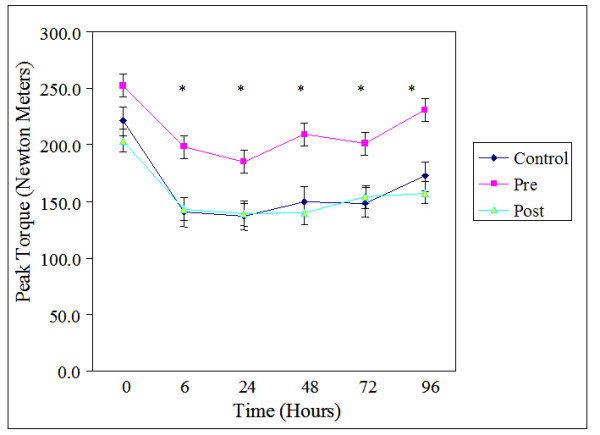
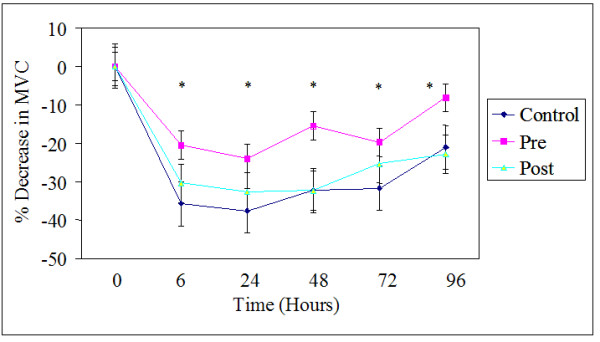
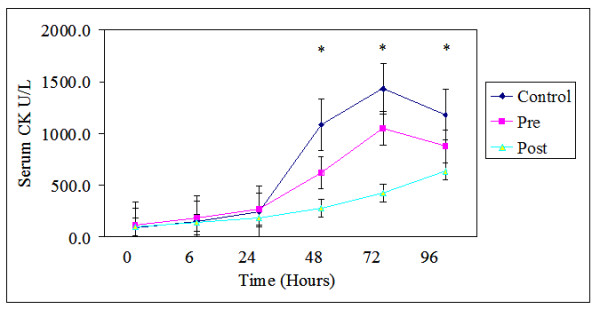
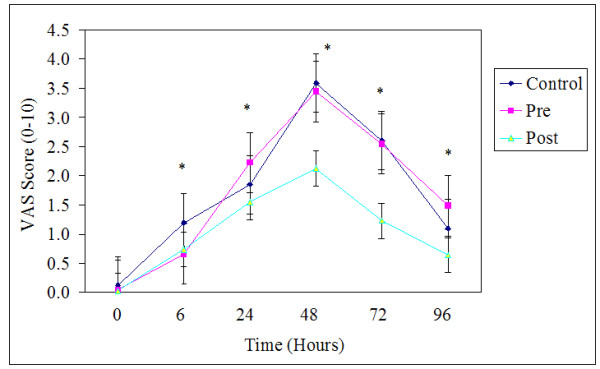
PURPOSE: To determine if timing of a supplement would have an effect on muscle damage, function and soreness. METHODS: Twenty-seven untrained men (21 +/- 3 yrs) were given a supplement before or after exercise. Subjects were randomly assigned to a pre exercise (n = 9), received carbohydrate/protein drink before exercise and placebo after, a post exercise (n = 9), received placebo before exercise and carbohydrate/protein drink after, or a control group (n = 9), received placebo before and after exercise. Subjects performed 50 eccentric quadriceps contractions on an isokinetic dynamometer. Tests for creatine kinase (CK), maximal voluntary contraction (MVC) and muscle soreness were recorded before exercise and at six, 24, 48, 72, and 96 h post exercise. Repeated measures ANOVA were used to analyze data. RESULTS: There were no group by time interactions however, CK significantly increased for all groups when compared to pre exercise (101 +/- 43 U/L) reaching a peak at 48 h (661 +/- 1178 U/L). MVC was significantly reduced at 24 h by 31.4 +/- 14.0%. Muscle soreness was also significantly increased from pre exercise peaking at 48 h. CONCLUSION: Eccentric exercise caused significant muscle damage, loss of strength, and soreness; however timing of ingestion of carbohydrate/protein supplement had no effect.
Overview
The claims and statistics of this paper haven’t been checked yet.
Free: it reads the open-access text and checks the first 5 claims that cite a source we can check. Create a free account to check every claim.
Integrity signals
Registry
Cites
Statistics
Figures
Verification
Claims the paper makes
The claims and statistics of this paper haven’t been checked yet.
Free: it reads the open-access text and checks the first 5 claims that cite a source we can check. Create a free account to check every claim.
Claims other papers make about this one
Each is checked against this paper’s own text: does it say what the citing paper says it does?
The source backs part of the claim, not all of it — or backs it for a different population, condition or comparison.
In the citing paper
“The results suggest that MPS rates can be acutely increased if a combination of carbohydrate + protein is consumed either before or after, but changes in force production or muscle damage may not be impacted by timed ingestion of a carbohydrate + protein combination.”
From International society of sports nutrition position stand: nutrient timing (2017) · cites this paper as [91]
Experimental — accuracy not yet measured
Self-check
Percentages, sums and reported differences re-computed from the paper’s own numbers.
The self-check needs the paper’s full text.
Citations
Cites
Generalized equations for predicting body density of men
Jackson, A. S., & Pollock, M. L. (1978) · British Journal of Nutrition · doi:10.1079/bjn19780152 · Cited by 3,201 · cited 1×
“Body composition was estimated using the sum of three skinfolds (chest, abdomen, thigh) following the procedures outlined by Jackson and Pollock [17].”
Reliability of the Visual Analog Scale for Measurement of Acute Pain
Bijur, P. E., Silver, W., & Gallagher, E. J. (2001) · Academic Emergency Medicine · doi:10.1111/j.1553-2712.2001.tb01132.x · Cited by 2,067 · cited 1×
“…using the visual analogue scale (VAS) which has been utilized as a valid indicator of pain in several studies [3,8,11,18] has correlated with other indices of muscle damage including MVC [8], and CK [8], and has obtained reported reliability scores as high as r = 0.97 for assessing soreness [19].”
InfluentialMyofibrillar damage following intense eccentric exercise in man
Fridén, J., Sjöström, M., & Ekblom, B. (1983) · International Journal of Sports Medicine · doi:10.1055/s-2008-1026030 · Cited by 1,005 · cited 1×
“Currently it is thought that mechanically induced trauma from physical exertion triggers a metabolic cascade of events characterized by progressive increases in microscopic indicators of muscle damage [5,6].”
The digestion rate of protein is an independent regulating factor of postprandial protein retention
Dangin, M., Boirie, Y., Garcia-Rodenas, C., Gachon, P., Fauquant, J., Callier, P., Ballèvre, O., & Beaufrère, B. (2001) · American Journal of Physiology-Endocrinology and Metabolism · doi:10.1152/ajpendo.2001.280.2.e340 · Cited by 572 · cited 1×
“It has been well established that the digestion rate of a protein or amino acid supplement can affect measures of protein balance [22].”
Tipton, K. D., Rasmussen, B. B., Miller, S. L., Wolf, S. E., Owens-Stovall, S. K., Petrini, B. E., & Wolfe, R. R. (2001) · American Journal of Physiology-Endocrinology and Metabolism · doi:10.1152/ajpendo.2001.281.2.e197 · Cited by 526 · cited 1×
“[26] found no differences between pre and post exercise whole protein ingestion on protein balance, which contrasted with past studies [27] which found greater protein balance when free form amino acids were ingested prior to rather than post exercise.”
Nissen, S., Sharp, R., Ray, M., Rathmacher, J. A., Rice, D., Fuller, J. C., Connelly, A. S., & Abumrad, N. (1996) · Journal of Applied Physiology · doi:10.1152/jappl.1996.81.5.2095 · Cited by 393
Damage to Skeletal Muscle from Eccentric Exercise
Proske, U., & Allen, T. J. (2005) · Exercise and Sport Sciences Reviews · doi:10.1097/00003677-200504000-00007 · Cited by 338 · cited 3×
“The compromised state of the myofiber triggers an inflammatory response, partly characterized by edema and subsequent swelling of the muscle tissue [25].”
InfluentialStimulation of net muscle protein synthesis by whey protein ingestion before and after exercise
Tipton, K. D., Elliott, T. A., Cree, M. G., Aarsland, A. A., Sanford, A. P., & Wolfe, R. R. (2007) · American Journal of Physiology-Endocrinology and Metabolism · doi:10.1152/ajpendo.00166.2006 · Cited by 307 · cited 1×
“[26] found no differences between pre and post exercise whole protein ingestion on protein balance, which contrasted with past studies [27] which found greater protein balance when free form amino acids were ingested prior to rather than post exercise.”
Effects of a Carbohydrate-Protein Beverage on Cycling Endurance and Muscle Damage
SAUNDERS, M. J., KANE, M. D., & TODD, M. K. (2004) · Medicine & Science in Sports & Exercise · doi:10.1249/01.mss.0000132377.66177.9f · Cited by 303 · cited 7×
“The discrepancies found in the present study compared to studies which found positive results with intact proteins and endurance exercise [1], or free form amino acids and resistance training [18] make it difficult to provide solid practical applications for sports nutritionists.”
InfluentialMetabolic changes following eccentric exercise in trained and untrained men
Evans, W. J., Meredith, C. N., Cannon, J. G., Dinarello, C. A., Frontera, W. R., Hughes, V. A., Jones, B. H., & Knuttgen, H. G. (1986) · Journal of Applied Physiology · doi:10.1152/jappl.1986.61.5.1864 · Cited by 301 · cited 2×
“3-methylhistidine is an amino acid mainly concentrated in skeletal muscle that is used as an indicator of actomyosin protein breakdown [5] and muscle fiber damage [5,14].”
Nutraceutical Effects of Branched-Chain Amino Acids on Skeletal Muscle
Shimomura, Y., Yamamoto, Y., Bajotto, G., Sato, J., Murakami, T., Shimomura, N., Kobayashi, H., & Mawatari, K. (2006) · The Journal of Nutrition · doi:10.1093/jn/136.2.529s · Cited by 288 · cited 3×
“Baseline muscle soreness was evaluated using the visual analogue scale (VAS) which has been utilized as a valid indicator of pain in several studies [3,8,11,18] has correlated with other indices of muscle damage including MVC [8], and CK [8], and has obtained reported reliability scores as high as r = 0.”
Exercise-induced muscle injury: A calpain hypothesis
Belcastro, A. N., Shewchuk, L. D., & Raj, D. A. (1998) · Molecular and Cellular Biochemistry · doi:10.1023/a:1006816123601 · Cited by 230 · cited 3×
“Background Both prolonged endurance [1,2] and short bouts of high intensity [3] exercise are associated with elevated muscle tissue damage; a process characterized by disruption of the sarcoplasmic reticulum and sarcomeric Z-line proteins [4].”
Brown, S. J., Child, R. B., Day, S. H., & Donnelly, A. E. (1997) · Journal of Sports Sciences · doi:10.1080/026404197367498 · Cited by 213 · cited 1×
“This included an isometric strength test using a maximal voluntary contraction (MVC) of the quadriceps [20].”
(2000) · PubMed · Cited by 187
Protein supplementation before and after resistance training in older men
Candow, D. G., Chilibeck, P. D., Facci, M., Abeysekara, S., & Zello, G. A. (2006) · European Journal of Applied Physiology · doi:10.1007/s00421-006-0223-8 · Cited by 158 · cited 1×
“Some indicators of muscle damage include increased levels of creatine kinase (CK), lactate dehydrogenase (LDH) and muscular soreness [7].”
Bird, S. P., Tarpenning, K. M., & Marino, F. E. (2006) · European Journal of Applied Physiology · doi:10.1007/s00421-005-0127-z · Cited by 122
Short-Term Immobilization after Eccentric Exercise. Part II: Creatine Kinase and Myoglobin
SAYERS, S. P., & CLARKSON, P. M. (2003) · Medicine & Science in Sports & Exercise · doi:10.1249/01.mss.0000064933.43824.ed · Cited by 108 · cited 2×
“However, as with past studies, [8,23,24] the CK response in the current experiment was highly variable and these results did not reach significance even when separate analyses were conducted to normalize the data, or remove possible outliers.”
Bird, S. P., Tarpenning, K. M., & Marino, F. E. (2006) · Metabolism · doi:10.1016/j.metabol.2005.11.011 · Cited by 96 · cited 1×
“[12,13] suggest that carbohydrates act synergistically with essential amino acids (EAAs) following resistance exercise to lower 3-methylhistidine levels, and increase lean body mass.”
Recovery from Run Training: Efficacy of a Carbohydrate-Protein Beverage?
Millard-Stafford, M., Warren, G. L., Thomas, L. M., Doyle, J. A., Snow, T., & Hitchcock, K. (2005) · International Journal of Sport Nutrition and Exercise Metabolism · doi:10.1123/ijsnem.15.6.610 · Cited by 84 · cited 3×
“As an example , Coombes et al. [ 9] As with free form amino acids, a combination of whole proteins/carbohydrates ingested before, after, or during endurance exercise has resulted in lowered post exercise muscle soreness [16], and plasma concentrations of both myoglobin [2] and CK [1,2].”
Callaghan, M. J., McCarthy, C. J., Al-Omar, A., & Oldham, J. A. (2000) · Clinical Biomechanics · doi:10.1016/s0268-0033(00)00032-2 · Cited by 78 · cited 1×
“89 in healthy and patient populations [21].”
Comparison of Carbohydrate and Milk-Based Beverages on Muscle Damage and Glycogen Following Exercise
Wojcik, J. R., Walberg-Rankin, J., Smith, L. L., & Gwazdauskas, F. C. (2001) · International Journal of Sport Nutrition and Exercise Metabolism · doi:10.1123/ijsnem.11.4.406 · Cited by 76 · cited 10×
“In contrast, a study which administered a milk protein and carbohydrate solution immediately following resistance training found no differences between the supplemented and placebo conditions on muscle soreness or maximal voluntary strength [3].”
InfluentialPlasma Creatine Kinase Activity and Glutathione after Eccentric Exercise
Lee, J., & Clarkson, P. M. (2003) · Medicine & Science in Sports & Exercise · doi:10.1249/01.mss.0000069553.47739.36 · Cited by 72 · cited 1×
“However, as with past studies, [8,23,24] the CK response in the current experiment was highly variable and these results did not reach significance even when separate analyses were conducted to normalize the data, or remove possible outliers.”
Muscle Damage, Fluid Ingestion, and Energy Supplementation during Recreational Alpine Skiing
Seifert, J. G., Kipp, R. W., Amann, M., & Gazal, O. S. (2005) · International Journal of Sport Nutrition and Exercise Metabolism · doi:10.1123/ijsnem.15.5.528 · Cited by 59 · cited 6×
“As with free form amino acids, a combination of whole proteins/carbohydrates ingested before, after, or during endurance exercise has resulted in lowered post exercise muscle soreness [16], and plasma concentrations of both myoglobin [2] and CK [1,2].”
InfluentialAmino Acid Mixture Improves Training Efficiency in Athletes
Ohtani, M., Sugita, M., & Maruyama, K. (2006) · The Journal of Nutrition · doi:10.1093/jn/136.2.538s · Cited by 58 · cited 6×
“The discrepancies found in the present study compared to studies which found positive results with intact proteins and endurance exercise [1], or free form amino acids and resistance training [18] make it difficult to provide solid practical applications for sports nutritionists.”
InfluentialNosaka, K., Chapman, D., Newton, M., & Sacco, P. (2006) · Applied Physiology, Nutrition, and Metabolism · doi:10.1139/h06-005 · Cited by 57 · cited 4×
“Data indicate significant correlations between MVC, plasma, functional, and reported indices of muscle damage, suggesting that MVC is a valid indirect measure of muscle damage [8].”
InfluentialThe Effect of Muscle Damage on Strength and Fatigue Deficits
BEHM, D. G., BAKER, K. M., KELLAND, R., & LOMOND, J. (2001) · Journal of Strength and Conditioning Research · doi:10.1519/00124278-200105000-00016 · Cited by 45
Is There a Physiologic Basis for Creatine Use in Children and Adolescents?
UNNITHAN, V. B., VEEHOF, S. H. E., VELLA, C. A., & KERN, M. (2001) · Journal of Strength and Conditioning Research · doi:10.1519/00124278-200111000-00021 · Cited by 18
Effect of dietary protein on calpastatin in canine skeletal muscle1
Helman, E. E., Huff-Lonergan, E. J., Davenport, G. M., & Lonergan, S. M. (2003) · Journal of Animal Science · doi:10.2527/2003.8192199x · Cited by 8 · cited 1×
“Directly, amino acids may depress pathways responsible for Z-Line disruption during the metabolic cascade triggered by mechanical trauma, [4,15] while indirect mechanisms relate to formation of specific amino acid derived metabolites, such as Beta-Hydroxy-BetaMethylbutyrate, shown in studies to lower indices of muscle…”
Cited by
International society of sports nutrition position stand: nutrient timing
Kerksick, C. M., Arent, S., Schoenfeld, B. J., Stout, J. R., Campbell, B., Wilborn, C. D., Taylor, L., Kalman, D., Smith-Ryan, A. E., Kreider, R. B., et al. (2017) · Journal of the International Society of Sports Nutrition · doi:10.1186/s12970-017-0189-4 · Cited by 622
International Society of Sports Nutrition position stand: Nutrient timing
Kerksick, C., Harvey, T., Stout, J., Campbell, B., Wilborn, C., Kreider, R., Kalman, D., Ziegenfuss, T., Lopez, H., Landis, J., et al. (2008) · Journal of the International Society of Sports Nutrition · doi:10.1186/1550-2783-5-17 · Cited by 456
Potential safety issues with blood flow restriction training
Loenneke, J. P., Wilson, J. M., Wilson, G. J., Pujol, T. J., & Bemben, M. G. (2011) · Scandinavian Journal of Medicine & Science in Sports · doi:10.1111/j.1600-0838.2010.01290.x · Cited by 275
Self-citationLow level laser therapy before eccentric exercise reduces muscle damage markers in humans
Baroni, B. M., Leal Junior, E. C. P., De Marchi, T., Lopes, A. L., Salvador, M., & Vaz, M. A. (2010) · European Journal of Applied Physiology · doi:10.1007/s00421-010-1562-z · Cited by 182
Branched-Chain Amino Acid Ingestion Can Ameliorate Soreness from Eccentric Exercise
JACKMAN, S. R., WITARD, O. C., JEUKENDRUP, A. E., & TIPTON, K. D. (2010) · Medicine & Science in Sports & Exercise · doi:10.1249/mss.0b013e3181c1b798 · Cited by 179
Metadata
- Authors
- White, J. P., Wilson, J. M., Austin, K. G., Greer, B. K., St John, N., & Panton, L. B.
- Affiliations
- University of South Carolina (US)
- Florida State University (US)
- Department of Nutrition, Food and Exercise SciencesFlorida State University FL 32306 Tallahassee USA
- Corresponding author
- White, James P
- Venue
- Journal of the International Society of Sports Nutrition
- Publisher
- Informa UK Limited
- Published
- 2008-01-03
- Volume
- 5
- Issue
- 1
- Pages
- 5-5
- ISSN
- 1550-2783 (ISSN-L)
- PMC
- PMC2288590
- OpenAlex
- W2110056911
- Cited by
- 106
- References
- 27
- Citations by year
- 2026: 1 · 2025: 1 · 2024: 2 · 2022: 7 · 2021: 4 · 2020: 5 · 2019: 6 · 2018: 2 · 2017: 12 · 2016: 8 · 2015: 3 · 2014: 9 · 2013: 16 · 2012: 7
- FWCI
- 8.23
- Type
- journal article
- Language
- en
- Open access
- gold
- doi.org
- Licence
- Locations
- Journal of the International Society of Sports Nutrition (publishedVersion, cc-by)
- PubMed Central (publishedVersion, cc-by)
- PubMed (publishedVersion)
- DOAJ (DOAJ: Directory of Open Access Journals) (submittedVersion)
- Topics
- Health Sciences › Medicine › Physiology (medical) › Exercise and Physiological Responses
- Health Sciences › Nursing › Nutrition and Dietetics › Muscle metabolism and nutrition
- Health Sciences › Medicine › Orthopedics and Sports Medicine › Sports Performance and Training
- Keywords
- eccentric exercise, creatine kinase, muscle soreness, muscle strength, quadriceps, isokinetic dynamometry, untrained men
About these checks
Registry, retraction, Cites and statistics results are computed, not judged, with one exception: a printed reference that no index lists is read once by a model before it counts as a citation error. Claims are extracted by a model and kept only when their quote appears verbatim in the text; each cited source is then checked, with a model’s help, for whether it says what the claim relies on. Those verdicts can be wrong — read the claim’s quote and the cited source before relying on one.
Statistics and arithmetic are recomputed, not judged.
Confidence bands are shown only for fields calibrated on our annotated test set. None is calibrated yet, so no band is shown.
What counts as a claim ›How we measure confidence ›How we check this ›
Are you an author, or do you see a problem with this page? Request a review
Data sources
Bibliographic data: Semantic Scholar, OpenAlex, Crossref.
Contains information from the Semantic Scholar Academic Graph Datasets, made available under the ODC Attribution License (ODC-BY 1.0).
Semantic Scholar’s data is described in: Kinney, R., et al. (2023). The Semantic Scholar Open Data Platform. arXiv:2301.10140.
