

Effect of nanoparticles on heat capacity of nanofluids based on molten salts as PCM for thermal energy storage
Open accessThe DOI matches its Crossref record; 55 of the 56 references it cites were found in a registry or an index.
Abstract
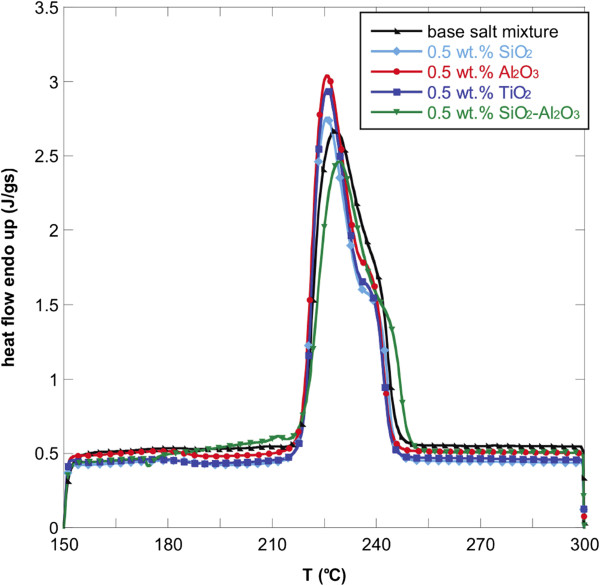
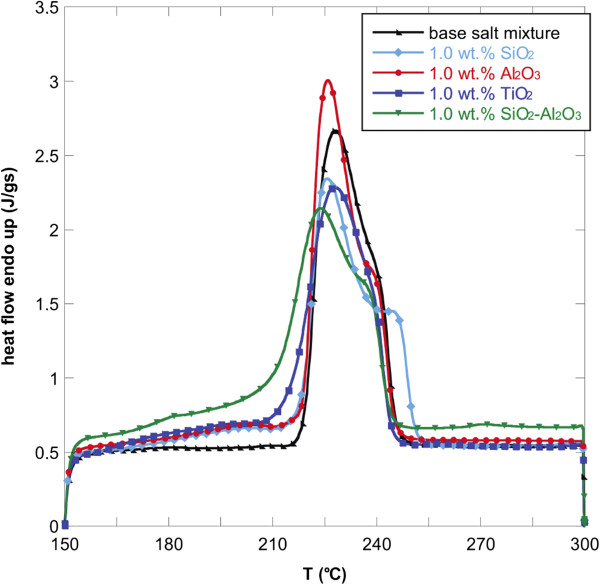
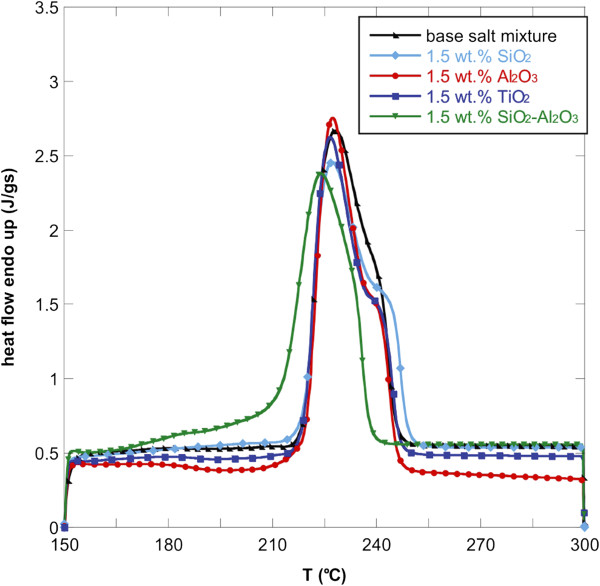
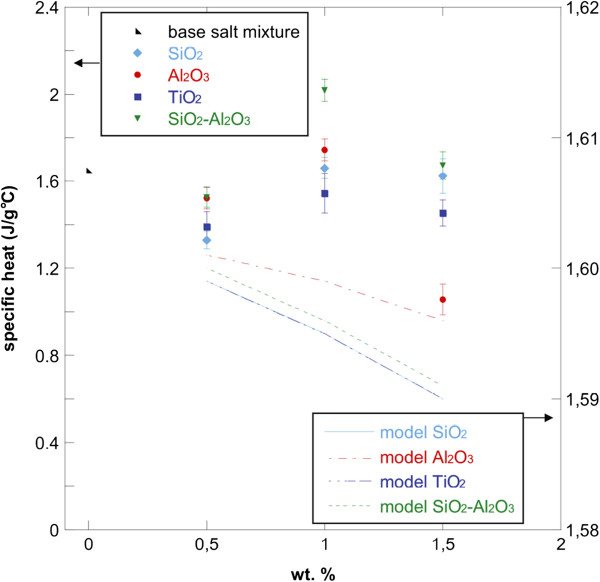
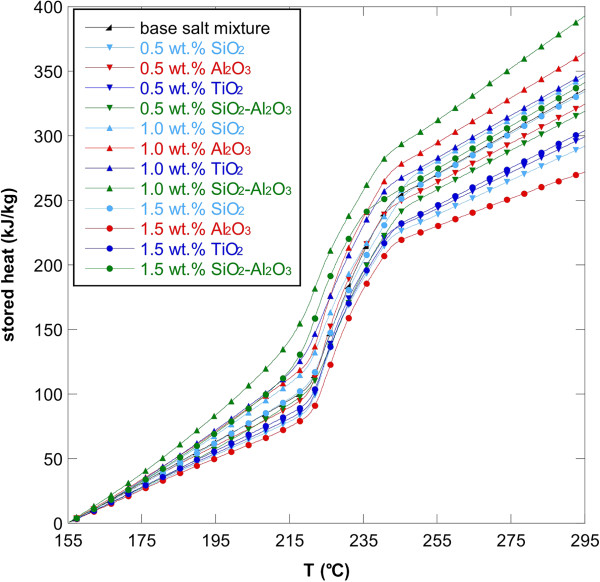
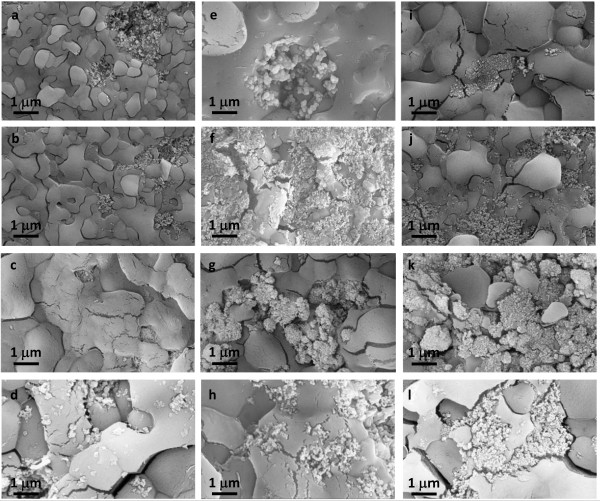
In this study, different nanofluids with phase change behavior were developed by mixing a molten salt base fluid (selected as phase change material) with nanoparticles using the direct-synthesis method. The thermal properties of the nanofluids obtained were investigated. These nanofluids can be used in concentrating solar plants with a reduction of storage material if an improvement in the specific heat is achieved. The base salt mixture was a NaNO3-KNO3 (60:40 ratio) binary salt. The nanoparticles used were silica (SiO2), alumina (Al2O3), titania (TiO2), and a mix of silica-alumina (SiO2-Al2O3). Three weight fractions were evaluated: 0.5, 1.0, and 1.5 wt.%. Each nanofluid was prepared in water solution, sonicated, and evaporated. Measurements on thermophysical properties were performed by differential scanning calorimetry analysis and the dispersion of the nanoparticles was analyzed by scanning electron microscopy (SEM). The results obtained show that the addition of 1.0 wt.% of nanoparticles to the base salt increases the specific heat of 15% to 57% in the solid phase and of 1% to 22% in the liquid phase. In particular, this research shows that the addition of silica-alumina nanoparticles has a significant potential for enhancing the thermal storage characteristics of the NaNO3-KNO3 binary salt. These results deviated from the predictions of the theoretical model used. SEM suggests a greater interaction between these nanoparticles and the salt.
Overview
The claims and statistics of this paper haven’t been checked yet.
Free: it reads the open-access text and checks the first 5 claims that cite a source we can check. Create a free account to check every claim.
Integrity signals
Registry
Cites
Statistics
Figures
Verification
Claims the paper makes
The claims and statistics of this paper haven’t been checked yet.
Free: it reads the open-access text and checks the first 5 claims that cite a source we can check. Create a free account to check every claim.
Claims other papers make about this one
Each is checked against this paper’s own text: does it say what the citing paper says it does?
The cited source says what the claim attributes to it.
In the citing paper
“All of the NPs reduced the onset and melting temperatures of the PCM.”
From Nano-Enhanced Phase Change Materials in Latent Heat Thermal Energy Storage Systems: A Review (2021) · cites this paper as [66]
The cited source says what the claim attributes to it.
In the citing paper
“The NPs also increased the specific heat and heat of fusion.”
From Nano-Enhanced Phase Change Materials in Latent Heat Thermal Energy Storage Systems: A Review (2021) · cites this paper as [66]
The cited source says what the claim attributes to it.
In the citing paper
“The 1.0 wt % concentration was the most effective by far, as were the SiO 2 -Al 2 O 3 NPs, although the other types of NPs were also effective [66].”
From Nano-Enhanced Phase Change Materials in Latent Heat Thermal Energy Storage Systems: A Review (2021) · cites this paper as [66]
The cited source says what the claim attributes to it.
In the citing paper
“1.0 wt % SiO 2 -Al 2 O 3 were the most effective”
From Nano-Enhanced Phase Change Materials in Latent Heat Thermal Energy Storage Systems: A Review (2021) · cites this paper as [66]
Self-check
Percentages, sums and reported differences re-computed from the paper’s own numbers.
The self-check needs the paper’s full text.
Citations
Cites
Convective Transport in Nanofluids
Buongiorno, J. (2006) · Journal of Heat Transfer · doi:10.1115/1.2150834 · Cited by 7,013 · cited 1×
“The measurements were also compared with a theoretical model based on the assumption of thermal equilibrium between the particles and the surrounding fluid [26,31]:”
Review on thermal energy storage with phase change materials and applications
Sharma, A., Tyagi, V. V., Chen, C. R., & Buddhi, D. (2009) · Renewable and Sustainable Energy Reviews · doi:10.1016/j.rser.2007.10.005 · Cited by 5,936 · cited 2×
“Therefore, several studies on PCM used as thermal energy storage material have been published [10-16].”
BackgroundZalba, B., Marı́n, J. M., Cabeza, L. F., & Mehling, H. (2003) · Applied Thermal Engineering · doi:10.1016/s1359-4311(02)00192-8 · Cited by 4,738 · cited 1×
“Therefore, several studies on PCM used as thermal energy storage material have been published [10-16].”
BackgroundA review on phase change energy storage: materials and applications
Farid, M. M., Khudhair, A. M., Razack, S. A. K., & Al-Hallaj, S. (2004) · Energy Conversion and Management · doi:10.1016/j.enconman.2003.09.015 · Cited by 3,097 · cited 1×
“Therefore, several studies on PCM used as thermal energy storage material have been published [10-16].”
BackgroundMaterials used as PCM in thermal energy storage in buildings: A review
Cabeza, L. F., Castell, A., Barreneche, C., de Gracia, A., & Fernández, A. I. (2011) · Renewable and Sustainable Energy Reviews · doi:10.1016/j.rser.2010.11.018 · Cited by 1,889
Gil, A., Medrano, M., Martorell, I., Lázaro, A., Dolado, P., Zalba, B., & Cabeza, L. F. (2010) · Renewable and Sustainable Energy Reviews · doi:10.1016/j.rser.2009.07.035 · Cited by 1,762
Yu, W., & Choi, S. U. S. (2003) · Journal of Nanoparticle Research · doi:10.1023/a:1024438603801 · Cited by 1,737
Role of Brownian motion in the enhanced thermal conductivity of nanofluids
Jang, S. P., & Choi, S. U. S. (2004) · Applied Physics Letters · doi:10.1063/1.1756684 · Cited by 1,596
Enhanced thermal conductivity of TiO2—water based nanofluids
Murshed, S. M. S., Leong, K. C., & Yang, C. (2005) · International Journal of Thermal Sciences · doi:10.1016/j.ijthermalsci.2004.12.005 · Cited by 1,395
Hasnain, S. M. (1998) · Energy Conversion and Management · doi:10.1016/s0196-8904(98)00025-9 · Cited by 1,267 · cited 2×
“Low-temperature storage systems are based almost entirely on sensible heat storage using liquid water [3], but for temperatures exceeding 100°C (concentrated solar power plants), non-pressurized liquid water and the use of pressure vessels make this technology unattractive.”
Background
Research works printed but not linked: 3
- Laing D Solar thermal energy storage technologies Energy Forum 10000 Solar Gigawatts, 23 April 2008 2008 Hannover: Hannover Messe http://www.dlr.de/Portaldata/41/Resources/dokumente/institut/thermischept/Solar_Thermal_Energy_Storage_Technologies_Hannover2008.pdf
- Choi SUS Developments Applications of Non-Newtonian Flows 1995 New York: ASME
- Little F Molten salt carbon nanotube thermal energy storage for concentrating solar power systems DOE Peer Review 2011 Texas A&M University: Space Engineering Research Center
Cited by
Items 201–300 of 381
Simplified prediction model of the discharging time of a shell-and-tube LHTES
Fornarelli, F., & Camporeale, S. M. (2020) · Applied Thermal Engineering · doi:10.1016/j.applthermaleng.2020.115709 · Cited by 16
Sn Nanoparticles Confined in Porous Silica Spheres for Enhanced Thermal Cyclic Stability
Zhu, S., Nguyen, M. T., Fumoto, K., Kanie, K., Muramatsu, A., & Yonezawa, T. (2018) · ACS Applied Nano Materials · doi:10.1021/acsanm.8b00698 · Cited by 18
Zhang, Z., & Chen, M. (2025) · Journal of Energy Storage · doi:10.1016/j.est.2025.116423 · Cited by 25
Gürgenç, E., Oztop, H. F., Yamaç, H. İ., Canbay, C. A., Şenocak, Ş. M., Ozabaci, M., & Gür, M. (2025) · Journal of Energy Storage · doi:10.1016/j.est.2025.119207 · Cited by 23
Dukarska, D., & Bartkowiak, M. (2016) · Journal of Polymer Research · doi:10.1007/s10965-016-1066-6 · Cited by 17
Specific Heat Capacity of Solar Salt-Based Nanofluids: Molecular Dynamics Simulation and Experiment
Abir, F. M., & Shin, D. (2024) · Materials · doi:10.3390/ma17020506 · Cited by 20
“…increase in SHC; however, most of the studies on water-based nanofluids have reported a decrease in SHC with the addition of NPs. Chieruzzi et al. [6] reported an increase in the SHC of nitrate-based nanofluids, and the agglomeration of NPs was shown to be the reason for the increase in the SHC…”
BackgroundWu, C., Wang, Q., Wang, X., Sun, S., Sun, M., & Zhang, J. (2024) · Chemical Engineering Journal · doi:10.1016/j.cej.2024.150789 · Cited by 17
Wang, X., Zhang, C., Zhang, C., Sun, H., & Wu, Y. (2025) · Solar Energy Materials and Solar Cells · doi:10.1016/j.solmat.2025.113492 · Cited by 16
Convection instability of non-Newtonian Walter's nanofluid along a vertical layer
Moatimid, G. M., & Hassan, M. A. (2016) · Journal of the Egyptian Mathematical Society · doi:10.1016/j.joems.2016.09.001 · Cited by 16
Железный, В. П., Khliyeva, O., Motovoy, I., & Lukianov, M. (2019) · Thermochimica Acta · doi:10.1016/j.tca.2019.05.011 · Cited by 16
Nayfeh, Y., Rizvi, S. M. M., Far, B. E., & Shin, D. (2020) · Nanomaterials · doi:10.3390/nano10112131 · Cited by 15
Gürgenç, E., Yamaç, H. İ., Öztop, M., Ozabaci, M., Canbay, C. A., Gürgenç, T., Gür, M., & Öztop, H. F. (2026) · Solar Energy Materials and Solar Cells · doi:10.1016/j.solmat.2026.114298 · Cited by 21
Abdoos, B., Ghazvini, M., Pourfayaz, F., Ahmadi, M. H., & Nouralishahi, A. (2022) · Environmental Progress & Sustainable Energy · doi:10.1002/ep.13808 · Cited by 16
“Chieruzzi et al.113 used different nanoparticles (SiO2, Al2O3, TiO2, and mix of Al2O3-TiO2) in three weight fractions (0.5 wt %, 1 wt %, and 1.5 wt”
BackgroundInfluentialAbdeali, G., Farhang, Z., & Bahramian, A. R. (2023) · Journal of Energy Storage · doi:10.1016/j.est.2023.109795 · Cited by 15
Chen, X., Qu, L., Zhang, M., Wu, Y., & Lu, Y. (2024) · Solar Energy Materials and Solar Cells · doi:10.1016/j.solmat.2024.113201 · Cited by 15
New method of thermal cycling stability test of phase change material
Putra, N. S. D., Amin, M., Luanto, R. A., Kosasih, E. A., & Abdullah, N. A. (2017) · MATEC Web of Conferences · doi:10.1051/matecconf/201710101007 · Cited by 16
Yu, Q., Lu, Y., Zhang, C., Wu, Y., & Sunden, B. A. (2019) · Journal of Thermal Analysis and Calorimetry · doi:10.1007/s10973-019-09112-9 · Cited by 15
Enhancing thermophysical properties of phase change material via alumina and copper nanoparticles
Jafarian, M., Delgado, M., Omid, M., Khanali, M., Mokhtari, M., & Lázaro, A. (2021) · International Journal of Energy Research · doi:10.1002/er.7594 · Cited by 15
Nitrate based high temperature nano-heat-transfer-fluids : formulation & characterisation
Lasfargues, M. (2014) · White Rose eTheses Online (University of Leeds, The University of Sheffield, University of York) · Cited by 15
Experimental heat transfer study of an enhanced storage medium
Awad, A. T., & Waleed, M. (2023) · Journal of Energy Storage · doi:10.1016/j.est.2023.108953 · Cited by 14
Numerical Study to Optimize the Melting Process of Phase Change Material Coupled with Extra Fluid
Khademi, A., Darbandi, M., & Schneider, G. E. (2020) · AIAA SciTech Forum · doi:10.2514/6.2020-1932 · Cited by 17
Emplacement of screen-printed graphene oxide coating for building thermal comfort discernment
Roy, A., Ghosh, A., Benson, D., Mallick, T. K., & Sundaram, S. (2020) · Scientific Reports · doi:10.1038/s41598-020-72670-8 · Cited by 14
Materials for Phase Change Material at High Temperature
Liu, M., Fernández, A. I., & Segarra, M. (2018) · Elsevier eBooks · doi:10.1016/b978-0-12-805323-2.00008-4 · Cited by 14
Железный, В. П., Motovoy, I., Khliyeva, O., & Lukianov, M. (2018) · Thermochimica Acta · doi:10.1016/j.tca.2018.11.020 · Cited by 16
Numerical Investigation of Direct Absorption Solar Collector using Nanofluids: A Review
Rasih, R. A., Sidik, N. A. C., & Samion, S. R. L. (2019) · IOP Conference Series Materials Science and Engineering · doi:10.1088/1757-899x/469/1/012059 · Cited by 14
“Past literature revealed that nanofluid can exhibit low pumping power [33], higher thermal conductivity [34] , adjustable fluid properties by concentration [34], better heat transfer characteristics [35], and higher specific heat capacity [36].”
BackgroundSalari, S., Khavarpour, M., Masoumi, M., & Mosivand, S. (2022) · Microfluidics and Nanofluidics · doi:10.1007/s10404-022-02585-5 · Cited by 12
Impact of blending of phase change material for performance enhancement of solar energy storage
Шазад, А., Uzair, M., & Tufail, M. (2024) · Renewable Energy · doi:10.1016/j.renene.2024.120530 · Cited by 13
Barai, D. P., Chichghare, K. K., Chawhan, S. S., & Bhanvase, B. A. (2020) · Green energy and technology · doi:10.1007/978-3-030-33774-2_1 · Cited by 14
Okahisa, Y., Yasunaga, Y., Iwai, K., Yagi, S., Abe, K., Nishizawa, I., & Ifuku, S. (2021) · Materials Today Communications · doi:10.1016/j.mtcomm.2021.102895 · Cited by 16
Textural characteristic of anodized aluminium foil for thermal energy storage application
Nualsing, D., Pannucharoenwong, N., Rattanadecho, P., Echaroj, S., Benjapiyaporn, C., & Benjapiyaporn, J. (2021) · Energy Reports · doi:10.1016/j.egyr.2021.07.083 · Cited by 13
The Importance of Nanostructured Materials for Energy Storage/Conversion
Mochane, M. J., Mokhena, T. C., Mokhothu, T. H., Mtibe, A., Sadiku, E. R., & Ray, S. S. (2018) · Elsevier eBooks · doi:10.1016/b978-0-12-813351-4.00044-4 · Cited by 13
“To make sense of the whole discussion, it is clear that storage will probably enhances the performance of a power plant for an example, thereby loading level and higher efficiency which would result in energy conservation and reduced generation cost overall [4].”
BackgroundNanotechnology for energy storage
Awad, A. T., Ahmed, W., & Waleed, M. (2021) · Elsevier eBooks · doi:10.1016/b978-0-12-821346-9.00009-2 · Cited by 21
Enhanced Specific Heat of Molten Salt Nano-Eutectic Via Nanostructural Change
Tiznobaik, H., Pournorouz, Z., Seo, J., Mostafavi, A., & Shin, D. (2021) · ASME Journal of Heat and Mass Transfer · doi:10.1115/1.4050173 · Cited by 11
Energy harvesting: role of hybrid nanofluids
Shah, T. R., Babar, H., & Ali, H. M. (2021) · Elsevier eBooks · doi:10.1016/b978-0-12-821346-9.00011-0 · Cited by 15
Synthesis of green nanocomposite material for engineering application
Tripathi, M., & Singh, B. (2022) · Elsevier eBooks · doi:10.1016/b978-0-12-824547-7.00012-6 · Cited by 15
Chieruzzi, M., Miliozzi, A., Crescenzi, T., Kenny, J. M., & Torre, L. (2017) · ASME Journal of Heat and Mass Transfer · doi:10.1115/1.4038415 · Cited by 14
Self-citationKarim, A., Islam, M., Arthur, O., & Yarlagadda, P. K. D. V. (2020) · Molecules · doi:10.3390/molecules25020375 · Cited by 12
Thermal synergy at the nanoscale: A review on hybrid nanofluids
Mukherjee, S., Wciślik, S., Kotrys-Działak, D., Khadanga, V., & Mishra, P. C. (2025) · International Communications in Heat and Mass Transfer · doi:10.1016/j.icheatmasstransfer.2025.109627 · Cited by 14
Wang, Y., Hu, Z., Zhu, Y., Gu, J., Li, X., Hu, H., Luo, G., & Yao, H. (2024) · Journal of Energy Storage · doi:10.1016/j.est.2024.111290 · Cited by 12
Enhancement of thermophysical coefficients in nanofluids: A simulation study
Cui, X., Cheng, X., Xu, H., Li, B., & Zhu, J. (2020) · International Journal of Modern Physics B · doi:10.1142/s0217979220502227 · Cited by 11
Particle Technology in the Formulation and Fabrication of Thermal Energy Storage Materials
Jiang, Z., Li, X., Jin, Y., Zhang, X., Tong, L., Wang, L., & Ding, Y. (2022) · Chemie Ingenieur Technik · doi:10.1002/cite.202200113 · Cited by 12
Jebali, M., Colangelo, G., Haurie, L., Bekri-Abbes, I., & Palacio, A. M. L. (2022) · Journal of Physics Conference Series · doi:10.1088/1742-6596/2385/1/012026 · Cited by 12
“So far, a variety of nanoparticle materials dispersed in PCM has been studied, including alumina [7,8] , copper oxide [3], titania [7], ferric oxide [10] , silica [7,8], zinc oxide [7,10,11] and carbon-based materials [2,9].”
BackgroundNanofluids with Enhanced Heat Transfer Properties for Thermal Energy Storage
Chieruzzi, M., Miliozzi, A., Torre, L., & Kenny, J. M. (2016) · doi:10.1002/9781119242628.ch10 · Cited by 11
Self-citationUsing statistical analysis to create a new database of Nanofluids’ specific heat capacity
Svobodova‐Sedlackova, A., Calderón, A., Morell, X. S., Neira-Viñas, M., Majó, M., Barreneche, C., Gamallo, P., & Fernández, A. I. (2022) · Journal of Molecular Liquids · doi:10.1016/j.molliq.2022.120847 · Cited by 10
Mirfendereski, S. M., & Bitaraf, P. (2025) · Desalination · doi:10.1016/j.desal.2025.118715 · Cited by 10
Yan, Y., Liang, Y., Liu, J., Zhang, Y., & Zhang, Z. (2025) · Machining Science and Technology · doi:10.1080/10910344.2025.2554146 · Cited by 12
Review on advance tubular receivers for central solar tower system
Kulkarni, K. G., Havaldar, S. N., & Bhattacharya, N. (2021) · IOP Conference Series Materials Science and Engineering · doi:10.1088/1757-899x/1136/1/012018 · Cited by 10
“One of the drawback of solar salt is the high melting and freezing point.[48, 49, 50, 51]”
BackgroundAltun, A., Doruk, S., & Şara, O. N. (2023) · International Journal of Thermophysics · doi:10.1007/s10765-023-03214-1 · Cited by 10
Enhanced thermophysical properties via PAO superstructure
Pournorouz, Z., Mostafavi, A., Pinto, A., Bokka, A., Jeon, J., & Shin, D. (2017) · Nanoscale Research Letters · doi:10.1186/s11671-016-1802-1 · Cited by 10
Oktay, B. (2018) · ChemistrySelect · doi:10.1002/slct.201802604 · Cited by 10
Sudheer, R., & Prabhu, K. N. (2017) · Journal of Materials Engineering and Performance · doi:10.1007/s11665-017-2827-z · Cited by 10
Variation of thermophysical parameters of PCM CaCl2.6H2O with dopant from T-history data analysis
Sutjahja, I. M., Silalahi, A. O., Sukmawati, N., Kurnia, D., & Wonorahardjo, S. (2018) · Materials Research Express · doi:10.1088/2053-1591/aab6f0 · Cited by 11
Heat Transfer Enhancement Technique of PCMs and Its Lattice Boltzmann Modeling
Qu, Z. (2019) · IntechOpen eBooks · doi:10.5772/intechopen.80574 · Cited by 12
“The SEM micrographs of nanoparticle-enhanced PCM (NaNO3-KNO3) with different nanoparticles and mass fractions are shown in Figure 5 [51].”
MethodAnalysis of performance of cold storage in existence of nano-sized additives within complex geometry
Ajour, M. N., Basem, A., AL-bonsrulah, H. A. Z., Milyani, A. H., Abu‐Hamdeh, N. H., & Aydi, W. (2024) · Journal of Energy Storage · doi:10.1016/j.est.2024.114404 · Cited by 9
Kamsuwan, C., Nokpho, P., Yurata, T., Wang, X., Taheri, M., Piemjaiswang, R., Piumsomboon, P., Manatura, K., Pratumwal, Y., Otarawanna, S., et al. (2025) · International Journal of Thermofluids · doi:10.1016/j.ijft.2025.101080 · Cited by 9
Copper-dispersed solar salt: An improved phase change material for thermal energy storage
M.K., S., & K.S., R. (2022) · Thermochimica Acta · doi:10.1016/j.tca.2022.179302 · Cited by 13
Silica and alumina nano-enhanced molten salts for thermal energy storage: A comparison
Muñoz-Sánchez, B., Nieto-Maestre, J., Iparraguirre-Torres, I., Julia, J. E., & García-Romero, A. (2017) · AIP conference proceedings · doi:10.1063/1.4984439 · Cited by 9
High-temperature heterogeneous catalysis in platinum nanoparticle – molten salt suspensions
Tangeysh, B., Palmer, C., Metiu, H. I., Gordon, M. J., & McFarland, E. W. (2020) · Catalysis Science & Technology · doi:10.1039/c9cy01823a · Cited by 9
Xu, M., Wei, G., Huang, C. R., Cui, L., & Du, X. (2024) · Solar Energy Materials and Solar Cells · doi:10.1016/j.solmat.2024.113222 · Cited by 8
MXene-enhanced nanofluids for superior thermal energy storage in concentrated solar power plants
Pineda, F., Zambrano-Mera, D. F., Lasanta, M. I., Guzmán, D., Angel, A., Palay, F. E., Ríos, P. L., González, R. I., Ramírez, M., Rogan, J. A., et al. (2025) · Solar Energy Materials and Solar Cells · doi:10.1016/j.solmat.2025.113461 · Cited by 9
Experimental heat capacity of highly stable diamond/thermal oil nano-suspensions
Ahmed, A., Ilyas, S. U., Noshad, N., Alsaady, M., Abdulrahman, A., Mahfouz, A. B., & Ali, A. (2025) · RSC Advances · doi:10.1039/d4ra08312a · Cited by 8
Wang, J., Yang, M., Jia, Y., & Chang, H. (2025) · International Communications in Heat and Mass Transfer · doi:10.1016/j.icheatmasstransfer.2025.108857 · Cited by 8
A review of applications of nanofluids in medium to high temperature solar energy systems
Zhao, N., Song, J., Jiang, W., Li, X., Liu, J., & Yang, L. (2025) · Powder Technology · doi:10.1016/j.powtec.2025.121858 · Cited by 8
Mahdi, N. S., Eidan, A. A., Abada, H. H., & Al-Fahham, M. (2022) · Australian Journal of Mechanical Engineering · doi:10.1080/14484846.2021.2023348 · Cited by 8
“These benefits lead to an improvement of the overall efficiency and a reduction of energy losses of the system (Chieruzzi et al. 2013).”
BackgroundPerspectives on Solar Salt‐Based Nanofluids Used in Concentrated Solar Power Plants
Pineda, F., Rosenkranz, A., & Pérez, F. J. (2024) · Solar RRL · doi:10.1002/solr.202400110 · Cited by 8
Nanotech-Based Cool Materials for Building Energy Efficiency
Pisello, A. L., Paolini, R., Diamanti, M. V., Fortunati, E., Castaldo, V. L., & Torre, L. (2016) · Springer eBooks · doi:10.1007/978-3-319-27505-5_9 · Cited by 8
Nanotechnology and Nanomaterials for Thermal Energy Storage
Mondragón, R., Martínez-Cuenca, R., Hernández, L., Andreu‐Cabedo, P., Cabedo, L., & Julia, J. E. (2015) · Wiley eBooks · doi:10.1002/9781118991978.hces224 · Cited by 11
Experimental Evaluation of a Combined Sensible and Latent Heat Thermal Energy Storage System
Miliozzi, A., Nicolini, D., Napoli, G., Giorgi, G., & Liberatore, R. (2025) · Energies · doi:10.3390/en18215808 · Cited by 17
Self-citationSalim, N. J., Rahman, M. A., & Firoz, S. H. (2022) · ASME Journal of Heat and Mass Transfer · doi:10.1115/1.4054716 · Cited by 7
Design of composite materials/devices for thermal storage – A critical review
Leng, G., Navarro, M. E., Yu, Q., Wellio, G., Qiao, G., Li, C. S., Huang, Y., Zhao, Y., Zhang, G., Meng, Y., et al. (2018) · Veruscript Functional Nanomaterials · doi:10.22261/ghv5w9 · Cited by 7
“[30] have compared the effects of SiO2, Al2O3, and TiO2 nanoparticles on nitrate salts (NaNO3:KNO3, 60:40) and it is found that the specific heat capacity would decrease with the addition of TiO2 nanoparticles while increase with SiO2 or Al2O3 nanoparticles.”
BackgroundMenilai Dampak BUMDES Bersama Danar terhadap Masyarakat di Kecamatan Leles Kabupaten Garut
Tarlani, T. (2020) · ETHOS (Jurnal Penelitian dan Pengabdian) · doi:10.29313/ethos.v8i2.5888 · Cited by 7
Adun, H. H., Bamisile, O., Kavaz, D., & Dagbasi, M. (2022) · Journal of Energy Storage · doi:10.1016/j.est.2022.105359 · Cited by 10
Zhang, C., Han, S., Wu, Y., Zhang, C., & Guo, H. (2022) · Journal of Thermal Analysis and Calorimetry · doi:10.1007/s10973-022-11800-y · Cited by 7
Muñoz-Sánchez, B., Nieto-Maestre, J., Iparraguirre-Torres, I., Sánchez-García, J. A., Julia, J. E., & García-Romero, A. (2016) · AIP conference proceedings · doi:10.1063/1.4949129 · Cited by 7
Tribotronic control and cyclic voltammetry of platinum interfaces with metal oxide nanofluids
Seed, C. M., Acharya, B., Perelygin, V., Smirnov, A. I., & Krim, J. (2021) · Applied Surface Science · doi:10.1016/j.apsusc.2021.150675 · Cited by 7
Sutjahja, I. M., Silalahi, A. O., Kurnia, D., & Wonorahardjo, S. (2019) · Journal of Physics Conference Series · doi:10.1088/1742-6596/1204/1/012056 · Cited by 7
“0 wt% addition of nanoparticles is in agreement with specific heat results, see for example reference [13] and references therein.”
BackgroundGürgenç, E., Oztop, H. F., Şenocak, Ş. M., Aktemur, C., Gürgenç, T., Varol, Y., Yamaç, H. İ., & Gür, M. (2025) · Thermal Science and Engineering Progress · doi:10.1016/j.tsep.2025.104257 · Cited by 15
Gupta, S. K., Kumari, S., & Singh, A. P. (2026) · Energy Storage and Saving · doi:10.1016/j.enss.2025.06.002 · Cited by 12
Insights into Carbon Nanotubes and Fullerenes in Molten Alkali Carbonates
Gutiérrez, A., Garroni, S., Souentie, S. N.-A., Cuesta‐López, S., Yakoumis, I. V., & Aparício, S. (2019) · The Journal of Physical Chemistry C · doi:10.1021/acs.jpcc.9b00855 · Cited by 6
Zhang, W., Zhu, C., Chen, S., Wang, S., Jing, Z., & Cui, L. (2024) · Energies · doi:10.3390/en17051080 · Cited by 6
“The speci fi c heat capacity of solar salt at 573.15 K is determined to be 1.610 J·g ·K , which However, in MD simulations, there is no sedimentation in aggregated nanofluids. is close to the experimental value of 1.648 J·g ·K obtained in the literature [47].”
BackgroundInfluentialEslami, R., Daneshazarian, R., Azizi, N., Rafieimehr, M., Berardi, U., & Zarrin, H. (2024) · ACS Applied Engineering Materials · doi:10.1021/acsaenm.4c00559 · Cited by 6
Svobodova‐Sedlackova, A., Barreneche, C., Gamallo, P., & Fernández, A. I. (2021) · Journal of Molecular Liquids · doi:10.1016/j.molliq.2021.118316 · Cited by 6
Simulation of charging of PCM within a duct containing nanoparticles
Zhang, J., Wang, F., Rothan, Y. A., Nofal, T. A., & Selim, M. M. (2022) · ZAMM ‐ Journal of Applied Mathematics and Mechanics / Zeitschrift für Angewandte Mathematik und Mechanik · doi:10.1002/zamm.202100375 · Cited by 6
“[60] utilized different material with nano-sized to expedite the process.”
MethodWu, H., & Zhang, L. (2023) · Case Studies in Thermal Engineering · doi:10.1016/j.csite.2023.103706 · Cited by 6
Miliozzi, A., Liberatore, R., Nicolini, D., Chieruzzi, M., Veca, E., Crescenzi, T., & Torre, L. (2018) · InTech eBooks · doi:10.5772/intechopen.73672 · Cited by 6
“In this case, the cylindrical capsules have a length of 0.5 m and a diameter of 15–25 mm and they are filled with a NaNO3-KNO3 eutectic mixture.”
BackgroundMethodSelf-citationSimulation of spiral tube during melting utilizing multi-type nanoparticles
Wang, F., Hamali, W., Almusawa, M. Y., Nofal, T. A., Selim, M. M., & Zhang, J. (2022) · Journal of Petroleum Science and Engineering · doi:10.1016/j.petrol.2022.110353 · Cited by 6
Temperature of a metallic nanoparticle embedded in a phase change media exposed to radiation
Tullius, T. K., & Bayazıtoğlu, Y. (2015) · International Journal of Heat and Mass Transfer · doi:10.1016/j.ijheatmasstransfer.2015.10.038 · Cited by 7
Silalahi, A. O., Sutjahja, I. M., Kurnia, D., & Wonorahardjo, S. (2019) · Journal of Physics Conference Series · doi:10.1088/1742-6596/1204/1/012055 · Cited by 6
“It is important to note, that although the change of specific heat or other thermophysical parameters of PCM in general still depends on the type of dopant, 1% dopant concentration is shown to be special due to the optimum stability of suspension [12].”
BackgroundA numerical study on the performance of water based copper oxide nanofluids in compact channel
Das, R. K., Sokhal, G. S., & Sehgal, S. S. (2020) · Materials Today Proceedings · doi:10.1016/j.matpr.2020.02.956 · Cited by 6
Phase Change Nanomaterials for Thermal Energy Storage
Pielichowska, K., & Pielichowski, K. (2017) · Wiley eBooks · doi:10.1002/9783527696109.ch20 · Cited by 8
Adsorption and nucleation mechanism of molten carbonate on nano-SiC surface
Wang, Y., Liu, S., Li, X., Guo, X. Y., Hu, Z., Xiao, W., Wang, X., Hu, H., Luo, G., & Yao, H. (2024) · Chemical Engineering Journal · doi:10.1016/j.cej.2024.154904 · Cited by 5
Parmar, N., Bendová, M., Wagner, Z., Pěnkavová, V., Douihri, I., & Jacquemin, J. (2021) · Industrial & Engineering Chemistry Research · doi:10.1021/acs.iecr.0c06008 · Cited by 5
Dominici, F., Miliozzi, A., & Torre, L. (2021) · Energies · doi:10.3390/en14217151 · Cited by 8
Self-citationTang, X., & Ryu, J. (2023) · International Journal of Thermophysics · doi:10.1007/s10765-023-03171-9 · Cited by 6
Building the Future: Integrating Phase Change Materials in Network of Nanogrids (NoN)
Kalair, A. R., Jamei, E., Seyedmahmoudian, M., Mekhilef, S., & Abas, N. (2024) · Energies · doi:10.3390/en17235862 · Cited by 5
“Adding silica-alumina nanoparticles into NaNO 3 -KNO 3 binary salt is claimed [246] to enhance thermal storage properties.”
López, L. H., Manca, O., Murshed, S. M. S., & Vicente, L. B. (2020) · Universitat Jaume I eBooks · doi:10.6035/ca15119.2020.01 · Cited by 4
Andiarto, R., Nuryadin, M. K., Taufik, A., & Saleh, R. (2017) · IOP Conference Series Materials Science and Engineering · doi:10.1088/1757-899x/188/1/012049 · Cited by 5
Li, S., Li, H., Liu, H., Hao, W., Jing, Y., Zong, Q., & Li, Y. (2025) · Energy & Fuels · doi:10.1021/acs.energyfuels.5c03142 · Cited by 5
Kumar, S., Sarkar, C., & Saha, S. (2024) · Energy, environment, and sustainability · doi:10.1007/978-981-97-1406-3_6 · Cited by 6
Nanoparticles-enhanced energy storage materials in solar thermal desalination
Kapoor, V., Rufuss, D. D. W., Arulvel, S., Akinaga, T., & Davies, P. A. (2022) · Elsevier eBooks · doi:10.1016/b978-0-12-821920-1.00005-4 · Cited by 7
Metadata
- Authors
- Chieruzzi, M., Cerritelli, G. F., Miliozzi, A., & Kenny, J. M.
- Affiliations
- University of Perugia (IT)
- National Agency for New Technologies, Energy and Sustainable Economic Development (IT)
- Corresponding author
- Chieruzzi, Manila
- Venue
- Nanoscale Research Letters
- Published
- 2013-10-29
- Volume
- 8
- Issue
- 1
- Pages
- 448-448
- ISSN
- 1556-276X (ISSN-L)
- PMC
- PMC4231368
- OpenAlex
- W2144901898
- Semantic Scholar
- 44593f0b2cdabe4b8f966638e2da5f84a09cc4be
- Cited by
- 381
- References
- 56
- Citations by year
- 2026: 18 · 2025: 28 · 2024: 23 · 2023: 29 · 2022: 41 · 2021: 44 · 2020: 52 · 2019: 42 · 2018: 28 · 2017: 28 · 2016: 25 · 2015: 19 · 2014: 4
- FWCI
- 21.23
- Type
- journal article
- Language
- en
- Open access
- gold
- doi.org
- Licence
- cc-by
- creativecommons.org/licenses/by/2.0 (tdm)
- Locations
- Nanoscale Research Letters (publishedVersion, cc-by)
- Europe PMC (PubMed Central) (publishedVersion, cc-by)
- PubMed Central (publishedVersion, cc-by)
- PubMed (publishedVersion)
- DIGITAL.CSIC (Spanish National Research Council (CSIC)) (submittedVersion, other-oa)
- ENEA Open Archive (National Agency for New Technologies, Energy and Sustainable Economic Development) (submittedVersion)
- Funders
- Agenzia Nazionale per le Nuove Tecnologie, l'Energia e lo Sviluppo Economico Sostenibile
- Topics
- Physical Sciences › Engineering › Mechanical Engineering › Phase Change Materials Research
- Physical Sciences › Chemical Engineering › Fluid Flow and Transfer Processes › Nanofluid Flow and Heat Transfer
- Physical Sciences › Engineering › Mechanical Engineering › Adsorption and Cooling Systems
- Keywords
- nanofluids, molten salts, phase change materials, thermal energy storage, specific heat enhancement, Al2O3 nanoparticles, titanium dioxide nanoparticles, silica nanoparticles, nanoparticle dispersion, concentrated solar power, direct synthesis
About these checks
Registry, retraction, Cites and statistics results are computed, not judged, with one exception: a printed reference that no index lists is read once by a model before it counts as a citation error. Claims are extracted by a model and kept only when their quote appears verbatim in the text; each cited source is then checked, with a model’s help, for whether it says what the claim relies on. Those verdicts can be wrong — read the claim’s quote and the cited source before relying on one.
Statistics and arithmetic are recomputed, not judged.
Confidence bands are shown only for fields calibrated on our annotated test set. None is calibrated yet, so no band is shown.
What counts as a claim ›How we measure confidence ›How we check this ›
Are you an author, or do you see a problem with this page? Request a review
Data sources
Bibliographic data: Semantic Scholar, OpenAlex, Crossref.
Contains information from the Semantic Scholar Academic Graph Datasets, made available under the ODC Attribution License (ODC-BY 1.0).
Semantic Scholar’s data is described in: Kinney, R., et al. (2023). The Semantic Scholar Open Data Platform. arXiv:2301.10140.
