

Effect of nanoparticles on heat capacity of nanofluids based on molten salts as PCM for thermal energy storage
Open accessThe DOI matches its Crossref record; 55 of the 56 references it cites were found in a registry or an index.
Abstract
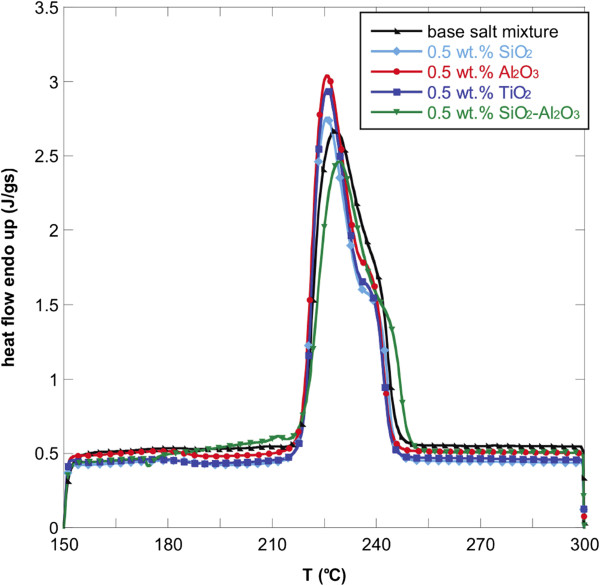
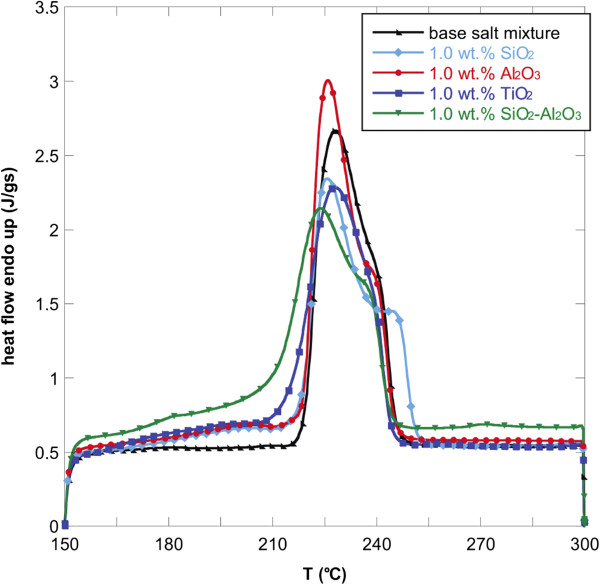
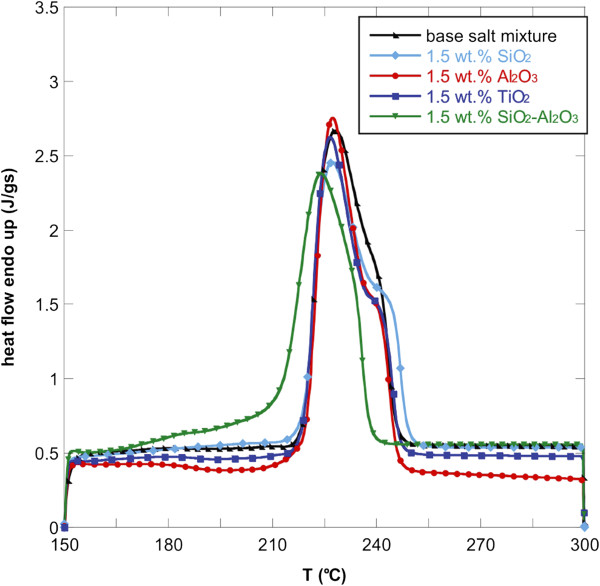
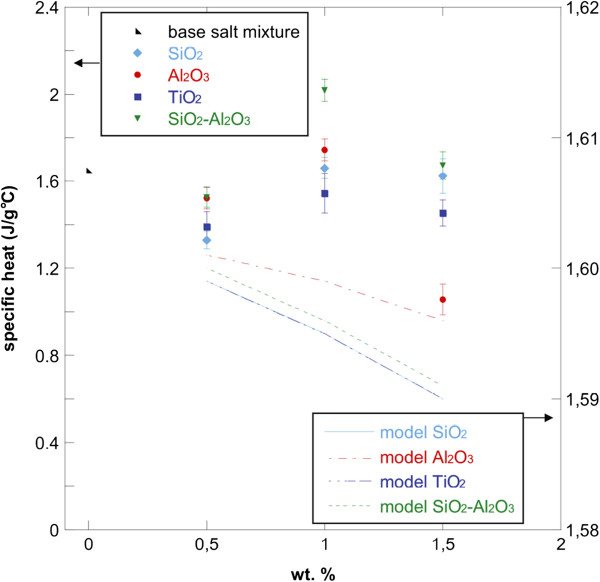
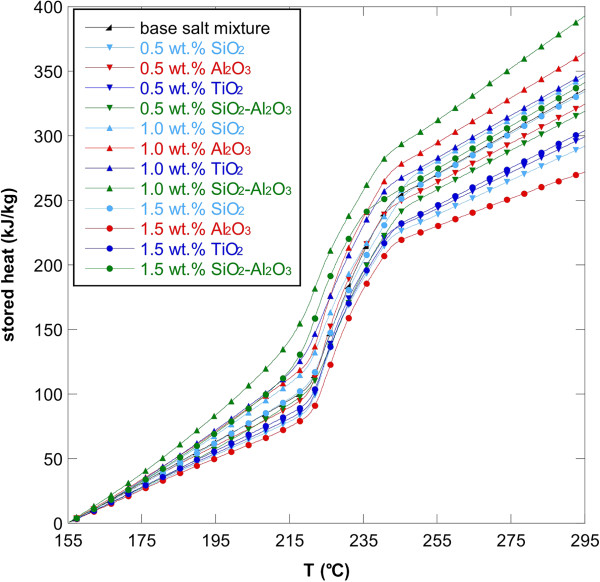
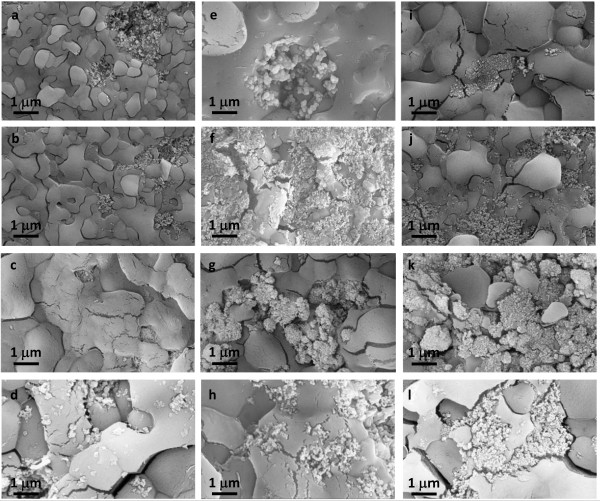
In this study, different nanofluids with phase change behavior were developed by mixing a molten salt base fluid (selected as phase change material) with nanoparticles using the direct-synthesis method. The thermal properties of the nanofluids obtained were investigated. These nanofluids can be used in concentrating solar plants with a reduction of storage material if an improvement in the specific heat is achieved. The base salt mixture was a NaNO3-KNO3 (60:40 ratio) binary salt. The nanoparticles used were silica (SiO2), alumina (Al2O3), titania (TiO2), and a mix of silica-alumina (SiO2-Al2O3). Three weight fractions were evaluated: 0.5, 1.0, and 1.5 wt.%. Each nanofluid was prepared in water solution, sonicated, and evaporated. Measurements on thermophysical properties were performed by differential scanning calorimetry analysis and the dispersion of the nanoparticles was analyzed by scanning electron microscopy (SEM). The results obtained show that the addition of 1.0 wt.% of nanoparticles to the base salt increases the specific heat of 15% to 57% in the solid phase and of 1% to 22% in the liquid phase. In particular, this research shows that the addition of silica-alumina nanoparticles has a significant potential for enhancing the thermal storage characteristics of the NaNO3-KNO3 binary salt. These results deviated from the predictions of the theoretical model used. SEM suggests a greater interaction between these nanoparticles and the salt.
Overview
The claims and statistics of this paper haven’t been checked yet.
Free: it reads the open-access text and checks the first 5 claims that cite a source we can check. Create a free account to check every claim.
Integrity signals
Registry
Cites
Statistics
Figures
Verification
Claims the paper makes
The claims and statistics of this paper haven’t been checked yet.
Free: it reads the open-access text and checks the first 5 claims that cite a source we can check. Create a free account to check every claim.
Claims other papers make about this one
Each is checked against this paper’s own text: does it say what the citing paper says it does?
The cited source says what the claim attributes to it.
In the citing paper
“All of the NPs reduced the onset and melting temperatures of the PCM.”
From Nano-Enhanced Phase Change Materials in Latent Heat Thermal Energy Storage Systems: A Review (2021) · cites this paper as [66]
The cited source says what the claim attributes to it.
In the citing paper
“The NPs also increased the specific heat and heat of fusion.”
From Nano-Enhanced Phase Change Materials in Latent Heat Thermal Energy Storage Systems: A Review (2021) · cites this paper as [66]
The cited source says what the claim attributes to it.
In the citing paper
“The 1.0 wt % concentration was the most effective by far, as were the SiO 2 -Al 2 O 3 NPs, although the other types of NPs were also effective [66].”
From Nano-Enhanced Phase Change Materials in Latent Heat Thermal Energy Storage Systems: A Review (2021) · cites this paper as [66]
The cited source says what the claim attributes to it.
In the citing paper
“1.0 wt % SiO 2 -Al 2 O 3 were the most effective”
From Nano-Enhanced Phase Change Materials in Latent Heat Thermal Energy Storage Systems: A Review (2021) · cites this paper as [66]
Self-check
Percentages, sums and reported differences re-computed from the paper’s own numbers.
The self-check needs the paper’s full text.
Citations
Cites
Convective Transport in Nanofluids
Buongiorno, J. (2006) · Journal of Heat Transfer · doi:10.1115/1.2150834 · Cited by 7,013 · cited 1×
“The measurements were also compared with a theoretical model based on the assumption of thermal equilibrium between the particles and the surrounding fluid [26,31]:”
Review on thermal energy storage with phase change materials and applications
Sharma, A., Tyagi, V. V., Chen, C. R., & Buddhi, D. (2009) · Renewable and Sustainable Energy Reviews · doi:10.1016/j.rser.2007.10.005 · Cited by 5,936 · cited 2×
“Therefore, several studies on PCM used as thermal energy storage material have been published [10-16].”
BackgroundZalba, B., Marı́n, J. M., Cabeza, L. F., & Mehling, H. (2003) · Applied Thermal Engineering · doi:10.1016/s1359-4311(02)00192-8 · Cited by 4,738 · cited 1×
“Therefore, several studies on PCM used as thermal energy storage material have been published [10-16].”
BackgroundA review on phase change energy storage: materials and applications
Farid, M. M., Khudhair, A. M., Razack, S. A. K., & Al-Hallaj, S. (2004) · Energy Conversion and Management · doi:10.1016/j.enconman.2003.09.015 · Cited by 3,097 · cited 1×
“Therefore, several studies on PCM used as thermal energy storage material have been published [10-16].”
BackgroundMaterials used as PCM in thermal energy storage in buildings: A review
Cabeza, L. F., Castell, A., Barreneche, C., de Gracia, A., & Fernández, A. I. (2011) · Renewable and Sustainable Energy Reviews · doi:10.1016/j.rser.2010.11.018 · Cited by 1,889
Gil, A., Medrano, M., Martorell, I., Lázaro, A., Dolado, P., Zalba, B., & Cabeza, L. F. (2010) · Renewable and Sustainable Energy Reviews · doi:10.1016/j.rser.2009.07.035 · Cited by 1,762
Yu, W., & Choi, S. U. S. (2003) · Journal of Nanoparticle Research · doi:10.1023/a:1024438603801 · Cited by 1,737
Role of Brownian motion in the enhanced thermal conductivity of nanofluids
Jang, S. P., & Choi, S. U. S. (2004) · Applied Physics Letters · doi:10.1063/1.1756684 · Cited by 1,596
Enhanced thermal conductivity of TiO2—water based nanofluids
Murshed, S. M. S., Leong, K. C., & Yang, C. (2005) · International Journal of Thermal Sciences · doi:10.1016/j.ijthermalsci.2004.12.005 · Cited by 1,395
Hasnain, S. M. (1998) · Energy Conversion and Management · doi:10.1016/s0196-8904(98)00025-9 · Cited by 1,267 · cited 2×
“Low-temperature storage systems are based almost entirely on sensible heat storage using liquid water [3], but for temperatures exceeding 100°C (concentrated solar power plants), non-pressurized liquid water and the use of pressure vessels make this technology unattractive.”
Background
Research works printed but not linked: 3
- Laing D Solar thermal energy storage technologies Energy Forum 10000 Solar Gigawatts, 23 April 2008 2008 Hannover: Hannover Messe http://www.dlr.de/Portaldata/41/Resources/dokumente/institut/thermischept/Solar_Thermal_Energy_Storage_Technologies_Hannover2008.pdf
- Choi SUS Developments Applications of Non-Newtonian Flows 1995 New York: ASME
- Little F Molten salt carbon nanotube thermal energy storage for concentrating solar power systems DOE Peer Review 2011 Texas A&M University: Space Engineering Research Center
Cited by
Items 301–381 of 381
Specific Heat Capacity and Density of Nanofluids
Choi, T. J., Kim, S., & Jang, S. P. (2022) · Royal Society of Chemistry eBooks · doi:10.1039/9781839166457-00282 · Cited by 4
The Multicomponent Heat Storage Nanofluid with Phase Change Behaviour for Solar Power Stations
Nurmatov, S., Xia, H., & Huang, Q. (2022) · Applied Solar Energy · doi:10.3103/s0003701x22040144 · Cited by 4
Influence of Nano Phase Change Materials on the Desalination Performance of Double Slope Solar Still
Sasilatha, T., Elavarasi, R., & Karthikeyan, V. (2021) · European Journal of Formal Sciences and Engineering · doi:10.26417/376bpl46s · Cited by 4
Discharging shape influence on the performance of a latent heat thermal energy storage
Fornarelli, F., Torresi, M., Oresta, P., Dambrosio, L., Miliozzi, A., & Camporeale, S. M. (2019) · AIP conference proceedings · doi:10.1063/1.5138812 · Cited by 4
Self-citationXiao, X., Liu, J., & Yao, M. (2026) · Solar Energy Materials and Solar Cells · doi:10.1016/j.solmat.2026.114183 · Cited by 3
Chen, X., Liang, Z., Qu, L., Li, X., Wang, X., & Wu, Y. (2026) · Journal of Energy Storage · doi:10.1016/j.est.2026.121765 · Cited by 2
Tiwari, R. K., Mittal, T. C., Singh, S., Sharma, S. R., & Rani, S. (2022) · Journal of Food Processing and Preservation · doi:10.1111/jfpp.17066 · Cited by 3
Rabani, R., & Naeini, K. H. (2025) · Sustainable Energy and Artificial Intelligence · doi:10.61186/seai.2506-1027 · Cited by 5
Molten salt composition and composites for improved latent heat thermal energy storage
Kotyla, J. (2017) · PAM Review Energy Science & Technology · doi:10.5130/pamr.v4i0.1445 · Cited by 3
“Heat capacity enhancement via nanoparticles in various Molten Salt compositions compiled from numerous sources [19-30].”
BackgroundLiu, H., Yang, J., Zheng, H., Chen, Y., & Li, Y. (2021) · Micron · doi:10.1016/j.micron.2021.103103 · Cited by 3
Kajau, T. A., Mamba, B. B., Mthombeni, N. H., & Motsa, M. M. (2022) · Thermal Science and Engineering Progress · doi:10.1016/j.tsep.2022.101371 · Cited by 3
Carbon Nanotube–Based Nanofluids
Abubakr, M., Hegab, H. A., Osman, T. A. E., Elharouni, F., Kishawy, H. A., & Esawi, A. M. K. (2022) · Springer eBooks · doi:10.1007/978-3-030-91346-5_32 · Cited by 3
Seed, C. M., Acharya, B., Nunn, N. A., Smirnov, A. I., & Krim, J. (2023) · The Journal of Chemical Physics · doi:10.1063/5.0155504 · Cited by 3
Altwarah, Q., Abir, F. M., Prince, C., & Shin, D. (2025) · Solar Energy Materials and Solar Cells · doi:10.1016/j.solmat.2025.113794 · Cited by 3
Srusti, B., Rajat, S., Amar, K., Daksh, S., & Kumar, M. B. S. (2020) · IOP Conference Series Earth and Environmental Science · doi:10.1088/1755-1315/573/1/012031 · Cited by 3
“Manila and Gian [7] using direct synthesis method different nano fluids, which have phase change behavior are generated by mixing nanoparticles and molten salts.”
Prospects of incorporation of nanoparticles in molten salt for water purification
Huq, M., & Ahmed, S. M. M. (2017) · Renewable and Sustainable Energy Reviews · doi:10.1016/j.rser.2017.10.004 · Cited by 3
Development of a New Method for Synthesizing HITEC Salt-Based Alumina Nanofluids
Isaza-Ruiz, M., & Bolívar, F. J. (2022) · Ingeniería e Investigación · doi:10.15446/ing.investig.93876 · Cited by 3
Sudharsan, S., Hari Suthan, V., Jeyaprakash, T., Suganthi, K. S., & Rajan, K. S. (2025) · Thermal Science and Engineering Progress · doi:10.1016/j.tsep.2025.103725 · Cited by 3
Linear Instability of Electromagnetic Viscoelastic Nanofluid: Analytical and Numerical Study
Hassan, M. A. (2020) · Differential Equations and Dynamical Systems · doi:10.1007/s12591-020-00541-9 · Cited by 2
A comprehensive review on harnessing energy from advanced materials
Jolly, B., Sharma, K. G., Verma, S. K., & Janyani, V. (2020) · Materials Today Proceedings · doi:10.1016/j.matpr.2020.10.821 · Cited by 2
Nanomaterials Enhanced Heat Storage in Molten Salts
Guo, X., Hu, D., Yu, L., Xia, L., & Chen, G. Z. (2021) · Springer eBooks · doi:10.1007/978-3-030-57492-5_6 · Cited by 2
A Literature Review on Novel Nitrate Molten Salt for Heat Storage
Chen, J. (2021) · Key engineering materials · doi:10.4028/www.scientific.net/kem.881.87 · Cited by 2
“However, Manila [23] found that when the concentration of Al2O3 (particle size 20nm) was 1wt%, the specific heat capacity of the molten salt increased by 5.”
BackgroundInfluentialEffect of doping liquid organic chains and nanoparticles on heat capacity of commercial engine oil
Rizvi, S. M. M., Nayfeh, Y., Far, B. E., & Shin, D. (2020) · International Journal of Heat and Mass Transfer · doi:10.1016/j.ijheatmasstransfer.2020.119922 · Cited by 2
Al-Gebory, L. (2020) · Nanotechnology · doi:10.1088/1361-6528/ab81c5 · Cited by 2
Boudraa, B., & Bessaïh, R. (2023) · Numerical Heat Transfer Part A Applications · doi:10.1080/10407782.2023.2235072 · Cited by 2
ENHANCED SPECIFIC HEAT OF MOLTEN SALT NANOFLUIDS
Tiznobaik, H. (2016) · UTA ResearchCommons (University of Texas Arlington) · Cited by 2
High-Temperature Ferrofluids Based on Molten Salts
Halstenberg, P., Kim, E. M., Nguyen, D., Maltsev, D. S., Gilbert, D. A., & Dai, S. (2024) · Industrial & Engineering Chemistry Research · doi:10.1021/acs.iecr.4c03410 · Cited by 3
Rahmani, K., & Mohammadi, S. (2025) · Journal of Electronic Materials · doi:10.1007/s11664-025-12318-3 · Cited by 1
“80,81 increasing the temperature.”
The Regulating Role of Nano-SiO2 Potential in the Thermophysical Properties of NaNO3-KNO3
Gu, M., Zhang, D., Zhu, C., Li, P., & Han, W. (2025) · Nanomaterials · doi:10.3390/nano15241854 · Cited by 1
“For the SS, the measured melting point and latent heat are 221.7 ◦ C and 114.8 J/g, respectively, closely matching the values found in the literature [21].”
InfluentialPraveen, M., Kumar, K. K. P., Sarveshvaran, S., Sakthivel, S., & Karthik, M. (2025) · Materials Today Chemistry · doi:10.1016/j.mtchem.2025.103282 · Cited by 1
Carrillo‐Berdugo, I., Grau‐Crespo, R., & Navas, J. (2026) · Materials & Design · doi:10.1016/j.matdes.2026.115451 · Cited by 1
DSC Evaluation of Heat–Cool–Heat Cycling on Diamond/Graphene Hybrid Thermal Oil Nanofluids
Ilyas, S. U., Naseer, H., Estellé, P., Alsaady, M., Ahmed, A., Merdad, N. A., & Shamsuddin, R. B. (2026) · International Journal of Thermophysics · doi:10.1007/s10765-026-03752-4 · Cited by 1
“These crossover trends are also reported in other findings when heating and cooling cycles are employed to calculate the activation energy of the sucrose-water system [53] and SHC of NF-based molten salts [54].”
The Effects of Nanoparticles on the Specific Heat Capacity of Molten Salts
Foldi, A., Nguyen, D. K. S., & Yap, Y. C. (2018) · PAM Review Energy Science & Technology · doi:10.5130/pamr.v5i0.1495 · Cited by 1
“[6] It was theorized that the diameter of the nanoparticles could play an essential role in increasing the SHC [6,7], this was achieved due to smaller nanoparticles being able to give greater solid/liquid interface area, resulting in an increasing contribution to the interfacial effect in the corresponding suspensions.”
BackgroundSodium Sulfate Salt Splitting for Sulfuric Acid and Sodium Hydroxide Production
Ditton, D., Goeckner, A., James, G., Knowles, N., Macdonald, D., Bernards, M. T., & Moberly, J. G. (2024) · Waste-management Education Research Conference (WERC) · doi:10.1109/werc62138.2024.10570056 · Cited by 1
“The alternative PCM materials on the market do not have these issues and therefore would be better suited for solar farm applications [15-20].”
BackgroundEnhanced Specific Heat of Sodium Acetate Trihydrate by In-Situ Nanostructure Synthesis
Mostafavi, A., Suzuki, S., Changla, S., Pinto, A., Ipposhi, S., & Shin, D. (2018) · ASME Journal of Heat and Mass Transfer · doi:10.1115/1.4041241 · Cited by 1
Liu, Y., Wang, Y. C., Deng, Z., Zhang, G. Q., Xu, G., & Li, B. (2019) · IOP Conference Series Materials Science and Engineering · doi:10.1088/1757-899x/504/1/012033 · Cited by 1
Rajagopalan, S., & Prabhu, K. N. (2021) · Materials Performance and Characterization · doi:10.1520/mpc20200135 · Cited by 1
Sudheer, R., & Prabhu Kishore, N. (2021) · Journal of Materials Engineering and Performance · doi:10.1007/s11665-021-06139-8 · Cited by 1
Wang, J., Alawee, W. H., Dhahad, H. A., Nofal, T. A., Musa, A., & Ping, X. (2022) · Journal of Energy Storage · doi:10.1016/j.est.2022.104683 · Cited by 2
Simulation of behavior of heat storage unit with mounting fins and loading nanoparticle
Zhang, Y.-F., Ayed, H., Al‐Zubaidi, A., Saif, A., Saad, H. A., Zhang, Y., & Hussin, A. M. (2022) · Journal of Energy Storage · doi:10.1016/j.est.2022.105587 · Cited by 1
Design and Synthesis of Nanofluid Fuels
Pan, L., Xiu‐tian‐feng, E., Cao, J., & Xue, K. (2020) · Wiley eBooks · doi:10.1002/9783527823789.ch7 · Cited by 2
Surface Decoration of Organic Ligands on Quantum Dots: Fine Tuning of Photophysical Properties
Kaur, N., Bharadwaj, V. K., Kaur, K., & Singh, N. (2015) · Springer eBooks · doi:10.1007/978-3-319-13188-7_51-1
Shan, X. (2014) · OakTrust (Texas A&M University Libraries)
Investigation of high temperature nanofluids for concentrating solar collector applications
Arthur, O. (2017) · Queensland University of Technology · doi:10.5204/thesis.eprints.104747
The Viability of Thermal Energy Storage and Phase Change Material: A Review
Subrahmanyam, P. B., & Soni, P. R. (2018) · International Journal of Trend in Scientific Research and Development · doi:10.31142/ijtsrd12776
Elsaeedy, H. I., Ahmari, A. A. S. A., El-Rahman, K. F. A., & Taha, S. (2020) · Energy and Earth Science · doi:10.22158/ees.v3n1p59 · Cited by 1
“This leads the SiO2 (nano-silica) takes part in the network structure as a network former (Chieruzzi et al., 2013, pp. 448-456).”
BackgroundMethodInfluentialDevelopment of nanofluidst based on nanoencapsulated phase change materials
Argilés, N. N. (2020) · Tesis Doctorals en Xarxa (Consorci de Serveis Universitaris de Catalunya) · doi:10.6035/14107.2020.434708 · Cited by 3
Advanced Thermal Energy Storage Materials
Ali, H. M., Jamil, F., & Babar, H. (2021) · Springer eBooks · doi:10.1007/978-981-16-1131-5_3
Performance Analysis of Multi-Energy Hybrid System Based on Molten Salt Energy Storage
Xu, X. X., & Zhang, L. (2021) · Energy Engineering · doi:10.32604/ee.2021.016738 · Cited by 1
“Li2CO3K2CO3 (TiO2) (10∼20 nm) [39] 488 163.”
Carbon Nanotube–Based Nanofluids
Abubakr, M., Hegab, H. A., Osman, T. A. E., Elharouni, F., Kishawy, H. A., & Esawi, A. M. K. (2021) · Springer eBooks · doi:10.1007/978-3-319-70614-6_32-1
Pour, S. B., Sardroodi, J. J., & Ebrahimzadeh, A. R. (2021) · SSRN Electronic Journal · doi:10.2139/ssrn.3991767
Carbon Nanotube–Based Nanofluids
Abubakr, M., Hegab, H. A., Osman, T. A. E., Elharouni, F., Kishawy, H. A., & Esawi, A. M. K. (2022) · Springer eBooks · doi:10.1007/978-3-319-70614-6_32-2
Nanofluid in Energy Harvesting and Related Applications
Mitra, D., Chattopadhyay, K. K., & Chattopadhyay, P. (2018) · Elsevier eBooks · doi:10.1016/b978-0-12-803581-8.11046-x
Seo, J. (2020) · Research Square · doi:10.21203/rs.3.rs-97853/v1
“According to previous studies [38, 40-41, 43], a sample was obtained by scraping off the bottom surface of a vial after drying in a hot plate unlike this.”
BackgroundMethodResultInfluentialChen, C., Ge, Z., & Hao, J. (2022) · SSRN Electronic Journal · doi:10.2139/ssrn.4109675
Mxene Enhanced Ternary Molten Salt Heat Transfer Fluid for Parabolic Trough Collector ApplicationPreprint
Krishna, Y., Noum, S. Y. E., Saidur, R., Faizal, M., Tan, K. H., Bhat, K. U., & Manihalla, P. P. (2022) · SSRN Electronic Journal · doi:10.2139/ssrn.4163721
Xiao, X., Jia, H., Wen, D., & Zhao, X. (2020) · doi:10.46855/energy-proceedings-1859
Surface Decoration of Organic Ligands on Quantum Dots: Fine Tuning of Photophysical Properties
Kaur, N., Bharadwaj, V. K., Kaur, K., & Singh, N. (2015) · Springer eBooks · doi:10.1007/978-3-319-15338-4_51
Improving the Effectiveness of Heat Pipe solar Connector by using Nano fluid
Alhakeem, M. R. H. (2022) · Brilliance Research of Artificial Intelligence · doi:10.47709/brilliance.v2i3.1716
Thermodynamic study of the effects of nanoparticles on thermal origin: A review
Wahhab, F., & Ghorbani, M. H. (2022) · Thermal Science · doi:10.2298/tsci220827193w
Giwa, S. O., Adeleke, A. E., Sharifpur, M., & Meyer, J. P. (2023) · Elsevier eBooks · doi:10.1016/b978-0-323-90498-8.00001-4
Ramani, R. V., Saparia, A. D., Maniar, N. P., & Markna, J. H. (2023) · Journal of Sustainable Materials Processing and Management · doi:10.30880/jsmpm.2023.03.01.006
“(2013) study the effect of nanoparticles on the heat capacity of nanofluids based on molten salts [8,10], while Hamilton (1962) considers the thermal conductivity of heterogeneous two-component systems [9].”
BackgroundNithiyanantham, U., Pradeep, N., & Reddy, K. S. (2023) · SSRN Electronic Journal · doi:10.2139/ssrn.4500120
Scale-up method for comparative heat capacity measurement of liquids
Skrbek, K., Bartůněk, V., & Sedmidubský, D. (2023) · AIP conference proceedings · doi:10.1063/5.0164148
Sayed, M., Gad, N., El-Aasser, M. A., Hashim, H., & Massoud, A. M. (2023) · Research Square · doi:10.21203/rs.3.rs-3563207/v1
Sadaghiani, A. K., Özbey, A., Karimzadehkhouei, M., & Koşar, A. (2024) · Elsevier eBooks · doi:10.1016/b978-0-12-816923-0.00003-4
Altwarah, Q., Abir, F. M., Prince, C., & Shin, D. (2025) · SSRN Electronic Journal · doi:10.2139/ssrn.5217438
Siddiki, M. N. A., Islam, M. A., & Saha, S. (2025) · Case Studies in Chemical and Environmental Engineering · doi:10.1016/j.cscee.2025.101287
Wang, Y., Xian, L. I., Yang, J., Hu, H., Liu, H., Liu, J., Zhang, B., Luo, G., & Yao, H. (2026) · SSRN Electronic Journal · doi:10.2139/ssrn.6235640
Zhang, Z., & Chen, M. (2026) · SSRN Electronic Journal · doi:10.2139/ssrn.6830562
Xiao, X., Yao, M., Liu, J., & Jin, X. (2026) · International Journal of Heat and Mass Transfer · doi:10.1016/j.ijheatmasstransfer.2026.129243 · Cited by 1
Khalil, M., Azab, A., Abulfotouh, F., Ebrahim, S., Elshaer, A. M., & Eltahan, A. (2026) · Journal of Thermal Analysis and Calorimetry · doi:10.1007/s10973-026-15990-7
“Furthermore, the impact of nanoparticle concentration on key thermal properties— including melting temperature, enthalpy, specific heat capacity, thermal conductivity, and total TES capacity—has not been comprehensively addressed for KNO 3 -based systems [3, 8, 19].”
Li, Y., Tian, L., Wang, S., & Zhu, Q. (2026) · International Journal of Thermophysics · doi:10.1007/s10765-026-03819-2
Hybrid nanofluids: combining nanoparticles for enhanced properties
Çalışkan, H., Tripathi, R. J., & Singh, V. K. (2026) · Elsevier eBooks · doi:10.1016/b978-0-443-44502-6.00011-6
Hari Suthan, V., Suganthi, K. S., & Rajan, K. S. (2026) · International Communications in Heat and Mass Transfer · doi:10.1016/j.icheatmasstransfer.2026.112453
Шазад, А., Uzair, M., Hussain, A., Shakoor, A., & Yassin, A. (2026) · Results in Engineering · doi:10.1016/j.rineng.2026.112730
Zhang, W., Yang, X., Cheng, S., Hu, W., Yin, Y., Hu, M., Yuan, Z., Xu, J., & Li, D. (2026) · Solar Energy Materials and Solar Cells · doi:10.1016/j.solmat.2026.114671
Septiadi, W. N., Joni, I. M., Panatarani, C., Putra, N. S. D., & Alim, M. (2026) · SSRN Electronic Journal · doi:10.2139/ssrn.7601822
Dhingra, G., & Kumar, A. (2026) · Solar Energy · doi:10.1016/j.solener.2026.115254
Metadata
- Authors
- Chieruzzi, M., Cerritelli, G. F., Miliozzi, A., & Kenny, J. M.
- Affiliations
- University of Perugia (IT)
- National Agency for New Technologies, Energy and Sustainable Economic Development (IT)
- Corresponding author
- Chieruzzi, Manila
- Venue
- Nanoscale Research Letters
- Published
- 2013-10-29
- Volume
- 8
- Issue
- 1
- Pages
- 448-448
- ISSN
- 1556-276X (ISSN-L)
- PMC
- PMC4231368
- OpenAlex
- W2144901898
- Semantic Scholar
- 44593f0b2cdabe4b8f966638e2da5f84a09cc4be
- Cited by
- 381
- References
- 56
- Citations by year
- 2026: 18 · 2025: 28 · 2024: 23 · 2023: 29 · 2022: 41 · 2021: 44 · 2020: 52 · 2019: 42 · 2018: 28 · 2017: 28 · 2016: 25 · 2015: 19 · 2014: 4
- FWCI
- 21.23
- Type
- journal article
- Language
- en
- Open access
- gold
- doi.org
- Licence
- cc-by
- creativecommons.org/licenses/by/2.0 (tdm)
- Locations
- Nanoscale Research Letters (publishedVersion, cc-by)
- Europe PMC (PubMed Central) (publishedVersion, cc-by)
- PubMed Central (publishedVersion, cc-by)
- PubMed (publishedVersion)
- DIGITAL.CSIC (Spanish National Research Council (CSIC)) (submittedVersion, other-oa)
- ENEA Open Archive (National Agency for New Technologies, Energy and Sustainable Economic Development) (submittedVersion)
- Funders
- Agenzia Nazionale per le Nuove Tecnologie, l'Energia e lo Sviluppo Economico Sostenibile
- Topics
- Physical Sciences › Engineering › Mechanical Engineering › Phase Change Materials Research
- Physical Sciences › Chemical Engineering › Fluid Flow and Transfer Processes › Nanofluid Flow and Heat Transfer
- Physical Sciences › Engineering › Mechanical Engineering › Adsorption and Cooling Systems
- Keywords
- nanofluids, molten salts, phase change materials, thermal energy storage, specific heat enhancement, Al2O3 nanoparticles, titanium dioxide nanoparticles, silica nanoparticles, nanoparticle dispersion, concentrated solar power, direct synthesis
About these checks
Registry, retraction, Cites and statistics results are computed, not judged, with one exception: a printed reference that no index lists is read once by a model before it counts as a citation error. Claims are extracted by a model and kept only when their quote appears verbatim in the text; each cited source is then checked, with a model’s help, for whether it says what the claim relies on. Those verdicts can be wrong — read the claim’s quote and the cited source before relying on one.
Statistics and arithmetic are recomputed, not judged.
Confidence bands are shown only for fields calibrated on our annotated test set. None is calibrated yet, so no band is shown.
What counts as a claim ›How we measure confidence ›How we check this ›
Are you an author, or do you see a problem with this page? Request a review
Data sources
Bibliographic data: Semantic Scholar, OpenAlex, Crossref.
Contains information from the Semantic Scholar Academic Graph Datasets, made available under the ODC Attribution License (ODC-BY 1.0).
Semantic Scholar’s data is described in: Kinney, R., et al. (2023). The Semantic Scholar Open Data Platform. arXiv:2301.10140.
