

Preventing the development of depression at work: a systematic review and meta-analysis of universal interventions in the workplace
Open accessThe DOI matches its Crossref record; 61 of the 61 references it cites were found in a registry or an index.
Abstract
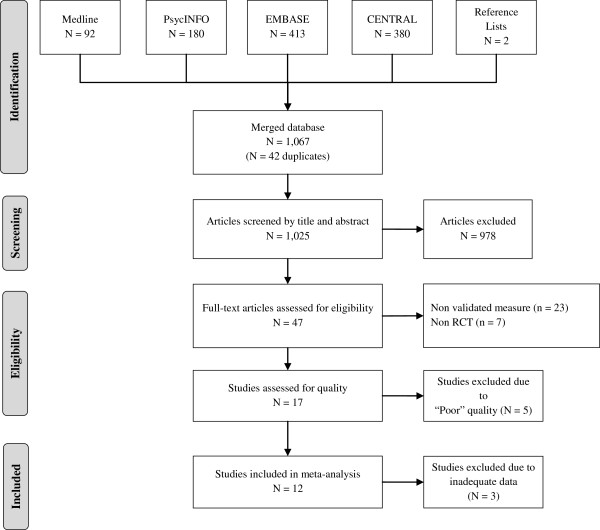
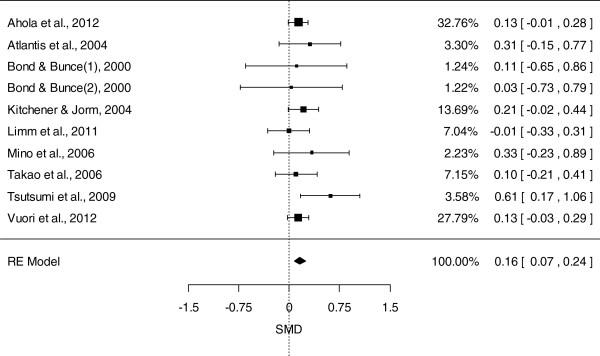
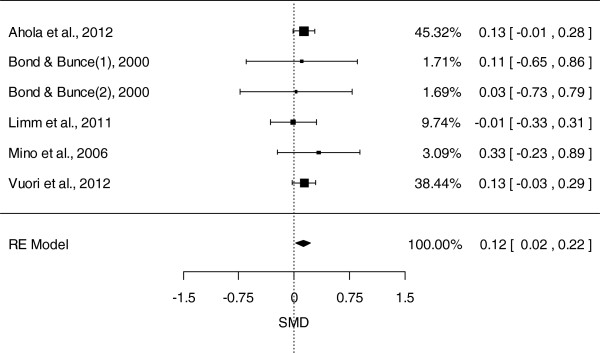
BACKGROUND: Depression is a major public health problem among working-age adults. The workplace is potentially an important location for interventions aimed at preventing the development of depression, but to date, the mental health impact of universal interventions in the workplace has been unclear. METHOD: A systematic search was conducted in relevant databases to identify randomized controlled trials of workplace interventions aimed at universal prevention of depression. The quality of studies was assessed using the Downs and Black checklist. A meta-analysis was performed using results from studies of adequate methodological quality, with pooled effect size estimates obtained from a random effects model. RESULTS: Nine workplace-based randomized controlled trials (RCT) were identified. The majority of the included studies utilized cognitive behavioral therapy (CBT) techniques. The overall standardized mean difference (SMD) between the intervention and control groups was 0.16 (95% confidence interval (CI): 0.07, 0.24, P = 0.0002), indicating a small positive effect. A separate analysis using only CBT-based interventions yielded a SMD of 0.12 (95% CI: -0.01, 0.24, P = 0.07). [corrected]. CONCLUSIONS: There is good quality evidence that universally delivered workplace mental health interventions can reduce the level of depression symptoms among workers. There is more evidence for the effectiveness of CBT-based programs than other interventions. Evidence-based workplace interventions should be a key component of efforts to prevent the development of depression among adults.
Overview
The claims and statistics of this paper haven’t been checked yet.
Free: it reads the open-access text and checks the first 5 claims that cite a source we can check. Create a free account to check every claim.
Integrity signals
Registry
Cites
Statistics
Figures
Verification
Claims the paper makes
The claims and statistics of this paper haven’t been checked yet.
Free: it reads the open-access text and checks the first 5 claims that cite a source we can check. Create a free account to check every claim.
Claims other papers make about this one
Each is checked against this paper’s own text: does it say what the citing paper says it does?
The source backs part of the claim, not all of it — or backs it for a different population, condition or comparison.
In the citing paper
“our review augments the findings of Tan et al. (2014), whose meta-analysis of nine RCTs of interventions aimed at ameliorating depression in the workplaceincluding but not limited to MBIsobserved a small positive effect.”
From Mindfulness-based interventions in the workplace: An inclusive systematic review and meta-analysis of their impact upon wellbeing (2019) · cites this paper as Tan et al. (2014)
Experimental — accuracy not yet measuredThe cited source says what the claim attributes to it.
In the citing paper
“A systematic review of universal workplace interventions on depressive symptoms found overall positive but small effects, but a challenge for these approaches is resource and time allocation to sufficiently engage the target population, especially in broad organizational level approaches which are less frequently studied (11).”
From An Ecological Study of a Universal Employee Depression Awareness and Stigma Reduction Intervention: “Right Direction” (2021) · cites this paper as [11]
The cited source says what the claim attributes to it.
In the citing paper
“A meta-analysis of work-based depression prevention programs found that various types of interventions, particularly those based on cognitive behavioural models, show evidence of an ability to reduce depressive symptoms in unselected working populations [12].”
From A pilot evaluation of a smartphone application for workplace depression (2020) · cites this paper as [12]
In the citing paper
“It concludes, consistent with an earlier systematic review on exercise, 416 that while the evidence base on exercise and social interventions to prevent antenatal depression in mothers is growing, it remains insufficient to support implementation and points to a prominent area of research need.”
From Time for united action on depression: a Lancet–World Psychiatric Association Commission (2022) · cites this paper as [415]
In the citing paper
“A stress management intervention, such as the one used in the present study which recruits participants with elevated (but not necessarily clinically significant) stress levels, is likely to report a smaller effect size than an intervention delivered within a clinical setting [54]”
3 more claims about this paper
Create a free account to see every claim other papers make about this one.
Self-check
Percentages, sums and reported differences re-computed from the paper’s own numbers.
The self-check needs the paper’s full text.
Citations
Cites
R: A Language and Environment for Statistical Computing
R Core Team (2025) · doi:10.32614/r.manuals · Cited by 352,181
Statistical Power Analysis for the Behavioral Sciences
Muller, K. (1989) · Technometrics · doi:10.1080/00401706.1989.10488618 · Cited by 99,167
Statistical power analysis for the behavioral sciences
(1990) · Computers, Environment and Urban Systems · doi:10.1016/0198-9715(90)90050-4 · Cited by 65,269
Measuring inconsistency in meta-analyses
Higgins, J. P. T., Thompson, S. G., Deeks, J. J., & Altman, D. G. (2003) · BMJ · doi:10.1136/bmj.327.7414.557 · Cited by 63,139 · cited 1×
“An I(2) value of 0% denotes no observed heterogeneity, whereas, 25% is “low”, 50% is “moderate” and 75% is “high” heterogeneity [33].”
BackgroundBias in meta-analysis detected by a simple, graphical test
Egger, M., Smith, G. D., Schneider, M., & Minder, C. (1997) · BMJ · doi:10.1136/bmj.315.7109.629 · Cited by 56,722 · cited 1×
“Hence, we also used Egger’s linear regression model to statistically test for funnel plot asymmetry [52].”
MethodCochrane Handbook for Systematic Reviews of Interventions: Cochrane Book Series
(2008) · doi:10.1002/9780470712184 · Cited by 25,048
Conducting Meta-Analyses in R with the metafor Package
Viechtbauer, W. (2010) · Journal of Statistical Software · doi:10.18637/jss.v036.i03 · Cited by 20,464 · cited 1×
“6 package for R [29].”
Projections of Global Mortality and Burden of Disease from 2002 to 2030
Mathers, C. D., & Loncar, D. (2006) · PLoS Medicine · doi:10.1371/journal.pmed.0030442 · Cited by 11,386
Downs, S. H., & Black, N. (1998) · Journal of Epidemiology and Community Health · doi:10.1136/jech.52.6.377 · Cited by 8,252 · cited 1×
“The quality of the identified randomized controlled trials was assessed using the Downs and Black checklist [22].”
MethodChapter 9: Analysing Data and Undertaking Meta-Analyses
Deeks, J. J., Higgins, J. P. T., & Altman, D. G. (2008) · Cited by 2,782
Research works printed but not linked: 3
- C3 Collaborating for Health Workplace Health Initiatives: Evidence of Effectiveness 2011 London, UK: C3 Collaborating for Health
- World Health Organization/World Economic Forum Preventing Noncommunicable Diseases in the Workplace through Diet and Physical Activity. Report of a joint event 2008 Geneva: World Health Organization
- Higgins JPT, Green S Cochrane Handbook for Systematic Reviews of Interventions 4.2.6 [updated September 2006] 2006 Chichester, UK: John Wiley & Sons, Ltd
Cited by
Time for united action on depression: a Lancet–World Psychiatric Association Commission
Herrman, H., Patel, V., Kieling, C., Berk, M., Buchweitz, C., Cuijpers, P., Furukawa, T. A., Kessler, R. C., Kohrt, B. A., Maj, M., et al. (2022) · The Lancet · doi:10.1016/s0140-6736(21)02141-3 · Cited by 1,104
Joyce, S., Shand, F., Tighe, J., Laurent, S. J., Bryant, R. A., & Harvey, S. B. (2018) · BMJ Open · doi:10.1136/bmjopen-2017-017858 · Cited by 864
Self-citationWorkplace interventions for common mental disorders: A systematic meta-review
Joyce, S., Modini, M., Christensen, H., Mykletun, A., Bryant, R., Mitchell, P. B., & Harvey, S. B. (2016) · Psychological Medicine · doi:10.1017/s0033291715002408 · Cited by 525
“While there are some promising results emerging (Tan et al. 2014), the overall effectiveness of resilience training needs to be examined in more detail before wide scale use of such interventions can be fully supported.”
BackgroundSelf-citationPsychological interventions to foster resilience in healthcare professionals
Kunzler, A. M., Helmreich, I., Chmitorz, A., König, J., Binder, H., Wessa, M., & Lieb, K. (2020) · Cochrane Database of Systematic Reviews · doi:10.1002/14651858.cd012527.pub2 · Cited by 390
Hammoudi Halat, D., Soltani, A., Dalli, R., Alsarraj, L., & Malki, A. (2023) · Journal of Clinical Medicine · doi:10.3390/jcm12134425 · Cited by 296
Rees, C. S., Breen, L. J., Cusack, L., & Hegney, D. (2015) · Frontiers in Psychology · doi:10.3389/fpsyg.2015.00073 · Cited by 297
“…outcomes such as high rates of depression and anxiety, burnout, secondary traumatic stress, and compassion fatigue (Figley, 2002; Bride et al., 2007) as well as a number of negative patient and organizational outcomes such as reduced work performance and comprised patient care (Tan et al., 2014).”
BackgroundInfluentialProper, K. I., & van Oostrom, S. H. (2019) · Scandinavian Journal of Work, Environment & Health · doi:10.5271/sjweh.3833 · Cited by 286
“Although CBT is particularly applied to patients, these techniques were included in workplace health promotion interventions to target behavioral changes to promote (mental) health (22).”
BackgroundResultInfluentialUnderstanding effective approaches to promoting mental health and preventing mental illness
(2017) · OECD Health Working Papers · doi:10.1787/bc364fb2-en · Cited by 259
“Other reviews have been more definitive in supporting the effectiveness of individual levels interventions, particularly cognitive behaviour therapy (CBT) (Bhui et al., 2012, Tan et al., 2014).”
Stratton, E., Lampit, A., Choi, I., Calvo, R. A., Harvey, S. B., & Glozier, N. (2017) · PLOS ONE · doi:10.1371/journal.pone.0189904 · Cited by 252
“Scores were pooled into four categories as used in other reviews [11]: Effectiveness of eHealth interventions for reducing mental health conditions in employees”
BackgroundMethodSelf-citationLomas, T., Medina, J. C., Ivtzan, I., Rupprecht, S., & Eiroa-Orosa, F. J. (2019) · The Journal of Positive Psychology · doi:10.1080/17439760.2018.1519588 · Cited by 236
“augments the findings of Tan et al. (2014), whose metaanalysis of nine RCTs of interventions aimed at ameliorating depression in the workplace – including but not”
BackgroundInfluentialThe Economic Case for the Prevention of Mental Illness
McDaid, D., Park, A.-L., & Wahlbeck, K. (2019) · Annual Review of Public Health · doi:10.1146/annurev-publhealth-040617-013629 · Cited by 225
Deady, M., Choi, I., Calvo, R. A., Glozier, N., Christensen, H., & Harvey, S. B. (2017) · BMC Psychiatry · doi:10.1186/s12888-017-1473-1 · Cited by 222
“These changes were in line with previous studies [33, 34].”
BackgroundResultSelf-citationGayed, A., Milligan-Saville, J. S., Nicholas, J., Bryan, B. T., LaMontagne, A. D., Milner, A., Madan, I., Calvo, R. A., Christensen, H., Mykletun, A., et al. (2018) · Occupational and Environmental Medicine · doi:10.1136/oemed-2017-104789 · Cited by 183
Self-citationEvidence of Workplace Interventions—A Systematic Review of Systematic Reviews
Pieper, C., Schröer, S., & Eilerts, A.-L. (2019) · International Journal of Environmental Research and Public Health · doi:10.3390/ijerph16193553 · Cited by 205
“Positive effects were shown for cognitive-behavioral interventions [2,7,26,28,37,42,47,49,57] and web-based cognitive-behavioral interventions [48].”
BackgroundConstruction Workers’ Well-Being: What Leads to Depression, Anxiety, and Stress?
Langdon, R. R., & Sawang, S. (2017) · Journal of Construction Engineering and Management · doi:10.1061/(asce)co.1943-7862.0001406 · Cited by 178
“The workplace offers a unique opportunity to assist with the reduction of psychological distress (e.g. depression) to promote wellbeing and increase productivity for its workforce (Tan et al., 2014).”
BackgroundMental Health in the Workplace
Goetzel, R. Z., Roemer, E. C., Holingue, C., Fallin, M. D., McCleary, K., Eaton, W. W., Agnew, J., Azocar, F., Ballard, D. W., Bartlett, J., et al. (2017) · Journal of Occupational and Environmental Medicine · doi:10.1097/jom.0000000000001271 · Cited by 194
“One form of treatment, cognitive behavior therapy (CBT), has been shown to be especially effective in treating depression symptoms among workers.(53) Access to these treatments should be provided at the parity with physical health interventions: with as few barriers as possible.”
BackgroundSmets, E., Raedt, W. D., & Hoof, C. A. V. (2018) · IEEE Journal of Biomedical and Health Informatics · doi:10.1109/jbhi.2018.2883751 · Cited by 127
“IN THE 21st century, stress and mental health at work have become major concerns for organizations worldwide [1].”
BackgroundA framework to create more mentally healthy workplaces: A viewpoint
Petrie, K., Joyce, S., Tan, L., Henderson, M., Johnson, A., Nguyen, H., Modini, M., Groth, M., Glozier, N., & Harvey, S. B. (2018) · Australian & New Zealand Journal of Psychiatry · doi:10.1177/0004867417726174 · Cited by 93
Self-citationA systematic review of axillary web syndrome (AWS)
Yeung, W.-Y., McPhail, S., & Kuys, S. S. (2015) · Journal of Cancer Survivorship · doi:10.1007/s11764-015-0435-1 · Cited by 94
Enns, J. E., Holmqvist, M., Wener, P. F., Halas, G., Rothney, J., Schultz, A. S. H., Goertzen, L. N., & Katz, A. (2016) · Preventive Medicine · doi:10.1016/j.ypmed.2016.02.022 · Cited by 113
Effects of Baduanjin on mental health: A comprehensive review
Cheng, F. K. (2014) · Journal of Bodywork and Movement Therapies · doi:10.1016/j.jbmt.2014.11.001 · Cited by 94
Preventing depression using a smartphone app: a randomized controlled trial
Deady, M., Glozier, N., Calvo, R., Johnston, D., Mackinnon, A., Milne, D., Choi, I., Gayed, A., Peters, D., Bryant, R., et al. (2022) · Psychological Medicine · doi:10.1017/s0033291720002081 · Cited by 85
“…with recent meta-analyses in the area of mHealth CBT-related apps (Rathbone, Clarry, & Prescott, 2017) and workplace depression prevention (Tan et al., 2014), the question about how clinically meaningful small changes in symptom scores remains to be seen and tempers conclusions around…”
BackgroundMethodResultInfluentialSelf-citationConsidine, R., Tynan, R. J., James, C. L., Wiggers, J., Lewin, T. J., Inder, K., Perkins, D. A., Handley, T. E., & Kelly, B. J. (2017) · PLoS ONE · doi:10.1371/journal.pone.0168445 · Cited by 94
Smail-Crevier, R., Powers, G., Noel, C., & Wang, J. (2019) · Journal of Medical Internet Research · doi:10.2196/11224 · Cited by 74
“From a public health perspective, universal interventions are attractive for their ability to reach more working adults and because they have the ability to reach specified groups and individuals without screening them, an exercise that has shown to be costly [17,18].”
Strengthening workplace well‐being: perceptions of intensive care nurses
Jarden, R., Sandham, M. H., Siegert, R. J., & Koziol‐McLain, J. (2018) · Nursing in Critical Care · doi:10.1111/nicc.12386 · Cited by 102
Weber, S., Lorenz, C., & Hemmings, N. (2019) · Frontiers in Psychology · doi:10.3389/fpsyg.2019.02745 · Cited by 74
Systematic review of universal and targeted workplace interventions for depression
Wan Mohd Yunus, W. M. A., Musiat, P., & Brown, J. S. L. (2018) · Occupational and Environmental Medicine · doi:10.1136/oemed-2017-104532 · Cited by 72
Deady, M., Johnston, D., Milne, D., Glozier, N., Peters, D., Calvo, R., & Harvey, S. (2018) · JMIR mHealth and uHealth · doi:10.2196/11661 · Cited by 72
“…reviews and meta-analyses to determine the effectiveness of workplace interventions for common mental disorders (CMD) [32], workplace depression prevention [33], the use of eHealth for prevention of CMD in general populations [34], and the use of eHealth tools for CMD in the workplace [23].”
Self-citationWhy hasn’t the mental health of Australians improved? The need for a national prevention strategy
Jorm, A. F. (2014) · Australian & New Zealand Journal of Psychiatry · doi:10.1177/0004867414546387 · Cited by 69
“A recent systematic review of trials showed that interventions Australian & New Zealand Journal of Psychiatry, 48(9) applied across a whole workplace can reduce risk of depression (Tan et al., 2014).”
BackgroundProfessional quality of life: A cross‐sectional survey among C hinese clinical nurses
Shen, J., Yu, H., Zhang, Y., & Jiang, A. (2015) · Nursing and Health Sciences · doi:10.1111/nhs.12228 · Cited by 78
“Professionals in a health care setting are more vulnerable, especially those who care for traumatized patients (Santos et al., 2010; Tan et al., 2014).”
Exhaustion-related changes in cardiovascular and cortisol reactivity to acute psychosocial stress
Jönsson, P., Österberg, K., Wallergård, M., Hansen, Å. M., Garde, A. H., Johansson, G., & Karlson, B. (2015) · Physiology & Behavior · doi:10.1016/j.physbeh.2015.07.020 · Cited by 58
“Workplace programs for primary prevention ofmental disorders are rare, though probably effective [58].”
We're told,‘Suck it up': long-term care workers' psychological health and safety
Braedley, S., Owusu, P., Przednowek, A., & Armstrong, P. (2018) · Ageing International · doi:10.1007/s12126-017-9288-4 · Cited by 62
Recent advances in the prevention of mental disorders
Mendelson, T., & Eaton, W. W. (2018) · Social Psychiatry and Psychiatric Epidemiology · doi:10.1007/s00127-018-1501-6 · Cited by 76
Spotlight on the Challenges of Depression following Retirement and Opportunities for Interventions
Dang, L., Ananthasubramaniam, A., & Mezuk, B. R. (2022) · Clinical Interventions in Aging · doi:10.2147/cia.s336301 · Cited by 83
Stansfeld, S. A., Kerry, S., Chandola, T., Russell, J., Berney, L., Hounsome, N., Lanz, D., Costelloe, C., Smuk, M., & Bhui, K. (2015) · BMJ Open · doi:10.1136/bmjopen-2015-007981 · Cited by 53
Bondar, J., Babich Morrow, C., Gueorguieva, R., Brown, M., Hawrilenko, M., Krystal, J. H., Corlett, P. R., & Chekroud, A. M. (2022) · JAMA Network Open · doi:10.1001/jamanetworkopen.2022.16349 · Cited by 53
Workplace mental health screening: a systematic review and meta-analysis
Strudwick, J., Gayed, A., Deady, M., Haffar, S., Mobbs, S., Malik, A., Akhtar, A., Braund, T. A., Bryant, R. A., & Harvey, S. B. (2023) · Occupational and Environmental Medicine · doi:10.1136/oemed-2022-108608 · Cited by 63
“15 Even a small improvement in employee reported mental health symptoms may have an important impact on the performance and functioning of employees as well as an organisation, particularly where individuals are not reporting clinical levels of symptoms.”
BackgroundSelf-citationLugata, S., Elinisa, M., Doshi, B., Kashuta, R. A., Hango, S., Mallosa, W. J., Kelly, C. A., & Ngocho, J. S. (2020) · Journal of Mental Health · doi:10.1080/09638237.2020.1793129 · Cited by 53
“High levels of depression are associated with suicidal ideation (Ibrahim et al., 2013), poor academic achievement (Hysenbegasi et al., 2005), relationship instability (Whitton & Whisman, 2010), and poor work performance (Tan et al., 2014).”
BackgroundStratton, E., Jones, N., Peters, S. E., Torous, J., & Glozier, N. (2021) · Journal of Occupational & Environmental Medicine · doi:10.1097/jom.0000000000002267 · Cited by 48
“Organizations are increasingly responding to the mental health needs of their employees through the development and implementation of workplace mental health programs.(7) A growing number of professional societies and government agencies have sought to guide organizational efforts through the establishment of both int…”
BackgroundHarvey, S. B., Sellahewa, D. A., Wang, M., Milligan-Saville, J. S., Bryan, B. T., Henderson, M., Hatch, S. L., & Mykletun, A. (2018) · The Lancet Psychiatry · doi:10.1016/s2215-0366(18)30137-8 · Cited by 53
Self-citationGómez‐Gómez, I., Bellón, J. Á., Resurrección, D. M., Cuijpers, P. J., Moreno-Peral, P., Rigabert, A., Maderuelo-Fernández, J. Á., & Motrico, E. (2020) · Preventive Medicine · doi:10.1016/j.ypmed.2020.106067 · Cited by 53
Measures to Improve the Mental Health of Construction Personnel Based on Expert Opinions
Nwaogu, J. M., Chan, A. P. C., & Naslund, J. A. (2022) · Journal of Management in Engineering · doi:10.1061/(asce)me.1943-5479.0001045 · Cited by 50
Cheng, J. T., Gerpott, F. H., Benson, A. J., Bucker, B., Foulsham, T., Lansu, T. A. M., Schülke, O., & Tsuchiya, K. (2022) · The Leadership Quarterly · doi:10.1016/j.leaqua.2022.101654 · Cited by 63
A mentally healthy framework to guide employers and policy makers
Deady, M., Sanatkar, S., Tan, L., Glozier, N., Gayed, A., Petrie, K., Dalgaard, V. L., Stratton, E., LaMontagne, A. D., & Harvey, S. B. (2024) · Frontiers in Public Health · doi:10.3389/fpubh.2024.1430540 · Cited by 70
Self-citationNielsen, K. M., & Shepherd, R. (2022) · Work & Stress · doi:10.1080/02678373.2022.2028318 · Cited by 63
“…health and wellbeing training in the workplace is the before and after design, ideally employing randomisation where participants are randomly assigned into two groups and changes in mental health and wellbeing are observed comparing the intervention with the control group (Tan et al., 2014).”
BackgroundMethodUniversal depression prevention: An umbrella review of meta-analyses
Hoare, E., Collins, S., Marx, W., Callaly, E., Moxham-Smith, R., Cuijpers, P., Holte, A., Nierenberg, A. A., Reavley, N., Christensen, H., et al. (2021) · Journal of Psychiatric Research · doi:10.1016/j.jpsychires.2021.10.006 · Cited by 41
Self-citationNixon, P., Boß, L., Heber, E., Ebert, D. D., & Lehr, D. (2021) · BMC Public Health · doi:10.1186/s12889-021-11504-2 · Cited by 43
Richmond, M. K., Pampel, F. C., Wood, R. C., & Nunes, A. P. (2016) · Journal of Occupational and Environmental Medicine · doi:10.1097/jom.0000000000000744 · Cited by 48
Interventions to improve working conditions of nursing staff in acute care hospitals: Scoping review
Barrientos‐Trigo, S., Vega-Vázquez, L., de Diego‐Cordero, R., Badanta, B., & Pórcel‐Gálvez, A. M. (2018) · Journal of Nursing Management · doi:10.1111/jonm.12538 · Cited by 51
James, C. L., Tynan, R. J., Roach, D., Leigh, L., Oldmeadow, C. J., Rahman, M. M., & Kelly, B. J. (2018) · PLoS ONE · doi:10.1371/journal.pone.0209377 · Cited by 48
Nigatu, Y. T., Huang, J., Rao, S., Gillis, K., Merali, Z., & Wang, J. (2019) · American Journal of Preventive Medicine · doi:10.1016/j.amepre.2018.08.027 · Cited by 41
Qin, X., Liu, C., Zhu, W. D., Chen, Y., & Wang, Y. (2022) · International Journal of Environmental Research and Public Health · doi:10.3390/ijerph192416824 · Cited by 57
“Depressive symptom reduction is the main outcome for evaluating the effectiveness of universal prevention [26].”
BackgroundNwaogu, J. M., & Chan, A. P. C. (2020) · Journal of Engineering Design and Technology · doi:10.1108/jedt-05-2020-0159 · Cited by 55
Primary prevention of depression: An umbrella review of controlled interventions
de Pablo, G. S., Solmi, M., Vaquerizo‐Serrano, J., Raduà, J., Passina, A., Mosillo, P., Correll, C. U., Borgwardt, S., Galderisi, S., Bechdolf, A., et al. (2021) · Journal of Affective Disorders · doi:10.1016/j.jad.2021.07.101 · Cited by 46
A pilot evaluation of a smartphone application for workplace depression
Collins, D. A. J., Harvey, S. B., Lavender, I., Glozier, N., Christensen, H., & Deady, M. (2020) · International Journal of Environmental Research and Public Health · doi:10.3390/ijerph17186753 · Cited by 37
“A meta-analysis of work-based depression prevention programs found that various types of interventions, particularly those based on cognitive behavioural models, show evidence of an ability to reduce depressive symptoms in unselected working populations [12].”
BackgroundSelf-citationArensman, E., O’Connor, C., Leduc, C., Griffin, E., Cully, G., Dhálaigh, D. N., Holland, C., Audenhove, C. V., Coppens, E., Tsantila, F., et al. (2022) · International Journal of Environmental Research and Public Health · doi:10.3390/ijerph19020947 · Cited by 49
“Supportive workplace environments have been linked to lower levels of job dissatisfaction, burnout, and depression [38,39].”
BackgroundMache, S., Baresi, L., Bernburg, M., Vitzthum, K., & Groneberg, D. A. (2016) · Archives of Gynecology and Obstetrics · doi:10.1007/s00404-016-4223-6 · Cited by 46
Prevalence and treatment of common mental disorders in the English national population, 1993–2007
Spiers, N., Qassem, T., Bebbington, P., McManus, S., King, M., Jenkins, R., Meltzer, H., & Brugha, T. S. (2016) · British Journal of Psychiatry · doi:10.1192/bjp.bp.115.174979 · Cited by 35
“55 Responding to this challenge remains an economic and humanitarian imperative.”
Lutz, N., Taeymans, J., Ballmer, C., Verhaeghe, N., Clarys, P., & Deliens, T. (2018) · European Journal of Public Health · doi:10.1093/eurpub/cky269 · Cited by 37
Woodward, A. M., Lipari, R. N., & Eaton, W. H. (2017) · Psychiatric Rehabilitation Journal · doi:10.1037/prj0000251 · Cited by 35
Nascimento, G. G., Leite, F. R. M., Corrêa, M. B., Peres, M. A., & Demarco, F. F. (2015) · Clinical Oral Investigations · doi:10.1007/s00784-015-1678-y · Cited by 37
Teaching multiple approaches to management to facilitate prosocial and environmental well-being
Dyck, B., & Caza, A. (2021) · Management Learning · doi:10.1177/13505076211045498 · Cited by 35
Home care workers in heart failure: a systematic review
Sterling, M. R., Shaw, A. L., Leung, P. B. K., Safford, M. M., Jones, C. D., Tsui, E. K., & Delgado, D. (2018) · Journal of Multidisciplinary Healthcare · doi:10.2147/jmdh.s175512 · Cited by 35
Prevention of mental disorders: evidence, challenges and opportunities
Jacka, F. N., & Reavley, N. J. (2014) · BMC Medicine · doi:10.1186/1741-7015-12-75 · Cited by 45
Imamura, K., Tran, T. T. T., Nguyen, H. T., Sasaki, N., Kuribayashi, K., Sakuraya, A., Bui, T. M., Nguyen, A. Q., Nguyen, Q. T., Nguyen, N. T., et al. (2021) · Scientific Reports · doi:10.1038/s41598-021-90320-5 · Cited by 31
Chan, P., Bhar, S. S., Davison, T. E., Doyle, C., Knight, B. G., Koder, D., Laidlaw, K., Pachana, N. A., Wells, Y., & Wuthrich, V. M. (2019) · Aging & Mental Health · doi:10.1080/13607863.2019.1686457 · Cited by 35
Shuck, B., Alagaraja, M., Rose, K. J., Owen, J. J., Osam, K., & Bergman, M. (2017) · Performance Improvement Quarterly · doi:10.1002/piq.21246 · Cited by 48
Weisel, K. K., Lehr, D., Heber, E., Zarski, A.-C., Berking, M., Riper, H., & Ebert, D. D. (2018) · Journal of Medical Internet Research · doi:10.2196/jmir.9387 · Cited by 28
Transtornos mentais e comportamentais em trabalhadores: estudo sobre os afastamentos laborais
Fernandes, M. A., Santos, J. D. M., de Moraes, L. M. V., Lima, J. S. R., Feitosa, C. D. A., & Sousa, L. F. C. (2018) · Revista da Escola de Enfermagem da USP · doi:10.1590/s1980-220x2017036403396 · Cited by 29
Nwaogu, J. M., Chan, A. P. C., & Tetteh, M. O. (2021) · Journal of Engineering Design and Technology · doi:10.1108/jedt-11-2020-0464 · Cited by 31
Meléndez‐Torres, G. J., O’Mara-Eves, A., Thomas, J., Brunton, G., Caird, J., & Petticrew, M. P. (2016) · Research Synthesis Methods · doi:10.1002/jrsm.1231 · Cited by 41
Bellón, J. Á., Cerón, S. C., Cortés-Abela, C., Pena-Andreu, J. M., García-Rodríguez, A., & Moreno-Peral, P. (2018) · Scandinavian Journal of Work Environment & Health · doi:10.5271/sjweh.3791 · Cited by 32
“Some systematic reviews and meta-analyses have been conducted to assess the effectiveness of interven - tions in reducing depressive symptoms in the workplace (23–25).”
Validation of an Emotion Regulation Training Program on Mental Well-Being
LeBlanc, S., Uzun, B., Aydemir, A., & Mohiyeddini, C. (2019) · Psychological Reports · doi:10.1177/0033294119878399 · Cited by 35
“For example, Tan et al. (2014) conducted the first systematic review of universal, preventive interventions in organizational settings.”
BackgroundJunge, M. N., Lehr, D., Bockting, C. L. H., Berking, M., Riper, H., Cuijpers, P., & Ebert, D. D. (2015) · Internet Interventions · doi:10.1016/j.invent.2014.11.007 · Cited by 25
“Even though depression is both preventable and treatable at the workplace (Corbière et al., 2009; Tan et al., 2014) and positive effects of psychological interventions on work-productivity have been found (Wang et al., 2007), the majority of affected individuals remain untreated (American…”
InfluentialAshry, H. S. A., Mansour, G., Kalil, A. C., Walters, R. W., & Vivekanandan, R. (2016) · Burns · doi:10.1016/j.burns.2016.02.024 · Cited by 26
“[15] Tan L, Wang MJ, Modini M, Joyce S, Mykletun A, Christensen H, et al.”
Backgroundvan de Voort, I., de Rijk, A. E., Hensing, G. K. E., & Bertilsson, M. (2019) · Journal of Occupational and Environmental Medicine · doi:10.1097/jom.0000000000001629 · Cited by 27
“Evidence suggests workplace interventions targeted at preventing CMDs to be effective.(5,12) However, most interventions or guidelines focus on secondary and tertiary prevention aimed at detection of or avoiding further deterioration rather than on preventing its onset primarily.”
BackgroundSystematic review of first responder post-deployment or post-incident psychosocial interventions
Tan, L., Petrie, K., Deady, M., Bryant, R. A., & Harvey, S. B. (2022) · Occupational Medicine · doi:10.1093/occmed/kqab182 · Cited by 32
Self-citationWorkplace Health Promotion and Mental Health: Three-Year Findings from Partnering Healthy@Work
Jarman, L., Martin, A. J., Venn, A., Otáhal, P., Blizzard, L., Teale, B., & Sanderson, K. A. (2016) · PLoS ONE · doi:10.1371/journal.pone.0156791 · Cited by 32
“Universal workplace interventions directly targeting mental health can be effective in reducing symptoms of depression [6,7].”
BackgroundLehr, D., Heber, E., Sieland, B., Hillert, A., Funk, B., & Ebert, D. D. (2016) · Prävention und Gesundheitsförderung · doi:10.1007/s11553-016-0541-6 · Cited by 29
Müller, G., Pfinder, M., Schmahl, C. G., Bohus, M., & Lyssenko, L. (2019) · BMC Public Health · doi:10.1186/s12889-019-7585-4 · Cited by 32
Need for Recovery as an Early Sign of Depression Risk in a Working Population
Nieuwenhuijsen, K., Sluiter, J. K., & Dewa, C. S. (2016) · Journal of Occupational and Environmental Medicine · doi:10.1097/jom.0000000000000866 · Cited by 24
Prevention of mental and substance use disorders: Shaping priorities for research and implementation
Baker, S. T. E., Deady, M., Birrell, L., Ross, K., Fitzpatrick, S., Newton, N. C., Cockayne, N. L., Loughland, C. M., Christensen, H. M., Teesson, M., et al. (2021) · Mental Health & Prevention · doi:10.1016/j.mhp.2021.200211 · Cited by 24
Self-citationMache, S., Bernburg, M., Baresi, L., & Groneberg, D. A. (2016) · European Journal of Emergency Medicine · doi:10.1097/mej.0000000000000434 · Cited by 26
Common mental disorders related to incidents and behaviour in physicians
de Jong, M., Nieuwenhuijsen, K., & Sluiter, J. K. (2016) · Occupational Medicine · doi:10.1093/occmed/kqw030 · Cited by 26
Deady, M., Johnston, D., Glozier, N., Milne, D., Choi, I., Mackinnon, A. J., Mykletun, A., Calvo, R. A., Gayed, A., Bryant, R. A., et al. (2018) · BMC Psychiatry · doi:10.1186/s12888-018-1752-5 · Cited by 26
“Given its immediacy and core role in the lives of individuals, the workplace may be an avenue for providing psychological interventions to those who might not otherwise access mental health services in a conventional manner [15].”
BackgroundSelf-citationBernburg, M., Baresi, L., Groneberg, D. A., & Mache, S. (2016) · European Journal of Pediatrics · doi:10.1007/s00431-016-2777-8 · Cited by 24
Sierk, A., Travers, E., Economides, M., Loe, B. S., Sun, L., & Bolton, H. (2022) · JMIR Mental Health · doi:10.2196/34103 · Cited by 21
Kawadler, J. M., Hemmings, N. R., Ponzo, S., Morelli, D., Bird, G., & Plans, D. (2020) · JMIR Formative Research · doi:10.2196/18067 · Cited by 20
“These results fit into a wider body of literature showing that digital health interventions may improve symptoms of depression, stress, and anxiety in a workplace environment [35-38], with more pronounced benefit in those with elevated stress levels [10,19].”
ResultWellness room as a strategy to reduce occupational stress: quasi-experimental study
Jacques, J. P. B., Ribeiro, R. P., Scholze, A. R., Galdino, M. J. Q., Martins, J. T., & Ribeiro, B. G. D. A. (2018) · Revista Brasileira de Enfermagem · doi:10.1590/0034-7167-2017-0572 · Cited by 26
Fukai, K., Kuwahara, K., Chen, S., Eguchi, M., Kochi, T., Kabe, I., & Mizoue, T. (2020) · Journal of Occupational Health · doi:10.1002/1348-9585.12120 · Cited by 24
Economides, M., Bolton, H., Male, R., & Cavanagh, K. (2022) · JMIR Formative Research · doi:10.2196/34032 · Cited by 19
“With fewer access barriers, digital platforms also have the potential to offer a preventative solution to common mental health problems by facilitating sustained, proactive engagement [8,9].”
Conceptualizing the dynamics of mental health among construction supervisors
Nwaogu, J. M., Chan, A. P. C., & Akinlolu, A. T. (2022) · International Journal of Construction Management · doi:10.1080/15623599.2022.2080932 · Cited by 22
Lemogne, C., Meneton, P., Wiernik, E., Quesnot, A., Consoli, S. M., Ducimetière, P., Nabi, H., Empana, J. P., Hoertel, N., Limosin, F., et al. (2017) · Circulation Cardiovascular Quality and Outcomes · doi:10.1161/circoutcomes.116.002767 · Cited by 22
Namazi, S., Dugan, A. G., Fortinsky, R. H., Barnes-Farrell, J. L., Coman, E., Ghaziri, M. E., & Cherniack, M. G. (2019) · Journal of Occupational and Environmental Medicine · doi:10.1097/jom.0000000000001664 · Cited by 20
(2023) · doi:10.2196/47350 · Cited by 18
“Previous research has shown that depressed primary care patients preferred psychological treatments over psychiatric drug treatment and research found that patients who did not receive their preferred form of treatment evidenced lower working alliance scores [4,6,13,14].”
Li, L. M. W. (2018) · Journal of Mental Health · doi:10.1080/09638237.2018.1466043 · Cited by 27
Smyth, A., Syrek, C. J., Reins, J. A., Domin, M., Janneck, M., & Lehr, D. (2018) · Prävention und Gesundheitsförderung · doi:10.1007/s11553-018-0664-z · Cited by 19
(2023) · doi:10.2196/preprints.47350 · Cited by 18
Differential item functioning of the CESDR-R and GAD-7 in African and white working adults
Henn, C., & Morgan, B. (2019) · SA Journal of Industrial Psychology · doi:10.4102/sajip.v45i0.1663 · Cited by 17
“A workplace is ‘an ideal setting for depression and anxiety interventions’ (Mykletun & Harvey, 2012, p. 868) because adults spend much of their time in the workplace (Tan et al., 2014).”
BackgroundEmployee Perceptions of Well-Being Programs
Edwards, A. V., & Marcus, S. (2018) · Journal of Social Behavioral and Health Sciences · doi:10.5590/jsbhs.2018.12.1.07 · Cited by 26
Metadata
- Authors
- Tan, L., Wang, M.-J., Modini, M., Joyce, S., Mykletun, A., Christensen, H., & Harvey, S. B.
- Affiliations
- Black Dog Institute (AU)
- Norwegian Institute of Public Health (NO)
- Corresponding author
- Tan, Leona
- ORCID
- Venue
- BMC Medicine
- Published
- 2014-05-09
- Volume
- 12
- Issue
- 1
- Pages
- 74-74
- ISSN
- 1741-7015 (ISSN-L)
- PMC
- PMC4014627
- OpenAlex
- W2164880936
- Cited by
- 208
- References
- 60
- Citations by year
- 2026: 3 · 2025: 11 · 2024: 9 · 2023: 19 · 2022: 20 · 2021: 29 · 2020: 17 · 2019: 22 · 2018: 26 · 2017: 16 · 2016: 16 · 2015: 11 · 2014: 9
- FWCI
- 2.95
- Type
- journal article
- Language
- en
- Update notices
- correction (2014-11-13)
- Open access
- gold
- doi.org
- Licence
- Locations
- BMC Medicine (publishedVersion, cc-by)
- Europe PMC (PubMed Central) (publishedVersion, other-oa)
- PubMed Central (publishedVersion, cc-by)
- PubMed (publishedVersion)
- BIBSYS Brage (BIBSYS (Norway)) (submittedVersion)
- NORA - Norwegian Open Research Archives (submittedVersion, other-oa)
- Topics
- Health Sciences › Medicine › Public Health, Environmental and Occupational Health › Workplace Health and Well-being
- Social Sciences › Psychology › Applied Psychology › Digital Mental Health Interventions
- Health Sciences › Medicine › Psychiatry and Mental health › Mental Health Treatment and Access
- Keywords
- depression prevention, workplace mental health interventions, universal prevention, cognitive behavioral therapy, depressive symptoms, working-age adults, workplace mental health
- MeSH terms
- Adult, Depression, Female, Humans, Male, Mental Health, Cognitive Behavioral Therapy, Randomized Controlled Trials as Topic, Workplace
About these checks
Registry, retraction, Cites and statistics results are computed, not judged, with one exception: a printed reference that no index lists is read once by a model before it counts as a citation error. Claims are extracted by a model and kept only when their quote appears verbatim in the text; each cited source is then checked, with a model’s help, for whether it says what the claim relies on. Those verdicts can be wrong — read the claim’s quote and the cited source before relying on one.
Statistics and arithmetic are recomputed, not judged.
Confidence bands are shown only for fields calibrated on our annotated test set. None is calibrated yet, so no band is shown.
What counts as a claim ›How we measure confidence ›How we check this ›
Are you an author, or do you see a problem with this page? Request a review
Data sources
Bibliographic data: Semantic Scholar, OpenAlex, Crossref.
Contains information from the Semantic Scholar Academic Graph Datasets, made available under the ODC Attribution License (ODC-BY 1.0).
Semantic Scholar’s data is described in: Kinney, R., et al. (2023). The Semantic Scholar Open Data Platform. arXiv:2301.10140.
