

Preventing the development of depression at work: a systematic review and meta-analysis of universal interventions in the workplace
Open accessThe DOI matches its Crossref record; 61 of the 61 references it cites were found in a registry or an index.
Abstract
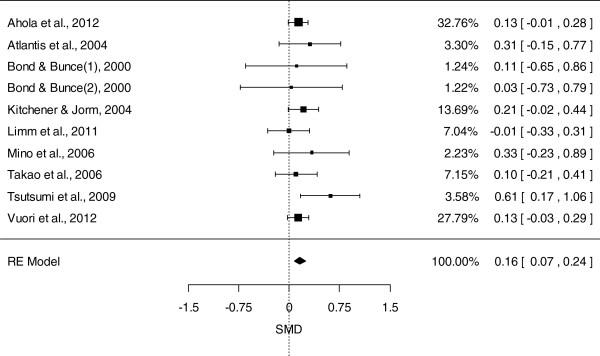
BACKGROUND: Depression is a major public health problem among working-age adults. The workplace is potentially an important location for interventions aimed at preventing the development of depression, but to date, the mental health impact of universal interventions in the workplace has been unclear. METHOD: A systematic search was conducted in relevant databases to identify randomized controlled trials of workplace interventions aimed at universal prevention of depression. The quality of studies was assessed using the Downs and Black checklist. A meta-analysis was performed using results from studies of adequate methodological quality, with pooled effect size estimates obtained from a random effects model. RESULTS: Nine workplace-based randomized controlled trials (RCT) were identified. The majority of the included studies utilized cognitive behavioral therapy (CBT) techniques. The overall standardized mean difference (SMD) between the intervention and control groups was 0.16 (95% confidence interval (CI): 0.07, 0.24, P = 0.0002), indicating a small positive effect. A separate analysis using only CBT-based interventions yielded a SMD of 0.12 (95% CI: -0.01, 0.24, P = 0.07). [corrected]. CONCLUSIONS: There is good quality evidence that universally delivered workplace mental health interventions can reduce the level of depression symptoms among workers. There is more evidence for the effectiveness of CBT-based programs than other interventions. Evidence-based workplace interventions should be a key component of efforts to prevent the development of depression among adults.
Overview
The claims and statistics of this paper haven’t been checked yet.
Free: it reads the open-access text and checks the first 5 claims that cite a source we can check. Create a free account to check every claim.
Integrity signals
Registry
Cites
Statistics
Figures
Verification
Claims the paper makes
The claims and statistics of this paper haven’t been checked yet.
Free: it reads the open-access text and checks the first 5 claims that cite a source we can check. Create a free account to check every claim.
Claims other papers make about this one
Each is checked against this paper’s own text: does it say what the citing paper says it does?
The source backs part of the claim, not all of it — or backs it for a different population, condition or comparison.
In the citing paper
“our review augments the findings of Tan et al. (2014), whose meta-analysis of nine RCTs of interventions aimed at ameliorating depression in the workplaceincluding but not limited to MBIsobserved a small positive effect.”
From Mindfulness-based interventions in the workplace: An inclusive systematic review and meta-analysis of their impact upon wellbeing (2019) · cites this paper as Tan et al. (2014)
Experimental — accuracy not yet measuredThe cited source says what the claim attributes to it.
In the citing paper
“A systematic review of universal workplace interventions on depressive symptoms found overall positive but small effects, but a challenge for these approaches is resource and time allocation to sufficiently engage the target population, especially in broad organizational level approaches which are less frequently studied (11).”
From An Ecological Study of a Universal Employee Depression Awareness and Stigma Reduction Intervention: “Right Direction” (2021) · cites this paper as [11]
The cited source says what the claim attributes to it.
In the citing paper
“A meta-analysis of work-based depression prevention programs found that various types of interventions, particularly those based on cognitive behavioural models, show evidence of an ability to reduce depressive symptoms in unselected working populations [12].”
From A pilot evaluation of a smartphone application for workplace depression (2020) · cites this paper as [12]
In the citing paper
“It concludes, consistent with an earlier systematic review on exercise, 416 that while the evidence base on exercise and social interventions to prevent antenatal depression in mothers is growing, it remains insufficient to support implementation and points to a prominent area of research need.”
From Time for united action on depression: a Lancet–World Psychiatric Association Commission (2022) · cites this paper as [415]
In the citing paper
“A stress management intervention, such as the one used in the present study which recruits participants with elevated (but not necessarily clinically significant) stress levels, is likely to report a smaller effect size than an intervention delivered within a clinical setting [54]”
3 more claims about this paper
Create a free account to see every claim other papers make about this one.
Self-check
Percentages, sums and reported differences re-computed from the paper’s own numbers.
The self-check needs the paper’s full text.
Citations
Cites
R: A Language and Environment for Statistical Computing
R Core Team (2025) · doi:10.32614/r.manuals · Cited by 352,181
Statistical Power Analysis for the Behavioral Sciences
Muller, K. (1989) · Technometrics · doi:10.1080/00401706.1989.10488618 · Cited by 99,167
Statistical power analysis for the behavioral sciences
(1990) · Computers, Environment and Urban Systems · doi:10.1016/0198-9715(90)90050-4 · Cited by 65,269
Measuring inconsistency in meta-analyses
Higgins, J. P. T., Thompson, S. G., Deeks, J. J., & Altman, D. G. (2003) · BMJ · doi:10.1136/bmj.327.7414.557 · Cited by 63,139 · cited 1×
“An I(2) value of 0% denotes no observed heterogeneity, whereas, 25% is “low”, 50% is “moderate” and 75% is “high” heterogeneity [33].”
BackgroundBias in meta-analysis detected by a simple, graphical test
Egger, M., Smith, G. D., Schneider, M., & Minder, C. (1997) · BMJ · doi:10.1136/bmj.315.7109.629 · Cited by 56,722 · cited 1×
“Hence, we also used Egger’s linear regression model to statistically test for funnel plot asymmetry [52].”
MethodCochrane Handbook for Systematic Reviews of Interventions: Cochrane Book Series
(2008) · doi:10.1002/9780470712184 · Cited by 25,048
Conducting Meta-Analyses in R with the metafor Package
Viechtbauer, W. (2010) · Journal of Statistical Software · doi:10.18637/jss.v036.i03 · Cited by 20,464 · cited 1×
“6 package for R [29].”
Projections of Global Mortality and Burden of Disease from 2002 to 2030
Mathers, C. D., & Loncar, D. (2006) · PLoS Medicine · doi:10.1371/journal.pmed.0030442 · Cited by 11,386
Downs, S. H., & Black, N. (1998) · Journal of Epidemiology and Community Health · doi:10.1136/jech.52.6.377 · Cited by 8,252 · cited 1×
“The quality of the identified randomized controlled trials was assessed using the Downs and Black checklist [22].”
MethodChapter 9: Analysing Data and Undertaking Meta-Analyses
Deeks, J. J., Higgins, J. P. T., & Altman, D. G. (2008) · Cited by 2,782
Analysing Data and Undertaking Meta‐Analyses
Deeks, J. J., Higgins, J. P., & Altman, D. G. (2008) · Cochrane Handbook for Systematic Reviews of Interventions · doi:10.1002/9780470712184.ch9 · Cited by 1,800
The Existence of Publication Bias and Risk Factors for Its Occurrence
Dickersin, K. (1990) · JAMA: The Journal of the American Medical Association · doi:10.1001/jama.1990.03440100097014 · Cited by 1,417 · cited 1×
“Publication bias occurs when the published studies are unrepresentative of all conducted studies due to the tendency to submit or accept manuscripts on the basis of the strength or direction of the results [34].”
BackgroundMindfulness-based stress reduction for health care professionals: results from a randomized trial
Shapiro, S. L., Astin, J. A., Bishop, S. R., & Cordova, M. (2005) · International Journal of Stress Management · doi:10.1037/1072-5245.12.2.164 · Cited by 1,323 · cited 3×
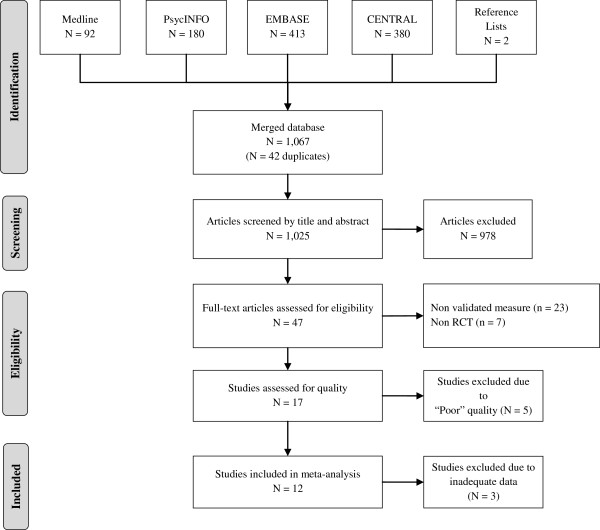
“Five studies were excluded from the meta-analysis due to poor quality [35,36,41,42,46].”
BackgroundRosenberg, M. S. (2005) · Evolution · doi:10.1111/j.0014-3820.2005.tb01004.x · Cited by 1,285 · cited 1×
“Additionally, we computed the Rosenberg’s fail-safe number, which gives the number of unpublished studies needed to reduce the effect to non-significance [53].”
MethodDelivering interventions for depression by using the internet: randomised controlled trial
Christensen, H. (2004) · BMJ · doi:10.1136/bmj.37945.566632.ee · Cited by 928 · cited 1×
“Internet-based CBT has been shown to be effective as a treatment for depression and anxiety and is able to enhance mental well-being in a community setting [58,59].”
BackgroundSelf-citationScales to Assess the Quality of Randomized Controlled Trials: A Systematic Review
Olivo, S. A., Macedo, L. G., Gadotti, I. C., Fuentes, J., Stanton, T., & Magee, D. J. (2008) · Physical Therapy · doi:10.2522/ptj.20070147 · Cited by 829
Mediators of change in emotion-focused and problem-focused worksite stress management interventions
Bond, F. W., & Bunce, D. (2000) · Journal of Occupational Health Psychology · doi:10.1037/1076-8998.5.1.156 · Cited by 607 · cited 17×
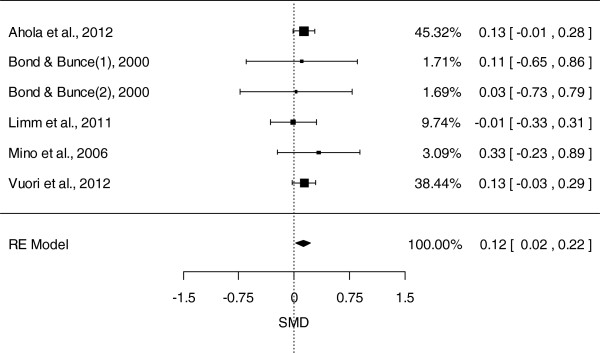
“The overall mean difference between CBT-based interventions and the control groups was 0.12 (95% CI: 0.02, 0.22, P = 0.01), indicating a positive effect for CBT-based interventions.”
BackgroundMethodInfluentialCuijpers, P., & Smit, F. (2004) · Acta Psychiatrica Scandinavica · doi:10.1111/j.1600-0447.2004.00301.x · Cited by 595 · cited 1×
“Given the difficulty of demonstrating true prevention in large clinical trials, studies of universal prevention without a baseline diagnostic assessment, testing universal symptom reduction in the workplace were also included in this review [21].”
BackgroundPreventing the Onset of Depressive Disorders: A Meta-Analytic Review of Psychological Interventions
Cuijpers, P., van Straten, A., Smit, F., Mihalopoulos, C., & Beekman, A. (2008) · American Journal of Psychiatry · doi:10.1176/appi.ajp.2008.07091422 · Cited by 456 · cited 4×
“Although the relative effectiveness of the different types of prevention as they relate to mental health remains unclear [13], there are theoretical and practical reasons that universal interventions may be most appropriate for the workplace.”
BackgroundInfluentialWork and common psychiatric disorders
Henderson, M., Harvey, S., Øverland, S., Mykletun, A., & Hotopf, M. (2011) · Journal of the Royal Society of Medicine · doi:10.1258/jrsm.2011.100231 · Cited by 379 · cited 1×
“Despite mental disorders being the leading cause of sickness absence and work incapacity in most developed countries [4,5], mental health has remained relatively ignored in the majority of workplace health programs.”
BackgroundSelf-citationSamoocha, D., Bruinvels, D. J., Elbers, N. A., Anema, J. R., & van der Beek, A. J. (2010) · Journal of Medical Internet Research · doi:10.2196/jmir.1286 · Cited by 374 · cited 1×
“As with previous studies [25,26], the tool was modified slightly for purposes of this review in that the scoring for question 27 on power was simplified to either zero or one-point based on whether or not there was sufficient power in the study to detect a clinically significant effect.”
MethodPreventing Depression: A Global Priority
Cuijpers, P., Beekman, A. T. F., & Reynolds, C. F. (2012) · JAMA · doi:10.1001/jama.2012.271 · Cited by 368
Prevention of major depression
Muñoz, R. F., Cuijpers, P., Smit, F., Barrera, A. Z., & Leykin, Y. (2010) · Annual Review of Clinical Psychology · doi:10.1146/annurev-clinpsy-033109-132040 · Cited by 326 · cited 1×
“The search strategy was limited to these years since the first prevention randomized controlled trials for depression were conducted around 1980 [19,20].”
MethodKitchener, B. A., & Jorm, A. F. (2004) · BMC Psychiatry · doi:10.1186/1471-244x-4-23 · Cited by 266
Martin, A., Sanderson, K., & Cocker, F. (2009) · Scandinavian Journal of Work, Environment & Health · doi:10.5271/sjweh.1295 · Cited by 237
Cuijpers, P. (2003) · American Journal of Psychiatry · doi:10.1176/appi.ajp.160.8.1385 · Cited by 217 · cited 1×
“Cuijpers has demonstrated this with a series of calculations, which showed that in order to be able to demonstrate that a true preventative program could reduce the rates of new onset depression over one year by 15%, both the experimental and control groups would need to consist of over 30,000 participants [54].”
BackgroundNurse Leader Mindfulness Meditation Program for Stress Management: A Randomized Controlled Trial
Pipe, T. B., Bortz, J. J., Dueck, A., Pendergast, D., Buchda, V., & Summers, J. (2009) · JONA: The Journal of Nursing Administration · doi:10.1097/nna.0b013e31819894a0 · Cited by 213 · cited 3×
“A further independent appraisal (by LT and SH) of the full text version of these articles resulted in 17 studies meeting the criteria for quality assessment [35-50].”
BackgroundMethodAtlantis, E., Chow, C.-M., Kirby, A., & Fiatarone Singh, M. (2004) · Preventive Medicine · doi:10.1016/j.ypmed.2004.02.007 · Cited by 213 · cited 7×
“Following this process, 12 studies were found to be of at least a “fair” quality with final assessment scores ranging from 16 to 23 [37-40,43-45,47-50].”
BackgroundMethodInfluentialWorksite mental health interventions: a systematic review of economic evaluations
Hamberg-van Reenen, H. H., Proper, K. I., & van den Berg, M. (2012) · Occupational and Environmental Medicine · doi:10.1136/oemed-2012-100668 · Cited by 213 · cited 1×
“A recent review suggested that interventions focused on the prevention or treatment of mental health problems were likely to produce a favorable financial return on the investment [12].”
BackgroundThe Public Health Impact of Major Depression: A Call for Interdisciplinary Prevention Efforts
McLaughlin, K. A. (2011) · Prevention Science · doi:10.1007/s11121-011-0231-8 · Cited by 196 · cited 1×
“From a public health perspective, universal interventions are attractive not only because they can reach more working adults, but also because they can reach selected and indicated groups without the need for screening, which has been found to be a costly exercise [14,15].”
BackgroundPreventing the Incidence of New Cases of Mental Disorders: A Meta-Analytic Review
Cuijpers, P., Van Straten, A., & Smit, F. (2005) · Journal of Nervous & Mental Disease · doi:10.1097/01.nmd.0000152810.76190.a6 · Cited by 180 · cited 2×
“The search strategy was limited to these years since the first prevention randomized controlled trials for depression were conducted around 1980 [19,20].”
BackgroundMethodHeaney, C. A., Price, R. H., & Rafferty, J. (1995) · Journal of Organizational Behavior · doi:10.1002/job.4030160405 · Cited by 179 · cited 3×
“Five studies were excluded from the meta-analysis due to poor quality [35,36,41,42,46].”
BackgroundTsutsumi, A., Nagami, M., Yoshikawa, T., Kogi, K., & Kawakami, N. (2009) · Journal of Occupational & Environmental Medicine · doi:10.1097/jom.0b013e3181a24d28 · Cited by 168 · cited 11×
“Adjustments were made for clustered RCTs.”
BackgroundMethodInfluentialPhysical Activity as a Predictor of Adolescent Body Fatness: A Systematic Review
Reichert, F. F., Menezes, A. M. B., Wells, J. C. K., Dumith, S. C., & Hallal, P. C. (2009) · Sports Medicine · doi:10.2165/00007256-200939040-00002 · Cited by 165 · cited 1×
“As with previous studies [25,26], the tool was modified slightly for purposes of this review in that the scoring for question 27 on power was simplified to either zero or one-point based on whether or not there was sufficient power in the study to detect a clinically significant effect.”
MethodMental health and employment: much work still to be done
Harvey, S. B., Henderson, M., Lelliott, P., & Hotopf, M. (2009) · British Journal of Psychiatry · doi:10.1192/bjp.bp.108.055111 · Cited by 159 · cited 1×
“Despite mental disorders being the leading cause of sickness absence and work incapacity in most developed countries [4,5], mental health has remained relatively ignored in the majority of workplace health programs.”
BackgroundSelf-citationVuori, J., Toppinen-Tanner, S., & Mutanen, P. (2012) · Journal of Applied Psychology · doi:10.1037/a0025584 · Cited by 159 · cited 14×
“The overall mean difference between CBT-based interventions and the control groups was 0.12 (95% CI: 0.02, 0.22, P = 0.01), indicating a positive effect for CBT-based interventions.”
BackgroundMethodInfluentialPowell, J., Hamborg, T., Stallard, N., Burls, A., McSorley, J., Bennett, K., Griffiths, K. M., & Christensen, H. (2012) · Journal of Medical Internet Research · doi:10.2196/jmir.2240 · Cited by 156 · cited 1×
“Internet-based CBT has been shown to be effective as a treatment for depression and anxiety and is able to enhance mental well-being in a community setting [58,59].”
BackgroundSelf-citation(2003) · Journal of science and medicine in sport · doi:10.1016/s1440-2440(03)80160-3 · Cited by 148
Limm, H., Gündel, H., Heinmüller, M., Marten-Mittag, B., Nater, U. M., Siegrist, J., & Angerer, P. (2011) · Occupational and Environmental Medicine · doi:10.1136/oem.2009.054148 · Cited by 142 · cited 12×
“The overall mean difference between CBT-based interventions and the control groups was 0.12 (95% CI: 0.02, 0.22, P = 0.01), indicating a positive effect for CBT-based interventions.”
BackgroundMethodInfluentialInterventions to improve occupational health in depressed people
Nieuwenhuijsen, K., Bültmann, U., Neumeyer-Gromen, A., Verhoeven, A. C., Verbeek, J. H., & Feltz-Cornelis, C. M. (2008) · Cochrane Database of Systematic Reviews · doi:10.1002/14651858.cd006237.pub2 · Cited by 129 · cited 1×
“75) and has previously been used in a similar Cochrane Collaboration review [24].”
MethodCost-effectiveness of an Intervention to Prevent Depression in At-Risk Teens
Lynch, F. L., Hornbrook, M., Clarke, G. N., Perrin, N., Polen, M. R., O’Connor, E., & Dickerson, J. (2005) · Archives of General Psychiatry · doi:10.1001/archpsyc.62.11.1241 · Cited by 121 · cited 1×
“From a public health perspective, universal interventions are attractive not only because they can reach more working adults, but also because they can reach selected and indicated groups without the need for screening, which has been found to be a costly exercise [14,15].”
BackgroundA Web-Based Approach to Managing Stress and Mood Disorders in the Workforce
Billings, D. W., Cook, R. F., Hendrickson, A., & Dove, D. C. (2008) · Journal of Occupational & Environmental Medicine · doi:10.1097/jom.0b013e31816c435b · Cited by 117 · cited 3×
“A further independent appraisal (by LT and SH) of the full text version of these articles resulted in 17 studies meeting the criteria for quality assessment [35-50].”
BackgroundMethodDepression and work performance: an ecological study using web-based screening
Harvey, S. B., Glozier, N., Henderson, M., Allaway, S., Litchfield, P., Holland-Elliott, K., & Hotopf, M. (2011) · Occupational Medicine · doi:10.1093/occmed/kqr020 · Cited by 115 · cited 2×
“While there are some early indications that computer-aided interventions are well received in the workplace [55], the effectiveness of universal workbased e-health prevention strategies remains unknown.”
BackgroundSelf-citationKappa Coefficient Calculation Using Multiple Ratings Per Subject: A Special Communication
Haley, S. M., & Osberg, J. S. (1989) · Physical Therapy · doi:10.1093/ptj/69.11.970 · Cited by 113 · cited 1×
“6 (Cohen’s kappa coefficient, Κ) was computed from the standard equation [51].”
MethodAn illustrated guide to the methods of meta‐analysis
Sutton, A. J., Abrams, K. R., & Jones, D. R. (2001) · Journal of Evaluation in Clinical Practice · doi:10.1046/j.1365-2753.2001.00281.x · Cited by 107 · cited 1×
“The random effects model is a more conservative approach that assumes that all studies are estimating different effects resulting from variations in factors such as study population [30], sampling variation within and between studies, and as a result produces wider confidence intervals [31].”
BackgroundWorkplace Effects of the Stigmatization of Depression
Glozier, N. (1998) · Journal of Occupational & Environmental Medicine · doi:10.1097/00043764-199809000-00008 · Cited by 103 · cited 1×
“Such fears may be particularly relevant in a workplace situation, where previous research has found evidence that prejudiced attitudes by employers towards individuals with depressive symptoms are common [17].”
BackgroundA systematic review of preventive interventions regarding mental health issues in organizations
Corbière, M., Shen, J., Rouleau, M., & Dewa, C. S. (2009) · Work · doi:10.3233/wor-2009-0846 · Cited by 91 · cited 1×
“Organizations are increasingly recognizing their obligation to employee health as marked by the rise in workplace health initiatives, particularly over the last two decades [1-3].”
BackgroundRelaxation training methods for nurse managers in Hong Kong: a controlled study
Yung, P. M. B., Fung, M. Y., Chan, T. M. F., & Lau, B. W. K. (2004) · International Journal of Mental Health Nursing · doi:10.1111/j.1445-8330.2004.00342.x · Cited by 91 · cited 3×
“Five studies were excluded from the meta-analysis due to poor quality [35,36,41,42,46].”
BackgroundMethodKilloran, A., White, P., Millward, L., & Fischer, A. (2009) · Journal of Public Health · doi:10.1093/pubmed/fdp073 · Cited by 81
Can Stress Management at the Workplace Prevent Depression? A Randomized Controlled Trial
Mino, Y., Babazono, A., Tsuda, T., & Yasuda, N. (2006) · Psychotherapy and Psychosomatics · doi:10.1159/000091775 · Cited by 80 · cited 15×
“The overall mean difference between CBT-based interventions and the control groups was 0.12 (95% CI: 0.02, 0.22, P = 0.01), indicating a positive effect for CBT-based interventions.”
BackgroundMethodInfluentialPuig-Ribera, A., McKenna, J., Gilson, N., & Brown, W. J. (2008) · Promotion & Education · doi:10.1177/1025382308097693 · Cited by 78 · cited 3×
“Five studies were excluded from the meta-analysis due to poor quality [35,36,41,42,46].”
BackgroundCouser, G. P. (2008) · Journal of Occupational & Environmental Medicine · doi:10.1097/jom.0b013e318168efe2 · Cited by 74 · cited 1×
“Targeting an entire population also reaches individuals who might not want to seek treatment or disclose symptoms for fear of stigmatization and the perceived negative effects on employment [16].”
BackgroundA Novel Stress and Coping Workplace Program Reduces Illness and Healthcare Utilization
Rahe, R. H., Taylor, C. B., Tolles, R. L., Newhall, L. M., Veach, T. L., & Bryson, S. (2002) · Psychosomatic Medicine · doi:10.1097/00006842-200203000-00011 · Cited by 54 · cited 3×
“A further independent appraisal (by LT and SH) of the full text version of these articles resulted in 17 studies meeting the criteria for quality assessment [35-50].”
BackgroundMethodToivanen, H., Helin, P., & H??nninen, O. (1993) · Journal of Occupational and Environmental Medicine · doi:10.1097/00043764-199311000-00015 · Cited by 54 · cited 3×
“Five studies were excluded from the meta-analysis due to poor quality [35,36,41,42,46].”
BackgroundTakao, S., Tsutsumi, A., Nishiuchi, K., Mineyama, S., & Kawakami, N. (2006) · Journal of Occupational Health · doi:10.1539/joh.48.494 · Cited by 50 · cited 17×
“Adjustments were made for clustered RCTs.”
BackgroundMethodInfluentialPrevention of mental disorders: a new era for workplace mental health
Mykletun, A., & Harvey, S. B. (2012) · Occupational and Environmental Medicine · doi:10.1136/oemed-2012-100846 · Cited by 46 · cited 2×
“Despite the appeal of such strategies, to date there has been very little consensus on whether such preventative programs are effective in the workplace [9].”
BackgroundSelf-citationAhola, K., Vuori, J., Toppinen‐Tanner, S., Mutanen, P., & Honkonen, T. (2012) · Occupational and Environmental Medicine · doi:10.1136/oemed-2011-100450 · Cited by 45 · cited 1×
“…affect Table 2 Summary of characteristics of workplace universal prevention studies included in meta-analysis Study Subjects (sample size) Design Intervention description Measure(s) Follow-up Results Ahola et al. (2012) [49] Employees from private and public sectors (n = 718) Individual RCT 1.”
BackgroundHarvey, S. B., & Henderson, M. (2009) · Psychiatry · doi:10.1016/j.mppsy.2009.03.011 · Cited by 40
Self-citationInformation technology as the key to accelerating advances in mental health care
Christensen, H. M., & Petrie, K. (2013) · Australian & New Zealand Journal of Psychiatry · doi:10.1177/0004867412471088 · Cited by 37 · cited 1×
“There is some emerging evidence that e-health technologies may be able to assist in meeting some of these practical challenges [57].”
BackgroundSelf-citationLong-term sickness absence among patients with chronic fatigue syndrome
Knudsen, A. K., Henderson, M., Harvey, S. B., & Chalder, T. (2011) · The British Journal of Psychiatry · doi:10.1192/bjp.bp.110.082974 · Cited by 34 · cited 1×
“The high cost of depression for employers, in terms of sickness absence and reduced work performance [55,56], also provides an opportunity for private organizations to be encouraged to help fund prevention programs; although further economic analysis of the costs and financial benefits of work-based universal interven…”
BackgroundSelf-citationInterventions to improve occupational health in depressed people
Nieuwenhuijsen, K., Verhoeven, A. C., Bültmann, U., Neumeyer‐Gromen, A., & Feltz-Cornelis, C. M. V. D. (2006) · Cochrane Database of Systematic Reviews · doi:10.1002/14651858.cd006237 · Cited by 24
Research works printed but not linked: 3
- C3 Collaborating for Health Workplace Health Initiatives: Evidence of Effectiveness 2011 London, UK: C3 Collaborating for Health
- World Health Organization/World Economic Forum Preventing Noncommunicable Diseases in the Workplace through Diet and Physical Activity. Report of a joint event 2008 Geneva: World Health Organization
- Higgins JPT, Green S Cochrane Handbook for Systematic Reviews of Interventions 4.2.6 [updated September 2006] 2006 Chichester, UK: John Wiley & Sons, Ltd
Cited by
Time for united action on depression: a Lancet–World Psychiatric Association Commission
Herrman, H., Patel, V., Kieling, C., Berk, M., Buchweitz, C., Cuijpers, P., Furukawa, T. A., Kessler, R. C., Kohrt, B. A., Maj, M., et al. (2022) · The Lancet · doi:10.1016/s0140-6736(21)02141-3 · Cited by 1,104
Joyce, S., Shand, F., Tighe, J., Laurent, S. J., Bryant, R. A., & Harvey, S. B. (2018) · BMJ Open · doi:10.1136/bmjopen-2017-017858 · Cited by 864
Self-citationWorkplace interventions for common mental disorders: A systematic meta-review
Joyce, S., Modini, M., Christensen, H., Mykletun, A., Bryant, R., Mitchell, P. B., & Harvey, S. B. (2016) · Psychological Medicine · doi:10.1017/s0033291715002408 · Cited by 525
“While there are some promising results emerging (Tan et al. 2014), the overall effectiveness of resilience training needs to be examined in more detail before wide scale use of such interventions can be fully supported.”
BackgroundSelf-citationPsychological interventions to foster resilience in healthcare professionals
Kunzler, A. M., Helmreich, I., Chmitorz, A., König, J., Binder, H., Wessa, M., & Lieb, K. (2020) · Cochrane Database of Systematic Reviews · doi:10.1002/14651858.cd012527.pub2 · Cited by 390
Hammoudi Halat, D., Soltani, A., Dalli, R., Alsarraj, L., & Malki, A. (2023) · Journal of Clinical Medicine · doi:10.3390/jcm12134425 · Cited by 296
Metadata
- Authors
- Tan, L., Wang, M.-J., Modini, M., Joyce, S., Mykletun, A., Christensen, H., & Harvey, S. B.
- Affiliations
- Black Dog Institute (AU)
- Norwegian Institute of Public Health (NO)
- Corresponding author
- Tan, Leona
- ORCID
- Venue
- BMC Medicine
- Published
- 2014-05-09
- Volume
- 12
- Issue
- 1
- Pages
- 74-74
- ISSN
- 1741-7015 (ISSN-L)
- PMC
- PMC4014627
- OpenAlex
- W2164880936
- Cited by
- 208
- References
- 60
- Citations by year
- 2026: 3 · 2025: 11 · 2024: 9 · 2023: 19 · 2022: 20 · 2021: 29 · 2020: 17 · 2019: 22 · 2018: 26 · 2017: 16 · 2016: 16 · 2015: 11 · 2014: 9
- FWCI
- 2.95
- Type
- journal article
- Language
- en
- Update notices
- correction (2014-11-13)
- Open access
- gold
- doi.org
- Licence
- Locations
- BMC Medicine (publishedVersion, cc-by)
- Europe PMC (PubMed Central) (publishedVersion, other-oa)
- PubMed Central (publishedVersion, cc-by)
- PubMed (publishedVersion)
- BIBSYS Brage (BIBSYS (Norway)) (submittedVersion)
- NORA - Norwegian Open Research Archives (submittedVersion, other-oa)
- Topics
- Health Sciences › Medicine › Public Health, Environmental and Occupational Health › Workplace Health and Well-being
- Social Sciences › Psychology › Applied Psychology › Digital Mental Health Interventions
- Health Sciences › Medicine › Psychiatry and Mental health › Mental Health Treatment and Access
- Keywords
- depression prevention, workplace mental health interventions, universal prevention, cognitive behavioral therapy, depressive symptoms, working-age adults, workplace mental health
- MeSH terms
- Adult, Depression, Female, Humans, Male, Mental Health, Cognitive Behavioral Therapy, Randomized Controlled Trials as Topic, Workplace
About these checks
Registry, retraction, Cites and statistics results are computed, not judged, with one exception: a printed reference that no index lists is read once by a model before it counts as a citation error. Claims are extracted by a model and kept only when their quote appears verbatim in the text; each cited source is then checked, with a model’s help, for whether it says what the claim relies on. Those verdicts can be wrong — read the claim’s quote and the cited source before relying on one.
Statistics and arithmetic are recomputed, not judged.
Confidence bands are shown only for fields calibrated on our annotated test set. None is calibrated yet, so no band is shown.
What counts as a claim ›How we measure confidence ›How we check this ›
Are you an author, or do you see a problem with this page? Request a review
Data sources
Bibliographic data: Semantic Scholar, OpenAlex, Crossref.
Contains information from the Semantic Scholar Academic Graph Datasets, made available under the ODC Attribution License (ODC-BY 1.0).
Semantic Scholar’s data is described in: Kinney, R., et al. (2023). The Semantic Scholar Open Data Platform. arXiv:2301.10140.
