

Preventing the development of depression at work: a systematic review and meta-analysis of universal interventions in the workplace
Open accessThe DOI matches its Crossref record; 61 of the 61 references it cites were found in a registry or an index.
Abstract
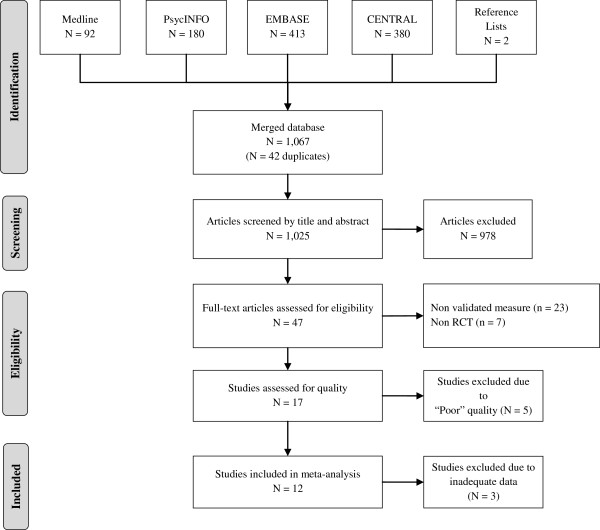
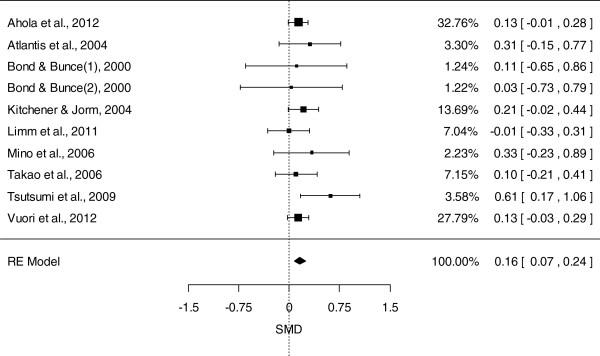
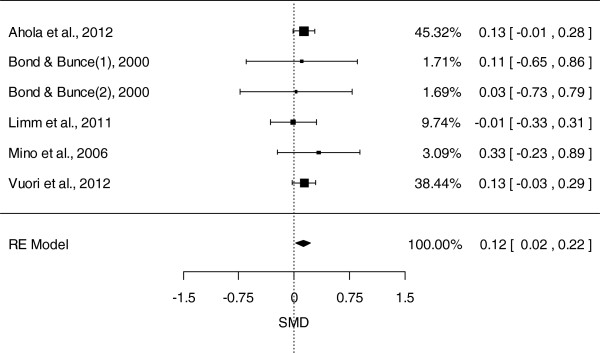
BACKGROUND: Depression is a major public health problem among working-age adults. The workplace is potentially an important location for interventions aimed at preventing the development of depression, but to date, the mental health impact of universal interventions in the workplace has been unclear. METHOD: A systematic search was conducted in relevant databases to identify randomized controlled trials of workplace interventions aimed at universal prevention of depression. The quality of studies was assessed using the Downs and Black checklist. A meta-analysis was performed using results from studies of adequate methodological quality, with pooled effect size estimates obtained from a random effects model. RESULTS: Nine workplace-based randomized controlled trials (RCT) were identified. The majority of the included studies utilized cognitive behavioral therapy (CBT) techniques. The overall standardized mean difference (SMD) between the intervention and control groups was 0.16 (95% confidence interval (CI): 0.07, 0.24, P = 0.0002), indicating a small positive effect. A separate analysis using only CBT-based interventions yielded a SMD of 0.12 (95% CI: -0.01, 0.24, P = 0.07). [corrected]. CONCLUSIONS: There is good quality evidence that universally delivered workplace mental health interventions can reduce the level of depression symptoms among workers. There is more evidence for the effectiveness of CBT-based programs than other interventions. Evidence-based workplace interventions should be a key component of efforts to prevent the development of depression among adults.
Overview
The claims and statistics of this paper haven’t been checked yet.
Free: it reads the open-access text and checks the first 5 claims that cite a source we can check. Create a free account to check every claim.
Integrity signals
Registry
Cites
Statistics
Figures
Verification
Claims the paper makes
The claims and statistics of this paper haven’t been checked yet.
Free: it reads the open-access text and checks the first 5 claims that cite a source we can check. Create a free account to check every claim.
Claims other papers make about this one
Each is checked against this paper’s own text: does it say what the citing paper says it does?
The source backs part of the claim, not all of it — or backs it for a different population, condition or comparison.
In the citing paper
“our review augments the findings of Tan et al. (2014), whose meta-analysis of nine RCTs of interventions aimed at ameliorating depression in the workplaceincluding but not limited to MBIsobserved a small positive effect.”
From Mindfulness-based interventions in the workplace: An inclusive systematic review and meta-analysis of their impact upon wellbeing (2019) · cites this paper as Tan et al. (2014)
Experimental — accuracy not yet measuredThe cited source says what the claim attributes to it.
In the citing paper
“A systematic review of universal workplace interventions on depressive symptoms found overall positive but small effects, but a challenge for these approaches is resource and time allocation to sufficiently engage the target population, especially in broad organizational level approaches which are less frequently studied (11).”
From An Ecological Study of a Universal Employee Depression Awareness and Stigma Reduction Intervention: “Right Direction” (2021) · cites this paper as [11]
The cited source says what the claim attributes to it.
In the citing paper
“A meta-analysis of work-based depression prevention programs found that various types of interventions, particularly those based on cognitive behavioural models, show evidence of an ability to reduce depressive symptoms in unselected working populations [12].”
From A pilot evaluation of a smartphone application for workplace depression (2020) · cites this paper as [12]
In the citing paper
“It concludes, consistent with an earlier systematic review on exercise, 416 that while the evidence base on exercise and social interventions to prevent antenatal depression in mothers is growing, it remains insufficient to support implementation and points to a prominent area of research need.”
From Time for united action on depression: a Lancet–World Psychiatric Association Commission (2022) · cites this paper as [415]
In the citing paper
“A stress management intervention, such as the one used in the present study which recruits participants with elevated (but not necessarily clinically significant) stress levels, is likely to report a smaller effect size than an intervention delivered within a clinical setting [54]”
3 more claims about this paper
Create a free account to see every claim other papers make about this one.
Self-check
Percentages, sums and reported differences re-computed from the paper’s own numbers.
The self-check needs the paper’s full text.
Citations
Cites
R: A Language and Environment for Statistical Computing
R Core Team (2025) · doi:10.32614/r.manuals · Cited by 352,181
Statistical Power Analysis for the Behavioral Sciences
Muller, K. (1989) · Technometrics · doi:10.1080/00401706.1989.10488618 · Cited by 99,167
Statistical power analysis for the behavioral sciences
(1990) · Computers, Environment and Urban Systems · doi:10.1016/0198-9715(90)90050-4 · Cited by 65,269
Measuring inconsistency in meta-analyses
Higgins, J. P. T., Thompson, S. G., Deeks, J. J., & Altman, D. G. (2003) · BMJ · doi:10.1136/bmj.327.7414.557 · Cited by 63,139 · cited 1×
“An I(2) value of 0% denotes no observed heterogeneity, whereas, 25% is “low”, 50% is “moderate” and 75% is “high” heterogeneity [33].”
BackgroundBias in meta-analysis detected by a simple, graphical test
Egger, M., Smith, G. D., Schneider, M., & Minder, C. (1997) · BMJ · doi:10.1136/bmj.315.7109.629 · Cited by 56,722 · cited 1×
“Hence, we also used Egger’s linear regression model to statistically test for funnel plot asymmetry [52].”
MethodCochrane Handbook for Systematic Reviews of Interventions: Cochrane Book Series
(2008) · doi:10.1002/9780470712184 · Cited by 25,048
Conducting Meta-Analyses in R with the metafor Package
Viechtbauer, W. (2010) · Journal of Statistical Software · doi:10.18637/jss.v036.i03 · Cited by 20,464 · cited 1×
“6 package for R [29].”
Projections of Global Mortality and Burden of Disease from 2002 to 2030
Mathers, C. D., & Loncar, D. (2006) · PLoS Medicine · doi:10.1371/journal.pmed.0030442 · Cited by 11,386
Downs, S. H., & Black, N. (1998) · Journal of Epidemiology and Community Health · doi:10.1136/jech.52.6.377 · Cited by 8,252 · cited 1×
“The quality of the identified randomized controlled trials was assessed using the Downs and Black checklist [22].”
MethodChapter 9: Analysing Data and Undertaking Meta-Analyses
Deeks, J. J., Higgins, J. P. T., & Altman, D. G. (2008) · Cited by 2,782
Research works printed but not linked: 3
- C3 Collaborating for Health Workplace Health Initiatives: Evidence of Effectiveness 2011 London, UK: C3 Collaborating for Health
- World Health Organization/World Economic Forum Preventing Noncommunicable Diseases in the Workplace through Diet and Physical Activity. Report of a joint event 2008 Geneva: World Health Organization
- Higgins JPT, Green S Cochrane Handbook for Systematic Reviews of Interventions 4.2.6 [updated September 2006] 2006 Chichester, UK: John Wiley & Sons, Ltd
Cited by
Items 101–200 of 214
Przybylko, G., Morton, D. P., & Renfrew, M. E. (2021) · Frontiers in Psychology · doi:10.3389/fpsyg.2021.644337 · Cited by 21
Understanding and Addressing Mental Health Disorders: a Workplace Imperative
Taubman, D. S., & Parikh, S. V. (2023) · Current Psychiatry Reports · doi:10.1007/s11920-023-01443-7 · Cited by 24
“Despite their potential to help many employees at once, few interventions have been conducted with employees or their managers (see [68, 69]).”
BackgroundLi, S., Riedel, N., Loerbroks, A., Müller, A., Wege, N., Angerer, P., & Li, J. (2015) · Journal of Occupational and Environmental Medicine · doi:10.1097/jom.0000000000000546 · Cited by 18
Arensman, E., Leduc, M., O’Brien, C., Corcoran, P. E., Griffin, E., Leduc, C., Coppens, E., Tsantila, F., Ross, V. L., Abdulla, K., et al. (2023) · Trials · doi:10.1186/s13063-023-07537-0 · Cited by 28
“Well-organised and managed workplaces can be a source of wellbeing [44–46].”
BackgroundGrummitt, L. R., Barrett, E. L., Halladay, J. E., Bailey, S., Birrell, L., Hunter, E., Kelly, E. V., Champion, K. E., Gardner, L. A., Nguyen, A., et al. (2023) · Mental Health & Prevention · doi:10.1016/j.mhp.2023.200308 · Cited by 17
Mache, S., Danzer, G., Klapp, B. F., & Groneberg, D. A. (2015) · Journal of surgical education · doi:10.1016/j.jsurg.2015.06.018 · Cited by 19
Deady, M., Johnston, D. A., Glozier, N., Milne, D., Choi, I., Mackinnon, A., Mykletun, A., Calvo, R. A., Gayed, A., Bryant, R., et al. (2018) · BMJ Open · doi:10.1136/bmjopen-2017-020510 · Cited by 14
Self-citationValidation of the irritation scale on a representative German sample: new normative data
Gralla, M., Guendel, H. O., Mueller, A., Brähler, E., Häuser, W., Kruse, J., Muschalla, B., Rigotti, T., Strauss, B. M., & Balint, E. M. (2023) · Scientific Reports · doi:10.1038/s41598-023-41829-4 · Cited by 14
“71 (2) Even at home I often think of my problems at work.”
BackgroundPublic Health Perspectives on Depressive Disorders
Cohen, N. L. (2017) · Johns Hopkins University Press eBooks · doi:10.1353/book.52762 · Cited by 99
Przybylko, G., Morton, D. P., Morton, J. K., & Renfrew, M. E. (2021) · JMIR Mental Health · doi:10.2196/29866 · Cited by 16
“However, Tan et al [69] asserts that the impact of small effect sizes can be large when translated to a population level.”
BackgroundBoß, L., Angerer, P., Dragano, N., Ebert, D. D., Engels, M., Heber, E., Kuhlmann, R., Ruhle, S. A., Schwens, C., Wulf, I. C., et al. (2021) · BMC Public Health · doi:10.1186/s12889-021-12229-y · Cited by 14
Díaz-Benito, V. J., Moro, M. I. B., Vanderhaegen, F., Remón, Á. L. C., Lozano, J. A. S., Cimadevilla-Fernández-Pola, E., & Hervás-Pérez, J. P. (2022) · Work · doi:10.3233/wor-210300 · Cited by 14
“The workplace has been considered as an important place for the development of specific interventions [6].”
Kawakami, N., Imamura, K., Watanabe, K., Sekiya, Y., Sasaki, N., Sato, N., & SMART-CBT Project Team (2021) · JMIR Research Protocols · doi:10.2196/30305 · Cited by 12
“Thus, universal preventive interventions are recognized as a potentially desirable approach [17].”
Depression in the workplace: screening and treatment
Neto, J. D., Myung, E., Murta, G. A., Vieira, A., de Lima, P. R. G., Lessa, L. A., & Bernardo, W. M. (2019) · Revista da Associação Médica Brasileira · doi:10.1590/1806-9282.65.3.295 · Cited by 14
Stratton, E., Glozier, N., Woolard, A. J., Gibbs, V., Demetriou, E. A., Boulton, K., Hickie, I. B., Pellicano, E., & Guastella, A. J. (2022) · Disability and Rehabilitation · doi:10.1080/09638288.2022.2066207 · Cited by 12
Stansfeld, S. A., Berney, L., Bhui, K. S., Chandola, T., Costelloe, C., Hounsome, N., Kerry, S., Lanz, D., & Russell, J. (2015) · Public Health Research · doi:10.3310/phr03090 · Cited by 12
Research on the Tufts Be Well at Work Program for Employees With Depression: 2005–2020
Lerner, D., Adler, D. A., Shayani, A., & Rogers, W. H. (2021) · Psychiatric Services · doi:10.1176/appi.ps.202000762 · Cited by 14
Armaou, M., Araviaki, E., Dutta, S., Konstantinidis, S. T., & Blake, H. (2022) · European Journal of Investigation in Health Psychology and Education · doi:10.3390/ejihpe12100102 · Cited by 15
Burgess, S., Junne, F., Rothermund, E., Zipfel, S., Gündel, H., Rieger, M. A., & Michaelis, M. (2019) · International Archives of Occupational and Environmental Health · doi:10.1007/s00420-019-01414-7 · Cited by 14
Boß, L., Ross, J., Reis, D., Pischel, S., Mallwitz, T., Brückner, H., Tanner, G., Nissen, H., Kalon, L., Schümann, M., et al. (2025) · International Journal of Nursing Studies · doi:10.1016/j.ijnurstu.2025.105076 · Cited by 13
Hanson, L. L. M., Peristera, P., Chungkham, H. S., & Westerlund, H. (2017) · Journal of Sleep Research · doi:10.1111/jsr.12494 · Cited by 12
Role and Value of the Corporate Medical Director
Pawlecki, J. B., Burton, W. N., Christensen, C., Crighton, K. A., Heron, R. J. L., Hudson, T. W., Hymel, P. A., & Roomes, D. (2018) · Journal of Occupational and Environmental Medicine · doi:10.1097/jom.0000000000001326 · Cited by 11
Leka, S., & Jain, A. (2025) · SSRN Electronic Journal · doi:10.2139/ssrn.5114626 · Cited by 10
Carolan, S., Harris, P. R., Greenwood, K., & Cavanagh, K. (2016) · Trials · doi:10.1186/s13063-016-1733-2 · Cited by 9
“A stress management intervention, such as the one used in the present study which recruits participants with elevated (but not necessarily clinically significant) stress levels, is likely to report a smaller effect size than an intervention delivered within a clinical setting [54], which makes it difficult to calculat…”
MethodWerk, L. P., & Muschalla, B. (2021) · Open Research Europe · doi:10.12688/openreseurope.13192.1 · Cited by 11
“Often, non-participation and drop-outs are not reported at all (e.g. Tan et al. , 2014).”
Raggi, A., Bernard, R. M., Toppo, C., Sabariego, C., Salvador‐Carulla, L., Lukersmith, S., Roijen, L. H., Merecz‐Kot, D., Olaya, B., Lima, R. A., et al. (2024) · Journal of Medical Internet Research · doi:10.2196/48504 · Cited by 10
Campion, J. (2018) · Springer eBooks · doi:10.1007/978-3-319-70554-5_31 · Cited by 10
Ang, S. Y., Hemsworth, D., Lim, S. H., Ayre, T. C., Ang, E. N. K., & López, V. (2020) · Journal of Nursing Measurement · doi:10.1891/jnm-d-19-00036 · Cited by 10
Tan, L., Wang, M., Modini, M., Joyce, S., Mykletun, A., Christensen, H. M., & Harvey, S. B. (2014) · BMC Medicine · doi:10.1186/s12916-014-0212-4 · Cited by 8
Self-citationde Miquel, C., Moneta, M. V., Weber, S., Lorenz, C., Olaya, B., & Haro, J. M. (2023) · Journal of Medical Internet Research · doi:10.2196/42317 · Cited by 8
“They also provide an opportunity for the provision of a proactive, preventative approach for employees’ mental health [6,9].”
Toro, C. T., Payne, A., Jackson, T., Russell, S., Daly, G. B. J., Waller, G., & Meyer, C. (2023) · International Journal of Eating Disorders · doi:10.1002/eat.23961 · Cited by 8
“A growing body of research supports the effectiveness of CBT-based interventions for mental health disorders offered in the work-place setting (Tan et al., 2014).”
Assessment of stress and associated factors in employees of a public higher education institution
Fonseca, N. T., Freire, A. S., Silva, R. M. A., Santos, L. R. C. S., Rocha, D. D. S., Oliveira, M. V., & Bezerra, V. M. (2022) · Revista Brasileira de Medicina do Trabalho · doi:10.47626/1679-4435-2022-700 · Cited by 7
Hultqvist, J., Zhang, P., Nyman, C. S., & Bertilsson, M. (2023) · Journal of Occupational and Environmental Medicine · doi:10.1097/jom.0000000000002950 · Cited by 9
“8 More current workplace interventions focus on the treatment of existing mental health problems instead of protection and prevention, 41 and manager training programs can be effective in influencing managers ’ behavior.”
BackgroundGómez‐Gómez, I., Barquero‐Jimenez, C., Johnson, E., Cerón, S. C., Moreno-Peral, P., Bellón, J. Á., & Motrico, E. (2024) · Preventive Medicine · doi:10.1016/j.ypmed.2024.107847 · Cited by 9
Enhancing social functioning using multi-user, immersive virtual reality
Holt, D. J., DeTore, N. R., Aideyan, B., Utter, L., Vinke, L. N., Johnson, D. S., Zimmerman, J., Dokholyan, K. N., & Burke, A. (2025) · Scientific Reports · doi:10.1038/s41598-024-84954-4 · Cited by 9
Petrie, K., Gregory, M., Collins, D., Gayed, A., Sanatkar, S., Dean, K., Deady, M., & Harvey, S. B. (2025) · Nature Mental Health · doi:10.1038/s44220-025-00450-2 · Cited by 6
“Evidence from reviews in general workplace settings indicates that universal CBT-based programs prevent depressive symptoms in workers, albeit with small effect sizes 24,25 .”
Self-citationPrävention der Depression: Ansätze, Evidenz und Beispiele guter Praxis
Koschig, M., Conrad, I., & Riedel-Heller, S. G. (2019) · Psychotherapeut · doi:10.1007/s00278-018-0328-7 · Cited by 6
“In ihrer Metaanalyse untersuchten Tan et al. (2014) 9 RCT im Arbeitssetting und fanden einen geringen, aber signifikant positiven Effekt der Interventionen.”
BackgroundLifestyle factors in preventing mental health disorders: an interview with Felice Jacka
Jacka, F. N. (2015) · BMC Medicine · doi:10.1186/s12916-015-0490-5 · Cited by 6
“See references [1–10].”
Esaki, K., Ikeda, M., Okochi, T., Taniguchi, S., Ninomiya, K., Shimasaki, A., Otsuka, Y., Oda, Y., Sakusabe, T., Mano, K., et al. (2020) · PLoS ONE · doi:10.1371/journal.pone.0240466 · Cited by 6
Chen, S., Wang, Y., & She, R. (2023) · BMC Psychiatry · doi:10.1186/s12888-023-04557-7 · Cited by 6
Sælid, G. A., Czajkowski, N. O., Holte, A., Tambs, K., & Aarø, L. E. (2016) · Scandinavian Journal of Psychology · doi:10.1111/sjop.12289 · Cited by 9
Sebastianski, M., Gates, M., Gates, A., Nuspl, M., Bialy, L. M., Featherstone, R. M., Breault, L. J., Mason-Lai, P., & Hartling, L. (2019) · BMJ Open · doi:10.1136/bmjopen-2018-026847 · Cited by 7
Workplace-based occupational therapy for mental health in Africa: a scoping review protocol
Hoosain, M., & Plastow, N. A. (2022) · BMJ Open · doi:10.1136/bmjopen-2021-054821 · Cited by 6
Preventing the onset of mental disorders: An emerging field
Cuijpers, P. J., & van Straten, A. (2021) · Clinical Psychology Review · doi:10.1016/j.cpr.2021.102097 · Cited by 6
Evidence review: The primary prevention of mental health conditions
VicHealth (2020) · doi:10.37309/2020.po906 · Cited by 13
Doty, B., Grzenda, A., Hwang, S., Godar, S., Gruttadaro, D., Hauge, K. A., Sherman, B., & Clarke, D. E. (2021) · Frontiers in Psychiatry · doi:10.3389/fpsyt.2021.581876 · Cited by 5
“A systematic review of universal workplace interventions on depressive symptoms found overall positive but small effects, but a challenge for these approaches is resource and time allocation to sufficiently engage the target population, especially in broad organizational level approaches which are less frequently stud…”
BackgroundKuribayashi, K., Takano, A., Inagaki, A., Imamura, K., & Kawakami, N. (2022) · BMJ Open · doi:10.1136/bmjopen-2022-062516 · Cited by 7
Mental Health in the Workplace: Strategies for Promoting Employee Well-Being
Randall, C. A. (2023) · Global International Journal of Innovative Research · doi:10.59613/global.v1i1.4 · Cited by 11
The Population Mean Mood Predicts The Prevalence of Depression in an Australian Context
Sia, A. D., Williams, L. J., Pasco, J. A., Jacka, F. N., Brennan-Olsen, S. L., & Veerman, L. J. (2017) · Australian & New Zealand Journal of Psychiatry · doi:10.1177/0004867417740207 · Cited by 5
Patel, K., Moukhtarian, T. R., Russell, S., Daly, G. B. J., Walasek, L., Tang, N. K. Y., Toro, C. T., & Meyer, C. (2022) · BMJ Open · doi:10.1136/bmjopen-2021-060545 · Cited by 7
Sælid, G. A., Czajkowski, N. O., Holte, A., Tambs, K., & Aarø, L. E. (2016) · International Journal of Mental Health Promotion · doi:10.1080/14623730.2016.1196231 · Cited by 5
“Previously, most interventions have aimed at reducing depressive symptoms in the workplace (Corbière et al., 2009; Martin, Sanderson, & Cocker, 2009; Odeen et al., 2012; Tan et al., 2014).”
BackgroundSørensen, H. Ø., Valentin, J. B., Bording, M. K., Larsen, J. I., Larsen, A., & Omland, Ø. (2019) · BMC Psychiatry · doi:10.1186/s12888-019-2027-5 · Cited by 8
Strategies in suicide prevention
Wasserman, D. (2021) · doi:10.1093/med/9780198834441.003.0050 · Cited by 5
Boß, L., Hannibal, S., & Lehr, D. (2025) · Frontiers in Psychology · doi:10.3389/fpsyg.2025.1524285 · Cited by 5
Culture, conditions and care support mental health of healthcare workers during crises
Maple, J., Whiteside, M., Smallwood, N., Putland, M., Baldwin, P. A., Bismark, M., Harrex, W., Johnson, D. F., Karimi, L., & Willis, K. F. (2024) · Occupational Medicine · doi:10.1093/occmed/kqae002 · Cited by 7
Aars, N. A., Bardal, I., Brinchmann, B., & Mykletun, A. (2025) · BMJ Open · doi:10.1136/bmjopen-2024-089758 · Cited by 4
Self-citationEffectively Employing Young Adult Peer Providers: A Toolkit
Delman, J., & Klodnick, V. V. (2017) · Psychiatry Information in Brief · doi:10.7191/pib.1175 · Cited by 4
Role and Value of the Corporate Medical Director
Stave, G. M., Burton, W. N., Heron, R. J. L., Hudson, T. W., Pawlecki, J. B., Roomes, D., Sepulveda, M., Rendel, M., & Hymel, P. A. (2023) · Journal of Occupational and Environmental Medicine · doi:10.1097/jom.0000000000002979 · Cited by 5
Assessment and Treatment of Mood and Anxiety Disorders in the Workplace
Taubman, D. S., Velyvis, V., & Parikh, S. V. (2019) · Integrating psychiatry and primary care · doi:10.1007/978-3-030-04266-0_8 · Cited by 6
Promoting Mentally Healthy Workplaces
Barry, M. M. (2019) · Springer eBooks · doi:10.1007/978-3-030-23455-3_12 · Cited by 4
Yunus, W. M. A. W. M., Musiat, P., & Brown, J. S. L. (2020) · Behavioral Sciences · doi:10.3390/bs10120193 · Cited by 5
“Should it be generally available for the whole working population, or restricted to a select group of individuals? A review and meta-analysis revealed that universal workplace interventions exhibited small but significant contributions towards the reduction of depressive symptoms among employees [40].”
BackgroundPromoting Workplace Mental Wellbeing: A Rapid Review of Recent Intervention Research
Martin, A. J., Shann, C., & LaMontagne, A. D. (2020) · Springer eBooks · doi:10.1007/978-3-030-24334-0_15 · Cited by 6
Managing Workplace Mental Health: Multiple Approaches at Patient, Provider, and Systems Levels
Taubman, D. S., Dewa, C. S., & Parikh, S. V. (2023) · Springer eBooks · doi:10.1007/978-3-030-42825-9_9-1 · Cited by 4
Promoting Workplace Mental Wellbeing: A Rapid Review of Recent Intervention Research
Martin, A. J., Shann, C., & LaMontagne, A. D. (2019) · Springer eBooks · doi:10.1007/978-3-319-75381-2_15-1 · Cited by 6
Gómez‐Gómez, I., Motrico, E., Moreno-Peral, P., Rigabert, A., Cerón, S. C., Ortega‐Calvo, M., Recio-Rodriguez, J. I., & Bellón, J. Á. (2019) · BMJ Open · doi:10.1136/bmjopen-2018-026842 · Cited by 5
Frantzeskakis, N., Tziraki, M., Spanakis, M., Katsarou, S., Papadopoulos, N., Linardakis, M. K., Vova-Chatzi, C., Kamekis, A., Pitsoulis, G., Papadakis, A., et al. (2025) · Healthcare · doi:10.3390/healthcare13182337 · Cited by 3
“These models offer streamlined risk assessments, evidence-based screenings, lifestyle interventions, and follow-up mechanisms, and have been shown to improve key indicators such as smoking cessation, physical activity, and chronic disease control [17,18].”
The Economic Case for Preventing Mental Ill Health
OECD (2026) · OECD health policy studies · doi:10.1787/16668f16-en · Cited by 9
Moukhtarian, T. R., Fletcher, S., Walasek, L., Kershaw, C., Patel, K., Hurley-Wallace, A. L., Russell, S., Daly, G. B. J., Tang, N. K. Y., Toro, C. T., et al. (2024) · BMC Digital Health · doi:10.1186/s44247-024-00114-8 · Cited by 3
A Survey of Post-Secondary School Deaf Adults Understanding of Mental Health Disorders in Ghana
Amoako, S. F., & Yankyera, A. P. (2020) · International Journal of Disability Development and Education · doi:10.1080/1034912x.2020.1792418 · Cited by 4
“Wozniak, 1987); workplace depression and anxiety symptoms (Martin, Sanderson, & Cocker, 2009); depressive illness (Tan et al., 2014); mental health in research environments;”
BackgroundThe implementation of basic income: A mental health approach
Mahabir, B., Hernandez, J., Swain, S., Sih, V. J., & Devkota, B. (2021) · Industrial and Organizational Psychology · doi:10.1017/iop.2021.103 · Cited by 5
Hansen, V., Pit, S., Fiorentino, M., Campion, S., Abraham, R., Cheng, J. D., & Phelan, S. (2020) · Archives of Environmental & Occupational Health · doi:10.1080/19338244.2020.1841722 · Cited by 6
Mental Health and Well-Being of Students and Faculty
Deredzai, M., Goronga, P., & Bondai, B. M. (2024) · Advances in higher education and professional development book series · doi:10.4018/979-8-3693-5483-4.ch018 · Cited by 3
Walker, N., Vernon-Smith, M., & Townend, M. (2021) · Mental Health Review Journal · doi:10.1108/mhrj-01-2021-0005 · Cited by 3
“…levels of anxiety and 83 depression compared to doing nothing at all (Doki et al., 2015, Mikkelsen and Rosholm, 84 2018, Nieuwenhuijsen et al., 2020, Nigatu et al., 2016, Tan et al., 2014), including a 85 Cochrane review describing specific components in detail (Nieuwenhuijsen et al., 2020).”
BackgroundToro, C. T., Jackson, T., Payne, A., Walasek, L., Russell, S., Daly, G. B. J., Waller, G., & Meyer, C. (2022) · International Journal of Eating Disorders · doi:10.1002/eat.23701 · Cited by 4
The entrepreneur well-being check: a screener for entrepreneur mental health and well-being
Freeman, M. A., Mazza, A., Johnson, S. L., & Heinz, A. J. (2025) · International Journal of Entrepreneurial Behaviour & Research · doi:10.1108/ijebr-02-2025-0147 · Cited by 5
İş Yeri Temelli Ruh Sağlığını Geliştirme Programları: Sistematik İnceleme
DÜLCEK, S., & Şişman, F. N. (2021) · Halk Sağlığı Hemşireliği Dergisi · doi:10.54061/jphn.946046 · Cited by 4
Maiketso, M., Wolvaardt, L., Uys, M., & Grobler, M. (2023) · Higher Education Skills and Work-based Learning · doi:10.1108/heswbl-11-2022-0247 · Cited by 3
Scanlan, J. N., & Lewis, J. (2014) · Australian Occupational Therapy Journal · doi:10.1111/1440-1630.12180 · Cited by 2
Hayes, J. M., Crowley, R., O’Brien, Y., Hannon, G., Hennessey, E., O’Connell, L., Twomey, D. M., Berry, D., Harrington, J. M., & McCarthy, P. (2020) · The Cognitive Behaviour Therapist · doi:10.1017/s1754470x20000380 · Cited by 3
“Tan et al. (2014) reported in their meta-analysis that there is robust evidence that workplace mental health interventions can reduce the level of depressive symptoms among workers.”
BackgroundDahlbäck, E., & Håkansson, C. (2023) · International Journal of Environmental Research and Public Health · doi:10.3390/ijerph20043009 · Cited by 7
“Other strategies can be manager and leadership training [22] and mental health education [23], but also individual strategies, such as stress management programs [24] or coaching [25], can be recommended.”
BackgroundAllen٭, K., Waswa, B. L., Edward, S., Moses, B., & Muhwezi, T. (2021) · Research Square · doi:10.21203/rs.3.rs-1107439/v1 · Cited by 2
“…mentioned by the study participants, for example adopting the model of using lay health counsellors for the implementation of depression treatment and prevention programs (Patel et al., 2010; Tan et al., 2014; Cuijpers et al., 2016), can help reduce depression risks in the general adult population.”
BackgroundThe Asian Conference on the Social Sciences 2023: Official Conference Proceedings
(2023) · The Asian Conference on the Arts, Humanities and Social Sciences Conference proceedings/Asian Conference on the Social Sciences official conference proceedings/Asian Conference on Arts & Humanities official conference proceedings · doi:10.22492/issn.2186-2303.2023 · Cited by 2
Effectiveness of a workplace wellness program for adolescents and young adults
Griffin, K. W., Williams, C., & Botvin, G. J. (2025) · Journal of Workplace Behavioral Health · doi:10.1080/15555240.2025.2533995 · Cited by 1
“Furthermore, wellness programs incorporating cognitive behavioral therapy techniques like cognitive restructuring or behavioral activation strategies have been found to reduce symptoms of depression among workers (Reif et al., 2020; Tan et al., 2014).”
Karakuş, A., & Akyürek, G. (2026) · Workplace Health & Safety · doi:10.1177/21650799261440356 · Cited by 1
“Tan et al. (2014) further emphasized improvements in social functioning often emerge as indirect outcomes of interventions, and when social dimensions are not explicitly targeted, their impact tends to remain modest.”
Lochmann, J., Patzke, K., Wahl, S., Renger, F., & Czirfusz, A. (2026) · Psychiatry International · doi:10.3390/psychiatryint7040186 · Cited by 1
“A systematic review and meta-analysis of nine randomised controlled trials of universal workplace interventions by Tan et al. [54] found a small but significant effect on depressive symptoms (standardised mean difference [SMD] = 0.16, 95% CI [0.07, 0.24], p = 0.0002), with the cognitive behavioural…”
InfluentialRintell, L. S., Buchholz, K. R., & Gladstone, T. R. G. (2021) · Springer eBooks · doi:10.1007/978-3-030-83469-2_6 · Cited by 1
Wong, C. S. M., Leung, C. M. C., Wu, S., Flores, F. P., Kim, Y., Xiao, X., Wong, S. B. K., Chang, W. C., Chan, W. C., Yu, N. X., et al. (2025) · The Lancet Regional Health - Western Pacific · doi:10.1016/j.lanwpc.2025.101757 · Cited by 5
Workplace mental health programmes reduce depression, study shows
Mayor, S. (2014) · BMJ · doi:10.1136/bmj.g3196 · Cited by 1
Promoting workplace mental wellbeing: a rapid review of recent intervention research
Martin, A. J., Shann, C., & LaMontagne, A. D. (2019) · UTAS Research Repository · Cited by 1
Addressing Mental Health Problems at Work
Barry, M. M. (2019) · Springer eBooks · doi:10.1007/978-3-030-23455-3_13 · Cited by 1
Effect of depression prevention programs among rice farmers in Thailand
Kaewboonchoo, O., Hanklang, S., Boonyamalik, P., & Morioka, I. (2020) · Environmental and Occupational Health Practice · doi:10.1539/eohp.2020-0001-oa · Cited by 1
Walker, N., & Dobbing, R. (2021) · Mental Health and Social Inclusion · doi:10.1108/mhsi-12-2020-0089 · Cited by 2
Mental Health and the Working Professional
Majumdar, B. (2022) · Springer eBooks · doi:10.1007/978-981-16-8263-6_10 · Cited by 3
Díaz-Benito, V. J. (2019) · UPM Digital Archive (Technical University of Madrid) · doi:10.20868/upm.thesis.56799 · Cited by 7
Allen٭, K., Waswa, B. L., Ssemakula, E., Moses, B., & Muhwezi, T. (2022) · Research Square · doi:10.21203/rs.3.rs-1107439/v2 · Cited by 2
Pirkis, J., Whiteford, H., Jorm, T., Harris, M., Reavley, N. J., Siskind, D. J., Bassilios, B., Diminic, S., Robinson, J., Carstensen, G., et al. (2014) · Cited by 1
Murphy, R. P., O’Donoghue, E., Doyle, C., & Taafe, C. (2019) · Trinity's Access to Research Output (TARA) (Trinity College Dublin)
Older workers' experiences of depression in the contemporary workplace
Adewunmi, T. (2021) · Lancaster EPrints (Lancaster University) · doi:10.17635/lancaster/thesis/1316
FAMILY WELL-BEING AND THE COVID-19 PANDEMIC IN THE UNITED STATES
Dayton, L. (2021)
Metadata
- Authors
- Tan, L., Wang, M.-J., Modini, M., Joyce, S., Mykletun, A., Christensen, H., & Harvey, S. B.
- Affiliations
- Black Dog Institute (AU)
- Norwegian Institute of Public Health (NO)
- Corresponding author
- Tan, Leona
- ORCID
- Venue
- BMC Medicine
- Published
- 2014-05-09
- Volume
- 12
- Issue
- 1
- Pages
- 74-74
- ISSN
- 1741-7015 (ISSN-L)
- PMC
- PMC4014627
- OpenAlex
- W2164880936
- Cited by
- 208
- References
- 60
- Citations by year
- 2026: 3 · 2025: 11 · 2024: 9 · 2023: 19 · 2022: 20 · 2021: 29 · 2020: 17 · 2019: 22 · 2018: 26 · 2017: 16 · 2016: 16 · 2015: 11 · 2014: 9
- FWCI
- 2.95
- Type
- journal article
- Language
- en
- Update notices
- correction (2014-11-13)
- Open access
- gold
- doi.org
- Licence
- Locations
- BMC Medicine (publishedVersion, cc-by)
- Europe PMC (PubMed Central) (publishedVersion, other-oa)
- PubMed Central (publishedVersion, cc-by)
- PubMed (publishedVersion)
- BIBSYS Brage (BIBSYS (Norway)) (submittedVersion)
- NORA - Norwegian Open Research Archives (submittedVersion, other-oa)
- Topics
- Health Sciences › Medicine › Public Health, Environmental and Occupational Health › Workplace Health and Well-being
- Social Sciences › Psychology › Applied Psychology › Digital Mental Health Interventions
- Health Sciences › Medicine › Psychiatry and Mental health › Mental Health Treatment and Access
- Keywords
- depression prevention, workplace mental health interventions, universal prevention, cognitive behavioral therapy, depressive symptoms, working-age adults, workplace mental health
- MeSH terms
- Adult, Depression, Female, Humans, Male, Mental Health, Cognitive Behavioral Therapy, Randomized Controlled Trials as Topic, Workplace
About these checks
Registry, retraction, Cites and statistics results are computed, not judged, with one exception: a printed reference that no index lists is read once by a model before it counts as a citation error. Claims are extracted by a model and kept only when their quote appears verbatim in the text; each cited source is then checked, with a model’s help, for whether it says what the claim relies on. Those verdicts can be wrong — read the claim’s quote and the cited source before relying on one.
Statistics and arithmetic are recomputed, not judged.
Confidence bands are shown only for fields calibrated on our annotated test set. None is calibrated yet, so no band is shown.
What counts as a claim ›How we measure confidence ›How we check this ›
Are you an author, or do you see a problem with this page? Request a review
Data sources
Bibliographic data: Semantic Scholar, OpenAlex, Crossref.
Contains information from the Semantic Scholar Academic Graph Datasets, made available under the ODC Attribution License (ODC-BY 1.0).
Semantic Scholar’s data is described in: Kinney, R., et al. (2023). The Semantic Scholar Open Data Platform. arXiv:2301.10140.
