

Interaction between stress and the BDNFVal66Met polymorphism in depression: a systematic review and meta-analysis
Open accessThe DOI matches its Crossref record; 93 of the 93 references it cites were found in a registry or an index.
Abstract
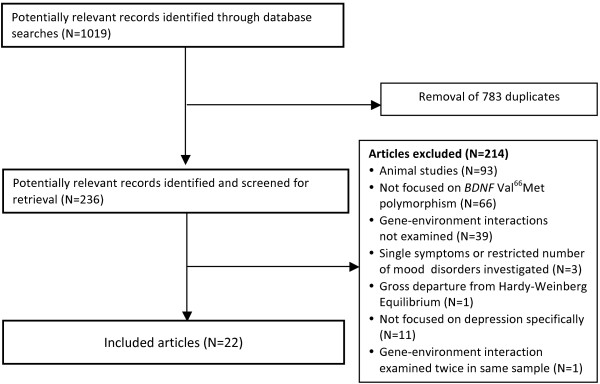
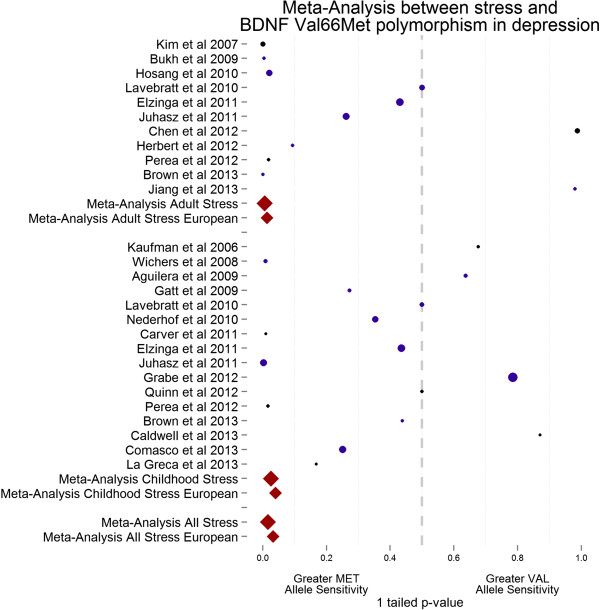
BACKGROUND: Major depression is a disabling psychiatric illness with complex origins. Life stress (childhood adversity and recent stressful events) is a robust risk factor for depression. The relationship between life stress and Val66Met polymorphism in the brain-derived neurotrophic factor (BDNF) gene has received much attention. The aim of the present work was to review and conduct a meta-analysis on the results from published studies examining this interaction. METHODS: A literature search was conducted using PsychINFO and PubMed databases until 22 November 2013. A total of 22 studies with a pooled total of 14,233 participants met the inclusion criteria, the results of which were combined and a meta-analysis performed using the Liptak-Stouffer z-score method. RESULTS: The results suggest that the Met allele of BDNF Val66Met significantly moderates the relationship between life stress and depression (P = 0.03). When the studies were stratified by type of environmental stressor, the evidence was stronger for an interaction with stressful life events (P = 0.01) and weaker for interaction of BDNF Val66Met with childhood adversity (P = 0.051). CONCLUSIONS: The interaction between BDNF and life stress in depression is stronger for stressful life events rather than childhood adversity. Methodological limitations of existing studies include poor measurement of life stress.
Overview
The claims and statistics of this paper haven’t been checked yet.
Free: it reads the open-access text and checks the first 5 claims that cite a source we can check. Create a free account to check every claim.
Integrity signals
Registry
Cites
Statistics
Figures
Verification
Claims the paper makes
The claims and statistics of this paper haven’t been checked yet.
Free: it reads the open-access text and checks the first 5 claims that cite a source we can check. Create a free account to check every claim.
Claims other papers make about this one
Each is checked against this paper’s own text: does it say what the citing paper says it does?
The source backs part of the claim, not all of it — or backs it for a different population, condition or comparison.
In the citing paper
“Yet again, several other meta-analyses did confirm the association between the val66met polymorphism and an increased susceptibility to mood disorders (Hosang et al. 2014; Li et al. 2016; Yan et al. 2014; Zou et al. 2010).”
From Neurotrophic factors and neuroplasticity pathways in the pathophysiology and treatment of depression (2018) · cites this paper as Hosang et al. 2014
Experimental — accuracy not yet measuredThe source backs part of the claim, not all of it — or backs it for a different population, condition or comparison.
In the citing paper
“In addition, several meta-analyses data confirm the association of the Val66Met polymorphism with an increase of susceptibility to develop mood disorders [200,201,202].”
From Neurotrophic Factor BDNF, Physiological Functions and Therapeutic Potential in Depression, Neurodegeneration and Brain Cancer (2020) · cites this paper as [200]
Experimental — accuracy not yet measuredThe cited source says what the claim attributes to it.
In the citing paper
“Another meta-analysis found that the Met allele significantly moderated the effect of stressful life events on MDD risk, suggesting that Met carriers are more genetically sensitive to adverse life experiences205.”
From Psychobiological factors of resilience and depression in late life (2019) · cites this paper as [205]
The check wasn’t confident either way, so it gives no verdict — never disputed.
In the citing paper
“BDNF single nucleotide polymorphism (val66met), however, is associated with the severity of depression in patients [64].”
From Brain-Derived Neurotrophic Factor in Brain Disorders: Focus on Neuroinflammation (2019) · cites this paper as [64]
Experimental — accuracy not yet measuredIn the citing paper
“Another meta-analysis found that the Met allele significantly moderated the effect of stressful life events on MDD risk, suggesting that Met carriers are more genetically sensitive to adverse life experiences205.”
From Psychobiological factors of resilience and depression in late life (2019) · cites this paper as [205]
Self-check
Percentages, sums and reported differences re-computed from the paper’s own numbers.
The self-check needs the paper’s full text.
Citations
Cites
Liberati, A., Altman, D. G., Tetzlaff, J., Mulrow, C., Gøtzsche, P. C., Ioannidis, J. P. A., Clarke, M., Devereaux, P. J., Kleijnen, J., & Moher, D. (2009) · PLoS Medicine · doi:10.1371/journal.pmed.1000100 · Cited by 28,164
von Elm, E., Altman, D. G., Egger, M., Pocock, S. J., Gøtzsche, P. C., Vandenbroucke, J. P., & Initiative, F. T. S. (2007) · PLoS Medicine · doi:10.1371/journal.pmed.0040296 · Cited by 23,020
von Elm, E., Altman, D. G., Egger, M., Pocock, S. J., Gøtzsche, P. C., & Vandenbroucke, J. P. (2007) · The Lancet · doi:10.1016/s0140-6736(07)61602-x · Cited by 21,320
Liberati, A., Altman, D. G., Tetzlaff, J., Mulrow, C., Gotzsche, P. C., Ioannidis, J. P. A., Clarke, M., Devereaux, P. J., Kleijnen, J., & Moher, D. (2009) · BMJ · doi:10.1136/bmj.b2700 · Cited by 17,648
Kessler, R. C., Chiu, W. T., Demler, O., & Walters, E. E. (2005) · Archives of General Psychiatry · doi:10.1001/archpsyc.62.6.617 · Cited by 12,052 · cited 1×
“Major depression has a lifetime prevalence of 17% [10] and is diagnosed based on the presentation of depressive”
BackgroundInfluence of life stress on depression: moderation by a polymorphism in the 5-HTT gene
Caspi, A., Sugden, K., Moffitt, T. E., Taylor, A., Craig, I. W., Harrington, H., McClay, J., Mill, J., Martin, J., Braithwaite, A., et al. (2003) · Science · doi:10.1126/science.1083968 · Cited by 8,120 · cited 3×
“There is strong evidence for an association between life stress and depression, research now focuses on identifying stress vulnerability factors in depression including genetic factors [31,32].”
BackgroundLopez, A. D., Mathers, C. D., Ezzati, M., Jamison, D. T., & Murray, C. J. (2006) · The Lancet · doi:10.1016/s0140-6736(06)68770-9 · Cited by 5,630 · cited 1×
“Major depression is considered one of the most burdensome diseases in the world [12] and it is projected that this illness will be the second leading cause of disease burden for developed countries by 2020 [13].”
BackgroundEgan, M. F., Kojima, M., Callicott, J. H., Goldberg, T. E., Kolachana, B. S., Bertolino, A., Zaitsev, E., Gold, B., Goldman, D., Dean, M., et al. (2003) · Cell · doi:10.1016/s0092-8674(03)00035-7 · Cited by 3,888
A Neurotrophic Model for Stress-Related Mood Disorders
Duman, R. S., & Monteggia, L. M. (2006) · Biological Psychiatry · doi:10.1016/j.biopsych.2006.02.013 · Cited by 3,375
Social Origins of Depression: A Study of Psychiatric Disorder in Women.
Schnitzer, P. K., Brown, G. W., & Harris, T. (1980) · Contemporary Sociology · doi:10.2307/2065631 · Cited by 3,053
Cited by
Items 101–200 of 316
Woodburn, S. C., Asrat, H. S., Flurer, J. K., Schwierling, H. C., Bollinger, J. L., Vollmer, L. L., & Wohleb, E. S. (2023) · Brain Behavior and Immunity · doi:10.1016/j.bbi.2023.01.014 · Cited by 32
Parpa, E., Tsilika, E., Galanos, A., Nikoloudi, M., & Mystakidou, K. (2019) · Supportive Care in Cancer · doi:10.1007/s00520-019-04715-2 · Cited by 29
He, S.-C., Wu, S., Wang, C., Du, X.-D., Yin, G., Jia, Q., Zhang, Y., Wang, L., Soares, J. C., & Zhang, X. Y. (2018) · Journal of Affective Disorders · doi:10.1016/j.jad.2018.04.089 · Cited by 28
BDNF Val66Met polymorphism moderates the link between child maltreatment and reappraisal ability
Miu, A. C., Cărnuţă, M., Vulturar, R., Szekely‐Copîndean, R. D., Bîlc, M. I., Chiş, A., Cioară, M., Fernandez, K. C., Szentágotai‐Tătar, A., & Gross, J. J. (2017) · Genes Brain & Behavior · doi:10.1111/gbb.12366 · Cited by 29
“For instance, a meta-analysis (Hosang et al. 2014) has recently indicated”
BackgroundFitzgerald, P. J., Hale, P. J., Ghimire, A., & Watson, B. O. (2021) · Frontiers in Behavioral Neuroscience · doi:10.3389/fnbeh.2020.620119 · Cited by 30
“It is well-established that chronic or marked acute psychological stress can induceMajor Depressive Disorder (MDD) in susceptible individuals (Hosang et al., 2014; Bonde et al., 2016).”
BackgroundThe Positive Role of Tai Chi in Responding to the COVID-19 Pandemic
Xu, S., Baker, J. S., & Ren, F. (2021) · International Journal of Environmental Research and Public Health · doi:10.3390/ijerph18147479 · Cited by 29
Li, L., Wang, T., Chen, S., Yue, Y., Xu, Z., & Yuan, Y. (2021) · Journal of Affective Disorders · doi:10.1016/j.jad.2021.08.016 · Cited by 29
Heterogeneity in major depressive disorder: The need for biomarker-based personalized treatments
Suseelan, S., & Pinna, G. (2022) · Advances in clinical chemistry · doi:10.1016/bs.acc.2022.09.001 · Cited by 33
Joung, J. Y., Song, J. G., Kim, H. W., & Oh, N. S. (2021) · Journal of Agricultural and Food Chemistry · doi:10.1021/acs.jafc.0c07292 · Cited by 30
Biosensors, Recent Advances in Determination of BDNF and NfL
Mobed, A., Charsouei, S., Yazdani, Y., Gargari, M. K., Ahmadalipour, A., Sadremousavi, S. R., Farrahizadeh, M., Shahbazi, A., & Haghani, M. (2023) · Cellular and Molecular Neurobiology · doi:10.1007/s10571-023-01401-0 · Cited by 27
“…fluid (CSF) and other physiological fluids has the potential to discover important clues for the development of therapeutic and diagnostic approaches for psychiatric diseases and neurodegenerative diseases such as Parkinson’s disease and Alzheimer’s disease (Scalzo et al. 2010; Hosang et al. 2014).”
BackgroundGene–environment interactions in psychopathology throughout early childhood: a systematic review
Pinto, R., Soares, I., Carvalho-Correia, E., & Mesquita, A. R. (2015) · Psychiatric Genetics · doi:10.1097/ypg.0000000000000106 · Cited by 27
“, 2009) and the depression phenotype (Hosang et al., 2014).”
BackgroundBruchim-Samuel, M., Lax, E., Gazit, T., Friedman, A., Ahdoot, H. L., Bairachnaya, M., Pinhasov, A., & Yadid, G. (2016) · Experimental Neurology · doi:10.1016/j.expneurol.2016.05.016 · Cited by 30
Fitzgerald, P. J., Kounelis-Wuillaume, S., Gheidi, A., Morrow, J. D., Spencer-Segal, J. L., & Watson, B. O. (2021) · Stress · doi:10.1080/10253890.2021.1871600 · Cited by 27
“Psychological stress is well known to be a causal or exacerbating factor in MDD and various anxiety disorders (Bonde et al., 2016; Costa e Silva & Steffen, 2019; Hosang et al., 2014; Lautarescu et al., 2020).”
BackgroundMa, J., Wang, L., Yang, Y., Qiao, Z., Fang, D., Qiu, X., Yang, X., Zhu, X., He, J., Pan, H., et al. (2017) · PLOS ONE · doi:10.1371/journal.pone.0170994 · Cited by 26
Manosso, L. M., Duarte, L. A., Martinello, N. S., de Mathia, G. B., & Réus, G. Z. (2023) · CNS & Neurological Disorders - Drug Targets · doi:10.2174/0118715273254093231020052002 · Cited by 29
BDNF val66met association with serotonin transporter binding in healthy humans
Fisher, P. M., Ozenne, B., Svarer, C., Adamsen, D., Lehel, S., Baaré, W. F. C., Jensen, P. S., & Knudsen, G. M. (2017) · Translational Psychiatry · doi:10.1038/tp.2016.295 · Cited by 35
Sharpley, C. F., Christie, D., Bitsika, V., Andronicos, N. M., Agnew, L. L., Richards, T. M., & McMillan, M. (2018) · Supportive Care in Cancer · doi:10.1007/s00520-018-4183-4 · Cited by 26
Tuerk, C., Gagner, C., Dégeilh, F., Bellerose, J., Lalonde, G., Landry-Roy, C., Séguin, M., Beaumont, L. D., Gravel, J., Bernier, A., et al. (2020) · Brain Research · doi:10.1016/j.brainres.2020.147061 · Cited by 26
Levchenko, А., Vyalova, N. M., Nurgaliev, T., Pozhidaev, I. V., Simutkin, G. G., Bokhan, N. A., & Ivanova, S. А. (2020) · Frontiers in Genetics · doi:10.3389/fgene.2020.00936 · Cited by 26
LeMoult, J., Carver, C. S., Johnson, S. L., & Joormann, J. (2014) · Cognitive Affective & Behavioral Neuroscience · doi:10.3758/s13415-014-0305-8 · Cited by 26
“Some past studies have shown a relation between the BDNF met allele and increased stress reactivity or increased risk for depression in interaction with stress (see the recent meta-analysis by Hosang et al., 2014).”
BackgroundChronic fatigue syndrome – an update
Rimbaut, S., Gutte, C. V., Brabander, L. V., & Bossche, L. V. (2016) · Acta Clinica Belgica · doi:10.1080/17843286.2016.1196862 · Cited by 25
Shame and Guilt-Proneness in Adolescents: Gene-Environment Interactions
Szentágotai-Tătar, A., Chiş, A., Vulturar, R., Dobrean, A., Nechita, D., & Miu, A. C. (2015) · PLoS ONE · doi:10.1371/journal.pone.0134716 · Cited by 25
“Although not all studies reported positive or convergent findings, meta-analyses support the view that carrying the low-expressing alleles of the Val66Met polymorphism in the brainderived neurotrophic factor (BDNF) gene [45] and the 5-HTTLPR polymorphism in the serotonin transporter gene promoter [46,47] is associated…”
ResultGabrys, R. L., Dixon, K., Holahan, M. R., & Anisman, H. (2017) · Clinical Journal of Sport Medicine · doi:10.1097/jsm.0000000000000550 · Cited by 24
Aizawa, S., Ishitobi, Y., Masuda, K., Inoue, A., Oshita, H., Hirakawa, H., Ninomiya, T., Maruyama, Y., Tanaka, Y., Okamoto, K., et al. (2015) · Brain and Behavior · doi:10.1002/brb3.360 · Cited by 24
“Life stresses such as childhood adversity or a recent stressful event, are recognized as being risk factors for depression (Hosang et al. 2014).”
BackgroundNeuroimaging genomic studies in major depressive disorder: A systematic review
Zhang, H., Mellor, D. J., & Peng, D. (2018) · CNS Neuroscience & Therapeutics · doi:10.1111/cns.12829 · Cited by 24
Childhood trauma and emotion regulation: The moderator role of BDNF Val66Met
Bîlc, M. I., Vulturar, R., Chiş, A., Buciuman, M.-O., Nutu, D., Bunea, I. M., Szentágotai-Tătar, A., & Miu, A. C. (2018) · Neuroscience Letters · doi:10.1016/j.neulet.2018.07.018 · Cited by 24
Therapeutic Implications of microRNAs in Depressive Disorders: A Review
Hassan, M., Amir, A., Shahzadi, S., & Kloczkowski, A. (2022) · International Journal of Molecular Sciences · doi:10.3390/ijms232113530 · Cited by 24
Wu, R., Dong, X. Y., Shan, X., Dong, Y. J., & Tao, W. (2020) · ACS Chemical Neuroscience · doi:10.1021/acschemneuro.0c00022 · Cited by 22
Antos, Z., Żukow, X., Bursztynowicz, L., & Jakubów, P. (2024) · International Journal of Molecular Sciences · doi:10.3390/ijms252413658 · Cited by 21
“In contrast, Hosang et al. study showed no interactions between BDNF Val66Met polymorphism and life stress in depression [169].”
Guillot, C. R., Kelly, M. E., Phillips, N. B., Su, M.-Y., Douglas, M. E., Poe, D. J., Berman, M. E., & Liang, T. (2023) · Journal of Psychiatric Research · doi:10.1016/j.jpsychires.2023.05.060 · Cited by 23
Santoro, M., Nociti, V., Fino, C. D., Caprara, A. L. F., Giordano, R., Palomba, N. P., Losavio, F. A., Marra, C., Patanella, A. K., Mirabella, M., et al. (2016) · European Journal of Neurology · doi:10.1111/ene.12913 · Cited by 21
Booth, C., Songco, A., Parsons, S. D., Heathcote, L. C., Vincent, J., Keers, R., & Fox, E. (2017) · BMC Psychology · doi:10.1186/s40359-017-0210-3 · Cited by 24
Bird, C. W., Baculis, B. C., Mayfield, J. J., Chavez, G. J., Ontiveros, T., Paine, D., Marks, A. J., Gonzales, A., Ron, D., & Valenzuela, C. F. (2018) · Genes Brain & Behavior · doi:10.1111/gbb.12484 · Cited by 22
Repeated Dosing of Ketamine in the Forced Swim Test: Are Multiple Shots Better Than One?
Weston, R., Fitzgerald, P. J., & Watson, B. O. (2021) · Frontiers in Psychiatry · doi:10.3389/fpsyt.2021.659052 · Cited by 21
Santos, M., Lima, L., Carvalho, S., Mota-Pereira, J., Pimentel, P., Maia, D., Correia, D., Barroso, M. F., Gomes, S., Cruz, A., et al. (2023) · International Journal of Molecular Sciences · doi:10.3390/ijms24076758 · Cited by 20
Talaee, N., Yekta, M. A., & Vaseghi, S. (2024) · Physiology & Behavior · doi:10.1016/j.physbeh.2024.114718 · Cited by 22
Azogu, I., & Plamondon, H. (2017) · Hormones and Behavior · doi:10.1016/j.yhbeh.2017.02.012 · Cited by 22
“Such evidence has led to the proposed neurotrophic hypothesis of depression (Duman, 2004; Duman and Aghajanian, 2012; Duman and Li, 2012; Duman and Voleti, 2012; Hosang et al., 2014), particularly suited to depressive disorders developing from stress exposure (Chao, 2003).”
Mansur, R. B., Brietzke, E. M., McIntyre, R. S., Cao, B., Lee, Y., Japiassú, L., Chen, K., Lu, R., Lu, W., Li, T., et al. (2017) · Acta Psychiatrica Scandinavica · doi:10.1111/acps.12822 · Cited by 20
“The effects of stress on BDNF regulation have been well documented and may also be a mechanistically relevant explanation (70, 71).”
BackgroundBDNF+/− rats exhibit depressive phenotype and altered expression of genes relevant in mood disorders
Martis, L., Wiborg, O., Holmes, M. C., & Harris, A. P. (2019) · Genes Brain & Behavior · doi:10.1111/gbb.12546 · Cited by 22
“shown to have a strong interaction with stressful life events in MDD pathogenesis.(15) Moreover, stress, which is known as a major environmental risk factor for MDD development across species,(3,4,16) reduces Megan C.”
BackgroundKazantseva, A. V., Gaysina, D., Kutlumbetova, Y., Канзафарова, Р. Ф., Malykh, S. B., Lobaskova, M. M., & Хуснутдинова, Э. К. (2014) · Progress in Neuro-Psychopharmacology and Biological Psychiatry · doi:10.1016/j.pnpbp.2014.08.001 · Cited by 22
“In humans, a number of studies have reported association between Met-allele and depression thatwasmodified by thepresenceof stressful life events (Brown et al., 2013; Hosang et al., 2014), or enhanced reactions to external stressful stimuli (Colzato et al.”
Genetic polymorphism involved in major depressive disorder: a systemic review and meta-analysis
Suktas, A., Ekalaksananan, T., Aromseree, S., Bumrungthai, S., Songserm, N., & Pientong, C. (2024) · BMC Psychiatry · doi:10.1186/s12888-024-06195-z · Cited by 20
Brain-derived neurotrophic factor signaling mitigates the impact of acute social stress
Rosenhauer, A. M., Beach, L. Q., Jeffress, E. C., Thompson, B. M., McCann, K. E., Partrick, K. A., Diaz, B., Norvelle, A., Choi, D. C., & Huhman, K. L. (2018) · Neuropharmacology · doi:10.1016/j.neuropharm.2018.12.016 · Cited by 19
“Additionally, a single nucleotide polymorphism in the human BDNF gene (Val66Met, in which methionine is substituted for valine in codon 66) has been associated with increased anxiety and an increased risk of stress-related depression and schizophrenia (Eisenberg et al., 2013; Gratacòs et al., 2007; Hosang et al., 2014…”
BackgroundGagner, C., Tuerk, C., Beaumont, L. D., Bernier, A., & Beauchamp, M. H. (2020) · Journal of Neurotrauma · doi:10.1089/neu.2019.6936 · Cited by 20
Soler, C. T., Kanders, S. H., Olofsdotter, S., Vadlin, S., Åslund, C., & Nilsson, K. W. (2022) · Genes · doi:10.3390/genes13071236 · Cited by 20
“The results of previous studies on the interaction between BDNF genotypes and physical activity on depressive symptoms are contradictory [33,58,59], and other studies have separated the effects of stress during childhood in relation to candidate genes and their relationship to depressive symptoms [68].”
ResultGenetic polymorphisms related to behavioral approach and behavioral inhibition scales
Johnson, S. L., Carver, C. S., Joormann, J., & Cuccaro, M. L. (2015) · Personality and Individual Differences · doi:10.1016/j.paid.2015.09.024 · Cited by 20
König, J., Block, A., Becker, M., Fenske, K., Hertel, J., der Auwera, S. V., Zymara, K., Völzke, H., Freyberger, H. J., & Grabe, H. J. (2018) · BMC Psychiatry · doi:10.1186/s12888-018-1649-3 · Cited by 19
Wu, S., Zhou, Y., Xuan, Z., Xiong, L., Ge, X., Ye, J., Liu, Y., Yuan, L., Xu, Y., Ding, G., et al. (2021) · Scientific Reports · doi:10.1038/s41598-021-92807-7 · Cited by 20
Suppli, N. P., Andersen, K. K., Agerbo, E., Rajagopal, V. M., Appadurai, V., Coleman, J. R. I., Breen, G. D., Bybjerg‐Grauholm, J., Bækvad‐Hansen, M., Pedersen, C. B., et al. (2021) · Biological Psychiatry Global Open Science · doi:10.1016/j.bpsgos.2021.11.003 · Cited by 18
Assary, E., Vincent, J., Machlitt‐Northen, S., Keers, R., & Pluess, M. (2020) · Springer eBooks · doi:10.1007/978-3-030-35213-4_7 · Cited by 22
Li, M., Liu, S., D’Arcy, C., Gao, T., & Meng, X. (2020) · Journal of Affective Disorders · doi:10.1016/j.jad.2020.06.055 · Cited by 18
Wang, J., Bastle, R. M., Bass, C. E., Hammer, R. P., Neisewander, J. L., & Nikulina, E. M. (2016) · Neuropharmacology · doi:10.1016/j.neuropharm.2016.04.045 · Cited by 20
“, 2001) or depression induced by life stress has been reported in human studies (Hosang et al., 2014).”
Cao, J., Gorwood, P. A. P. M., Ramoz, N., & Viltart, O. (2024) · Nutrients · doi:10.3390/nu16162617 · Cited by 18
“The prevalence of childhood adversity and stressful life events in AN patient further supports the role of BDNF as an intermediary factor in the relationship between life stress and psychiatric disorders [108,112,156,164].”
BackgroundSharma, S., Graham, R., Rohde, R. E., & Ceballos, N. A. (2016) · Pharmacology Biochemistry and Behavior · doi:10.1016/j.pbb.2016.12.002 · Cited by 18
“…the results of animal studies, which note a significant downregulation of brain BDNF following short- and long-term exposure to negative stressors (Hosang et al., 2014; Lee et al., 2008; Murakami et al., 2005; Nair et al., 2007; Rothman et al., 2012; Smith et al., 1995; Tsankova et al., 2006;…”
Bleier, H., Lützerath, J., & Schaller, A. (2023) · Frontiers in Psychology · doi:10.3389/fpsyg.2023.1101235 · Cited by 18
BDNF and COMT, but not APOE, alleles are associated with psychiatric symptoms in refractory epilepsy
Doherty, C. M., Hogue, O., Floden, D. P., Altemus, J. B., Najm, I., Eng, C., & Busch, R. M. (2019) · Epilepsy & Behavior · doi:10.1016/j.yebeh.2019.02.032 · Cited by 18
Harkness, K. L., Strauss, J., Bagby, R. M., Stewart, J. G., Rocque, C. L. L., Mazurka, R., Ravindran, A. V., Wynne‐Edwards, K. E., Rector, N. A., & Kennedy, J. L. (2015) · Psychiatry Research · doi:10.1016/j.psychres.2015.04.040 · Cited by 18
“These results are inconsistent with meta-analysis identifying Met as the risk allele in depression in the face of recent stress (Hosang et al., 2014); however, they are consistent with some studies on the moderating effect of childhood stress on the BDNF-depression link (Comasco et al., 2013).”
ResultAgnafors, S., Sydsjö, G., Comasco, E., Bladh, M. K., Oreland, L., & Svedin, C. G. (2016) · BMC Pediatrics · doi:10.1186/s12887-016-0614-x · Cited by 23
“A recent meta-analysis on the gene-by environment interaction effects between BDNF Val66Met and stress on depression, lists two possible reasons for null findings: firstly the use of child and adolescent cohorts and secondly the use of objective measurements such as interviews [16].”
BackgroundThe cumulative effect of genetic polymorphisms on depression and brain structural integrity
Kostic, M. V., Canu, E., Agosta, F., Munjiza, A., Novaković, I. V., Dobričić, V., Ferraro, P. M., Miler-Jerković, V., Pekmezovic, T. D., Toševski, D. L., et al. (2016) · Human Brain Mapping · doi:10.1002/hbm.23165 · Cited by 17
“, 2013]; and the brain-derived neurotrophic factor gene (BDNF) Val66Met known to modulate neuroplasticity [Hosang et al., 2014].”
BackgroundHealthy minds 0–100 years: Optimising the use of European brain imaging cohorts (“Lifebrain”)
Walhovd, K. B., Fjell, A. M., Westerhausen, R., Nyberg, L. H., Ebmeier, K. P., Lindenberger, U., Bartrés‐Faz, D., Baaré, W. F. C., Siebner, H. R., Henson, R. N., et al. (2018) · European Psychiatry · doi:10.1016/j.eurpsy.2017.10.005 · Cited by 17
“Equally, brain-derived neurotrophic factor (BNDF) is linked to neuronal growth and differentiation, and thus contributes to memory and learning, leading to differential cognitive trajectories [41] and to mental health differences [42].”
Woods, R., McInnis, O. A., Bedard, M., Asokumar, A., Santoni, S., Anisman, H., Matheson, K., & McQuaid, R. J. (2019) · Social Neuroscience · doi:10.1080/17470919.2019.1650826 · Cited by 17
“…a serious concern, it is important to underscore that the current findings are in line with meta-analytic work suggesting that the BDNF Val66Met SNP is related to different responses to life stressors (Hosang et al., 2014) and involved in depressive symptomatology among men (Verhagen et al., 2010).”
ResultXiao, D., Huang, W., Ou, M., Guo, C., Ye, X., Liu, Y., Wang, M., Zhang, B., Zhang, N., Huang, S., et al. (2016) · Oncotarget · doi:10.18632/oncotarget.12399 · Cited by 16
“Further studies are needed to test the association between MHC rs2516448 and cervical precancerous lesions among those with non-Caucasian backgrounds [39].”
Predicting the use of corporal punishment: Child aggression, parent religiosity, and the BDNF gene
Avinun, R., Davidov, M., Mankuta, D., & Knafo‐Noam, A. (2017) · Aggressive Behavior · doi:10.1002/ab.21740 · Cited by 17
Embang, J. E. G., Tan, Y. H. V., Ng, Y. X., Loyola, G. J. P., Wong, L., Guo, Y., & Dong, Y. (2024) · Journal of Neurochemistry · doi:10.1111/jnc.16270 · Cited by 16
McHale, P., Fahy, K., Pennington, A., Schlüter, D. K., Barr, B., & Taylor-Robinson, D. C. (2025) · BMJ Open · doi:10.1136/bmjopen-2024-084147 · Cited by 17
Griep, Y., Hanson, L. L. M., Leineweber, C., & Geurts, S. A. E. (2022) · International Journal of Clinical and Health Psychology · doi:10.1016/j.ijchp.2022.100363 · Cited by 17
5-HT2A Receptors and BDNF Regulation: Implications for Psychopathology
Jaggar, M., & Vaidya, V. A. (2018) · Springer eBooks · doi:10.1007/978-3-319-70474-6_17 · Cited by 19
Correlation of brain-derived neurotrophic factor with severity of depression and treatment response
Chauhan, V. S., Khan, S. A., & Kulhari, K. (2020) · Medical Journal Armed Forces India · doi:10.1016/j.mjafi.2020.09.014 · Cited by 16
Risk and Resilience: The Role of Brain-derived Neurotrophic Factor in Alcohol Use Disorder
Ceballos, N. A., & Sharma, S. (2016) · AIMS neuroscience · doi:10.3934/neuroscience.2016.4.398 · Cited by 15
“In this role and others, BDNF promotes the formation and survival of dendritic spines, which are crucial for proper synaptic plasticity and connectivity in the adult brain [13,14].”
BackgroundShimasaki, A., Kondo, K., Saito, T., Esaki, K., Otsuka, Y., Mano, K., Ikeda, M., & Iwata, N. (2014) · PLoS ONE · doi:10.1371/journal.pone.0115135 · Cited by 16
“Another three SNPs and one variant (5-HTTLPR) were selected on the basis of candidate gene (SLC6A4 [9, 10, 11], BDNF [8], FKBP5 [16, 17], and DBH) studies, which were prioritized as risk genes for MDD in score-based analysis [18], with significant P PLOS ONE | DOI:10.1371/journal.pone.0115135 December 17, 2014 3 / 10…”
BackgroundMethodResultInfluentialMusazzi, L., Tornese, P., Sala, N., Lee, F. S., Popoli, M., & Ieraci, A. (2022) · Journal of Cellular Physiology · doi:10.1002/jcp.30833 · Cited by 14
“psychiatric and neurodegenerative disorders, and altered vulnerability to stress (Chen et al., 2006; Egan et al., 2003; Hosang et al., 2014).”
BackgroundYoshimura, R., Okamoto, N., Chibaatar, E., Natsuyama, T., & Ikenouchi, A. (2023) · Biomedicines · doi:10.3390/biomedicines11020584 · Cited by 15
“Furthermore, the BDNF gene Val66Met polymorphism is associated with vulnerability to MD [28,29].”
BackgroundGenetic Variation Associated With Depressive Symptoms in Breast Cancer Patients: A Systematic Review
Bayer, S. J., Yang, G. S., & Lyon, D. (2020) · Cancer Nursing · doi:10.1097/ncc.0000000000000903 · Cited by 14
Wunram, H. L., Oberste, M., Ziemendorff, A., Hamacher, S., Kapanci, T., Heller, R., Blick, S., Bloch, W., Clajus, T. C., Schönaü, E., et al. (2021) · Physiology & Behavior · doi:10.1016/j.physbeh.2021.113596 · Cited by 14
BDNF-related mutations in major depressive disorder: a systematic review
Hartig, J., & Nemeş, B. (2022) · Acta Neuropsychiatrica · doi:10.1017/neu.2022.22 · Cited by 15
Martinez‐Torteya, C., Figge, C. J., Gilchrist, M., Muzik, M., King, A. P. J., & Sorenson, M. (2018) · Development and Psychopathology · doi:10.1017/s0954579418000329 · Cited by 15
“ity, attention-deficit/hyperactivity disorder, depression, and posttraumatic stress disorder (Gunnar et al., 2012; Hayden et al., 2010; Hosang et al., 2014; La Greca et al., 2013).”
BackgroundCecerska‐Heryć, E., Polikowska, A., Serwin, N. M., Michalczyk, A., Stodolak, P., Goszka, M., Zoń, M., Budkowska, M., Tyburski, E. M., Podwalski, P., et al. (2024) · Schizophrenia Research · doi:10.1016/j.schres.2024.05.018 · Cited by 16
The C825T Polymorphism of the G-Protein β3 Gene as a Risk Factor for Depression: A Meta-Analysis
Fang, L., Zhou, C., Bai, S., Huang, C., Pan, J., Wang, L., Wang, X., Mao, Q., Sun, L., & Xie, P. (2015) · PLoS ONE · doi:10.1371/journal.pone.0132274 · Cited by 14
Stein, S., Winnik, S. H., & Matter, C. M. (2015) · European Heart Journal · doi:10.1093/eurheartj/ehv692 · Cited by 13
“Interestingly, reduced BDNF activity, resulting from a single nucleotide polymorphism (SNP) in the coding region of the BDNF gene (Val66Met; rs6265), has been associated with neuropsychiatric disorders in humans such as depression.(1)”
BackgroundStem Cell Models for Context-Specific Modeling in Psychiatric Disorders
Seah, C., Huckins, L. M., & Brennand, K. (2022) · Biological Psychiatry · doi:10.1016/j.biopsych.2022.09.033 · Cited by 12
Fan, M., Li, R. H., Hu, M. S., Xiao, L. Y., Zhou, X., Ran, M., & Fang, D. Z. (2017) · Physiology & Behavior · doi:10.1016/j.physbeh.2017.05.018 · Cited by 12
The Interplay of Genetics, Behavior, and Pain with Depressive Symptoms in the Elderly
Klinedinst, N. J., Resnick, B. M., Yerges‐Armstrong, L. M., & Dorsey, S. G. (2015) · The Gerontologist · doi:10.1093/geront/gnv015 · Cited by 12
Al-Hatamleh, M. A. I., Hussin, T. M. A. R., Taib, W. R. W., & Ismail, I. (2019) · Journal of Taibah University Medical Sciences · doi:10.1016/j.jtumed.2019.09.003 · Cited by 16
Inequities along the Depression Care Cascade in African American Women: An Integrative Review
Perez, N. B., Lanier, Y., & Squires, A. P. (2020) · Issues in Mental Health Nursing · doi:10.1080/01612840.2020.1853289 · Cited by 11
Anhedonia in depression: neurobiological and genetic aspects
Kibitov, A. O., & Mazo, G. E. (2021) · S S Korsakov Journal of Neurology and Psychiatry · doi:10.17116/jnevro2021121031146 · Cited by 11
Yang, C., Sun, N., Liu, Z., Li, X., Xu, Y. J., & Zhang, K. (2016) · Psychiatry Research · doi:10.1016/j.psychres.2016.01.076 · Cited by 15
“, 2009; Hornung and Heim, 2014), and a recent meta-analyses confirmed that BDNF Val66Met polymorphism significantly moderates the relationship between life stress and depression (Hosang et al., 2014).”
BackgroundFuentes, C., Msc, L. O., Wolfenson, Á., & Schonffeldt, G. (2019) · Revista Médica Clínica Las Condes · doi:10.1016/j.rmclc.2019.10.005 · Cited by 13
Zhang, L., Hu, X., Benedek, D. M., Fullerton, C. S., Forsten, R. D., Naifeh, J. A., Li, X., Wynn, G. H., Russell, D. W., & Ursano, R. J. (2019) · Journal of Psychiatric Research · doi:10.1016/j.jpsychires.2019.03.007 · Cited by 10
Wang, M., Tian, X., & Zhang, W. (2020) · Journal of Affective Disorders · doi:10.1016/j.jad.2020.01.064 · Cited by 10
Teng, S.-W., Chen, X.-L., & Chen, Z.-Y. (2026) · Molecular Psychiatry · doi:10.1038/s41380-026-03552-0 · Cited by 9
Resolving a paradox: antidepressants, neuroinflammation, and neurodegeneration
Rajkumar, R. P. (2024) · Exploration of Neuroprotective Therapy · doi:10.37349/ent.2024.00068 · Cited by 9
Testing influences of APOE and BDNF genes and heart failure on cognitive function
Jung, M., Apostolova, L. G., Gao, S., Burney, H. N., Lai, D., Foroud, T., Saykin, A. J., & Pressler, S. J. (2020) · Heart & Lung · doi:10.1016/j.hrtlng.2020.06.014 · Cited by 11
BDNF Val66Met polymorphism and stressful life events in melancholic childhood-onset depression
Rimay, T., Benák, I., Kiss, E., Baji, I., Fehér, Á., Juhász, A., Strauss, J., Kennedy, J. L., Barr, C. L., Kovács, M., et al. (2015) · Psychiatric Genetics · doi:10.1097/ypg.0000000000000107 · Cited by 8
“However, even factors other than genetic vulnerability and diagnostic procedure must be considered to explain the development of MDD (Hosang et al., 2014).”
BackgroundDetection of six novel de novo mutations in individuals with low resilience to psychological stress
Azad-Marzabadi, E., & Haghighatfard, A. (2021) · PLoS ONE · doi:10.1371/journal.pone.0256285 · Cited by 10
The Role of Vesicle Release and Synaptic Transmission in Depression
Zhang, C., Zhu, L., Shi, H., & Zhu, L. (2022) · Neuroscience · doi:10.1016/j.neuroscience.2022.10.001 · Cited by 9
Medved, S., Salinas, J., Kojis, D. J., Weinstein, G., Vasan, R. S., Beiser, A., & Seshadri, S. S. (2024) · Psychiatry and Clinical Neurosciences · doi:10.1111/pcn.13664 · Cited by 9
GENETIC RESEARCHES OF DEPRESSIVE DISORDERS: LITERATURE REVIEW
Платонкина, Т., Bogovin, L. V., Naumov, D. E., & Иванович, О. А. (2018) · Bulletin physiology and pathology of respiration · doi:10.12737/article_5b19ee7411be17.38016141 · Cited by 8
A Load to Find Clinically Useful Biomarkers for Depression
Perković, M. N., Šagud, M., Tudor, L., Konjevod, M., Štrac, D. Š., & Pivac, N. (2021) · Advances in experimental medicine and biology · doi:10.1007/978-981-33-6044-0_11 · Cited by 8
Chen, P., Li, Y., Zadrozny, S., Seifer, R., & Belger, A. (2024) · Preventive Medicine · doi:10.1016/j.ypmed.2024.108048 · Cited by 8
Purwoningsih, E., Arozal, W., Lee, H. J., Barinda, A. J., Sani, Y., & Mun’im, A. (2022) · Journal of Experimental Pharmacology · doi:10.2147/jep.s386745 · Cited by 9
“Previous studies have found that exposure to various types of chronic stress could decrease BDNF expression level in the hippocampus and prefrontal cortex and BDNF activity in the limbic brain areas.(13,14) It has been established that free radicals such as reactive oxygen species (ROS) and reactive nitrogen species (…”
BackgroundWebb, C., Gunn, J. M., Potiriadis, M., Everall, I., & Bousman, C. (2016) · Frontiers in Psychiatry · doi:10.3389/fpsyt.2016.00151 · Cited by 8
Metadata
- Authors
- Hosang, G. M., Shiles, C., Tansey, K. E., McGuffin, P., & Uher, R.
- Affiliations
- University of London (GB)
- King's College London (GB)
- Dalhousie University (CA)
- Corresponding author
- Hosang, Georgina M
- Venue
- BMC Medicine
- Published
- 2014-01-16
- Volume
- 12
- Issue
- 1
- Pages
- 7-7
- ISSN
- 1741-7015 (ISSN-L)
- PMC
- PMC3912923
- OpenAlex
- W2115742198
- Cited by
- 292
- References
- 93
- Citations by year
- 2026: 10 · 2025: 8 · 2024: 20 · 2023: 19 · 2022: 19 · 2021: 20 · 2020: 22 · 2019: 28 · 2018: 32 · 2017: 30 · 2016: 31 · 2015: 35 · 2014: 16
- FWCI
- 4.26
- Type
- journal article
- Language
- en
- Open access
- gold
- doi.org
- Licence
- Locations
- BMC Medicine (publishedVersion, cc-by)
- Europe PMC (PubMed Central) (publishedVersion, cc-by)
- PubMed Central (publishedVersion, cc-by)
- PubMed (publishedVersion)
- ORCA Online Research @Cardiff (Cardiff University) (acceptedVersion)
- Queen Mary Research Online (Queen Mary University of London) (submittedVersion, cc-by)
- Funders
- Canada Research Chairs
- Medical Research Council
- Economic and Social Research Council (ES/H04678X/1, PTA-037-27-0165)
- Topics
- Life Sciences › Neuroscience › Cellular and Molecular Neuroscience › Neurotransmitter Receptor Influence on Behavior
- Life Sciences › Biochemistry, Genetics and Molecular Biology › Genetics › Genetic Associations and Epidemiology
- Life Sciences › Neuroscience › Behavioral Neuroscience › Stress Responses and Cortisol
- Keywords
- major depressive disorder, BDNF Val66Met polymorphism, brain-derived neurotrophic factor, life events, childhood adversity, gene-environment interaction, genetic susceptibility to depression
- MeSH terms
- Depression, Humans, Methionine, Polymorphism, Genetic, Stress, Psychological, Valine, Brain-Derived Neurotrophic Factor
About these checks
Registry, retraction, Cites and statistics results are computed, not judged, with one exception: a printed reference that no index lists is read once by a model before it counts as a citation error. Claims are extracted by a model and kept only when their quote appears verbatim in the text; each cited source is then checked, with a model’s help, for whether it says what the claim relies on. Those verdicts can be wrong — read the claim’s quote and the cited source before relying on one.
Statistics and arithmetic are recomputed, not judged.
Confidence bands are shown only for fields calibrated on our annotated test set. None is calibrated yet, so no band is shown.
What counts as a claim ›How we measure confidence ›How we check this ›
Are you an author, or do you see a problem with this page? Request a review
Data sources
Bibliographic data: Semantic Scholar, OpenAlex, Crossref.
Contains information from the Semantic Scholar Academic Graph Datasets, made available under the ODC Attribution License (ODC-BY 1.0).
Semantic Scholar’s data is described in: Kinney, R., et al. (2023). The Semantic Scholar Open Data Platform. arXiv:2301.10140.
