

EEG complexity as a biomarker for autism spectrum disorder risk
Open accessThe DOI matches its Crossref record; 59 of the 60 references it cites were found in a registry or an index.
Abstract
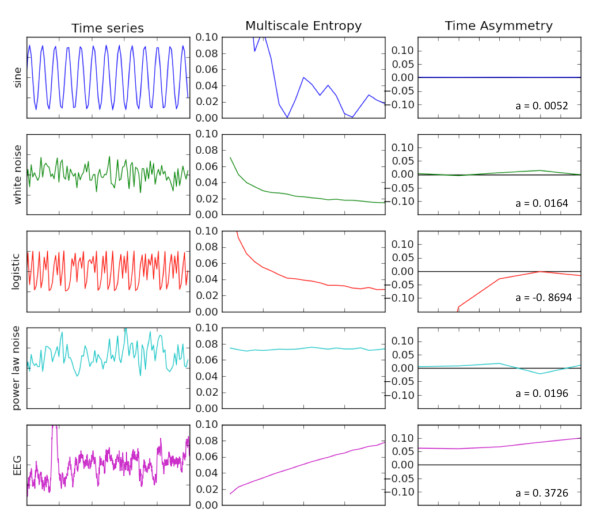
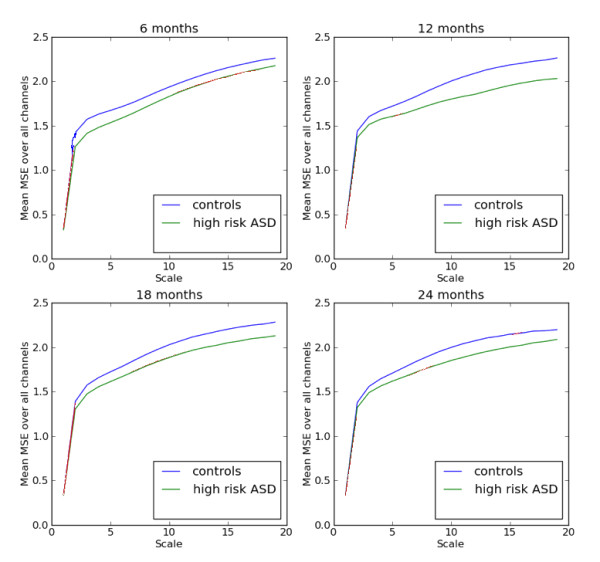
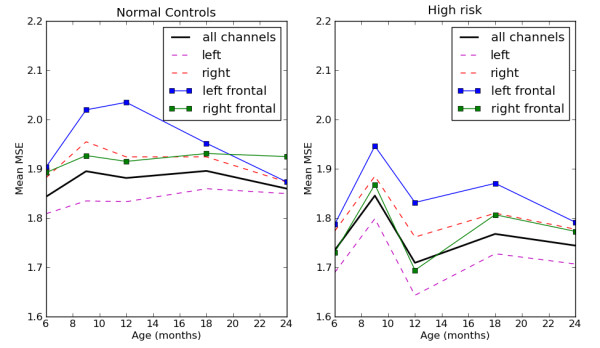
BACKGROUND: Complex neurodevelopmental disorders may be characterized by subtle brain function signatures early in life before behavioral symptoms are apparent. Such endophenotypes may be measurable biomarkers for later cognitive impairments. The nonlinear complexity of electroencephalography (EEG) signals is believed to contain information about the architecture of the neural networks in the brain on many scales. Early detection of abnormalities in EEG signals may be an early biomarker for developmental cognitive disorders. The goal of this paper is to demonstrate that the modified multiscale entropy (mMSE) computed on the basis of resting state EEG data can be used as a biomarker of normal brain development and distinguish typically developing children from a group of infants at high risk for autism spectrum disorder (ASD), defined on the basis of an older sibling with ASD. METHODS: Using mMSE as a feature vector, a multiclass support vector machine algorithm was used to classify typically developing and high-risk groups. Classification was computed separately within each age group from 6 to 24 months. RESULTS: Multiscale entropy appears to go through a different developmental trajectory in infants at high risk for autism (HRA) than it does in typically developing controls. Differences appear to be greatest at ages 9 to 12 months. Using several machine learning algorithms with mMSE as a feature vector, infants were classified with over 80% accuracy into control and HRA groups at age 9 months. Classification accuracy for boys was close to 100% at age 9 months and remains high (70% to 90%) at ages 12 and 18 months. For girls, classification accuracy was highest at age 6 months, but declines thereafter. CONCLUSIONS: This proof-of-principle study suggests that mMSE computed from resting state EEG signals may be a useful biomarker for early detection of risk for ASD and abnormalities in cognitive development in infants. To our knowledge, this is the first demonstration of an information theoretic analysis of EEG data for biomarkers in infants at risk for a complex neurodevelopmental disorder.
Overview
The claims and statistics of this paper haven’t been checked yet.
Free: it reads the open-access text and checks the first 5 claims that cite a source we can check. Create a free account to check every claim.
Integrity signals
Registry
Cites
Statistics
Figures
Verification
Claims the paper makes
The claims and statistics of this paper haven’t been checked yet.
Free: it reads the open-access text and checks the first 5 claims that cite a source we can check. Create a free account to check every claim.
Claims other papers make about this one
Each is checked against this paper’s own text: does it say what the citing paper says it does?
The source backs part of the claim, not all of it — or backs it for a different population, condition or comparison.
In the citing paper
“There is now accumulating evidence from electroencephalographic (EEG) studies suggesting that infants at high risk for ASD, regardless of whether they ultimately meet diagnostic criteria for ASD, have different developmental trajectories within the first year of life compared to low-risk infants [10–20].”
From EEG power at 3 months in infants at high familial risk for autism (2017) · cites this paper as [10]
Experimental — accuracy not yet measured
Self-check
Percentages, sums and reported differences re-computed from the paper’s own numbers.
The self-check needs the paper’s full text.
Citations
Cites
Lecture Notes in Computer Science 1205
(1999) · Industrial Robot: An International Journal · doi:10.1108/ir.1999.04926fae.001 · Cited by 38,662
Buzsáki, G. (2006) · doi:10.1093/acprof:oso/9780195301069.001.0001 · Cited by 4,873
The brainweb: phase synchronization and large-scale integration
Varela, F., Lachaux, J.-P., Rodriguez, E., & Martinerie, J. (2001) · Nature Reviews Neuroscience · doi:10.1038/35067550 · Cited by 4,761 · cited 2×
“The analysis of signal complexity on multiple scales may reveal information about neural connectivity that is diagnostically useful [1,19,22].”
BackgroundSynchronization: A Universal Concept in Nonlinear Sciences
Pikovsky, A., Rosenblum, M., & Kurths, J. (2001) · Cambridge University Press eBooks · doi:10.1017/cbo9780511755743 · Cited by 4,652
Bassett, D. S., & Bullmore, E. (2006) · The Neuroscientist · doi:10.1177/1073858406293182 · Cited by 2,600 · cited 1×
“This remarkable connectivity is achieved by a kind of hierarchical organization that is not fully understood in the brain, but is ubiquitous in nature and is called a scale-free network [2-4] that changes with development.”
BackgroundNunez, P. L., & Srinivasan, R. (2006) · doi:10.1093/acprof:oso/9780195050387.001.0001 · Cited by 2,531
Multiscale entropy analysis of biological signals
Costa, M., Goldberger, A. L., & Peng, C.-K. (2005) · Physical Review E · doi:10.1103/physreve.71.021906 · Cited by 2,482 · cited 3×
“One interpretation of biological complexity is that it reflects a system’s ability to adapt quickly and function in a changing environment [23].”
BackgroundInfluentialElectric Fields of the Brain: The Neurophysics of EEG
Nunez, P. L., & Harth, E. (1982) · Physics Today · doi:10.1063/1.2915137 · Cited by 2,232
Hierarchical organization in complex networks
Ravasz, E., & Barabási, A.-L. (2003) · Physical Review E · doi:10.1103/physreve.67.026112 · Cited by 2,160
Scale-Free Networks: A Decade and Beyond
Barabási, A.-L. (2009) · Science · doi:10.1126/science.1173299 · Cited by 2,109 · cited 2×
“This remarkable connectivity is achieved by a kind of hierarchical organization that is not fully understood in the brain, but is ubiquitous in nature and is called a scale-free network [2-4] that changes with development.”
Background
Cited by
Items 501–516 of 516
EEG connectivity changes in early response to antidepressant treatment
Kathpalia, A., VLACHOS, I. K., Hlinka, J., Brunovský, M., Bareš, M., & Paluš, M. (2026) · Clinical Neurophysiology · doi:10.1016/j.clinph.2026.2111905
Kang, J., Zhang, L., Yang, X., Li, X., Fan, X., & Zheng, S. (2026) · ALPHA PSYCHIATRY · doi:10.31083/ap45250
“It reflects the brain’s information processing capacity and functional flexibility, which are often reduced in neurodevelopmental disorders such as ASD [27,28].”
Measuring Brain Complexity During Neural Motor ResonancePreprint
Fassett‐Carman, A., Hubley, K. M., Lin, T., Yuan, J., Hager, B., Lab, S. I. A. M., Styczynski, N., DiGirolamo, M. A., Abcede, D., Simon, J. C., et al. (2023) · OSF Preprints (OSF Preprints)
Ang, J., Chen, Y., Liao, W., Rao, J., Ji, Y., Xu, H., & Song, Z. (2026) · International Conference on Educational and Information Technology · doi:10.1109/iceit68991.2026.11521842
“…and identification, previous studies have employed machine learning and deep learning approaches to model and analyze electroencephalography (EEG), functional magnetic resonance imaging (fMRI), and behavioral data, with the aim of improving the accuracy of automated ASD identification [3]-[4].”
郑, 瑞. (2026) · Advances in Clinical Medicine · doi:10.12677/acm.2026.1652072
An integrated intelligent model for early diagnosis of autism spectrum disorder
Tandon, A., Mazumdar, B. D., & Pal, M. K. (2026) · Franklin Open · doi:10.1016/j.fraope.2026.100663
Towards a Unified AI Framework for Autism Support: System Design and Pilot Evaluation
Tarek, T. I., Dash, A., Shoumita, B. S., & Rahman, M. S. (2026) · IEEE International Conference on Quantum Photonics, Artificial Intelligence & Networking (QPAIN) · doi:10.1109/qpain69676.2026.11546353
“In summary, past research work shows gaze, gesture, facial expression, body motion, speech, games, and EEG can help in autism detection and intervention [3], [12], [14]–[16], [20], [22], [27], [28].”
Qi, X. L., Ou, X., Li, J., Zhang, M., Xue, F., Wei, H., Su, W., Wang, J., Sun, Y., Zhou, J., et al. (2026) · CNS Neuroscience & Therapeutics · doi:10.1002/cns.71012
“While SE has been linked to excitation-inhibition balance in previous studies [28, 29, 30], this interpretation remains debated.”
Normative EEG Effective Connectivity as a neural marker of Autism Spectrum DisorderPreprint
Amato, L. G., Fattorini, F., Vergani, A. A., Pagani, M., Meneghetti, N., Mazzoni, A., & Fabbrizzi, M. (2026) · medRxiv · doi:10.64898/2026.07.27.26359031
Neural feature spaces: characterizing the geometry of brain activity across developmentPreprint
Caplette, L., Haartsen, R., Davoudi, S., Knoth, I. S., Leech, R., Jones, E., & Lippé, S. (2026) · bioRxiv (Cold Spring Harbor Laboratory) · doi:10.64898/2026.08.03.742613
“…we computed various features that reflect important aspects of brain activity that have been related to neural development and various neurodevelopmental disorders (Bosl et al., 2011; Cross et al., 2025; Davoudi et al., 2025; Lippé et al., 2009; Miskovic et al., 2015; Proteau-Lemieux et al., 2021).”
Coutu-Nadeau, E., Arutiunian, V., Martin, C.-O., Fontaine, V. K., Bélanger, A.-M., Jizi, K., Knoth, I. S., Hosein, A., Davoudi, S., Caplette, L., et al. (2026) · Research Square · doi:10.21203/rs.3.rs-10692457/v1
Liu, N., Li, Y., Li, X., Liu, T., & Kang, J. (2026) · Cognitive Systems Research · doi:10.1016/j.cogsys.2026.101509
Atypical Age‐Related Patterns of Neural Signal Complexity in Autism Spectrum Disorder
Han, J., Liang, L., Song, R., Zhang, X., Liu, J., Jiang, G., & Li, X. (2026) · CNS Neuroscience & Therapeutics · doi:10.1002/cns.71173
“Research in infants at elevated familial risk for ASD has shown that early developmental trajectories of EEG complexity differ from those of low-risk infants, suggesting that atypical neural dynamics may emerge early in development [14].”
Identification of Biological Age from Clinical Pediatric EEG
Colussi, F., Paramento, M., Passarotto, E., Favaro, J., Ancona, C., Toldo, I., Sartori, S., Spicher, N., Sparacino, G., & Rubega, M. (2026) · World Congress on Medical Physics and Biomedical Engineering, September 7 - 12, 2009, Munich, Germany · doi:10.1007/978-3-032-39674-7_5
Coutu-Nadeau, E. (2026) · Papyrus : Institutional Repository (Université de Montréal) · doi:10.71781/36396
Alamdari, S. B., Damavandi, M. S., Zarei, M., & Khosrowabadi, R. (2022) · doi:10.3389/fnhum.2022.828985.s001
Metadata
- Authors
- Bosl, W., Tierney, A., Tager-Flusberg, H., & Nelson, C.
- Affiliations
- Harvard University (US)
- Boston Children's Hospital (US)
- Boston University (US)
- Corresponding author
- Bosl, William
- Venue
- BMC Medicine
- Published
- 2011-02-22
- Volume
- 9
- Issue
- 1
- ISSN
- 1741-7015 (ISSN-L)
- PMC
- PMC3050760
- OpenAlex
- W2171693726
- Cited by
- 485
- References
- 60
- Citations by year
- 2026: 21 · 2025: 33 · 2024: 22 · 2023: 40 · 2022: 41 · 2021: 53 · 2020: 38 · 2019: 30 · 2018: 34 · 2017: 30 · 2016: 28 · 2015: 23 · 2014: 39 · 2013: 23 · 2012: 17
- FWCI
- 14.93
- Type
- journal article
- Language
- en
- Open access
- gold
- doi.org
- Licence
- Locations
- BMC Medicine (publishedVersion, cc-by)
- Digital Access to Scholarship at Harvard (DASH) (Harvard University) (submittedVersion, cc-by)
- USF Scholarship Repository (University of San Francisco) (submittedVersion)
- DOAJ (DOAJ: Directory of Open Access Journals) (submittedVersion)
- OpenBU (Boston University) (submittedVersion, cc-by)
- Funders
- Autism Speaks (AS1323)
- Simons Foundation
- National Institute on Deafness and Other Communication Disorders (R01 DC10290, R21 DC08647)
- Topics
- Life Sciences › Neuroscience › Cognitive Neuroscience › Autism Spectrum Disorder Research
- Life Sciences › Neuroscience › Cognitive Neuroscience › EEG and Brain-Computer Interfaces
- Life Sciences › Biochemistry, Genetics and Molecular Biology › Genetics › Genetics and Neurodevelopmental Disorders
- Keywords
- autism spectrum disorder, resting-state EEG, endophenotypes, typically developing infants, brain development, early detection, support vector machine classification, sex differences
About these checks
Registry, retraction, Cites and statistics results are computed, not judged, with one exception: a printed reference that no index lists is read once by a model before it counts as a citation error. Claims are extracted by a model and kept only when their quote appears verbatim in the text; each cited source is then checked, with a model’s help, for whether it says what the claim relies on. Those verdicts can be wrong — read the claim’s quote and the cited source before relying on one.
Statistics and arithmetic are recomputed, not judged.
Confidence bands are shown only for fields calibrated on our annotated test set. None is calibrated yet, so no band is shown.
What counts as a claim ›How we measure confidence ›How we check this ›
Are you an author, or do you see a problem with this page? Request a review
Data sources
Bibliographic data: Semantic Scholar, OpenAlex, Crossref.
Contains information from the Semantic Scholar Academic Graph Datasets, made available under the ODC Attribution License (ODC-BY 1.0).
Semantic Scholar’s data is described in: Kinney, R., et al. (2023). The Semantic Scholar Open Data Platform. arXiv:2301.10140.
