

Neuro-inflammation induced by lipopolysaccharide causes cognitive impairment through enhancement of beta-amyloid generation
Open accessThe DOI matches its Crossref record; 56 of the 56 references it cites were found in a registry or an index.
Abstract
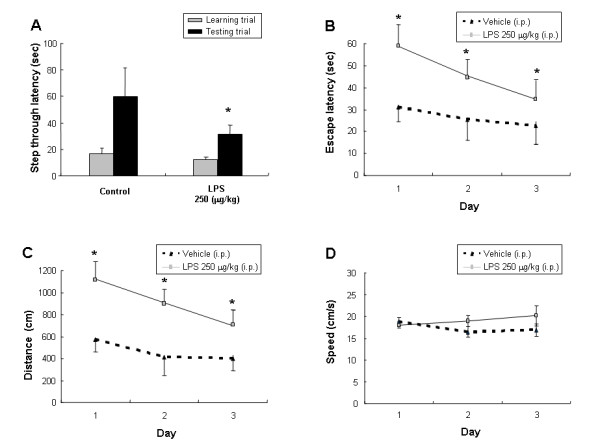
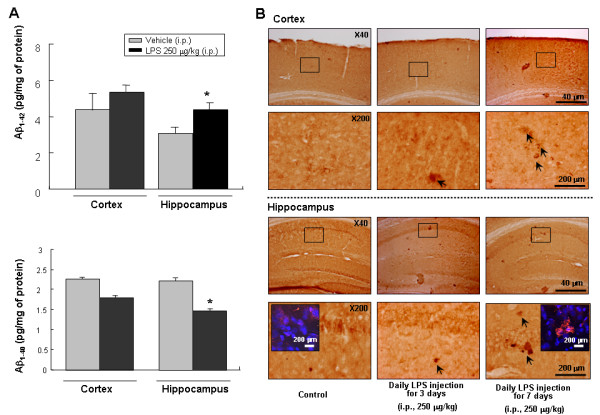
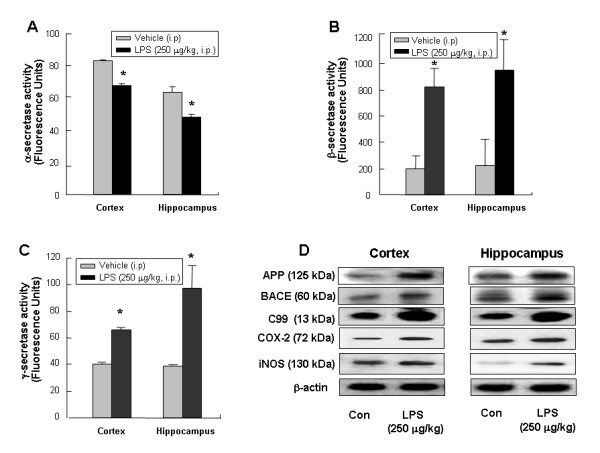
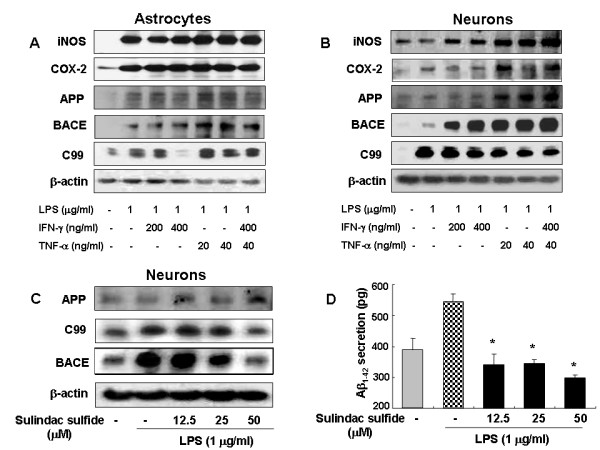
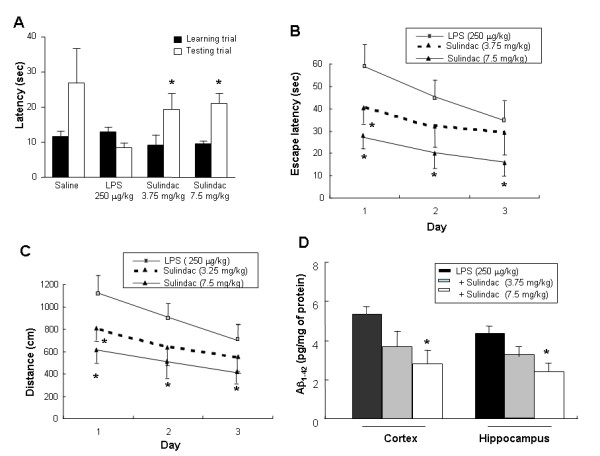
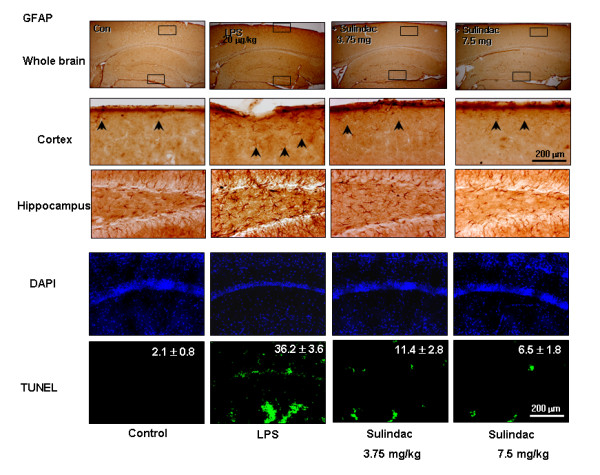
Background: Alzheimer's disease (AD) is characterized by extensive loss of neurons in the brain of AD patients. Intracellular accumulation of beta-amyloid peptide (Aβ) has also shown to occur in AD. Neuro-inflammation has been known to play a role in the pathogenesis of AD. Methods: In this study, we investigated neuro-inflammation and amyloidogenesis and memory impairment following the systemic inflammation generated by lipopolysaccharide (LPS) using immunohistochemistry, ELISA, behavioral tests and Western blotting. Results: Intraperitoneal injection of LPS, (250 μg/kg) induced memory impairment determined by passive avoidance and water maze tests in mice. Repeated injection of LPS (250 μg/kg, 3 or 7 times) resulted in an accumulation of Aβ 1–42 in the hippocampus and cerebralcortex of mice brains through increased β- and γ-secretase activities accompanied with the increased expression of amyloid precursor protein (APP), 99-residue carboxy-terminal fragment of APP (C99) and generation of Aβ 1–42 as well as activation of astrocytes in vivo. 3 weeks of pretreatment of sulindac sulfide (3.75 and 7.5 mg/kg, orally), an anti-inflammatory agent, suppressed the LPS-induced amyloidogenesis, memory dysfunction as well as neuronal cell death in vivo. Sulindac sulfide (12.5–50 μM) also suppressed LPS (1 μg/ml)-induced amyloidogenesis in cultured neurons and astrocytes in vitro. Conclusion: This study suggests that neuro-inflammatory reaction could contribute to AD pathology, and anti-inflammatory agent could be useful for the prevention of AD.
Overview
The claims and statistics of this paper haven’t been checked yet.
Free: it reads the open-access text and checks the first 5 claims that cite a source we can check. Create a free account to check every claim.
Integrity signals
Registry
Cites
Statistics
Figures
Verification
Claims the paper makes
The claims and statistics of this paper haven’t been checked yet.
Free: it reads the open-access text and checks the first 5 claims that cite a source we can check. Create a free account to check every claim.
Claims other papers make about this one
Each is checked against this paper’s own text: does it say what the citing paper says it does?
The source backs part of the claim, not all of it — or backs it for a different population, condition or comparison.
In the citing paper
“Endotoxin promotes amyloid β and tau aggregation and neuropathology”
From The endotoxin hypothesis of neurodegeneration (2019) · cites this paper as [66]
Experimental — accuracy not yet measuredIn the citing paper
“Importantly, RP improves cognitive function and recapitulates the effects of exercise on neural stem cell activity possibly by reducing the baseline negative effects of inflammation on adult neurogenesis and cognition34,35.”
From Exercise plasma boosts memory and dampens brain inflammation via clusterin (2021) · cites this paper as [34]
In the citing paper
“Endotoxin may also promote the production or aggregation of amyloid β [66–68], tau [68, 69] and α-synuclein [70, 71].”
From The endotoxin hypothesis of neurodegeneration (2019) · cites this paper as [66]
Self-check
Percentages, sums and reported differences re-computed from the paper’s own numbers.
The self-check needs the paper’s full text.
Citations
Cites
Developments of a water-maze procedure for studying spatial learning in the rat
Morris, R. (1984) · Journal of Neuroscience Methods · doi:10.1016/0165-0270(84)90007-4 · Cited by 7,180
Inflammation and Alzheimer’s disease
Akiyama, H. (2000) · Neurobiology of Aging · doi:10.1016/s0197-4580(00)00124-x · Cited by 4,514
Ibuprofen Suppresses Plaque Pathology and Inflammation in a Mouse Model for Alzheimer's Disease
Lim, G. P., Yang, F., Chu, T., Chen, P., Beech, W., Teter, B., Tran, T., Ubeda, O., Ashe, K. H., Frautschy, S. A., et al. (2000) · The Journal of Neuroscience · doi:10.1523/jneurosci.20-15-05709.2000 · Cited by 884
Inflammatory processes in Alzheimer's disease
Heneka, M. T., & O'Banion, M. K. (2007) · Journal of Neuroimmunology · doi:10.1016/j.jneuroim.2006.11.017 · Cited by 782
Perry, V. H. (2004) · Brain Behavior and Immunity · doi:10.1016/j.bbi.2004.01.004 · Cited by 560
Buxbaum, J. D., Oishi, M., Chen, H. I., Pinkas-Kramarski, R., Jaffe, E. A., Gandy, S. E., & Greengard, P. (1992) · Proceedings of the National Academy of Sciences · doi:10.1073/pnas.89.21.10075 · Cited by 559
Analysis of the DNA-binding and activation properties of the human transcription factor AP-2.
Williams, T., & Tjian, R. (1991) · Genes & Development · doi:10.1101/gad.5.4.670 · Cited by 507
Inflammatory processes in Alzheimer's disease
McGeer, E. G., & McGeer, P. L. (2003) · Progress in Neuro-Psychopharmacology and Biological Psychiatry · doi:10.1016/s0278-5846(03)00124-6 · Cited by 472
Yan, Q., Zhang, J., Liu, H., Babu-Khan, S., Vassar, R., Biere, A. L., Citron, M., & Landreth, G. (2003) · The Journal of Neuroscience · doi:10.1523/jneurosci.23-20-07504.2003 · Cited by 469
Anti‐inflammatory agents as a therapeutic approach to Alzheimer's disease
McGeer, P. L., & Rogers, J. (1992) · Neurology · doi:10.1212/wnl.42.2.447 · Cited by 406
Neuroinflammation in Alzheimer's disease and prion disease
Eikelenboom, P., Bate, C., Van Gool, W. A., Hoozemans, J. J. M., Rozemuller, J. M., Veerhuis, R., & Williams, A. (2002) · Glia · doi:10.1002/glia.10146 · Cited by 405
He, P., Zhong, Z., Lindholm, K., Berning, L., Lee, W., Lemere, C., Staufenbiel, M., Li, R., & Shen, Y. (2007) · The Journal of Cell Biology · doi:10.1083/jcb.200705042 · Cited by 390
Liao, Y.-F., Wang, B.-J., Cheng, H.-T., Kuo, L.-H., & Wolfe, M. S. (2004) · Journal of Biological Chemistry · doi:10.1074/jbc.m402034200 · Cited by 389
Sheng, J. (2003) · Neurobiology of Disease · doi:10.1016/s0969-9961(03)00069-x · Cited by 388
p38 Kinase Is Activated in the Alzheimer's Disease Brain
Hensley, K., Floyd, R. A., Zheng, N., Nael, R., Robinson, K. A., Nguyen, X., Pye, Q. N., Stewart, C. A., Geddes, J., Markesbery, W. R., et al. (1999) · Journal of Neurochemistry · doi:10.1046/j.1471-4159.1999.0722053.x · Cited by 373
Sastre, M., Dewachter, I., Landreth, G. E., Willson, T. M., Klockgether, T., van Leuven, F., & Heneka, M. T. (2003) · The Journal of Neuroscience · doi:10.1523/jneurosci.23-30-09796.2003 · Cited by 357
The promoter of Alzheimer's disease amyloid A4 precursor gene.
Salbaum, J. M., Weidemann, A., Lemaire, H. G., Masters, C. L., & Beyreuther, K. (1988) · The EMBO Journal · doi:10.1002/j.1460-2075.1988.tb03136.x · Cited by 313
Zou, K., Gong, J.-S., Yanagisawa, K., & Michikawa, M. (2002) · The Journal of Neuroscience · doi:10.1523/jneurosci.22-12-04833.2002 · Cited by 305
Inflammatory mechanisms in Alzheimer's disease
Eikelenboom, P., Zhan, S.-S., van Gool, W. A., & Allsop, D. (1994) · Trends in Pharmacological Sciences · doi:10.1016/0165-6147(94)90057-4 · Cited by 291
Rogers, J. T., Leiter, L. M., McPhee, J., Cahill, C. M., Zhan, S.-S., Potter, H., & Nilsson, L. N. G. (1999) · Journal of Biological Chemistry · doi:10.1074/jbc.274.10.6421 · Cited by 290
BLASKO, I., MARX, F., STEINER, E., HARTMANN, T., & GRUBECK‐LOEBENSTEIN, B. (1999) · The FASEB Journal · doi:10.1096/fasebj.13.1.63 · Cited by 280
Mattson, M. P., Maudsley, S., & Martin, B. (2004) · Ageing Research Reviews · doi:10.1016/j.arr.2004.08.001 · Cited by 268
Shaw, K. (2001) · Behavioural Brain Research · doi:10.1016/s0166-4328(01)00232-7 · Cited by 240
Giovannini, M. G., Scali, C., Prosperi, C., Bellucci, A., Vannucchi, M. G., Rosi, S., Pepeu, G., & Casamenti, F. (2002) · Neurobiology of Disease · doi:10.1006/nbdi.2002.0538 · Cited by 190
The β-Secretase, BACE: A Prime Drug Target for Alzheimer's Disease
Vassar, R. (2001) · Journal of Molecular Neuroscience · doi:10.1385/jmn:17:2:157 · Cited by 186
Sung, S., Yang, H., Uryu, K., Lee, E. B., Zhao, L., Shineman, D. W., Trojanowski, J. Q., Lee, V. M. ‐., & Praticò, D. (2004) · American Journal Of Pathology · doi:10.1016/s0002-9440(10)63269-5 · Cited by 180
Culbert, A. A., Skaper, S. D., Howlett, D. R., Evans, N. A., Facci, L., Soden, P. E., Seymour, Z. M., Guillot, F., Gaestel, M., & Richardson, J. C. (2006) · Journal of Biological Chemistry · doi:10.1074/jbc.m513646200 · Cited by 170
The cell biology of Alzheimer's disease: uncovering the secrets of secretases
Walter, J., Kaether, C., Steiner, H., & Haass, C. (2001) · Current Opinion in Neurobiology · doi:10.1016/s0959-4388(00)00253-1 · Cited by 160
Zou, K., Kim, D., Kakio, A., Byun, K., Gong, J., Kim, J., Kim, M., Sawamura, N., Nishimoto, S., Matsuzaki, K., et al. (2003) · Journal of Neurochemistry · doi:10.1046/j.1471-4159.2003.02018.x · Cited by 155
Guo, J.-T., Yu, J., Grass, D., de Beer, F. C., & Kindy, M. S. (2002) · The Journal of Neuroscience · doi:10.1523/jneurosci.22-14-05900.2002 · Cited by 152
Sparkman, N. L., Martin, L. A., Calvert, W. S., & Boehm, G. W. (2005) · Behavioural Brain Research · doi:10.1016/j.bbr.2004.10.011 · Cited by 126
Praticò, D., & Trojanowski, J. Q. (2000) · Neurobiology of Aging · doi:10.1016/s0197-4580(00)00141-x · Cited by 116
Trejo, J., Massamiri, T., Deng, T., Dewji, N. N., Bayney, R. M., & Brown, J. H. (1994) · Journal of Biological Chemistry · doi:10.1016/s0021-9258(17)31860-4 · Cited by 114
Park, K. S., Lee, R. D., Kang, S.-K., Han, S. Y., Park, K. L., Yang, K. H., Song, Y. S., Park, H. J., Lee, Y. M., Yun, Y. P., et al. (2004) · Experimental Cell Research · doi:10.1016/j.yexcr.2004.03.034 · Cited by 106
Self-citationJang, J.-H., & Surh, Y. (2005) · Free Radical Biology and Medicine · doi:10.1016/j.freeradbiomed.2005.02.023 · Cited by 101
Gasparini, L., Rusconi, L., Xu, H., Del Soldato, P., & Ongini, E. (2004) · Journal of Neurochemistry · doi:10.1111/j.1471-4159.2004.02154.x · Cited by 98
Milatovic, D., Zaja‐Milatovic, S., Montine, K. S., Horner, P. J., & Montine, T. J. (2003) · Journal of Neurochemistry · doi:10.1046/j.1471-4159.2003.02120.x · Cited by 97
Ibuprofen Decreases Cytokine-Induced Amyloid Beta Production in Neuronal Cells
Blasko, I., Apochal, A., Boeck, G., Hartmann, T., Grubeck-Loebenstein, B., & Ransmayr, G. (2001) · Neurobiology of Disease · doi:10.1006/nbdi.2001.0451 · Cited by 92
Interferon-gamma increases neuronal death in response to amyloid-beta1-42.
Bate, C., Kempster, S. L., Last, V., & Williams, A. (2006) · Journal of Neuroinflammation · doi:10.1186/1742-2094-3-7 · Cited by 80
Quitschke, W. W., & Goldgaber, D. (1992) · Journal of Biological Chemistry · doi:10.1016/s0021-9258(18)41934-5 · Cited by 78
Neurodegenerative dementias : clinical features and pathological mechanisms
Clark, C. M., & Trojanowski, J. Q. (2000) · McGraw-Hill, Health Professions Division eBooks · Cited by 72
Noble, F., Rubira, E., Boulanouar, M., Palmier, B., Plotkine, M., Warnet, J., Marchand‐Leroux, C., & Massicot, F. (2007) · Neuroscience Letters · doi:10.1016/j.neulet.2007.07.005 · Cited by 72
Hwang, D. Y., Cho, J. S., Lee, S. H., Chae, K. R., Lim, H. J., Min, S. H., Seo, S. J., Song, Y. S., Song, C. W., Paik, S. G., et al. (2004) · Experimental Neurology · doi:10.1016/j.expneurol.2003.09.021 · Cited by 69
Lee, S. M., Nga, N. T. H., Park, M. H., Kim, K. S., Cho, K., Moon, D. C., Kim, H. Y., Yoon, D. Y., & Hong, J. T. (2004) · Biochemical and Biophysical Research Communications · doi:10.1016/j.bbrc.2004.06.060 · Cited by 67
Self-citationBandyopadhyay, S., Hartley, D. M., Cahill, C. M., Lahiri, D. K., Chattopadhyay, N., & Rogers, J. T. (2006) · Journal of Neuroscience Research · doi:10.1002/jnr.20864 · Cited by 63
Song, Y. S., Park, H. J., Kim, S. Y., Lee, S. H., Yoo, H. S., Lee, H. S., Lee, M. K., Oh, K. W., Kang, S.-K., Lee, S. E., et al. (2004) · Neuroscience Research · doi:10.1016/j.neures.2004.01.010 · Cited by 62
Self-citationSzczepanik, A. M., & Ringheim, G. E. (2003) · Journal of Alzheimer's Disease · doi:10.3233/jad-2003-5205 · Cited by 61
Transforming Growth Factor β2 Is a Neuronal Death-Inducing Ligand for Amyloid-β Precursor Protein
Hashimoto, Y., Chiba, T., Yamada, M., Nawa, M., Kanekura, K., Suzuki, H., Terashita, K., Aiso, S., Nishimoto, I., & Matsuoka, M. (2005) · Molecular and Cellular Biology · doi:10.1128/mcb.25.21.9304-9317.2005 · Cited by 51
Hauss‐Wegrzyniak, B., & Wenk, G. L. (2002) · Neuroscience Letters · doi:10.1016/s0304-3940(02)00087-3 · Cited by 39
Abnormal IL-1β cytokine expression in the cerebellum of the ataxic mutant mice staggerer and Lurcher
Garabedian, B. V.-D., Lemaigre‐Dubreuil, Y., Delhaye‐Bouchaud, N., & Mariani, J. (1998) · Molecular Brain Research · doi:10.1016/s0169-328x(98)00268-x · Cited by 35
TNFR-associated factor-2 (TRAF-2) in Alzheimer's disease
Culpan, D., Cram, D., Chalmers, K., Cornish, A., Palmer, L., Palmer, J. C., Hughes, A., Passmore, P., Craigs, D., Wilcock, G. K., et al. (2007) · Neurobiology of Aging · doi:10.1016/j.neurobiolaging.2007.10.014 · Cited by 33
Transforming growth factor β2 autocrinally mediates neuronal cell death induced by amyloid‐β
Hashimoto, Y., Nawa, M., Chiba, T., Aiso, S., Nishimoto, I., & Matsuoka, M. (2006) · Journal of Neuroscience Research · doi:10.1002/jnr.20804 · Cited by 31
Ma, G., Chen, S., Wang, X., Ba, M., Yang, H., & Lu, G. (2005) · Journal of Neuroscience Research · doi:10.1002/jnr.20515 · Cited by 30
Hirose, Y., Imai, Y., Nakajima, K., Takemoto, N., Toya, S., & Kohsaka, S. (1994) · Biochemical and Biophysical Research Communications · doi:10.1006/bbrc.1994.1074 · Cited by 20
Ma, Chen, Wang, Ba, Yang, & Lü (2006) · 中国生物学文摘 · Cited by 19
Kuperstein, F., Brand, A., & Yavin, E. (2004) · Journal of Neurochemistry · doi:10.1111/j.1471-4159.2004.02778.x · Cited by 9
Cited by
Role of pro-inflammatory cytokines released from microglia in Alzheimer's disease.
(2015) · Europe PMC (PubMed Central) · doi:10.3978/j.issn.2305-5839.2015.03.49 · Cited by 1,288
Age-dependent dysregulation of innate immunity
Shaw, A. C., Goldstein, D. R., & Montgomery, R. R. (2013) · Nature Reviews Immunology · doi:10.1038/nri3547 · Cited by 1,061
Obesity and neuroinflammation: A pathway to cognitive impairment
Miller, A. A., & Spencer, S. J. (2014) · Brain, Behavior, and Immunity · doi:10.1016/j.bbi.2014.04.001 · Cited by 788
Microglia and neurodegeneration: The role of systemic inflammation
Cunningham, C. (2013) · Glia · doi:10.1002/glia.22350 · Cited by 769
Neuroinflammation in Alzheimer disease
Heneka, M. T., van der Flier, W. M., Jessen, F., Hoozemanns, J., Thal, D. R., Boche, D., Brosseron, F., Teunissen, C., Zetterberg, H., Jacobs, A. H., et al. (2025) · Nature Reviews Immunology · doi:10.1038/s41577-024-01104-7 · Cited by 638
Metadata
- Authors
- Lee, J. W., Lee, Y. K., Yuk, D. Y., Choi, D. Y., Ban, S. B., Oh, K. W., & Hong, J. T.
- Affiliations
- Chungbuk National University (KR)
- University of Kentucky (US)
- Corresponding author
- Hong, Jin Tae
- Venue
- Journal of Neuroinflammation
- Published
- 2008-08-29
- Volume
- 5
- Issue
- 1
- Pages
- 37-37
- ISSN
- 1742-2094 (ISSN-L)
- PMC
- PMC2556656
- OpenAlex
- W2099157718
- Cited by
- 772
- References
- 56
- Citations by year
- 2026: 27 · 2025: 48 · 2024: 57 · 2023: 59 · 2022: 69 · 2021: 70 · 2020: 62 · 2019: 65 · 2018: 62 · 2017: 46 · 2016: 43 · 2015: 34 · 2014: 31 · 2013: 22 · 2012: 34
- FWCI
- 9.71
- Type
- journal article
- Language
- en
- Open access
- gold
- doi.org
- Licence
- cc-by
- Locations
- Journal of Neuroinflammation (publishedVersion, cc-by)
- PubMed Central (publishedVersion, cc-by)
- PubMed (publishedVersion)
- DOAJ (DOAJ: Directory of Open Access Journals) (submittedVersion)
- Funders
- Ministry of Education and Human Resources Development
- Topics
- Life Sciences › Neuroscience › Cellular and Molecular Neuroscience › Alzheimer's disease research and treatments
- Life Sciences › Neuroscience › Neurology › Neuroinflammation and Neurodegeneration Mechanisms
- Health Sciences › Medicine › Psychiatry and Mental health › Dementia and Cognitive Impairment Research
- Keywords
- neuroinflammation, lipopolysaccharide, Alzheimer's disease, amyloid-beta 42, amyloid precursor protein, beta-secretase, gamma-secretase, C99, astrocyte activation, memory impairment, sulindac sulfide, anti-inflammatory agents, neuronal cell death, hippocampus, systemic inflammation
- MeSH terms
- Alzheimer Disease, Animals, Anti-Inflammatory Agents, Non-Steroidal, Behavior, Animal, Brain, Cells, Cultured, Cognition Disorders, Female, Humans, Inflammation, Isoenzymes, Learning, Lipopolysaccharides, Male, Memory Disorders, Neurons, Pregnancy, Random Allocation, Sulindac, Amyloid beta-Peptides, Amyloid beta-Protein Precursor, Rats, Sprague-Dawley, Mice, Rats, Amyloid Precursor Protein Secretases
About these checks
Registry, retraction, Cites and statistics results are computed, not judged, with one exception: a printed reference that no index lists is read once by a model before it counts as a citation error. Claims are extracted by a model and kept only when their quote appears verbatim in the text; each cited source is then checked, with a model’s help, for whether it says what the claim relies on. Those verdicts can be wrong — read the claim’s quote and the cited source before relying on one.
Statistics and arithmetic are recomputed, not judged.
Confidence bands are shown only for fields calibrated on our annotated test set. None is calibrated yet, so no band is shown.
What counts as a claim ›How we measure confidence ›How we check this ›
Are you an author, or do you see a problem with this page? Request a review
Data sources
Bibliographic data: Semantic Scholar, OpenAlex, Crossref.
Contains information from the Semantic Scholar Academic Graph Datasets, made available under the ODC Attribution License (ODC-BY 1.0).
Semantic Scholar’s data is described in: Kinney, R., et al. (2023). The Semantic Scholar Open Data Platform. arXiv:2301.10140.
