

Neuro-inflammation induced by lipopolysaccharide causes cognitive impairment through enhancement of beta-amyloid generation
Open accessThe DOI matches its Crossref record; 56 of the 56 references it cites were found in a registry or an index.
Abstract
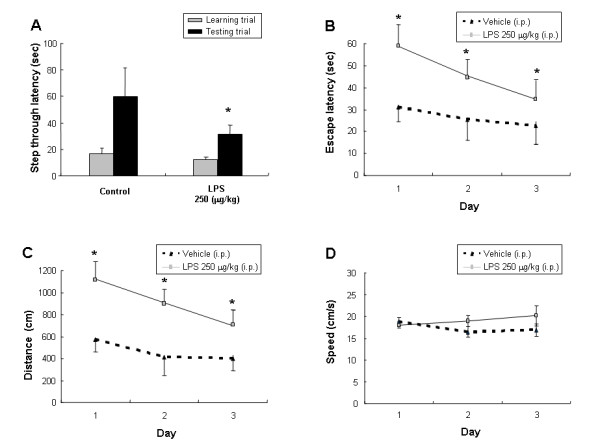
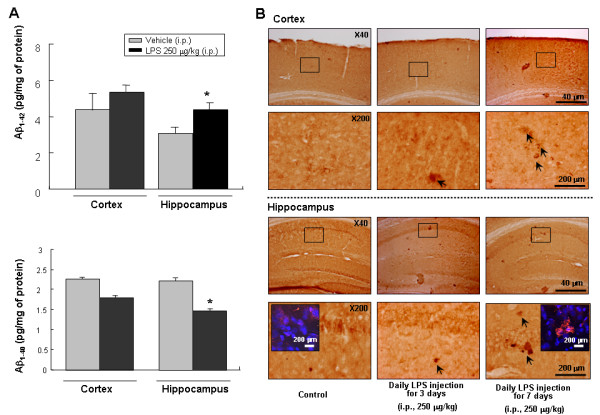
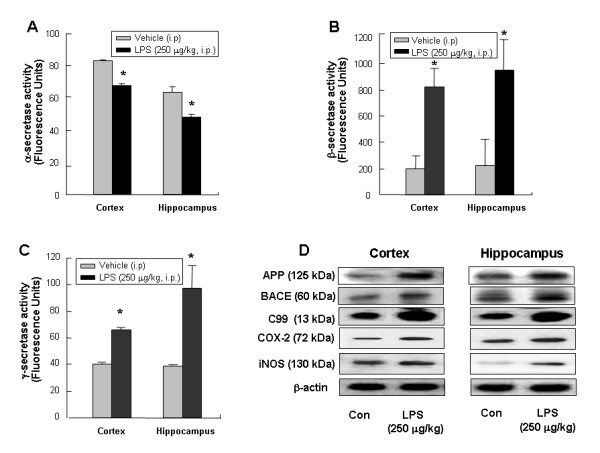
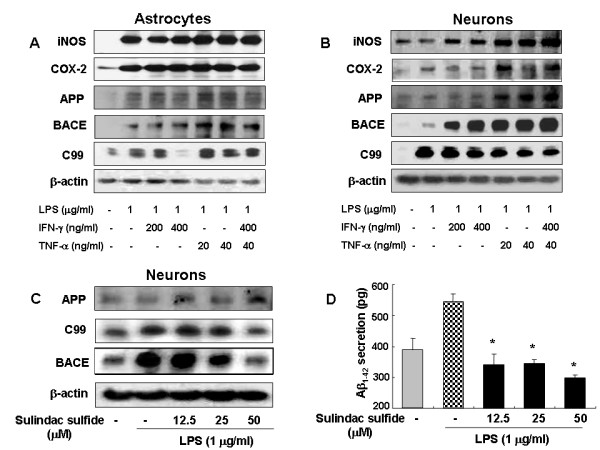
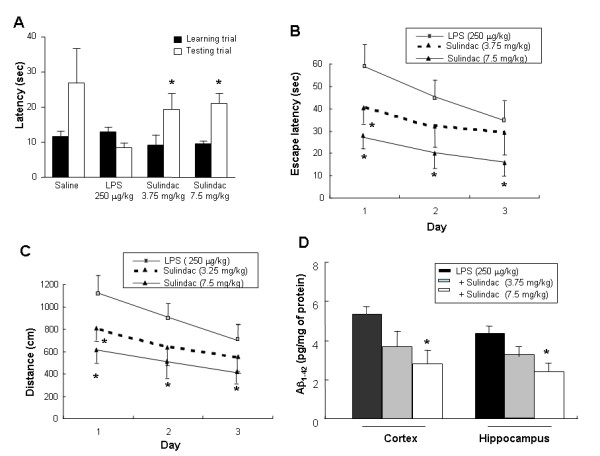
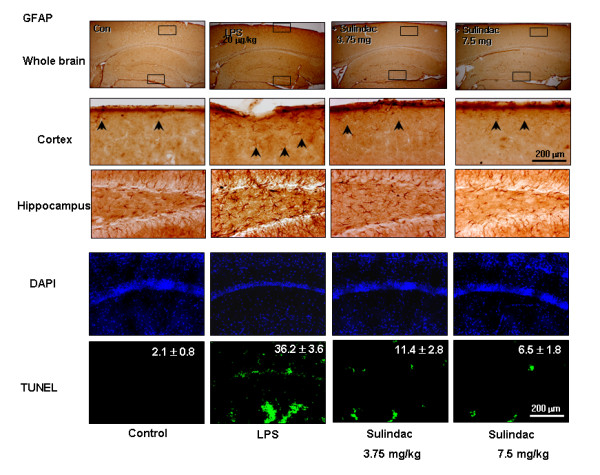
Background: Alzheimer's disease (AD) is characterized by extensive loss of neurons in the brain of AD patients. Intracellular accumulation of beta-amyloid peptide (Aβ) has also shown to occur in AD. Neuro-inflammation has been known to play a role in the pathogenesis of AD. Methods: In this study, we investigated neuro-inflammation and amyloidogenesis and memory impairment following the systemic inflammation generated by lipopolysaccharide (LPS) using immunohistochemistry, ELISA, behavioral tests and Western blotting. Results: Intraperitoneal injection of LPS, (250 μg/kg) induced memory impairment determined by passive avoidance and water maze tests in mice. Repeated injection of LPS (250 μg/kg, 3 or 7 times) resulted in an accumulation of Aβ 1–42 in the hippocampus and cerebralcortex of mice brains through increased β- and γ-secretase activities accompanied with the increased expression of amyloid precursor protein (APP), 99-residue carboxy-terminal fragment of APP (C99) and generation of Aβ 1–42 as well as activation of astrocytes in vivo. 3 weeks of pretreatment of sulindac sulfide (3.75 and 7.5 mg/kg, orally), an anti-inflammatory agent, suppressed the LPS-induced amyloidogenesis, memory dysfunction as well as neuronal cell death in vivo. Sulindac sulfide (12.5–50 μM) also suppressed LPS (1 μg/ml)-induced amyloidogenesis in cultured neurons and astrocytes in vitro. Conclusion: This study suggests that neuro-inflammatory reaction could contribute to AD pathology, and anti-inflammatory agent could be useful for the prevention of AD.
Overview
The claims and statistics of this paper haven’t been checked yet.
Free: it reads the open-access text and checks the first 5 claims that cite a source we can check. Create a free account to check every claim.
Integrity signals
Registry
Cites
Statistics
Figures
Verification
Claims the paper makes
The claims and statistics of this paper haven’t been checked yet.
Free: it reads the open-access text and checks the first 5 claims that cite a source we can check. Create a free account to check every claim.
Claims other papers make about this one
Each is checked against this paper’s own text: does it say what the citing paper says it does?
The source backs part of the claim, not all of it — or backs it for a different population, condition or comparison.
In the citing paper
“Endotoxin promotes amyloid β and tau aggregation and neuropathology”
From The endotoxin hypothesis of neurodegeneration (2019) · cites this paper as [66]
Experimental — accuracy not yet measuredIn the citing paper
“Importantly, RP improves cognitive function and recapitulates the effects of exercise on neural stem cell activity possibly by reducing the baseline negative effects of inflammation on adult neurogenesis and cognition34,35.”
From Exercise plasma boosts memory and dampens brain inflammation via clusterin (2021) · cites this paper as [34]
In the citing paper
“Endotoxin may also promote the production or aggregation of amyloid β [66–68], tau [68, 69] and α-synuclein [70, 71].”
From The endotoxin hypothesis of neurodegeneration (2019) · cites this paper as [66]
Self-check
Percentages, sums and reported differences re-computed from the paper’s own numbers.
The self-check needs the paper’s full text.
Citations
Cites
Developments of a water-maze procedure for studying spatial learning in the rat
Morris, R. (1984) · Journal of Neuroscience Methods · doi:10.1016/0165-0270(84)90007-4 · Cited by 7,180
Inflammation and Alzheimer’s disease
Akiyama, H. (2000) · Neurobiology of Aging · doi:10.1016/s0197-4580(00)00124-x · Cited by 4,514
Ibuprofen Suppresses Plaque Pathology and Inflammation in a Mouse Model for Alzheimer's Disease
Lim, G. P., Yang, F., Chu, T., Chen, P., Beech, W., Teter, B., Tran, T., Ubeda, O., Ashe, K. H., Frautschy, S. A., et al. (2000) · The Journal of Neuroscience · doi:10.1523/jneurosci.20-15-05709.2000 · Cited by 884
Inflammatory processes in Alzheimer's disease
Heneka, M. T., & O'Banion, M. K. (2007) · Journal of Neuroimmunology · doi:10.1016/j.jneuroim.2006.11.017 · Cited by 782
Perry, V. H. (2004) · Brain Behavior and Immunity · doi:10.1016/j.bbi.2004.01.004 · Cited by 560
Buxbaum, J. D., Oishi, M., Chen, H. I., Pinkas-Kramarski, R., Jaffe, E. A., Gandy, S. E., & Greengard, P. (1992) · Proceedings of the National Academy of Sciences · doi:10.1073/pnas.89.21.10075 · Cited by 559
Analysis of the DNA-binding and activation properties of the human transcription factor AP-2.
Williams, T., & Tjian, R. (1991) · Genes & Development · doi:10.1101/gad.5.4.670 · Cited by 507
Inflammatory processes in Alzheimer's disease
McGeer, E. G., & McGeer, P. L. (2003) · Progress in Neuro-Psychopharmacology and Biological Psychiatry · doi:10.1016/s0278-5846(03)00124-6 · Cited by 472
Yan, Q., Zhang, J., Liu, H., Babu-Khan, S., Vassar, R., Biere, A. L., Citron, M., & Landreth, G. (2003) · The Journal of Neuroscience · doi:10.1523/jneurosci.23-20-07504.2003 · Cited by 469
Anti‐inflammatory agents as a therapeutic approach to Alzheimer's disease
McGeer, P. L., & Rogers, J. (1992) · Neurology · doi:10.1212/wnl.42.2.447 · Cited by 406
Cited by
Role of pro-inflammatory cytokines released from microglia in Alzheimer's disease.
(2015) · Europe PMC (PubMed Central) · doi:10.3978/j.issn.2305-5839.2015.03.49 · Cited by 1,288
Age-dependent dysregulation of innate immunity
Shaw, A. C., Goldstein, D. R., & Montgomery, R. R. (2013) · Nature Reviews Immunology · doi:10.1038/nri3547 · Cited by 1,061
Obesity and neuroinflammation: A pathway to cognitive impairment
Miller, A. A., & Spencer, S. J. (2014) · Brain, Behavior, and Immunity · doi:10.1016/j.bbi.2014.04.001 · Cited by 788
Microglia and neurodegeneration: The role of systemic inflammation
Cunningham, C. (2013) · Glia · doi:10.1002/glia.22350 · Cited by 769
Neuroinflammation in Alzheimer disease
Heneka, M. T., van der Flier, W. M., Jessen, F., Hoozemanns, J., Thal, D. R., Boche, D., Brosseron, F., Teunissen, C., Zetterberg, H., Jacobs, A. H., et al. (2025) · Nature Reviews Immunology · doi:10.1038/s41577-024-01104-7 · Cited by 638
González-Reyes, R. E., Nava-Mesa, M. O., Vargas-Sánchez, K., Ariza-Salamanca, D., & Mora-Muñoz, L. (2017) · Frontiers in Molecular Neuroscience · doi:10.3389/fnmol.2017.00427 · Cited by 527
Lipopolysaccharide-induced neuroinflammation as a bridge to understand neurodegeneration
Batista, C. R. A., Gomes, G. F., Candelario-Jalil, E., Fiebich, B. L., & de Oliveira, A. C. P. (2019) · International Journal of Molecular Sciences · doi:10.3390/ijms20092293 · Cited by 529
The neuroinflammatory hypothesis of delirium
Cerejeira, J., Firmino, H., Vaz-Serra, A., & Mukaetova-Ladinska, E. B. (2010) · Acta Neuropathologica · doi:10.1007/s00401-010-0674-1 · Cited by 472
The endotoxin hypothesis of neurodegeneration
Brown, G. C. (2019) · Journal of Neuroinflammation · doi:10.1186/s12974-019-1564-7 · Cited by 457
The role of astrocytes in amyloid production and Alzheimer's disease
Frost, G. R., & Li, Y.-M. (2017) · Open Biology · doi:10.1098/rsob.170228 · Cited by 435
Exercise plasma boosts memory and dampens brain inflammation via clusterin
De Miguel, Z., Khoury, N., Betley, M. J., Lehallier, B., Willoughby, D., Olsson, N., Yang, A. C., Hahn, O., Lu, N., Vest, R. T., et al. (2021) · Nature · doi:10.1038/s41586-021-04183-x · Cited by 422
Erickson, M. A., & Banks, W. A. (2018) · Pharmacological Reviews · doi:10.1124/pr.117.014647 · Cited by 378
Inflammation and Alzheimer’s disease
Lee, Y.-J., Han, S. B., Nam, S.-Y., Oh, K.-W., & Hong, J. T. (2010) · Archives of Pharmacal Research · doi:10.1007/s12272-010-1006-7 · Cited by 396
Self-citationTLR4 Cross-Talk With NLRP3 Inflammasome and Complement Signaling Pathways in Alzheimer's Disease
Yang, J., Wise, L., & Fukuchi, K.-I. (2020) · Frontiers in Immunology · doi:10.3389/fimmu.2020.00724 · Cited by 387
Zhao, Y., Jaber, V., & Lukiw, W. J. (2017) · Frontiers in Cellular and Infection Microbiology · doi:10.3389/fcimb.2017.00318 · Cited by 379
Ilievski, V., Zuchowska, P. K., Green, S. J., Toth, P. T., Ragozzino, M. E., Le, K., Aljewari, H. W., O’Brien-Simpson, N. M., Reynolds, E. C., & Watanabe, K. (2018) · PLOS ONE · doi:10.1371/journal.pone.0204941 · Cited by 372
Inflammasomes in neuroinflammation and changes in brain function: a focused review
Singhal, G., Jaehne, E. J., Corrigan, F., Toben, C., & Baune, B. T. (2014) · Frontiers in Neuroscience · doi:10.3389/fnins.2014.00315 · Cited by 365
Alzheimer’s disease and gut microbiota
Hu, X., Wang, T., & Jin, F. (2016) · Science China Life Sciences · doi:10.1007/s11427-016-5083-9 · Cited by 371
Webers, A., Heneka, M. T., & Gleeson, P. A. (2020) · Immunology & Cell Biology · doi:10.1111/imcb.12301 · Cited by 367
Review: Systemic inflammation andAlzheimer's disease
Holmes, C. (2013) · Neuropathology and Applied Neurobiology · doi:10.1111/j.1365-2990.2012.01307.x · Cited by 356
Systemic inflammation impairs microglial Aβ clearance through NLRP3 inflammasome
Tejera, D., Mercan, D., Sanchez‐Caro, J. M., Hanan, M., Greenberg, D., Soreq, H., Latz, E., Golenbock, D., & Heneka, M. T. (2019) · The EMBO Journal · doi:10.15252/embj.2018101064 · Cited by 351
Marizzoni, M., Cattaneo, A., Mirabelli, P., Festari, C., Lopizzo, N., Nicolosi, V., Mombelli, E., Mazzelli, M., Luongo, D., Naviglio, D., et al. (2020) · Journal of Alzheimer's Disease · doi:10.3233/jad-200306 · Cited by 333
Nho, K., Kueider‐Paisley, A., MahmoudianDehkordi, S., Arnold, M., Risacher, S. L., Louie, G., Blach, C., Baillie, R., Han, X., Kastenmüller, G., et al. (2019) · Alzheimer's & Dementia · doi:10.1016/j.jalz.2018.08.012 · Cited by 343
(2018) · doi:10.1101/284141 · Cited by 342
The Impact of Systemic Inflammation on Alzheimer’s Disease Pathology
Xie, J., Van Hoecke, L., & Vandenbroucke, R. E. (2022) · Frontiers in Immunology · doi:10.3389/fimmu.2021.796867 · Cited by 324
The role of lipopolysaccharide-induced cell signalling in chronic inflammation
Page, M. J., Kell, D. B., & Pretorius, E. (2022) · Chronic Stress · doi:10.1177/24705470221076390 · Cited by 315
Paudel, Y. N., Shaikh, M. F., Chakraborti, A., Kumari, Y., Aledo-Serrano, Á., Aleksovska, K., Alvim, M. K. M., & Othman, I. (2018) · Frontiers in Neuroscience · doi:10.3389/fnins.2018.00628 · Cited by 311
Lopez‐Rodriguez, A. B., Hennessy, E., Murray, C. L., Nazmi, A., Delaney, H. J., Healy, D., Fagan, S. G., Rooney, M., Stewart, E., Lewis, A., et al. (2021) · Alzheimer's & Dementia · doi:10.1002/alz.12341 · Cited by 293
Bacteroides fragilis Lipopolysaccharide and Inflammatory Signaling in Alzheimer’s Disease
Lukiw, W. J. (2016) · Frontiers in Microbiology · doi:10.3389/fmicb.2016.01544 · Cited by 288
Liu, Y., Zhang, Y., Zheng, X., Fang, T., Yang, X., Luo, X., Guo, A., Newell, K. A., Huang, X.-F., & Yu, Y. (2018) · Journal of Neuroinflammation · doi:10.1186/s12974-018-1141-5 · Cited by 285
Lee, H. J., Lee, J. K., Lee, H., Carter, J. E., Chang, J. W., Oh, W., Yang, Y. S., Suh, J.-G., Lee, B.-H., Jin, H. K., et al. (2012) · Neurobiology of Aging · doi:10.1016/j.neurobiolaging.2010.03.024 · Cited by 283
Self-citationContribution of systemic inflammation to chronic neurodegeneration
Perry, V. H. (2010) · Acta Neuropathologica · doi:10.1007/s00401-010-0722-x · Cited by 277
Dinel, A.-L., André, C., Aubert, A., Ferreira, G., Layé, S., & Castanon, N. (2011) · PLoS ONE · doi:10.1371/journal.pone.0024325 · Cited by 264
Lee, J. W., Lee, Y. K., Ban, J. O., Ha, T. Y., Yun, Y. P., Han, S. B., Oh, K. W., & Hong, J. T. (2009) · The Journal of Nutrition · doi:10.3945/jn.109.109785 · Cited by 269
Self-citationMolecular mechanisms of cognitive dysfunction following traumatic brain injury
Walker, K. R., & Tesco, G. (2013) · Frontiers in Aging Neuroscience · doi:10.3389/fnagi.2013.00029 · Cited by 265
Priming Microglia for Innate Immune Memory in the Brain
Neher, J. J., & Cunningham, C. (2019) · Trends in Immunology · doi:10.1016/j.it.2019.02.001 · Cited by 253
The olfactory bulb as the entry site for prion-like propagation in neurodegenerative diseases
Rey, N. L., Wesson, D. W., & Brundin, P. (2018) · Neurobiology of Disease · doi:10.1016/j.nbd.2016.12.013 · Cited by 257
Rodent models of neuroinflammation for Alzheimer’s disease
Nazem, A., Sankowski, R., Bacher, M., & Al-Abed, Y. (2015) · Journal of Neuroinflammation · doi:10.1186/s12974-015-0291-y · Cited by 248
Michaud, J.-P., Hallé, M., Lampron, A., Thériault, P., Préfontaine, P., Filali, M., Tribout-Jover, P., Lanteigne, A.-M., Jodoin, R., Cluff, C., et al. (2013) · Proceedings of the National Academy of Sciences · doi:10.1073/pnas.1215165110 · Cited by 252
Wu, Z., Ni, J., Liu, Y., Teeling, J. L., Takayama, F., Collcutt, A., Ibbett, P., & Nakanishi, H. (2017) · Brain, Behavior, and Immunity · doi:10.1016/j.bbi.2017.06.002 · Cited by 238
Baik, S. H., Kang, S., Son, S. M., & Mook-Jung, I. (2016) · Glia · doi:10.1002/glia.23074 · Cited by 234
Ishida, N., Ishihara, Y., Ishida, K., Tada, H., Funaki-Kato, Y., Hagiwara, M., Ferdous, T., Abdullah, M., Mitani, A., Michikawa, M., et al. (2017) · npj Aging and Mechanisms of Disease · doi:10.1038/s41514-017-0015-x · Cited by 222
The immunology of neurodegeneration
Czirr, E., & Wyss-Coray, T. (2012) · Journal of Clinical Investigation · doi:10.1172/jci58656 · Cited by 213
Noh, H., Jeon, J., & Seo, H. (2014) · Neurochemistry International · doi:10.1016/j.neuint.2014.02.008 · Cited by 201
Cunningham, C., & Hennessy, E. (2015) · Alzheimer's Research & Therapy · doi:10.1186/s13195-015-0117-2 · Cited by 211
Inflammation Induced by Infection Potentiates Tau Pathological Features in Transgenic Mice
Sy, M., Kitazawa, M., Medeiros, R., Whitman, L., Cheng, D., Lane, T. E., & LaFerla, F. M. (2011) · The American Journal of Pathology · doi:10.1016/j.ajpath.2011.02.012 · Cited by 210
Sundman, M. H., Chen, N.-K., Subbian, V., & Chou, Y.-H. (2017) · Brain, Behavior, and Immunity · doi:10.1016/j.bbi.2017.05.009 · Cited by 199
Lee, Y.-J., Choi, D.-Y., Yun, Y.-P., Han, S. B., Oh, K.-W., & Hong, J. T. (2013) · The Journal of Nutritional Biochemistry · doi:10.1016/j.jnutbio.2012.06.011 · Cited by 195
Self-citationKim, T. I., Lee, Y. K., Park, S. G., Choi, I. S., Ban, J. O., Park, H. K., Nam, S.-Y., Yun, Y. W., Han, S. B., Oh, K. W., et al. (2009) · Free Radical Biology and Medicine · doi:10.1016/j.freeradbiomed.2009.09.008 · Cited by 192
Self-citationCerebral dysfunctions caused by sepsis during ageing
Manabe, T., & Heneka, M. T. (2022) · Nature Reviews Immunology · doi:10.1038/s41577-021-00643-7 · Cited by 191
Estrogens, inflammation and cognition
Au, A., Feher, A., McPhee, L., Jessa, A., Oh, S., & Einstein, G. (2016) · Frontiers in Neuroendocrinology · doi:10.1016/j.yfrne.2016.01.002 · Cited by 174
Teixeira, F. B., Saito, M. T., Matheus, F. C., Prediger, R. D., Yamada, E. S., Maia, C. S. F., & Lima, R. R. (2017) · Frontiers in Aging Neuroscience · doi:10.3389/fnagi.2017.00327 · Cited by 174
Lee, Y. K., Yuk, D. Y., Lee, J. W., Lee, S. Y., Ha, T. Y., Oh, K. W., Yun, Y. P., & Hong, J. T. (2009) · Brain Research · doi:10.1016/j.brainres.2008.10.012 · Cited by 181
Self-citationValero, J., Mastrella, G., Neiva, I., Sánchez, S., & Malva, J. O. (2014) · Frontiers in Neuroscience · doi:10.3389/fnins.2014.00083 · Cited by 178
Exploiting microglial and peripheral immune cell crosstalk to treat Alzheimer’s disease
Dionisio-Santos, D. A., Olschowka, J. A., & O’Banion, M. K. (2019) · Journal of Neuroinflammation · doi:10.1186/s12974-019-1453-0 · Cited by 184
Kahn, M. S., Kranjac, D., Alonzo, C. A., Haase, J. H., Cedillos, R. O., McLinden, K. A., Boehm, G. W., & Chumley, M. J. (2012) · Behavioural Brain Research · doi:10.1016/j.bbr.2012.01.010 · Cited by 177
Gut microbiota and pro/prebiotics in Alzheimer’s disease
Pluta, R., Ułamek-Kozioł, M., Januszewski, S., & Czuczwar, S. J. (2020) · Aging · doi:10.18632/aging.102930 · Cited by 167
Hook, V., Yoon, M., Mosier, C., Ito, G., Podvin, S., Head, B. P., Rissman, R., O'Donoghue, A. J., & Hook, G. (2020) · Biochimica et Biophysica Acta (BBA) - Proteins and Proteomics · doi:10.1016/j.bbapap.2020.140428 · Cited by 173
Periodontal microorganisms and Alzheimer disease – A causative relationship?
Jungbauer, G., Stähli, A., Zhu, X., Auber Alberi, L., Sculean, A., & Eick, S. (2022) · Periodontology 2000 · doi:10.1111/prd.12429 · Cited by 174
Role of Endogenous Lipopolysaccharides in Neurological Disorders
Kalyan, M., Hediyal, T. A., Sonali, S., Vichitra, C., Sunanda, T., Praveenraj, S. S., Ray, B., Gorantla, V. R., Rungratanawanich, W., Mahalakshmi, A. M., et al. (2022) · Cells · doi:10.3390/cells11244038 · Cited by 186
Sun, Y.-B., Zhao, H., Mu, D.-L., Zhang, W., Cui, J., Wu, L., Alam, A., Wang, D.-X., & Ma, D. (2019) · Cell Death & Disease · doi:10.1038/s41419-019-1416-5 · Cited by 164
Kim, H. S., Kim, S., Shin, S. J., Park, Y. H., Nam, Y., Kim, C. W., Lee, K. W., Kim, S.-M., Jung, I. D., Yang, H. D., et al. (2021) · Translational Neurodegeneration · doi:10.1186/s40035-021-00273-y · Cited by 148
Lipopolysaccharide-Induced Memory Impairment in Rats: a Model of Alzheimer’s Disease
ZAKARIA, R., WAN YAACOB, W. M. H., OTHMAN, Z., LONG, I., AHMAD, A. H., & AL-RAHBI, B. (2017) · Physiological Research · doi:10.33549/physiolres.933480 · Cited by 167
Scholtzova, H., Kascsak, R. J., Bates, K. A., Boutajangout, A., Kerr, D. J., Meeker, H. C., Mehta, P. D., Spinner, D. S., & Wisniewski, T. (2009) · The Journal of Neuroscience · doi:10.1523/jneurosci.5715-08.2009 · Cited by 166
Tai, L. M., Ghura, S., Koster, K. P., Liakaite, V., Maienschein‐Cline, M., Kanabar, P., Collins, N., Ben‐Aissa, M., Lei, A. Z., Bahroos, N., et al. (2015) · Journal of Neurochemistry · doi:10.1111/jnc.13072 · Cited by 165
Lee, H.-J., Lee, K.-E., Kim, J.-K., & Kim, D.-H. (2019) · Scientific Reports · doi:10.1038/s41598-019-48342-7 · Cited by 164
The Role of Gut Microbiota in an Ischemic Stroke
Pluta, R. M., Januszewski, S., & Czuczwar, S. J. (2021) · International Journal of Molecular Sciences · doi:10.3390/ijms22020915 · Cited by 172
Kim, Y. E., Hwang, C. J., Lee, H. P., Kim, C. S., Son, D. J., Ham, Y. W., Hellström, M., Han, S.-B., Kim, H. S., Park, E. K., et al. (2017) · Neuropharmacology · doi:10.1016/j.neuropharm.2017.01.025 · Cited by 158
Self-citationPeriodontal disease as a possible cause for Alzheimer's disease
Kamer, A. R., Craig, R. G., Niederman, R., Fortea, J., & de Leon, M. J. (2020) · Periodontology 2000 · doi:10.1111/prd.12327 · Cited by 178
Haran, J. P., Bradley, E. S., Zeamer, A. L., Cincotta, L., Salive, M.-C., Dutta, P., Mutaawe, S., Anya, O., Meza-Segura, M., Moormann, A. M., et al. (2021) · JCI Insight · doi:10.1172/jci.insight.152346 · Cited by 178
Association between periodontitis and alzheimer′s disease
Abbayya, K., Chidambar, Y., Naduwinmani, S., & Puthanakar, N. (2015) · North American Journal of Medical Sciences · doi:10.4103/1947-2714.159325 · Cited by 151
Exercise suppresses neuroinflammation for alleviating Alzheimer’s disease
Wang, M., Zhang, H., Liang, J., Huang, J., & Chen, N. (2023) · Journal of Neuroinflammation · doi:10.1186/s12974-023-02753-6 · Cited by 162
Systemic inflammation and delirium: important co-factors in the progression of dementia
Cunningham, C. (2011) · Biochemical Society Transactions · doi:10.1042/bst0390945 · Cited by 153
Sun, J., Zhang, S., Zhang, X., Zhang, X., Dong, H., & Qian, Y. (2015) · Journal of Neuroinflammation · doi:10.1186/s12974-015-0394-5 · Cited by 148
Mottahedin, A., Ardalan, M., Chumak, T., Riebe, I., Ek, J., & Mallard, C. (2017) · Frontiers in Cellular Neuroscience · doi:10.3389/fncel.2017.00190 · Cited by 147
Sheppard, O., Coleman, M. P., & Durrant, C. S. (2019) · Journal of Neuroinflammation · doi:10.1186/s12974-019-1490-8 · Cited by 147
The endotoxin hypothesis of Alzheimer’s disease
Brown, G. C., & Heneka, M. T. (2024) · Molecular Neurodegeneration · doi:10.1186/s13024-024-00722-y · Cited by 158
Hennessy, E., Gormley, S., Lopez-Rodriguez, A. B., Murray, C., Murray, C., & Cunningham, C. (2017) · Brain, Behavior, and Immunity · doi:10.1016/j.bbi.2016.09.011 · Cited by 140
Liu, Q., Chen, Y., Shen, C., Xiao, Y., Wang, Y., Liu, Z., & Liu, X. (2017) · The FASEB Journal · doi:10.1096/fj.201601071r · Cited by 147
Erickson, M. A., Hartvigson, P. E., Morofuji, Y., Owen, J. B., Butterfield, D. A., & Banks, W. A. (2012) · Journal of Neuroinflammation · doi:10.1186/1742-2094-9-150 · Cited by 145
Daulatzai, M. A. (2014) · Neurochemical Research · doi:10.1007/s11064-014-1266-6 · Cited by 155
Atherosclerosis and Alzheimer - diseases with a common cause? Inflammation, oxysterols, vasculature
Lathe, R., Sapronova, A., & Kotelevtsev, Y. (2014) · BMC Geriatrics · doi:10.1186/1471-2318-14-36 · Cited by 137
Inflammation in Neurological Disorders: The Thin Boundary Between Brain and Periphery
Cervellati, C., Trentini, A., Pecorelli, A., & Valacchi, G. (2020) · Antioxidants & Redox Signaling · doi:10.1089/ars.2020.8076 · Cited by 135
Park, S. Y., JIN, M. L., Kim, Y. H., Kim, Y., & Lee, S. J. (2012) · International Immunopharmacology · doi:10.1016/j.intimp.2012.06.003 · Cited by 146
The Oral-Gut-Brain AXIS: The Influence of Microbes in Alzheimer’s Disease
Narengaowa, Kong, W., Lan, F., Awan, M. U. F., Qing, H., & Ni, J. (2021) · Frontiers in Cellular Neuroscience · doi:10.3389/fncel.2021.633735 · Cited by 149
Progranulin Mutations as Risk Factors for Alzheimer Disease
Perry, D. C., Lehmann, M., Yokoyama, J. S., Karydas, A., Lee, J. J., Coppola, G., Grinberg, L. T., Geschwind, D., Seeley, W. W., Miller, B. L., et al. (2013) · JAMA Neurology · doi:10.1001/2013.jamaneurol.393 · Cited by 133
Self-citationInsulin Resistance Exacerbates Alzheimer Disease via Multiple Mechanisms
Wei, Z., Koya, J., & Reznik, S. E. (2021) · Frontiers in Neuroscience · doi:10.3389/fnins.2021.687157 · Cited by 115
Lee, Y.-J., Choi, D.-Y., Choi, I. S., Kim, K. H., Kim, Y. H., Kim, H. M., Lee, K., Cho, W. G., Jung, J. K., Han, S. B., et al. (2012) · Journal of Neuroinflammation · doi:10.1186/1742-2094-9-35 · Cited by 133
Self-citationIfuku, M., Katafuchi, T., Mawatari, S., Noda, M., Miake, K., Sugiyama, M., & Fujino, T. (2012) · Journal of Neuroinflammation · doi:10.1186/1742-2094-9-197 · Cited by 130
The Inflammatory Continuum of Traumatic Brain Injury and Alzheimer’s Disease
Kokiko-Cochran, O. N., & Godbout, J. P. (2018) · Frontiers in Immunology · doi:10.3389/fimmu.2018.00672 · Cited by 128
Nanotoxicology and nanomedicine: The Yin and Yang of nano-bio interactions for the new decade
Bondarenko, O. M., Mortimer, M., Kahru, A., Feliu, N., Javed, I., Käkinen, A., Lin, S., Xia, T., Song, Y., Davis, T. P., et al. (2021) · Nano Today · doi:10.1016/j.nantod.2021.101184 · Cited by 135
Khan, M. S., Ali, T., Kim, M. W., Jo, M. H., Jo, M. G., Badshah, H., & Kim, M. O. (2016) · Neurochemistry International · doi:10.1016/j.neuint.2016.08.005 · Cited by 124
Alasmari, F., Alshammari, M. A., Alasmari, A. F., Alanazi, W. A., & Alhazzani, K. (2018) · BioMed Research International · doi:10.1155/2018/3087475 · Cited by 125
Alzheimer’s Disease: Etiology, Neuropathology and Pathogenesis
Sheppard, O., & Coleman, M. P. (2020) · Exon Publications eBooks · doi:10.36255/exonpublications.alzheimersdisease.2020.ch1 · Cited by 208
TLR4 is a link between diabetes and Alzheimer’s disease
Huang, N., Jin, H. D., Zhou, S., Shi, J., & Jin, F. J. (2016) · Behavioural Brain Research · doi:10.1016/j.bbr.2016.08.047 · Cited by 126
The pharmacological importance of agmatine in the brain
Uzbay, T. I. (2011) · Neuroscience & Biobehavioral Reviews · doi:10.1016/j.neubiorev.2011.08.006 · Cited by 127
A peripheral signature of Alzheimer’s disease featuring microbiota-gut-brain axis markers
Marizzoni, M., Mirabelli, P., Mombelli, E., Coppola, L., Festari, C., Lopizzo, N., Luongo, D., Mazzelli, M., Naviglio, D., Blouin, J.-L., et al. (2023) · Alzheimer's Research & Therapy · doi:10.1186/s13195-023-01218-5 · Cited by 121
Pharmacological approaches to mitigate neuroinflammation in Alzheimer’s disease
Uddin, M. S., Kabir, M. T., Mamun, A. A., Barreto, G. E., Rashid, M., Perveen, A., & Ashraf, G. M. (2020) · International Immunopharmacology · doi:10.1016/j.intimp.2020.106479 · Cited by 114
In vivo molecular imaging of neuroinflammation in Alzheimer's disease
Chaney, A., Williams, S. R., & Boutin, H. (2019) · Journal of Neurochemistry · doi:10.1111/jnc.14615 · Cited by 115
Chen, C.-H., Lin, C.-L., & Kao, C.-H. (2016) · PLOS ONE · doi:10.1371/journal.pone.0144589 · Cited by 114
Metadata
- Authors
- Lee, J. W., Lee, Y. K., Yuk, D. Y., Choi, D. Y., Ban, S. B., Oh, K. W., & Hong, J. T.
- Affiliations
- Chungbuk National University (KR)
- University of Kentucky (US)
- Corresponding author
- Hong, Jin Tae
- Venue
- Journal of Neuroinflammation
- Published
- 2008-08-29
- Volume
- 5
- Issue
- 1
- Pages
- 37-37
- ISSN
- 1742-2094 (ISSN-L)
- PMC
- PMC2556656
- OpenAlex
- W2099157718
- Cited by
- 772
- References
- 56
- Citations by year
- 2026: 27 · 2025: 48 · 2024: 57 · 2023: 59 · 2022: 69 · 2021: 70 · 2020: 62 · 2019: 65 · 2018: 62 · 2017: 46 · 2016: 43 · 2015: 34 · 2014: 31 · 2013: 22 · 2012: 34
- FWCI
- 9.71
- Type
- journal article
- Language
- en
- Open access
- gold
- doi.org
- Licence
- cc-by
- Locations
- Journal of Neuroinflammation (publishedVersion, cc-by)
- PubMed Central (publishedVersion, cc-by)
- PubMed (publishedVersion)
- DOAJ (DOAJ: Directory of Open Access Journals) (submittedVersion)
- Funders
- Ministry of Education and Human Resources Development
- Topics
- Life Sciences › Neuroscience › Cellular and Molecular Neuroscience › Alzheimer's disease research and treatments
- Life Sciences › Neuroscience › Neurology › Neuroinflammation and Neurodegeneration Mechanisms
- Health Sciences › Medicine › Psychiatry and Mental health › Dementia and Cognitive Impairment Research
- Keywords
- neuroinflammation, lipopolysaccharide, Alzheimer's disease, amyloid-beta 42, amyloid precursor protein, beta-secretase, gamma-secretase, C99, astrocyte activation, memory impairment, sulindac sulfide, anti-inflammatory agents, neuronal cell death, hippocampus, systemic inflammation
- MeSH terms
- Alzheimer Disease, Animals, Anti-Inflammatory Agents, Non-Steroidal, Behavior, Animal, Brain, Cells, Cultured, Cognition Disorders, Female, Humans, Inflammation, Isoenzymes, Learning, Lipopolysaccharides, Male, Memory Disorders, Neurons, Pregnancy, Random Allocation, Sulindac, Amyloid beta-Peptides, Amyloid beta-Protein Precursor, Rats, Sprague-Dawley, Mice, Rats, Amyloid Precursor Protein Secretases
About these checks
Registry, retraction, Cites and statistics results are computed, not judged, with one exception: a printed reference that no index lists is read once by a model before it counts as a citation error. Claims are extracted by a model and kept only when their quote appears verbatim in the text; each cited source is then checked, with a model’s help, for whether it says what the claim relies on. Those verdicts can be wrong — read the claim’s quote and the cited source before relying on one.
Statistics and arithmetic are recomputed, not judged.
Confidence bands are shown only for fields calibrated on our annotated test set. None is calibrated yet, so no band is shown.
What counts as a claim ›How we measure confidence ›How we check this ›
Are you an author, or do you see a problem with this page? Request a review
Data sources
Bibliographic data: Semantic Scholar, OpenAlex, Crossref.
Contains information from the Semantic Scholar Academic Graph Datasets, made available under the ODC Attribution License (ODC-BY 1.0).
Semantic Scholar’s data is described in: Kinney, R., et al. (2023). The Semantic Scholar Open Data Platform. arXiv:2301.10140.
