

Severe depression is associated with increased microglial quinolinic acid in subregions of the anterior cingulate gyrus: Evidence for an immune-modulated glutamatergic neurotransmission?
Open accessThe DOI matches its Crossref record; 53 of the 53 references it cites were found in a registry or an index.
Abstract
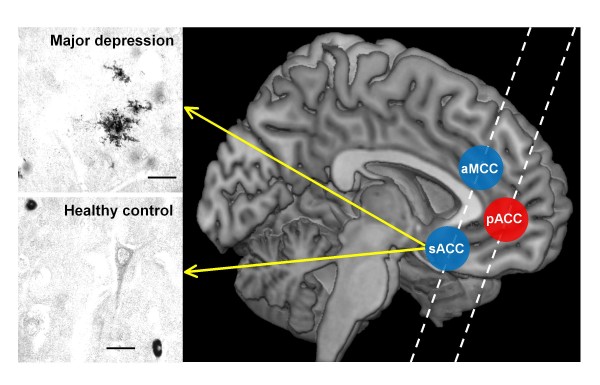
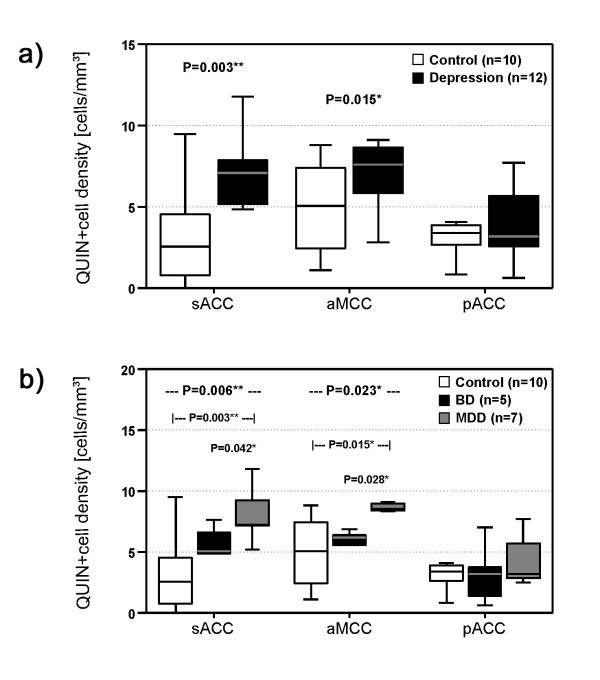
BACKGROUND: Immune dysfunction, including monocytosis and increased blood levels of interleukin-1, interleukin-6 and tumour necrosis factor α has been observed during acute episodes of major depression. These peripheral immune processes may be accompanied by microglial activation in subregions of the anterior cingulate cortex where depression-associated alterations of glutamatergic neurotransmission have been described. METHODS: Microglial immunoreactivity of the N-methyl-D-aspartate (NMDA) glutamate receptor agonist quinolinic acid (QUIN) in the subgenual anterior cingulate cortex (sACC), anterior midcingulate cortex (aMCC) and pregenual anterior cingulate cortex (pACC) of 12 acutely depressed suicidal patients (major depressive disorder/MDD, n = 7; bipolar disorder/BD, n = 5) was analyzed using immunohistochemistry and compared with its expression in 10 healthy control subjects. RESULTS: Depressed patients had a significantly increased density of QUIN-positive cells in the sACC (P = 0.003) and the aMCC (P = 0.015) compared to controls. In contrast, counts of QUIN-positive cells in the pACC did not differ between the groups (P = 0.558). Post-hoc tests showed that significant findings were attributed to MDD and were absent in BD. CONCLUSIONS: These results add a novel link to the immune hypothesis of depression by providing evidence for an upregulation of microglial QUIN in brain regions known to be responsive to infusion of NMDA antagonists such as ketamine. Further work in this area could lead to a greater understanding of the pathophysiology of depressive disorders and pave the way for novel NMDA receptor therapies or immune-modulating strategies.
Overview
The claims and statistics of this paper haven’t been checked yet.
Free: it reads the open-access text and checks the first 5 claims that cite a source we can check. Create a free account to check every claim.
Integrity signals
Registry
Cites
Statistics
Figures
Verification
Claims the paper makes
The claims and statistics of this paper haven’t been checked yet.
Free: it reads the open-access text and checks the first 5 claims that cite a source we can check. Create a free account to check every claim.
Claims other papers make about this one
Each is checked against this paper’s own text: does it say what the citing paper says it does?
The cited source says what the claim attributes to it.
In the citing paper
“Of note, increased levels of quinolinic acid have been found in microglia in the ACC of suicide victims who suffered from depression77.”
From The role of inflammation in depression: from evolutionary imperative to modern treatment target (2016) · cites this paper as [77]
In the citing paper
“Studies have revealed microglial activation in depressed patients, with a greater magnitude of activation in individuals who completed suicide (181–183)”
From Microglia Function in the Central Nervous System During Health and Neurodegeneration (2017) · cites this paper as [182]
In the citing paper
“Substances not measured in the present study are neurotoxic kynurenine-pathway metabolites such as 3-hydroxykynurenine and quinolinic acid that have been suggested to be important for further understanding of imbalance of tryptophan-kynurenine pathway in MDD (Dantzer et al., 2011;Halaris et al., 2015;Steiner et al., 2011).”
From Tryptophan-kynurenine and lipid related metabolites as blood biomarkers for first-episode drug-naïve patients with major depressive disorder: An exploratory pilot case-control study (2018) · cites this paper as Steiner et al., 2011
Self-check
Percentages, sums and reported differences re-computed from the paper’s own numbers.
The self-check needs the paper’s full text.
Citations
Cites
From inflammation to sickness and depression: when the immune system subjugates the brain
Dantzer, R., O'Connor, J. C., Freund, G. G., Johnson, R. W., & Kelley, K. W. (2008) · Nature Reviews Neuroscience · doi:10.1038/nrn2297 · Cited by 7,395 · cited 6×
“Increased levels of QUIN, which is also produced by macrophages and monocytes, have already been found in the blood and cerebrospinal fluid of subjects with cytokine-induced depression or MDD [1,21,22].”
BackgroundInfluentialInflammation and Its Discontents: The Role of Cytokines in the Pathophysiology of Major Depression
Miller, A. H., Maletic, V., & Raison, C. L. (2009) · Biological Psychiatry · doi:10.1016/j.biopsych.2008.11.029 · Cited by 3,848 · cited 2×
“Thus, our result of increased microglial QUIN expression in suicidal MDD patients is in line with the hypothesis of a systemic MPS activation during acute disease phases of depression [2-9,14].”
BackgroundResultA randomized trial of an N-methyl-D-aspartate antagonist in treatment-resistant major depression.
Zarate, C. A., Singh, J. B., Carlson, P. J., Brutsche, N. E., Ameli, R., Luckenbaugh, D. A., Charney, D. S., & Manji, H. K. (2006) · Archives of General Psychiatry · doi:10.1001/archpsyc.63.8.856 · Cited by 3,766
Jeurgen, K., Assheuer, J., & Paxinos, G. (1997) · Medical Entomology and Zoology · Cited by 1,403
Targeting abnormal neural circuits in mood and anxiety disorders: from the laboratory to the clinic
Ressler, K. J., & Mayberg, H. S. (2007) · Nature Neuroscience · doi:10.1038/nn1944 · Cited by 1,007 · cited 1×
“Importantly, the metabolic activity after deep brain stimulation in the sACC, as measured by positron emission tomography, shows a reduction in hyperactivity similar to a region bordering the aMCC and the pACC [53].”
MethodThe Relationship of Depression and Stressors to Immunological Assays: A Meta-Analytic Review
Zorrilla, E. P., Luborsky, L., McKay, J. R., Rosenthal, R., Houldin, A., Tax, A., McCorkle, R., Seligman, D. A., & Schmidt, K. (2001) · Brain, Behavior, and Immunity · doi:10.1006/brbi.2000.0597 · Cited by 995 · cited 2×
“Thus, our result of increased microglial QUIN expression in suicidal MDD patients is in line with the hypothesis of a systemic MPS activation during acute disease phases of depression [2-9,14].”
BackgroundResultDiazgranados, N., Ibrahim, L., Brutsche, N. E., Newberg, A., Kronstein, P., Khalife, S., Kammerer, W. A., Quezado, Z., Luckenbaugh, D. A., Salvadore, G., et al. (2010) · Archives of General Psychiatry · doi:10.1001/archgenpsychiatry.2010.90 · Cited by 963
Targeting the glutamatergic system to develop novel, improved therapeutics for mood disorders
Sanacora, G., Zarate, C. A., Krystal, J. H., & Manji, H. K. (2008) · Nature Reviews Drug Discovery · doi:10.1038/nrd2462 · Cited by 894
Steiner, J., Bielau, H., Brisch, R., Danos, P., Ullrich, O., Mawrin, C., Bernstein, H.-G., & Bogerts, B. (2008) · Journal of Psychiatric Research · doi:10.1016/j.jpsychires.2006.10.013 · Cited by 791 · cited 3×
“Indeed, an increased density of microglia expressing human leukocyte antigen (HLA)-DR has recently been observed in the anterior midcingulate cortex (aMCC), the dorsolateral prefrontal cortex and the mediodorsal thalamus of suicidal patients with affective disorders [14].”
BackgroundMethodResultSelf-citationThe neurobiology of psychedelic drugs: implications for the treatment of mood disorders
Vollenweider, F. X., & Kometer, M. (2010) · Nature Reviews Neuroscience · doi:10.1038/nrn2884 · Cited by 723 · cited 3×
“Here we present the first study providing evidence that supports a disease-related upregulation of microglial QUIN in depressive disorders, particularly in brain regions known to be responsive to infusion of NMDA antagonists such as ketamine [55].”
BackgroundInfluentialHsu, S. M., & Soban, E. (1982) · Journal of Histochemistry & Cytochemistry · doi:10.1177/30.10.6182185 · Cited by 659 · cited 1×
“Chromogen 3,3’-diaminobenzidine (DAB) and ammonium nickel sulfate were used to visualize the reaction product [36].”
MethodRaison, C. L., Dantzer, R., Kelley, K. W., Lawson, M. A., Woolwine, B. J., Vogt, G., Spivey, J. R., Saito, K., & Miller, A. H. (2010) · Molecular Psychiatry · doi:10.1038/mp.2009.116 · Cited by 630 · cited 2×
“Increased levels of QUIN, which is also produced by macrophages and monocytes, have already been found in the blood and cerebrospinal fluid of subjects with cytokine-induced depression or MDD [1,21,22].”
BackgroundPrice, R. B., Nock, M. K., Charney, D. S., & Mathew, S. J. (2009) · Biological Psychiatry · doi:10.1016/j.biopsych.2009.04.029 · Cited by 600
Auer, D. P., Pütz, B., Kraft, E., Lipinski, B., Schill, J., & Holsboer, F. (2000) · Biological Psychiatry · doi:10.1016/s0006-3223(99)00159-6 · Cited by 564 · cited 1×
“[48] found a reduced deactivation during a task study, reflected in smaller negative BOLD responses in a sample of severely depressed patients; this functional deficit was accompanied by decreased pACC glutamate and glutamine levels, which are correlated with the severity of clinical depressive symptoms [49-51].”
BackgroundKynurenine pathway metabolism in human astrocytes: a paradox for neuronal protection
Guillemin, G. J., Kerr, S. J., Smythe, G. A., Smith, D. G., Kapoor, V., Armati, P. J., Croitoru, J., & Brew, B. J. (2001) · Journal of Neurochemistry · doi:10.1046/j.1471-4159.2001.00498.x · Cited by 538 · cited 2×
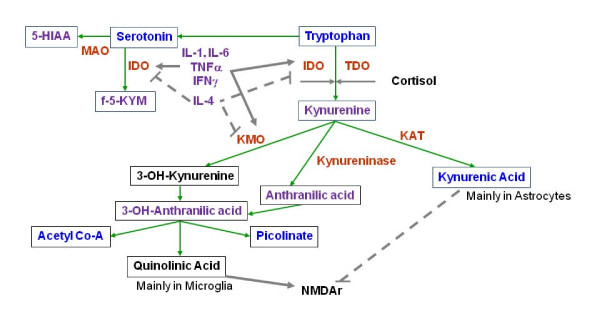
“MPS cells, such as microglia, macrophages and monocytes, mainly produce the NMDA receptor agonist QUIN, while astrocytes synthesize the NMDA receptor antagonist kynurenic acid (KYNA) because they lack the enzyme kynurenine monoxygenase (KMO) [18-20].”
BackgroundSelf-citationKynurenine pathway in major depression: Evidence of impaired neuroprotection
Myint, A.-M., Kim, Y. K., Verkerk, R., Scharpé, S., Steinbusch, H., & Leonard, B. (2007) · Journal of Affective Disorders · doi:10.1016/j.jad.2006.07.013 · Cited by 527
Self-citationGuillemin, G. J., Smythe, G., Takikawa, O., & Brew, B. J. (2005) · Glia · doi:10.1002/glia.20090 · Cited by 497 · cited 2×
“MPS cells, such as microglia, macrophages and monocytes, mainly produce the NMDA receptor agonist QUIN, while astrocytes synthesize the NMDA receptor antagonist kynurenic acid (KYNA) because they lack the enzyme kynurenine monoxygenase (KMO) [18-20].”
BackgroundSelf-citationKynurenic acid levels are elevated in the cerebrospinal fluid of patients with schizophrenia
Erhardt, S., Blennow, K., Nordin, C., Skogh, E., Lindström, L. H., & Engberg, G. (2001) · Neuroscience Letters · doi:10.1016/s0304-3940(01)02242-x · Cited by 471
Levkovitz, Y., Mendlovich, S., Riwkes, S., Braw, Y., Levkovitch-Verbin, H., Gal, G., Fennig, S., Treves, I., & Kron, S. (2010) · The Journal of Clinical Psychiatry · doi:10.4088/jcp.08m04666yel · Cited by 387 · cited 1×
“Potential candidate drugs include the tetracycline antibiotic minocycline, which inhibits microglial activation by blocking NF-kappa B nuclear translocation [39-42] or antiinflammatory inhibitors of cyclooxygenase-2 [43,44].”
BackgroundCytokine–serotonin interaction through IDO: a neurodegeneration hypothesis of depression
Myint, A. M., & Kim, Y. K. (2003) · Medical Hypotheses · doi:10.1016/s0306-9877(03)00207-x · Cited by 374 · cited 3×
“These results add a novel link to the immune [1,26] and neurodegeneration [15] hypotheses of depression.”
BackgroundResultSelf-citationTh1, Th2, and Th3 cytokine alterations in major depression
MYINT, A., LEONARD, B., STEINBUSCH, H., & KIM, Y. (2005) · Journal of Affective Disorders · doi:10.1016/j.jad.2005.07.008 · Cited by 371
Self-citationReceptor architecture of human cingulate cortex: Evaluation of the four‐region neurobiological model
Palomero‐Gallagher, N., Vogt, B. A., Schleicher, A., Mayberg, H. S., & Zilles, K. (2009) · Human Brain Mapping · doi:10.1002/hbm.20667 · Cited by 348
Padmos, R. C., Hillegers, M. H. J., Knijff, E. M., Vonk, R., Bouvy, A., Staal, F. J. T., de Ridder, D., Kupka, R. W., Nolen, W. A., & Drexhage, H. A. (2008) · Archives of General Psychiatry · doi:10.1001/archpsyc.65.4.395 · Cited by 336 · cited 2×
“Thus, our result of increased microglial QUIN expression in suicidal MDD patients is in line with the hypothesis of a systemic MPS activation during acute disease phases of depression [2-9,14].”
BackgroundResultIncreased Levels of Kynurenine and Kynurenic Acid in the CSF of Patients With Schizophrenia
Linderholm, K. R., Skogh, E., Olsson, S. K., Dahl, M.-L., Holtze, M., Engberg, G., Samuelsson, M., & Erhardt, S. (2012) · Schizophrenia Bulletin · doi:10.1093/schbul/sbq086 · Cited by 325
Walter, M., Henning, A., Grimm, S., Schulte, R. F., Beck, J., Dydak, U., Schnepf, B., Boeker, H., Boesiger, P., & Northoff, G. (2009) · Archives of General Psychiatry · doi:10.1001/archgenpsychiatry.2009.39 · Cited by 306
Self-citationRowland, L. M., Bustillo, J. R., Mullins, P. G., Jung, R. E., Lenroot, R., Landgraf, E., Barrow, R., Yeo, R., Lauriello, J., & Brooks, W. M. (2005) · American Journal of Psychiatry · doi:10.1176/appi.ajp.162.2.394 · Cited by 304 · cited 1×
“The importance of the pregenual anterior cingulate cortex (pACC) in MDD is supported by the pronounced effects of the glutamate modulating NMDA antagonist ketamine on the improvement of clinical symptoms in treatment-resistant MDD patients [28], in which ketamine leads to an increase in glutamate concentration precise…”
BackgroundAKHONDZADEH, S., TABATABAEE, M., AMINI, H., AHMADIABHARI, S., ABBASI, S., & BEHNAM, B. (2007) · Schizophrenia Research · doi:10.1016/j.schres.2006.11.016 · Cited by 289
Horn (2010) · Frontiers in Systems Neuroscience · doi:10.3389/fnsys.2010.00033 · Cited by 276
Bollini, P., Pampaliona, S., Tibaldi, G., Kupelnick, B., & Munizza, C. (1999) · British Journal of Psychiatry · doi:10.1192/bjp.174.4.297 · Cited by 274
Drexhage, R. C., Knijff, E. M., Padmos, R. C., Heul-Nieuwenhuijzen, L. V. D., Beumer, W., Versnel, M. A., & Drexhage, H. A. (2010) · Expert Review of Neurotherapeutics · doi:10.1586/ern.09.144 · Cited by 263 · cited 7×
“An upregulated production of QUIN by microglia in regions with specific susceptibility to abnormal NMDA throughput would support the hypothesis of an upregulated MPS, and would close the gap between neurochemical imbalances and regional as well as functional in vivo imaging findings in depression.”
BackgroundResultInfluentialElevated levels of kynurenic acid in the cerebrospinal fluid of male patients with schizophrenia
Nilsson, L. K., Linderholm, K. R., Engberg, G., Paulson, L., Blennow, K., Lindström, L. H., Nordin, C., Karanti, A., Persson, P., & Erhardt, S. (2005) · Schizophrenia Research · doi:10.1016/j.schres.2005.07.013 · Cited by 238
Distribution of HLA-DR-positive microglia in schizophrenia reflects impaired cerebral lateralization
Steiner, J., Mawrin, C., Ziegeler, A., Bielau, H., Ullrich, O., Bernstein, H.-G., & Bogerts, B. (2006) · Acta Neuropathologica · doi:10.1007/s00401-006-0090-8 · Cited by 229 · cited 1×
“Tissue preparation was performed as described previously [14,34].”
MethodSelf-citationSalvadore, G., Cornwell, B. R., Sambataro, F., Latov, D., Colon-Rosario, V., Carver, F., Holroyd, T., DiazGranados, N., Machado-Vieira, R., Grillon, C., et al. (2010) · Neuropsychopharmacology · doi:10.1038/npp.2010.24 · Cited by 218 · cited 1×
“[54], activity bordering the pACC does indeed predict the responsiveness towards ketamine treatment; therefore, our finding may represent a histopathological surrogate.”
BackgroundConnor, T. J., Starr, N., O'Sullivan, J. B., & Harkin, A. (2008) · Neuroscience Letters · doi:10.1016/j.neulet.2008.06.007 · Cited by 215
REY, M.-J., SCHULZ, P., COSTA, C., DICK, P., & TISSOT, R. (1989) · International Clinical Psychopharmacology · doi:10.1097/00004850-198904000-00001 · Cited by 190 · cited 1×
“As summarized in Table 2 the mean daily doses of psychotropic medication taken by patients during the last 90 lifetime days were established according to the clinical files [31-33].”
MethodLeukocytosis, monocytosis and neutrophilia: Hallmarks of severe depression
Maes, M., Van Der Planken, M., Stevens, W. J., Peeters, D., DeClerck, L. S., Bridts, C. H., Schotte, C., & Cosyns, P. (1992) · Journal of Psychiatric Research · doi:10.1016/0022-3956(92)90004-8 · Cited by 186
Kaestner, F., Hettich, M., Peters, M., Sibrowski, W., Hetzel, G., Ponath, G., Arolt, V., Cassens, U., & Rothermundt, M. (2005) · Journal of Affective Disorders · doi:10.1016/j.jad.2005.03.012 · Cited by 176 · cited 2×
“Thus, our result of increased microglial QUIN expression in suicidal MDD patients is in line with the hypothesis of a systemic MPS activation during acute disease phases of depression [2-9,14].”
BackgroundResultSteiner, J., Bogerts, B., Sarnyai, Z., Walter, M., Gos, T., Bernstein, H.-G., & Myint, A.-M. (2012) · The World Journal of Biological Psychiatry · doi:10.3109/15622975.2011.583941 · Cited by 160 · cited 8×
“An upregulated production of QUIN by microglia in regions with specific susceptibility to abnormal NMDA throughput would support the hypothesis of an upregulated MPS, and would close the gap between neurochemical imbalances and regional as well as functional in vivo imaging findings in depression.”
BackgroundInfluentialSelf-citationRosenberg, D. R., MacMaster, F. P., Mirza, Y., Smith, J. M., Easter, P. C., Banerjee, S. P., Bhandari, R. P., Boyd, C. C., Lynch, M. A., Rose, M., et al. (2005) · Biological Psychiatry · doi:10.1016/j.biopsych.2005.05.007 · Cited by 150 · cited 1×
“[48] found a reduced deactivation during a task study, reflected in smaller negative BOLD responses in a sample of severely depressed patients; this functional deficit was accompanied by decreased pACC glutamate and glutamine levels, which are correlated with the severity of clinical depressive symptoms [49-51].”
BackgroundInvolvement of quinolinic acid in aids dementia complex
Guillemin, G. J., Kerr, S. J., & Brew, B. J. (2005) · Neurotoxicity Research · doi:10.1007/bf03033781 · Cited by 145 · cited 1×
“in human tissue [38].”
Self-citationMajor depressive disorder is associated with elevated monocyte counts
Seidel, A., Arolt, V., Hunstiger, M., Rink, L., Behnisch, A., & Kirchner, H. (1996) · Acta Psychiatrica Scandinavica · doi:10.1111/j.1600-0447.1996.tb09849.x · Cited by 123 · cited 2×
“Thus, our result of increased microglial QUIN expression in suicidal MDD patients is in line with the hypothesis of a systemic MPS activation during acute disease phases of depression [2-9,14].”
BackgroundResultCOX-2 inhibitors as antidepressants and antipsychotics: clinical evidence.
Müller, N. (2010) · PubMed · Cited by 122
Laugeray, A., Launay, J., Callebert, J., Surget, A., Belzung, C., & Barone, P. R. (2010) · Behavioural Brain Research · doi:10.1016/j.bbr.2010.02.014 · Cited by 120
Reduced negative BOLD responses in the default-mode network and increased self-focus in depression
Grimm, S., Ernst, J., Boesiger, P., Schuepbach, D., Boeker, H., & Northoff, G. (2011) · The World Journal of Biological Psychiatry · doi:10.3109/15622975.2010.545145 · Cited by 120 · cited 1×
“[48] found a reduced deactivation during a task study, reflected in smaller negative BOLD responses in a sample of severely depressed patients; this functional deficit was accompanied by decreased pACC glutamate and glutamine levels, which are correlated with the severity of clinical depressive symptoms [49-51].”
BackgroundDoes minocycline have antidepressant effect?
Pae, C., Marks, D. M., Han, C., & Patkar, A. A. (2008) · Biomedicine & Pharmacotherapy · doi:10.1016/j.biopha.2007.12.005 · Cited by 117 · cited 1×
“Potential candidate drugs include the tetracycline antibiotic minocycline, which inhibits microglial activation by blocking NF-kappa B nuclear translocation [39-42] or antiinflammatory inhibitors of cyclooxygenase-2 [43,44].”
BackgroundAntidepressant-like actions of minocycline combined with several glutamate antagonists
Molina-Hernández, M., Téllez-Alcántara, N. P., Pérez-García, J., Olivera-Lopez, J. I., & Jaramillo, M. T. (2007) · Progress in Neuro-Psychopharmacology and Biological Psychiatry · doi:10.1016/j.pnpbp.2007.09.004 · Cited by 114 · cited 1×
“Potential candidate drugs include the tetracycline antibiotic minocycline, which inhibits microglial activation by blocking NF-kappa B nuclear translocation [39-42] or antiinflammatory inhibitors of cyclooxygenase-2 [43,44].”
BackgroundLow natural killer cytotoxicity in major depression
Irwin, M. R., Smith, T. L., & Gillin, J. C. (1987) · Life Sciences · doi:10.1016/0024-3205(87)90531-5 · Cited by 112 · cited 1×
“lymphocyte and natural killer cell abnormalities have been described [10-12].”
BackgroundPossible antipsychotic effects of minocycline in patients with schizophrenia
Miyaoka, T., Yasukawa, R., YASUDA, H., Hayashida, M., Inagaki, T., & Horiguchi, J. (2006) · Progress in Neuro-Psychopharmacology and Biological Psychiatry · doi:10.1016/j.pnpbp.2006.08.013 · Cited by 111 · cited 1×
“Potential candidate drugs include the tetracycline antibiotic minocycline, which inhibits microglial activation by blocking NF-kappa B nuclear translocation [39-42] or antiinflammatory inhibitors of cyclooxygenase-2 [43,44].”
BackgroundGuillemin, G. J., Smith, D. G., Kerr, S. J., Smythe, G. A., Kapoor, V., Armati, P. J., & Brew, B. J. (2000) · Redox Report · doi:10.1179/135100000101535375 · Cited by 108
Self-citationHU, B., HISSONG, B. D., & CARLIN, J. M. (1995) · Journal of Interferon & Cytokine Research · doi:10.1089/jir.1995.15.617 · Cited by 80
Sedative/Hypnotic Dependence: Patient Stabilization, Tolerance Testing, and Withdrawal
Perry, P. J., & Alexander, B. (1986) · Drug Intelligence & Clinical Pharmacy · doi:10.1177/106002808602000702 · Cited by 41 · cited 1×
“As summarized in Table 2 the mean daily doses of psychotropic medication taken by patients during the last 90 lifetime days were established according to the clinical files [31-33].”
MethodMaes, M., Lambrechts, J., Suy, E., Vandervorst, C., & Bosnians, E. (1994) · Neuropsychobiology · doi:10.1159/000119080 · Cited by 35 · cited 1×
“lymphocyte and natural killer cell abnormalities have been described [10-12].”
BackgroundDepression, hypothalamic-pituitary-adrenocortical activity, and lymphocyte function.
Kronfol, Z., & House, J. D. (1985) · PubMed · Cited by 34
Cited by
The role of inflammation in depression: from evolutionary imperative to modern treatment target
Miller, A. H., & Raison, C. L. (2016) · Nature Reviews Immunology · doi:10.1038/nri.2015.5 · Cited by 3,942
Microglia Function in the Central Nervous System During Health and Neurodegeneration
Colonna, M., & Butovsky, O. (2017) · Annual Review of Immunology · doi:10.1146/annurev-immunol-051116-052358 · Cited by 2,894
Kynurenines in the mammalian brain: when physiology meets pathology
Schwarcz, R., Bruno, J. P., Muchowski, P. J., & Wu, H.-Q. (2012) · Nature Reviews Neuroscience · doi:10.1038/nrn3257 · Cited by 1,530
Depression as a Microglial Disease
Yirmiya, R., Rimmerman, N., & Reshef, R. (2015) · Trends in Neurosciences · doi:10.1016/j.tins.2015.08.001 · Cited by 944
“This increase was particularly evident in the subgenual anterior cingulate gyrus and anterior mid-cingulate cortex, which contain a high density of NMDA receptors (which mediate QUIN signaling) [136].”
BackgroundSetiawan, E., Wilson, A. A., Mizrahi, R., Rusjan, P. M., Miler, L., Rajkowska, G., Suridjan, I., Kennedy, J. L., Rekkas, P. V., Houle, S., et al. (2015) · JAMA Psychiatry · doi:10.1001/jamapsychiatry.2014.2427 · Cited by 939
Metadata
- Authors
- Steiner, J., Walter, M., Gos, T., Guillemin, G. J., Bernstein, H.-G., Sarnyai, Z., Mawrin, C., Brisch, R., Bielau, H., zu Schwabedissen, L., Bogerts, B., & Myint, A.-M.
- Affiliations
- Otto-von-Guericke-Universität Magdeburg (DE)
- Gdańsk Medical University (PL)
- UNSW Sydney (AU)
- Ludwig-Maximilians-Universität München (DE)
- Venue
- Journal of Neuroinflammation
- Published
- 2011
- Volume
- 8
- Issue
- 1
- Pages
- 94
- ISSN
- 1742-2094 (ISSN-L)
- PMC
- PMC3177898
- OpenAlex
- W2146758523
- Cited by
- 568
- References
- 53
- Citations by year
- 2026: 20 · 2025: 18 · 2024: 36 · 2023: 27 · 2022: 58 · 2021: 42 · 2020: 42 · 2019: 48 · 2018: 49 · 2017: 44 · 2016: 43 · 2015: 53 · 2014: 35 · 2013: 27 · 2012: 24
- FWCI
- 8.07
- Type
- journal article
- Language
- en
- Open access
- gold
- doi.org
- Licence
- cc-by
- Locations
- Journal of Neuroinflammation (publishedVersion, cc-by)
- PubMed Central (publishedVersion, cc-by)
- PubMed (publishedVersion)
- Apollo (University of Cambridge) (submittedVersion, cc-by)
- DOAJ (DOAJ: Directory of Open Access Journals) (submittedVersion)
- Open access LMU (Ludwid Maxmilian's Universitat Munchen) (submittedVersion)
- Funders
- Deutsche Forschungsgemeinschaft (SFB 779)
- Topics
- Life Sciences › Neuroscience › Biological Psychiatry › Tryptophan and brain disorders
- Life Sciences › Neuroscience › Neurology › Neuroinflammation and Neurodegeneration Mechanisms
- Health Sciences › Medicine › Pharmacology (medical) › Treatment of Major Depression
- Keywords
- major depressive disorder, bipolar disorder, microglial activation, quinolinic acid, subgenual anterior cingulate cortex, anterior midcingulate cortex, pregenual anterior cingulate cortex, NMDA receptor, glutamatergic neurotransmission, neuroinflammation, suicidal depression, ketamine
- MeSH terms
- Adult, Aged, Major Depressive Disorder, Female, Gyrus Cinguli, Humans, Male, Middle Aged, Synaptic Transmission, Serotonin, Tryptophan, Quinolinic Acid, Microglia, Glutamic Acid
About these checks
Registry, retraction, Cites and statistics results are computed, not judged, with one exception: a printed reference that no index lists is read once by a model before it counts as a citation error. Claims are extracted by a model and kept only when their quote appears verbatim in the text; each cited source is then checked, with a model’s help, for whether it says what the claim relies on. Those verdicts can be wrong — read the claim’s quote and the cited source before relying on one.
Statistics and arithmetic are recomputed, not judged.
Confidence bands are shown only for fields calibrated on our annotated test set. None is calibrated yet, so no band is shown.
What counts as a claim ›How we measure confidence ›How we check this ›
Are you an author, or do you see a problem with this page? Request a review
Data sources
Bibliographic data: Semantic Scholar, OpenAlex, Crossref.
Contains information from the Semantic Scholar Academic Graph Datasets, made available under the ODC Attribution License (ODC-BY 1.0).
Semantic Scholar’s data is described in: Kinney, R., et al. (2023). The Semantic Scholar Open Data Platform. arXiv:2301.10140.
