

Severe depression is associated with increased microglial quinolinic acid in subregions of the anterior cingulate gyrus: Evidence for an immune-modulated glutamatergic neurotransmission?
Open accessThe DOI matches its Crossref record; 53 of the 53 references it cites were found in a registry or an index.
Abstract
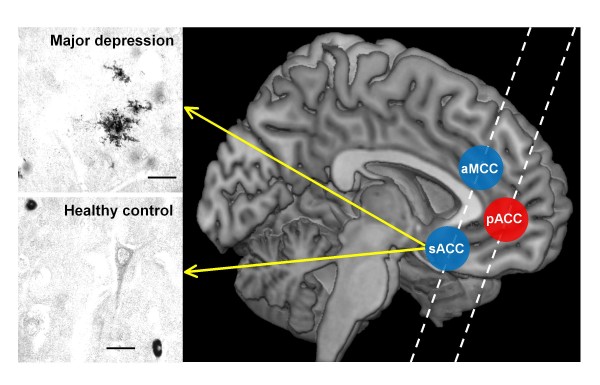
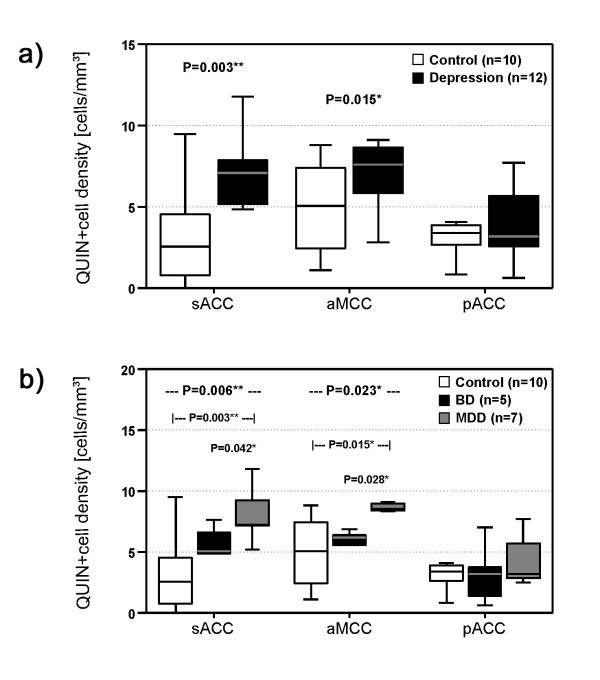
BACKGROUND: Immune dysfunction, including monocytosis and increased blood levels of interleukin-1, interleukin-6 and tumour necrosis factor α has been observed during acute episodes of major depression. These peripheral immune processes may be accompanied by microglial activation in subregions of the anterior cingulate cortex where depression-associated alterations of glutamatergic neurotransmission have been described. METHODS: Microglial immunoreactivity of the N-methyl-D-aspartate (NMDA) glutamate receptor agonist quinolinic acid (QUIN) in the subgenual anterior cingulate cortex (sACC), anterior midcingulate cortex (aMCC) and pregenual anterior cingulate cortex (pACC) of 12 acutely depressed suicidal patients (major depressive disorder/MDD, n = 7; bipolar disorder/BD, n = 5) was analyzed using immunohistochemistry and compared with its expression in 10 healthy control subjects. RESULTS: Depressed patients had a significantly increased density of QUIN-positive cells in the sACC (P = 0.003) and the aMCC (P = 0.015) compared to controls. In contrast, counts of QUIN-positive cells in the pACC did not differ between the groups (P = 0.558). Post-hoc tests showed that significant findings were attributed to MDD and were absent in BD. CONCLUSIONS: These results add a novel link to the immune hypothesis of depression by providing evidence for an upregulation of microglial QUIN in brain regions known to be responsive to infusion of NMDA antagonists such as ketamine. Further work in this area could lead to a greater understanding of the pathophysiology of depressive disorders and pave the way for novel NMDA receptor therapies or immune-modulating strategies.
Overview
The claims and statistics of this paper haven’t been checked yet.
Free: it reads the open-access text and checks the first 5 claims that cite a source we can check. Create a free account to check every claim.
Integrity signals
Registry
Cites
Statistics
Figures
Verification
Claims the paper makes
The claims and statistics of this paper haven’t been checked yet.
Free: it reads the open-access text and checks the first 5 claims that cite a source we can check. Create a free account to check every claim.
Claims other papers make about this one
Each is checked against this paper’s own text: does it say what the citing paper says it does?
The cited source says what the claim attributes to it.
In the citing paper
“Of note, increased levels of quinolinic acid have been found in microglia in the ACC of suicide victims who suffered from depression77.”
From The role of inflammation in depression: from evolutionary imperative to modern treatment target (2016) · cites this paper as [77]
In the citing paper
“Studies have revealed microglial activation in depressed patients, with a greater magnitude of activation in individuals who completed suicide (181–183)”
From Microglia Function in the Central Nervous System During Health and Neurodegeneration (2017) · cites this paper as [182]
In the citing paper
“Substances not measured in the present study are neurotoxic kynurenine-pathway metabolites such as 3-hydroxykynurenine and quinolinic acid that have been suggested to be important for further understanding of imbalance of tryptophan-kynurenine pathway in MDD (Dantzer et al., 2011;Halaris et al., 2015;Steiner et al., 2011).”
From Tryptophan-kynurenine and lipid related metabolites as blood biomarkers for first-episode drug-naïve patients with major depressive disorder: An exploratory pilot case-control study (2018) · cites this paper as Steiner et al., 2011
Self-check
Percentages, sums and reported differences re-computed from the paper’s own numbers.
The self-check needs the paper’s full text.
Citations
Cites
From inflammation to sickness and depression: when the immune system subjugates the brain
Dantzer, R., O'Connor, J. C., Freund, G. G., Johnson, R. W., & Kelley, K. W. (2008) · Nature Reviews Neuroscience · doi:10.1038/nrn2297 · Cited by 7,395 · cited 6×
“Increased levels of QUIN, which is also produced by macrophages and monocytes, have already been found in the blood and cerebrospinal fluid of subjects with cytokine-induced depression or MDD [1,21,22].”
BackgroundInfluentialInflammation and Its Discontents: The Role of Cytokines in the Pathophysiology of Major Depression
Miller, A. H., Maletic, V., & Raison, C. L. (2009) · Biological Psychiatry · doi:10.1016/j.biopsych.2008.11.029 · Cited by 3,848 · cited 2×
“Thus, our result of increased microglial QUIN expression in suicidal MDD patients is in line with the hypothesis of a systemic MPS activation during acute disease phases of depression [2-9,14].”
BackgroundResultA randomized trial of an N-methyl-D-aspartate antagonist in treatment-resistant major depression.
Zarate, C. A., Singh, J. B., Carlson, P. J., Brutsche, N. E., Ameli, R., Luckenbaugh, D. A., Charney, D. S., & Manji, H. K. (2006) · Archives of General Psychiatry · doi:10.1001/archpsyc.63.8.856 · Cited by 3,766
Jeurgen, K., Assheuer, J., & Paxinos, G. (1997) · Medical Entomology and Zoology · Cited by 1,403
Targeting abnormal neural circuits in mood and anxiety disorders: from the laboratory to the clinic
Ressler, K. J., & Mayberg, H. S. (2007) · Nature Neuroscience · doi:10.1038/nn1944 · Cited by 1,007 · cited 1×
“Importantly, the metabolic activity after deep brain stimulation in the sACC, as measured by positron emission tomography, shows a reduction in hyperactivity similar to a region bordering the aMCC and the pACC [53].”
MethodThe Relationship of Depression and Stressors to Immunological Assays: A Meta-Analytic Review
Zorrilla, E. P., Luborsky, L., McKay, J. R., Rosenthal, R., Houldin, A., Tax, A., McCorkle, R., Seligman, D. A., & Schmidt, K. (2001) · Brain, Behavior, and Immunity · doi:10.1006/brbi.2000.0597 · Cited by 995 · cited 2×
“Thus, our result of increased microglial QUIN expression in suicidal MDD patients is in line with the hypothesis of a systemic MPS activation during acute disease phases of depression [2-9,14].”
BackgroundResultDiazgranados, N., Ibrahim, L., Brutsche, N. E., Newberg, A., Kronstein, P., Khalife, S., Kammerer, W. A., Quezado, Z., Luckenbaugh, D. A., Salvadore, G., et al. (2010) · Archives of General Psychiatry · doi:10.1001/archgenpsychiatry.2010.90 · Cited by 963
Targeting the glutamatergic system to develop novel, improved therapeutics for mood disorders
Sanacora, G., Zarate, C. A., Krystal, J. H., & Manji, H. K. (2008) · Nature Reviews Drug Discovery · doi:10.1038/nrd2462 · Cited by 894
Steiner, J., Bielau, H., Brisch, R., Danos, P., Ullrich, O., Mawrin, C., Bernstein, H.-G., & Bogerts, B. (2008) · Journal of Psychiatric Research · doi:10.1016/j.jpsychires.2006.10.013 · Cited by 791 · cited 3×
“Indeed, an increased density of microglia expressing human leukocyte antigen (HLA)-DR has recently been observed in the anterior midcingulate cortex (aMCC), the dorsolateral prefrontal cortex and the mediodorsal thalamus of suicidal patients with affective disorders [14].”
BackgroundMethodResultSelf-citationThe neurobiology of psychedelic drugs: implications for the treatment of mood disorders
Vollenweider, F. X., & Kometer, M. (2010) · Nature Reviews Neuroscience · doi:10.1038/nrn2884 · Cited by 723 · cited 3×
“Here we present the first study providing evidence that supports a disease-related upregulation of microglial QUIN in depressive disorders, particularly in brain regions known to be responsive to infusion of NMDA antagonists such as ketamine [55].”
BackgroundInfluential
Cited by
The role of inflammation in depression: from evolutionary imperative to modern treatment target
Miller, A. H., & Raison, C. L. (2016) · Nature Reviews Immunology · doi:10.1038/nri.2015.5 · Cited by 3,942
Microglia Function in the Central Nervous System During Health and Neurodegeneration
Colonna, M., & Butovsky, O. (2017) · Annual Review of Immunology · doi:10.1146/annurev-immunol-051116-052358 · Cited by 2,894
Kynurenines in the mammalian brain: when physiology meets pathology
Schwarcz, R., Bruno, J. P., Muchowski, P. J., & Wu, H.-Q. (2012) · Nature Reviews Neuroscience · doi:10.1038/nrn3257 · Cited by 1,530
Depression as a Microglial Disease
Yirmiya, R., Rimmerman, N., & Reshef, R. (2015) · Trends in Neurosciences · doi:10.1016/j.tins.2015.08.001 · Cited by 944
“This increase was particularly evident in the subgenual anterior cingulate gyrus and anterior mid-cingulate cortex, which contain a high density of NMDA receptors (which mediate QUIN signaling) [136].”
BackgroundSetiawan, E., Wilson, A. A., Mizrahi, R., Rusjan, P. M., Miler, L., Rajkowska, G., Suridjan, I., Kennedy, J. L., Rekkas, P. V., Houle, S., et al. (2015) · JAMA Psychiatry · doi:10.1001/jamapsychiatry.2014.2427 · Cited by 939
The kynurenine pathway: a finger in every pie
Savitz, J. (2020) · Molecular Psychiatry · doi:10.1038/s41380-019-0414-4 · Cited by 756
Neuroinflammation and psychiatric illness
Najjar, S., Pearlman, D. M., Alper, K., Najjar, A., & Devinsky, O. (2013) · Journal of Neuroinflammation · doi:10.1186/1742-2094-10-43 · Cited by 733
“…[45,137] astroglial EAAT-mediated glutamate reuptake function; 2) proinflammatory cytokines can enhance microglial quinolinic acid synthesis [53], which has been experimentally shown to promote synaptosomal glutamate release [15,17,29,190]; 3) increased COX-2/PGE-2 and TNF-α levels can…”
InfluentialLopresti, A. L., Hood, S. D., & Drummond, P. D. (2013) · Journal of Affective Disorders · doi:10.1016/j.jad.2013.01.014 · Cited by 663
Depression and sickness behavior are Janus-faced responses to shared inflammatory pathways
Maes, M., Berk, M., Goehler, L., Song, C., Anderson, G., Gałecki, P., & Leonard, B. (2012) · BMC Medicine · doi:10.1186/1741-7015-10-66 · Cited by 629
“One study shows increased TRYCATs in adolescents with melancholic depression [110] and another study increased quinolinic acid in microglia of depressed suicide victims [111].”
BackgroundMicroglia in depression: an overview of microglia in the pathogenesis and treatment of depression
Wang, H., He, Y., Sun, Z., Ren, S., Liu, M., Wang, G., & Yang, J. (2022) · Journal of Neuroinflammation · doi:10.1186/s12974-022-02492-0 · Cited by 571
“Correspondingly, in an autopsy study of patients with MDD, the concentrations of quinolinic acid (QUIN) produced by microglia were increased in the subgenual ACC and anterior midcingulate cortex of suicide victims [49].”
BackgroundEnache, D., Pariante, C. M., & Mondelli, V. (2019) · Brain, Behavior, and Immunity · doi:10.1016/j.bbi.2019.06.015 · Cited by 615
Pathogenesis of depression: Insights from human and rodent studies
Ménard, C., Hodes, G. E., & Russo, S. J. (2016) · Neuroscience · doi:10.1016/j.neuroscience.2015.05.053 · Cited by 593
“Target Human studies Rat/mice studies Neuronal/synaptic remodeling BDNF Pezawas et al., 2004; Szesko et al., 2005; Bueller et al., 2006 Berton et al., 2006; Chen et al., 2006; Aznar et al., 2010; Magarinos et al., 2011 p11 Svenningsson et al., 2006; Su et al., 2009; Zhang et al., 2011a Svenningsson et al., 2006; Alexa…”
BackgroundInfluentialNeuroimmune mechanisms of depression
Hodes, G. E., Kana, V., Menard, C., Merad, M., & Russo, S. J. (2015) · Nature Neuroscience · doi:10.1038/nn.4113 · Cited by 585
Torres-Platas, S. G., Cruceanu, C., Chen, G. G., Turecki, G., & Mechawar, N. (2014) · Brain, Behavior, and Immunity · doi:10.1016/j.bbi.2014.05.007 · Cited by 545
“It would also be consistent with accumulating evidence of altered microglial activity and metabolism in major depression and suicide (Erhardt et al., 2013; Steiner et al., 2008, 2011).”
Inflammation in psychiatric disorders: what comes first?
Bauer, M. E., & Teixeira, A. L. (2019) · Annals of the New York Academy of Sciences · doi:10.1111/nyas.13712 · Cited by 500
Rudzki, L., Ostrowska, L., Pawlak, D., Małus, A., Pawlak, K., Waszkiewicz, N., & Szulc, A. (2019) · Psychoneuroendocrinology · doi:10.1016/j.psyneuen.2018.10.010 · Cited by 499
“Moreover, kynurenines are believed to play a significant role in the pathogenesis of major depressive disorder (Schwarcz et al., 2012; Steiner et al., 2011; Wichers et al., 2005).”
BackgroundInflammation Effects on Motivation and Motor Activity: Role of Dopamine
Felger, J. C., & Treadway, M. T. (2017) · Neuropsychopharmacology · doi:10.1038/npp.2016.143 · Cited by 442
“…macrophages to perivascular spaces, as well as localized activation of microglia neighboring theses blood vessels and increased expression of MCP-1, has been observed in the dorsal ACC of post-mortem tissue from suicide patients with mood disorders (Steiner et al, 2011; Torres-Platas et al, 2014).”
BackgroundImpact of endometriosis on quality of life and mental health:Pelvic pain makes the difference
Facchin, F., Barbara, G., Saita, E., Mosconi, P., Roberto, A., Fedele, L., & Vercellini, P. (2015) · Journal of Psychosomatic Obstetrics & Gynecology · doi:10.3109/0167482x.2015.1074173 · Cited by 468
“Medical research has demonstrated the link between inflammatory diseases and mood disorders [5,6].”
BackgroundImaging the Role of Inflammation in Mood and Anxiety-related Disorders
Felger, J. C. (2018) · Current Neuropharmacology · doi:10.2174/1570159x15666171123201142 · Cited by 427
“Furthermore, recruitment of activated peripheral macrophages to perivascular spaces, as well as localized activation of microglia neighboring theses blood vessels and increased expression of MCP-1, has been observed in the dorsal ACC of post mortem tissue from suicide patients with mood disorders [99, 100].”
BackgroundInflammation and depression: a causal or coincidental link to the pathophysiology?
Leonard, B. E. (2018) · Acta Neuropsychiatrica · doi:10.1017/neu.2016.69 · Cited by 409
Kynurenines in CNS disease: regulation by inflammatory cytokines.
Campbell, B. M., Charych, E., Lee, A. W., & Möller, T. (2014) · Frontiers in Neuroscience · doi:10.3389/fnins.2014.00012 · Cited by 409
“QUIN is elevated in the anterior cingulate cortex of depressed patients, but only in severely depressed individuals (Steiner et al., 2011).”
BackgroundAspirin: a review of its neurobiological properties and therapeutic potential for mental illness
Berk, M., Dean, O., Drexhage, H., McNeil, J. J., Moylan, S., O'Neil, A., Davey, C. G., Sanna, L., & Maes, M. (2013) · BMC Medicine · doi:10.1186/1741-7015-11-74 · Cited by 391
Quinolinic acid: an endogenous neurotoxin with multiple targets
Lugo-Huitrón, R., Ugalde Muñiz, P., Pineda, B., Pedraza-Chaverrí, J., Ríos, C., & Pérez-de la Cruz, V. (2013) · Oxidative Medicine and Cellular Longevity · doi:10.1155/2013/104024 · Cited by 394
Correia, A. S., & Vale, N. (2022) · International Journal of Molecular Sciences · doi:10.3390/ijms23158493 · Cited by 350
“Additionally, it was observed that increases in the levels of QA contribute to reduced levels of dopamine, choline, and γ-aminobutyric acid (GABA) [36], as well as disturbances in glutamatergic pathways, also known to be dysfunctional in depression [19,37].”
BackgroundNeuromodulation by the immune system: a focus on cytokines
Salvador, A. F., de Lima, K. A., & Kipnis, J. (2021) · Nature Reviews Immunology · doi:10.1038/s41577-021-00508-z · Cited by 389
NLRP3 inflammasome-driven pathways in depression: clinical and preclinical findings
Kaufmann, F. N., Costa, A. P., Ghisleni, G., Diaz, A. P., Rodrigues, A. L. S., Peluffo, H., & Kaster, M. P. (2017) · Brain, Behavior, and Immunity · doi:10.1016/j.bbi.2017.03.002 · Cited by 370
“…tissue from patients with MDD revealed that microglia exhibit a reactive morphology associated with higher quinolinic acid expression in the subgenual anterior cingulate cortex and the anterior midcingulate cortex, which are two areas involved in the pathophysiology of MDD (Steiner et al., 2011).”
InfluentialImmune targets for therapeutic development in depression: towards precision medicine
Drevets, W. C., Wittenberg, G. M., Bullmore, E. T., & Manji, H. K. (2022) · Nature Reviews Drug Discovery · doi:10.1038/s41573-021-00368-1 · Cited by 348
Beumer, W., Gibney, S. M., Drexhage, R. C., Pont-Lezica, L., Doorduin, J., Klein, H. C., Steiner, J., Connor, T. J., Harkin, A., Versnel, M. A., et al. (2012) · Journal of Leukocyte Biology · doi:10.1189/jlb.0212100 · Cited by 347
“[66] Laboratory for Experimental Psychiatry, Department of Psychiatry, University of Magdeburg Subregions of the anterior cingulate cortex (sACC, aMCC, pACC) Quinolinic acid immunoreactivity increased in microglial cells of sACC and aMCC of depressed patients compared with controls (particularly in MD but not in BD) T…”
BackgroundInfluentialSelf-citationHolmes, S. E., Hinz, R., Conen, S., Gregory, C. J., Matthews, J. C., Anton-Rodriguez, J. M., Gerhard, A., & Talbot, P. S. (2018) · Biological Psychiatry · doi:10.1016/j.biopsych.2017.08.005 · Cited by 346
“Postmortem studies find increased inflammatory markers in the ACC of depressed individuals (31-33), and levels of systemic cytokines are associated with increased activation in the ACC (17, 50, 51), suggesting that the ACC might be particularly sensitive to heightened peripheral inflammation and be central to inflamma…”
BackgroundMethodResultInfluentialConnecting inflammation with glutamate agonism in suicidality
Erhardt, S., Lim, C. K., Linderholm, K. R., Janelidze, S., Lindqvist, D., Samuelsson, M., Lundberg, K., Postolache, T. T., Träskman-Bendz, L., Guillemin, G. J., et al. (2013) · Neuropsychopharmacology · doi:10.1038/npp.2012.248 · Cited by 345
“…inflammation and subsequent stimulation of glutamate neurotransmission could potentially be prevalent in so-called treatment-resistant or severe depression; diagnostic groups where suicides, attempts and suicidal ideation all are common (Brent et al, 2009; Price et al, 2009; Steiner et al, 2011).”
BackgroundResultSelf-citationA Starring Role for Microglia in Brain Sex Differences
Lenz, K. M., & McCarthy, M. M. (2015) · The Neuroscientist · doi:10.1177/1073858414536468 · Cited by 342
Hikikomori : Multidimensional understanding, assessment, and future international perspectives
Kato, T. A., Kanba, S., & Teo, A. R. (2019) · Psychiatry and Clinical Neurosciences · doi:10.1111/pcn.12895 · Cited by 335
Microglia Control Neuronal Network Excitability via BDNF Signalling
Ferrini, F., & De Koninck, Y. (2013) · Neural Plasticity · doi:10.1155/2013/429815 · Cited by 318
“In this respect, a role has been described for cytokines [115], glycine [116], NMDA receptor agonists [117], adenosine [118], and ATP [119].”
Blood-brain barrier regulation in psychiatric disorders
Kealy, J., Greene, C., & Campbell, M. (2020) · Neuroscience Letters · doi:10.1016/j.neulet.2018.06.033 · Cited by 307
“microglial activation has been reported in the subgenual anterior cingulate cortex [189] further reinforcing the immune link to MDD.”
Bay-Richter, C., Linderholm, K. R., Lim, C. K., Samuelsson, M., Träskman-Bendz, L., Guillemin, G. J., Erhardt, S., & Brundin, L. (2015) · Brain, Behavior, and Immunity · doi:10.1016/j.bbi.2014.07.012 · Cited by 304
“Moreover, Steiner and colleagues provided evidence of an increased expression of QUIN-reactive microglia cells in the brains of depressed patients who died by suicide (Steiner et al., 2011).”
BackgroundSelf-citationWon, E., & Kim, Y.-K. (2016) · Current Neuropharmacology · doi:10.2174/1570159x14666151208113006 · Cited by 300
“Increased density of quinolinic acid positive cells of the anterior cingulate cortex, a brain area which has repeatedly been implicated in the pathology of MDD [96], has been reported in acutely depressed patients who have committed suicide [97].”
BackgroundMicroglial Dysregulation in Psychiatric Disease
Frick, L. R., Williams, K., & Pittenger, C. (2013) · Clinical and Developmental Immunology · doi:10.1155/2013/608654 · Cited by 299
Switching of the Microglial Activation Phenotype Is a Possible Treatment for Depression Disorder
Zhang, L., Zhang, J., & You, Z. (2018) · Frontiers in Cellular Neuroscience · doi:10.3389/fncel.2018.00306 · Cited by 280
“A single electroconvulsive stimulus (ECS), similar to electroconvulsive therapy used for severe depression in clinical practice, can significantly increase the number of newborn neurons that survive (Tang et al., 2016).”
Fenn, A. M., Gensel, J. C., Huang, Y., Popovich, P. G., Lifshitz, J., & Godbout, J. P. (2014) · Biological Psychiatry · doi:10.1016/j.biopsych.2013.10.014 · Cited by 283
“The underlying mechanism of these inflammatory-associated cognitive and depressive complications is likely reduced long-term potentiation and neuronal firing within the HPC (71–73) in conjunction with increased metabolism of tryptophan to the neuroactive excitotoxin, quinolinic acid (74,75).”
BackgroundKopschina Feltes, P., Doorduin, J., Klein, H. C., Juárez-Orozco, L. E., Dierckx, R. A., Moriguchi-Jeckel, C. M., & de Vries, E. F. (2017) · Journal of Psychopharmacology · doi:10.1177/0269881117711708 · Cited by 279
“Elevated pro-inflammatory cytokines and hypothalamic–pituitary–adrenal (HPA) dysfunction in major depressive disorder Numerous studies have indicated that MDD is accompanied by elevated levels of inflammatory biomarkers, such as the proinflammatory cytokines interleukin (IL)-1β, IL-6, IL-18, tumor necrosis factor alph…”
BackgroundInfluentialRapaport, M. H., Nierenberg, A. A., Schettler, P. J., Kinkead, B., Cardoos, A., Walker, R., & Mischoulon, D. (2016) · Molecular Psychiatry · doi:10.1038/mp.2015.22 · Cited by 265
The role of the innate immune system in psychiatric disorders
Jones, K. A., & Thomsen, C. (2013) · Molecular and Cellular Neuroscience · doi:10.1016/j.mcn.2012.10.002 · Cited by 274
“…in anterior cingulate gyrus support the glutamate hypothesis of depression since these brain regions are known to be responsive to infusion of NMDA antagonists such as ketaminewhich has rapid antidepressant effects in humans (Duman andVoleti, 2012; Steiner et al., 2011; Salvadore et al., 2010).”
Savitz, J., Drevets, W. C., Smith, C. M., Victor, T. A., Wurfel, B. E., Bellgowan, P. S., Bodurka, J., Teague, T. K., & Dantzer, R. (2015) · Neuropsychopharmacology · doi:10.1038/npp.2014.194 · Cited by 272
Lim, C. K., Bilgin, A., Lovejoy, D. B., Tan, V., Bustamante, S., Taylor, B. V., Bessede, A., Brew, B. J., & Guillemin, G. J. (2017) · Scientific Reports · doi:10.1038/srep41473 · Cited by 255
Self-citationRole of Inflammation in Suicide: From Mechanisms to Treatment
Brundin, L., Bryleva, E. Y., & Thirtamara Rajamani, K. (2017) · Neuropsychopharmacology · doi:10.1038/npp.2016.116 · Cited by 257
“Interestingly, a post-mortem study found increased QUIN immunoreactivity in suicidal depressed patients seemingly in agreement with our findings (Steiner et al , 2011).”
Hellwig, S., Brioschi, S., Dieni, S., Frings, L., Masuch, A., Blank, T., & Biber, K. (2016) · Brain, Behavior, and Immunity · doi:10.1016/j.bbi.2015.11.008 · Cited by 252
“Two post mortem studies provide evidence for morphological activation of microglia in patients with major depression (Bayer et al., 1999; Steiner et al., 2011).”
BackgroundChen, L.-M., Bao, C.-H., Wu, Y., Liang, S.-H., Wang, D., Wu, L.-Y., Huang, Y., Liu, H.-R., & Wu, H.-G. (2021) · Journal of Neuroinflammation · doi:10.1186/s12974-021-02175-2 · Cited by 227
“Another group of autopsy studies found that QUIN levels were higher in the anterior cingulate cortex and midbrain cortical microglia in patients who died by suicide from depression [125].”
ResultNajjar, S., Pearlman, D. M., Devinsky, O., Najjar, A., & Zagzag, D. (2013) · Journal of Neuroinflammation · doi:10.1186/1742-2094-10-142 · Cited by 248
The common inflammatory etiology of depression and cognitive impairment: a therapeutic target
Allison, D. J., & Ditor, D. S. (2014) · Journal of Neuroinflammation · doi:10.1186/s12974-014-0151-1 · Cited by 231
“Elevated levels of both QUIN and cortisol have been demonstrated in individuals with depression [43,44].”
BackgroundA Narrative Review of Cancer-Related Fatigue (CRF) and Its Possible Pathogenesis
Yang, S., Chu, S., Gao, Y., Ai, Q., Liu, Y., Li, X., & Chen, N. (2019) · Cells · doi:10.3390/cells8070738 · Cited by 225
Kynurenines: from the perspective of major psychiatric disorders
Myint, A. M. (2012) · The FEBS Journal · doi:10.1111/j.1742-4658.2012.08551.x · Cited by 229
Self-citationNetwork beyond IDO in psychiatric disorders: Revisiting neurodegeneration hypothesis
Myint, A.-M., & Kim, Y.-K. (2014) · Progress in Neuro-Psychopharmacology and Biological Psychiatry · doi:10.1016/j.pnpbp.2013.08.008 · Cited by 230
Self-citationThe role of the gut microbiota in dietary interventions for depression and anxiety
Bear, T. L. K., Dalziel, J. E., Coad, J., Roy, N. C., Butts, C. A., & Gopal, P. K. (2020) · Advances in Nutrition · doi:10.1093/advances/nmaa016 · Cited by 229
Immune-to-Brain Communication Pathways in Inflammation-Associated Sickness and Depression
D’Mello, C., & Swain, M. G. (2016) · Current Topics in Behavioral Neurosciences · doi:10.1007/7854_2016_37 · Cited by 208
Réus, G. Z., Jansen, K., Titus, S., Carvalho, A. F., Gabbay, V., & Quevedo, J. (2015) · Journal of Psychiatric Research · doi:10.1016/j.jpsychires.2015.05.007 · Cited by 221
“A uthor M anuscript A uthor M anuscript A uthor M anuscript A uthor M anuscript increased QUIN immunoreactivity in the prefrontal cortex of patients with MDD and bipolar depression (Steiner et al., 2011).”
BackgroundRole of microglial m1/m2 polarization in relapse and remission of psychiatric disorders and diseases
Nakagawa, Y., & Chiba, K. (2014) · Pharmaceuticals · doi:10.3390/ph7121028 · Cited by 215
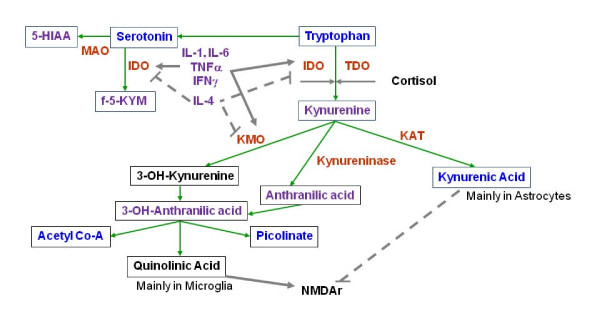
“IL-1β and IL-6 potentiate the metabolic pathways from tryptophan to kynurenic acid and quinolinic acid [67,68], suggesting that M1 microglia can decrease 5-HT production.”
BackgroundKoo, J., Marangell, L. B., Nakamura, M., Armstrong, A., Jeon, C., Bhutani, T., & Wu, J. J. (2017) · Journal of the European Academy of Dermatology and Venereology · doi:10.1111/jdv.14460 · Cited by 207
Antidepressant therapies inhibit inflammation and microglial M1-polarization
Kalkman, H. O., & Feuerbach, D. (2016) · Pharmacology & Therapeutics · doi:10.1016/j.pharmthera.2016.04.001 · Cited by 212
Microglia of Prefrontal White Matter in Suicide
Schnieder, T. P., Trencevska, I., Rosoklija, G., Stankov, A., Mann, J. J., Smiley, J., & Dwork, A. J. (2014) · Journal of Neuropathology & Experimental Neurology · doi:10.1097/nen.0000000000000107 · Cited by 202
“It is possible that serotonin levels are depleted by activated microglia that have enhanced metabolism of tryptophan to quinolinic acid via the kynurenine pathway (76).”
Immunomodulatory Effects Mediated by Serotonin
Arreola, R., Becerril-Villanueva, E., Cruz-Fuentes, C., Velasco-Velázquez, M. A., Garcés-Alvarez, M. E., Hurtado-Alvarado, G., Quintero-Fabian, S., & Pavón, L. (2015) · Journal of Immunology Research · doi:10.1155/2015/354957 · Cited by 186
“5-HT is generated from tryptophan and serves as a substrate for the synthesis of a diverse set of molecules, such as melatonin, formyl-5-hydroxykynurenamine, and 5-hydroxyindoleacetic acid [1].”
BackgroundBusse, S., Busse, M., Schiltz, K., Bielau, H., Gos, T., Brisch, R., Mawrin, C., Schmitt, A., Jordan, W., Müller, U. J., et al. (2012) · Brain, Behavior, and Immunity · doi:10.1016/j.bbi.2012.08.005 · Cited by 194
Self-citationSuicide and Microglia: Recent Findings and Future Perspectives Based on Human Studies
Suzuki, H., Ohgidani, M., Kuwano, N., Chrétien, F., Lorin de la Grandmaison, G., Onaya, M., Tominaga, I., Setoyama, D., Kang, D., Mimura, M., et al. (2019) · Frontiers in Cellular Neuroscience · doi:10.3389/fncel.2019.00031 · Cited by 198
Song, C., Shieh, C.-H., Wu, Y.-S., Kalueff, A., Gaikwad, S., & Su, K.-P. (2016) · Progress in Lipid Research · doi:10.1016/j.plipres.2015.12.003 · Cited by 187
Brundin, L., Sellgren, C. M., Lim, C. K., Grit, J., Pålsson, E., Landén, M., Samuelsson, M., Lundgren, K., Brundin, P., Fuchs, D., et al. (2016) · Translational Psychiatry · doi:10.1038/tp.2016.133 · Cited by 195
Self-citationOlloquequi, J., Cornejo-Córdova, E., Verdaguer, E., Soriano, F. X., Binvignat, O., Auladell, C., & Camins, A. (2018) · Journal of Psychopharmacology · doi:10.1177/0269881118754680 · Cited by 189
Novel therapeutic targets in depression: Minocycline as a candidate treatment
Soczynska, J. K., Mansur, R. B., Brietzke, E., Swardfager, W., Kennedy, S. H., Woldeyohannes, H. O., Powell, A. M., Manierka, M. S., & McIntyre, R. S. (2012) · Behavioural Brain Research · doi:10.1016/j.bbr.2012.07.026 · Cited by 189
Richards, E. M., Zanotti-Fregonara, P., Fujita, M., Newman, L., Farmer, C., Ballard, E. D., Machado-Vieira, R., Yuan, P., Niciu, M. J., Lyoo, C. H., et al. (2018) · EJNMMI Research · doi:10.1186/s13550-018-0401-9 · Cited by 180
“Increased microglial quinolinic acid immunoreactivity in specific subregions of the ACC further underscores the involvement of these regions and supports the role of the immune system in the pathophysiology of MDD [31].”
BackgroundMithaiwala, M. N., Santana-Coelho, D., Porter, G. A., & O’Connor, J. C. (2021) · Cells · doi:10.3390/cells10061548 · Cited by 190
Brain-derived neurotrophic factor and inflammation in depression: Pathogenic partners in crime?
Porter, G. A., & O’Connor, J. C. (2022) · World Journal of Psychiatry · doi:10.5498/wjp.v12.i1.77 · Cited by 178
Major Depression: One Brain, One Disease, One Set of Intertwined Processes
Filatova, E. V., Shadrina, M. I., & Slominsky, P. A. (2021) · Cells · doi:10.3390/cells10061283 · Cited by 160
How inflammation affects the brain in depression: a review of functional and structural MRI studies
Han, K.-M., & Ham, B.-J. (2021) · Journal of Clinical Neurology · doi:10.3988/jcn.2021.17.4.503 · Cited by 187
Central pathways causing fatigue in neuro-inflammatory and autoimmune illnesses
Morris, G., Berk, M., Walder, K., & Maes, M. (2015) · BMC Medicine · doi:10.1186/s12916-014-0259-2 · Cited by 181
“Chronic systemic inflammation and the presence of activated microglia are also found in patients with major depression [19-22].”
BackgroundRole of Adiposity-Driven Inflammation in Depressive Morbidity
Capuron, L., Lasselin, J., & Castanon, N. (2017) · Neuropsychopharmacology · doi:10.1038/npp.2016.123 · Cited by 182
“…neurotoxic metabolites are elevated in several neuropsychiatric or neurodegenerative diseases (Campbell et al, 2014; Schwarcz et al, 2001; Steiner et al, 2011; Stone et al, 2012) and have been related to the stretch of brain damages, impaired neurogenesis, and development of…”
BackgroundNeuroinflammation—A Crucial Factor in the Pathophysiology of Depression—A Comprehensive Review
Sălcudean, A., Bodo, C.-R., Popovici, R. A., Lica, M. M., Păcurar, M., Crăciun, R.-E., Crișan, A., ENĂTESCU, V. R., Marinescu, I. P., Cîmpian, D. M., et al. (2025) · Biomolecules · doi:10.3390/biom15040502 · Cited by 198
“The impact of neuroinflammation on neurotransmitter systems is further emphasized by the role of specific cytokines [130].”
The role of inflammation in suicidal behaviour
Brundin, L., Erhardt, S., Bryleva, E. Y., Achtyes, E. D., & Postolache, T. T. (2015) · Acta Psychiatrica Scandinavica · doi:10.1111/acps.12458 · Cited by 172
Meier, T. B., Drevets, W. C., Wurfel, B. E., Ford, B. N., Morris, H. M., Victor, T. A., Bodurka, J., Teague, T. K., Dantzer, R., & Savitz, J. (2016) · Brain, Behavior, and Immunity · doi:10.1016/j.bbi.2015.11.003 · Cited by 175
Muneer, A. (2020) · Clinical Psychopharmacology and Neuroscience · doi:10.9758/cpn.2020.18.4.507 · Cited by 159
The role of depressive subtypes within the neuroinflammation hypothesis of major depressive disorder
Woelfer, M., Kasties, V., Kahlfuss, S., & Walter, M. (2019) · Neuroscience · doi:10.1016/j.neuroscience.2018.03.034 · Cited by 171
Self-citationKynurenine pathway metabolites and suicidality
Bryleva, E. Y., & Brundin, L. (2017) · Neuropharmacology · doi:10.1016/j.neuropharm.2016.01.034 · Cited by 168
“…et al. reported an increase in density of QUIN-reactive microglia cells in some regions of anterior cingulate cortex (i.e. subgenual anterior cingulate cortex (sACC) and anterior midcingulate cortex (aMCC)) in postmortem brains of depressed patients who died by suicide (Steiner et al., 2011).”
Neurobiology of resilience in depression: immune and vascular insights from human and animal studies
Dudek, K. A., Dion‐Albert, L., Kaufmann, F. N., Tuck, E., Lebel, M., & Menard, C. (2021) · European Journal of Neuroscience · doi:10.1111/ejn.14547 · Cited by 151
“In parallel, postmortem analysis of brain tissue from depressed patients who committed suicide suggests an increase in microglia activation (Steiner et al. 2011; Steiner et al., 2006, 2008).”
BackgroundNeuropathology of mood disorders: Do we see the stigmata of inflammation?
Mechawar, N., & Savitz, J. (2016) · Translational Psychiatry · doi:10.1038/tp.2016.212 · Cited by 165
Westfall, S., Caracci, F., Zhao, D., Wu, Q.-L., Frolinger, T., Simon, J., & Pasinetti, G. M. (2021) · Brain, Behavior, and Immunity · doi:10.1016/j.bbi.2020.10.013 · Cited by 161
“Elevated QA occurs in both the serum and cerebral spinal fluid of patients with neurodegenerative and inflammatory disorders, including depression (Steiner et al., 2011; Savitz, 2017) and is strongly correlated to depressive suicidal victims (Brundin et al., 2016).”
BackgroundKim, Y., & Won, E. (2017) · Behavioural Brain Research · doi:10.1016/j.bbr.2017.04.020 · Cited by 168
Involvement of the kynurenine pathway in the pathogenesis of Parkinson's disease
Lim, C. K., Fernández-Gomez, F. J., Braidy, N., Estrada, C., Costa, C., Costa, S., Bessede, A., Fernandez-Villalba, E., Zinger, A., Herrero, M. T., et al. (2017) · Progress in Neurobiology · doi:10.1016/j.pneurobio.2015.12.009 · Cited by 159
“…2008), brain tumours (Adams et al., 2012; Adams et al., 2014), brain trauma (Saito et al., 1993), and neuropsychiatric disorders including depression (Steiner et al., 2011b), suicide (Bay-Richter et al., 2014), schizophrenia (Kegel et al., 2014; Muller et al., 2011), and autism (Essa et al., 2013).”
BackgroundSelf-citationHaapakoski, R., Ebmeier, K. P., Alenius, H., & Kivimäki, M. (2016) · Progress in Neuro-Psychopharmacology and Biological Psychiatry · doi:10.1016/j.pnpbp.2015.11.012 · Cited by 157
“positive cells (Steiner et al., 2011) increased glutamate (Hashimoto et al.”
BackgroundCorona, A. W., Norden, D. M., Skendelas, J. P., Huang, Y., O’Connor, J. C., Lawson, M., Dantzer, R., Kelley, K. W., & Godbout, J. P. (2013) · Brain, Behavior, and Immunity · doi:10.1016/j.bbi.2012.08.008 · Cited by 152
“Moreover, a recent study using post mortem immunohistochemical analysis showed increased QUIN positive microglia in the anterior cingulate gyrus of severely depressed and suicidal patients compared to controls (Steiner et al., 2011).”
BackgroundResultHaroon, E., Woolwine, B. J., Chen, X., Pace, T. W., Parekh, S., Spivey, J. R., Hu, X. P., & Miller, A. H. (2014) · Neuropsychopharmacology · doi:10.1038/npp.2014.25 · Cited by 154
“Interestingly, increased quinolinic acid immunoreactive cells have been found in the same ACC region sampled in the current study (Steiner et al, 2011).”
BackgroundMicroglial dysfunction connects depression and Alzheimer’s disease
Santos, L. E., Beckman, D., & Ferreira, S. T. (2016) · Brain, Behavior, and Immunity · doi:10.1016/j.bbi.2015.11.011 · Cited by 154
“Initially described in peripheral inflammation (Mårtensson and Nässberger, 1993; Roumestan et al., 2007), the anti-inflammatory actions of SSRIs are now known to extend to microglial function, inhibiting TNF-a and nitric oxide production (Su et al., 2015; Tynan et al., 2012; Zhang et al., 2012).”
BackgroundTherapeutic Implications of Brain–Immune Interactions: Treatment in Translation
Miller, A. H., Haroon, E., & Felger, J. C. (2017) · Neuropsychopharmacology · doi:10.1038/npp.2016.167 · Cited by 152
Stress induced microglial activation contributes to depression
Li, B., Yang, W., Ge, T., Wang, Y., & Cui, R. (2022) · Pharmacological Research · doi:10.1016/j.phrs.2022.106145 · Cited by 151
Lopresti, A. L., Hood, S. D., & Drummond, P. D. (2012) · Journal of Psychopharmacology · doi:10.1177/0269881112458732 · Cited by 151
“Excess QUIN levels were found in depression (Raison et al., 2010; Steiner et al., 2011) and in neurological conditions such as Alzheimer’s disease, Parkinson’s disease and multiple sclerosis (Zádori et al., 2009; Kincses et al., 2010).”
BackgroundEffects of Physical Exercise on Depressive Symptoms and Biomarkers in Depression
Archer, T., Josefsson, T., & Lindwall, M. (2015) · CNS & Neurological Disorders - Drug Targets · doi:10.2174/1871527313666141130203245 · Cited by 144
“Severe depression is associated with increased microglial quinolinic acid (QUIN) in regions of the anterior cingulate cortex (165).”
Herbert, J., & Lucassen, P. J. (2016) · Frontiers in Neuroendocrinology · doi:10.1016/j.yfrne.2015.12.001 · Cited by 150
“There is also uncertainty about whether treating depression with anti-depressant drugs reduces the risk of later AD (Kessing et al., 2011), though anti-depressants may lower IL6 (Strawbridge et al., 2015).”
BackgroundInfluentialArnone, D., Mumuni, A. N., Jauhar, S., Condon, B., & Cavanagh, J. (2015) · European Neuropsychopharmacology · doi:10.1016/j.euroneuro.2015.04.016 · Cited by 150
“Quinolinic acid is a NMDA receptor agonist that is potentially neurotoxic and has been associated with depression and increased suicidality (Dantzer and Walker, 2014)(Steiner et al., 2011)(Erhardt et al., 2013).”
BackgroundNeuroinflammation in suicide: Toward a comprehensive model
Courtet, P., Giner, L., Seneque, M., Guillaume, S., Olie, E., & Ducasse, D. (2016) · The World Journal of Biological Psychiatry · doi:10.3109/15622975.2015.1054879 · Cited by 146
Is there a role for glutamate-mediated excitotoxicity in inflammation-induced depression?
Dantzer, R., & Walker, A. K. (2014) · Journal of Neural Transmission · doi:10.1007/s00702-014-1187-1 · Cited by 136
Maternal separation induces neuroinflammation and long-lasting emotional alterations in mice
Gracia-Rubio, I., Moscoso-Castro, M., Pozo, O. J., Marcos, J., Nadal, R., & Valverde, O. (2016) · Progress in Neuro-Psychopharmacology and Biological Psychiatry · doi:10.1016/j.pnpbp.2015.09.003 · Cited by 144
Dionisie, V., Filip, G. A., Manea, M. C., Manea, M., & Riga, S. (2020) · Inflammopharmacology · doi:10.1007/s10787-020-00777-5 · Cited by 181
Li, H., Sagar, A. P., & Kéri, S. (2017) · Progress in Neuro-Psychopharmacology and Biological Psychiatry · doi:10.1016/j.pnpbp.2017.12.011 · Cited by 146
“Due to the inclusion of heterogeneous, small clinical samples, and other methodological limitations, post-mortem studies provided mixed results (Dean et al., 2010; Shelton et al., 2011; Steiner et al., 2011; Thomas et al., 2000).”
Metadata
- Authors
- Steiner, J., Walter, M., Gos, T., Guillemin, G. J., Bernstein, H.-G., Sarnyai, Z., Mawrin, C., Brisch, R., Bielau, H., zu Schwabedissen, L., Bogerts, B., & Myint, A.-M.
- Affiliations
- Otto-von-Guericke-Universität Magdeburg (DE)
- Gdańsk Medical University (PL)
- UNSW Sydney (AU)
- Ludwig-Maximilians-Universität München (DE)
- Venue
- Journal of Neuroinflammation
- Published
- 2011
- Volume
- 8
- Issue
- 1
- Pages
- 94
- ISSN
- 1742-2094 (ISSN-L)
- PMC
- PMC3177898
- OpenAlex
- W2146758523
- Cited by
- 568
- References
- 53
- Citations by year
- 2026: 20 · 2025: 18 · 2024: 36 · 2023: 27 · 2022: 58 · 2021: 42 · 2020: 42 · 2019: 48 · 2018: 49 · 2017: 44 · 2016: 43 · 2015: 53 · 2014: 35 · 2013: 27 · 2012: 24
- FWCI
- 8.07
- Type
- journal article
- Language
- en
- Open access
- gold
- doi.org
- Licence
- cc-by
- Locations
- Journal of Neuroinflammation (publishedVersion, cc-by)
- PubMed Central (publishedVersion, cc-by)
- PubMed (publishedVersion)
- Apollo (University of Cambridge) (submittedVersion, cc-by)
- DOAJ (DOAJ: Directory of Open Access Journals) (submittedVersion)
- Open access LMU (Ludwid Maxmilian's Universitat Munchen) (submittedVersion)
- Funders
- Deutsche Forschungsgemeinschaft (SFB 779)
- Topics
- Life Sciences › Neuroscience › Biological Psychiatry › Tryptophan and brain disorders
- Life Sciences › Neuroscience › Neurology › Neuroinflammation and Neurodegeneration Mechanisms
- Health Sciences › Medicine › Pharmacology (medical) › Treatment of Major Depression
- Keywords
- major depressive disorder, bipolar disorder, microglial activation, quinolinic acid, subgenual anterior cingulate cortex, anterior midcingulate cortex, pregenual anterior cingulate cortex, NMDA receptor, glutamatergic neurotransmission, neuroinflammation, suicidal depression, ketamine
- MeSH terms
- Adult, Aged, Major Depressive Disorder, Female, Gyrus Cinguli, Humans, Male, Middle Aged, Synaptic Transmission, Serotonin, Tryptophan, Quinolinic Acid, Microglia, Glutamic Acid
About these checks
Registry, retraction, Cites and statistics results are computed, not judged, with one exception: a printed reference that no index lists is read once by a model before it counts as a citation error. Claims are extracted by a model and kept only when their quote appears verbatim in the text; each cited source is then checked, with a model’s help, for whether it says what the claim relies on. Those verdicts can be wrong — read the claim’s quote and the cited source before relying on one.
Statistics and arithmetic are recomputed, not judged.
Confidence bands are shown only for fields calibrated on our annotated test set. None is calibrated yet, so no band is shown.
What counts as a claim ›How we measure confidence ›How we check this ›
Are you an author, or do you see a problem with this page? Request a review
Data sources
Bibliographic data: Semantic Scholar, OpenAlex, Crossref.
Contains information from the Semantic Scholar Academic Graph Datasets, made available under the ODC Attribution License (ODC-BY 1.0).
Semantic Scholar’s data is described in: Kinney, R., et al. (2023). The Semantic Scholar Open Data Platform. arXiv:2301.10140.
