

Systematic review of Kinect applications in elderly care and stroke rehabilitation
Open accessThe DOI matches its Crossref record; 117 of the 117 references it cites were found in a registry or an index.
Abstract
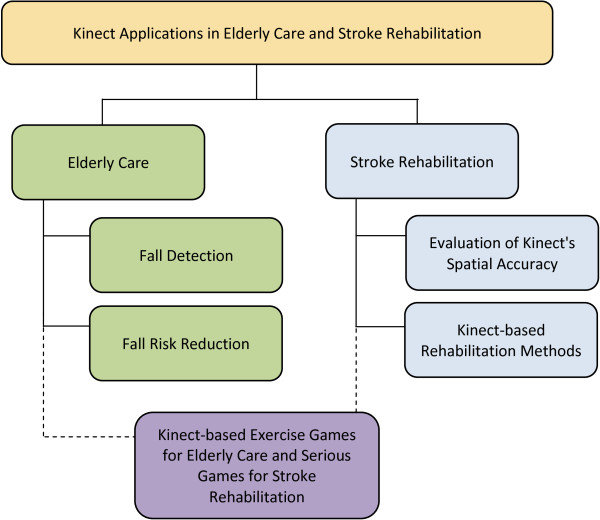
In this paper we present a review of the most current avenues of research into Kinect-based elderly care and stroke rehabilitation systems to provide an overview of the state of the art, limitations, and issues of concern as well as suggestions for future work in this direction. The central purpose of this review was to collect all relevant study information into one place in order to support and guide current research as well as inform researchers planning to embark on similar studies or applications. The paper is structured into three main sections, each one presenting a review of the literature for a specific topic. Elderly Care section is comprised of two subsections: Fall detection and Fall risk reduction. Stroke Rehabilitation section contains studies grouped under Evaluation of Kinect's spatial accuracy, and Kinect-based rehabilitation methods. The third section, Serious and exercise games, contains studies that are indirectly related to the first two sections and present a complete system for elderly care or stroke rehabilitation in a Kinect-based game format. Each of the three main sections conclude with a discussion of limitations of Kinect in its respective applications. The paper concludes with overall remarks regarding use of Kinect in elderly care and stroke rehabilitation applications and suggestions for future work. A concise summary with significant findings and subject demographics (when applicable) of each study included in the review is also provided in table format.
Overview
The claims and statistics of this paper haven’t been checked yet.
Free: it reads the open-access text and checks the first 5 claims that cite a source we can check. Create a free account to check every claim.
Integrity signals
Registry
Cites
Statistics
Figures
Verification
Claims the paper makes
The claims and statistics of this paper haven’t been checked yet.
Free: it reads the open-access text and checks the first 5 claims that cite a source we can check. Create a free account to check every claim.
Claims other papers make about this one
Each is checked against this paper’s own text: does it say what the citing paper says it does?
In the citing paper
“Another application area of CV is assisted living or rehabilitation, such as continuous sign language recognition to assist people with communication difficulties 139 , and monitoring of physiotherapy exercises for stroke rehabilitation 140 .”
From Deep learning-enabled medical computer vision (2021) · cites this paper as [140]
Self-check
Percentages, sums and reported differences re-computed from the paper’s own numbers.
The self-check needs the paper’s full text.
Citations
Cites
Greedy function approximation: A gradient boosting machine
Friedman, J. H. (2001) · The Annals of Statistics · doi:10.1214/aos/1013203451 · Cited by 30,731 · cited 1×
“[25] developed a method of full body gait analysis through the use of Kinect-based data and a multiple additive regression tree algorithm [51,52].”
MethodA Tutorial on Support Vector Machines for Pattern Recognition
Burges, C. J. C. (1998) · Data Mining and Knowledge Discovery · doi:10.1023/a:1009715923555 · Cited by 16,429 · cited 1×
“[26] demonstrated that variables of Kinect-based posture and gait recognition can also be accurately acquired (up to 99%) through the use of the specific biomechanic and algorithmic parameters of: height/shoulder width, arms’ coordinates, and c-support vector machine scaling (for an optimal hyper-plane [53]).”
MethodDowns, S. H., & Black, N. (1998) · Journal of Epidemiology and Community Health · doi:10.1136/jech.52.6.377 · Cited by 8,252 · cited 1×
“Contingency bias Initially, we planned to assess study quality with the Downs and Black check-list [47]; however, based on the observation that current systems developed utilizing the Kinect are often at an immature ‘proof of concept’ state, this approach was deemed unfruitful.”
MethodFriedman, J. H. (2002) · Computational Statistics & Data Analysis · doi:10.1016/s0167-9473(01)00065-2 · Cited by 7,067 · cited 1×
“[25] developed a method of full body gait analysis through the use of Kinect-based data and a multiple additive regression tree algorithm [51,52].”
MethodRisk Factors for Falls among Elderly Persons Living in the Community
Tinetti, M. E., Speechley, M., & Ginter, S. F. (1988) · New England Journal of Medicine · doi:10.1056/nejm198812293192604 · Cited by 6,509 · cited 2×
“These alert systems focus on reducing the probability a fall incident will occur; a leading cause of injury, emotional distress, and financial burden to the elderly [7-17].”
BackgroundInternational Classification of Functioning Disability and Health (ICF)
Battistella, L. R., & Brito, C. M. M. D. (2002) · Acta Fisiátrica · doi:10.5935/0104-7795.20020003 · Cited by 4,446
Performance‐Oriented Assessment of Mobility Problems in Elderly Patients
Tinetti, M. E. (1986) · Journal of the American Geriatrics Society · doi:10.1111/j.1532-5415.1986.tb05480.x · Cited by 3,352 · cited 1×
“Assessment was with the Berg balance scale (BBS) [4]; The balance subscale of the Tinetti performance oriented mobility assessment (POBMAb) [5], and the Brunnel balance assessment (BBA) [6].”
MethodFalls in older people: epidemiology, risk factors and strategies for prevention
Rubenstein, L. Z. (2006) · Age and Ageing · doi:10.1093/ageing/afl084 · Cited by 3,287 · cited 2×
“These alert systems focus on reducing the probability a fall incident will occur; a leading cause of injury, emotional distress, and financial burden to the elderly [7-17].”
BackgroundAgeing populations: the challenges ahead
Christensen, K., Doblhammer, G., Rau, R., & Vaupel, J. W. (2009) · The Lancet · doi:10.1016/s0140-6736(09)61460-4 · Cited by 3,011 · cited 1×
“Introduction The median age of the general population is projected to significantly rise in the upcoming years [1].”
BackgroundMeasuring balance in the elderly: validation of an instrument.
Berg, K., Wood-Dauphinée, S., Williams, J. I., & Maki, B. E. (1992) · PubMed · Cited by 2,961
Research works printed but not linked: 2
- Heyn P, Abreu BC, Ottenbacher KJ: The effects of exercise training on elderly persons with cognitive impairment and dementia: a meta-analysis. Arch Phys Med Rehabil 2004, 85(10):1694-1704.
- Gerling K, Masuch M: When gaming is not suitable for everyone: playtesting wii games with frail elderly. In 1st Workshop on Game Accessibility: Xtreme Interaction Design (GAXID'11): ACM; 2011.
Cited by
Items 201–300 of 440
Doi, K., Chia, D. S. Y., Hattori, Y., & Sakamoto, S. (2022) · Journal of Hand Surgery Global Online · doi:10.1016/j.jhsg.2021.12.005 · Cited by 11
Sattar, S., Papadopoulos, E., Smith, G. V. H., Haase, K. R., Kobekyaa, F. K., Tejero, I., Bradley, C., Nadler, M. B., Campbell, K. L., Mina, D. S., et al. (2023) · Journal of Cancer Survivorship · doi:10.1007/s11764-023-01427-9 · Cited by 15
“Evidence from the general geriatric population suggests exergam-ing equipment such as the Nintendo Wii is relatively simple to install and operate, is considered low cost [69, 70], and, importantly, provides positive motivation for exercise [68, 70].”
Semi-automated home-based therapy for the upper extremity of stroke survivors
Rikakis, T., Kelliher, A., Choi, J., Huang, J., Kitani, K., Zilevu, S., & Wolf, S. L. (2018) · International Conference on PErvasive Technologies Related to Assistive Environments (PETRA) · doi:10.1145/3197768.3197777 · Cited by 12
Social Information as a Means to Enhance Engagement in Citizen Science‐Based Telerehabilitation
Nakayama, S., Tolbert, T. J., Nov, O., & Porfiri, M. (2018) · Journal of the Association for Information Science and Technology · doi:10.1002/asi.24147 · Cited by 12
“An alternative would be an application of vision-based motion sensing such as Kinect (Chang, Chen, & Huang, 2011; Palermo et al., 2017; Webster & Celik, 2014).”
BackgroundAlmeida, J., & Nunes, F. (2020) · JMIR Rehabilitation and Assistive Technologies · doi:10.2196/15428 · Cited by 13
“We know as a community that serious games can help treat conditions such as Parkinson disease [10,16] and stroke [17,18] and help improve balance or exercise for different patients [19,20].”
BackgroundApplication of naïve Bayes classifier in fall detection systems based on infrared depth sensors
Mazurek, P., & Morawski, R. Z. (2015) · IEEE International Conference on Intelligent Data Acquisition and Advanced Computing Systems: Technology and Applications (IDAACS) · doi:10.1109/idaacs.2015.7341397 · Cited by 11
“There are three main categories of monitoring techniques already applied in care practice – wearable, environmental, visionbased – and two emerging categories: depth-camera-based [1-16] and radar-based techniques [17-28].”
BackgroundAssistance for Older Adults in Serious Game Using an Interactive System
Tran, M. K. P., Brémond, F., & Robert, P. H. (2016) · Lecture notes in computer science · doi:10.1007/978-3-319-40216-1_30 · Cited by 12
Mazurek, P., Miękina, A., & Morawski, R. Z. (2016) · Measurement · doi:10.1016/j.measurement.2016.03.025 · Cited by 11
Predicting muscle forces measurements from kinematics data using kinect in stroke rehabilitation
Hoda, M., Hoda, Y., Hafidh, B., & Saddik, A. E. (2017) · Multimedia Tools and Applications · doi:10.1007/s11042-016-4274-5 · Cited by 12
“Finally, it is worth to say that in literature the number of subjects in similar studies is relatively small [13, 33].”
BackgroundBernardino, A. J. M., Vismara, C., Badia, S. B. I., Gouveia, É. R., Baptista, F., Carnide, F., Oom, S., & Gamboa, H. F. S. (2016) · International Conference on Technology and Innovation in Sports, Health and Wellbeing (TISHW) · doi:10.1109/tishw.2016.7847782 · Cited by 11
“Despite some range and accuracy limitations, the Kinect Sensor has been employed in a multitude of applications in health care with notable potential in making therapy and alert systems financially accessible and medically beneficial to a large population [20].”
BackgroundGY MEDIC: Analysis and Rehabilitation System for Patients with Facial Paralysis
Guanoluisa, G. M., Pilatasig, J. A., & Andaluz, V. H. (2019) · Lecture notes in computer science · doi:10.1007/978-3-030-14815-7_6 · Cited by 11
VR based Duale education at E.ON The win-win-win situation for companies, graduates and universities
Kvasznicza, Z., Kovács, J., Maza, G., & Peli, M. (2019) · IEEE International Conference on Cognitive Infocommunications · doi:10.1109/coginfocom47531.2019.9089961 · Cited by 11
Serious game design for stroke rehabilitation
Chan, C. L. (2018) · DR-NTU (Nanyang Technological University) · doi:10.32657/10356/75902 · Cited by 11
“Due to the increase in accessibility and decrease in cost, it is inevitable to see growth in research on games for rehabilitative purposes, such as for stroke rehabilitation [28].”
BackgroundOh, J., Kuenze, C. M., Signorile, J. F., Andersen, M. S., Letter, M. I., Best, T. M., Ripic, Z., Emerson, C. P., & Eltoukhy, M. A. (2020) · Gait & Posture · doi:10.1016/j.gaitpost.2020.12.025 · Cited by 12
Patients’ follow-up using biomechanical analysis of rehabilitation exercises
Bonnechère, B., Jansen, B., Omelina, L., Sholukha, V. A., & Jan, S. V. S. (2017) · International Journal of Serious Games · doi:10.17083/ijsg.v4i1.121 · Cited by 10
“Therefore results of the clinical studies exploring the possibilities of the integration of such kind of exercises in physical rehabilitation did not, currently, present a high level of evidence [1][4].”
BackgroundAbabneh, M. K., Sha'ban, H., AlShalabe, D., Khader, D., Mahameed, H., & AlQudimat, M. (2018) · International Multi-Conference on Systems, Signals & Devices (SSD) · doi:10.1109/ssd.2018.8570547 · Cited by 13
“Moreover, elderly care and rehabilitation systems were discussed in [7, 8, 9], where health effect of increasing mental and physical activities is examined.”
Background9 Assistive robots in care: Expectations and perceptions of older people
Hoppe, J. A., Johansson‐Pajala, R., Gustafsson, C., Melkas, H., Tuisku, O., Pekkarinen, S., Hennala, L., & Thommes, K. (2020) · De Gruyter eBooks · doi:10.1515/9783110677485-009 · Cited by 17
From Hospital to Home Care: Creating a Domotic Environment for Elderly and Disabled People
López, N. M., Ponce, S., Piccinini, D., Pérez, E., & Roberti, M. (2016) · IEEE Pulse · doi:10.1109/mpul.2016.2539105 · Cited by 10
An Intelligent Decision Support System for Stroke Rehabilitation Assessment
Lee, M. H. (2019) · International ACM SIGACCESS Conference on Computers and Accessibility (ASSETS) · doi:10.1145/3308561.3356106 · Cited by 9
“Researchers have explored the feasibility of computer-assisted monitoring and assessment of chronic diseases [10].”
BackgroundImproved algorithms for movement pattern recognition and classification in physical rehabilitation
Szücs, V., Guzsvinecz, T., & Magyar, A. (2019) · IEEE International Conference on Cognitive Infocommunications · doi:10.1109/coginfocom47531.2019.9089987 · Cited by 9
“The combined effect of these two can most likely cause the failure of rehabilitation.[17] [18]”
BackgroundShared Decision-Making to Improve Health-Related Outcomes for Adults with Stroke Disease
Băjenaru, L., Sorici, A., Mocanu, I. G., Florea, A. M., Antochi, F. A., & Ribigan, A. C. (2023) · Healthcare · doi:10.3390/healthcare11121803 · Cited by 11
“Another aspect considered by the professionals in the field is the assessment of rehabilitation, which is essential to determine an appropriate intervention for a patient after a stroke [37].”
BackgroundFu, Y., Li, Q., & Ma, D. (2023) · IEEE Access · doi:10.1109/access.2023.3320947 · Cited by 16
“One of the key issues is that tracking with the Kinect sensor is not precise enough to be completely reliable, which causes some problems when interacting with games and produces an incorrect outcome [20].”
BackgroundA modular middleware approach for exergaming
Eckert, M., Gómez-Martinho, I., Meneses, J., & Martínez-Ortega, J.-F. (2016) · IEEE International Conference on Consumer Electronics - Berlin (ICCE-Berlin) · doi:10.1109/icce-berlin.2016.7684747 · Cited by 9
“) and are not commonly applicable [1].”
BackgroundGoršič, M., Cikajlo, I., Javh, M., Goljar, N., & Novak, D. (2019) · International Conference on Rehabilitation Robotics · doi:10.1109/icorr.2019.8779514 · Cited by 9
“, the Microsoft Kinect [2]) or rehabilitation robots [3], [4] and intelligent virtual environments (VEs).”
BackgroundEmbodied Interaction Design to Promote Creative Social Engagement for Older Adults
Lee, L., Okerlund, J., Maher, M. L., & Farina, T. (2020) · Lecture notes in computer science · doi:10.1007/978-3-030-50252-2_13 · Cited by 12
Gardner, P. M., Surlin, S., Akinyemi, A., Rauchberg, J. S., McArthur, C., Hao, Y., Zheng, R., & Παπαϊωάννου, Α. (2021) · Lecture notes in computer science · doi:10.1007/978-3-030-78111-8_4 · Cited by 9
Usage of VR Headsets for Rehabilitation Exergames
Eckert, M., Zarco, J., Meneses, J., & Martínez-Ortega, J.-F. (2017) · Lecture notes in computer science · doi:10.1007/978-3-319-56154-7_39 · Cited by 9
Posturography stability score generation for stroke patient using Kinect: Fuzzy based approach
Mazumder, O., Chakravarty, K., Chatterjee, D., Sinha, A., & Das, A. (2017) · Annual International Conference of the IEEE Engineering in Medicine and Biology Society (EMBC) · doi:10.1109/embc.2017.8037501 · Cited by 9
“Kinect provides a natural method of human-computer interaction and a platform for development of stimulating game based application for both elderly care and stroke rehabilitation [6].”
MethodChu, H., Joo, S., Kim, J., Kim, J. K., Kim, C., Seo, J., Kang, D. G., Lee, H. S., Sung, K.-K., & Lee, S. (2018) · Medicine · doi:10.1097/md.0000000000011082 · Cited by 9
“The Kinect-based devices and markerless motion capture systems have been also developed to be applied to many clinical fields such as rehabilitation for patients with stroke patients([3,4]) or sclerosis.”
MethodTsukagoshi, S., Furuta, M., Hirayanagi, K., Furuta, N., Nakazato, S., Fujii, M., Yuminaka, Y., & Ikeda, Y. (2019) · Journal of Clinical Neuroscience · doi:10.1016/j.jocn.2019.08.101 · Cited by 9
Mazurek, P., Wagner, J., Miękina, A., & Morawski, R. Z. (2019) · Measurement · doi:10.1016/j.measurement.2019.107455 · Cited by 9
Herne, R., Shiratuddin, M. F., Rai, S., Laga, H., Dixon, J., & Blacker, D. (2019) · Australian Conference on Human-Computer Interaction (OzCHI) · doi:10.1145/3369457.3369496 · Cited by 13
“Webster and Celik [6] reviewed the use of the Microsoft Kinect and VR together in stroke rehabilitation and found the Kinect has real potential to make therapy both beneficial and financially accessible to sizeable groups of stroke survivors.”
BackgroundFan, W., Zhang, Y., Wang, Q. M., Bai, Y., & Wu, Y. (2020) · Medical & Biological Engineering & Computing · doi:10.1007/s11517-020-02173-1 · Cited by 10
“One is self-occlusion errors; another is the proportional bias [47].”
BackgroundGeman, O., Postolache, O. A., & Chiuchisan, I. (2019) · Intelligent systems reference library · doi:10.1007/978-3-030-30817-9_4 · Cited by 9
Developing a Serious Video Game to Engage the Upper Limb Post-Stroke Rehabilitation
Silva, J. A., Silva, M. F., Oliveira, H. P., & Rocha, C. (2025) · Applied Sciences · doi:10.3390/app15158240 · Cited by 8
Prediction Scoring in Exergames for Rehabilitation Patients using K-Means Clustering
Zainal, N., Faeid, M. Z. M., Kahaki, S. M. M., Hussain, H., Bahari, M., & Ismail, W. (2019) · International Conference on Research and Innovation in Information Systems · doi:10.1109/icriis48246.2019.9073659 · Cited by 9
“Studies reported its ability to significantly assist in the process of rehabilitation [3, 4, 5].”
BackgroundLee, S.-H., & Song, W.-K. (2024) · Sensors · doi:10.3390/s24113331 · Cited by 8
Valdés, B. A., Shirzad, N., Hung, C.-T., der Loos, H. F. M. V., Glegg, S., & Reeds, E. (2015) · International Conference on Virtual Rehabilitation · doi:10.1109/icvr.2015.7358571 · Cited by 9
“Reports of successful home therapy using motion-based game controllers [4], [1] include limited information regarding the utility of the extractable kinematic data afforded by these systems, as research has focused primarily on determining their motion tracking accuracy and on evaluating client outcomes by means of st…”
Depth-Sensor Applications for the Elderly: A Viable Option to Promote a Better Quality of Life
Kawamoto, A. L. S., & da Silva, F. S. C. (2017) · IEEE Consumer Electronics Magazine · doi:10.1109/mce.2017.2692800 · Cited by 8
“Considering the criteria established by Webster and Celik [31] as well as several studies that indicate that the main causes of death and disability among the elderly are falls [11], [12], we proposed a taxonomy for the work encountered during the process of review presented here, which classifies the papers into: ▼ f…”
BackgroundMethodA review of sensor devices in stroke rehabilitation
Alex, M., Chen, C., & Wünsche, B. C. (2017) · International Conference on Image and Vision Computing New Zealand (IVCNZ) · doi:10.1109/ivcnz.2017.8402480 · Cited by 8
“[21] and Gama et al.”
A Video-Based Classification System for Assessing Locomotor Skills in Children.
Chow, D. H. K., Cheng, W. H. W., & Tam, S. S. M. (2020) · PubMed Central · Cited by 11
Pre-studies on Using Digital Games for the Elderly’s Physical Activities
Pyae, A., Luimula, M., & Smed, J. (2016) · Communications in computer and information science · doi:10.1007/978-3-319-44672-1_8 · Cited by 13
Development of a game-based system to support stroke rehabilitation using kinect device
Bamrungthai, P., & Pleehachinda, W. (2015) · doi:10.1109/ticst.2015.7369379 · Cited by 8
“A systematic review on using the Kinect for rehabilitation can be found in [6].”
BackgroundExergame Experience of Young and Old Individuals Under Different Difficulty Adjustment Methods
Kaplan, O., Yamamoto, G., Taketomi, T., Plopski, A., Sandor, C., & Kato, H. (2018) · Computers · doi:10.3390/computers7040059 · Cited by 9
Kinect-based Virtual Rehabilitation for Upper Extremity Motor Recovery in Chronic Stroke
Almasi, S., Shahmoradi, L., Ansari, N. N., Honarpishe, R., & Ahmadi, H. (2020) · International Serious Games Symposium (ISGS) · doi:10.1109/isgs51981.2020.9375290 · Cited by 8
Art activities with Kinect to Students with Cognitive Disabilities: Improving all Motor Skills
Bravo, C. B., Ojeda-Castelo, J. J., & Piedra-Fernandez, J. A. (2017) · Procedia - Social and Behavioral Sciences · doi:10.1016/j.sbspro.2017.02.170 · Cited by 8
Belmonte-Hernández, A., Theodoridis, T., Burgos, M. G., Hernández-Peñaloza, G., Solachidis, V., Ramos, J. J., Álvarez, F., Vretos, N., Carrasco, L., & Daras, P. (2019) · International Conference on PErvasive Technologies Related to Assistive Environments (PETRA) · doi:10.1145/3316782.3322759 · Cited by 8
“Finally, in [5, 7] studies about the use of Nintendo Wii and Kinect camera in rehabilitation scenarios is presented.”
BackgroundIntelligent Agent for Assessing and Guiding Rehabilitation Exercises
Lee, M. H. (2019) · International Joint Conference on Artificial Intelligence · doi:10.24963/ijcai.2019/911 · Cited by 7
E-BabyNet: Enhanced Action Recognition of Infant Reaching in Unconstrained Environments
Dechemi, A., & Karydis, K. (2024) · IEEE Transactions on Neural Systems and Rehabilitation Engineering · doi:10.1109/tnsre.2024.3392161 · Cited by 8
Developing an intelligent activity-based client-centred training system with a user-centred approach
Knippenberg, E., Hout, L. V., Smeets, W., Palmaers, S., Timmermans, A. A. A., & Spooren, A. I. F. (2019) · Technology and Health Care · doi:10.3233/thc-191854 · Cited by 7
Scalona, E., Taborri, J., Hayes, D. R., Prete, Z. D., Rossi, S., & Palermo, E. (2019) · Electronics · doi:10.3390/electronics8121495 · Cited by 7
“In the latter category, Microsoft Kinect has been used in experiments as a low-cost markerless solution for human motion tracking [22,23], as it offers a tremendous potential to serve as a natural user interface [24].”
MethodGmez-Portes, C., Castro-Schez, J. J., Albusac, J. A., Monekosso, D., & Vallejo, D. (2021) · Mathematics · doi:10.3390/math9121427 · Cited by 8
“It should be noted that technological solutions based on the low-cost Microsoft KinectTM device have underpinned much of the research work conducted in recent years [6], with numerous studies giving credit to the clinical validity of the generated tools [7,8].”
BackgroundWhat works and why in the implementation of eRehabilitation after stroke – a process evaluation
Brouns, B., Meesters, J. J. L., de Kloet, A. J., Vlieland, T. P. M. V., Houdijk, S., Arwert, H. J., & van Bodegom‐Vos, L. (2022) · Disability and Rehabilitation Assistive Technology · doi:10.1080/17483107.2022.2088867 · Cited by 8
“…rehabilitation (eRehabilitation) has increased [1,2]. eRehabilitation may include various modalities such as online physical or cognitive exercise programs, serious gaming, education or e-consultations [3–6] and has the potential to improve the quality and frequency of rehabilitation therapy [7,8].”
BackgroundRazfar, N., Kashef, R. F., & Mohammadi, F. A. (2021) · IEEE International Conference on High Performance Computing and Communications; IEEE International Conference on Smart City; IEEE International Conference on Data Science and Systems (HPCC/SmartCity/DSS) · doi:10.1109/hpcc-dss-smartcity-dependsys53884.2021.00205 · Cited by 9
Zhao, Q., Chen, Z., Landis, C. D., Lytle, A. E., Rao, A. K., Zanotto, D., & Guo, Y. P. (2022) · Wearable Technologies · doi:10.1017/wtc.2022.23 · Cited by 7
Fluet, G. G., Roy, D., Lloréns, R., Badia, S. B. I., & Deutsch, J. E. (2022) · Springer eBooks · doi:10.1007/978-3-031-08995-4_20 · Cited by 10
Slowik, J. S., McCutcheon, T. W., Lerch, B. G., & Fleisig, G. S. (2023) · Journal of Biomechanics · doi:10.1016/j.jbiomech.2023.111746 · Cited by 9
Fall Detection Using Body-Worn Accelerometer and Depth Maps Acquired by Active Camera
Kępski, M., & Kwolek, B. (2016) · Lecture notes in computer science · doi:10.1007/978-3-319-32034-2_35 · Cited by 7
“A short time ago the Kinect’s sensor has been proposed to be employed in fall detection [6][7][4].”
BackgroundMethodA Bio-Inspired Model-Based Approach for Context-Aware Post-WIMP Tele-Rehabilitation
López‐Jaquero, V., Rodríguez, A., Teruel, M. Á., Montero, F., Navarro, E., & González, P. (2016) · Sensors · doi:10.3390/s16101689 · Cited by 7
“The main criteria for the selection of what sensors to use has relied on their availability and affordability (around 300€ the whole set), and also on previous experiences reported in the rehabilitation domain using those sensors [22].”
BackgroundBrouns, B., van Bodegom‐Vos, L., de Kloet, A. J., Vlieland, T. P. M. V., Gil, I. L. C., Souza, L. M. N., Braga, L. W., & Meesters, J. J. L. (2020) · BMC Health Services Research · doi:10.1186/s12913-020-05339-7 · Cited by 11
Oliva-Zamora, M. Á., & Mangirón, C. (2025) · Universal Access in the Information Society · doi:10.1007/s10209-025-01231-5 · Cited by 11
“In fact, several games for health are used for analysing the effect of gaming in the mental state of elderly people with cognitive decline [30], which evidences that cognitive accessibility is not only concerned with birth impairments.”
Cardoso, V. F., Valencia, N., Loterio, F. A., Floriano, A. S. D. P., Valadão, C., Frizera, A., & Bastos-Filho, T. (2022) · Research on Biomedical Engineering · doi:10.1007/s42600-022-00218-y · Cited by 6
“2019), which implies motivating the patient to practice the needed movements for rehabilitation over long periods of time (Krakauer 2006, Webster and Celik 2014; Daly and Ruff 2007).”
BackgroundSkeleton Tracking Solutions for a Low-Cost Stroke Rehabilitation Support System
Cóias, A. R., Lee, M. H., Bernardino, A. J. M., & Smailagic, A. (2023) · International Conference on Rehabilitation Robotics · doi:10.1109/icorr58425.2023.10304749 · Cited by 6
“Based on skeleton tracking, computer systems have emerged as promising solutions to support autonomous stroke rehabilitation at home or healthcare facilities [5] [6] [7].”
BackgroundNavigating Through Innovation in Elderly’s Health: A Scoping Review of Digital Health Interventions
Hirmas, M., Castillo-Laborde, C., Awad, C., Jasmen, A., Mattoli, M., Molina, X., Andrea Olea, N., Matute, I., Soto, F., Rubilar, P. A., et al. (2024) · Public health reviews · doi:10.3389/phrs.2024.1607756 · Cited by 9
Woodman, S., Hiden, H., Turner, M., Dowsland, S., & Watson, P. (2015) · IEEE International Conference on eScience · doi:10.1109/escience.2015.29 · Cited by 6
“The use of computer games to aid rehabilitation following a stroke has been actively pursued by other groups [18].”
BackgroundEckert, M., Gómez-Martinho, I., Esteban, C., Peláez, Y., Jiménez, M., Martín-Ruiz, M.-L., Manzano, M., Aglio, A., Osma-Ruiz, V., Meneses, J., et al. (2018) · EAI Endorsed Transactions on Game-Based Learning · doi:10.4108/eai.13-7-2018.155085 · Cited by 6
“Many scientific studies for application in rehabilitation systems have appeared recently, especially with the availability of 3D motion capture cameras like the Microsoft Kinect, proving that home exercising using virtual reality environments is healthy and safe [1, 2, 3].”
BackgroundDesign and Development of Lower Limb Chair Exercise Support System with Depth Sensor
Watanabe, T., Shibusawa, S., Kamada, M., Yonekura, T., & Ohtsuka, N. (2015) · Transactions on Networks and Communications · doi:10.14738/tnc.34.1387 · Cited by 6
“Moreover, because Kinect is a compact device engineered for use in affordable games, it is already being widely deployed and used in ordinary homes, and is expected to see many new applications in medical, disability support, and other healthcare-related areas [6-10].”
BackgroundFace movement analysis with MS Kinect
Schätz, M., Procházka, A., Ťupa, O., Vyšata, O., & Sedlák, V. (2016) · International Workshop on Computational Intelligence for Multimedia Understanding (IWCIM) · doi:10.1109/iwcim.2016.7801179 · Cited by 6
“The usage of MS Kinect in medicine and rehabilitation is increasing each year, as its features are found useful for new purposes [1, 2].”
BackgroundTouch-free reaching task for Parkinson's disease patients: A motion sensing approach
Salimpour, Y., Chien, J., Liu, C. J., Lee, S., Guadix, S. W., Mills, K. A., & Anderson, W. S. (2017) · Annual International Conference of the IEEE Engineering in Medicine and Biology Society (EMBC) · doi:10.1109/embc.2017.8037713 · Cited by 7
Fatigue Status Recognition in a Post-Stroke Rehabilitation Exercise with sEMG Signal
Shahmoradi, S., Zare, A., & Behzadipour, S. (2017) · National and International Iranian Conference on Biomedical Engineering (ICBME) · doi:10.1109/icbme.2017.8430264 · Cited by 6
“Technology-assisted exercises using Kinect and virtual reality have gained much interest in the stroke rehabilitation [2,3] and researches on intelligent systems, which benefit from a feedback of patient’s status is under development [4].”
BackgroundChen, J.-F., Wang, C., Wu, E. H., & Chou, C. (2020) · IEEE Systems Journal · doi:10.1109/jsyst.2020.2963842 · Cited by 6
“[19] D. Webster and O. Celik, “Systematic review of kinect applications in elderly care and stroke rehabilitation,” J. Neuroeng.”
BackgroundInfluentialOngun, M. F., Güdükbay, U., & Aksoy, S. (2020) · Journal of Visual Communication and Image Representation · doi:10.1016/j.jvcir.2020.102970 · Cited by 6
“The emergence of depth cameras to be used in schools and homes made it possible to capture the movements of the patients and promoted the use of these types of cameras in virtual rehabilitation [2].”
BackgroundMethodA serious game for virtual rehabilitation: evaluation with patients and physiotherapists
Funabashi, A. M. M., Aranha, R. V., da Silva, T. D., Monteiro, C. B. D. M., Silva, W. S., & Nunes, F. L. S. (2018) · Journal on Interactive Systems · doi:10.5753/jis.2018.698 · Cited by 6
“According to [9], the use of VR and affective computing in the rehabilitation process of post-stroke patients can significantly contribute to improving the performance of day to day tasks.”
BackgroundMuñoz, J. E., Gonçalves, A., Cameirão, M. S., Badia, S. B. I., & Gouveia, É. R. (2018) · International Conference on Virtual Worlds and Games for Serious Applications (VS-Games) · doi:10.1109/vs-games.2018.8493433 · Cited by 6
Dimaguila, G. L., Gray, K., & Merolli, M. (2020) · JMIR Research Protocols · doi:10.2196/16827 · Cited by 6
“Simulated stroke rehabilitation systems, in particular using the industry-leading Kinect (Microsoft), simulate rehabilitation activities in a clinical environment in real time [38].”
BackgroundHaltaufderheide, J., Hovemann, J., & Vollmann, J. (2020) · De Gruyter eBooks · doi:10.1515/9783110677485 · Cited by 9
Mazurek, P., Wagner, J., Miękina, A., & Morawski, R. Z. (2017) · IEEE International Conference on Computational Intelligence and Virtual Environments for Measurement Systems and Applications (CIVEMSA) · doi:10.1109/civemsa.2017.7995327 · Cited by 6
“Two last years have brought numerous publications where the Kinect depth-imaging cameras are used for patients monitoring; representative examples are provided in [10, 11, 17, 18].”
BackgroundComparative Analysis of Cameras and Software Tools for Skeleton Tracking
Aharony, N., Meshurer, A., Krakovski, M., Parmet, Y., Melzer, I., & Edan, Y. (2024) · IEEE Sensors Journal · doi:10.1109/jsen.2024.3450754 · Cited by 7
Elderly Fall Detection: A Lightweight Kinect Based Deep Learning Approach
Fayad, M., Hachani, M.-Y., Mostefaoui, A., Chouali, S., & Yahiaoui, R. (2022) · ACM International Symposium on Mobility Management and Wireless Access (MobiWac) · doi:10.1145/3551660.3560911 · Cited by 5
“Among these new technologies, we mention the Kinect camera that has shown its effectiveness in the health sector for the elderly [29].”
BackgroundThe Application of Virtual Reality in Shoulder Surgery Rehabilitation
Nam, J., Koh, Y., Chung, S., Kim, P. S., Jang, J., Park, J.-H., & Kang, K. (2024) · Cureus · doi:10.7759/cureus.58280 · Cited by 5
Applicability of mel-cepstrum in a fall detection system based on infrared depth sensors
Wagner, J., & Morawski, R. Z. (2015) · IEEE International Conference on Intelligent Data Acquisition and Advanced Computing Systems: Technology and Applications (IDAACS) · doi:10.1109/idaacs.2015.7341396 · Cited by 5
Kelliher, A., Choi, J., Huang, J., Rikakis, T., & Kitani, K. (2017) · International ACM SIGACCESS Conference on Computers and Accessibility (ASSETS) · doi:10.1145/3132525.3134807 · Cited by 5
“Recent developments using low-cost interactive technologies such as tablet computers and the Kinect increase the possibility of long-term, affordable home managed care through tangible, augmented, virtual, and mixed reality applications [2, 3, 4].”
BackgroundSIT LESS: A prototype home-based system for monitoring older adults sedentary behavior
Tirkel, T., Edan, Y., Khvorostianov, N., & Bar‐Haim, S. (2018) · Assistive Technology · doi:10.1080/10400435.2018.1493707 · Cited by 6
“A recent review of Kinect applications for older adults care indicated its advent in commercial popularity and affordability (Webster & Celik, 2014).”
BackgroundThe Mutual-Support Model of Elderly Care for Aged Farmers in Shandong Province
Zhou, G. (2021) · Annual International Conference on Social Science and Contemporary Humanity Development (SSCHD) · doi:10.2991/assehr.k.210121.189 · Cited by 6
“Mutual-aid care insurance funds can be established in the form of combination of compulsory and voluntary (Webster & Celik, 2014).”
BackgroundMirrorcle: Enhanced Visual Feedback to support Motor Learning in Low Back Pain
Burghoorn, A. W., Dhaeze, E. R., Faber, J. S., Wories, J. W. H., Feijs, L. M. G., & Timmermans, A. A. A. (2015) · Workshop on ICTs for improving Patients Rehabilitation Research Techniques (REHAB) · doi:10.1145/2838944.2838951 · Cited by 5
“KINECT has already been used as a basis for Serious Games [8] for the rehabilitation of patients with NSCLPB [19] and also for elderly and stroke patients [22].”
MethodRegularised differentiation of measurement data in systems for monitoring of human movements
Wagner, J., Mazurek, P., Miękina, A., & Morawski, R. Z. (2018) · Biomedical Signal Processing and Control · doi:10.1016/j.bspc.2018.02.010 · Cited by 5
The Jungle Warm-Up Run: Augmenting Athletes with Coach-Guided Dynamic Game Elements
Wiehr, F., Vujic, M., Krüger, A., & Daiber, F. (2020) · Augmented Humans International Conference (AHs) · doi:10.1145/3384657.3384779 · Cited by 8
“Recently, exergames have also been studied for their potential health and rehabilitation benefits including in diverse patient populations, such as individuals with multiple sclerosis, Parkinson’s disease, and stroke [3, 56, 59].”
BackgroundBrouns, B., van Bodegom‐Vos, L., de Kloet, A. J., Vlieland, T. P. M. V., Gil, I. L. C., Souza, L. M. N., Braga, L. W., & Meesters, J. J. L. (2020) · BMC Health Services Research · doi:10.1186/s12913-020-05457-2 · Cited by 5
Yazdi, S. A., Janghorbani, A., & Maleki, A. (2024) · Journal of Medical Signals & Sensors · doi:10.4103/jmss.jmss_19_24 · Cited by 4
Xu, J., Zhang, W., & Liu, W. (2025) · JMIR Aging · doi:10.2196/76609 · Cited by 4
Automatic and adaptable registration of live RGBD video streams
Rafighi, A., Seifi, S., & Meruvia-Pastor, O. (2015) · Motion in Games · doi:10.1145/2822013.2822027 · Cited by 4
“In the health-care sector, active and immersive games are being used together with RGBD sensors to help reha-bilitate patients with motor disabilities and for other treatments as well [Koenig et al. 2014, Webster and Celik 2014, Altamimi and Skinner 2012].”
MethodOnline Social Exergames for Seniors: A Pillar of Gamification for Clinical Practice
Konstantinidis, S. T., Brox, E., Kummervold, P. E., Hallberg, J., Evertsen, G., & Hirche, J. (2015) · Advances in medical technologies and clinical practice book series · doi:10.4018/978-1-4666-9522-1.ch012 · Cited by 6
Technologies de l’information et de la communication et santé des seniors
Sanchez, S., de Boissieu, P., Gueyraud, C., Armingaud, D., Guerrier, M., & Denormandie, P. (2016) · Soins Gérontologie · doi:10.1016/j.sger.2016.07.003 · Cited by 5
Regularized numerical differentiation of depth-sensor data in a fall detection system
Wagner, J., Mazurek, P., & Morawski, R. Z. (2017) · IEEE International Conference on Computational Intelligence and Virtual Environments for Measurement Systems and Applications (CIVEMSA) · doi:10.1109/civemsa.2017.7995332 · Cited by 4
Dimaguila, G. L., Batchelor, F., Merolli, M., & Gray, K. M. (2020) · BMJ Health & Care Informatics · doi:10.1136/bmjhci-2020-100149 · Cited by 4
Knippenberg, E., Timmermans, A. A. A., Coolen, J., Neven, K., Hallet, P., Lemmens, J., & Spooren, A. I. F. (2021) · Journal of NeuroEngineering and Rehabilitation · doi:10.1186/s12984-021-00977-2 · Cited by 4
Application Issues for Robotics
Wirz, M., & Rupp, R. (2016) · Springer eBooks · doi:10.1007/978-3-319-28603-7_8 · Cited by 5
Serious Games for Balance Improvement: A Systematic Literature Mapping
Bosse, R., Soares, A. V., & Hounsell, M. D. S. (2016) · Advances in intelligent systems and computing · doi:10.1007/978-3-319-31307-8_8 · Cited by 4
Gait Analysis for Biometric Surveillances Using Kinect™: A Study Case of Axial Skeletal Movements
Nadhif, M. H., Hadiputra, A. P., Whulanza, Y., & Supriadi, S. (2019) · International Conference on Quality in Research (QiR): International Symposium on Electrical and Computer Engineering · doi:10.1109/qir.2019.8898273 · Cited by 4
“Furthermore, the device has been used for rehabilitation exercises [9], such as in elderly and stroke patients [11].”
MethodAutomated Upper Limb Motor Functions Assessment System Using One-Class Support Vector Machine
Mohamed, A. A., Awad, M. I., Maged, S. A., & Gaber, M. M. (2021) · International Conference on Computer Engineering & Systems (ICCES) · doi:10.1109/icces54031.2021.9686161 · Cited by 4
“Given the above, and as researches showed that sensors have the ability to automatically assess patient’s movements to ease the process of physical rehabilitation [25], various Mohamed Medhat Gaber Faculty of Computer Science and Engineering Galala University & Faculty of Computing, Engineering and the Built Environme…”
Background
Metadata
- Authors
- Webster, D., & Celik, O.
- Affiliations
- San Francisco State University (US)
- Venue
- Journal of NeuroEngineering and Rehabilitation
- Published
- 2014
- Volume
- 11
- Issue
- 1
- Pages
- 108
- ISSN
- 1743-0003 (ISSN-L)
- PMC
- PMC4094409
- OpenAlex
- W2114222512
- Semantic Scholar
- 6ca45b55ace3a46b35811b358d8400712140436a
- Cited by
- 436
- References
- 117
- Citations by year
- 2026: 7 · 2025: 19 · 2024: 15 · 2023: 27 · 2022: 42 · 2021: 36 · 2020: 57 · 2019: 51 · 2018: 43 · 2017: 50 · 2016: 51 · 2015: 36 · 2014: 1
- FWCI
- 5.74
- Type
- journal article
- Language
- en
- Open access
- gold
- doi.org
- Licence
- cc-by
- Locations
- Journal of NeuroEngineering and Rehabilitation (publishedVersion, cc-by)
- Europe PMC (PubMed Central) (publishedVersion, cc-by)
- PubMed Central (publishedVersion, cc-by)
- PubMed (publishedVersion)
- Funders
- San Francisco State University
- Topics
- Health Sciences › Medicine › Rehabilitation › Stroke Rehabilitation and Recovery
- Physical Sciences › Computer Science › Computer Vision and Pattern Recognition › Context-Aware Activity Recognition Systems
- Health Sciences › Medicine › Geriatrics and Gerontology › Technology Use by Older Adults
- Keywords
- Kinect sensor, elderly care, stroke rehabilitation, fall detection, fall risk reduction, spatial accuracy, serious games, exercise games
- MeSH terms
- Stroke Rehabilitation, Aged, Exercise Therapy, Humans
About these checks
Registry, retraction, Cites and statistics results are computed, not judged, with one exception: a printed reference that no index lists is read once by a model before it counts as a citation error. Claims are extracted by a model and kept only when their quote appears verbatim in the text; each cited source is then checked, with a model’s help, for whether it says what the claim relies on. Those verdicts can be wrong — read the claim’s quote and the cited source before relying on one.
Statistics and arithmetic are recomputed, not judged.
Confidence bands are shown only for fields calibrated on our annotated test set. None is calibrated yet, so no band is shown.
What counts as a claim ›How we measure confidence ›How we check this ›
Are you an author, or do you see a problem with this page? Request a review
Data sources
Bibliographic data: Semantic Scholar, OpenAlex, Crossref.
Contains information from the Semantic Scholar Academic Graph Datasets, made available under the ODC Attribution License (ODC-BY 1.0).
Semantic Scholar’s data is described in: Kinney, R., et al. (2023). The Semantic Scholar Open Data Platform. arXiv:2301.10140.
