

Systematic review of Kinect applications in elderly care and stroke rehabilitation
Open accessThe DOI matches its Crossref record; 117 of the 117 references it cites were found in a registry or an index.
Abstract
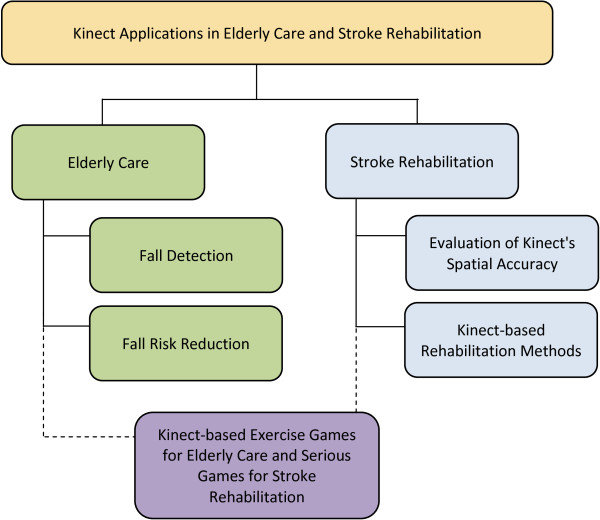
In this paper we present a review of the most current avenues of research into Kinect-based elderly care and stroke rehabilitation systems to provide an overview of the state of the art, limitations, and issues of concern as well as suggestions for future work in this direction. The central purpose of this review was to collect all relevant study information into one place in order to support and guide current research as well as inform researchers planning to embark on similar studies or applications. The paper is structured into three main sections, each one presenting a review of the literature for a specific topic. Elderly Care section is comprised of two subsections: Fall detection and Fall risk reduction. Stroke Rehabilitation section contains studies grouped under Evaluation of Kinect's spatial accuracy, and Kinect-based rehabilitation methods. The third section, Serious and exercise games, contains studies that are indirectly related to the first two sections and present a complete system for elderly care or stroke rehabilitation in a Kinect-based game format. Each of the three main sections conclude with a discussion of limitations of Kinect in its respective applications. The paper concludes with overall remarks regarding use of Kinect in elderly care and stroke rehabilitation applications and suggestions for future work. A concise summary with significant findings and subject demographics (when applicable) of each study included in the review is also provided in table format.
Overview
The claims and statistics of this paper haven’t been checked yet.
Free: it reads the open-access text and checks the first 5 claims that cite a source we can check. Create a free account to check every claim.
Integrity signals
Registry
Cites
Statistics
Figures
Verification
Claims the paper makes
The claims and statistics of this paper haven’t been checked yet.
Free: it reads the open-access text and checks the first 5 claims that cite a source we can check. Create a free account to check every claim.
Claims other papers make about this one
Each is checked against this paper’s own text: does it say what the citing paper says it does?
In the citing paper
“Another application area of CV is assisted living or rehabilitation, such as continuous sign language recognition to assist people with communication difficulties 139 , and monitoring of physiotherapy exercises for stroke rehabilitation 140 .”
From Deep learning-enabled medical computer vision (2021) · cites this paper as [140]
Self-check
Percentages, sums and reported differences re-computed from the paper’s own numbers.
The self-check needs the paper’s full text.
Citations
Cites
Greedy function approximation: A gradient boosting machine
Friedman, J. H. (2001) · The Annals of Statistics · doi:10.1214/aos/1013203451 · Cited by 30,731 · cited 1×
“[25] developed a method of full body gait analysis through the use of Kinect-based data and a multiple additive regression tree algorithm [51,52].”
MethodA Tutorial on Support Vector Machines for Pattern Recognition
Burges, C. J. C. (1998) · Data Mining and Knowledge Discovery · doi:10.1023/a:1009715923555 · Cited by 16,429 · cited 1×
“[26] demonstrated that variables of Kinect-based posture and gait recognition can also be accurately acquired (up to 99%) through the use of the specific biomechanic and algorithmic parameters of: height/shoulder width, arms’ coordinates, and c-support vector machine scaling (for an optimal hyper-plane [53]).”
MethodDowns, S. H., & Black, N. (1998) · Journal of Epidemiology and Community Health · doi:10.1136/jech.52.6.377 · Cited by 8,252 · cited 1×
“Contingency bias Initially, we planned to assess study quality with the Downs and Black check-list [47]; however, based on the observation that current systems developed utilizing the Kinect are often at an immature ‘proof of concept’ state, this approach was deemed unfruitful.”
MethodFriedman, J. H. (2002) · Computational Statistics & Data Analysis · doi:10.1016/s0167-9473(01)00065-2 · Cited by 7,067 · cited 1×
“[25] developed a method of full body gait analysis through the use of Kinect-based data and a multiple additive regression tree algorithm [51,52].”
MethodRisk Factors for Falls among Elderly Persons Living in the Community
Tinetti, M. E., Speechley, M., & Ginter, S. F. (1988) · New England Journal of Medicine · doi:10.1056/nejm198812293192604 · Cited by 6,509 · cited 2×
“These alert systems focus on reducing the probability a fall incident will occur; a leading cause of injury, emotional distress, and financial burden to the elderly [7-17].”
BackgroundInternational Classification of Functioning Disability and Health (ICF)
Battistella, L. R., & Brito, C. M. M. D. (2002) · Acta Fisiátrica · doi:10.5935/0104-7795.20020003 · Cited by 4,446
Performance‐Oriented Assessment of Mobility Problems in Elderly Patients
Tinetti, M. E. (1986) · Journal of the American Geriatrics Society · doi:10.1111/j.1532-5415.1986.tb05480.x · Cited by 3,352 · cited 1×
“Assessment was with the Berg balance scale (BBS) [4]; The balance subscale of the Tinetti performance oriented mobility assessment (POBMAb) [5], and the Brunnel balance assessment (BBA) [6].”
MethodFalls in older people: epidemiology, risk factors and strategies for prevention
Rubenstein, L. Z. (2006) · Age and Ageing · doi:10.1093/ageing/afl084 · Cited by 3,287 · cited 2×
“These alert systems focus on reducing the probability a fall incident will occur; a leading cause of injury, emotional distress, and financial burden to the elderly [7-17].”
BackgroundAgeing populations: the challenges ahead
Christensen, K., Doblhammer, G., Rau, R., & Vaupel, J. W. (2009) · The Lancet · doi:10.1016/s0140-6736(09)61460-4 · Cited by 3,011 · cited 1×
“Introduction The median age of the general population is projected to significantly rise in the upcoming years [1].”
BackgroundMeasuring balance in the elderly: validation of an instrument.
Berg, K., Wood-Dauphinée, S., Williams, J. I., & Maki, B. E. (1992) · PubMed · Cited by 2,961
Research works printed but not linked: 2
- Heyn P, Abreu BC, Ottenbacher KJ: The effects of exercise training on elderly persons with cognitive impairment and dementia: a meta-analysis. Arch Phys Med Rehabil 2004, 85(10):1694-1704.
- Gerling K, Masuch M: When gaming is not suitable for everyone: playtesting wii games with frail elderly. In 1st Workshop on Game Accessibility: Xtreme Interaction Design (GAXID'11): ACM; 2011.
Cited by
Items 301–400 of 440
Towards a Real-Time Fall Detection System using Kinect Sensor
Baha, N., Beloudah, E., & Ousmer, M. (2016) · International Journal of Computer Vision and Image Processing · doi:10.4018/ijcvip.2016010104 · Cited by 4
“(Igual et al.2013), Webster and Celik (2014), Mubashir et al. (2012) and Noury et al. (2008) reviewed the principal methods used in existing fall detection approaches.”
BackgroundMethodRehabFork: An Interactive Game-assisted Upper Limb Stroke Rehabilitation System
Jayasree-Krishnan, V., Bethi, S. R., Kumar, S., Jayanthi, R. K. R., Ghosh, S., Raghavan, P., & Kapila, V. (2020) · Annual International Conference of the IEEE Engineering in Medicine and Biology Society (EMBC) · doi:10.1109/embc44109.2020.9176168 · Cited by 4
“In recent years, many researchers have developed various devices that can be integrated with the stateof-art game consoles such as Sony PlayStation, Nintendo Wii, Microsoft Kinect, among others, [13].”
BackgroundJamey, K., Laflamme, H., Foster, N. E. V., Rigoulot, S., Hyde, K. L., & Bella, S. D. (2025) · Research Square · doi:10.21203/rs.3.rs-5790839/v1 · Cited by 4
Stepanenko, N. P., & Дубко, А. Г. (2025) · International Science Journal of Engineering & Agriculture · doi:10.46299/j.isjea.20250406.06 · Cited by 4
Zhang, R., Gao, B., Li, R., & Zhou, R. (2025) · Aging Clinical and Experimental Research · doi:10.1007/s40520-025-03233-y · Cited by 3
Scoring People With Spinal Muscular Atrophy on the Motor Function Measure Using the Microsoft Kinect
Vincent-Genod, D., Rippert, P., Coton, J., Goff, L. L., Barrière, A., Berruyer, A., Bernard, M., Garde, C., Gutierrez-Garcia, M., Gilabert, S., et al. (2022) · Pediatric Physical Therapy · doi:10.1097/pep.0000000000000968 · Cited by 5
Morán, R. C. D. (2024) · Retos · doi:10.47197/retos.v60.109195 · Cited by 6
“…de la RV en la RF, abarcando una variedad de aplicaciones que in-cluyen la rehabilitación de pacientes con accidentes cere-brovasculares, lesiones cerebrales traumáticas, y proble-mas ortopédicos, así como la mejora de la movilidad en personas mayores (Lohse et al., 2014; Webster & Celik, 2014).”
BackgroundKinematic instrumental assessment quantifies compensatory strategies in post-stroke patients
Scano, A., Guanziroli, E., Brambilla, C., Specchia, A., Tosatti, L. M., & Molteni, F. (2025) · Medical & Biological Engineering & Computing · doi:10.1007/s11517-025-03439-2 · Cited by 5
“Kinect-based rehabilitation offers a low-cost and flexible method, providing rehabilitation exercises based on video games [17] that promote motivation and adherence to the treatment to improve patients’ motor performance [18].”
Risto, S., & Kallergi, M. (2015) · Journal of Physics Conference Series · doi:10.1088/1742-6596/637/1/012043 · Cited by 3
Neurorehabilitation mit einem Roboterball – ein geeignetes Therapiekonzept?
Neuendorf, T., Zschäbitz, D., Nitzsche, N., & Schulz, H. (2017) · neuroreha · doi:10.1055/s-0043-101367 · Cited by 3
Multicamera Summarization of Rehabilitation Sessions in Home Environment
Elgamal, T., & Nahrstedt, K. (2017) · ACM International Conference on Multimedia (ACM MM) · doi:10.1145/3123266.3123387 · Cited by 3
Blexer – Full Play Therapeutic Blender Exergames for People with Physical Impairments
Eckert, M., Gómez-Martinho, I., Estéban, C., Peláez, Y., Meneses, J., & Salgado, L. (2018) · Lecture notes of the Institute for Computer Sciences, Social Informatics and Telecommunications Engineering · doi:10.1007/978-3-319-76111-4_30 · Cited by 3
Bouri, M., Khalfallah, A., & Salim, M. (2020) · International Journal of Advanced Computer Science and Applications · doi:10.14569/ijacsa.2020.0110720 · Cited by 3
“Among the many Motion Capture (MoCap) sensors, Kinect is the most prominent tool for medical applications and especially those related to physiotherapy [12, 13] that can be used for preventive purposes when detecting falls of the aged people [14], or rehabilitation exercises dedicated to people with temporary disabili…”
BackgroundAn RGB-D sensor-based instrument for sitting balance assessment
Bartlett, K. A., & Camba, J. D. (2023) · Multimedia Tools and Applications · doi:10.1007/s11042-023-14518-7 · Cited by 3
“In their review of Kinect-based applications to elderly care and stroke rehabilitation, authors Webster & Celik [60] acknowledged the Kinect’s potential as a component of financially accessible and medically beneficial therapy and alert systems.”
BackgroundSutoyo, R., Herriyandi, Lesmana, T. F., & Susanto, E. (2017) · Journal of Physics Conference Series · doi:10.1088/1742-6596/801/1/012053 · Cited by 3
“It helps in the area of education [4] [5], healthcare [6], indoor mapping [7], and robot [8].”
BackgroundBenchmarking Search and Annotation in Continuous Human Skeleton Sequences
Sedmidubský, J., Eliáš, P., & Zezula, P. (2019) · International Conference on Multimedia Retrieval · doi:10.1145/3323873.3325013 · Cited by 3
“…of rehabilitative treatments [9] or to discover movement disorders, in sports to detect fouls or analyze performance of athletes, in military to simulate conflict-resolving situations using virtual characters, or at smart homes to detect anomalous behavior or body positions of elderly people [30].”
BackgroundMoKey: A versatile exergame creator for everyday usage
Eckert, M., López, M., Lázaro-Carrascosa, C., & Meneses, J. (2017) · Assistive Technology · doi:10.1080/10400435.2017.1406016 · Cited by 3
“Webster and Celik (2014) found that most exergames are aimed at solving individual problems or frequent diseases particularly common in the elderly, such as arm rehabilitation for stroke patients or balance training for Parkinson.”
BackgroundMethodResultInfluentialNeuendorf, T., Zschäbitz, D., Nitzsche, N., & Schulz, H. (2017) · Aktuelle Neurologie · doi:10.1055/s-0043-122220 · Cited by 3
Advancements in medical imaging through Kinect: A review
Jawaid, I., & Qureshi, J. K. (2017) · International Symposium on Wireless Systems and Networks (ISWSN) · doi:10.1109/iswsn.2017.8250032 · Cited by 3
“Apart from this, Kinect has served majorly in the rehabilitation tasks [32-34].”
MethodReMoVES Remote Monitoring Validation Engineering System: New Way of Care
Ferrara, E., Ponte, S., Morando, M., & Dellepiane, S. (2019) · Lecture notes in electrical engineering · doi:10.1007/978-3-030-04672-9_15 · Cited by 3
An Agent-based Approach to Physical Rehabilitation of Patients affected by Neurological Diseases
Vallejo, D., Schez-Sobrino, S., Albusac, J. A., Castro-Schez, J. J., & Glez-Morcillo, C. (2019) · Procedia Computer Science · doi:10.1016/j.procs.2019.11.081 · Cited by 3
A cognitive system of elderly exercise evaluation with sensors and robots
Yamazaki, T. (2020) · Elsevier eBooks · doi:10.1016/b978-0-12-819445-4.00003-5 · Cited by 3
Sharma, S., Gusain, U., Goyal, K., Goyal, M., & Sharma, P. (2024) · Advances in medical technologies and clinical practice book series · doi:10.4018/979-8-3693-1115-8.ch016 · Cited by 3
Fall detection based on depth images via wavelet moment
Ding, Y., Li, H., Li, C., Xu, K., & Guo, P. (2017) · International Congress on Image and Signal Processing (CISP) · doi:10.1109/cisp-bmei.2017.8302057 · Cited by 3
“INTRODUCTION Fall detection is a hot issue in human abnormal behavior detection [1].”
BackgroundLee, S., & Yim, J. (2025) · Applied Sciences · doi:10.3390/app15137620 · Cited by 2
Application Issues for Robotics
Wirz, M., & Rupp, R. (2011) · Springer eBooks · doi:10.1007/978-1-4471-2277-7_2 · Cited by 2
Demo: Smartwatch-Driven Gaming for Stroke Rehabilitation
Chandel, V., Ghose, A., & Sinha, A. (2024) · ACM Conference on Embedded Networked Sensor Systems (SenSys) · doi:10.1145/3666025.3699421 · Cited by 2
“Today, a gamified approach towards such therapies is common including games designed for Virtual Reality [3], using devices like Microsoft Kinect [5], or dedicated consoles like Sony PlayStation, Nintendo Wii etc. [4] utilizing specialised motion or vision hardware.”
Face to face: an interactive facial exercise system for stroke patients with facial weakness
Breedon, P., Logan, P., Pearce, D. A., Edmans, J. A., Childs, B., & O’Brien, R. (2016) · Nottingham Trent University's Institutional Repository (Nottingham Trent Repository) · Cited by 2
Automatic Exercise Recognition Based on Kinect Sensor for Telerehabilitation
Velasco, F., & Narváez, F. (2020) · Communications in computer and information science · doi:10.1007/978-3-030-46785-2_25 · Cited by 2
Aggrawal, R. K., & Gahlan, M. (2020) · Communications in computer and information science · doi:10.1007/978-981-15-5827-6_35 · Cited by 2
Tiba, A., & Manea, L. (2022) · Journal of Evidence-Based Psychotherapies · doi:10.24193/jebp.2022.1.8 · Cited by 3
Oosthuizen, R. M. (2024) · Springer eBooks · doi:10.1007/978-3-031-54585-6_11 · Cited by 3
Biomechanical Analysis of Rehabilitation Exercises Performed During Serious Games Exercises
Bonnechère, B., Jansen, B., Omelina, L., Sholukha, V. A., & Jan, S. V. S. (2016) · Lecture notes in computer science · doi:10.1007/978-3-319-40216-1_32 · Cited by 2
Neuendorf, T., Zschäbitz, D., Nitzsche, N., & Schulz, H. (2017) · Neurology International Open · doi:10.1055/s-0043-115360 · Cited by 2
“Besides the use of smartphones [29–32], entertainment industry hardware components, such as the Nintendo Wii game console [33] and the Microsoft Kinect camera [34, 35] continue to gain wider acceptance in rehabilitation.”
Neuendorf, T., Zschäbitz, D., Nitzsche, N., & Schulz, H. (2017) · Neurology International Open · doi:10.1055/s-0043-122200 · Cited by 3
“There are examples of the Microsoft Kinect webcam used in stroke rehabilitation [30, 38–44] as well as for game consoles such as the Nintendo Wii [45–47], Sony Playstation [48] or Microsoft XBox [44].”
InfluentialCenteno, A. D., Silva-Calpa, G. F. M., & Raposo, A. B. (2019) · Brazilian Symposium on Computer Games and Digital Entertainment (SBGames) · doi:10.1109/sbgames.2019.00023 · Cited by 2
“Webster and Celik [13] performed a systematic review of Kinect applications for rehabilitation.”
BackgroundA Kinect-based motor rehabilitation system for stroke recovery
Saha, S., & Das, N. (2021) · Elsevier eBooks · doi:10.1016/b978-0-12-822260-7.00007-8 · Cited by 2
Rupp, R., & Wirz, M. (2022) · Springer eBooks · doi:10.1007/978-3-031-08995-4_13 · Cited by 3
Kinect V2 as a tool for stroke recovery: Pilot study of motion scale monitoring
Ťupa, O., Vyšata, O., Procházka, A., Dostál, O., & Schätz, M. (2016) · International Workshop on Computational Intelligence for Multimedia Understanding (IWCIM) · doi:10.1109/iwcim.2016.7801186 · Cited by 2
“[9] D. Webster and O. Celik, “Systematic review of kinect applications in elderly care and stroke rehabilitation,” Journal of NeuroEngineering and Rehabilitation, vol. 11, no. 1, pp. 1–24, 2014.”
BackgroundExergames for telerehabilitationPreprint
Bethi, S. R. (2020) · arXiv (Cornell University) · doi:10.48550/arxiv.2006.10110 · Cited by 2
Hierarchical Graph-Convolutional Variational AutoEncoding for Generative Modelling of Human MotionPreprint
Bourached, A., Gray, R., Guan, X., Griffiths, R., Jha, A., & Nachev, P. (2021) · arXiv (Cornell University) · doi:10.48550/arxiv.2111.12602 · Cited by 4
“Understanding it is implicit in pose estimation, action recognition, motion synthesis, and motion prediction, across a wide variety of applications within healthcare [1, 2], physical rehabilitation and training [3, 4], robotics [5–7], navigation [8–11], manufacture [12], entertainment [13–15], and security [16–18].”
BackgroundTemizkan, E., & Ekici, G. (2018) · Ergoterapi ve Rehabilitasyon Dergisi · doi:10.30720/ered.396603 · Cited by 1
Temizkan, E., & Ekici, G. (2020) · Ergoterapi ve Rehabilitasyon Dergisi · doi:10.30720/ered.657114 · Cited by 1
Nusantoro, H., Maulina, E., Muftiadi, A., & Purnomo, M. (2022) · Corporate Law & Governance Review · doi:10.22495/clgrv4i1p5 · Cited by 1
“The quantity of scientific literature on specific study disciplines or topics is usually massive, making it difficult for researchers and practitioners to provide an organized overview of appropriate information (Webster & Celik, 2014).”
BackgroundAn Advanced Integrated Sensor-Based Method for Fall Risk Assessment in Rehabilitation Setting
Chen, M., Zhang, L., Yu, L., Yeung, E., Zhao, Q., Cao, J., Wang, X., Huang, J., Wang, H., & Zhao, Y. (2025) · IEEE Sensors Journal · doi:10.1109/jsen.2025.3547925 · Cited by 1
“Some studies suggest that certain features unique to Kinect skeletal data, such as joint angles, which are not obtainable from IMUs, may offer specific advantages [33], [41].”
Ivaşcu, L., Vinatu, V.-F., & Găianu, M. (2025) · Processes · doi:10.3390/pr13041198 · Cited by 1
UI/UX design requirements for young stroke survivors: recommendations from the literature
Passey, D., Ferdous, H. S., Burns, K., Gilbert, C. A., Power, E., Rose, T., Bernhardt, J. A., Thijs, V., & Daniel Capurro, N. (2025) · npj Digital Medicine · doi:10.1038/s41746-025-01796-8 · Cited by 1
“Motion-sensing systems, such as a Kinect, use cameras and infrared detectors to recognise gestures and body movements and provide feedback using PGHD to populate dashboards and track rehabilitation progress 31 .”
Towards Accessible & Affordable Home-Rehabilitation For Stroke Patients
Chandel, V., Sinha, A., & Ghose, A. (2025) · Annual International Conference of the IEEE Engineering in Medicine and Biology Society (EMBC) · doi:10.1109/embc58623.2025.11254338 · Cited by 1
“…reality games primarily to train the reach and grab actions along with cognitive training component, depth vision sensing using Kinect, or exploiting dedicated gaming technology like the Wii remote, or games like Wii Fit with additional peripherals for balance-based exercises [23][24][25].”
Development of a 3D Avatar to improve the User Experience of a Movement-based Rehabilitation System
Molina, P. C., Penichet, V. M. R., Lozano, M. D., Garrido, J. E., Garcia-Garcia, J. M., & Marco, F. A. (2022) · doi:10.1145/3549865.3549907 · Cited by 1
“area of e-health, a lot of rehabilitation proposals involving Kinect came up [1][20].”
BackgroundUsing Deep Learning to Detect Rehabilitation Exercise for Patients Diagnosed with Sarcopenia
Huang, P.-W., Weng, Y.-C., Chia, C.-H., & Chia, T.-L. (2025) · International Conference on Machine Learning and Human-Computer Interaction (MLHMI) · doi:10.1109/mlhmi66056.2025.00012 · Cited by 1
“Based on a review of rehabilitation training movements from the relevant literature [3,5,12,14], as summarized in Table II, this study consolidates rehabilitation exercises suitable for home-based implementation.”
Rehabilitation Strategies for Restorative Approaches After Stroke and Neurotrauma
Dobkin, B. H. (2016) · Springer eBooks · doi:10.1007/978-1-4899-7654-3_28 · Cited by 1
Pajaro-Blázquez, M., Dueñas, A., Ferrer-González, B., Moreno-Conde, A., Sánchez, F. J., & Parra, C. (2014) · International Congress on Neurotechnology, Electronics and Informatics · doi:10.5220/0005190401350142 · Cited by 1
“Serious Games are aimed at improving motor deficits while monitoring and evaluating patient progress, and offer game-based rehabilitation environments that motivate the patient during training (Webster & Celik, 2014).”
BackgroundCaro, K., Beltrán, J., Martínez-García, A. I., & Soto-Mendoza, V. (2016) · International Conference on Pervasive Computing Technologies for Healthcare · doi:10.4108/eai.16-5-2016.2263860 · Cited by 1
Hachaj, T. (2017) · PRZEGLĄD ELEKTROTECHNICZNY · doi:10.15199/48.2017.05.12 · Cited by 1
“Microsoft Kinect is a very popular hardware module that can be used in various applications for example in medicine [20], intelligent home technology [21][22] nonverbal behavior analysis [23], 3-D kinematic measurement [24] or even zootechnics [25].”
BackgroundTraining der oberen Extremitäten mit einem Roboterball bei Schlaganfallpatienten
Neuendorf, T., Zschäbitz, D., Nitzsche, N., & Schulz, H. (2017) · Aktuelle Neurologie · doi:10.1055/s-0043-115379 · Cited by 1
“Neben dem Einsatz von Smartphones [29–32] haben sich Hardwarekomponenten aus der Unterhaltungsindustrie wie die Nintendo Wii Spielekonsole [33] oder die Microsoft Kinect Kamera [34, 35] in der Rehabilitation zunehmend etabliert.”
BackgroundBesoins et ressentis des aidants en oncogériatrie, utilité d’un serious game
Rollot, F., Chéron, M., Bonhomme, S., Fromantin, I., & Engels, C. (2021) · Soins Gérontologie · doi:10.1016/j.sger.2021.08.008 · Cited by 2
Halisyah, A. N., Humaidi, R., Rafly, M., Silvia, C., & Adiputra, D. (2022) · Lecture notes in electrical engineering · doi:10.1007/978-981-19-1804-9_36 · Cited by 1
Touch-less Remedial Game Prototype for Hand Rehabilitation - Feedback Results
Zsolczay, R. G., Perrin, D., Maire, F., & Türkay, S. (2023) · Australian Conference on Computer-Human Interaction (OzCHI) · doi:10.1145/3638380.3638432 · Cited by 1
“Vision based interactive applications have been used in medical environments to successfully aid both the physical and psychological recovery of various types of patients [4, 6, 28, 30, 41–43 , 45 ].”
MethodA Multiple-stage Classification of Fall Motions Using Kinect Camera
Patsadu, O., Watanapa, B., & Nukoolkit, C. (2017) · Advances in intelligent systems and computing · doi:10.1007/978-3-319-60663-7_11 · Cited by 1
“Falls may occur from several causes such as congenital diseases, environment, or ageing-related issues [2, 3].”
BackgroundMillar, L. (2017) · Current Trends in Biomedical Engineering & Biosciences · doi:10.19080/ctbeb.2017.03.555610 · Cited by 1
“However the majority of studies which investigate the use of visualisation and virtual reality are not yet at the stage to be tested with patients [7], therefore there is very little data on patient response to feedback of this type.”
BackgroundMethodUser-Centered Development of an Information System in Patient’s Motor Capacity Evaluation
Coton, J., Vincent-Genod, D., Thomann, G., Vuillerot, C., & Villeneuve, F. (2017) · Springer proceedings in mathematics & statistics · doi:10.1007/978-3-319-66146-9_11 · Cited by 2
VR-based "9-square matrix" aerobic exercise for prevention of physical decline in older adults
Dwivedi, S., Theimjarus, S., & Nantajeewarawat, E. (2018) · Joint International Conference on Digital Arts, Media and Technology with ECTI Northern Section Conference on Electrical, Electronics, Computer and Telecommunications Engineering (ECTI DAMT & NCON) · doi:10.1109/ecti-ncon.2018.8378291 · Cited by 1
“There exist many virtual reality (VR) based exergames that are based on traditional exercises using commercially available consoles such as the Nintendo Wii [2-6], Microsoft Xbox Kinect [7-10], Sony EyeToy kinetics [11] and DDR based dance step pad [12].”
MethodA New Motion-Based Tool for Occupation and Monitoring of Residents in Nursing Homes
Foloppe, D. A., Richard, P., Allain, P., & Calenda, A. (2019) · Lecture notes in computer science · doi:10.1007/978-3-030-22649-7_37 · Cited by 1
Gait analysis for Alzheimer’s disease therapies using Kinect™: A preliminary report
Nadhif, M. H., Hadiputra, A. P., Alief, N. A., Whulanza, Y., & Supriadi, S. (2019) · AIP conference proceedings · doi:10.1063/1.5139375 · Cited by 1
Real-time 2D Human Skeleton Monitoring System
Kilicceken, S., Çubukçu, B., & Yüzgeç, U. (2019) · International Symposium on Multidisciplinary Studies and Innovative Technologies (ISMSIT) · doi:10.1109/ismsit.2019.8932864 · Cited by 1
“Bu cihazlar, sahip oldukları derinlik kameraları ve alıcıları sayesinde insan hareketlerinin iskelet görüntü bilgilerini zamana bağlı olarak üretebilirler ve bu bilgileri kablosuz olarak bilgisayarlara aktarabilirler [2-4].”
Amelard, R., Murray, K. R., Hedge, E. T., Cleworth, T. W., Noguchi, M., Laing, A. C., & Hughson, R. L. (2020) · IEEE Transactions on Neural Systems and Rehabilitation Engineering · doi:10.1109/tnsre.2020.2971340 · Cited by 2
“based technologies [21], [22], have the benefit of ambient imaging without markers, but existing methods have not demonstrated sub-millimeter accuracy at anatomically relevant locations during quiet standing and require specialized imaging setups.”
Virtual reality and its therapeutic uses in the elderly: A narrative clinical review
Sousa, A. D., Lodha, P., & Karia, S. (2020) · Journal of Geriatric Mental Health · doi:10.4103/jgmh.jgmh_8_20 · Cited by 3
Ruíz, J. C. (2020) · Revista Salud Bosque · doi:10.18270/rsb.v10i2.2678 · Cited by 1
Gamification as Upper Limb Rehabilitation Process
Simões-Silva, V., Mesquita, A. F. D., Silva, K. L. S. D., Quental, V. S. A., & Marques, A. J. (2020) · Advances in medical technologies and clinical practice book series · doi:10.4018/978-1-7998-7472-0.ch013 · Cited by 1
Karaaslan, Ö. Ç. (2021) · The Turkish Journal of Geriatrics · doi:10.31086/tjgeri.2021.234 · Cited by 1
“The numbers and proportion of the population aged over 65 years are increasing due to extended lifespans, health improvements and decreasing birth rates (1).”
BackgroundDevelopment of Motion Game for Elderly Based on Sensory Stimulus Presentation
Tatsukawa, S., Nakamura, G., Omori, K., Fukui, K., Ando, Y., Sagara, J., & Chin, R. (2021) · International Conference on Electrical, Computer and Energy Technologies (ICECET) · doi:10.1109/icecet52533.2021.9698615 · Cited by 1
Wagner, J., Mazurek, P., & Morawski, R. Z. (2022) · Health information science · doi:10.1007/978-3-030-96009-4_9 · Cited by 1
A Review of Human Activity Recognition (HAV) Techniques
Rao, T. V. S., & Bisht, D. S. (2022) · Lecture notes in mechanical engineering · doi:10.1007/978-981-19-0296-3_59 · Cited by 1
A Step Towards Automated Functional Assessment of Activities of Daily Living
Debnath, B., O'Brien, M. R., Kumar, S., & Behera, A. (2022) · Studies in computational intelligence · doi:10.1007/978-3-031-14771-5_13 · Cited by 1
Developing an exergame for unsupervised home-based balance training in older adults
van Diest, M. (2016) · University of Groningen research database (University of Groningen / Centre for Information Technology) · Cited by 2
Software framework for sensor-based therapy games
Gonçalves, D. B., Toth, P., Wittmann, F., Gassert, R., & Pauchard, Y. (2015) · Swiss Medical Informatics · doi:10.4414/smi.31.00334
A Novel Rehabilitation Approach Based on Inertial Sensor Units
Chen, H.-R., Rau, C.-L., & Yu, C.-H. (2015) · International Conference on Platform Technology and Service · doi:10.1109/platcon.2015.24
“But there are inherent limitations of using the Kinect in this domain as, high dependence on background light conditions and disturbances, impossibility of capturing any movements behind the body (Fig 1A), inability in capturing if person is blocked by another person or object (Fig 1 B), and limb supination/ pronation…”
BackgroundLiving Lab AVC-LR : accident vasculaire cérébral en Languedoc-Roussillon
Hève, D., Héroum, C., Sablot, D., Bouly, S., & Vergne-Richard, C. (2015) · La Presse Médicale · doi:10.1016/j.lpm.2015.07.011
Automatic and adaptable registration of live RGBD video streams sharing partially overlapping views
Rafighi, A. (2015) · Memorial University Research Repository (Memorial University)
The Implementation of Action Observation Therapy in Virtual Worlds
Wellwood, N. (2016) · Open Access Victoria University of Wellington | Te Herenga Waka (Figshare) · doi:10.26686/wgtn.17060105.v1
Use of kinect v2 sensor in upper extremity stroke rehabilitation
Cinfwat, K. (2016)
Chiam, H. (2017) · TSpace (University of Toronto)
Behavior Analysis in the Elderly Care Center Using Kinect Depth Sensor
Liao, H., Lin, Y.-T., Chen, J.-S., Xiao, M.-H., Chang, C.-S., & Chen, W. (2016) · International Journal of Electronics and Electrical Engineering · doi:10.18178/ijeee.4.3.263-267
Silverstein, E. (2017) · Human Biology
“Was it easy”? “Yes”. “Will you use it”? “No”. Elderly Trying Out a Kinect Interface
Verne, G. (2017) · Advances in Computer-Human Interaction
Klishkovskaia, T. A., & Aksenov, A. Y. (2018) · Preprints.org · doi:10.20944/preprints201811.0533.v1
Dehkordi, S. R., Ismail, M., Diah, N. M., & Syaiful, L. (2019) · IEEE Symposium on Computer Applications & Industrial Electronics (ISCAIE) · doi:10.1109/iscaie.2019.8743795
“On the other hand, some limitations can also be seen in the literature, as the majority of studies have not yet moved beyond initial game design and development [11].”
BackgroundA constructivist grounded theory of Ghara Igbanwe for the older Igbo people
Ahuzi, M. C. (2019) · ORCA Online Research @Cardiff (Cardiff University)
Neuendorf, T., Zschäbitz, D., Nitzsche, N., & Schulz, H. (2019) · Springer eBooks · doi:10.1007/978-3-658-23987-9_14
Challenges of Games Virtualization Applied to Educational
dos Santos, W. O., & da Silva, C. G. (2016) · doi:10.5753/desafie.2016.9160
Bilişsel ve Fizyolojik Destek Sistemi Olarak Dijital Oyun Uygulamalarının Sistematik Analizi
ÇARDAK, U., & Özbey, M. (2020) · AJIT-e Academic Journal of Information Technology · doi:10.5824/ajite.2020.02.002.x · Cited by 3
Modelling familiarity : towards age-friendly exergame design
Zhang, H. (2020) · DR-NTU (Nanyang Technological University) · doi:10.32657/10356/144182
Improving Smart Healthcare Safety and Security Using Kinect
Singh, V. K., Saxena, N., Pathak, D., Saini, G., & Bhatnagar, D. (2021) · Communications in computer and information science · doi:10.1007/978-3-030-84842-2_6
Gmez-Portes, C., Lacave, C., Molina, A. I., Vallejo, D., & Schez-Sobrino, S. (2021) · Lecture notes in business information processing · doi:10.1007/978-3-030-75418-1_35
Mathematics and Digital Signal Processing
Lyakhov, P. A. (2021) · MDPI eBooks · doi:10.3390/books978-3-0365-1475-8
TELEATENDIMENTO EM REABILITAÇÃO USANDO O KINECT PARA CONSTRUÇÃO DE UM SISTEMA INTELIGENTE
Marques, F., Gomes, A. L., da Silva, M. R., Periard, K. O. D. S., de Sá, J. N. B., dos Santos, F. P., & Martins, V. C. (2022) · Encontro da Saúde do IFRJ/Campus Realengo · doi:10.29327/encontrodasaude2021.414005
Metadata
- Authors
- Webster, D., & Celik, O.
- Affiliations
- San Francisco State University (US)
- Venue
- Journal of NeuroEngineering and Rehabilitation
- Published
- 2014
- Volume
- 11
- Issue
- 1
- Pages
- 108
- ISSN
- 1743-0003 (ISSN-L)
- PMC
- PMC4094409
- OpenAlex
- W2114222512
- Semantic Scholar
- 6ca45b55ace3a46b35811b358d8400712140436a
- Cited by
- 436
- References
- 117
- Citations by year
- 2026: 7 · 2025: 19 · 2024: 15 · 2023: 27 · 2022: 42 · 2021: 36 · 2020: 57 · 2019: 51 · 2018: 43 · 2017: 50 · 2016: 51 · 2015: 36 · 2014: 1
- FWCI
- 5.74
- Type
- journal article
- Language
- en
- Open access
- gold
- doi.org
- Licence
- cc-by
- Locations
- Journal of NeuroEngineering and Rehabilitation (publishedVersion, cc-by)
- Europe PMC (PubMed Central) (publishedVersion, cc-by)
- PubMed Central (publishedVersion, cc-by)
- PubMed (publishedVersion)
- Funders
- San Francisco State University
- Topics
- Health Sciences › Medicine › Rehabilitation › Stroke Rehabilitation and Recovery
- Physical Sciences › Computer Science › Computer Vision and Pattern Recognition › Context-Aware Activity Recognition Systems
- Health Sciences › Medicine › Geriatrics and Gerontology › Technology Use by Older Adults
- Keywords
- Kinect sensor, elderly care, stroke rehabilitation, fall detection, fall risk reduction, spatial accuracy, serious games, exercise games
- MeSH terms
- Stroke Rehabilitation, Aged, Exercise Therapy, Humans
About these checks
Registry, retraction, Cites and statistics results are computed, not judged, with one exception: a printed reference that no index lists is read once by a model before it counts as a citation error. Claims are extracted by a model and kept only when their quote appears verbatim in the text; each cited source is then checked, with a model’s help, for whether it says what the claim relies on. Those verdicts can be wrong — read the claim’s quote and the cited source before relying on one.
Statistics and arithmetic are recomputed, not judged.
Confidence bands are shown only for fields calibrated on our annotated test set. None is calibrated yet, so no band is shown.
What counts as a claim ›How we measure confidence ›How we check this ›
Are you an author, or do you see a problem with this page? Request a review
Data sources
Bibliographic data: Semantic Scholar, OpenAlex, Crossref.
Contains information from the Semantic Scholar Academic Graph Datasets, made available under the ODC Attribution License (ODC-BY 1.0).
Semantic Scholar’s data is described in: Kinney, R., et al. (2023). The Semantic Scholar Open Data Platform. arXiv:2301.10140.
