

Systematic review of Kinect applications in elderly care and stroke rehabilitation
Open accessThe DOI matches its Crossref record; 117 of the 117 references it cites were found in a registry or an index.
Abstract
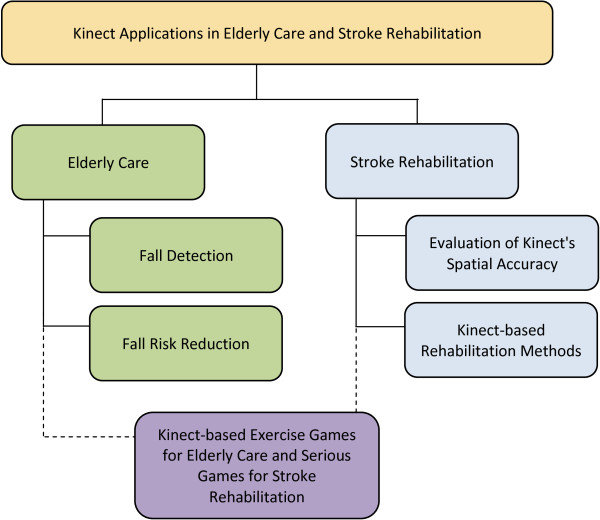
In this paper we present a review of the most current avenues of research into Kinect-based elderly care and stroke rehabilitation systems to provide an overview of the state of the art, limitations, and issues of concern as well as suggestions for future work in this direction. The central purpose of this review was to collect all relevant study information into one place in order to support and guide current research as well as inform researchers planning to embark on similar studies or applications. The paper is structured into three main sections, each one presenting a review of the literature for a specific topic. Elderly Care section is comprised of two subsections: Fall detection and Fall risk reduction. Stroke Rehabilitation section contains studies grouped under Evaluation of Kinect's spatial accuracy, and Kinect-based rehabilitation methods. The third section, Serious and exercise games, contains studies that are indirectly related to the first two sections and present a complete system for elderly care or stroke rehabilitation in a Kinect-based game format. Each of the three main sections conclude with a discussion of limitations of Kinect in its respective applications. The paper concludes with overall remarks regarding use of Kinect in elderly care and stroke rehabilitation applications and suggestions for future work. A concise summary with significant findings and subject demographics (when applicable) of each study included in the review is also provided in table format.
Overview
The claims and statistics of this paper haven’t been checked yet.
Free: it reads the open-access text and checks the first 5 claims that cite a source we can check. Create a free account to check every claim.
Integrity signals
Registry
Cites
Statistics
Figures
Verification
Claims the paper makes
The claims and statistics of this paper haven’t been checked yet.
Free: it reads the open-access text and checks the first 5 claims that cite a source we can check. Create a free account to check every claim.
Claims other papers make about this one
Each is checked against this paper’s own text: does it say what the citing paper says it does?
In the citing paper
“Another application area of CV is assisted living or rehabilitation, such as continuous sign language recognition to assist people with communication difficulties 139 , and monitoring of physiotherapy exercises for stroke rehabilitation 140 .”
From Deep learning-enabled medical computer vision (2021) · cites this paper as [140]
Self-check
Percentages, sums and reported differences re-computed from the paper’s own numbers.
The self-check needs the paper’s full text.
Citations
Cites
Greedy function approximation: A gradient boosting machine
Friedman, J. H. (2001) · The Annals of Statistics · doi:10.1214/aos/1013203451 · Cited by 30,731 · cited 1×
“[25] developed a method of full body gait analysis through the use of Kinect-based data and a multiple additive regression tree algorithm [51,52].”
MethodA Tutorial on Support Vector Machines for Pattern Recognition
Burges, C. J. C. (1998) · Data Mining and Knowledge Discovery · doi:10.1023/a:1009715923555 · Cited by 16,429 · cited 1×
“[26] demonstrated that variables of Kinect-based posture and gait recognition can also be accurately acquired (up to 99%) through the use of the specific biomechanic and algorithmic parameters of: height/shoulder width, arms’ coordinates, and c-support vector machine scaling (for an optimal hyper-plane [53]).”
MethodDowns, S. H., & Black, N. (1998) · Journal of Epidemiology and Community Health · doi:10.1136/jech.52.6.377 · Cited by 8,252 · cited 1×
“Contingency bias Initially, we planned to assess study quality with the Downs and Black check-list [47]; however, based on the observation that current systems developed utilizing the Kinect are often at an immature ‘proof of concept’ state, this approach was deemed unfruitful.”
MethodFriedman, J. H. (2002) · Computational Statistics & Data Analysis · doi:10.1016/s0167-9473(01)00065-2 · Cited by 7,067 · cited 1×
“[25] developed a method of full body gait analysis through the use of Kinect-based data and a multiple additive regression tree algorithm [51,52].”
MethodRisk Factors for Falls among Elderly Persons Living in the Community
Tinetti, M. E., Speechley, M., & Ginter, S. F. (1988) · New England Journal of Medicine · doi:10.1056/nejm198812293192604 · Cited by 6,509 · cited 2×
“These alert systems focus on reducing the probability a fall incident will occur; a leading cause of injury, emotional distress, and financial burden to the elderly [7-17].”
BackgroundInternational Classification of Functioning Disability and Health (ICF)
Battistella, L. R., & Brito, C. M. M. D. (2002) · Acta Fisiátrica · doi:10.5935/0104-7795.20020003 · Cited by 4,446
Performance‐Oriented Assessment of Mobility Problems in Elderly Patients
Tinetti, M. E. (1986) · Journal of the American Geriatrics Society · doi:10.1111/j.1532-5415.1986.tb05480.x · Cited by 3,352 · cited 1×
“Assessment was with the Berg balance scale (BBS) [4]; The balance subscale of the Tinetti performance oriented mobility assessment (POBMAb) [5], and the Brunnel balance assessment (BBA) [6].”
MethodFalls in older people: epidemiology, risk factors and strategies for prevention
Rubenstein, L. Z. (2006) · Age and Ageing · doi:10.1093/ageing/afl084 · Cited by 3,287 · cited 2×
“These alert systems focus on reducing the probability a fall incident will occur; a leading cause of injury, emotional distress, and financial burden to the elderly [7-17].”
BackgroundAgeing populations: the challenges ahead
Christensen, K., Doblhammer, G., Rau, R., & Vaupel, J. W. (2009) · The Lancet · doi:10.1016/s0140-6736(09)61460-4 · Cited by 3,011 · cited 1×
“Introduction The median age of the general population is projected to significantly rise in the upcoming years [1].”
BackgroundMeasuring balance in the elderly: validation of an instrument.
Berg, K., Wood-Dauphinée, S., Williams, J. I., & Maki, B. E. (1992) · PubMed · Cited by 2,961
Preventing Falls in Elderly Persons
Tinetti, M. E. (2003) · New England Journal of Medicine · doi:10.1056/nejmcp020719 · Cited by 1,660
The Balance Scale: reliability assessment with elderly residents and patients with an acute stroke
Berg, K., Wood-Dauphinee, S., & Williams, J. (1995) · Journal of Rehabilitation Medicine · doi:10.2340/1650197719952736 · Cited by 1,639 · cited 2×
“The results of this follow-up study involving chronic stroke patients showed improvement on the Berg Balance Scale [4] of 49.”
BackgroundMethodThe costs of fatal and non-fatal falls among older adults
Stevens, J. A., Corso, P. S., Finkelstein, E. A., & Miller, T. R. (2006) · Injury Prevention · doi:10.1136/ip.2005.011015 · Cited by 1,501 · cited 2×
“These alert systems focus on reducing the probability a fall incident will occur; a leading cause of injury, emotional distress, and financial burden to the elderly [7-17].”
BackgroundRisk Factors for Falls in Community-dwelling Older People: A Systematic Review and Meta-analysis
Deandrea, S., Lucenteforte, E., Bravi, F., Foschi, R., La Vecchia, C., & Negri, E. (2010) · Epidemiology · doi:10.1097/ede.0b013e3181e89905 · Cited by 1,455 · cited 1×
“With falls being a main cause of injury and mortality for the elderly [7-17,49] development of robust, affordable, and widely dispersible in-home fall detection and risk reduction alert systems is needed and there is significant interest in applications of Kinect to address this need.”
BackgroundEffective Exercise for the Prevention of Falls: A Systematic Review and Meta‐Analysis
Sherrington, C., Whitney, J. C., Lord, S. R., Herbert, R. D., Cumming, R. G., & Close, J. C. T. (2008) · Journal of the American Geriatrics Society · doi:10.1111/j.1532-5415.2008.02014.x · Cited by 1,309 · cited 2×
“Serious games offer patients rehabilitation environments which help motivate successful completion of otherwise dreary or demanding rehabilitation regimens [36], whereas the aim of exercise games (also termed “exergames”) is to create stimulating methods of maintaining an active lifestyle tailored to the specific phys…”
BackgroundHeyn, P., Abreu, B. C., & Ottenbacher, K. J. (2004) · Archives of Physical Medicine and Rehabilitation · doi:10.1016/j.apmr.2004.03.019 · Cited by 1,223 · cited 2×
“Serious games offer patients rehabilitation environments which help motivate successful completion of otherwise dreary or demanding rehabilitation regimens [36], whereas the aim of exercise games (also termed “exergames”) is to create stimulating methods of maintaining an active lifestyle tailored to the specific phys…”
BackgroundChang, J. T., Morton, S. C., Rubenstein, L. Z., Mojica, W. A., Maglione, M., Suttorp, M. J., Roth, E. A., & Shekelle, P. G. (2004) · BMJ · doi:10.1136/bmj.328.7441.680 · Cited by 1,168 · cited 2×
“These alert systems focus on reducing the probability a fall incident will occur; a leading cause of injury, emotional distress, and financial burden to the elderly [7-17].”
BackgroundVirtual Environments for Motor Rehabilitation: Review
Holden, M. K. (2005) · CyberPsychology & Behavior · doi:10.1089/cpb.2005.8.187 · Cited by 1,154 · cited 1×
“Serious and exercise games Historically, virtual reality rehabilitation has always been a promising field with an infeasibly high price tag for mass implementation [73].”
BackgroundPrevention of falls and consequent injuries in elderly people
Kannus, P., Sievänen, H., Palvanen, M., Järvinen, T., & Parkkari, J. (2005) · The Lancet · doi:10.1016/s0140-6736(05)67604-0 · Cited by 1,129 · cited 2×
“These alert systems focus on reducing the probability a fall incident will occur; a leading cause of injury, emotional distress, and financial burden to the elderly [7-17].”
BackgroundIncidence of and Risk Factors for Falls and Injurious Falls among the Community-dwelling Elderly
O'Loughlin, J. L., Robitaille, Y., Boivin, J.-F., & Suissa, S. (1993) · American Journal of Epidemiology · doi:10.1093/oxfordjournals.aje.a116681 · Cited by 1,127 · cited 2×
“These alert systems focus on reducing the probability a fall incident will occur; a leading cause of injury, emotional distress, and financial burden to the elderly [7-17].”
BackgroundFriedman, S. M., Munoz, B., West, S. K., Rubin, G. S., & Fried, L. P. (2002) · Journal of the American Geriatrics Society · doi:10.1046/j.1532-5415.2002.50352.x · Cited by 1,050 · cited 2×
“These alert systems focus on reducing the probability a fall incident will occur; a leading cause of injury, emotional distress, and financial burden to the elderly [7-17].”
BackgroundProvince, M. A. (1995) · JAMA · doi:10.1001/jama.1995.03520410035023 · Cited by 1,020
Aerobic fitness is associated with hippocampal volume in elderly humans
Erickson, K. I., Prakash, R. S., Voss, M. W., Chaddock, L., Hu, L., Morris, K. S., White, S. M., Wójcicki, T. R., McAuley, E., & Kramer, A. F. (2009) · Hippocampus · doi:10.1002/hipo.20547 · Cited by 1,007 · cited 2×
“Serious games offer patients rehabilitation environments which help motivate successful completion of otherwise dreary or demanding rehabilitation regimens [36], whereas the aim of exercise games (also termed “exergames”) is to create stimulating methods of maintaining an active lifestyle tailored to the specific phys…”
BackgroundAL, L., & H, N. (2007) · Journal of Health and Translational Medicine · doi:10.22452/jummec.vol10no2.3 · Cited by 929
Dobkin, B. H. (2005) · New England Journal of Medicine · doi:10.1056/nejmcp043511 · Cited by 910
(2010) · Lecture Notes in Computer Science · doi:10.1007/978-3-642-14097-6 · Cited by 883
The prevalence and correlates of fear of falling in elderly persons living in the community.
Arfken, C. L., Lach, H. W., Birge, S. J., & Miller, J. P. (1994) · American Journal of Public Health · doi:10.2105/ajph.84.4.565 · Cited by 703 · cited 2×
“These alert systems focus on reducing the probability a fall incident will occur; a leading cause of injury, emotional distress, and financial burden to the elderly [7-17].”
BackgroundValidity of the Microsoft Kinect for assessment of postural control
Clark, R. A., Pua, Y.-H., Fortin, K., Ritchie, C., Webster, K. E., Denehy, L., & Bryant, A. L. (2012) · Gait & Posture · doi:10.1016/j.gaitpost.2012.03.033 · Cited by 687 · cited 3×
“Clark et al. 2012 Study type: methodology Participants: 20 (healthy, m = 10, f = 10) Age: 27.1 yr (± 4.5) Height: 173.7cm (± 10.3) Mass: 71.7kg (± 11.0) Type 2,1 intra-class correlation coefficient difference between Kinect and Vicon Nexus (ICC) and ratio of coefficient of variation difference…”
BackgroundMethodInfluentialFuller, G. F. (2000) · PubMed · Cited by 669
The cost and frequency of hospitalization for fall-related injuries in older adults.
Alexander, B. H., Rivara, F. P., & Wolf, M. E. (1992) · American Journal of Public Health · doi:10.2105/ajph.82.7.1020 · Cited by 639 · cited 2×
“These alert systems focus on reducing the probability a fall incident will occur; a leading cause of injury, emotional distress, and financial burden to the elderly [7-17].”
BackgroundVirtual Reality in Stroke Rehabilitation: A Meta-Analysis and Implications for Clinicians
Saposnik, G., Levin, M., & for the Stroke Outcome Research Canada (SORCan) Working Group (2011) · Stroke · doi:10.1161/strokeaha.110.605451 · Cited by 629 · cited 1×
“Virtual reality-based rehabilitation offers a a highly interactive system with many documented benefits specifically to stroke patients [66], and a large variety of Kinect-based approaches of stroke rehabilitation have recently come to the forefront.”
BackgroundAssociation between Physical Activity and Markers of Inflammation in a Healthy Elderly Population
Geffken, D. F., Cushman, M., Burke, G. L., Polak, J. F., Sakkinen, P. A., & Tracy, R. P. (2001) · American Journal of Epidemiology · doi:10.1093/aje/153.3.242 · Cited by 599 · cited 2×
“Serious games offer patients rehabilitation environments which help motivate successful completion of otherwise dreary or demanding rehabilitation regimens [36], whereas the aim of exercise games (also termed “exergames”) is to create stimulating methods of maintaining an active lifestyle tailored to the specific phys…”
BackgroundVirtual Reality–Augmented Rehabilitation for Patients Following Stroke
Merians, A. S., Jack, D., Boian, R., Tremaine, M., Burdea, G. C., Adamovich, S. V., Recce, M., & Poizner, H. (2002) · Physical Therapy · doi:10.1093/ptj/82.9.898 · Cited by 571 · cited 1×
“Historically, a majority of research in gesture controlled virtual reality interfaces has been focused on upper limb rehabilitation [60], usually utilizing hand gestures that required various bulky and impractical designs [61,62].”
BackgroundKLITGAARD, H., MANTONI, M., SCHIAFFINO, S., AUSONI, S., GORZA, L., LAURENT‐WINTER, C., SCHNOHR, P., & SALTIN, B. (1990) · Acta Physiologica Scandinavica · doi:10.1111/j.1748-1716.1990.tb08974.x · Cited by 568 · cited 2×
“Serious games offer patients rehabilitation environments which help motivate successful completion of otherwise dreary or demanding rehabilitation regimens [36], whereas the aim of exercise games (also termed “exergames”) is to create stimulating methods of maintaining an active lifestyle tailored to the specific phys…”
BackgroundDigital game design for elderly users
Ijsselsteijn, W., Nap, H. H., de Kort, Y., & Poels, K. (2007) · Proceedings of the 2007 conference on Future Play - Future Play '07 · doi:10.1145/1328202.1328206 · Cited by 532 · cited 1×
“Serious games The physical changes that accompany ageing affect a wide range of functions, including sensory-perceptual processes, motor abilities, response speed and cognitive processes [89].”
BackgroundEngineering in Medicine and Biology Society (EMBC), 2012 Annual International Conference of the IEEE
Fadlallah, B. H., Brockmeier, A. J., Seth, S., Li, L., Keil, A., & Príncipe, J. C. (2012) · CiteSeer X (The Pennsylvania State University) · Cited by 520
Physical Activity and Hemostatic and Inflammatory Variables in Elderly Men
Wannamethee, S. G., Lowe, G. D. O., Whincup, P. H., Rumley, A., Walker, M., & Lennon, L. (2002) · Circulation · doi:10.1161/01.cir.0000016346.14762.71 · Cited by 487 · cited 2×
“Serious games offer patients rehabilitation environments which help motivate successful completion of otherwise dreary or demanding rehabilitation regimens [36], whereas the aim of exercise games (also termed “exergames”) is to create stimulating methods of maintaining an active lifestyle tailored to the specific phys…”
BackgroundPhysical Activity Prevents Age-Related Impairment in Nitric Oxide Availability in Elderly Athletes
Taddei, S., Galetta, F., Virdis, A., Ghiadoni, L., Salvetti, G., Franzoni, F., Giusti, C., & Salvetti, A. (2000) · Circulation · doi:10.1161/01.cir.101.25.2896 · Cited by 465 · cited 2×
“Serious games offer patients rehabilitation environments which help motivate successful completion of otherwise dreary or demanding rehabilitation regimens [36], whereas the aim of exercise games (also termed “exergames”) is to create stimulating methods of maintaining an active lifestyle tailored to the specific phys…”
BackgroundEngineering in Medicine and Biology Society, 2006.
Nambakhsh, Ahmadian, A., Ghavami, M., Dilmaghani, R., & Karimifard, S. (2006) · Cited by 458
Lange, B., Chang, C.-Y., Suma, E., Newman, B., Rizzo, A. S., & Bolas, M. (2011) · 2011 Annual International Conference of the IEEE Engineering in Medicine and Biology Society · doi:10.1109/iembs.2011.6090521 · Cited by 402 · cited 3×
“Lange et al. 2011 Study type: methodology Participants: 23 (m = 19, f = 4) Participants consisted of those with balance issues related to Stroke (n = 10), TBI (n = 4) and SCI (n = 9) and 10 clinicians (m = 4, f = 6) The study presented and discussed three potential applications of the Kinect.”
BackgroundMethodReliability and validity of measures obtained from stroke patients using the balance master
Liston, R. A. L., & Brouwer, B. J. (1996) · Archives of Physical Medicine and Rehabilitation · doi:10.1016/s0003-9993(96)90028-3 · Cited by 389 · cited 1×
“[96].”
Rossier, P., & Wade, D. T. (2001) · Archives of Physical Medicine and Rehabilitation · doi:10.1053/apmr.2001.9396 · Cited by 387 · cited 2×
“For detailed BBS, POBMAb, and BBA results please see Table two on page 111 of the study. and stroke rehabilitation and conducted within one of the subfields presented in the previous section, and also in Figure 1, were included in this review.”
MethodFall detection system using Kinect’s infrared sensor
Mastorakis, G., & Makris, D. (2014) · Journal of Real-Time Image Processing · doi:10.1007/s11554-012-0246-9 · Cited by 356 · cited 2×
“First, Mastorakis and Makris’s [21] bounding box method utilized a participant’s width, height and depth instead of a more standard method of skeletization; calculations derived from a center of mass; or specific measurements of predetermined body points.”
MethodDuncan, P., Richards, L., Wallace, D., Stoker-Yates, J., Pohl, P., Luchies, C., Ogle, A., & Studenski, S. (1998) · Stroke · doi:10.1161/01.str.29.10.2055 · Cited by 352 · cited 2×
“Serious games offer patients rehabilitation environments which help motivate successful completion of otherwise dreary or demanding rehabilitation regimens [36], whereas the aim of exercise games (also termed “exergames”) is to create stimulating methods of maintaining an active lifestyle tailored to the specific phys…”
BackgroundFull body gait analysis with Kinect
Gabel, M., Gilad-Bachrach, R., Renshaw, E., & Schuster, A. (2012) · 2012 Annual International Conference of the IEEE Engineering in Medicine and Biology Society · doi:10.1109/embc.2012.6346340 · Cited by 331 · cited 3×
“Current prototype alert support systems of fall detection and/or risk reduction show tentative promise of becoming successful tools to extend elderly independent life through accurate fall detection [18-22] and automated gait assessment [23-26].”
MethodAccuracy and robustness of Kinect pose estimation in the context of coaching of elderly population
Obdrzalek, S., Kurillo, G., Ofli, F., Bajcsy, R., Seto, E., Jimison, H., & Pavel, M. (2012) · 2012 Annual International Conference of the IEEE Engineering in Medicine and Biology Society · doi:10.1109/embc.2012.6346149 · Cited by 319 · cited 3×
“[29], the Kinect does not perform well at skeletizing positions under significant participant occlusion, or non-participant object interference.”
BackgroundMethodGardner, M. M., Robertson, M. C., & Campbell, A. J. (2000) · British Journal of Sports Medicine · doi:10.1136/bjsm.34.1.7 · Cited by 319 · cited 2×
“Serious games offer patients rehabilitation environments which help motivate successful completion of otherwise dreary or demanding rehabilitation regimens [36], whereas the aim of exercise games (also termed “exergames”) is to create stimulating methods of maintaining an active lifestyle tailored to the specific phys…”
BackgroundFull-body motion-based game interaction for older adults
Gerling, K., Livingston, I., Nacke, L., & Mandryk, R. (2012) · Proceedings of the SIGCHI Conference on Human Factors in Computing Systems · doi:10.1145/2207676.2208324 · Cited by 306 · cited 3×
“Each of these systems concluded with overall positive results and demonstrated that Kinect-based gaming can significantly improve quality of life using a variety of measures, such as participant’s emotional state [85], physical function, level of body pain [88], visual performance skills, reaction time, and hand-eye c…”
BackgroundInfluentialPhysical Activity and Hemostatic and Inflammatory Variables in Elderly Men
Wannamethee, S. G. (2002) · Circulation · doi:10.1161/hc1502.107117 · Cited by 296
Fern'ndez-Baena, A., Susin, A., & Lligadas, X. (2012) · 2012 Fourth International Conference on Intelligent Networking and Collaborative Systems · doi:10.1109/incos.2012.66 · Cited by 281 · cited 2×
“[31], and Obdrzálek et al.”
BackgroundTowards Pervasive Physical Rehabilitation Using Microsoft Kinect
Chang, C.-Y., Lange, B., Zhang, M., Koenig, S., Requejo, P., Somboon, N., Sawchuk, A., & Rizzo, A. (2012) · Proceedings of the 6th International Conference on Pervasive Computing Technologies for Healthcare · doi:10.4108/icst.pervasivehealth.2012.248714 · Cited by 256 · cited 3×
“[27]; however, observed acceptable wrist and elbow joint tracking, but the shoulder trajectory readings were found to be widely inconsistent.”
BackgroundMethod(2004) · The Lancet · doi:10.1016/s0140-6736(04)15434-2 · Cited by 251 · cited 1×
“[72].”
A New Gaze-BCI-Driven Control of an Upper Limb Exoskeleton for Rehabilitation in Real-World Tasks
Frisoli, A., Loconsole, C., Leonardis, D., Banno, F., Barsotti, M., Chisari, C., & Bergamasco, M. (2012) · IEEE Transactions on Systems, Man, and Cybernetics, Part C (Applications and Reviews) · doi:10.1109/tsmcc.2012.2226444 · Cited by 217 · cited 2×
“’s [71] multi-modal architecture for braincontrolled interface-driven robotic upper limb exoskeleton, there is a broad range of potential Kinect-based applications.”
BackgroundInfluentialHaptic feedback: a brief history from telepresence to virtual reality
Stone, R. J. (2001) · Lecture Notes in Computer Science · doi:10.1007/3-540-44589-7_1 · Cited by 213 · cited 1×
“Historically, a majority of research in gesture controlled virtual reality interfaces has been focused on upper limb rehabilitation [60], usually utilizing hand gestures that required various bulky and impractical designs [61,62].”
BackgroundSerious games in prevention and rehabilitation—a new panacea for elderly people?
Wiemeyer, J., & Kliem, A. (2012) · European Review of Aging and Physical Activity · doi:10.1007/s11556-011-0093-x · Cited by 211 · cited 1×
“Serious games offer patients rehabilitation environments which help motivate successful completion of otherwise dreary or demanding rehabilitation regimens [36], whereas the aim of exercise games (also termed “exergames”) is to create stimulating methods of maintaining an active lifestyle tailored to the specific phys…”
BackgroundVirtual reality in stroke rehabilitation: Still more virtual than real
Crosbie, J. H., Lennon, S., Basford, J. R., & McDonough, S. M. (2007) · Disability and Rehabilitation · doi:10.1080/09638280600960909 · Cited by 197 · cited 2×
“Historically, a majority of research in gesture controlled virtual reality interfaces has been focused on upper limb rehabilitation [60], usually utilizing hand gestures that required various bulky and impractical designs [61,62].”
BackgroundCosta, R., Carneiro, D., Novais, P., Lima, L., Machado, J., Marques, A., & Neves, J. (2008) · Advances in Soft Computing · doi:10.1007/978-3-540-85867-6_10 · Cited by 191
Proceedings of the 13th international conference on Ubiquitous computing
(2011) · doi:10.1145/2030112 · Cited by 175
Fall Detection from Depth Map Video Sequences
Rougier, C., Auvinet, E., Rousseau, J., Mignotte, M., & Meunier, J. (2011) · Lecture Notes in Computer Science · doi:10.1007/978-3-642-21535-3_16 · Cited by 172 · cited 3×
“Current prototype alert support systems of fall detection and/or risk reduction show tentative promise of becoming successful tools to extend elderly independent life through accurate fall detection [18-22] and automated gait assessment [23-26].”
MethodEvaluation of an inexpensive depth camera for in-home gait assessment
Stone, E., & Skubic, M. (2011) · Journal of Ambient Intelligence and Smart Environments · doi:10.3233/ais-2011-0124 · Cited by 169 · cited 2×
“Current prototype alert support systems of fall detection and/or risk reduction show tentative promise of becoming successful tools to extend elderly independent life through accurate fall detection [18-22] and automated gait assessment [23-26].”
MethodCoughlin, J. F., D'Ambrosio, L. A., Reimer, B., & Pratt, M. R. (2007) · 2007 29th Annual International Conference of the IEEE Engineering in Medicine and Biology Society · doi:10.1109/iembs.2007.4352665 · Cited by 167 · cited 1×
“With the Kinect having the potential to be widely disbursed in in-home setting monitoring systems, this avenue of research has become more viable and relevant [55-57].”
BackgroundAgeing populations: the challenges ahead
Roizen, M. F. (2010) · Yearbook of Anesthesiology and Pain Management · doi:10.1016/s1073-5437(10)79489-4 · Cited by 152
Designing and evaluating digital games for frail elderly persons
Gerling, K. M., Schulte, F. P., & Masuch, M. (2011) · Proceedings of the 8th International Conference on Advances in Computer Entertainment Technology · doi:10.1145/2071423.2071501 · Cited by 132 · cited 1×
“[81] also proposed an iterative method of game development and noted that while age-related visual, hearing, and motion impairments can be accounted for during design, it is advisable to conduct multiple stages of user-feedback driven design prototypes in order to accommodate more specific impairments as well as to en…”
MethodSelf-adaptive games for rehabilitation at home
Pirovano, M., Mainetti, R., Baud‐Bovy, G., Lanzi, P. L., & Borghese, N. A. (2012) · IEEE Conference on Computational Intelligence and Games (CIG) · doi:10.1109/cig.2012.6374154 · Cited by 122 · cited 3×
“Pirovano et al. 2012 Study type: methodology A low-cost game-oriented platform for patients who would benefit greatly from intensive rehabilitation at home.”
BackgroundMethodA feasibility study of an upper limb rehabilitation system using kinect and computer games
Pastor, I., Hayes, H. A., & Bamberg, S. J. M. (2012) · 2012 Annual International Conference of the IEEE Engineering in Medicine and Biology Society · doi:10.1109/embc.2012.6346173 · Cited by 121 · cited 2×
“[68] presented a game-based system where the level of difficulty can be personalized to the patient’s specific impairment-related needs through explicit/direct parameter adjustments or based on performance during game play.”
BackgroundMethodA low-cost game framework for a home-based stroke rehabilitation system
Saini, S., Rambli, D. R. A., Sulaiman, S. B., Zakaria, M. N., & Shukri, S. R. M. (2012) · doi:10.1109/iccisci.2012.6297212 · Cited by 118 · cited 2×
“[94] proposed the “watch dog” monitor in order to prevent overuse or overexertion injuries.”
BackgroundMethodJoint angle estimation in rehabilitation with inertial sensors and its integration with Kinect
Bo, A. P. L., Hayashibe, M., & Poignet, P. (2011) · 2011 Annual International Conference of the IEEE Engineering in Medicine and Biology Society · doi:10.1109/iembs.2011.6090940 · Cited by 116 · cited 2×
“Table 2 Overview of studies categorized under the section applications of Kinect in stroke rehabilitation (Continued) Bo et al. 2011 Study type: methodology Participants: unspecified (healthy) Age: unspecified Study proposed a system which utilized a fusion of Kinect and inertial measurement units…”
MethodLiving in a glass house: a survey of private moments in the home
Choe, E. K., Consolvo, S., Jung, J., Harrison, B., & Kientz, J. A. (2011) · Proceedings of the 13th international conference on Ubiquitous computing · doi:10.1145/2030112.2030118 · Cited by 107 · cited 1×
“With the Kinect having the potential to be widely disbursed in in-home setting monitoring systems, this avenue of research has become more viable and relevant [55-57].”
BackgroundA Comparison of Exergaming Interfaces for Use in Rehabilitation Programs and Research
Tanaka, K., Parker, J. R., Baradoy, G., Sheehan, D. P., Holash, R. J., & Katz, L. (2012) · Loading · Cited by 106
Introducing the use of depth data for fall detection
Planinc, R., & Kampel, M. (2012) · Personal and Ubiquitous Computing · doi:10.1007/s00779-012-0552-z · Cited by 105 · cited 3×
“Current prototype alert support systems of fall detection and/or risk reduction show tentative promise of becoming successful tools to extend elderly independent life through accurate fall detection [18-22] and automated gait assessment [23-26].”
BackgroundMethodInteractive Videogame Technologies to Support Independence in the Elderly: A Narrative Review
Marston, H. R., & Smith, S. T. (2012) · Games for Health Journal · doi:10.1089/g4h.2011.0008 · Cited by 96 · cited 1×
“The majority of current design considerations focus on accessibility challenges caused by software development decisions [76] and handheld and floor-based physical devices such as the Wii, EyeToy, and Dance-Dance Revolution modifications, in addition to Kinect [77,78]; however, our discussion here focuses mainly on de…”
BackgroundEvidence-Based Rating of Upper-Extremity Motor Function Tests Used for People Following a Stroke
Croarkin, E., Danoff, J., & Barnes, C. (2004) · Physical Therapy · doi:10.1093/ptj/84.1.62 · Cited by 92 · cited 1×
“are utilized in current, widely used stroke impairment classification tests [64].”
MethodPrivacy Preserving Automatic Fall Detection for Elderly Using RGBD Cameras
Zhang, C., Tian, Y., & Capezuti, E. (2012) · Lecture notes in computer science · doi:10.1007/978-3-642-31522-0_95 · Cited by 88 · cited 4×
“Current prototype alert support systems of fall detection and/or risk reduction show tentative promise of becoming successful tools to extend elderly independent life through accurate fall detection [18-22] and automated gait assessment [23-26].”
BackgroundMethodInfluentialThe promise of exergames as tools to measure physical health
Staiano, A. E., & Calvert, S. L. (2011) · Entertainment Computing · doi:10.1016/j.entcom.2011.03.008 · Cited by 86 · cited 1×
“Growing out of this solid foundation, Kinect-based gaming has notable potential to create a low-cost and enjoyable exercise setting while simultaneously gathering quantitative data related to rehabilitation progress, general caloric expenditure, and aerobic activity [74,75].”
BackgroundPreventing Falls in Elderly Persons
Stephenson, J. (2002) · JAMA · doi:10.1001/jama.288.6.689-b · Cited by 85
Incidence of and risk factors for falls and injurious falls among the community-dwelling elderly
(1994) · Journal of Safety Research · doi:10.1016/0022-4375(94)90017-5 · Cited by 83
MUSTARD: a multi user see through AR display
Karnik, A., Mayol-Cuevas, W., & Subramanian, S. (2012) · Proceedings of the SIGCHI Conference on Human Factors in Computing Systems · doi:10.1145/2207676.2208641 · Cited by 78
Haptic human-computer interaction
Brewster, S. (2003) · Proceedings of the 4th Annual Conference of the ACM Special Interest Group on Computer-Human Interaction - CHINZ '03 · doi:10.1145/2331829.2331830 · Cited by 78
Toward Useful Services for Elderly and People with Disabilities
(2011) · Lecture notes in computer science · doi:10.1007/978-3-642-21535-3 · Cited by 77
Senior health monitoring using Kinect
Parajuli, M., Tran, D., Ma, W., & Sharma, D. K. (2012) · International Conference on Communications and Electronics (ICCE) · doi:10.1109/cce.2012.6315918 · Cited by 72 · cited 4×
“Current prototype alert support systems of fall detection and/or risk reduction show tentative promise of becoming successful tools to extend elderly independent life through accurate fall detection [18-22] and automated gait assessment [23-26].”
MethodInfluentialSmith, S., & Schoene, D. (2012) · Aging Health · doi:10.2217/ahe.12.30 · Cited by 65 · cited 1×
“The majority of current design considerations focus on accessibility challenges caused by software development decisions [76] and handheld and floor-based physical devices such as the Wii, EyeToy, and Dance-Dance Revolution modifications, in addition to Kinect [77,78]; however, our discussion here focuses mainly on de…”
BackgroundGama, A. E. F. D., Chaves, T. F., Figueiredo, L. S., & Teichrieb, V. (2012) · IEEE Symposium on 3D User Interfaces (3DUI) · doi:10.1109/3dui.2012.6184203 · Cited by 65 · cited 2×
“[67] Pastor et al.”
MethodProceedings of the 2007 conference on Future Play
Kapralos, B., Katchabaw, M., & Rajnovich, J. (2007) · Cited by 58
Fall Detection on Embedded Platform Using Kinect and Wireless Accelerometer
Kępski, M., & Kwolek, B. (2012) · Lecture notes in computer science · doi:10.1007/978-3-642-31534-3_60 · Cited by 55 · cited 1×
“The creation of 3D Red-Green-Blue-Depth (RGBD) cameras is leading to the development of novel alert support system prototypes striving to overcome these previous limitations as well as to enable anonymous privacy preserving fall detection [19,50].”
BackgroundChiang, I.-T., Tsai, J., & Chen, S.-T. (2012) · IEEE International Conference on Digital Game and Intelligent Toy Enhanced Learning (DIGITEL) · doi:10.1109/digitel.2012.69 · Cited by 51 · cited 3×
“(t11 = 0.28, p = 0.79) Chiang et al. 2012 Study type: research Experimental Group: Participants: 22 Age: 78.55 (± 6.70) The Vienna Test System, the Soda Pop test, and a Mann-Whitney nonparametric test were used to evaluate beneficial effects of Kinect usage on reaction time and hand-eye…”
BackgroundMethodInfluentialNeuronal functional connectivity dynamics in cortex: An MSC-based analysis
Li, L., Park, I. M., Seth, S., Sanchez, J. C., & Príncipe, J. C. (2010) · Annual International Conference of the IEEE Engineering in Medicine and Biology Society (EMBC) · doi:10.1109/iembs.2010.5627362 · Cited by 51
Lloréns, R., Alcañíz, M., Colomer, C., & Navarro, M. D. (2012) · PubMed · Cited by 50
Passive, In-Home Gait Measurement Using an Inexpensive Depth Camera: Initial Results
Stone, E. E., & Skubic, M. (2012) · International Conference on Pervasive Computing Technologies for Healthcare · doi:10.4108/icst.pervasivehealth.2012.248731 · Cited by 50 · cited 5×
“Stone and Skubic [24] collected and compared gait related data using the Kinect, a dual web-camera system, and a ground-truth Vicon motion capture system.”
BackgroundMethodInfluentialProceedings of the International Conference on the Foundations of Digital Games
El‐Nasr, M. S., Consalvo, M., & Feiner, S. (2012) · Cited by 48
Using Somatosensory Video Games to Promote Quality of Life for the Elderly with Disabilities
Chen, S.-T., Huang, Y.-G. L., & Chiang, I.-T. (2012) · IEEE International Conference on Digital Game and Intelligent Toy Enhanced Learning (DIGITEL) · doi:10.1109/digitel.2012.68 · Cited by 48 · cited 3×
“…in 1.61, and an increase in SD of 5.49 Table 1 Overview of studies categorized under the section applications of Kinect in elderly care (Continued) Chen et al. 2012 Study type: research Experimental Group: Participants: 21 (m = 3 f = 19) Age: 65–92 Control Group: Participants: 39 (m = 15, f = 24)…”
BackgroundMethodInfluentialLee, Y.-S., & Chung, W.-Y. (2012) · Sensors · doi:10.3390/s120100573 · Cited by 46 · cited 2×
“[20] put forth an algorithm capable of monitoring in shadow filled or completely dark environments.”
BackgroundMethodPrototype of a VR upper-limb rehabilitation system enhanced with motion-based tactile feedback
Sadihov, D., Migge, B., Gassert, R., & Kim, Y. (2013) · 2013 World Haptics Conference (WHC) · doi:10.1109/whc.2013.6548450 · Cited by 44 · cited 2×
“[93] developed three minigame applications to offer a variety of game play, motor requirement, and difficulty options: 1) a table wiping game; 2) a meteor deflection game, and 3) a rope pulling game.”
BackgroundExergames for the elderly: Towards an embedded Kinect-based clinical test of falls risk
Garcia, J. A., Karla, F. N., Schoene, D., Smith, S., & Pisan, Y. (2012) · Studies in health technology and informatics · doi:10.3233/978-1-61499-078-9-51 · Cited by 42 · cited 2×
“Growing out of this solid foundation, Kinect-based gaming has notable potential to create a low-cost and enjoyable exercise setting while simultaneously gathering quantitative data related to rehabilitation progress, general caloric expenditure, and aerobic activity [74,75].”
BackgroundMethodA Study for the Application of Body Sensing in Assisted Rehabilitation Training
Yeh, S.-C., Hwang, W.-Y., Huang, T.-C., Liu, W.-K., Chen, Y.-T., & Hung, Y.-P. (2012) · 2012 International Symposium on Computer, Consumer and Control · doi:10.1109/is3c.2012.240 · Cited by 42 · cited 3×
“[69] proposed a system that, through the manipulation of varied virtual balls, aims to entertain a patient who has to perform repetitive and what would otherwise be dull exercises.”
BackgroundInfluentialSun, T., & Lee, C.-H. (2013) · PLoS ONE · doi:10.1371/journal.pone.0069471 · Cited by 39 · cited 2×
“[86] developed a Kinect-based exergame which allowed players to participate in interactive balance exercises with visual feedback, and explored howKinect-based balance training exercises influence the balance control ability and the tolerable intensity level of a player.”
BackgroundAdvances in Human Aspects of Healthcare
Andreoni, G., Costa, F., MAZZOLA, M., Fusca, M., Romero, M. E., Zambarbieri, D., Santambrogio, G. C., & Carniglia, E. (2012) · CRC Press eBooks · doi:10.1201/b12318 · Cited by 37
An integrated low-cost system for at-home rehabilitation
Borghese, N. A., Pirovano, M., Mainetti, R., & Lanzi, P. L. (2012) · International Conference on Virtual Systems and Multimedia (VSMM) · doi:10.1109/vsmm.2012.6365975 · Cited by 36 · cited 3×
“[34] in the development of Animal Feeder, which offered training for dual task management, and of Fruit Catcher, a game which required reaching and weight shift techniques to be employed without movement of the feet.”
BackgroundMethodWiederhold, B. K., & Riva, G. (2011) · Cited by 32
Markerless Full Body Tracking: Depth-Sensing Technology within Virtual Environments
Lange, B. S., Rizzo, A., Chang, C., Suma, E. A., & Bolas, M. T. (2011) · Cited by 31
Game controllers for older adults: experimental study on gameplay experiences and preferences
Pham, T. P., & Theng, Y. (2012) · International Conference on the Foundations of Digital Games (FDG) · doi:10.1145/2282338.2282401 · Cited by 28 · cited 2×
“Pham and Theng [79] demonstrated an interesting interaction between participant performance and preferences.”
BackgroundGaming for upper extremities rehabilitation
Huang, M.-C., Chen, E., Xu, W., & Sarrafzadeh, M. (2011) · Wireless Health · doi:10.1145/2077546.2077576 · Cited by 26 · cited 2×
“Huang et al. 2011 Study type: methodology A prototype of a serious game based off Jewel Mine using a Smart Glove that would enable participants to actually reach out and grasp target gems, which are located in a semi-circle above a virtual avatar, and place the gems into a receptacle instead of…”
BackgroundMethodKinect evaluation for human body movement analysis
Pedro, L. M., & Caurin, G. A. P. (2012) · 2022 9th IEEE RAS/EMBS International Conference for Biomedical Robotics and Biomechatronics (BioRob) · doi:10.1109/biorob.2012.6290751 · Cited by 25 · cited 3×
“[32] utilized a ‘points of interest’ approach”
BackgroundMethodA new Kinect-based guidance mode for upper limb robot-aided neurorehabilitation
Loconsole, C., Bannò, F., Frisoli, A., & Bergamasco, M. (2012) · IEEE/RSJ International Conference on Intelligent Robots and Systems (IROS) · doi:10.1109/iros.2012.6386097 · Cited by 25 · cited 4×
“…three on page 5 of the study Table 2 Overview of studies categorized under the section applications of Kinect in stroke rehabilitation (Continued) Loconsole et al. 2012 Study type: methodology Participants: 1 (healthy, male) Age: 25 This study utilized an L-Exos controller exoskeleton robot…”
BackgroundMethodInfluentialKischka, U., & Wade, D. T. (2004) · CRC Press eBooks · doi:10.3109/9780203996942-14 · Cited by 21
Proceedings of the 13th International Conference on Advances in Computer Entertainment Technology
Kuramoto, I., Ando, H., & Wallner, G. (2016) · doi:10.1145/3001773 · Cited by 20
John, M., Klose, S., Kock, G., Jendreck, M., Feichtinger, R., Hennig, B., Reithinger, N., Kiselev, J., Gövercin, M., Steinhagen‐Thiessen, E., et al. (2012) · Advanced technologies and societal change · doi:10.1007/978-3-642-27491-6_22 · Cited by 14 · cited 2×
“Research on the efficacy of serious games to retain and rehabilitate optimal abilities have been limited mainly to qualitative studies with small sample sizes and focusing on a variety of controllers and inertial sensor systems [33].”
BackgroundTouch versus In-Air Hand Gestures: Evaluating the Acceptance by Seniors of Human-Robot Interaction
Hassani, A. Z., van Dijk, B., Ludden, G., & Eertink, H. (2011) · Lecture notes in computer science · doi:10.1007/978-3-642-25167-2_42 · Cited by 14 · cited 2×
“[84] noted that this more comfortable interactionmethod was especially observed in frail or partially disabled participants who did not desire to get up and walk toward a computer screen.”
BackgroundInfluentialProceedings of the 2nd Conference on Wireless Health
Jacobs, I. M., Soon‐Shiong, P., Topol, E. J., & Toumazou, C. (2011) · doi:10.1145/2077546 · Cited by 14
A modular sensor-based system for the Rehabilitation and Assessment of manipulation
Hussain, A., Roach, N., Balasubramanian, S., & Burdet, E. (2012) · IEEE Haptics Symposium · doi:10.1109/haptic.2012.6183798 · Cited by 13 · cited 2×
“Hussain et al. 2012 Study type: methodology A prototype system SITAR (System for Independent Task-oriented Assessment and Rehabilitation) aimed at delivering controlled, taskoriented stroke therapy in an independent manner with minimal therapist supervision was presented.”
MethodSupporting seniors rehabilitation through videogame technology: A distributed approach
Maggiorini, D., Ripamonti, L. A., & Zanon, E. (2012) · doi:10.1109/gas.2012.6225920 · Cited by 13
Evaluating user experiences in rehabilitation games
McNeill, M. D. J., Charles, D. K., Burke, J. W., Crosbie, J., & McDonough, S. (2012) · Journal of Assistive Technologies · doi:10.1108/17549451211261290 · Cited by 11
Arntzen, A. B. (2011) · Zenodo (CERN European Organization for Nuclear Research) · doi:10.5281/zenodo.1329694 · Cited by 9
Integrated gesture recognition based interface for people with upper extremity mobility impairments
(2012) · CRC Press eBooks · doi:10.1201/b12318-69 · Cited by 8 · cited 2×
“[83] suggested a number of heuristics for selecting Kinect-based gesture patterns specific to patients with upper extremity impairments.”
BackgroundShiratuddin, M. F., Alen Hajnal, A., Farkas, A., Wong, K. W., & Legradi, G. (2012) · doi:10.1109/iccisci.2012.6297181 · Cited by 7 · cited 2×
“’s [70] interactive visuotactile 3D virtual environment, and Frisoli et al.”
BackgroundMethodSupporting seniors rehabilitation through videogame technology: a distributed approach
Maggiorini, D., Ripamonti, L. A., & Zanon, E. (2012) · doi:10.5555/2663700.2663704 · Cited by 6 · cited 3×
“[54], would be ideal for a game-based exercise and rehabilitation paradigm.”
BackgroundMethodTrends in home-based safety and health alert support systems for older people
Pirapinthan, M., Moulton, B. D., & Lal, S. (2011) · International Conference on Broadband Communications, Information Technology & Biomedical Applications · doi:10.1109/ib2com.2011.6217921 · Cited by 5 · cited 1×
“With the Kinect having the potential to be widely disbursed in in-home setting monitoring systems, this avenue of research has become more viable and relevant [55-57].”
BackgroundGolby, C., Raja, V., Hundt, G. L., & Badiyani, S. (2026) · Warwick Research Archive Portal (University of Warwick) · doi:10.82444/warw.33653923 · Cited by 2
Research works printed but not linked: 2
- Heyn P, Abreu BC, Ottenbacher KJ: The effects of exercise training on elderly persons with cognitive impairment and dementia: a meta-analysis. Arch Phys Med Rehabil 2004, 85(10):1694-1704.
- Gerling K, Masuch M: When gaming is not suitable for everyone: playtesting wii games with frail elderly. In 1st Workshop on Game Accessibility: Xtreme Interaction Design (GAXID'11): ACM; 2011.
Cited by
Deep learning-enabled medical computer vision
Esteva, A., Chou, K., Yeung, S., Naik, N., Madani, A., Mottaghi, A., Liu, Y., Topol, E., Dean, J., & Socher, R. (2021) · npj Digital Medicine · doi:10.1038/s41746-020-00376-2 · Cited by 1,406
Virtual reality for stroke rehabilitation
Laver, K. E., George, S., Thomas, S., Deutsch, J. E., & Crotty, M. (2015) · Cochrane Database of Systematic Reviews · doi:10.1002/14651858.cd008349.pub3 · Cited by 1,131
Virtual reality for stroke rehabilitation
Laver, K. E., Lange, B., George, S., Deutsch, J. E., Saposnik, G., & Crotty, M. (2017) · Cochrane Database of Systematic Reviews · doi:10.1002/14651858.cd008349.pub4 · Cited by 800
Wade, L., Needham, L., McGuigan, P., & Bilzon, J. (2022) · PeerJ · doi:10.7717/peerj.12995 · Cited by 384
“…several in-depth reviews of these systems (Clark et al. 2019; Garcia-Agundez et al. 2019; Knippenberg et al. 2017; Mousavi Hondori & Khademi 2014; Webster & Celik 2014) and while depth cameras are still an active area of research, this review will focus on single and multi-camera markerless…”
BackgroundHome-based technologies for stroke rehabilitation: A systematic review
Chen, Y., Abel, K. T., Janecek, J. T., Chen, Y., Zheng, K., & Cramer, S. C. (2019) · International Journal of Medical Informatics · doi:10.1016/j.ijmedinf.2018.12.001 · Cited by 328
Metadata
- Authors
- Webster, D., & Celik, O.
- Affiliations
- San Francisco State University (US)
- Venue
- Journal of NeuroEngineering and Rehabilitation
- Published
- 2014
- Volume
- 11
- Issue
- 1
- Pages
- 108
- ISSN
- 1743-0003 (ISSN-L)
- PMC
- PMC4094409
- OpenAlex
- W2114222512
- Cited by
- 436
- References
- 117
- Citations by year
- 2026: 7 · 2025: 19 · 2024: 15 · 2023: 27 · 2022: 42 · 2021: 36 · 2020: 57 · 2019: 51 · 2018: 43 · 2017: 50 · 2016: 51 · 2015: 36 · 2014: 1
- FWCI
- 5.74
- Type
- journal article
- Language
- en
- Open access
- gold
- doi.org
- Licence
- cc-by
- Locations
- Journal of NeuroEngineering and Rehabilitation (publishedVersion, cc-by)
- Europe PMC (PubMed Central) (publishedVersion, cc-by)
- PubMed Central (publishedVersion, cc-by)
- PubMed (publishedVersion)
- Funders
- San Francisco State University
- Topics
- Health Sciences › Medicine › Rehabilitation › Stroke Rehabilitation and Recovery
- Physical Sciences › Computer Science › Computer Vision and Pattern Recognition › Context-Aware Activity Recognition Systems
- Health Sciences › Medicine › Geriatrics and Gerontology › Technology Use by Older Adults
- Keywords
- Kinect sensor, elderly care, stroke rehabilitation, fall detection, fall risk reduction, spatial accuracy, serious games, exercise games
- MeSH terms
- Stroke Rehabilitation, Aged, Exercise Therapy, Humans
About these checks
Registry, retraction, Cites and statistics results are computed, not judged, with one exception: a printed reference that no index lists is read once by a model before it counts as a citation error. Claims are extracted by a model and kept only when their quote appears verbatim in the text; each cited source is then checked, with a model’s help, for whether it says what the claim relies on. Those verdicts can be wrong — read the claim’s quote and the cited source before relying on one.
Statistics and arithmetic are recomputed, not judged.
Confidence bands are shown only for fields calibrated on our annotated test set. None is calibrated yet, so no band is shown.
What counts as a claim ›How we measure confidence ›How we check this ›
Are you an author, or do you see a problem with this page? Request a review
Data sources
Bibliographic data: Semantic Scholar, OpenAlex, Crossref.
Contains information from the Semantic Scholar Academic Graph Datasets, made available under the ODC Attribution License (ODC-BY 1.0).
Semantic Scholar’s data is described in: Kinney, R., et al. (2023). The Semantic Scholar Open Data Platform. arXiv:2301.10140.
