

Systematic review of Kinect applications in elderly care and stroke rehabilitation
Open accessThe DOI matches its Crossref record; 117 of the 117 references it cites were found in a registry or an index.
Abstract
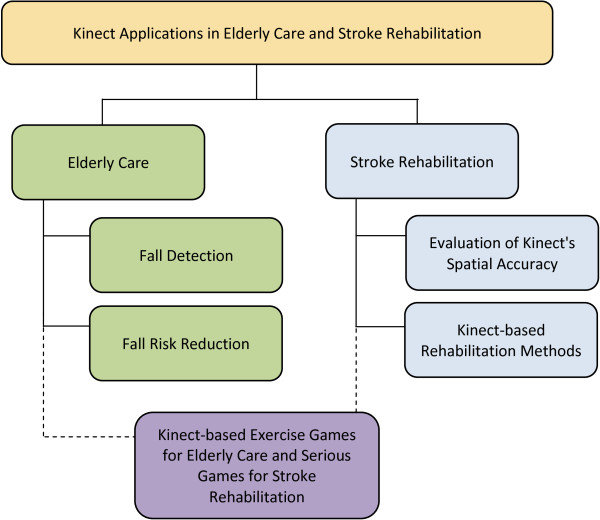
In this paper we present a review of the most current avenues of research into Kinect-based elderly care and stroke rehabilitation systems to provide an overview of the state of the art, limitations, and issues of concern as well as suggestions for future work in this direction. The central purpose of this review was to collect all relevant study information into one place in order to support and guide current research as well as inform researchers planning to embark on similar studies or applications. The paper is structured into three main sections, each one presenting a review of the literature for a specific topic. Elderly Care section is comprised of two subsections: Fall detection and Fall risk reduction. Stroke Rehabilitation section contains studies grouped under Evaluation of Kinect's spatial accuracy, and Kinect-based rehabilitation methods. The third section, Serious and exercise games, contains studies that are indirectly related to the first two sections and present a complete system for elderly care or stroke rehabilitation in a Kinect-based game format. Each of the three main sections conclude with a discussion of limitations of Kinect in its respective applications. The paper concludes with overall remarks regarding use of Kinect in elderly care and stroke rehabilitation applications and suggestions for future work. A concise summary with significant findings and subject demographics (when applicable) of each study included in the review is also provided in table format.
Overview
The claims and statistics of this paper haven’t been checked yet.
Free: it reads the open-access text and checks the first 5 claims that cite a source we can check. Create a free account to check every claim.
Integrity signals
Registry
Cites
Statistics
Figures
Verification
Claims the paper makes
The claims and statistics of this paper haven’t been checked yet.
Free: it reads the open-access text and checks the first 5 claims that cite a source we can check. Create a free account to check every claim.
Claims other papers make about this one
Each is checked against this paper’s own text: does it say what the citing paper says it does?
In the citing paper
“Another application area of CV is assisted living or rehabilitation, such as continuous sign language recognition to assist people with communication difficulties 139 , and monitoring of physiotherapy exercises for stroke rehabilitation 140 .”
From Deep learning-enabled medical computer vision (2021) · cites this paper as [140]
Self-check
Percentages, sums and reported differences re-computed from the paper’s own numbers.
The self-check needs the paper’s full text.
Citations
Cites
Greedy function approximation: A gradient boosting machine
Friedman, J. H. (2001) · The Annals of Statistics · doi:10.1214/aos/1013203451 · Cited by 30,731 · cited 1×
“[25] developed a method of full body gait analysis through the use of Kinect-based data and a multiple additive regression tree algorithm [51,52].”
MethodA Tutorial on Support Vector Machines for Pattern Recognition
Burges, C. J. C. (1998) · Data Mining and Knowledge Discovery · doi:10.1023/a:1009715923555 · Cited by 16,429 · cited 1×
“[26] demonstrated that variables of Kinect-based posture and gait recognition can also be accurately acquired (up to 99%) through the use of the specific biomechanic and algorithmic parameters of: height/shoulder width, arms’ coordinates, and c-support vector machine scaling (for an optimal hyper-plane [53]).”
MethodDowns, S. H., & Black, N. (1998) · Journal of Epidemiology and Community Health · doi:10.1136/jech.52.6.377 · Cited by 8,252 · cited 1×
“Contingency bias Initially, we planned to assess study quality with the Downs and Black check-list [47]; however, based on the observation that current systems developed utilizing the Kinect are often at an immature ‘proof of concept’ state, this approach was deemed unfruitful.”
MethodFriedman, J. H. (2002) · Computational Statistics & Data Analysis · doi:10.1016/s0167-9473(01)00065-2 · Cited by 7,067 · cited 1×
“[25] developed a method of full body gait analysis through the use of Kinect-based data and a multiple additive regression tree algorithm [51,52].”
MethodRisk Factors for Falls among Elderly Persons Living in the Community
Tinetti, M. E., Speechley, M., & Ginter, S. F. (1988) · New England Journal of Medicine · doi:10.1056/nejm198812293192604 · Cited by 6,509 · cited 2×
“These alert systems focus on reducing the probability a fall incident will occur; a leading cause of injury, emotional distress, and financial burden to the elderly [7-17].”
BackgroundInternational Classification of Functioning Disability and Health (ICF)
Battistella, L. R., & Brito, C. M. M. D. (2002) · Acta Fisiátrica · doi:10.5935/0104-7795.20020003 · Cited by 4,446
Performance‐Oriented Assessment of Mobility Problems in Elderly Patients
Tinetti, M. E. (1986) · Journal of the American Geriatrics Society · doi:10.1111/j.1532-5415.1986.tb05480.x · Cited by 3,352 · cited 1×
“Assessment was with the Berg balance scale (BBS) [4]; The balance subscale of the Tinetti performance oriented mobility assessment (POBMAb) [5], and the Brunnel balance assessment (BBA) [6].”
MethodFalls in older people: epidemiology, risk factors and strategies for prevention
Rubenstein, L. Z. (2006) · Age and Ageing · doi:10.1093/ageing/afl084 · Cited by 3,287 · cited 2×
“These alert systems focus on reducing the probability a fall incident will occur; a leading cause of injury, emotional distress, and financial burden to the elderly [7-17].”
BackgroundAgeing populations: the challenges ahead
Christensen, K., Doblhammer, G., Rau, R., & Vaupel, J. W. (2009) · The Lancet · doi:10.1016/s0140-6736(09)61460-4 · Cited by 3,011 · cited 1×
“Introduction The median age of the general population is projected to significantly rise in the upcoming years [1].”
BackgroundMeasuring balance in the elderly: validation of an instrument.
Berg, K., Wood-Dauphinée, S., Williams, J. I., & Maki, B. E. (1992) · PubMed · Cited by 2,961
Research works printed but not linked: 2
- Heyn P, Abreu BC, Ottenbacher KJ: The effects of exercise training on elderly persons with cognitive impairment and dementia: a meta-analysis. Arch Phys Med Rehabil 2004, 85(10):1694-1704.
- Gerling K, Masuch M: When gaming is not suitable for everyone: playtesting wii games with frail elderly. In 1st Workshop on Game Accessibility: Xtreme Interaction Design (GAXID'11): ACM; 2011.
Cited by
Items 401–440 of 440
Interactive Art Therapy for Mental Health Using Microsoft Kinect
Mat, R. C., & Long, S. C. (2022) · Lecture notes of the Institute for Computer Sciences, Social Informatics and Telecommunications Engineering · doi:10.1007/978-3-030-99188-3_10
Rosenthal, A. K., Mickschl, D. J., Burns, E. A., Neumann, E., Urbain, J., Tarima, S. S., & Grindel, S. I. (2020) · Wiley eBooks · doi:10.1002/9781119057840.ch164
Online Social Exergames for Seniors: A Pillar of Gamification for Clinical Practice
Konstantinidis, S. T., Brox, E., Kummervold, P. E., Hallberg, J., Evertsen, G., & Hirche, J. (2019) · IGI Global eBooks · doi:10.4018/978-1-7998-1204-3.ch080
Munteanu, C. (2020) · Balneo Research Journal · doi:10.12680/balneo.2020.346 · Cited by 1
Clinical applications of wearable and non-contact sensors
俊世, 田. (2020) · JAPANES JOURNAL OF MEDICAL INSTRUMENTATION · doi:10.4286/jjmi.90.11 · Cited by 2
Measuring posture change to detect emotional conditions for workers: A scoping review
Do, J.-H., & Yoo, I. (2022) · Work · doi:10.3233/wor-210496
“Recently, however, Kinect’s sensor was proposed to detect human motion [49].”
Huang, L., Huang, H., Wang, J., Liao, R., Zhou, X., Ya, D., Pu, X., & Guo, S. (2022) · doi:10.2196/preprints.43266
Technologie in zorg en welzijn
Hagedoren-Meuwissen, E., Heijkers, J., & Knippenberg, E. (2022) · Bohn Stafleu van Loghum eBooks · doi:10.1007/978-90-368-2829-1_26
Tarikh Akmal Pangestu, S., & Setyonugroho, W. (2023) · World Journal of Advanced Research and Reviews · doi:10.30574/wjarr.2023.17.1.0062 · Cited by 1
Yaşam Boyu Gelişim Açısından Yaşlılık ve Yaşama Sanatı
Yavuzer, N., & Yavuzer, H. (2023) · doi:10.5152/0521
Yaşlanmanın Moleküler Temelleri
Tarhan, Ç. (2023) · doi:10.5152/0513
Bir Yaşlı Doğuyor: Psikanalitik Gerontoloji
Yiğiter, S. (2023) · doi:10.5152/0522
Yaşlanma ve Ömür Uzunluğunun Evrimsel Biyolojisi
Başıbüyük, H. H. (2023) · doi:10.5152/0512
Mobile Application for Tele-Rehabilitation: Enhancing User Experience in Managing Chronic Pain
Atmosukarto, I., Wong, H. S., & To, B. S. (2023) · IEEE International Conference on e-Health Networking, Applications and Services (Healthcom) · doi:10.1109/healthcom56612.2023.10472359
A single camera based automatic movement assessment system to rehabilitation exercise therapy
Yang, S., Li, X., Xu, Z., Fan, Y., & Hu, Y. S. (2024) · IEEE International Conference on Computational Intelligence and Virtual Environments for Measurement Systems and Applications (CIVEMSA) · doi:10.1109/civemsa58715.2024.10586470
“However, recent research has demonstrated the following characteristics: (i)Existing literature extensively uses complex and expensive devices such as inertial measurement units (IMUs) [11] [12], RGB-D cameras [17] [16] [18] [19], and movement capture devices [14] [15].”
BackgroundDeshpande, A. H., Borkar, S. S., & Baheti, J. (2025) · Algorithms for intelligent systems · doi:10.1007/978-981-96-3648-8_3 · Cited by 1
Domingues, G. C., Yoshida, L., Peres, F. F. F., Maurício, C. R. M., & Teixeira, J. M. (2025) · Lecture notes in computer science · doi:10.1007/978-3-032-04999-5_36
Jo, S. (2025) · Physical therapy rehabilitation science · doi:10.14474/ptrs.2025.14.3.304
Imaduddin, H., Song, Q., Takano, M., Siow, C. Z., Ardilla, F., & Kubota, N. (2025) · International Conference on Machine Learning and Cybernetics · doi:10.1109/icmlc66258.2025.11280220
“Key challenges include limited motion tracking accuracy—especially for fine movements—and the need for larger-scale studies to validate their long-term effectiveness [8].”
Brouns, B., van Bodegom‐Vos, L., de Kloet, A. J., Vliet Vlieland, T. P. M., Gil, I. L. C., Souza, L. M. D. N., Braga, L. W., & Meesters, J. J. L. (2020) · Figshare · doi:10.6084/m9.figshare.12579300
Blasco, J.-M., Díaz-Díaz, B., Camacho, C. I., Pérez-Maletzki, J., Hernández-Guilén, D., & Roig‐Casasús, S. (2023) · Figshare · doi:10.6084/m9.figshare.23529143
Xue, Y., Liu, Y., Wang, S., & Liu, Y. (2026) · Communications in computer and information science · doi:10.1007/978-3-032-12764-8_31
Development of a Low-cost Portable Rehabilitation System for Patients with Hand Dysfunction
Zeng, D., Xie, S., & Luo, Z. (2025) · International Conference on Advanced Computer Theory and Engineering · doi:10.1109/icacte66284.2025.11411994
“Moreover, the gaming application's "information clarity" received a relatively lower score (5.1 points), prompting a clear recommendation to optimize the game guide and on-screen instructions [14].”
Influential深度センサーを用いた脳卒中後の運動機能の自動評価システム開発に関する研究
大西, 智. (2020) · Institutional Repositories DataBase (IRDB) · doi:10.14990/00003538
Puyjarinet, F. (2019) · theses.fr (ABES) · doi:10.70675/a90a8473z03e2z4d1azb9c6za58155f7da5e · Cited by 1
Interactive and connected rehabilitation systems for e-health
Tannous, H. (2018) · theses.fr (ABES) · doi:10.70675/90a73d45z3300z439bz9f95zd8bcc6cc0e7d · Cited by 1
Chang, S.-C., & Hsu, W.-S. (2026) · Multimedia Tools and Applications · doi:10.1007/s11042-026-21558-2
Peluang dan Tantangan Jurnalisme Multiplatform di Era Teknologi Kecerdasan Buatan
Dharmawan, D. (2026) · Bayyin Jurnal Komunikasi dan Penyiaran Islam · doi:10.71029/bayyin.v4i1.158
Early Detection of Autism Spectrum Disorder Using Machine Learning
Yazdi, S. A., Janghorbani, A., & Maleki, A. (2024) · Iranian Journal of Health Insurance · doi:10.66224/ihio.7.3.199 · Cited by 1
A Design of Virtual Reality Application in Physical Rehabilitation Based on a Usability Test
Monroy, G., Lumbreras, G. A. N., & Neira-Tovar, L. (2026) · Lecture notes in computer science · doi:10.1007/978-3-032-29656-6_32
Bouchouras, G., Sofianidis, G., & Kontaxakis, E. (2026) · Medical Engineering & Physics · doi:10.1088/1873-4030/ae9d82
Kim, J., Lee, C., & Jung, K. (2026) · Electronics · doi:10.3390/electronics15173988
Park, T. S., Lee, J. H., Jang, M. H., Kim, S.-H., Lee, B., Yoon, J. A., Shin, Y. B., & Shin, M. (2026) · Technology and Health Care · doi:10.1177/09287329261484333
Preliminary Evaluation of eJamar Game Controller as Hand Range of Motion Measurement Tool
Oña, E. D., Yépez-Figueroa, J. J., Cela, A., & Jardón, A. (2026) · Biosystems & biorobotics · doi:10.1007/978-3-032-18746-8_20
GRAFF-MM : Graph-Frequency Filtering for Multi-Modal Memorability PredictionPreprint
Banna, T. T., Deb, S., Rahman, S., & Rahman, S. (2026) · Research Square · doi:10.21203/rs.3.rs-10283943/v1
Metadata
- Authors
- Webster, D., & Celik, O.
- Affiliations
- San Francisco State University (US)
- Venue
- Journal of NeuroEngineering and Rehabilitation
- Published
- 2014
- Volume
- 11
- Issue
- 1
- Pages
- 108
- ISSN
- 1743-0003 (ISSN-L)
- PMC
- PMC4094409
- OpenAlex
- W2114222512
- Semantic Scholar
- 6ca45b55ace3a46b35811b358d8400712140436a
- Cited by
- 436
- References
- 117
- Citations by year
- 2026: 7 · 2025: 19 · 2024: 15 · 2023: 27 · 2022: 42 · 2021: 36 · 2020: 57 · 2019: 51 · 2018: 43 · 2017: 50 · 2016: 51 · 2015: 36 · 2014: 1
- FWCI
- 5.74
- Type
- journal article
- Language
- en
- Open access
- gold
- doi.org
- Licence
- cc-by
- Locations
- Journal of NeuroEngineering and Rehabilitation (publishedVersion, cc-by)
- Europe PMC (PubMed Central) (publishedVersion, cc-by)
- PubMed Central (publishedVersion, cc-by)
- PubMed (publishedVersion)
- Funders
- San Francisco State University
- Topics
- Health Sciences › Medicine › Rehabilitation › Stroke Rehabilitation and Recovery
- Physical Sciences › Computer Science › Computer Vision and Pattern Recognition › Context-Aware Activity Recognition Systems
- Health Sciences › Medicine › Geriatrics and Gerontology › Technology Use by Older Adults
- Keywords
- Kinect sensor, elderly care, stroke rehabilitation, fall detection, fall risk reduction, spatial accuracy, serious games, exercise games
- MeSH terms
- Stroke Rehabilitation, Aged, Exercise Therapy, Humans
About these checks
Registry, retraction, Cites and statistics results are computed, not judged, with one exception: a printed reference that no index lists is read once by a model before it counts as a citation error. Claims are extracted by a model and kept only when their quote appears verbatim in the text; each cited source is then checked, with a model’s help, for whether it says what the claim relies on. Those verdicts can be wrong — read the claim’s quote and the cited source before relying on one.
Statistics and arithmetic are recomputed, not judged.
Confidence bands are shown only for fields calibrated on our annotated test set. None is calibrated yet, so no band is shown.
What counts as a claim ›How we measure confidence ›How we check this ›
Are you an author, or do you see a problem with this page? Request a review
Data sources
Bibliographic data: Semantic Scholar, OpenAlex, Crossref.
Contains information from the Semantic Scholar Academic Graph Datasets, made available under the ODC Attribution License (ODC-BY 1.0).
Semantic Scholar’s data is described in: Kinney, R., et al. (2023). The Semantic Scholar Open Data Platform. arXiv:2301.10140.
