

Human-robot cooperative movement training: Learning a novel sensory motor transformation during walking with robotic assistance-as-needed
Open accessThe DOI matches its Crossref record; 35 of the 39 references it cites were found in a registry or an index.
Abstract
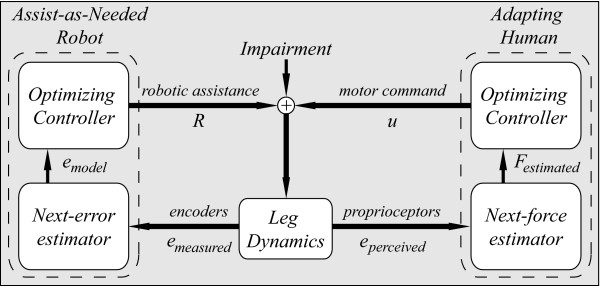
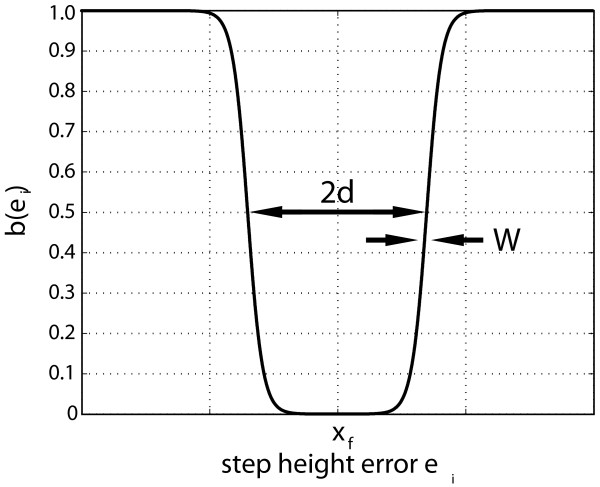
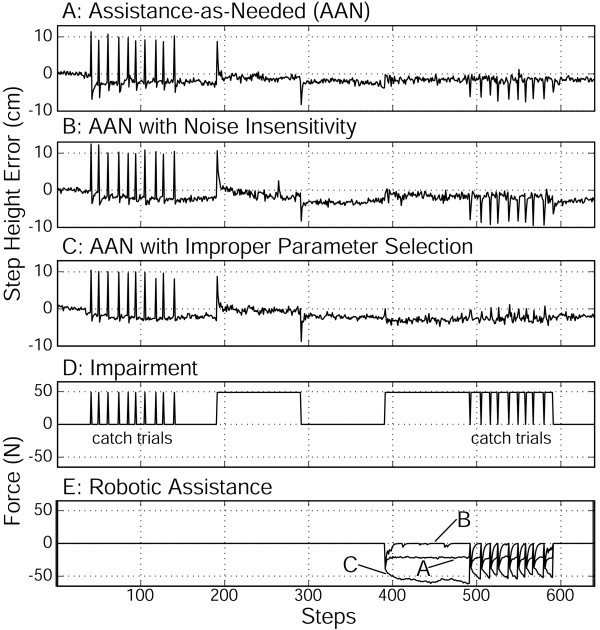
Background: A prevailing paradigm of physical rehabilitation following neurologic injury is to "assist-as-needed" in completing desired movements. Several research groups are attempting to automate this principle with robotic movement training devices and patient cooperative algorithms that encourage voluntary participation. These attempts are currently not based on computational models of motor learning. Methods: Here we assume that motor recovery from a neurologic injury can be modelled as a process of learning a novel sensory motor transformation, which allows us to study a simplified experimental protocol amenable to mathematical description. Specifically, we use a robotic force field paradigm to impose a virtual impairment on the left leg of unimpaired subjects walking on a treadmill. We then derive an "assist-as-needed" robotic training algorithm to help subjects overcome the virtual impairment and walk normally. The problem is posed as an optimization of performance error and robotic assistance. The optimal robotic movement trainer becomes an error-based controller with a forgetting factor that bounds kinematic errors while systematically reducing its assistance when those errors are small. As humans have a natural range of movement variability, we introduce an error weighting function that causes the robotic trainer to disregard this variability. Results: We experimentally validated the controller with ten unimpaired subjects by demonstrating how it helped the subjects learn the novel sensory motor transformation necessary to counteract the virtual impairment, while also preventing them from experiencing large kinematic errors. The addition of the error weighting function allowed the robot assistance to fade to zero even though the subjects' movements were variable. We also show that in order to assist-as-needed, the robot must relax its assistance at a rate faster than that of the learning human. Conclusion: The assist-as-needed algorithm proposed here can limit error during the learning of a dynamic motor task. The algorithm encourages learning by decreasing its assistance as a function of the ongoing progression of movement error. This type of algorithm is well suited for helping people learn dynamic tasks for which large kinematic errors are dangerous or discouraging, and thus may prove useful for robot-assisted movement training of walking or reaching following neurologic injury.
Overview
The claims and statistics of this paper haven’t been checked yet.
Free: it reads the open-access text and checks the first 5 claims that cite a source we can check. Create a free account to check every claim.
Integrity signals
Registry
Cites
Statistics
Figures
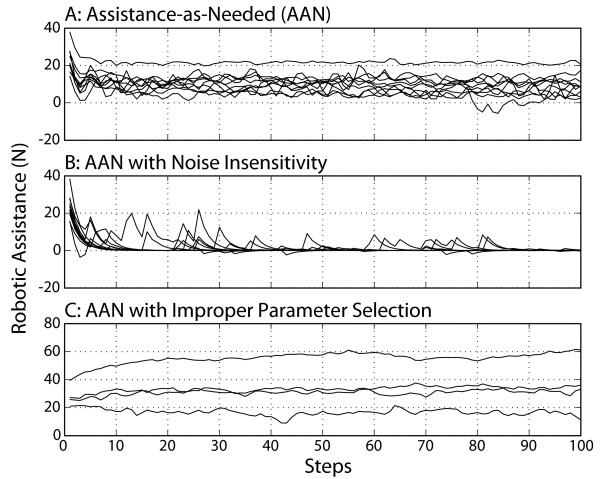
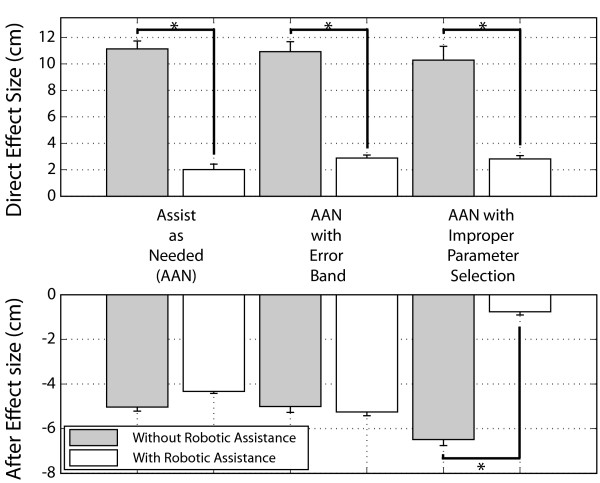
Verification
Claims the paper makes
The claims and statistics of this paper haven’t been checked yet.
Free: it reads the open-access text and checks the first 5 claims that cite a source we can check. Create a free account to check every claim.
Claims other papers make about this one
Each is checked against this paper’s own text: does it say what the citing paper says it does?
The cited source says what the claim attributes to it.
In the citing paper
“Thus, making errors drives motor learning (Emken et al., 2007;Emken & Reinkensmeyer, 2005;Patton, Stoykov, Kovic, & Mussa-Ivaldi, 2006;Reisman, Wityk, Silver, & Bastian, 2007;Thoroughman & Shadmehr, 2000;v a n Beers, 2009).”
From Augmented visual, auditory, haptic, and multimodal feedback in motor learning: A review (2013) · cites this paper as Emken et al., 2007
Experimental — accuracy not yet measured
Self-check
Percentages, sums and reported differences re-computed from the paper’s own numbers.
The self-check needs the paper’s full text.
Citations
Cites
Adaptive representation of dynamics during learning of a motor task
Shadmehr, R., & Mussa-Ivaldi, F. (1994) · The Journal of Neuroscience · doi:10.1523/jneurosci.14-05-03208.1994 · Cited by 2,612
Vidyasagar, M., & Johnson, S. H. (1978) · Journal of Dynamic Systems, Measurement, and Control · doi:10.1115/1.3426360 · Cited by 1,817
Robot-aided neurorehabilitation
Krebs, H. I., Hogan, N., Aisen, M. L., & Volpe, B. T. (1998) · IEEE Transactions on Rehabilitation Engineering · doi:10.1109/86.662623 · Cited by 1,425
Vidyasagar, M. (2002) · Society for Industrial and Applied Mathematics eBooks · doi:10.1137/1.9780898719185 · Cited by 996
Learning of action through adaptive combination of motor primitives
Thoroughman, K. A., & Shadmehr, R. (2000) · Nature · doi:10.1038/35037588 · Cited by 945
Patient- cooperative strategies for robot-aided treadmill training: first experimental results
Riener, R., Lunenburger, L., Jezernik, S., Anderschitz, M., Colombo, G., & Dietz, V. (2005) · IEEE Transactions on Neural Systems and Rehabilitation Engineering · doi:10.1109/tnsre.2005.848628 · Cited by 729
Rehabilitation Robotics: Performance-Based Progressive Robot-Assisted Therapy
Krebs, H. I., Palazzolo, J. J., Dipietro, L., Ferraro, M., Krol, J., Rannekleiv, K., Volpe, B. T., & Hogan, N. (2003) · Autonomous Robots · doi:10.1023/a:1024494031121 · Cited by 714
Patton, J. L., Stoykov, M. E., Kovic, M., & Mussa-Ivaldi, F. A. (2006) · Experimental Brain Research · doi:10.1007/s00221-005-0097-8 · Cited by 469
Robotics, Motor Learning, and Neurologic Recovery
Reinkensmeyer, D. J., Emken, J. L., & Cramer, S. C. (2004) · Annual Review of Biomedical Engineering · doi:10.1146/annurev.bioeng.6.040803.140223 · Cited by 415
Self-citationLearning to move amid uncertainty
Scheidt, R. A., Dingwell, J. B., & Mussa-Ivaldi, F. A. (2001) · Journal of Neurophysiology · doi:10.1152/jn.2001.86.2.971 · Cited by 411
Research works printed but not linked: 3
- Trombly CA Occupational therapy for dysfunction, 4th Edition 1995 4th Baltimore, Williams and Wilkins
- Kahn LE Lum PS Reinkensmeyer DJ Selection of Robotic Therapy Algorithms for the Upper Extremity in Chronic Stroke: Insights from MIME and ARM Guide Results:; Kaist, Daejeon, Republic of Korea. 2003 208 210
- Reinkensmeyer DJ Emken JL Liu J Bobrow JE The Nervous System Appears to Minimize a Weighted Sum of Kinematic Error, Force, and Change in Force when Adapting to Viscous Environments during Reaching and Stepping: Oct; San Diego, CA,. 2004
Cited by
Items 101–200 of 200
Robotic Impedance Learning for Robot-Assisted Physical Training
Li, Y., Zhou, X., Zhong, J., & Li, X. (2019) · Frontiers in Robotics and AI · doi:10.3389/frobt.2019.00078 · Cited by 14
Locomotor adaptation and retention to gradual and sudden dynamic perturbations
van Asseldonk, E. H. F., Koopman, H. F. J. M., & van der Kooij, H. (2011) · International Conference on Rehabilitation Robotics · doi:10.1109/icorr.2011.5975379 · Cited by 15
Schlieβmann, D., Schuld, C., Schneiders, M., Derlien, S., Glöckner, M., Gladow, T., Weidner, N., & Rupp, R. (2014) · Frontiers in Human Neuroscience · doi:10.3389/fnhum.2014.00416 · Cited by 14
Adaptive control of an end-effector based electromechanical gait rehabilitation device
Hussein, S., Schmidt, H., & Krüger, J. (2009) · International Conference on Rehabilitation Robotics · doi:10.1109/icorr.2009.5209485 · Cited by 16
Stiffness control of a pneumatic rehabilitation robot for exercise therapy with multiple stages
Tsuji, T., Momiki, C., & Sakaino, S. (2013) · IEEE/RSJ International Conference on Intelligent Robots and Systems (IROS) · doi:10.1109/iros.2013.6696544 · Cited by 13
Non-linear adaptive controllers for an over-actuated pneumatic MR-compatible stepper
Hollnagel, C., Vallery, H., Schädler, R., López, I. G.-L., Jaeger, L., Wolf, P., Riener, R., & Marchal–Crespo, L. (2013) · Medical & Biological Engineering & Computing · doi:10.1007/s11517-013-1050-9 · Cited by 13
Motor learning with fading and growing haptic guidance
Heuer, H., & Lüttgen, J. (2014) · Experimental Brain Research · doi:10.1007/s00221-014-3914-0 · Cited by 16
Data sample size needed for prediction of movement distributions
Wright, Z. A., Bittmann, M. F., Huang, F. C., & Patton, J. L. (2014) · Annual International Conference of the IEEE Engineering in Medicine and Biology Society (EMBC) · doi:10.1109/embc.2014.6944941 · Cited by 12
An Online Transition of Speed-dependent Reference Joint Trajectories for Robotic Gait Training
Shin, S. Y., & Sulzer, J. S. (2019) · International Conference on Rehabilitation Robotics · doi:10.1109/icorr.2019.8779359 · Cited by 11
Sarasola-Sanz, A., López‐Larraz, E., Irastorza-Landa, N., Rossi, G., Figueiredo, T. C., McIntyre, J., & Ramos‐Murguialday, A. (2022) · Frontiers in Neuroscience · doi:10.3389/fnins.2022.764936 · Cited by 12
Liu, W. (2018) · Topics in Stroke Rehabilitation · doi:10.1080/10749357.2018.1466970 · Cited by 13
Evans, N. H., & Field-Fote, E. C. (2022) · Neurology Report · doi:10.1097/npt.0000000000000403 · Cited by 10
Naghavi, N., Akbarzadeh, A., Khaniki, O., Kardan, I., & Moradi, A. (2023) · Journal of Intelligent & Robotic Systems · doi:10.1007/s10846-023-01854-x · Cited by 10
Leerskov, K., Rikhof, C. J. H., Spaich, E. G., Dosen, S. S., Prange-Lasonder, G. B., Prinsen, E. C., Rietman, J. S., & Struijk, L. N. S. A. (2024) · Computers in Biology and Medicine · doi:10.1016/j.compbiomed.2024.108839 · Cited by 15
Dispositivo Robótico Multifuncional para la Rehabilitación de las Extremidades Superiores
Mancisidor, A., Zubizarreta, A., Cabanes, I., Bengoa, P., & Jung, J. H. (2018) · Revista Iberoamericana de Automática e Informática Industrial RIAI · doi:10.4995/riai.2017.8820 · Cited by 14
Output feedback control of an actuated lower limb orthosis with bounded input
Lalami, M. E., Rifaï, H., Mohammed, S., Hassani, W., Fried, G., & Amirat, Y. (2013) · Industrial Robot the international journal of robotics research and application · doi:10.1108/ir-05-2013-363 · Cited by 10
Sensory-Motor Interactions and Error Augmentation
Patton, J. L., & Huang, F. C. (2016) · Springer eBooks · doi:10.1007/978-3-319-28603-7_5 · Cited by 16
Haptic Assistance That Restricts the Use of Redundant Solutions is Detrimental to Motor Learning
Lokesh, R., & Ranganathan, R. (2020) · IEEE Transactions on Neural Systems and Rehabilitation Engineering · doi:10.1109/tnsre.2020.2990129 · Cited by 10
Neuromusculoskeletal model self-calibration for on-line sequential bayesian moment estimation
Bueno, D. R., & Montano, L. (2017) · Journal of Neural Engineering · doi:10.1088/1741-2552/aa58f5 · Cited by 9
Development of novel devices for upper-extremity rehabilitation
Stienen, A. H. A. (2008) · doi:10.3990/1.9789036527842 · Cited by 10
Real-time fuzzy trajectory generation for robotic rehabilitation therapy
Martin, P., & Emami, M. R. (2009) · International Conference on Rehabilitation Robotics · doi:10.1109/icorr.2009.5209533 · Cited by 8
Towards the development of more human-like robotic therapy devices: A review
Sy, A. C., & Bugtai, N. T. (2010) · IEEE Workshop on Health Care Management (WHCM) · doi:10.1109/whcm.2010.5441275 · Cited by 7
Assistive Devices for Human Mobility and Gait Rehabilitation
Cifuentes, C. A., & Frizera, A. (2016) · Springer tracts in advanced robotics · doi:10.1007/978-3-319-34063-0_1 · Cited by 8
Kao, P.-C., Srivastava, S., Higginson, J. S., Agrawal, S. K., & Scholz, J. P. (2015) · PubMed · Cited by 7
Li, A., Minto, R., Dölling, M., Boschetti, G., & Zanotto, D. (2025) · IEEE Transactions on Neural Systems and Rehabilitation Engineering · doi:10.1109/tnsre.2025.3650096 · Cited by 8
Makowski, N. S., Fitzpatrick, M. N., Triolo, R. J., Reyes, R.-D., Quinn, R. D., & Audu, M. L. (2022) · Bioengineering · doi:10.3390/bioengineering9020071 · Cited by 6
Robot-Aided Gait Training with LOPES
van Asseldonk, E. H. F., & van der Kooij, H. (2016) · Springer eBooks · doi:10.1007/978-3-319-28603-7_22 · Cited by 6
Hussein, S., & Krüger, J. (2011) · International Conference on Rehabilitation Robotics · doi:10.1109/icorr.2011.5975451 · Cited by 6
Boehm, W. L., & Gruben, K. G. (2018) · Journal of Rehabilitation and Assistive Technologies Engineering · doi:10.1177/2055668318793585 · Cited by 7
(2009) · Neurorehabilitation and neural repair · doi:10.1177/1545968309338028 · Cited by 8
Lu, Y., Lin, Z., Li, Y., Lv, J., Zhang, J., Xiao, C., Ye, L., Chen, X., Song, T., Chai, G., et al. (2024) · Frontiers in Robotics and AI · doi:10.3389/frobt.2024.1404814 · Cited by 5
Adaptive Response of Muscle Activity to Exoskeleton-Assisted Walking
Lagomarsino, B., Bellitto, A., Massone, A., Marchesi, G., Pierella, C., & Casadio, M. (2025) · IEEE Access · doi:10.1109/access.2025.3577700 · Cited by 5
Qian, Y., Xiong, J., Yu, H., & Fu, C. (2026) · IEEE Transactions on Biomedical Engineering · doi:10.1109/tbme.2026.3660874 · Cited by 7
Imani, B., & Najafi, F. (2023) · Proceedings of the Institution of Mechanical Engineers Part I Journal of Systems and Control Engineering · doi:10.1177/09596518231156537 · Cited by 6
Kager, S., Hussain, A., Budhota, A., Dailey, W., Hughes, C. M., Vishwanath, D. A., Kuah, C. W. K., Ng, C. Y., Yam, L. H. L., Xiang, L., et al. (2019) · Journal of Rehabilitation and Assistive Technologies Engineering · doi:10.1177/2055668319881583 · Cited by 7
Zhou, X., Liu, G., Yang, L., & Han, B. (2020) · International Conference on Control, Automation and Robotics (ICCAR) · doi:10.1109/iccar49639.2020.9108081 · Cited by 5
Zhang, J., Zeng, H., Li, X., Xu, G., Li, Y., & Song, A. (2023) · Robotica · doi:10.1017/s0263574723000899 · Cited by 8
Intelligent active assistive and resistive orthotic device for knee rehabilitation
Chandrapal, M., & Chen, X. (2009) · International Conference on Control and Automation · doi:10.1109/icca.2009.5410528 · Cited by 5
Rodriguez‐Guerrero, C., Fraile, J. C., Turiel, J. P., & Farina, P. R. (2011) · Revista Iberoamericana de Automática e Informática Industrial RIAI · doi:10.1016/s1697-7912(11)70027-9 · Cited by 5
Lower Limb Exoskeleton Robot to Facilitate the Gait of Stroke Patients
Yeung, L.-F., & Tong, R. K. (2018) · Elsevier eBooks · doi:10.1016/b978-0-12-811810-8.00005-1 · Cited by 5
Visual error amplification showed no benefit for non-naïve subjects in trunk-arm rowing
Gerig, N., Basalp, E., Sigrist, R., Riener, R., & Wolf, P. (2019) · Current Issues in Sport Science (CISS) · doi:10.15203/ciss_2018.013 · Cited by 7
Design of high performance DC motor actuated cable driving system for compact devices
Direkwatana, C., & Suthakorn, J. (2020) · International Journal of Power Electronics and Drive Systems/International Journal of Electrical and Computer Engineering · doi:10.11591/ijpeds.v11.i2.pp580-593 · Cited by 5
Adapting spatiotemporal gait symmetry to functional electrical stimulation during treadmill walking
Kim, S.-J., Worthy, A., Lee, B., Jafari, S., Dyke, O., Cho, J., & Brown, E. (2024) · PLoS ONE · doi:10.1371/journal.pone.0312285 · Cited by 5
Sparse Identification Of Motor Learning Using Proxy Process Models
Parmar, P. N., & Patton, J. L. (2019) · International Conference on Rehabilitation Robotics · doi:10.1109/icorr.2019.8779423 · Cited by 4
Muscle Synergy-Based Control of Human-Manipulator Interactions
Chen, S., Yi, J., & Liu, T. (2020) · IEEE/ASME International Conference on Advanced Intelligent Mechatronics · doi:10.1109/aim43001.2020.9158935 · Cited by 5
Control Strategies for Robot-Assisted Training - Literature Review and Experimental Impressions
Marchal–Crespo, L. (2013) · Biosystems & biorobotics · doi:10.1007/978-3-642-34546-3_19 · Cited by 4
Sy, A. C., Bugtai, N. T., Domingo, A. D., Liang, S.-Y. M. V., & Santos, M. L. R. (2015) · International Conference on Humanoid, Nanotechnology, Information Technology,Communication and Control, Environment and Management · doi:10.1109/hnicem.2015.7393260 · Cited by 4
Li, A., Li, H., Teker, A., Rocha, M. H., Gebre, B. A., Nolan, K. J., POCHIRAJU, K. V., & Zanotto, D. (2025) · IEEE/RSJ International Conference on Intelligent Robots and Systems (IROS) · doi:10.1109/iros60139.2025.11246270 · Cited by 3
Optimal torque adaptation in bimanual assisted rehabilitation
Steingräber, R., Schmidt, H., & Krüger, J. (2012) · IEEE-RAS International Conference on Humanoid Robots (Humanoids) · doi:10.1109/humanoids.2012.6651503 · Cited by 4
Modeling the dynamics of the recovery process in robot therapy
Casadio, M., Novaković, V., Morasso, P., & Sanguineti, V. (2009) · International Conference on Virtual Rehabilitation · doi:10.1109/icvr.2009.5174213 · Cited by 3
Evaluation of a mixed controller that amplifies spatial errors while reducing timing errors
Marchal–Crespo, L., Baumann, T., Fichmann, D., Maassen, S., Duarte, J. E., & Riener, R. (2016) · Annual International Conference of the IEEE Engineering in Medicine and Biology Society (EMBC) · doi:10.1109/embc.2016.7591883 · Cited by 4
Exoskeletal Robotics for Functional Substitution
Pons, J. L., Moreno, J. C., & Rocón, E. (2013) · Wiley eBooks · doi:10.1002/9781118628522.ch17 · Cited by 3
Cable-Driven Exoskeleton for Ankle Rehabilitation in Children with Cerebral Palsy
Varela, I. D., Sorozábal, P., Delgado-Oleas, G., Muñoz, J., Gutiérrez, Á., & Rocón, E. (2025) · Applied Sciences · doi:10.3390/app15147817 · Cited by 2
TeachingBot: Robot Teacher for Human Handwriting
Hou, Z., Yu, C., Hsu, D., & Yu, H. (2026) · IEEE Robotics and Automation Letters · doi:10.1109/lra.2026.3653298 · Cited by 7
Nataraj, R., Liu, M., Shi, Y., Dewil, S., & Harel, N. Y. (2026) · Frontiers in Virtual Reality · doi:10.3389/frvir.2026.1772411 · Cited by 3
Sensory-Motor Interactions and the Manipulation of Movement Error
Parmar, P. N., Huang, F. C., & Patton, J. L. (2022) · Springer eBooks · doi:10.1007/978-3-031-08995-4_11 · Cited by 2
A Cable-Driven Exoskeleton to Control Ankle Mobility During Gait in Children with Cerebral Palsy
Varela, I. D., Sorozábal, P., Delgado-Oleas, G., Gutiérrez, Á., Muñoz, J., & Rocón, E. (2024) · Iberian Robotics Conference (ROBOT) · doi:10.1109/robot61475.2024.10796916 · Cited by 3
Model-Based Optimization for the Personalization of Robot-Assisted Gait Training
Christou, A., Gordon, D., Stouraitis, T., Moreno, J. C., & Vijayakumar, S. (2025) · IEEE Transactions on Medical Robotics and Bionics · doi:10.1109/tmrb.2025.3550649 · Cited by 2
Smith, J. D., & West, A. A. (2008) · Proceedings of the Institution of Mechanical Engineers Part H Journal of Engineering in Medicine · doi:10.1243/09544119jeim368 · Cited by 2
Monitoring method of interactive torque between human and robot in exoskeleton systems
Hwang, B., Moon, H., & Jeon, D. (2009) · International Conference on Rehabilitation Robotics · doi:10.1109/icorr.2009.5209478 · Cited by 2
Design of a novel assist interface where toddlers walk with a mobile robot supported at the waist
Jin, N., Kang, J., & Agrawal, S. K. (2015) · International Conference on Rehabilitation Robotics · doi:10.1109/icorr.2015.7281262 · Cited by 2
Garofolini, A., Mickle, K. J., McLaughlin, P. A., & Taylor, S. B. (2024) · European Journal of Sport Science · doi:10.1002/ejsc.12056 · Cited by 1
Reinkensmeyer, D. J. (2026) · Neurorehabilitation and neural repair · doi:10.1177/15459683261448473 · Cited by 1
Self-citationOu, C., Peng, Y., & Zhang, F. (2026) · Healthcare · doi:10.3390/healthcare14111523 · Cited by 1
Interfacing Engineering Technology and Rehabilitation: A New Frontier for Physical Therapy
Trumbower, R. D., Peters, D. M., & Wolf, S. L. (2017) · Orthopaedic Section, APTA, Inc. eBooks · doi:10.17832/isc.2017.27.4.2 · Cited by 1
Wolbrecht, E. T., Ketkar, V. D., & Perry, J. C. (2023) · International Conference on Rehabilitation Robotics · doi:10.1109/icorr58425.2023.10304762 · Cited by 1
Minimizing Interference in Robotic Rehabilitation via Asymmetric Stiffness Force Fields
Kato, Y., Sakaino, S., & Tsuji, T. (2025) · IEEE Open Journal of the Industrial Electronics Society · doi:10.1109/ojies.2025.3570789 · Cited by 4
Park, K. (2012) · Journal of Bioengineering and Biomedical Sciences · doi:10.4172/2155-9538.1000112 · Cited by 1
van Asseldonk, E. H. F. (2008) · University of Twente Research Information · doi:10.3990/1.9789036526401 · Cited by 2
An Active Orthosis for Gait Rehabilitation
Hussain, S., & Xie, S. Q. (2013) · Wiley eBooks · doi:10.1002/9781118614549.ch6
Evaluation of bilateral transfer characteristics based on virtual impairment
Park, K., Kim, Y., Nagai, C., & Obinata, G. (2012) · IEEE RO-MAN · doi:10.1109/roman.2012.6343834
Learning a locomotor task: with or without
Schneider, J., Jaeger, L., & Riener, R. (2014)
Kora, K., Xie, S. Q., & McDaid, A. (2015) · Advances in computational intelligence and robotics book series · doi:10.4018/978-1-4666-7387-8.ch012
Optimizing motor memory in healthy adults
Hussain, S. J., Cole, K. J., Darling, W. G., Hazeltine, E., Voss, M., & Frey‐Law, L. (2016) · doi:10.17077/etd.2btexlsz
Adaptive control for wearable robots in human-centered rehabilitation tasks
Rajasekaran, V. (2015) · UPCommons institutional repository (Universitat Politècnica de Catalunya) · doi:10.5821/dissertation-2117-96044 · Cited by 4
Evaluation Of Impedance Control On A Powered Hip Exoskeleton
condoor, P. (2021) · ScholarWorks@UMassAmherst (University of Massachusetts Amherst) · doi:10.7275/10445357
The effects of gait retraining on muscle coordination and functional walking ability post-stroke
Srivastava, S. (2014) · Library, Museums and Press - UDSpace (University of Delaware) · doi:10.58088/pdqt-aa13 · Cited by 2
Budhota, A. (2018) · DR-NTU (Nanyang Technological University) · doi:10.32657/10356/75837
Online and Offline Contributions in Adapted Movements
Wijeyaratnam, D. O. (2018) · uO Research (University of Ottawa) · doi:10.20381/ruor-22361
Motoric and Perceptual Kinesthetic Symmetry in Bi-Manual Interactions
Mohanty, R. R., Adhikari, R. R., & Krishnamurthy, V. R. (2021) · Journal of Computing and Information Science in Engineering · doi:10.1115/1.4050289
Changes in Muscle Activity with Assistance Level During Exoskeletal Gait in Acute StrokePreprint
O’Callaghan, B., Flood, M. W., Tonellato, M., Fingleton, C., Lowery, M. M., & Lennon, O. C. (2021) · Research Square · doi:10.21203/rs.3.rs-674617/v1 · Cited by 1
Swaminathan, K., Porciuncula, F., Park, S., Kannan, H., Erard, J., Wendel, N. C., Baker, T. C., Ellis, T. D., Awad, L. N., & Walsh, C. J. (2023) · Figshare · doi:10.6084/m9.figshare.23612538
Kaneko, H., & Ayusawa, K. (2024) · IEEE Transactions on Neural Systems and Rehabilitation Engineering · doi:10.1109/tnsre.2024.3506600
Aichaoui, N. E. Y., & Kovács, T. A. (2025) · NATO science for peace and security series. C, Environmental security · doi:10.1007/978-94-024-2308-2_1
Chen, S., Zhu, C., Yi, J., & Liu, T. (2025) · Journal of Dynamic Systems Measurement and Control · doi:10.1115/1.4068881
Vaidhiyalingam, P., & Shah, S. (2025) · Expert Review of Neurotherapeutics · doi:10.1080/14737175.2025.2564712
Study on bilateral transfer for planning robot-aided bimanual movement training
Park, K., & 朴, 根. (2012) · Institutional Repositories DataBase (IRDB)
Alingh, J. F., Fleerkotte, B. M., Groen, B. E., Rietman, J. S., Weerdesteyn, V., van Asseldonk, E. H. F., Geurts, A. C. H., & Buurke, J. H. (2021) · Figshare · doi:10.6084/m9.figshare.13725162
Swaminathan, K., Porciuncula, F., Park, S., Kannan, H., Erard, J., Wendel, N. C., Baker, T. C., Ellis, T. D., Awad, L. N., & Walsh, C. J. (2023) · Figshare · doi:10.6084/m9.figshare.23612535
Alingh, J. F., Fleerkotte, B. M., Groen, B. E., Rietman, J. S., Weerdesteyn, V., van Asseldonk, E. H. F., Geurts, A. C. H., & Buurke, J. H. (2021) · Figshare · doi:10.6084/m9.figshare.13725165
Swaminathan, K., Porciuncula, F., Park, S., Kannan, H., Erard, J., Wendel, N. C., Baker, T. C., Ellis, T. D., Awad, L. N., & Walsh, C. J. (2023) · Figshare · doi:10.6084/m9.figshare.23612526
Swaminathan, K., Porciuncula, F., Park, S., Kannan, H., Erard, J., Wendel, N. C., Baker, T. C., Ellis, T. D., Awad, L. N., & Walsh, C. J. (2023) · Figshare · doi:10.6084/m9.figshare.23612532
Swaminathan, K., Porciuncula, F., Park, S., Kannan, H., Erard, J., Wendel, N. C., Baker, T. C., Ellis, T. D., Awad, L. N., & Walsh, C. J. (2023) · Figshare · doi:10.6084/m9.figshare.23612529
Hybrid path controller enables haptic guidance along self-crossing paths
Rauter, G., Gerig, N., Sigrist, R., Vallery, H., Riener, R., & Wolf, P. (2025) · at - Automatisierungstechnik · doi:10.1515/auto-2025-0108
Pedagogical Approaches for Surgical Education
Ferrier-Barbut, É. (2022) · theses.fr (ABES) · doi:10.70675/043bf326z7bc1z4feez892ez61be0383cd42
Yeom, K. (2026) · Lecture notes in electrical engineering · doi:10.1007/978-981-95-7425-4_34
Reinforcement Learning Control Outperforms Iterative Learning in Exoskeleton-Assisted Gait Training
Li, A., Li, H., Teker, A., Rocha, M. H., Gebre, B. A., Nolan, K. J., POCHIRAJU, K. V., & Zanotto, D. (2026) · Proceedings - IEEE International Conference on Robotics and Automation/Proceedings · doi:10.1109/icra57385.2026.11696624
Metadata
- Authors
- Emken, J. L., Benitez, R., & Reinkensmeyer, D. J.
- Affiliations
- University of California, Irvine (US)
- Corresponding author
- Reinkensmeyer, David J
- Venue
- Journal of NeuroEngineering and Rehabilitation
- Published
- 2007-03-28
- Volume
- 4
- Issue
- 1
- Pages
- 8-8
- ISSN
- 1743-0003 (ISSN-L)
- PMC
- PMC1847825
- OpenAlex
- W2003775018
- Cited by
- 199
- References
- 39
- Citations by year
- 2026: 7 · 2025: 12 · 2024: 8 · 2023: 10 · 2022: 8 · 2021: 11 · 2020: 12 · 2019: 9 · 2018: 11 · 2017: 10 · 2016: 8 · 2015: 10 · 2014: 13 · 2013: 14 · 2012: 15
- FWCI
- 7.18
- Type
- journal article
- Language
- en
- Open access
- gold
- doi.org
- Licence
- cc-by
- Locations
- Journal of NeuroEngineering and Rehabilitation (publishedVersion, cc-by)
- Europe PMC (PubMed Central) (publishedVersion, cc-by)
- PubMed Central (publishedVersion, cc-by)
- PubMed (publishedVersion)
- RECERCAT (Consorci de Serveis Universitaris de Catalunya) (acceptedVersion, other-oa)
- LA Referencia (Red Federada de Repositorios Institucionales de Publicaciones Científicas) (submittedVersion, public-domain)
- DOAJ (DOAJ: Directory of Open Access Journals) (submittedVersion)
- eScholarship (California Digital Library) (submittedVersion)
- UPCommons institutional repository (Universitat Politècnica de Catalunya) (submittedVersion, cc-by-nc-nd)
- Funders
- Achievement Rewards for College Scientists Foundation
- National Institutes of Health (NIH-R01)
- National Institute of Standards and Technology
- National Institute on Disability and Rehabilitation Research (H133E020732)
- National Institute of Neurological Disorders and Stroke (R01NS040917)
- National Center for Research Resources (M-01RR00827, M01RR000827)
- Topics
- Physical Sciences › Engineering › Biomedical Engineering › Prosthetics and Rehabilitation Robotics
- Life Sciences › Neuroscience › Cognitive Neuroscience › Motor Control and Adaptation
- Health Sciences › Medicine › Rehabilitation › Stroke Rehabilitation and Recovery
- Keywords
- robotic assistance, human-robot collaboration, sensory-motor transformation, motor learning, force fields, treadmill walking, forgetting factor, error weighting, movement variability, kinematic error
- MeSH terms
- Adult, Algorithms, Female, Humans, Learning, Male, Models, Theoretical, Nervous System Diseases, Robotics, Task Performance and Analysis, Vision Disorders, Walking
About these checks
Registry, retraction, Cites and statistics results are computed, not judged, with one exception: a printed reference that no index lists is read once by a model before it counts as a citation error. Claims are extracted by a model and kept only when their quote appears verbatim in the text; each cited source is then checked, with a model’s help, for whether it says what the claim relies on. Those verdicts can be wrong — read the claim’s quote and the cited source before relying on one.
Statistics and arithmetic are recomputed, not judged.
Confidence bands are shown only for fields calibrated on our annotated test set. None is calibrated yet, so no band is shown.
What counts as a claim ›How we measure confidence ›How we check this ›
Are you an author, or do you see a problem with this page? Request a review
Data sources
Bibliographic data: Semantic Scholar, OpenAlex, Crossref.
Contains information from the Semantic Scholar Academic Graph Datasets, made available under the ODC Attribution License (ODC-BY 1.0).
Semantic Scholar’s data is described in: Kinney, R., et al. (2023). The Semantic Scholar Open Data Platform. arXiv:2301.10140.
