

Human-robot cooperative movement training: Learning a novel sensory motor transformation during walking with robotic assistance-as-needed
Open accessThe DOI matches its Crossref record; 35 of the 39 references it cites were found in a registry or an index, and 1 are not checked yet.
Abstract
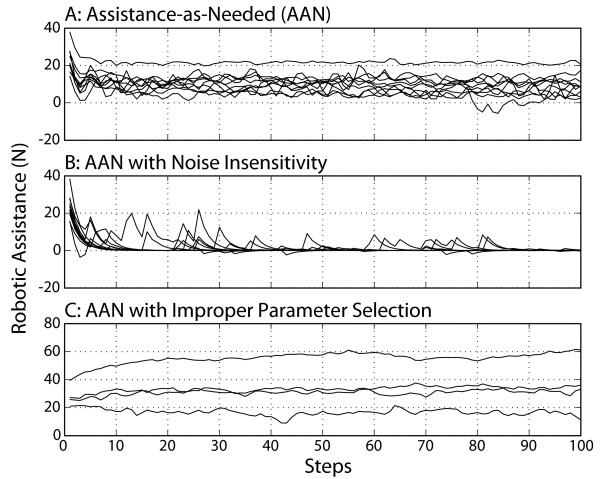
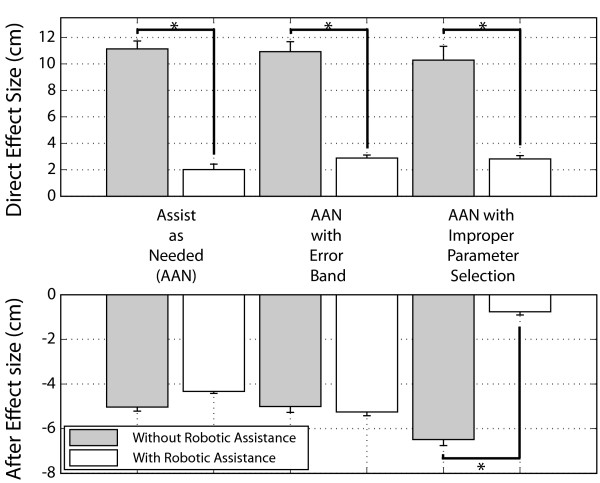
Background: A prevailing paradigm of physical rehabilitation following neurologic injury is to "assist-as-needed" in completing desired movements. Several research groups are attempting to automate this principle with robotic movement training devices and patient cooperative algorithms that encourage voluntary participation. These attempts are currently not based on computational models of motor learning. Methods: Here we assume that motor recovery from a neurologic injury can be modelled as a process of learning a novel sensory motor transformation, which allows us to study a simplified experimental protocol amenable to mathematical description. Specifically, we use a robotic force field paradigm to impose a virtual impairment on the left leg of unimpaired subjects walking on a treadmill. We then derive an "assist-as-needed" robotic training algorithm to help subjects overcome the virtual impairment and walk normally. The problem is posed as an optimization of performance error and robotic assistance. The optimal robotic movement trainer becomes an error-based controller with a forgetting factor that bounds kinematic errors while systematically reducing its assistance when those errors are small. As humans have a natural range of movement variability, we introduce an error weighting function that causes the robotic trainer to disregard this variability. Results: We experimentally validated the controller with ten unimpaired subjects by demonstrating how it helped the subjects learn the novel sensory motor transformation necessary to counteract the virtual impairment, while also preventing them from experiencing large kinematic errors. The addition of the error weighting function allowed the robot assistance to fade to zero even though the subjects' movements were variable. We also show that in order to assist-as-needed, the robot must relax its assistance at a rate faster than that of the learning human. Conclusion: The assist-as-needed algorithm proposed here can limit error during the learning of a dynamic motor task. The algorithm encourages learning by decreasing its assistance as a function of the ongoing progression of movement error. This type of algorithm is well suited for helping people learn dynamic tasks for which large kinematic errors are dangerous or discouraging, and thus may prove useful for robot-assisted movement training of walking or reaching following neurologic injury.
Overview
The claims and statistics of this paper haven’t been checked yet.
Free: it reads the open-access text and checks the first 5 claims that cite a source we can check. Create a free account to check every claim.
Integrity signals
Registry
Cites
Statistics
Figures
Verification
Claims the paper makes
The claims and statistics of this paper haven’t been checked yet.
Free: it reads the open-access text and checks the first 5 claims that cite a source we can check. Create a free account to check every claim.
Claims other papers make about this one
Each is checked against this paper’s own text: does it say what the citing paper says it does?
The cited source says what the claim attributes to it.
In the citing paper
“Thus, making errors drives motor learning (Emken et al., 2007;Emken & Reinkensmeyer, 2005;Patton, Stoykov, Kovic, & Mussa-Ivaldi, 2006;Reisman, Wityk, Silver, & Bastian, 2007;Thoroughman & Shadmehr, 2000;v a n Beers, 2009).”
From Augmented visual, auditory, haptic, and multimodal feedback in motor learning: A review (2013) · cites this paper as Emken et al., 2007
Experimental — accuracy not yet measured
Self-check
Percentages, sums and reported differences re-computed from the paper’s own numbers.
The self-check needs the paper’s full text.
Citations
Cites
Adaptive representation of dynamics during learning of a motor task
Shadmehr, R., & Mussa-Ivaldi, F. (1994) · The Journal of Neuroscience · doi:10.1523/jneurosci.14-05-03208.1994 · Cited by 2,612
Vidyasagar, M., & Johnson, S. H. (1978) · Journal of Dynamic Systems, Measurement, and Control · doi:10.1115/1.3426360 · Cited by 1,817
Robot-aided neurorehabilitation
Krebs, H. I., Hogan, N., Aisen, M. L., & Volpe, B. T. (1998) · IEEE Transactions on Rehabilitation Engineering · doi:10.1109/86.662623 · Cited by 1,425
Vidyasagar, M. (2002) · Society for Industrial and Applied Mathematics eBooks · doi:10.1137/1.9780898719185 · Cited by 996
Learning of action through adaptive combination of motor primitives
Thoroughman, K. A., & Shadmehr, R. (2000) · Nature · doi:10.1038/35037588 · Cited by 945
Patient- cooperative strategies for robot-aided treadmill training: first experimental results
Riener, R., Lunenburger, L., Jezernik, S., Anderschitz, M., Colombo, G., & Dietz, V. (2005) · IEEE Transactions on Neural Systems and Rehabilitation Engineering · doi:10.1109/tnsre.2005.848628 · Cited by 729
Rehabilitation Robotics: Performance-Based Progressive Robot-Assisted Therapy
Krebs, H. I., Palazzolo, J. J., Dipietro, L., Ferraro, M., Krol, J., Rannekleiv, K., Volpe, B. T., & Hogan, N. (2003) · Autonomous Robots · doi:10.1023/a:1024494031121 · Cited by 714
Patton, J. L., Stoykov, M. E., Kovic, M., & Mussa-Ivaldi, F. A. (2006) · Experimental Brain Research · doi:10.1007/s00221-005-0097-8 · Cited by 469
Robotics, Motor Learning, and Neurologic Recovery
Reinkensmeyer, D. J., Emken, J. L., & Cramer, S. C. (2004) · Annual Review of Biomedical Engineering · doi:10.1146/annurev.bioeng.6.040803.140223 · Cited by 415
Self-citationLearning to move amid uncertainty
Scheidt, R. A., Dingwell, J. B., & Mussa-Ivaldi, F. A. (2001) · Journal of Neurophysiology · doi:10.1152/jn.2001.86.2.971 · Cited by 411
Research works printed but not linked: 3
- Trombly CA Occupational therapy for dysfunction, 4th Edition 1995 4th Baltimore, Williams and Wilkins
- Kahn LE Lum PS Reinkensmeyer DJ Selection of Robotic Therapy Algorithms for the Upper Extremity in Chronic Stroke: Insights from MIME and ARM Guide Results:; Kaist, Daejeon, Republic of Korea. 2003 208 210
- Reinkensmeyer DJ Emken JL Liu J Bobrow JE The Nervous System Appears to Minimize a Weighted Sum of Kinematic Error, Force, and Change in Force when Adapting to Viscous Environments during Reaching and Stepping: Oct; San Diego, CA,. 2004
Cited by
Augmented visual, auditory, haptic, and multimodal feedback in motor learning: A review
Sigrist, R., Rauter, G., Riener, R., & Wolf, P. (2013) · Psychonomic Bulletin & Review · doi:10.3758/s13423-012-0333-8 · Cited by 1,416
Review of control strategies for robotic movement training after neurologic injury
Marchal-Crespo, L., & Reinkensmeyer, D. J. (2009) · Journal of NeuroEngineering and Rehabilitation · doi:10.1186/1743-0003-6-20 · Cited by 1,182
Self-citationOptimizing Compliant, Model-Based Robotic Assistance to Promote Neurorehabilitation
Wolbrecht, E. T., Chan, V., Reinkensmeyer, D. J., & Bobrow, J. E. (2008) · IEEE Transactions on Neural Systems and Rehabilitation Engineering · doi:10.1109/tnsre.2008.918389 · Cited by 506
Self-citationRobotic neurorehabilitation: a computational motor learning perspective
Huang, V. S., & Krakauer, J. W. (2009) · Journal of NeuroEngineering and Rehabilitation · doi:10.1186/1743-0003-6-5 · Cited by 425
Design of a Cable-Driven Arm Exoskeleton (CAREX) for Neural Rehabilitation
Mao, Y., & Agrawal, S. K. (2012) · IEEE Transactions on Robotics · doi:10.1109/tro.2012.2189496 · Cited by 409
Field-Fote, E. C., & Roach, K. E. (2011) · Physical Therapy · doi:10.2522/ptj.20090359 · Cited by 302
Motor Adaptation as a Greedy Optimization of Error and Effort
Emken, J. L., Benitez, R., Sideris, A., Bobrow, J. E., & Reinkensmeyer, D. J. (2007) · Journal of Neurophysiology · doi:10.1152/jn.01095.2006 · Cited by 256
Self-citationAdaptive Impedance Control of a Robotic Orthosis for Gait Rehabilitation
Hussain, S., Xie, S. Q., & Jamwal, P. K. (2013) · IEEE Transactions on Cybernetics · doi:10.1109/tsmcb.2012.2222374 · Cited by 223
Computational neurorehabilitation: modeling plasticity and learning to predict recovery
Reinkensmeyer, D. J., Burdet, E., Casadio, M., Krakauer, J. W., Kwakkel, G., Lang, C. E., Swinnen, S. P., Ward, N. S., & Schweighofer, N. (2016) · Journal of NeuroEngineering and Rehabilitation · doi:10.1186/s12984-016-0148-3 · Cited by 183
Self-citationHuman Movement Training With a Cable Driven ARm EXoskeleton (CAREX)
Mao, Y., Jin, X., Gera Dutta, G., Scholz, J. P., & Agrawal, S. K. (2015) · IEEE Transactions on Neural Systems and Rehabilitation Engineering · doi:10.1109/tnsre.2014.2329018 · Cited by 178
A Framework to Describe, Analyze and Generate Interactive Motor Behaviors
Jarrassé, N., Charalambous, T., & Burdet, E. (2012) · PLoS ONE · doi:10.1371/journal.pone.0049945 · Cited by 177
Haptic Guidance Can Enhance Motor Learning of a Steering Task
Crespo, L. M., & Reinkensmeyer, D. J. (2008) · Journal of Motor Behavior · doi:10.3200/jmbr.40.6.545-557 · Cited by 166
Self-citationTeramae, T., Noda, T., & Morimoto, J. (2018) · IEEE Robotics and Automation Letters · doi:10.1109/lra.2017.2737478 · Cited by 156
The effect of haptic guidance, aging, and initial skill level on motor learning of a steering task
Marchal-Crespo, L., McHughen, S., Cramer, S. C., & Reinkensmeyer, D. J. (2010) · Experimental Brain Research · doi:10.1007/s00221-009-2026-8 · Cited by 143
Self-citationJohnson, M. J. (2006) · Journal of NeuroEngineering and Rehabilitation · doi:10.1186/1743-0003-3-29 · Cited by 161
Can Robots Help the Learning of Skilled Actions?
Reinkensmeyer, D. J., & Patton, J. L. (2009) · Exercise and Sport Sciences Reviews · doi:10.1097/jes.0b013e3181912108 · Cited by 133
Self-citationRehabilitation and Health Care Robotics
der Loos, H. F. M. V., Reinkensmeyer, D. J., & Guglielmelli, E. (2016) · Springer handbooks · doi:10.1007/978-3-319-32552-1_64 · Cited by 146
Self-citationReview on Patient-Cooperative Control Strategies for Upper-Limb Rehabilitation Exoskeletons
Gasperina, S. D., Roveda, L., Pedrocchi, A., Braghin, F., & Gandolla, M. (2021) · Frontiers in Robotics and AI · doi:10.3389/frobt.2021.745018 · Cited by 138
Robot assisted treadmill training: Mechanisms and training strategies
Hussain, S., Xie, S. Q., & Liu, G. (2011) · Medical Engineering & Physics · doi:10.1016/j.medengphy.2010.12.010 · Cited by 122
Sigrist, R., Rauter, G., Riener, R., & Wolf, P. (2013) · Journal of Motor Behavior · doi:10.1080/00222895.2013.826169 · Cited by 134
The effect of haptic guidance and visual feedback on learning a complex tennis task
Marchal–Crespo, L., van Raai, M. A., Rauter, G., Wolf, P., & Riener, R. (2013) · Experimental Brain Research · doi:10.1007/s00221-013-3690-2 · Cited by 126
Aguirre-Ollinger, G., & Yu, H. (2020) · IEEE Transactions on Robotics · doi:10.1109/tro.2020.3034017 · Cited by 103
Assist-as-Needed Control of an Intrinsically Compliant Robotic Gait Training Orthosis
Hussain, S., Jamwal, P. K., Ghayesh, M. H., & Xie, S. Q. (2016) · IEEE Transactions on Industrial Electronics · doi:10.1109/tie.2016.2580123 · Cited by 105
The Body-Machine Interface: A New Perspective on an Old Theme
Casadio, M., Ranganathan, R., & Mussa-Ivaldi, F. A. (2012) · Journal of Motor Behavior · doi:10.1080/00222895.2012.700968 · Cited by 109
Multidirectional transparent support for overground gait training
Vallery, H., Lutz, P., Zitzewitz, J. V., Rauter, G., Fritschi, M., Everarts, C., Ronsse, R., Curt, A. E. P., & Bolliger, M. (2013) · International Conference on Rehabilitation Robotics · doi:10.1109/icorr.2013.6650512 · Cited by 98
Koopman, B., van Asseldonk, E. H. F., & van der Kooij, H. (2013) · Journal of NeuroEngineering and Rehabilitation · doi:10.1186/1743-0003-10-3 · Cited by 81
Learning, Retention, and Slacking: A Model of the Dynamics of Recovery in Robot Therapy
Casadio, M., & Sanguineti, V. (2012) · IEEE Transactions on Neural Systems and Rehabilitation Engineering · doi:10.1109/tnsre.2012.2190827 · Cited by 77
Sawers, A. B., Bhattacharjee, T., McKay, J. L., Hackney, M. E., Kemp, C. C., & Ting, L. H. (2017) · Journal of NeuroEngineering and Rehabilitation · doi:10.1186/s12984-017-0217-2 · Cited by 77
Adaptive Impedance Control Applied to Robot-Aided Neuro-Rehabilitation of the Ankle
Perez-Ibarra, J. C., Siqueira, A. A. G., Silva‐Couto, M. A., Russo, T. L., & Krebs, H. I. (2018) · IEEE Robotics and Automation Letters · doi:10.1109/lra.2018.2885165 · Cited by 75
Wu, M., Landry, J. M., Schmit, B. D., Hornby, T. G., & Yen, S. (2012) · Archives of Physical Medicine and Rehabilitation · doi:10.1016/j.apmr.2011.12.018 · Cited by 77
Influence of haptic guidance in learning a novel visuomotor task
van Asseldonk, E. H. F., Wessels, M., Stienen, A. H. A., van der Helm, F. C. T., & van der Kooij, H. (2009) · Journal of Physiology-Paris · doi:10.1016/j.jphysparis.2009.08.010 · Cited by 80
Robotic Gait Rehabilitation Trainer
Pietrusinski, M. D., Cajigas, I., Severini, G., Bonato, P., & Mavroidis, C. (2013) · IEEE/ASME Transactions on Mechatronics · doi:10.1109/tmech.2013.2243915 · Cited by 68
Assist-As-Needed control of a hip exoskeleton based on a novel strength index
Naghavi, N., Akbarzadeh, A., Tahamipour-Z., S. M., & Kardan, I. (2020) · Robotics and Autonomous Systems · doi:10.1016/j.robot.2020.103667 · Cited by 69
State-of-the-Art Assistive Powered Upper Limb Exoskeletons for Elderly
Kapsalyamov, A., Hussain, S., & Jamwal, P. K. (2020) · IEEE Access · doi:10.1109/access.2020.3026641 · Cited by 69
Closed-Loop Brain–Machine–Body Interfaces for Noninvasive Rehabilitation of Movement Disorders
Broccard, F. D., Mullen, T. R., Chi, Y. M., Peterson, D., Iversen, J. R., Arnold, M., Kreutz-Delgado, K., Jung, T., Makeig, S., Poizner, H., et al. (2014) · Annals of Biomedical Engineering · doi:10.1007/s10439-014-1032-6 · Cited by 68
Processing Surface EMG Signals for Exoskeleton Motion Control
Yin, G., Zhang, X., Chen, D., Li, H., Chen, J., Chen, C., & Lemos, S. E. (2020) · Frontiers in Neurorobotics · doi:10.3389/fnbot.2020.00040 · Cited by 68
Model Predictive Control for Human-Centred Lower Limb Robotic Assistance
Caulcrick, C., Huo, W., Franco, E., Mohammed, S., Hoult, W., & Vaidyanathan, R. (2021) · IEEE Transactions on Medical Robotics and Bionics · doi:10.1109/tmrb.2021.3105141 · Cited by 58
Learning a locomotor task: with or without errors?
Marchal–Crespo, L., Schneider, J., Jaeger, L., & Riener, R. (2014) · Journal of NeuroEngineering and Rehabilitation · doi:10.1186/1743-0003-11-25 · Cited by 61
Feasibility of an optimal EMG-driven adaptive impedance control applied to an active knee orthosis
Peña, G. G., Consoni, L. J., dos Santos, W. M., & Siqueira, A. A. G. (2018) · Robotics and Autonomous Systems · doi:10.1016/j.robot.2018.11.011 · Cited by 58
Wolbrecht, E. T., Chan, V., Le, V., Cramer, S. C., Reinkensmeyer, D. J., & Bobrow, J. E. (2007) · International IEEE/EMBS Conference on Neural Engineering · doi:10.1109/cne.2007.369635 · Cited by 57
Self-citationKao, P.-C., Srivastava, S., Agrawal, S. K., & Scholz, J. P. (2012) · Gait & Posture · doi:10.1016/j.gaitpost.2012.06.025 · Cited by 55
Robot-supported assessment of balance in standing and walking
Shirota, C., van Asseldonk, E. H. F., Matjačić, Z., Vallery, H., Barralon, P., Maggioni, S., Buurke, J. H., & Veneman, J. F. (2017) · Journal of NeuroEngineering and Rehabilitation · doi:10.1186/s12984-017-0273-7 · Cited by 53
Rehabilitation and Health Care Robotics
der Loos, H. F. M. V., & Reinkensmeyer, D. J. (2008) · Springer eBooks · doi:10.1007/978-3-540-30301-5_54 · Cited by 78
Self-citationReinkensmeyer, D. J., Wolbrecht, E. T., & Bobrow, J. E. (2007) · Conference proceedings · doi:10.1109/iembs.2007.4353215 · Cited by 49
Self-citationAn Adaptive and Hybrid End-Point/Joint Impedance Controller for Lower Limb Exoskeletons
Maggioni, S., Reinert, N., Lünenburger, L., & Melendez-Calderon, A. (2018) · Frontiers in Robotics and AI · doi:10.3389/frobt.2018.00104 · Cited by 48
Online Reference Trajectory Adaptation: A Personalized Control Strategy for Lower Limb Exoskeletons
Shushtari, M., Nasiri, R., & Arami, A. (2021) · IEEE Robotics and Automation Letters · doi:10.1109/lra.2021.3115572 · Cited by 56
Alingh, J. F., Fleerkotte, B. M., Groen, B. E., Rietman, J. S., Weerdesteyn, V., van Asseldonk, E. H. F., Geurts, A. C. H., & Buurke, J. H. (2021) · Journal of NeuroEngineering and Rehabilitation · doi:10.1186/s12984-020-00800-4 · Cited by 48
Robot assistance of motor learning: A neuro-cognitive perspective
Heuer, H., & Lüttgen, J. (2015) · Neuroscience & Biobehavioral Reviews · doi:10.1016/j.neubiorev.2015.07.005 · Cited by 50
Manual Skill Generalization Enhanced by Negative Viscosity
Huang, F. C., Patton, J. L., & Mussa-Ivaldi, F. A. (2010) · Journal of Neurophysiology · doi:10.1152/jn.00433.2009 · Cited by 45
A tendon-based parallel robot applied to motor learning in sports
Rauter, G., von Zitzewitz, J., Duschau-Wicke, A., Vallery, H., & Riener, R. (2010) · 2010 3rd IEEE RAS & EMBS International Conference on Biomedical Robotics and Biomechatronics · doi:10.1109/biorob.2010.5627788 · Cited by 41
Mao, Y., & Agrawal, S. K. (2012) · Proceedings - IEEE International Conference on Robotics and Automation/Proceedings · doi:10.1109/icra.2012.6224906 · Cited by 41
Neurorobotic and hybrid management of lower limb motor disorders: a review
Moreno, J. C., del‐Ama, A. J., Reyes-Guzmán, A. D. L., Gil-Agudo, A. M., Ceres, R., & Pons, J. L. (2011) · Medical & Biological Engineering & Computing · doi:10.1007/s11517-011-0821-4 · Cited by 48
Luca, A. D., Bellitto, A., Mandraccia, S., Marchesi, G., Pellegrino, L., Coscia, M., Leoncini, C., Rossi, L., Gamba, S., Massone, A., et al. (2019) · Applied Sciences · doi:10.3390/app9142868 · Cited by 45
Aguirre-Ollinger, G., Narayan, A., & Yu, H. (2019) · IEEE Transactions on Neural Systems and Rehabilitation Engineering · doi:10.1109/tnsre.2019.2944665 · Cited by 39
Atashzar, S. F., Shahbazi, M., & Patel, R. V. (2018) · Mechatronics · doi:10.1016/j.mechatronics.2018.03.002 · Cited by 42
Adaptive Assist-as-needed Control Based on Actor-Critic Reinforcement Learning
Zhang, Y., Li, S., Nolan, K. J., & Zanotto, D. (2019) · IEEE/RSJ International Conference on Intelligent Robots and Systems (IROS) · doi:10.1109/iros40897.2019.8968464 · Cited by 42
Kressler, J., Nash, M. S., Burns, P. A., & Field-Fote, E. C. (2013) · Archives of Physical Medicine and Rehabilitation · doi:10.1016/j.apmr.2013.02.018 · Cited by 44
Robotic orthoses for gait rehabilitation: An overview of mechanical design and control strategies
Jamwal, P. K., Hussain, S., & Ghayesh, M. H. (2020) · Proceedings of the Institution of Mechanical Engineers Part H Journal of Engineering in Medicine · doi:10.1177/0954411919898293 · Cited by 40
Reinkensmeyer, D. J., Galvez, J. A., Marchal–Crespo, L., Wolbrecht, E. T., & Bobrow, J. E. (2007) · International Conference on Rehabilitation Robotics · doi:10.1109/icorr.2007.4428547 · Cited by 39
Self-citationRauter, G., Sigrist, R., Riener, R., & Wolf, P. (2015) · IEEE Transactions on Haptics · doi:10.1109/toh.2015.2431686 · Cited by 42
The effectiveness of robotic training depends on motor task characteristics
Marchal–Crespo, L., Rappo, N., & Riener, R. (2017) · Experimental Brain Research · doi:10.1007/s00221-017-5099-9 · Cited by 38
Lemus, D., Berry, A., Jabeen, S., Jayaraman, C., Hohl, K., van der Helm, F. C. T., Jayaraman, A., & Vallery, H. (2020) · Scientific Reports · doi:10.1038/s41598-020-66760-w · Cited by 38
Assist-As-Needed Control Strategy of Bilateral Upper Limb Rehabilitation Robot Based on GMM
Li, M., Zhang, J., Zuo, G., Feng, G., & Zhang, X. (2022) · Machines · doi:10.3390/machines10020076 · Cited by 32
Construction Robot Teleoperation Safeguard Based on Real-Time Human Hand Motion Prediction
Zhou, T., Zhu, Q., Shi, Y., & Du, J. (2022) · Journal of Construction Engineering and Management · doi:10.1061/(asce)co.1943-7862.0002289 · Cited by 38
The Effect of Haptic Guidance on Learning a Hybrid Rhythmic-Discrete Motor Task
Marchal–Crespo, L., Bannwart, M., Riener, R., & Vallery, H. (2014) · IEEE Transactions on Haptics · doi:10.1109/toh.2014.2375173 · Cited by 37
Squeri, V., Basteris, A., & Sanguineti, V. (2011) · International Conference on Rehabilitation Robotics · doi:10.1109/icorr.2011.5975375 · Cited by 37
Reinforcement Learning Methods for Assistive and Rehabilitation Robotic Systems: A Survey
Sharifi, M., Tripathi, S., Chen, Y., Zhang, Q., & Tavakoli, M. (2025) · IEEE Transactions on Systems Man and Cybernetics Systems · doi:10.1109/tsmc.2025.3555598 · Cited by 47
Robot-Assisted Rehabilitation Therapy: Recovery Mechanisms and Their Implications for Machine Design
Bejarano, N. C., Maggioni, S., Rijcke, L. D., Cifuentes, C. A., & Reinkensmeyer, D. J. (2015) · Biosystems & biorobotics · doi:10.1007/978-3-319-24901-8_8 · Cited by 37
Self-citationOptimized passive dynamics improve transparency of haptic devices
Vallery, H., Duschau-Wicke, A., & Riener, R. (2009) · Proceedings - IEEE International Conference on Robotics and Automation/Proceedings · doi:10.1109/robot.2009.5152619 · Cited by 32
Assisting Versus Repelling Force-Feedback for Learning of a Line Following Task in a Wheelchair
Chen, X., & Agrawal, S. K. (2013) · IEEE Transactions on Neural Systems and Rehabilitation Engineering · doi:10.1109/tnsre.2013.2245917 · Cited by 37
Design and Validation of a Lower-Limb Haptic Rehabilitation Robot
Dawson-Elli, A., & Adamczyk, P. G. (2020) · IEEE Transactions on Neural Systems and Rehabilitation Engineering · doi:10.1109/tnsre.2020.3000735 · Cited by 34
An Adaptive Assistance Controller to Optimize the Exoskeleton Contribution in Rehabilitation
Nasiri, R., Shushtari, M., & Arami, A. (2021) · Robotics · doi:10.3390/robotics10030095 · Cited by 33
Robot therapy for stroke survivors: proprioceptive training and regulation of assistance
Sanguineti, V., Casadio, M., Vergaro, E., Squeri, V., Giannoni, P., & Morasso, P. (2009) · Studies in health technology and informatics · doi:10.3233/978-1-60750-018-6-126 · Cited by 28
Zhou, T., Wang, Y., Zhu, Q., & Du, J. (2022) · Automation in Construction · doi:10.1016/j.autcon.2022.104232 · Cited by 28
Kao, P.-C., Lewis, C. L., & Ferris, D. P. (2010) · Journal of NeuroEngineering and Rehabilitation · doi:10.1186/1743-0003-7-33 · Cited by 31
Theriault, A. R., Nagurka, M. L., & Johnson, M. J. (2013) · IEEE Transactions on Haptics · doi:10.1109/toh.2013.51 · Cited by 28
Robot-aided assessment of walking function based on an adaptive algorithm
Maggioni, S., Lünenburger, L., Riener, R., & Melendez-Calderon, A. (2015) · International Conference on Rehabilitation Robotics · doi:10.1109/icorr.2015.7281301 · Cited by 28
Ankle-targeted exosuit resistance increases paretic propulsion in people post-stroke
Swaminathan, K., Porciuncula, F., Park, S., Kannan, H., Erard, J., Wendel, N. C., Baker, T. C., Ellis, T. D., Awad, L. N., & Walsh, C. J. (2023) · Journal of NeuroEngineering and Rehabilitation · doi:10.1186/s12984-023-01204-w · Cited by 29
Washabaugh, E., Treadway, E., Gillespie, R., Remy, C., & Krishnan, C. (2018) · Restorative Neurology and Neuroscience · doi:10.3233/rnn-180830 · Cited by 30
Robot Training With Vector Fields Based on Stroke Survivors’ Individual Movement Statistics
Wright, Z. A., Lazzaro, E., Thielbar, K. O., Patton, J. L., & Huang, F. C. (2017) · IEEE Transactions on Neural Systems and Rehabilitation Engineering · doi:10.1109/tnsre.2017.2763458 · Cited by 25
Assistance or challenge? Filling a gap in user-cooperative control
Rauter, G., Sigrist, R., Marchal-Crespo, L., Vallery, H., Riener, R., & Wolf, P. (2011) · 2011 IEEE/RSJ International Conference on Intelligent Robots and Systems · doi:10.1109/iros.2011.6094832 · Cited by 24
Maggioni, S., Lünenburger, L., Riener, R., Curt, A. E. P., Bolliger, M., & Melendez-Calderon, A. (2023) · Journal of NeuroEngineering and Rehabilitation · doi:10.1186/s12984-023-01226-4 · Cited by 28
Robotic assistance for upper extremity training after stroke.
Reinkensmeyer, D. J. (2009) · PubMed · Cited by 25
Self-citationRobot-Aided Gait Training with LOPES
van Asseldonk, E. H. F., & van der Kooij, H. (2011) · Springer eBooks · doi:10.1007/978-1-4471-2277-7_21 · Cited by 28
Learning with Slight Forgetting Optimizes Sensorimotor Transformation in Redundant Motor Systems
Hirashima, M., & Nozaki, D. (2012) · PLoS Computational Biology · doi:10.1371/journal.pcbi.1002590 · Cited by 28
Oscillator-Based Transparent Control of an Active/Semiactive Ankle-Foot Orthosis
Zhang, Y., Nolan, K. J., & Zanotto, D. (2018) · IEEE Robotics and Automation Letters · doi:10.1109/lra.2018.2886400 · Cited by 22
Augmenting rehabilitation robotics with spinal cord neuromodulation: A proof of concept
Hankov, N., Caban, M., Demesmaeker, R., Roulet, M., Komi, S., Xiloyannis, M., Gehrig, A., Varescon, C., Spiess, M. R., Maggioni, S., et al. (2025) · Science Robotics · doi:10.1126/scirobotics.adn5564 · Cited by 30
Synthesis and control of an assistive robotic tennis trainer
Marchal-Crespo, L., Rauter, G., Wyss, D., von Zitzewitz, J., & Riener, R. (2012) · 2012 4th IEEE RAS & EMBS International Conference on Biomedical Robotics and Biomechatronics (BioRob) · doi:10.1109/biorob.2012.6290262 · Cited by 20
Huang, X., Naghdy, F., Du, H., Naghdy, G. A., & Murray, G. (2017) · Computer Methods in Biomechanics and Biomedical Engineering Imaging & Visualization · doi:10.1080/21681163.2017.1343687 · Cited by 20
A Tool for Balance Control Training Using Muscle Synergies and Multimodal Interfaces
Galeano, D., Brunetti, F., Torricelli, D., Piazza, S., & Pons, J. L. (2014) · BioMed Research International · doi:10.1155/2014/565370 · Cited by 19
An fMRI pilot study to evaluate brain activation associated with locomotion adaptation
Marchal–Crespo, L., Hollnagel, C., Brügger, M., Kollias, S., & Riener, R. (2011) · International Conference on Rehabilitation Robotics · doi:10.1109/icorr.2011.5975371 · Cited by 23
van Asseldonk, E. H. F., Koopman, B., Buurke, J. H., Simons, C. D. M., & van der Kooij, H. (2009) · International Conference on Rehabilitation Robotics · doi:10.1109/icorr.2009.5209514 · Cited by 19
Lag–lead based assessment and adaptation of exercise speed for stroke survivors
Basteris, A., Nijenhuis, S. M., Buurke, J. H., Prange, G. B., & Amirabdollahian, F. (2014) · Robotics and Autonomous Systems · doi:10.1016/j.robot.2014.08.013 · Cited by 23
Reinforcement Learning Assist-as-needed Control for Robot Assisted Gait Training
Zhang, Y., Li, S., Nolan, K. J., & Zanotto, D. (2020) · IEEE/RAS-EMBS International Conference on Biomedical Robotics and Biomechatronics (BioRob) · doi:10.1109/biorob49111.2020.9224392 · Cited by 22
Shaping Individualized Impedance Landscapes for Gait Training via Reinforcement Learning
Zhang, Y., Li, S., Nolan, K. J., & Zanotto, D. (2021) · IEEE Transactions on Medical Robotics and Bionics · doi:10.1109/tmrb.2021.3137971 · Cited by 18
Mancisidor, A., Zubizarreta, A., Cabanes, I., Bengoa, P., Brull, A., & Jung, J. H. (2019) · Mechatronics · doi:10.1016/j.mechatronics.2019.02.002 · Cited by 16
Evaluation of force field training customized according to individual movement deficit patterns
Wright, Z. A., Patton, J. L., Huang, F. C., & Lazzaro, E. (2015) · International Conference on Rehabilitation Robotics · doi:10.1109/icorr.2015.7281198 · Cited by 16
Perturbation schedule does not alter retention of a locomotor adaptation across days
Hussain, S. J., & Morton, S. M. (2014) · Journal of Neurophysiology · doi:10.1152/jn.00570.2013 · Cited by 19
Givon-Mayo, R., Simons, E., Ohry, A., Karpin, H., Israely, S., & Carmeli, E. (2014) · International Journal of Therapy and Rehabilitation · doi:10.12968/ijtr.2014.21.4.160 · Cited by 18
Yoon, H. U., Wang, R. F., Hutchinson, S., & Hur, P. (2017) · Robotics and Autonomous Systems · doi:10.1016/j.robot.2017.01.015 · Cited by 15
Metadata
- Authors
- Emken, J. L., Benitez, R., & Reinkensmeyer, D. J.
- Affiliations
- University of California, Irvine (US)
- Corresponding author
- Reinkensmeyer, David J
- Venue
- Journal of NeuroEngineering and Rehabilitation
- Published
- 2007-03-28
- Volume
- 4
- Issue
- 1
- Pages
- 8-8
- ISSN
- 1743-0003 (ISSN-L)
- PMC
- PMC1847825
- OpenAlex
- W2003775018
- Cited by
- 199
- References
- 39
- Citations by year
- 2026: 7 · 2025: 12 · 2024: 8 · 2023: 10 · 2022: 8 · 2021: 11 · 2020: 12 · 2019: 9 · 2018: 11 · 2017: 10 · 2016: 8 · 2015: 10 · 2014: 13 · 2013: 14 · 2012: 15
- FWCI
- 7.18
- Type
- journal article
- Language
- en
- Open access
- gold
- doi.org
- Licence
- cc-by
- Locations
- Journal of NeuroEngineering and Rehabilitation (publishedVersion, cc-by)
- Europe PMC (PubMed Central) (publishedVersion, cc-by)
- PubMed Central (publishedVersion, cc-by)
- PubMed (publishedVersion)
- RECERCAT (Consorci de Serveis Universitaris de Catalunya) (acceptedVersion, other-oa)
- LA Referencia (Red Federada de Repositorios Institucionales de Publicaciones Científicas) (submittedVersion, public-domain)
- DOAJ (DOAJ: Directory of Open Access Journals) (submittedVersion)
- eScholarship (California Digital Library) (submittedVersion)
- UPCommons institutional repository (Universitat Politècnica de Catalunya) (submittedVersion, cc-by-nc-nd)
- Funders
- Achievement Rewards for College Scientists Foundation
- National Institutes of Health (NIH-R01)
- National Institute of Standards and Technology
- National Institute on Disability and Rehabilitation Research (H133E020732)
- National Institute of Neurological Disorders and Stroke (R01NS040917)
- National Center for Research Resources (M-01RR00827, M01RR000827)
- Topics
- Physical Sciences › Engineering › Biomedical Engineering › Prosthetics and Rehabilitation Robotics
- Life Sciences › Neuroscience › Cognitive Neuroscience › Motor Control and Adaptation
- Health Sciences › Medicine › Rehabilitation › Stroke Rehabilitation and Recovery
- Keywords
- robotic assistance, human-robot collaboration, sensory-motor transformation, motor learning, force fields, treadmill walking, forgetting factor, error weighting, movement variability, kinematic error
- MeSH terms
- Adult, Algorithms, Female, Humans, Learning, Male, Models, Theoretical, Nervous System Diseases, Robotics, Task Performance and Analysis, Vision Disorders, Walking
About these checks
Registry, retraction, Cites and statistics results are computed, not judged, with one exception: a printed reference that no index lists is read once by a model before it counts as a citation error. Claims are extracted by a model and kept only when their quote appears verbatim in the text; each cited source is then checked, with a model’s help, for whether it says what the claim relies on. Those verdicts can be wrong — read the claim’s quote and the cited source before relying on one.
Statistics and arithmetic are recomputed, not judged.
Confidence bands are shown only for fields calibrated on our annotated test set. None is calibrated yet, so no band is shown.
What counts as a claim ›How we measure confidence ›How we check this ›
Are you an author, or do you see a problem with this page? Request a review
Data sources
Bibliographic data: Semantic Scholar, OpenAlex, Crossref.
Contains information from the Semantic Scholar Academic Graph Datasets, made available under the ODC Attribution License (ODC-BY 1.0).
Semantic Scholar’s data is described in: Kinney, R., et al. (2023). The Semantic Scholar Open Data Platform. arXiv:2301.10140.
