

Human-robot cooperative movement training: Learning a novel sensory motor transformation during walking with robotic assistance-as-needed
Open accessThe DOI matches its Crossref record; 35 of the 39 references it cites were found in a registry or an index.
Abstract
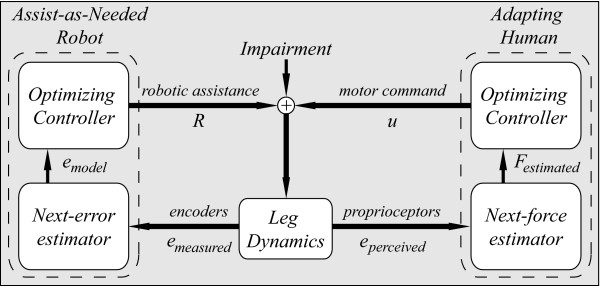
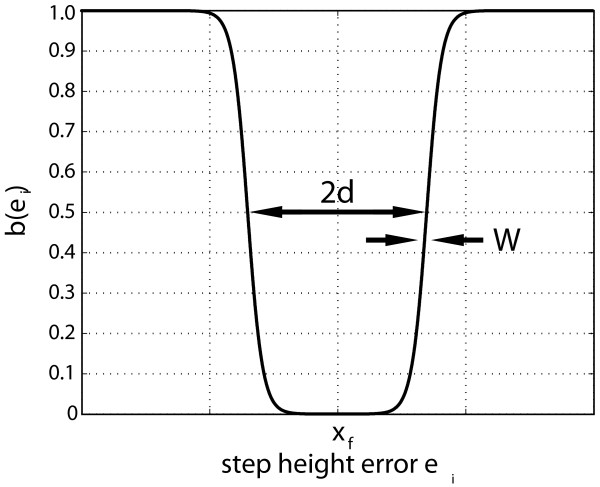
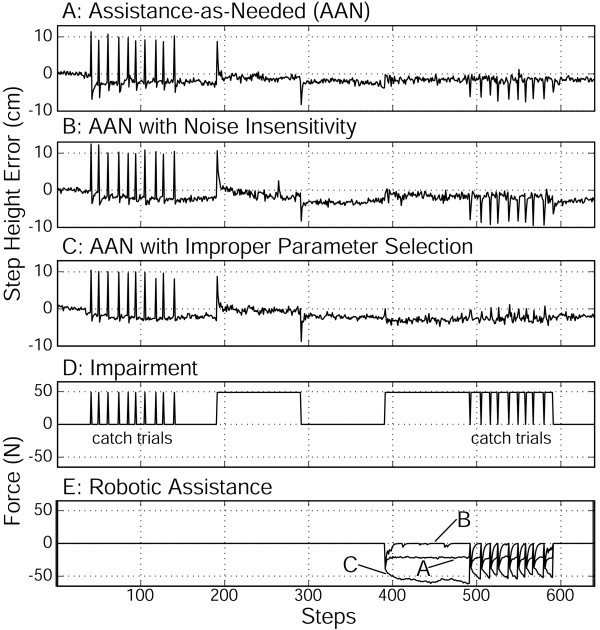
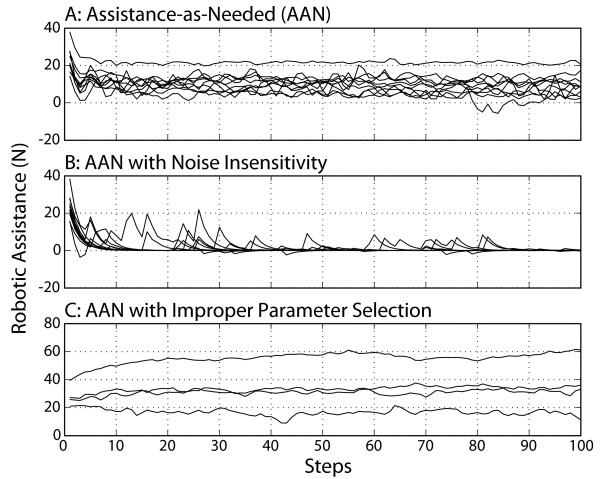
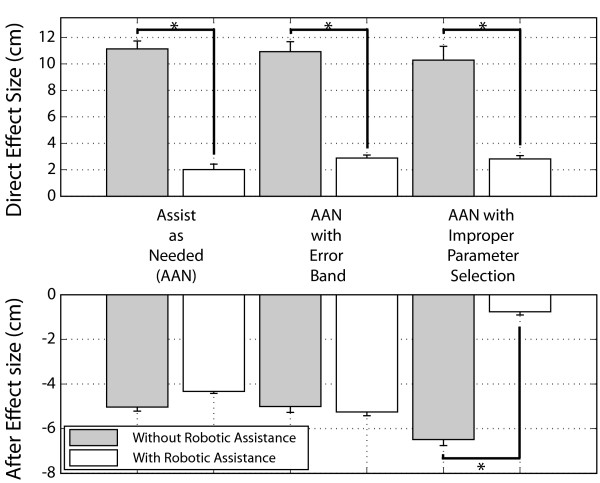
Background: A prevailing paradigm of physical rehabilitation following neurologic injury is to "assist-as-needed" in completing desired movements. Several research groups are attempting to automate this principle with robotic movement training devices and patient cooperative algorithms that encourage voluntary participation. These attempts are currently not based on computational models of motor learning. Methods: Here we assume that motor recovery from a neurologic injury can be modelled as a process of learning a novel sensory motor transformation, which allows us to study a simplified experimental protocol amenable to mathematical description. Specifically, we use a robotic force field paradigm to impose a virtual impairment on the left leg of unimpaired subjects walking on a treadmill. We then derive an "assist-as-needed" robotic training algorithm to help subjects overcome the virtual impairment and walk normally. The problem is posed as an optimization of performance error and robotic assistance. The optimal robotic movement trainer becomes an error-based controller with a forgetting factor that bounds kinematic errors while systematically reducing its assistance when those errors are small. As humans have a natural range of movement variability, we introduce an error weighting function that causes the robotic trainer to disregard this variability. Results: We experimentally validated the controller with ten unimpaired subjects by demonstrating how it helped the subjects learn the novel sensory motor transformation necessary to counteract the virtual impairment, while also preventing them from experiencing large kinematic errors. The addition of the error weighting function allowed the robot assistance to fade to zero even though the subjects' movements were variable. We also show that in order to assist-as-needed, the robot must relax its assistance at a rate faster than that of the learning human. Conclusion: The assist-as-needed algorithm proposed here can limit error during the learning of a dynamic motor task. The algorithm encourages learning by decreasing its assistance as a function of the ongoing progression of movement error. This type of algorithm is well suited for helping people learn dynamic tasks for which large kinematic errors are dangerous or discouraging, and thus may prove useful for robot-assisted movement training of walking or reaching following neurologic injury.
Overview
The claims and statistics of this paper haven’t been checked yet.
Free: it reads the open-access text and checks the first 5 claims that cite a source we can check. Create a free account to check every claim.
Integrity signals
Registry
Cites
Statistics
Figures
Verification
Claims the paper makes
The claims and statistics of this paper haven’t been checked yet.
Free: it reads the open-access text and checks the first 5 claims that cite a source we can check. Create a free account to check every claim.
Claims other papers make about this one
Each is checked against this paper’s own text: does it say what the citing paper says it does?
The cited source says what the claim attributes to it.
In the citing paper
“Thus, making errors drives motor learning (Emken et al., 2007;Emken & Reinkensmeyer, 2005;Patton, Stoykov, Kovic, & Mussa-Ivaldi, 2006;Reisman, Wityk, Silver, & Bastian, 2007;Thoroughman & Shadmehr, 2000;v a n Beers, 2009).”
From Augmented visual, auditory, haptic, and multimodal feedback in motor learning: A review (2013) · cites this paper as Emken et al., 2007
Experimental — accuracy not yet measured
Self-check
Percentages, sums and reported differences re-computed from the paper’s own numbers.
The self-check needs the paper’s full text.
Citations
Cites
Adaptive representation of dynamics during learning of a motor task
Shadmehr, R., & Mussa-Ivaldi, F. (1994) · The Journal of Neuroscience · doi:10.1523/jneurosci.14-05-03208.1994 · Cited by 2,612
Vidyasagar, M., & Johnson, S. H. (1978) · Journal of Dynamic Systems, Measurement, and Control · doi:10.1115/1.3426360 · Cited by 1,817
Robot-aided neurorehabilitation
Krebs, H. I., Hogan, N., Aisen, M. L., & Volpe, B. T. (1998) · IEEE Transactions on Rehabilitation Engineering · doi:10.1109/86.662623 · Cited by 1,425
Vidyasagar, M. (2002) · Society for Industrial and Applied Mathematics eBooks · doi:10.1137/1.9780898719185 · Cited by 996
Learning of action through adaptive combination of motor primitives
Thoroughman, K. A., & Shadmehr, R. (2000) · Nature · doi:10.1038/35037588 · Cited by 945
Patient- cooperative strategies for robot-aided treadmill training: first experimental results
Riener, R., Lunenburger, L., Jezernik, S., Anderschitz, M., Colombo, G., & Dietz, V. (2005) · IEEE Transactions on Neural Systems and Rehabilitation Engineering · doi:10.1109/tnsre.2005.848628 · Cited by 729
Rehabilitation Robotics: Performance-Based Progressive Robot-Assisted Therapy
Krebs, H. I., Palazzolo, J. J., Dipietro, L., Ferraro, M., Krol, J., Rannekleiv, K., Volpe, B. T., & Hogan, N. (2003) · Autonomous Robots · doi:10.1023/a:1024494031121 · Cited by 714
Patton, J. L., Stoykov, M. E., Kovic, M., & Mussa-Ivaldi, F. A. (2006) · Experimental Brain Research · doi:10.1007/s00221-005-0097-8 · Cited by 469
Robotics, Motor Learning, and Neurologic Recovery
Reinkensmeyer, D. J., Emken, J. L., & Cramer, S. C. (2004) · Annual Review of Biomedical Engineering · doi:10.1146/annurev.bioeng.6.040803.140223 · Cited by 415
Self-citationLearning to move amid uncertainty
Scheidt, R. A., Dingwell, J. B., & Mussa-Ivaldi, F. A. (2001) · Journal of Neurophysiology · doi:10.1152/jn.2001.86.2.971 · Cited by 411
Nonlinear systems analysis (2nd ed.)
Vidyasagar, M. (1993) · Prentice-Hall, Inc eBooks · Cited by 408
Robotic techniques for upper limb evaluation and rehabilitation of stroke patients
Colombo, R., Pisano, F., Micera, S., Mazzone, A., Delconte, C., Carrozza, M. C., Dario, P., & Minuco, G. (2005) · IEEE Transactions on Neural Systems and Rehabilitation Engineering · doi:10.1109/tnsre.2005.848352 · Cited by 399
Driven gait orthosis for improvement of locomotor training in paraplegic patients
Colombo, G., Wirz, M., & Dietz, V (2001) · Spinal Cord · doi:10.1038/sj.sc.3101154 · Cited by 396
Kahn, L. E., Zygman, M. L., Rymer, W. Z., & Reinkensmeyer, D. J. (2006) · Journal of NeuroEngineering and Rehabilitation · doi:10.1186/1743-0003-3-12 · Cited by 375
Self-citationAutomatic Gait-Pattern Adaptation Algorithms for Rehabilitation With a 4-DOF Robotic Orthosis
Jezernik, S., Colombo, G., & Morari, M. (2004) · IEEE Transactions on Robotics and Automation · doi:10.1109/tra.2004.825515 · Cited by 312
Emken, J. L., & Reinkensmeyer, D. J. (2005) · IEEE Transactions on Neural Systems and Rehabilitation Engineering · doi:10.1109/tnsre.2004.843173 · Cited by 300
Self-citationLum, P. S., Burgar, C. G., & Shor, P. C. (2004) · IEEE Transactions on Neural Systems and Rehabilitation Engineering · doi:10.1109/tnsre.2004.827225 · Cited by 281
Failure to Consolidate the Consolidation Theory of Learning for Sensorimotor Adaptation Tasks
Caithness, G., Osu, R., Bays, P., Chase, H., Klassen, J., Kawato, M., Wolpert, D. M., & Flanagan, J. R. (2004) · The Journal of Neuroscience · doi:10.1523/jneurosci.2214-04.2004 · Cited by 264
Customized interactive robotic treatment for stroke: EMG-triggered therapy
Dipietro, L., Ferraro, M., Palazzolo, J. J., Krebs, H. I., Volpe, B. T., & Hogan, N. (2005) · IEEE Transactions on Neural Systems and Rehabilitation Engineering · doi:10.1109/tnsre.2005.850423 · Cited by 241
Role of Voluntary Drive in Encoding an Elementary Motor Memory
Kaelin-Lang, A., Sawaki, L., & Cohen, L. G. (2005) · Journal of Neurophysiology · doi:10.1152/jn.00143.2004 · Cited by 190
Learning and recall of incremental kinematic and dynamic sensorimotor transformations
Klassen, J., Tong, C., & Flanagan, J. R. (2005) · Experimental Brain Research · doi:10.1007/s00221-005-2247-4 · Cited by 165
Instrumental learning within the spinal cord: I. Behavioral properties.
Grau, J. W., Barstow, D. G., & Joynes, R. L. (1998) · Behavioral Neuroscience · doi:10.1037//0735-7044.112.6.1366 · Cited by 139
Experimental results using force-feedback cueing in robot-assisted stroke therapy
Johnson, M. J., der Loos, H. F. M. V., Burgar, C. G., Shor, P. C., & LEIFER, L. J. (2005) · IEEE Transactions on Neural Systems and Rehabilitation Engineering · doi:10.1109/tnsre.2005.850428 · Cited by 94
Instrumental learning within the spinal cord
Crown, E. D., Ferguson, A. R., Joynes, R. L., & Grau, J. W. (2002) · Physiology & Behavior · doi:10.1016/s0031-9384(02)00859-4 · Cited by 93
Adaptive assistance for guided force training in chronic stroke
Kahn, L. E., Rymer, W. Z., & Reinkensmeyer, D. J. (2005) · The 26th Annual International Conference of the IEEE Engineering in Medicine and Biology Society · doi:10.1109/iembs.2004.1403780 · Cited by 88
Self-citationHesse, S., Werner, C., Uhlenbrock, D., Frankenberg, S. V., Bardeleben, A., & Brandl-Hesse, B. (2001) · Neurorehabilitation and Neural Repair · doi:10.1177/154596830101500106 · Cited by 84
A robotic device for manipulating human stepping
Emken, J. L., Wynne, J. H., Harkema, S. J., & Reinkensmeyer, D. J. (2006) · IEEE Transactions on Robotics · doi:10.1109/tro.2005.861481 · Cited by 62
Self-citationRobotic gait training: toward more natural movements and optimal training algorithms
(2004) · The 26th Annual International Conference of the IEEE Engineering in Medicine and Biology Society IEMBS-04 · doi:10.1109/iembs.2004.1404333 · Cited by 55
Self-citationAltering movement patterns in healthy and brain-injured subjects via custom designed robotic forces
Patton, J. L., Mussa-Ivaldi, F. A., & Rymer, W. Z. (2005) · 2001 Conference Proceedings of the 23rd Annual International Conference of the IEEE Engineering in Medicine and Biology Society · doi:10.1109/iembs.2001.1020448 · Cited by 41
Reinkensmeyer, D. J. (2004) · Annual International Conference of the IEEE Engineering in Medicine and Biology Society (EMBC) · doi:10.1109/iembs.2003.1279616 · Cited by 31
Self-citationError Correction Movement for Machine Assisted Stroke Rehabilitation
Amirabdollahian, F., Loureiro, R. C. V., Driessen, B., & Harwin, W. (2001) · University of Hertfordshire Research Archive (University of Hertfordshire) · doi:10.25405/ncl.34660245 · Cited by 27
Cai, L. L., Fong, A. J., Otoshi, C. K., Liang, Y., Cham, J. G., Zhong, H., Roy, R. R., Edgerton, V. R., & Burdick, J. W. (2005) · International Conference on Rehabilitation Robotics · doi:10.1109/icorr.2005.1502028 · Cited by 25
Kurtzer, I., DiZio, P., & Lackner, J. (2003) · Experimental Brain Research · doi:10.1007/s00221-003-1632-0 · Cited by 24
Task performance in spinal cord injury: effect of helplessness training.
Wool, R., Siegel, D., & Fine, P. R. (1980) · PubMed · Cited by 20
Consequences of Error Production in a Perceptual-Motor Task
Lippman, L. G., & Rees, R. (1997) · The Journal of General Psychology · doi:10.1080/00221309709595512 · Cited by 15
Research works printed but not linked: 3
- Trombly CA Occupational therapy for dysfunction, 4th Edition 1995 4th Baltimore, Williams and Wilkins
- Kahn LE Lum PS Reinkensmeyer DJ Selection of Robotic Therapy Algorithms for the Upper Extremity in Chronic Stroke: Insights from MIME and ARM Guide Results:; Kaist, Daejeon, Republic of Korea. 2003 208 210
- Reinkensmeyer DJ Emken JL Liu J Bobrow JE The Nervous System Appears to Minimize a Weighted Sum of Kinematic Error, Force, and Change in Force when Adapting to Viscous Environments during Reaching and Stepping: Oct; San Diego, CA,. 2004
Cited by
Augmented visual, auditory, haptic, and multimodal feedback in motor learning: A review
Sigrist, R., Rauter, G., Riener, R., & Wolf, P. (2013) · Psychonomic Bulletin & Review · doi:10.3758/s13423-012-0333-8 · Cited by 1,416
Review of control strategies for robotic movement training after neurologic injury
Marchal-Crespo, L., & Reinkensmeyer, D. J. (2009) · Journal of NeuroEngineering and Rehabilitation · doi:10.1186/1743-0003-6-20 · Cited by 1,182
Self-citationOptimizing Compliant, Model-Based Robotic Assistance to Promote Neurorehabilitation
Wolbrecht, E. T., Chan, V., Reinkensmeyer, D. J., & Bobrow, J. E. (2008) · IEEE Transactions on Neural Systems and Rehabilitation Engineering · doi:10.1109/tnsre.2008.918389 · Cited by 506
Self-citationRobotic neurorehabilitation: a computational motor learning perspective
Huang, V. S., & Krakauer, J. W. (2009) · Journal of NeuroEngineering and Rehabilitation · doi:10.1186/1743-0003-6-5 · Cited by 425
Design of a Cable-Driven Arm Exoskeleton (CAREX) for Neural Rehabilitation
Mao, Y., & Agrawal, S. K. (2012) · IEEE Transactions on Robotics · doi:10.1109/tro.2012.2189496 · Cited by 409
Metadata
- Authors
- Emken, J. L., Benitez, R., & Reinkensmeyer, D. J.
- Affiliations
- University of California, Irvine (US)
- Corresponding author
- Reinkensmeyer, David J
- Venue
- Journal of NeuroEngineering and Rehabilitation
- Published
- 2007-03-28
- Volume
- 4
- Issue
- 1
- Pages
- 8-8
- ISSN
- 1743-0003 (ISSN-L)
- PMC
- PMC1847825
- OpenAlex
- W2003775018
- Cited by
- 199
- References
- 39
- Citations by year
- 2026: 7 · 2025: 12 · 2024: 8 · 2023: 10 · 2022: 8 · 2021: 11 · 2020: 12 · 2019: 9 · 2018: 11 · 2017: 10 · 2016: 8 · 2015: 10 · 2014: 13 · 2013: 14 · 2012: 15
- FWCI
- 7.18
- Type
- journal article
- Language
- en
- Open access
- gold
- doi.org
- Licence
- cc-by
- Locations
- Journal of NeuroEngineering and Rehabilitation (publishedVersion, cc-by)
- Europe PMC (PubMed Central) (publishedVersion, cc-by)
- PubMed Central (publishedVersion, cc-by)
- PubMed (publishedVersion)
- RECERCAT (Consorci de Serveis Universitaris de Catalunya) (acceptedVersion, other-oa)
- LA Referencia (Red Federada de Repositorios Institucionales de Publicaciones Científicas) (submittedVersion, public-domain)
- DOAJ (DOAJ: Directory of Open Access Journals) (submittedVersion)
- eScholarship (California Digital Library) (submittedVersion)
- UPCommons institutional repository (Universitat Politècnica de Catalunya) (submittedVersion, cc-by-nc-nd)
- Funders
- Achievement Rewards for College Scientists Foundation
- National Institutes of Health (NIH-R01)
- National Institute of Standards and Technology
- National Institute on Disability and Rehabilitation Research (H133E020732)
- National Institute of Neurological Disorders and Stroke (R01NS040917)
- National Center for Research Resources (M-01RR00827, M01RR000827)
- Topics
- Physical Sciences › Engineering › Biomedical Engineering › Prosthetics and Rehabilitation Robotics
- Life Sciences › Neuroscience › Cognitive Neuroscience › Motor Control and Adaptation
- Health Sciences › Medicine › Rehabilitation › Stroke Rehabilitation and Recovery
- Keywords
- robotic assistance, human-robot collaboration, sensory-motor transformation, motor learning, force fields, treadmill walking, forgetting factor, error weighting, movement variability, kinematic error
- MeSH terms
- Adult, Algorithms, Female, Humans, Learning, Male, Models, Theoretical, Nervous System Diseases, Robotics, Task Performance and Analysis, Vision Disorders, Walking
About these checks
Registry, retraction, Cites and statistics results are computed, not judged, with one exception: a printed reference that no index lists is read once by a model before it counts as a citation error. Claims are extracted by a model and kept only when their quote appears verbatim in the text; each cited source is then checked, with a model’s help, for whether it says what the claim relies on. Those verdicts can be wrong — read the claim’s quote and the cited source before relying on one.
Statistics and arithmetic are recomputed, not judged.
Confidence bands are shown only for fields calibrated on our annotated test set. None is calibrated yet, so no band is shown.
What counts as a claim ›How we measure confidence ›How we check this ›
Are you an author, or do you see a problem with this page? Request a review
Data sources
Bibliographic data: Semantic Scholar, OpenAlex, Crossref.
Contains information from the Semantic Scholar Academic Graph Datasets, made available under the ODC Attribution License (ODC-BY 1.0).
Semantic Scholar’s data is described in: Kinney, R., et al. (2023). The Semantic Scholar Open Data Platform. arXiv:2301.10140.
