

Psycho-physiological assessment of a prosthetic hand sensory feedback system based on an auditory display: a preliminary study
Open accessThe DOI matches its Crossref record; 60 of the 60 references it cites were found in a registry or an index; 2 of the 59 sources its claims cite were checked for support.
Abstract
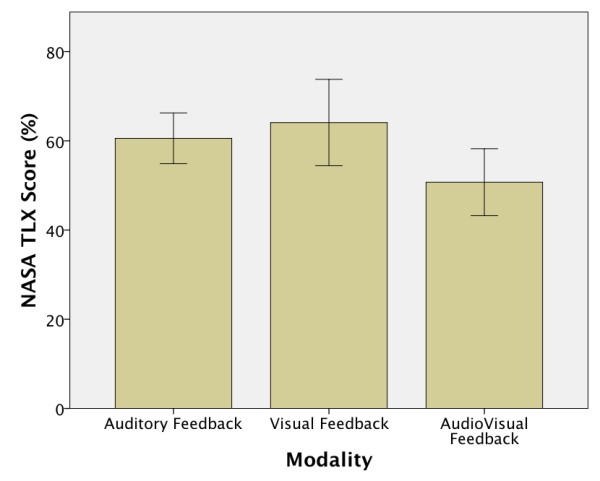
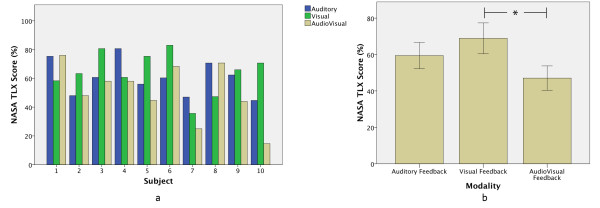
BACKGROUND: Prosthetic hand users have to rely extensively on visual feedback, which seems to lead to a high conscious burden for the users, in order to manipulate their prosthetic devices. Indirect methods (electro-cutaneous, vibrotactile, auditory cues) have been used to convey information from the artificial limb to the amputee, but the usability and advantages of these feedback methods were explored mainly by looking at the performance results, not taking into account measurements of the user's mental effort, attention, and emotions. The main objective of this study was to explore the feasibility of using psycho-physiological measurements to assess cognitive effort when manipulating a robot hand with and without the usage of a sensory substitution system based on auditory feedback, and how these psycho-physiological recordings relate to temporal and grasping performance in a static setting. METHODS: 10 male subjects (26+/-years old), participated in this study and were asked to come for 2 consecutive days. On the first day the experiment objective, tasks, and experiment setting was explained. Then, they completed a 30 minutes guided training. On the second day each subject was tested in 3 different modalities: Auditory Feedback only control (AF), Visual Feedback only control (VF), and Audiovisual Feedback control (AVF). For each modality they were asked to perform 10 trials. At the end of each test, the subject had to answer the NASA TLX questionnaire. Also, during the test the subject's EEG, ECG, electro-dermal activity (EDA), and respiration rate were measured. RESULTS: The results show that a higher mental effort is needed when the subjects rely only on their vision, and that this effort seems to be reduced when auditory feedback is added to the human-machine interaction (multimodal feedback). Furthermore, better temporal performance and better grasping performance was obtained in the audiovisual modality. CONCLUSIONS: The performance improvements when using auditory cues, along with vision (multimodal feedback), can be attributed to a reduced attentional demand during the task, which can be attributed to a visual "pop-out" or enhance effect. Also, the NASA TLX, the EEG's Alpha and Beta band, and the Heart Rate could be used to further evaluate sensory feedback systems in prosthetic applications.
Overview
CoChat Summary
## TL;DR
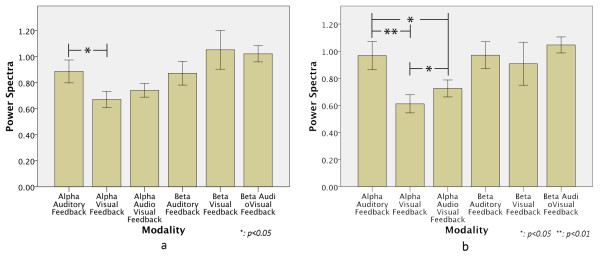
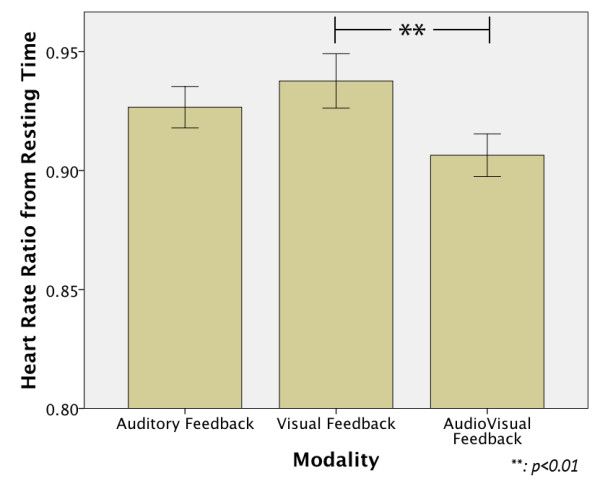
This preliminary study tested whether psycho-physiological measures can assess mental effort while manipulating a prosthetic-style robot hand with auditory, visual, or audiovisual feedback. The audiovisual condition produced the best performance and the lowest perceived/physiological workload, suggesting auditory cues added to vision reduced attentional demand.
## Key findings
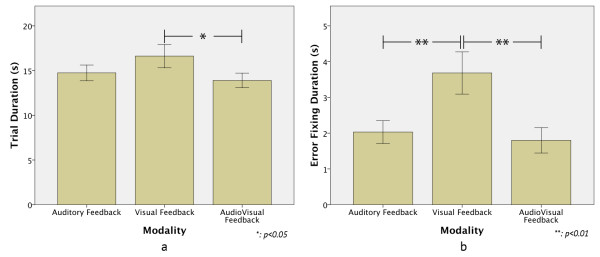
- Trial duration differed by modality: VF was significantly longer than AVF (p = 0.023), while VF vs AF was not significant (p = 0.22).
- Error detection/fix time was significantly worse in VF than in AF and AVF (both p < 0.001); AF vs AVF was not significant (p = 0.478).
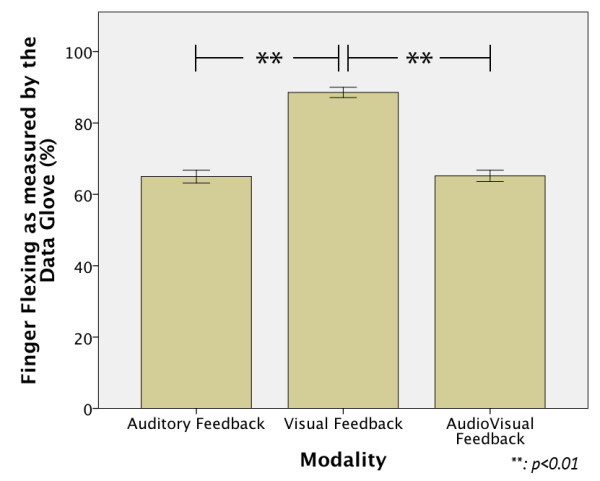
- Grasping performance also differed: finger flexion in VF was significantly different from both AF and AVF (both p = 0.001), and AF vs AVF was not significant (p = 0.48); the paper says the task required about 60% flexion for a complete grasp.
- NASA TLX, EEG alpha suppression, and heart rate all pointed to AVF as least demanding; after excluding Subjects 1 and 8 as outliers, the NASA TLX effect was significant, F(1.8,12.9) = 7.954, p = 0.006, and EEG alpha showed significant modality effects, F(1.27,75.2) = 14.06, p < 0.001.
- Heart rate decelerated in all modalities, with a significant modality effect, F(1.7,133.6) = 6.944, p = 0.002; respiration increased most in AF and EDA showed no significant effect.
## Methods
- Preliminary within-subject experiment with 10 male, right-handed subjects aged 22–30, tested over 2 consecutive days; they received 30 minutes of guided training on day 1 and completed 10 trials per modality on day 2.
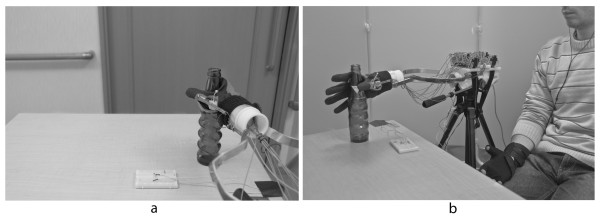
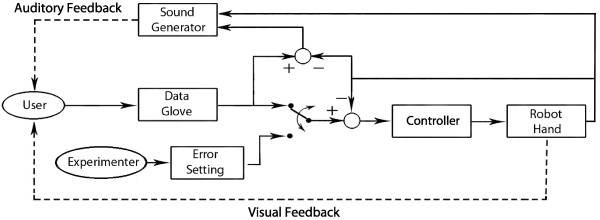
- Three feedback conditions were compared: auditory feedback only (AF), visual feedback only (VF), and audiovisual feedback (AVF). Participants performed open-close-open grasping motions on a tendon-driven robot hand; the study sampled thumb, pointer, and middle finger motion at 40 Hz.
- Outcomes included trial duration, error detection/fix time, grasp flexion, NASA TLX, EEG alpha/beta power, ECG heart rate/HRV, EDA, and respiration. Analysis used repeated-measures ANOVA in SPSS with Greenhouse-Geisser correction.
## Limitations
- The paper explicitly calls the study “preliminary” and says the task was static; it states results may not generalize to daily-life use, longer-term use, fatigue, or more complex dynamic tasks.
- Only 9 subjects were analyzed for psycho-physiological signals because of contamination, and only 7 were used for EDA because of a transducer problem.
- The paper itself notes that the task may have been too simple to elicit strong EDA activity, and that using only 1 EEG channel gives limited resolution; it also says at least 2 to 4 channels would be better.
- Evident from the text: the sample was small and all-male, and the findings are based on able-bodied participants rather than amputees (the study did not test prosthetic users).
Model-written summary. Check it against the paper before relying on it.
Integrity signals
Registry
Cites
Statistics
Figures
Verification
Claims the paper makes
0 Valid · 2 Not valid · 27 Not checked · 89 Own results and interpretations
A result the paper reports from its own data — it cites no other source for it, so there is none to check. The quote shows it is in the paper.
In the paper
“The results show that a higher mental effort is needed when the subjects rely only on their vision”
§ Psycho-physiological assessment of a prosthetic hand sensory feedback system based on an auditory display: a preliminary study > Abstract > Results
plainstates a cause- Asserted: passes — The authors put it forward as true.
- Checkable: passes — It can be checked against evidence.
- Load-bearing: passes — The paper’s conclusions depend on it.
- Based: passes — The paper gives a reason why it holds.
A result the paper reports from its own data — it cites no other source for it, so there is none to check. The quote shows it is in the paper.
In the paper
“and that this effort seems to be reduced when auditory feedback is added to the human-machine interaction (multimodal feedback).”
§ Psycho-physiological assessment of a prosthetic hand sensory feedback system based on an auditory display: a preliminary study > Abstract > Results
hedgedstates a possible cause- Asserted: passes — The authors put it forward as true.
- Checkable: passes — It can be checked against evidence.
- Load-bearing: passes — The paper’s conclusions depend on it.
- Based: passes — The paper gives a reason why it holds.
A result the paper reports from its own data — it cites no other source for it, so there is none to check. The quote shows it is in the paper.
In the paper
“Furthermore, better temporal performance and better grasping performance was obtained in the audiovisual modality.”
§ Psycho-physiological assessment of a prosthetic hand sensory feedback system based on an auditory display: a preliminary study > Abstract > Results
plainstates a cause- Asserted: passes — The authors put it forward as true.
- Checkable: passes — It can be checked against evidence.
- Load-bearing: passes — The paper’s conclusions depend on it.
- Based: passes — The paper gives a reason why it holds.
A result the paper reports from its own data — it cites no other source for it, so there is none to check. The quote shows it is in the paper.
In the paper
“there is no significant difference between the trial durations of the VF and AF modalities (p = 0.22)”
§ Psycho-physiological assessment of a prosthetic hand sensory feedback system based on an auditory display: a preliminary study > Results > Performance
plain- Asserted: passes — The authors put it forward as true.
- Checkable: passes — It can be checked against evidence.
- Load-bearing: unclear — It is unclear whether the paper’s conclusions depend on it.
- Based: passes — The paper gives a reason why it holds.
61 more claims
Create a free account to see all 118 claims and every source verdict.
- Probably not a substantial claim. 24
- It may state two separate claims as one. 34
- The quote only partly states this claim. 1
Claims other papers make about this one
Each is checked against this paper’s own text: does it say what the citing paper says it does?
The check wasn’t confident either way, so it gives no verdict — never disputed.
In the citing paper
“While in vitro and on-body artificial sensory neurons can communicate to batches of afferent cells using optical methods, they currently lack the ability to selectively connect with individual neurons (Figure 10A).[426,427]”
From Flexible Electronics and Devices as Human–Machine Interfaces for Medical Robotics (2022) · cites this paper as [426]
Experimental — accuracy not yet measured
Statistics recomputed
Every reported test result, recomputed from its test statistic and degrees of freedom. A result shows as not adding up only once an independent check has confirmed it.
- ConsistentF(1.9, 135) = 184.99reported p < .01 · recomputed p < .001
“F(1.9,135) = 184.99, p < .01”
- ConsistentF(1.4, 105) = 6.455reported p = .006 · recomputed p = .006
“F(1.4,105)=6.455, p = .006”
Self-check
Percentages, sums and reported differences re-computed from the paper’s own numbers.
Self-check results appear here once an independent check has confirmed them.
Citations
Cites
Heart Rate Variability: Standards of Measurement, Physiological Interpretation, and Clinical Use
Electrophysiology, T. F. O. T. E. S. O. C. T. N. A. (1996) · Circulation · doi:10.1161/01.cir.93.5.1043 · Cited by 17,159
Heart rate variability: Standards of measurement, physiological interpretation, and clinical use
Malik, M., Bigger, J. T., Camm, A. J., Kleiger, R. E., Malliani, A., Moss, A. J., & Schwartz, P. J. (1996) · European Heart Journal · doi:10.1093/oxfordjournals.eurheartj.a014868 · Cited by 15,289
NASA-Task Load Index (NASA-TLX); 20 Years Later
Hart, S. G. (2006) · Proceedings of the Human Factors and Ergonomics Society Annual Meeting · doi:10.1177/154193120605000909 · Cited by 4,297 · cited 2×
“This scale has been successfully used to assess workload in different human-machine interfaces applications as described in [23,24,28].”
MethodAttention: Some theoretical considerations.
Deutsch, J. A., & Deutsch, D. (1963) · Psychological Review · doi:10.1037/h0039515 · Cited by 1,835
Ray, W. J., & Cole, H. W. (1985) · Science · doi:10.1126/science.3992243 · Cited by 1,140
Contextual cues in selective listening
Treisman, A. M. (1960) · Quarterly Journal of Experimental Psychology · doi:10.1080/17470216008416732 · Cited by 1,067 · cited 1×
“[54] and Deutsch, J.”
Electrotactile and vibrotactile displays for sensory substitution systems
Kaczmarek, K. A., Webster, J. G., Bach-y-Rita, P., & Tompkins, W. J. (1991) · IEEE Transactions on Biomedical Engineering · doi:10.1109/10.68204 · Cited by 827
Direct neural sensory feedback and control of a prosthetic arm
Dhillon, G. S., & Horch, K. W. (2005) · IEEE Transactions on Neural Systems and Rehabilitation Engineering · doi:10.1109/tnsre.2005.856072 · Cited by 573
Using psychophysiological techniques to measure user experience with entertainment technologies
Mandryk, R. L., Inkpen, K. M., & Calvert, T. W. (2006) · Behaviour & Information Technology · doi:10.1080/01449290500331156 · Cited by 518
Research works printed but not linked: 1
- Richard P A Comparison of Haptic, Visual and Auditive Force Feedback for Deformable Virtual Objects Proceedings of the Internation Conference on Automation Technology (ICAT) 1994 49 62
Cited by
Flexible Electronics and Devices as Human–Machine Interfaces for Medical Robotics
Heng, W., Solomon, S., & Gao, W. (2022) · Advanced Materials · doi:10.1002/adma.202107902 · Cited by 609
Sensory feedback in upper limb prosthetics
Antfolk, C., D’Alonzo, M., Rosén, B., Lundborg, G., Sebelius, F., & Cipriani, C. (2013) · Expert Review of Medical Devices · doi:10.1586/erd.12.68 · Cited by 466
“[41] Gonzales et al. (2012) Hand configuration O (auditory) –”
BackgroundA Review of Sensory Feedback in Upper-Limb Prostheses From the Perspective of Human Motor Control
Sensinger, J. W., & Dosen, S. (2020) · Frontiers in Neuroscience · doi:10.3389/fnins.2020.00345 · Cited by 230
D’Anna, E., Petrini, F. M., Artoni, F., Popovic, I., Simanić, I., Raspopovic, S., & Micera, S. (2017) · Scientific Reports · doi:10.1038/s41598-017-11306-w · Cited by 215
A review of invasive and non-invasive sensory feedback in upper limb prostheses
Svensson, P., Wijk, U., Björkman, A., & Antfolk, C. (2017) · Expert Review of Medical Devices · doi:10.1080/17434440.2017.1332989 · Cited by 192
Applications of sensory feedback in motorized upper extremity prosthesis: a review
Schofield, J. S., Evans, K. R., Carey, J. P., & Hebert, J. S. (2014) · Expert Review of Medical Devices · doi:10.1586/17434440.2014.929496 · Cited by 155
Sensor fusion and computer vision for context-aware control of a multi degree-of-freedom prosthesis
Markovic, M., Dosen, S., Popovic, D., Graimann, B., & Farina, D. (2015) · Journal of Neural Engineering · doi:10.1088/1741-2560/12/6/066022 · Cited by 137
Forearm amputees' views of prosthesis use and sensory feedback
Wijk, U., & Carlsson, I. (2015) · Journal of Hand Therapy · doi:10.1016/j.jht.2015.01.013 · Cited by 114
Current Solutions and Future Trends for Robotic Prosthetic Hands
Mendez, V., Iberite, F., Shokur, S., & Micera, S. (2021) · Annual Review of Control Robotics and Autonomous Systems · doi:10.1146/annurev-control-071020-104336 · Cited by 130
Demolder, C., Molina, A., Hammond, F. L., & Yeo, W. (2021) · Biosensors and Bioelectronics · doi:10.1016/j.bios.2021.113443 · Cited by 125
Active upper limb prostheses: a review on current state and upcoming breakthroughs
Marinelli, A., Boccardo, N., Tessari, F., Domenico, D. D., Caserta, G., Canepa, M., Gini, G. C., Barresi, G., Laffranchi, M., Michieli, L. D., et al. (2023) · Progress in Biomedical Engineering · doi:10.1088/2516-1091/acac57 · Cited by 132
Towards the sEMG hand: internet of things sensors and haptic feedback application
Li, G., Zhang, L., Sun, Y., & Kong, J. (2018) · Multimedia Tools and Applications · doi:10.1007/s11042-018-6293-x · Cited by 83
Kumar, D., Jelfs, B., Sui, X., & Arjunan, S. P. (2019) · Biomedical Signal Processing and Control · doi:10.1016/j.bspc.2019.101588 · Cited by 90
Schofield, J. S., Shell, C. E., Beckler, D. T., Thumser, Z. C., & Marasco, P. D. (2020) · Frontiers in Neuroscience · doi:10.3389/fnins.2020.00120 · Cited by 68
“This involves continual visual attention paid to prostheses and monitoring of other indirect cues such as the sound of the motors, vibrations, and changes in pressure or leverage between the prosthetic socket and the residual limb (Gonzalez et al., 2012; Schofield et al., 2014).”
BackgroundMeasuring mental workload in assistive wearable devices: a review
Marchand, C., Graaf, J. B. D., & Jarrassé, N. (2021) · Journal of NeuroEngineering and Rehabilitation · doi:10.1186/s12984-021-00953-w · Cited by 83
Chai, G., Zhang, D., & Zhu, X. (2016) · IEEE Transactions on Neural Systems and Rehabilitation Engineering · doi:10.1109/tnsre.2016.2580905 · Cited by 67
Zhang, D., Xu, H., Shull, P. B., Liu, J., & Zhu, X. (2015) · Journal of NeuroEngineering and Rehabilitation · doi:10.1186/s12984-015-0037-1 · Cited by 69
Workload Estimation in Physical Human–Robot Interaction Using Physiological Measurements
Novak, D., Beyeler, B., Omlin, X., & Riener, R. (2015) · Interacting with Computers · doi:10.1093/iwc/iwu021 · Cited by 57
Tactile Feedback of Object Slip Facilitates Virtual Object Manipulation
Walker, J. M., Blank, A. A., Shewokis, P. A., & O’Malley, M. K. (2015) · IEEE Transactions on Haptics · doi:10.1109/toh.2015.2420096 · Cited by 62
White, M. M., Zhang, W., Winslow, A. T., Zahabi, M., Zhang, F., Huang, H., & KABER, D. B. (2017) · IEEE Transactions on Human-Machine Systems · doi:10.1109/thms.2017.2759762 · Cited by 58
Nonlinear effect of biological feedback on brain attentional state
Александрович, М. В., Hramov, A. E., Grubov, V., Nedaivozov, V. O., Makarov, V. V., & Pisarchik, A. N. (2018) · Nonlinear Dynamics · doi:10.1007/s11071-018-4668-1 · Cited by 56
“Along with visual and auditory stimuli [16], the feedback was used to stimulate median and ulnar nerves according to information provided by artificial sensors from a hand prosthesis [17].”
MethodIntuitive Human-Robot-Environment Interaction with EMG Signals: A Review
Xiong, D., Zhang, D., Chu, Y., Zhao, Y., & Zhao, X. (2024) · IEEE/CAA Journal of Automatica Sinica · doi:10.1109/jas.2024.124329 · Cited by 73
Evaluating Internal Model Strength and Performance of Myoelectric Prosthesis Control Strategies
Shehata, A. W., Scheme, E., & Sensinger, J. W. (2018) · IEEE Transactions on Neural Systems and Rehabilitation Engineering · doi:10.1109/tnsre.2018.2826981 · Cited by 54
GLIMPSE: Google Glass interface for sensory feedback in myoelectric hand prostheses
Markovic, M., Karnal, H., Graimann, B., Farina, D., & Dosen, S. (2017) · Journal of Neural Engineering · doi:10.1088/1741-2552/aa620a · Cited by 51
Improving internal model strength and performance of prosthetic hands using augmented feedback
Shehata, A. W., Engels, L. F., Controzzi, M., Cipriani, C., Scheme, E., & Sensinger, J. W. (2018) · Journal of NeuroEngineering and Rehabilitation · doi:10.1186/s12984-018-0417-4 · Cited by 57
Development and Real World Use of a Vibratory Haptic Feedback System for Upper-Limb Prosthetic Users
Chou, T. G. R., Daly, W. K., Austin, R., Chaubey, P., & Boone, D. A. (2016) · JPO Journal of Prosthetics and Orthotics · doi:10.1097/jpo.0000000000000107 · Cited by 42
Audible Feedback Improves Internal Model Strength and Performance of Myoelectric Prosthesis Control
Shehata, A. W., Scheme, E., & Sensinger, J. W. (2018) · Scientific Reports · doi:10.1038/s41598-018-26810-w · Cited by 46
Chen, B., Feng, Y., & Wang, Q. (2016) · Frontiers in Neurorobotics · doi:10.3389/fnbot.2016.00008 · Cited by 40
Differential experiences of embodiment between body-powered and myoelectric prosthesis users
Engdahl, S. M., Meehan, S. K., & Gates, D. H. (2020) · Scientific Reports · doi:10.1038/s41598-020-72470-0 · Cited by 41
Cognitive Workload Assessment of Prosthetic Devices: A Review of Literature and Meta-Analysis
Park, J., & Zahabi, M. (2022) · IEEE Transactions on Human-Machine Systems · doi:10.1109/thms.2022.3143998 · Cited by 34
Affective state estimation based on Russell’s model and physiological measurements
Cittadini, R., Tamantini, C., di Luzio, F. S., Lauretti, C., Zollo, L., & Cordella, F. (2023) · Scientific Reports · doi:10.1038/s41598-023-36915-6 · Cited by 47
Evoking Apparent Moving Sensation in the Hand via Transcutaneous Electrical Nerve Stimulation
Scarpelli, A., Demofonti, A., Terracina, F., Ciancio, A. L., & Zollo, L. (2020) · Frontiers in Neuroscience · doi:10.3389/fnins.2020.00534 · Cited by 35
Integration of proprioception in upper limb prostheses through non-invasive strategies: a review
Papaleo, E. D., D’Alonzo, M., Fiori, F., Piombino, V., Falato, E., Pilato, F., Liso, A. D., Lazzaro, V. D., & Pino, G. D. (2023) · Journal of NeuroEngineering and Rehabilitation · doi:10.1186/s12984-023-01242-4 · Cited by 40
Pinardi, M., Longo, M. R., Formica, D., Strbac, M. D., Mehring, C., Burdet, E., & Pino, G. D. (2023) · Communications Engineering · doi:10.1038/s44172-023-00111-1 · Cited by 38
Parr, J. V. V., Galpin, A. J., Uiga, L., Marshall, B., Wright, D. J., Franklin, Z. C., & Wood, G. (2023) · PLoS ONE · doi:10.1371/journal.pone.0285382 · Cited by 39
Integration of biological systems with electronic-mechanical assemblies
Yi, N., Cui, H., Zhang, L. G., & Cheng, H. (2019) · Acta Biomaterialia · doi:10.1016/j.actbio.2019.04.032 · Cited by 33
Application of Cognitive Task Performance Modeling for Assessing Usability of Transradial Prostheses
Zahabi, M., White, M. M., Zhang, W., Winslow, A. T., Zhang, F., Huang, H., & KABER, D. B. (2019) · IEEE Transactions on Human-Machine Systems · doi:10.1109/thms.2019.2903188 · Cited by 30
Biomechatronic design and control of an anthropomorphic artificial hand for prosthetic applications
Zhang, T., Wang, X. Q., Jiang, L., Wu, X., Feng, W., Zhou, D., & Liu, H. (2015) · Robotica · doi:10.1017/s0263574714002902 · Cited by 28
Nanivadekar, A. C., Chandrasekaran, S., Helm, E. R., Boninger, M. L., Collinger, J. L., Gaunt, R. A., & Fisher, L. E. (2022) · Scientific Reports · doi:10.1038/s41598-022-21264-7 · Cited by 28
Vibrotactile stimulation for 3D printed prosthetic hand
Nabeel, M., Aqeel, K., Ashraf, M. N., Awan, M. I., & Khurram, M. (2016) · doi:10.1109/icrai.2016.7791254 · Cited by 29
Su, S., Chai, G., Shu, X., Sheng, X., & Zhu, X. (2020) · Journal of Neural Engineering · doi:10.1088/1741-2552/ab5ee9 · Cited by 26
Gašparić, F., Jorgovanović, N., Höfer, C., Russold, M., Koppe, M., Stanišić, D., & Dosen, S. S. (2023) · IEEE Transactions on Haptics · doi:10.1109/toh.2023.3293545 · Cited by 23
Vourvopoulos, A., Muñoz, J. E., & Badia, S. B. I. (2015) · International Conference on Virtual Rehabilitation · doi:10.1109/icvr.2015.7358592 · Cited by 24
Ara, J., Hwang, S. H., Song, T., & Khang, G. (2014) · International Journal of Precision Engineering and Manufacturing · doi:10.1007/s12541-014-0339-4 · Cited by 21
Engdahl, S. M., & Gates, D. H. (2021) · Clinical Biomechanics · doi:10.1016/j.clinbiomech.2021.105311 · Cited by 20
Tactile feedback of object slip improves performance in a grasp and hold task
Walker, J. M., Blank, A. A., Shewokis, P. A., & O’Malley, M. K. (2014) · IEEE Haptics Symposium · doi:10.1109/haptics.2014.6775499 · Cited by 19
Substitutive proprioception feedback of a prosthetic wrist by electrotactile stimulation
Han, Y., Lu, Y., Zuo, Y., Song, H., Chou, C.-H., Xing, W., Li, X., Li, L., Niu, C. M., & Hou, W. (2023) · Frontiers in Neuroscience · doi:10.3389/fnins.2023.1135687 · Cited by 18
Gašparić, F., Jorgovanović, N., Höfer, C., Russold, M., Koppe, M., Stanišić, D., & Dosen, S. S. (2023) · IEEE Transactions on Neural Systems and Rehabilitation Engineering · doi:10.1109/tnsre.2023.3330502 · Cited by 18
Olsen, C. D., Olsen, N. R., Stone, E. S., Tully, T. N., Paskett, M. D., Teramoto, M., Clark, G. A., & George, J. A. (2024) · Scientific Reports · doi:10.1038/s41598-024-73855-1 · Cited by 16
Comparison of Cognitive Workload Assessment Techniques in EMG-based Prosthetic Device Studies
Park, J., & Zahabi, M. (2020) · Conference proceedings/Conference proceedings - IEEE International Conference on Systems, Man, and Cybernetics · doi:10.1109/smc42975.2020.9283229 · Cited by 15
Kashiwakura, J., Alva, P. G. S., Guerra, I. M., Bona, C., Atashzar, S. F., & Farina, D. (2023) · IEEE Transactions on Medical Robotics and Bionics · doi:10.1109/tmrb.2023.3310717 · Cited by 12
Hinson, R. M., Berman, J., Lee, I., Filer, W. G., & Huang, H. (2023) · IEEE Transactions on Neural Systems and Rehabilitation Engineering · doi:10.1109/tnsre.2023.3297448 · Cited by 13
Vibratory feedback for artificial hands
Hanif, N. H. H. M., Chappell, P. H., Cranny, A., & White, N. M. (2013) · International Conference on Electronics, Computer and Computation · doi:10.1109/icecco.2013.6718275 · Cited by 12
A Strengthened and Sensorised Custom Silicone Glove for use with an Intelligent Prosthetic Hand
Kyberd, P., Findlayson, D., Jayasuriya, M., & Chibante, L. P. F. (2022) · Medical Engineering & Physics · doi:10.1016/j.medengphy.2022.103845 · Cited by 10
Ko, C., Chang, Y., Kim, S., Kim, S.-K., Kim, G., Ryu, J., & Mun, M.-S. (2014) · Physiology & Behavior · doi:10.1016/j.physbeh.2014.10.021 · Cited by 9
Sonomyography for Control of Upper-Limb Prostheses: Current State and Future Directions
Engdahl, S. M., Acuña, S. A., Kaliki, R. R., & Sikdar, S. (2023) · JPO Journal of Prosthetics and Orthotics · doi:10.1097/jpo.0000000000000482 · Cited by 14
Sekine, M., Shiota, K., Kita, K., et al. (2016) · Advances in Mechanical Engineering · doi:10.1177/1687814016645982 · Cited by 7
Self-citationPatwardhan, S., Mukherjee, B., Dhawan, A. S., Alzamani, M., Noor, A., Engdahl, S. M., Joiner, W. M., & Sikdar, S. (2020) · Annual International Conference of the IEEE Engineering in Medicine and Biology Society (EMBC) · doi:10.1109/embc44109.2020.9176524 · Cited by 6
Chai, G., Sui, X., Li, P., Liu, X., & Lan, N. (2014) · Journal of Shanghai Jiaotong University (Science) · doi:10.1007/s12204-014-1546-y · Cited by 10
A Review of Proprioceptive Feedback Strategies for Upper-Limb Myoelectric Prostheses
Lecompte, O., Achiche, S., & Mohebbi, A. (2024) · IEEE Transactions on Medical Robotics and Bionics · doi:10.1109/tmrb.2024.3407532 · Cited by 10
Tactile to vibrotactile sensory feedback interface for prosthethic hand users
Hanif, N. H. H. M., Hashim, N. N. W. N., Chappell, P. H., White, N. M., & Cranny, A. (2016) · IEEE-EMBS Conference on Biomedical Engineering and Sciences · doi:10.1109/iecbes.2016.7843467 · Cited by 4
Sekine, M., Kita, K., & Yu, W. (2015) · Medical Devices Evidence and Research · doi:10.2147/mder.s83756 · Cited by 4
Self-citationKo, C., Chang, Y., Kim, S., Kim, S.-K., Kim, G., Ryu, J., & Mun, M.-S. (2013) · Journal of Biomechanical Engineering · doi:10.1115/1.4025777 · Cited by 3
A cross-modal feedback scheme for control of prosthetic grasp strength
Kaneris, I., Gibson, A. E., & Artemiadis, P. (2016) · Journal of Rehabilitation and Assistive Technologies Engineering · doi:10.1177/2055668316663121 · Cited by 3
A psychophysical investigation on vibrotactile sensing for transradial prosthesis users
Hanif, N. H. H. M., Chappell, P. H., White, N. M., & Cranny, A. (2018) · Cogent Engineering · doi:10.1080/23311916.2018.1539943 · Cited by 4
Yu, T., Mohammadi, A., Tan, Y., et al. (2024) · IEEE Transactions on Neural Systems and Rehabilitation Engineering · doi:10.1109/tnsre.2024.3450973 · Cited by 2
Development of Vibrotactile Sensory Feedback for Prosthetic Hand Users
Hanif, N. H. H. M., Chappell, P. H., White, N. M., & Cranny, A. (2014) · doi:10.2316/p.2014.818-076 · Cited by 3
Tactile sensing and feedback in SEMG hand
Zhang, L., Zheng, Z., Li, G., Sun, Y., Jiang, G., Kong, J., Tao, B., Xu, S., Yu, H. L., & Liu, H. (2018) · International Journal of Computing Science and Mathematics · doi:10.1504/ijcsm.2018.094670 · Cited by 2
Engels, L. F., Cappello, L., Fischer-Janzen, A., & Cipriani, C. (2021) · PLoS ONE · doi:10.1371/journal.pone.0256753 · Cited by 3
Han, Y., Hu, H., Zuo, Y., Song, H., Zhou, Y. J., Yinping, L., Li, L., & Xing, W. (2022) · Procedia Computer Science · doi:10.1016/j.procs.2022.10.094 · Cited by 5
Effects of movement-specific reinvestment on upper-limb prosthesis control and user experience
Mohamed, M. O., Wood, G., Wright, D. J., Uiga, L., Masters, R. S. W., & Parr, J. V. V. (2025) · Disability and Rehabilitation · doi:10.1080/09638288.2025.2503955 · Cited by 1
Packy, A. L., Shuggi, I. M., Oh, H., & Gentili, R. J. (2025) · International Conference on Rehabilitation Robotics · doi:10.1109/icorr66766.2025.11063193 · Cited by 1
Lu, H., Sun, S., Zhang, X., Ge, C., Ye, R., Wang, J., Mébarki, A., Wu, J., & Yang, Y. (2025) · Safety Science · doi:10.1016/j.ssci.2025.107045 · Cited by 2
Zheng, S., Li, M., Wu, C., et al. (2026) · IEEE Robotics and Automation Letters · doi:10.1109/lra.2026.3682526 · Cited by 1
“In prosthetics, Gonzalez et al . used pitch to sonify finger angles,effectivelyconveyingproprioceptionandreducingvisual reliance[16].”
Valgeirsdóttir, V. V., Sigurðardóttir, J. S., Jóhannesson, Ó. I., Alexandersson, Á., & Kristjansson, A. K. (2021) · JPO Journal of Prosthetics and Orthotics · doi:10.1097/jpo.0000000000000354 · Cited by 1
Qin, C., Liang, W., & Bi, S. (2021) · IEEE International Conference on Real-time Computing and Robotics (RCAR) · doi:10.1109/rcar52367.2021.9517562 · Cited by 1
Molina, A., Kelly, E., Majditehran, H., & Hammond, F. L. (2023) · IEEE RO-MAN · doi:10.1109/ro-man57019.2023.10309406 · Cited by 1
Sensor Fusion for Closed-loop Control of Upper-limb Prostheses
Marković, M. (2016) · eDiss (Georg-August-Universität Göttingen) · doi:10.53846/goediss-5733 · Cited by 2
Sensory Feedback in SEMG Prosthetic Hand
Zhang, L., Sun, Y., He, Y., & Tan, C. I. (2017) · International Conference on Management, Education, Information and Control (MEICI) · doi:10.2991/meici-17.2017.158
Evaluation of an interphalangeal-joint prosthetic hand in trans-radial prosthesis users
Sutthison, N., Sasaki, K., Guerra, G., Chaisumritchoke, S., Niamsang, W., & Charatrungolan, T. (2023) · Annals of Medicine · doi:10.1080/07853890.2023.2166979
Kelly, E., Wheaton, L. A., & Hammond, F. L. (2023) · IEEE RO-MAN · doi:10.1109/ro-man57019.2023.10309396
Closed-Loop Shared Proportional Position Control of a Prosthetic Hand Using Sonomyography
Patwardhan, S., Bashatah, A., Joiner, W. M., Schofield, J. S., & Sikdar, S. (2024) · IEEE/RAS-EMBS International Conference on Biomedical Robotics and Biomechatronics (BioRob) · doi:10.1109/biorob60516.2024.10719773 · Cited by 1
Continuous auditory feedback for sensorimotor learning
Boyer, E. (2015) · theses.fr (ABES) · doi:10.70675/a712575az3e0cz48cdza3bdzabc76ae19b25 · Cited by 9
Vers un contrôle sensori-moteur bio-inspiré des prothèses myoélectriques du membre supérieur
Guémann, M. (2019) · theses.fr (ABES) · doi:10.70675/258d8d05z8ac0z4098za529z537005e4fba0
Gaskins, C., Kontson, K. L., Oh, H., He, X., Hatfield, B. D., & Gentili, R. J. (2026) · Journal of Neural Engineering · doi:10.1088/1741-2552/ae7e26
Marliani, V., Mori, T., Anselmi, M., Cappello, L., Mastinu, E., & Cipriani, C. (2026) · IEEE Transactions on Neural Systems and Rehabilitation Engineering · doi:10.1109/tnsre.2026.3719427
Metadata
- Authors
- Gonzalez, J., Soma, H., Sekine, M., & Yu, W.
- Affiliations
- Chiba University (JP)
- Venue
- Journal of NeuroEngineering and Rehabilitation
- Published
- 2012
- Volume
- 9
- Issue
- 1
- Pages
- 33
- ISSN
- 1743-0003 (ISSN-L)
- PMC
- PMC3481360
- OpenAlex
- W2146050353
- Cited by
- 87
- References
- 60
- Citations by year
- 2026: 3 · 2025: 4 · 2024: 5 · 2023: 13 · 2022: 5 · 2021: 8 · 2020: 6 · 2019: 5 · 2018: 7 · 2017: 5 · 2016: 8 · 2015: 8 · 2014: 7 · 2013: 3
- FWCI
- 3.28
- Type
- journal article
- Language
- en
- Open access
- gold
- doi.org
- Licence
- cc-by
- Locations
- Journal of NeuroEngineering and Rehabilitation (publishedVersion, cc-by)
- PubMed Central (publishedVersion, cc-by)
- PubMed (publishedVersion)
- DOAJ (DOAJ: Directory of Open Access Journals) (submittedVersion)
- Funders
- Japan Society for the Promotion of Science (23300206)
- Topics
- Physical Sciences › Engineering › Biomedical Engineering › Prosthetics and Rehabilitation Robotics
- Life Sciences › Neuroscience › Cognitive Neuroscience › EEG and Brain-Computer Interfaces
- Physical Sciences › Engineering › Biomedical Engineering › Muscle activation and electromyography studies
- Keywords
- prosthetic hand, sensory substitution, auditory feedback, robotic hand, multimodal feedback, cognitive effort, cognitive load, NASA-TLX, heart rate, electrodermal activity, respiration rate, grasping performance, temporal performance, visual feedback, attention
- MeSH terms
- Acoustic Stimulation, Adult, Artificial Limbs, Cognition, Electrocardiography, Electroencephalography, Feasibility Studies, Galvanic Skin Response, Hand, Heart Rate, Humans, Male, Mental Processes, Prosthesis Design, Psychomotor Performance, Psychophysiology, Surveys and Questionnaires, Robotics, Self-Assessment, Hand Strength, Young Adult, Respiratory Rate, Feedback, Sensory
About these checks
Registry, retraction, Cites and statistics results are computed, not judged, with one exception: a printed reference that no index lists is read once by a model before it counts as a citation error. Claims are extracted by a model and kept only when their quote appears verbatim in the text; each cited source is then checked, with a model’s help, for whether it says what the claim relies on. Those verdicts can be wrong — read the claim’s quote and the cited source before relying on one.
The claim verdicts this report counts are experimental: their accuracy is not yet measured.
A language model drew the claims from the paper on 2026-10-10, under version 3 of the claim definition (model deepseek-v4.1-flash, prompt extract-v3).
A second model labelled each claim on 2026-10-10 (model jev-1.13-20260917, definition revision gold-guideline-v0.2).
Statistics and arithmetic are recomputed, not judged.
Confidence bands are shown only for fields calibrated on our annotated test set. None is calibrated yet, so no band is shown.
What counts as a claim ›How we measure confidence ›How we check this ›
Are you an author, or do you see a problem with this page? Request a review
Data sources
Bibliographic data: Semantic Scholar, OpenAlex, Crossref.
Contains information from the Semantic Scholar Academic Graph Datasets, made available under the ODC Attribution License (ODC-BY 1.0).
Semantic Scholar’s data is described in: Kinney, R., et al. (2023). The Semantic Scholar Open Data Platform. arXiv:2301.10140.
