

Psycho-physiological assessment of a prosthetic hand sensory feedback system based on an auditory display: a preliminary study
Open accessThe DOI matches its Crossref record; 60 of the 60 references it cites were found in a registry or an index; 2 of the 59 sources its claims cite were checked for support.
Abstract
BACKGROUND: Prosthetic hand users have to rely extensively on visual feedback, which seems to lead to a high conscious burden for the users, in order to manipulate their prosthetic devices. Indirect methods (electro-cutaneous, vibrotactile, auditory cues) have been used to convey information from the artificial limb to the amputee, but the usability and advantages of these feedback methods were explored mainly by looking at the performance results, not taking into account measurements of the user's mental effort, attention, and emotions. The main objective of this study was to explore the feasibility of using psycho-physiological measurements to assess cognitive effort when manipulating a robot hand with and without the usage of a sensory substitution system based on auditory feedback, and how these psycho-physiological recordings relate to temporal and grasping performance in a static setting. METHODS: 10 male subjects (26+/-years old), participated in this study and were asked to come for 2 consecutive days. On the first day the experiment objective, tasks, and experiment setting was explained. Then, they completed a 30 minutes guided training. On the second day each subject was tested in 3 different modalities: Auditory Feedback only control (AF), Visual Feedback only control (VF), and Audiovisual Feedback control (AVF). For each modality they were asked to perform 10 trials. At the end of each test, the subject had to answer the NASA TLX questionnaire. Also, during the test the subject's EEG, ECG, electro-dermal activity (EDA), and respiration rate were measured. RESULTS: The results show that a higher mental effort is needed when the subjects rely only on their vision, and that this effort seems to be reduced when auditory feedback is added to the human-machine interaction (multimodal feedback). Furthermore, better temporal performance and better grasping performance was obtained in the audiovisual modality. CONCLUSIONS: The performance improvements when using auditory cues, along with vision (multimodal feedback), can be attributed to a reduced attentional demand during the task, which can be attributed to a visual "pop-out" or enhance effect. Also, the NASA TLX, the EEG's Alpha and Beta band, and the Heart Rate could be used to further evaluate sensory feedback systems in prosthetic applications.
Overview
CoChat Summary
## TL;DR
This preliminary study tested whether psycho-physiological measures can assess mental effort while manipulating a prosthetic-style robot hand with auditory, visual, or audiovisual feedback. The audiovisual condition produced the best performance and the lowest perceived/physiological workload, suggesting auditory cues added to vision reduced attentional demand.
## Key findings
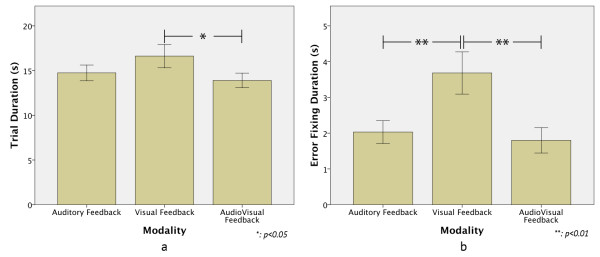
- Trial duration differed by modality: VF was significantly longer than AVF (p = 0.023), while VF vs AF was not significant (p = 0.22).
- Error detection/fix time was significantly worse in VF than in AF and AVF (both p < 0.001); AF vs AVF was not significant (p = 0.478).
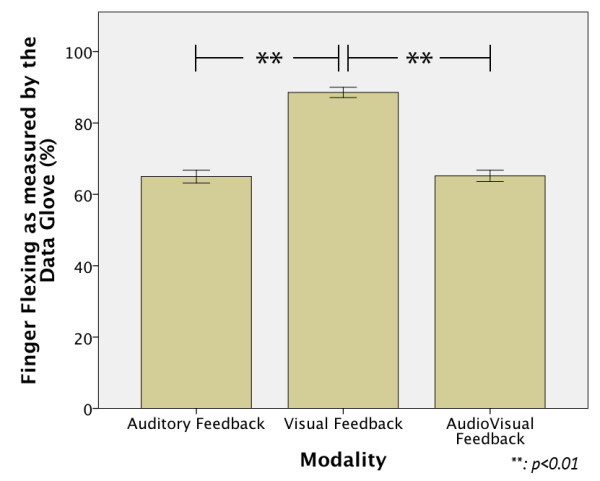
- Grasping performance also differed: finger flexion in VF was significantly different from both AF and AVF (both p = 0.001), and AF vs AVF was not significant (p = 0.48); the paper says the task required about 60% flexion for a complete grasp.
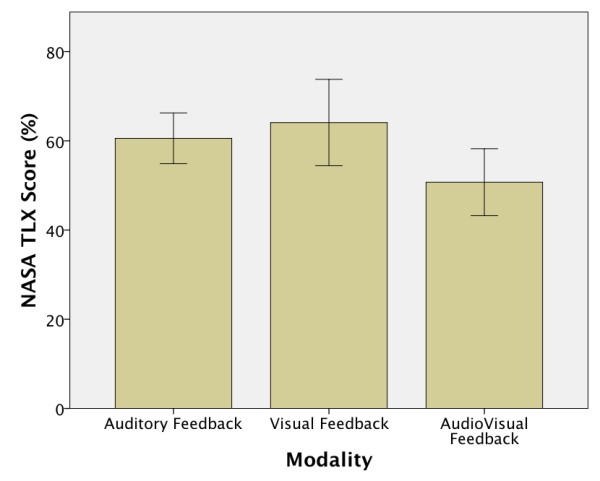
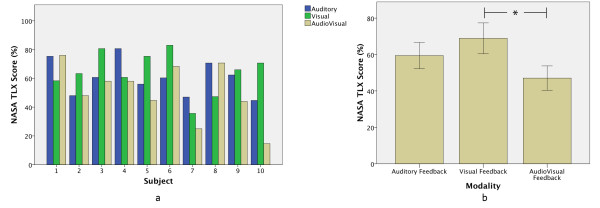
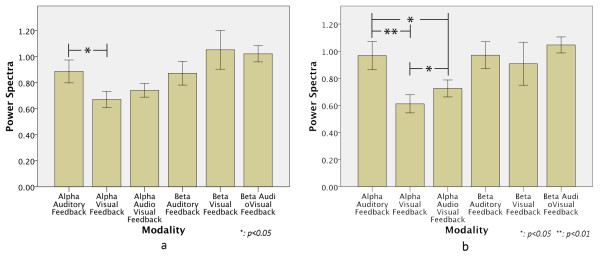
- NASA TLX, EEG alpha suppression, and heart rate all pointed to AVF as least demanding; after excluding Subjects 1 and 8 as outliers, the NASA TLX effect was significant, F(1.8,12.9) = 7.954, p = 0.006, and EEG alpha showed significant modality effects, F(1.27,75.2) = 14.06, p < 0.001.
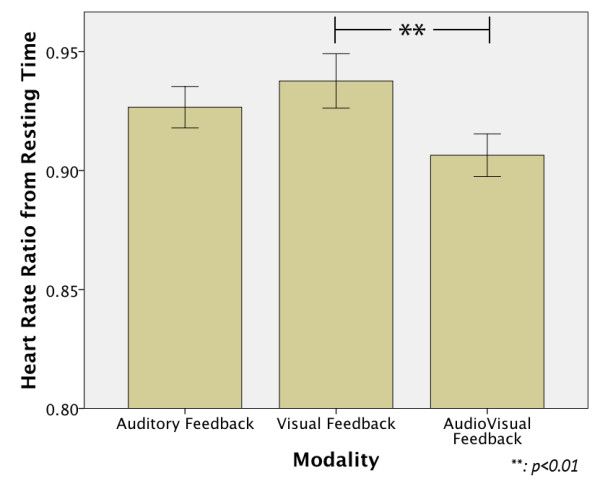
- Heart rate decelerated in all modalities, with a significant modality effect, F(1.7,133.6) = 6.944, p = 0.002; respiration increased most in AF and EDA showed no significant effect.
## Methods
- Preliminary within-subject experiment with 10 male, right-handed subjects aged 22–30, tested over 2 consecutive days; they received 30 minutes of guided training on day 1 and completed 10 trials per modality on day 2.
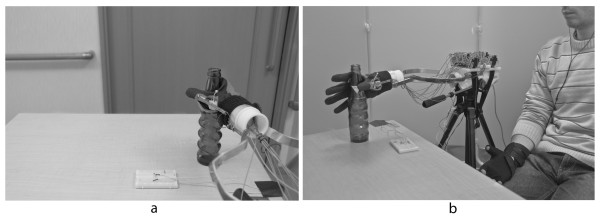
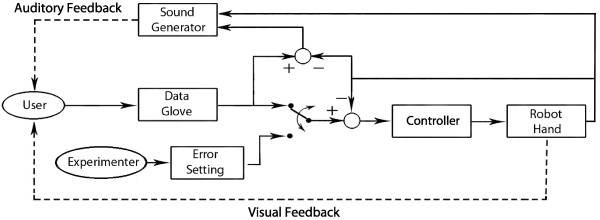
- Three feedback conditions were compared: auditory feedback only (AF), visual feedback only (VF), and audiovisual feedback (AVF). Participants performed open-close-open grasping motions on a tendon-driven robot hand; the study sampled thumb, pointer, and middle finger motion at 40 Hz.
- Outcomes included trial duration, error detection/fix time, grasp flexion, NASA TLX, EEG alpha/beta power, ECG heart rate/HRV, EDA, and respiration. Analysis used repeated-measures ANOVA in SPSS with Greenhouse-Geisser correction.
## Limitations
- The paper explicitly calls the study “preliminary” and says the task was static; it states results may not generalize to daily-life use, longer-term use, fatigue, or more complex dynamic tasks.
- Only 9 subjects were analyzed for psycho-physiological signals because of contamination, and only 7 were used for EDA because of a transducer problem.
- The paper itself notes that the task may have been too simple to elicit strong EDA activity, and that using only 1 EEG channel gives limited resolution; it also says at least 2 to 4 channels would be better.
- Evident from the text: the sample was small and all-male, and the findings are based on able-bodied participants rather than amputees (the study did not test prosthetic users).
Model-written summary. Check it against the paper before relying on it.
Integrity signals
Registry
Cites
Statistics
Figures
Verification
Claims the paper makes
0 Valid · 2 Not valid · 27 Not checked · 89 Own results and interpretations
A result the paper reports from its own data — it cites no other source for it, so there is none to check. The quote shows it is in the paper.
In the paper
“The results show that a higher mental effort is needed when the subjects rely only on their vision”
§ Psycho-physiological assessment of a prosthetic hand sensory feedback system based on an auditory display: a preliminary study > Abstract > Results
plainstates a cause- Asserted: passes — The authors put it forward as true.
- Checkable: passes — It can be checked against evidence.
- Load-bearing: passes — The paper’s conclusions depend on it.
- Based: passes — The paper gives a reason why it holds.
A result the paper reports from its own data — it cites no other source for it, so there is none to check. The quote shows it is in the paper.
In the paper
“and that this effort seems to be reduced when auditory feedback is added to the human-machine interaction (multimodal feedback).”
§ Psycho-physiological assessment of a prosthetic hand sensory feedback system based on an auditory display: a preliminary study > Abstract > Results
hedgedstates a possible cause- Asserted: passes — The authors put it forward as true.
- Checkable: passes — It can be checked against evidence.
- Load-bearing: passes — The paper’s conclusions depend on it.
- Based: passes — The paper gives a reason why it holds.
A result the paper reports from its own data — it cites no other source for it, so there is none to check. The quote shows it is in the paper.
In the paper
“Furthermore, better temporal performance and better grasping performance was obtained in the audiovisual modality.”
§ Psycho-physiological assessment of a prosthetic hand sensory feedback system based on an auditory display: a preliminary study > Abstract > Results
plainstates a cause- Asserted: passes — The authors put it forward as true.
- Checkable: passes — It can be checked against evidence.
- Load-bearing: passes — The paper’s conclusions depend on it.
- Based: passes — The paper gives a reason why it holds.
A result the paper reports from its own data — it cites no other source for it, so there is none to check. The quote shows it is in the paper.
In the paper
“there is no significant difference between the trial durations of the VF and AF modalities (p = 0.22)”
§ Psycho-physiological assessment of a prosthetic hand sensory feedback system based on an auditory display: a preliminary study > Results > Performance
plain- Asserted: passes — The authors put it forward as true.
- Checkable: passes — It can be checked against evidence.
- Load-bearing: unclear — It is unclear whether the paper’s conclusions depend on it.
- Based: passes — The paper gives a reason why it holds.
61 more claims
Create a free account to see all 118 claims and every source verdict.
- Probably not a substantial claim. 24
- It may state two separate claims as one. 34
- The quote only partly states this claim. 1
Claims other papers make about this one
Each is checked against this paper’s own text: does it say what the citing paper says it does?
The check wasn’t confident either way, so it gives no verdict — never disputed.
In the citing paper
“While in vitro and on-body artificial sensory neurons can communicate to batches of afferent cells using optical methods, they currently lack the ability to selectively connect with individual neurons (Figure 10A).[426,427]”
From Flexible Electronics and Devices as Human–Machine Interfaces for Medical Robotics (2022) · cites this paper as [426]
Experimental — accuracy not yet measured
Statistics recomputed
Every reported test result, recomputed from its test statistic and degrees of freedom. A result shows as not adding up only once an independent check has confirmed it.
- ConsistentF(1.9, 135) = 184.99reported p < .01 · recomputed p < .001
“F(1.9,135) = 184.99, p < .01”
- ConsistentF(1.4, 105) = 6.455reported p = .006 · recomputed p = .006
“F(1.4,105)=6.455, p = .006”
Self-check
Percentages, sums and reported differences re-computed from the paper’s own numbers.
Self-check results appear here once an independent check has confirmed them.
Citations
Cites
Heart Rate Variability: Standards of Measurement, Physiological Interpretation, and Clinical Use
Electrophysiology, T. F. O. T. E. S. O. C. T. N. A. (1996) · Circulation · doi:10.1161/01.cir.93.5.1043 · Cited by 17,159
Heart rate variability: Standards of measurement, physiological interpretation, and clinical use
Malik, M., Bigger, J. T., Camm, A. J., Kleiger, R. E., Malliani, A., Moss, A. J., & Schwartz, P. J. (1996) · European Heart Journal · doi:10.1093/oxfordjournals.eurheartj.a014868 · Cited by 15,289
NASA-Task Load Index (NASA-TLX); 20 Years Later
Hart, S. G. (2006) · Proceedings of the Human Factors and Ergonomics Society Annual Meeting · doi:10.1177/154193120605000909 · Cited by 4,297 · cited 2×
“This scale has been successfully used to assess workload in different human-machine interfaces applications as described in [23,24,28].”
MethodAttention: Some theoretical considerations.
Deutsch, J. A., & Deutsch, D. (1963) · Psychological Review · doi:10.1037/h0039515 · Cited by 1,835
Ray, W. J., & Cole, H. W. (1985) · Science · doi:10.1126/science.3992243 · Cited by 1,140
Contextual cues in selective listening
Treisman, A. M. (1960) · Quarterly Journal of Experimental Psychology · doi:10.1080/17470216008416732 · Cited by 1,067 · cited 1×
“[54] and Deutsch, J.”
Electrotactile and vibrotactile displays for sensory substitution systems
Kaczmarek, K. A., Webster, J. G., Bach-y-Rita, P., & Tompkins, W. J. (1991) · IEEE Transactions on Biomedical Engineering · doi:10.1109/10.68204 · Cited by 827
Direct neural sensory feedback and control of a prosthetic arm
Dhillon, G. S., & Horch, K. W. (2005) · IEEE Transactions on Neural Systems and Rehabilitation Engineering · doi:10.1109/tnsre.2005.856072 · Cited by 573
Using psychophysiological techniques to measure user experience with entertainment technologies
Mandryk, R. L., Inkpen, K. M., & Calvert, T. W. (2006) · Behaviour & Information Technology · doi:10.1080/01449290500331156 · Cited by 518
From emotion perception to emotion experience: Emotions evoked by pictures and classical music
Baumgartner, T., Esslen, M., & Jäncke, L. (2006) · International Journal of Psychophysiology · doi:10.1016/j.ijpsycho.2005.04.007 · Cited by 517
Physiological metrics of mental workload: A review of recent progress
Kramer, A. F. (2020) · Multiple-task performance · doi:10.1201/9781003069447-14 · Cited by 459
Sound enhances visual perception: Cross-modal effects of auditory organization on vision.
Vroomen, J., & Gelder, B. D. (2000) · Journal of Experimental Psychology: Human Perception and Performance · doi:10.1037//0096-1523.26.5.1583 · Cited by 434
Multisensory integration: methodological approaches and emerging principles in the human brain.
Calvert, G. A., & Thesen, T. (2004) · Journal of Physiology-Paris · doi:10.1016/j.jphysparis.2004.03.018 · Cited by 425 · cited 2×
“Also, different studies in neuroscience have shown a coactivation by both visual and auditory information in different portions of the brain [56-58], which points out an integration of sensory information in an early stage of processing.”
BackgroundPsychophysiological investigation of vigilance decrement: boredom or cognitive fatigue?
Pattyn, N., Neyt, X., Henderickx, D., & Soetens, E. (2008) · Physiology & Behavior · doi:10.1016/j.physbeh.2007.09.016 · Cited by 422 · cited 1×
“Respiration rate and electro-dermal activity Respiration rate, in [50,52], was found to be significantly faster during a tracking and mental arithmetic multi-task condition, i.”
BackgroundRyu, K., & Myung, R. (2005) · International Journal of Industrial Ergonomics · doi:10.1016/j.ergon.2005.04.005 · Cited by 399
Psycho-physiological measures for assessing cognitive load
Haapalainen, E., Kim, S., Forlizzi, J. F., & Dey, A. K. (2010) · Proceedings of the 12th ACM international conference on Ubiquitous computing · doi:10.1145/1864349.1864395 · Cited by 382 · cited 2×
“This scale has been successfully used to assess workload in different human-machine interfaces applications as described in [23,24,28].”
MethodA Comparison of Visual and Auditory Motion Processing in Human Cerebral Cortex
Lewis, J. W. (2000) · Cerebral Cortex · doi:10.1093/cercor/10.9.873 · Cited by 381
Dhillon, G. S., Lawrence, S. M., Hutchinson, D. T., & Horch, K. W. (2004) · The Journal of Hand Surgery · doi:10.1016/j.jhsa.2004.02.006 · Cited by 354 · cited 1×
“Japan researchers are trying to cope with by using indirect methods to convey information from the artificial limb to the amputee, such as electro-cutaneous stimulation [3-8], vibrotactile stimulation [8-12], force stimulation [13-18], or auditory cues [19-22].”
BackgroundRobotic touch shifts perception of embodiment to a prosthesis in targeted reinnervation amputees
Marasco, P. D., Kim, K., Colgate, J. E., Peshkin, M. A., & Kuiken, T. A. (2011) · Brain · doi:10.1093/brain/awq361 · Cited by 335 · cited 1×
“Japan researchers are trying to cope with by using indirect methods to convey information from the artificial limb to the amputee, such as electro-cutaneous stimulation [3-8], vibrotactile stimulation [8-12], force stimulation [13-18], or auditory cues [19-22].”
BackgroundRecent developments in biofeedback for neuromotor rehabilitation
Huang, H., Wolf, S. L., & He, J. (2006) · Journal of NeuroEngineering and Rehabilitation · doi:10.1186/1743-0003-3-11 · Cited by 333
Kuiken, T. A., Marasco, P. D., Lock, B. A., Harden, R. N., & Dewald, J. P. A. (2007) · Proceedings of the National Academy of Sciences · doi:10.1073/pnas.0706525104 · Cited by 283
Electrocutaneous Stimulation for Sensory Communication in Rehabilitation Engineering
Szeto, A. Y. J., & Saunders, F. A. (1982) · IEEE Transactions on Biomedical Engineering · doi:10.1109/tbme.1982.324948 · Cited by 223
Driver, J., & Spence, C. (1998) · Current Opinion in Neurobiology · doi:10.1016/s0959-4388(98)80147-5 · Cited by 220
EEG differences in children between eyes-closed and eyes-open resting conditions
Barry, R. J., Clarke, A. R., Johnstone, S. J., & Brown, C. R. (2009) · Clinical Neurophysiology · doi:10.1016/j.clinph.2009.08.006 · Cited by 215
Movement Sonification: Effects on Perception and Action
Effenberg, A. O. (2005) · IEEE Multimedia · doi:10.1109/mmul.2005.31 · Cited by 177 · cited 3×
“Auditory icons refer to sounds designed to convey information of a discrete event by analogy to everyday sound, for example the sound made by deleting files on a computer [33,34].”
BackgroundMethodA Miniature Vibrotactile Sensory Substitution Device for Multifingered Hand Prosthetics
Cipriani, C., D'Alonzo, M., & Carrozza, M. C. (2012) · IEEE Transactions on Biomedical Engineering · doi:10.1109/tbme.2011.2173342 · Cited by 164
Closed-loop control in prosthetic systems: Historical perspective
Childress, D. S. (1980) · Annals of Biomedical Engineering · doi:10.1007/bf02363433 · Cited by 158 · cited 2×
“It has been claimed or assumed in literature that, by adding a feedback loop to the prosthetic control, the users will improve his performance and awareness of the robot hand, reducing their consciousness burden [1-3,6-13,17].”
BackgroundFournier, L. R., Wilson, G. F., & Swain, C. R. (1999) · International Journal of Psychophysiology · doi:10.1016/s0167-8760(98)00049-x · Cited by 158 · cited 1×
“Respiration rate and electro-dermal activity Respiration rate, in [50,52], was found to be significantly faster during a tracking and mental arithmetic multi-task condition, i.”
BackgroundDesign and Evaluation of a Low-Cost Force Feedback System for Myoelectric Prosthetic Hands
Pylatiuk, C., Kargov, A., & Schulz, S. (2006) · JPO Journal of Prosthetics and Orthotics · doi:10.1097/00008526-200604000-00007 · Cited by 156 · cited 1×
“Japan researchers are trying to cope with by using indirect methods to convey information from the artificial limb to the amputee, such as electro-cutaneous stimulation [3-8], vibrotactile stimulation [8-12], force stimulation [13-18], or auditory cues [19-22].”
BackgroundChanges in EEG alpha power during simulated driving: a demonstration
Schier, M. A. (2000) · International Journal of Psychophysiology · doi:10.1016/s0167-8760(00)00079-9 · Cited by 156 · cited 1×
“[49] showed how simulated driving imposes significant demands on attention by a higher suppression of the alpha band.”
BackgroundExtended physiologic taction: design and evaluation of a proportional force feedback system.
Meek, S. G., Jacobsen, S. C., & Goulding, P. P. (1989) · PubMed · Cited by 135
Survey of Psychophysiology Measurements Applied to Human-Robot Interaction
Bethel, C. L., Salomon, K., Murphy, R. R., & Burke, J. L. (2007) · RO-MAN 2007 - The 16th IEEE International Symposium on Robot and Human Interactive Communication · doi:10.1109/roman.2007.4415182 · Cited by 118
Testing a Prosthetic Haptic Feedback Simulator With an Interactive Force Matching Task
Chatterjee, A., Chaubey, P., Martin, J., & Thakor, N. (2008) · JPO Journal of Prosthetics and Orthotics · doi:10.1097/01.jpo.0000311041.61628.be · Cited by 111
Guest Editors' Introduction: An Introduction to Interactive Sonification
Hermann, T., & Hunt, A. (2005) · IEEE MultiMedia · doi:10.1109/mmul.2005.26 · Cited by 104
On the Design of Miniature Haptic Devices for Upper Extremity Prosthetics
Kim, K., Colgate, J. E., Santos-Munne, J. J., Makhlin, A., & Peshkin, M. A. (2010) · IEEE/ASME Transactions on Mechatronics · doi:10.1109/tmech.2009.2013944 · Cited by 100
Anxiety detection during human-robot interaction
Kulic, D., & Croft, E. (2005) · 2005 IEEE/RSJ International Conference on Intelligent Robots and Systems · doi:10.1109/iros.2005.1545012 · Cited by 85
Respiratory responses during affective picture viewing
Gomez, P., Stahel, W. A., & Danuser, B. (2004) · Biological Psychology · doi:10.1016/j.biopsycho.2004.03.013 · Cited by 84 · cited 1×
“[53], the speed in which the sounds changed could have affected directly the respiration rate, which can explain why in the AF and the AVF modalities the subjects had a larger respiration rate.”
BackgroundHearing as substitution for sensation: A new principle for artificial sensibility
Lundborg, G., Rosén, B., & Lindberg, S. (1999) · The Journal Of Hand Surgery · doi:10.1053/jhsu.1999.0219 · Cited by 78
Assessing the Benefits of Multimodal Feedback on Dual-Task Performance under Demanding Conditions
Lee, J.-H., & Spence, C. (2008) · Electronic Workshops in Computing · doi:10.14236/ewic/hci2008.18 · Cited by 73
Intermittent Stimulation Delays Adaptation to Electrocutaneous Sensory Feedback
Buma, D. G., Buitenweg, J. R., & Veltink, P. H. (2007) · IEEE Transactions on Neural Systems and Rehabilitation Engineering · doi:10.1109/tnsre.2007.903942 · Cited by 68
PhysioSonic - Evaluated Movement Sonification as Auditory Feedback in Physiotherapy
Vogt, K., Pirrò, D., Kobenz, I., Höldrich, R., & Eckel, G. (2010) · Lecture notes in computer science · doi:10.1007/978-3-642-12439-6_6 · Cited by 61
Audiovisual integration of stimulus transients
Andersen, T., & Mamassian, P. (2008) · Vision Research · doi:10.1016/j.visres.2008.08.018 · Cited by 53
Pascalis, V. D., Barry, R. J., & Sparita, A. (1995) · International Journal of Psychophysiology · doi:10.1016/0167-8760(95)00023-l · Cited by 48
Task-Orientated Biofeedback System for the Rehabilitation of the Upper Limb
Kousidou, S., Tsagarakis, N. G., Smith, C., & Caldwell, D. G. (2007) · 2007 IEEE 10th International Conference on Rehabilitation Robotics · doi:10.1109/icorr.2007.4428453 · Cited by 43
Stepp, C. E., & Matsuoka, Y. (2010) · 2010 Annual International Conference of the IEEE Engineering in Medicine and Biology · doi:10.1109/iembs.2010.5626120 · Cited by 42
SmartHand tactile display: A new concept for providing sensory feedback in hand prostheses
Antfolk, C., Balkenius, C., Rosén, B., Lundborg, G., & Sebelius, F. (2010) · Journal of Plastic Surgery and Hand Surgery · doi:10.3109/02844310903259090 · Cited by 39
Lundborg, G., Björkman, A., Hansson, T., Nylander, L., Nyman, T., & Rosén, B. (2005) · Scandinavian Journal of Plastic and Reconstructive Surgery and Hand Surgery · doi:10.1080/02844310500369920 · Cited by 36
(2000) · Cited by 34
Selection of valid and reliable EEG features for predicting auditory and visual alertness levels.
Huang, R., Tsai, L., & Kuo, C. J. (2001) · PubMed · Cited by 30
Cardiac responses induced during thought-based control of a virtual environment
Pfurtscheller, G., Leeb, R., & Slater, M. (2006) · International Journal of Psychophysiology · doi:10.1016/j.ijpsycho.2006.03.001 · Cited by 28
Vibrotactile sensory substitution in multi-fingered hand prostheses: Evaluation studies
D’Alonzo, M., Cipriani, C., & Carrozza, M. C. (2011) · International Conference on Rehabilitation Robotics · doi:10.1109/icorr.2011.5975477 · Cited by 26
Beer, A. L., & Watanabe, T. (2009) · Experimental Brain Research · doi:10.1007/s00221-009-1769-6 · Cited by 25 · cited 1×
“Also, different studies in neuroscience have shown a coactivation by both visual and auditory information in different portions of the brain [56-58], which points out an integration of sensory information in an early stage of processing.”
BackgroundIdeas on sensory feedback in hand prostheses
Herberts, P., & Körner, L. K. (1979) · Prosthetics and Orthotics International · doi:10.3109/03093647909103104 · Cited by 22
Ewing, K. C., & Fairclough, S. H. (2010) · Proceedings of the Human Factors and Ergonomics Society Annual Meeting · doi:10.1177/154193121005400316 · Cited by 18
Classification of Upper Limb Motions from Around-Shoulder Muscle Activities: Hand Biofeedback
Gonzalez-Vargas, J. E., Horiuchi, Y., & Yu, W. (2010) · The Open Medical Informatics Journal · doi:10.2174/1874431101004020074 · Cited by 16
Self-citationAn fMRI Study on the Effects of Electrical Stimulation as Biofeedback
Alejandro, H., Kato, R., Yokoi, H., Arai, T., & Ohnishi, T. (2006) · IEEE/RSJ International Conference on Intelligent Robots and Systems (IROS) · doi:10.1109/iros.2006.282006 · Cited by 14
(2009) · Cited by 12
Audio aided electro-tactile perception training for finger posture biofeedback
Gonzalez-Vargas, J. E., & Yu, W. (2008) · Annual International Conference of the IEEE Engineering in Medicine and Biology Society (EMBC) · doi:10.1109/iembs.2008.4650143 · Cited by 9
Self-citationAttention and cross-modal processing: Evidence from heart rate analyses
Robinson, C., & Sloutsky, V. M. (2010) · Proceedings of the Annual Meeting of the Cognitive Science Society · Cited by 3
Research works printed but not linked: 1
- Richard P A Comparison of Haptic, Visual and Auditive Force Feedback for Deformable Virtual Objects Proceedings of the Internation Conference on Automation Technology (ICAT) 1994 49 62
Cited by
Flexible Electronics and Devices as Human–Machine Interfaces for Medical Robotics
Heng, W., Solomon, S., & Gao, W. (2022) · Advanced Materials · doi:10.1002/adma.202107902 · Cited by 609
Sensory feedback in upper limb prosthetics
Antfolk, C., D’Alonzo, M., Rosén, B., Lundborg, G., Sebelius, F., & Cipriani, C. (2013) · Expert Review of Medical Devices · doi:10.1586/erd.12.68 · Cited by 466
“[41] Gonzales et al. (2012) Hand configuration O (auditory) –”
BackgroundA Review of Sensory Feedback in Upper-Limb Prostheses From the Perspective of Human Motor Control
Sensinger, J. W., & Dosen, S. (2020) · Frontiers in Neuroscience · doi:10.3389/fnins.2020.00345 · Cited by 230
D’Anna, E., Petrini, F. M., Artoni, F., Popovic, I., Simanić, I., Raspopovic, S., & Micera, S. (2017) · Scientific Reports · doi:10.1038/s41598-017-11306-w · Cited by 215
A review of invasive and non-invasive sensory feedback in upper limb prostheses
Svensson, P., Wijk, U., Björkman, A., & Antfolk, C. (2017) · Expert Review of Medical Devices · doi:10.1080/17434440.2017.1332989 · Cited by 192
Metadata
- Authors
- Gonzalez, J., Soma, H., Sekine, M., & Yu, W.
- Affiliations
- Chiba University (JP)
- Venue
- Journal of NeuroEngineering and Rehabilitation
- Published
- 2012
- Volume
- 9
- Issue
- 1
- Pages
- 33
- ISSN
- 1743-0003 (ISSN-L)
- PMC
- PMC3481360
- OpenAlex
- W2146050353
- Cited by
- 87
- References
- 60
- Citations by year
- 2026: 3 · 2025: 4 · 2024: 5 · 2023: 13 · 2022: 5 · 2021: 8 · 2020: 6 · 2019: 5 · 2018: 7 · 2017: 5 · 2016: 8 · 2015: 8 · 2014: 7 · 2013: 3
- FWCI
- 3.28
- Type
- journal article
- Language
- en
- Open access
- gold
- doi.org
- Licence
- cc-by
- Locations
- Journal of NeuroEngineering and Rehabilitation (publishedVersion, cc-by)
- PubMed Central (publishedVersion, cc-by)
- PubMed (publishedVersion)
- DOAJ (DOAJ: Directory of Open Access Journals) (submittedVersion)
- Funders
- Japan Society for the Promotion of Science (23300206)
- Topics
- Physical Sciences › Engineering › Biomedical Engineering › Prosthetics and Rehabilitation Robotics
- Life Sciences › Neuroscience › Cognitive Neuroscience › EEG and Brain-Computer Interfaces
- Physical Sciences › Engineering › Biomedical Engineering › Muscle activation and electromyography studies
- Keywords
- prosthetic hand, sensory substitution, auditory feedback, robotic hand, multimodal feedback, cognitive effort, cognitive load, NASA-TLX, heart rate, electrodermal activity, respiration rate, grasping performance, temporal performance, visual feedback, attention
- MeSH terms
- Acoustic Stimulation, Adult, Artificial Limbs, Cognition, Electrocardiography, Electroencephalography, Feasibility Studies, Galvanic Skin Response, Hand, Heart Rate, Humans, Male, Mental Processes, Prosthesis Design, Psychomotor Performance, Psychophysiology, Surveys and Questionnaires, Robotics, Self-Assessment, Hand Strength, Young Adult, Respiratory Rate, Feedback, Sensory
About these checks
Registry, retraction, Cites and statistics results are computed, not judged, with one exception: a printed reference that no index lists is read once by a model before it counts as a citation error. Claims are extracted by a model and kept only when their quote appears verbatim in the text; each cited source is then checked, with a model’s help, for whether it says what the claim relies on. Those verdicts can be wrong — read the claim’s quote and the cited source before relying on one.
The claim verdicts this report counts are experimental: their accuracy is not yet measured.
A language model drew the claims from the paper on 2026-10-10, under version 3 of the claim definition (model deepseek-v4.1-flash, prompt extract-v3).
A second model labelled each claim on 2026-10-10 (model jev-1.13-20260917, definition revision gold-guideline-v0.2).
Statistics and arithmetic are recomputed, not judged.
Confidence bands are shown only for fields calibrated on our annotated test set. None is calibrated yet, so no band is shown.
What counts as a claim ›How we measure confidence ›How we check this ›
Are you an author, or do you see a problem with this page? Request a review
Data sources
Bibliographic data: Semantic Scholar, OpenAlex, Crossref.
Contains information from the Semantic Scholar Academic Graph Datasets, made available under the ODC Attribution License (ODC-BY 1.0).
Semantic Scholar’s data is described in: Kinney, R., et al. (2023). The Semantic Scholar Open Data Platform. arXiv:2301.10140.
