

Acceptance and commitment therapy for anxious children and adolescents: study protocol for a randomized controlled trial.
Open accessThe DOI matches its Crossref record; 62 of the 65 references it cites were found in a registry or an index; 8 of the 85 sources its claims cite were checked for support.
Abstract
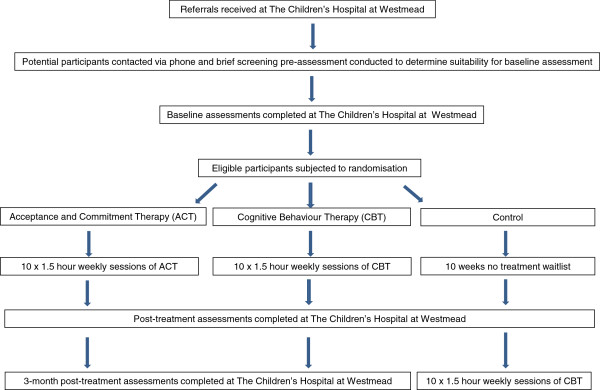
Background: Anxiety disorders affect approximately 10% to 20% of young people, can be enduring if left untreated, and have been associated with psychopathology in later life. Despite this, there is a paucity of empirical research to assist clinicians in determining appropriate treatment options. We describe a protocol for a randomized controlled trial in which we will examine the effectiveness of a group-based acceptance and commitment therapy program for children and adolescents with a primary diagnosis of anxiety disorder. For the adolescent participants we will also evaluate the elements of the intervention that act as mechanisms for change.Methods/design: We will recruit 150 young people (90 children and 60 adolescents) diagnosed with an anxiety disorder and their parent or caregiver. After completion of baseline assessment, participants will be randomized to one of three conditions (acceptance and commitment therapy, cognitive behavior therapy or waitlist control). Those in the acceptance and commitment therapy and cognitive behavior therapy groups will receive 10 × 1.5 hour weekly group-therapy sessions using a manualized treatment program, in accordance with the relevant therapy, to be delivered by psychologists. Controls will receive the cognitive behavior therapy program after 10 weeks waitlisted. Repeated measures will be taken immediately post-therapy and at three months after therapy cessation.Discussion: To the best of our knowledge, this study will be the largest trial of acceptance and commitment therapy in the treatment of children and young people to date. It will provide comprehensive data on the use of acceptance and commitment therapy for anxiety disorders and will offer evidence for mechanisms involved in the process of change. Furthermore, additional data will be obtained for the use of cognitive behavior therapy in this population and this research will illustrate the comparative effectiveness of these two interventions, which are currently implemented widely in contemporary clinical practice. Anticipated difficulties for the trial are the recruitment and retention of participants, particularly adolescents. To avert these concerns and maximize recruitment, several strategies will be adopted to optimize referral rates as well as reduce participant drop-outs.Trial Registration: This trial is registered with the Australian and New Zealand Clinical Trials Registry, registration number: ACTRN12611001280998.
Overview
CoChat Summary
## TL;DR
This paper is a study protocol for a three-arm randomized controlled trial testing a manualized group Acceptance and Commitment Therapy (ACT) program for children and adolescents with diagnosed anxiety disorders, compared with Cognitive Behavior Therapy (CBT) and waitlist control. It also plans to examine mechanisms of change in adolescents, focusing on processes such as experiential avoidance, cognitive fusion, acceptance, mindfulness, and valued living.
## Key findings
- Not stated in the paper.
- The planned sample is approximately 150 young people: 90 children and 60 adolescents, ages 7 to 17 years, plus a parent or caregiver.
- Participants will be randomized to ACT, CBT, or waitlist control; ACT and CBT each consist of 10 weekly 1.5-hour group sessions, with up to eight participants per group.
- The trial’s primary efficacy outcomes are changes in DSM-IV anxiety diagnosis/severity and scores on the ADIS-IV, CBCL, and MASC; secondary outcomes include depression, quality of life/self-efficacy, and adolescent process measures.
## Methods
- Design: Prospective three-group randomized controlled trial with a 3 × 3 repeated-measures factorial design (pre-, immediate post-, and three-month post-treatment).
- Sample/data: About 150 children/adolescents with a primary DSM-IV anxiety disorder recruited through referrals to The Children’s Hospital at Westmead; both the young person and a parent/caregiver participate in assessment and treatment.
- Main analysis: Intention-to-treat and completer analyses using paired t-tests and linear mixed models for outcome change; mechanism analyses planned with correlation, t-tests, multivariate regression, mediation analysis, and ROC curves, with full information maximum likelihood for missing data.
## Limitations
- The paper itself states anticipated difficulties with recruitment and retention, especially for adolescents, because of stringent inclusion/exclusion criteria and the need to attend at least 80% of sessions.
- Because this is a study protocol, it reports planned methods and hypothesized outcomes, not results; no empirical effectiveness findings are presented.
- Evident from the text: the trial is conducted at a single clinical site and excludes several groups (for example non-English speakers, youth with developmental/language delay, psychosis, conduct disorder, active suicidality, or poorly controlled ADHD), which may limit generalizability.
Model-written summary. Check it against the paper before relying on it.
Integrity signals
Registry
Cites
Statistics
Figures
Verification
Claims the paper makes
2 Valid · 5 Not valid · 48 Not checked · 32 Own results and interpretations
The cited sources that could be checked couldn’t confirm or dispute this claim.
In the paper
“Research evidence has supported the use of mindfulness, one of the ACT core processes, in the treatment of young people.”
§ Acceptance and Commitment Therapy for anxious children and adolescents: study protocol for a randomized controlled trial > Background
What the sources say
- Not checked — no full text of the sourcecites [24] Biegel GM Brown KW Shapiro SL Schubert CM Mindfulness-based stress reduction for the treatment of adolescent psychiatric outpatients: a randomized clinical trial J Consult Clin Psychol 2009 77 855 866 19803566 source
- Not checked — no full text of the sourcecites [25] Semple RJ Reid EFG Miller L Treating anxiety with mindfulness: an open trial of mindfulness training for anxious children J Cogn Behav Psychot 2005 19 379 392 10.1891/jcop.2005.19.4.379 source
- Not checked — no full text of the sourcecites [26] Lee J Semple R Rosa D Miller L Mindfulness-based cognitive therapy for children: results of a pilot study J Cogn Behav Psychot 2008 22 15 28 10.1891/0889.8391.22.1.15 source
- Could not verifycites [27] Semple RJ Lee J Rosa D Miller LF A randomized trial of mindfulness-based cognitive therapy for children: Promoting mindful attention to enhance social-emotional resiliency in children J Child Fam Stud 2010 19 218 229 10.1007/s10826-009-9301-y sourceExperimental — accuracy not yet measured
The Abstract describes a diagnostic interview and a study of its reliability; the Sample section describes the children recruited. Searches for mindfulness, ACT, and mindfulness treatment found no passage addressing whether mindfulness helps treat young people. (LLM, conf=0.76)
plainstates a cause- Asserted: passes — The authors put it forward as true.
- Checkable: passes — It can be checked against evidence.
- Load-bearing: passes — The paper’s conclusions depend on it.
- Based: passes — The paper gives a reason why it holds.
The cited sources that could be checked couldn’t confirm or dispute this claim.
In the paper
“A literature search produced only one published study, that being a case study [19].”
§ Acceptance and Commitment Therapy for anxious children and adolescents: study protocol for a randomized controlled trial > Background
What the sources say
- Could not verifycites [19] Brown FJ Hooper S Acceptance and Commitment Therapy (ACT) with a learning disabled young person experiencing anxious and obsessive thoughts J Intellect Disabil 2009 13 195 201 10.1177/1744629509346173 19786502 sourceExperimental — accuracy not yet measured
The Abstract discusses one known study of parent–child agreement on the ADIS, not a literature search on ACT. Searches for ACT, acceptance and commitment therapy, and a published case study found no passage addressing the claim in our copy. (LLM, conf=0.78)
plainSingle case- Asserted: passes — The authors put it forward as true.
- Checkable: passes — It can be checked against evidence.
- Load-bearing: passes — The paper’s conclusions depend on it.
- Based: passes — The paper gives a reason why it holds.
- Could not verify
The cited sources that could be checked couldn’t confirm or dispute this claim.
In the paper
“there is currently a paucity of research examining the efficacy of ACT in children and adolescents with anxiety.”
§ Acceptance and Commitment Therapy for anxious children and adolescents: study protocol for a randomized controlled trial > Background
What the sources say
- Could not verifycites [19] Brown FJ Hooper S Acceptance and Commitment Therapy (ACT) with a learning disabled young person experiencing anxious and obsessive thoughts J Intellect Disabil 2009 13 195 201 10.1177/1744629509346173 19786502 sourceExperimental — accuracy not yet measured
The Abstract discusses a paucity of studies on parent–child agreement using the ADIS, not the efficacy of ACT. A search of our full-text copy for ACT and treatment efficacy found no passage addressing research on ACT for anxious children or adolescents. (LLM, conf=0.76)
plainSingle case- Asserted: passes — The authors put it forward as true.
- Checkable: passes — It can be checked against evidence.
- Load-bearing: passes — The paper’s conclusions depend on it.
- Based: passes — The paper gives a reason why it holds.
- Could not verify
In the paper
“Cognitive Behavior Therapy (CBT) was found to be the first-line evidence-based psychosocial intervention for anxiety among adults and is currently the most empirically supported therapeutic approach for children and adolescents [8].”
- Also stated in: § CBT program - Cool Kids (ages 7 to 11 years) and Chilled® (ages 12 to 17 years) · plain
“Because CBT is currently the most empirically supported therapeutic approach for children and adolescents [8], it was determined to be the most stringent comparison condition to employ within this trial.”
§ Acceptance and Commitment Therapy for anxious children and adolescents: study protocol for a randomized controlled trial > Background
What the sources say
- Not checked — no full text of the sourcecites [8] The Australian Psychological Society Evidence-based Psychological Interventions in the Treatment of Mental Disorders: a Literature Review 2010 3 Melbourne, VIC: The Australian Psychological Society source
plain- Asserted: passes — The authors put it forward as true.
- Checkable: passes — It can be checked against evidence.
- Load-bearing: passes — The paper’s conclusions depend on it.
- Based: passes — The paper gives a reason why it holds.
- Also stated in: § CBT program - Cool Kids (ages 7 to 11 years) and Chilled® (ages 12 to 17 years) · plain
A claim is checked only against the cited paper’s full text, never its abstract, and none is available for its sources.
In the paper
“anxiety in children is often minimized by health professionals, potentially due to a common perception that in this population anxiety is developmental, transient and innocuous [3,4].”
§ Acceptance and Commitment Therapy for anxious children and adolescents: study protocol for a randomized controlled trial > Background
What the sources say
- Not checked — no full text of the sourcecites [3] Hirshfeld-Becker DR Masek B Henin A Blakely LR Pollock-Wurman RA McQuade J DePetrillo L Briesch J Ollendick TH Rosenbaum JF Biederman J Cognitive behavioral therapy for 4- to 7-year-old children with anxiety disorders: a randomized clinical trial J Consult Clin Psychol 2010 78 498 510 20658807 source
- Not checked — no full text of the sourcecites [4] Piacentini J Roblek T Recognizing and treating childhood anxiety disorders West J Med 2002 176 149 151 10.1136/ewjm.176.3.149 12016234 PMC1071700 source
plain- Asserted: passes — The authors put it forward as true.
- Checkable: passes — It can be checked against evidence.
- Load-bearing: unclear — It is unclear whether the paper’s conclusions depend on it.
- Based: passes — The paper gives a reason why it holds.
23 more claims
Create a free account to see all 87 claims and every source verdict.
- Probably not a substantial claim. 47
- It may state two separate claims as one. 27
Claims other papers make about this one
Each is checked against this paper’s own text: does it say what the citing paper says it does?
The cited source says what the claim attributes to it.
In the citing paper
“While promising, the intervention did not directly target or measure parent psychological flexibility as a variable that may impact the ability to respond effectively to one's anxious child.”
From Acceptance and commitment therapy group protocol for caregivers of anxious youth: an open trial pilot study (2024) · cites this paper as [27]
Citations
Cites
Diagnostic and Statistical Manual of Mental Disorders
Williams, J. B. W., & First, M. (2013) · Encyclopedia of Social Work · doi:10.1093/acrefore/9780199975839.013.104 · Cited by 109,519
(2013) · Cited by 44,563
Development and validation of brief measures of positive and negative affect: The PANAS scales.
Watson, D., Clark, L. A., & Tellegen, A. (1988) · Journal of Personality and Social Psychology · doi:10.1037/0022-3514.54.6.1063 · Cited by 32,433
Acceptance and commitment therapy: model, processes and outcomes
Hayes, S. C., Luoma, J. B., Bond, F. W., Masuda, A., & Lillis, J. (2006) · Behaviour Research and Therapy · doi:10.1016/j.brat.2005.06.006 · Cited by 6,587
Bagby, R. M., Parker, J. D. A., & Taylor, G. J. (1994) · Journal of Psychosomatic Research · doi:10.1016/0022-3999(94)90005-1 · Cited by 5,293 · cited 4×
“Toronto Alexithymia Scale (TAS-20) [56].”
InfluentialDiagnostic and Statistical Manual of Mental Disorders ( DSM ‐ IV ‐ TR )
Segal, D. L. (2010) · The Corsini Encyclopedia of Psychology · doi:10.1002/9780470479216.corpsy0271 · Cited by 4,666
The PANAS-X: Manual for the Positive and Negative Affect Schedule - Expanded Form
Watson, D., & Clark, L. A. (1994) · University of Iowa · doi:10.17077/48vt-m4t2 · Cited by 3,700
THE McMASTER FAMILY ASSESSMENT DEVICE*
Epstein, N. B., Baldwin, L. M., & Bishop, D. S. (1983) · Journal of Marital and Family Therapy · doi:10.1111/j.1752-0606.1983.tb01497.x · Cited by 3,510 · cited 6×
“Moderate-to-strong reliabilities have been obtained for the FAD [50].”
BackgroundMethodInfluentialHayes, S. C. (2004) · Behavior Therapy · doi:10.1016/s0005-7894(04)80013-3 · Cited by 2,493
The twenty-item Toronto Alexithymia scale—II. Convergent, discriminant, and concurrent validity
Bagby, R. M., Taylor, G. J., & Parker, J. D. A. (1994) · Journal of Psychosomatic Research · doi:10.1016/0022-3999(94)90006-x · Cited by 2,427 · cited 1×
“The TAS-20 has been found to demonstrate adequate convergent, discriminant and concurrent validity [58].”
MethodThe Multidimensional Anxiety Scale for Children (MASC): factor structure, reliability, and validity
MARCH, J. S., PARKER, J. D. A., SULLIVAN, K., STALLINGS, P., & CONNERS, C. K. (1997) · Journal of the American Academy of Child & Adolescent Psychiatry · doi:10.1097/00004583-199704000-00019 · Cited by 2,236 · cited 1×
“Research has shown the MASC exhibits acceptable convergent and divergent validity, moderate-to-strong internal reliability, and adequate test-retest and discriminate validity [34,39,40].”
BackgroundTHE McMASTER FAMILY ASSESSMENT DEVICE: RELIABILITY AND VALIDITY*
Miller, I. W., Epstein, N. B., Bishop, D. S., & Keitner, G. I. (1985) · Journal of Marital and Family Therapy · doi:10.1111/j.1752-0606.1985.tb00028.x · Cited by 1,243
SILVERMAN, W. K., SAAVEDRA, L. M., & PINA, A. A. (2001) · Journal of the American Academy of Child & Adolescent Psychiatry · doi:10.1097/00004583-200108000-00016 · Cited by 1,190 · cited 1×
“ADIS-C and ADIS-P demonstrate good-to-excellent clinician inter-rater agreement, diagnostic reliability and testretest reliability [35,36].”
BackgroundCaspi, A. (1996) · Archives of General Psychiatry · doi:10.1001/archpsyc.1996.01830110071009 · Cited by 1,159
The 20-Item Toronto Alexithymia Scale
Parker, J. D. A., Taylor, G. J., & Bagby, R. M. (2003) · Journal of Psychosomatic Research · doi:10.1016/s0022-3999(02)00578-0 · Cited by 1,036 · cited 1×
“The TAS-20 is a 20-item self-report inventory of the construct of alexithymia and produces scores in three related domains: difficulty identifying feelings, difficulty describing feelings and externally-orientated thinking [57].”
BackgroundThe Children's Depression Inventory: A systematic evaluation of psychometric properties.
Saylor, C. F., Finch, A. J., Spirito, A., & Bennett, B. (1984) · Journal of Consulting and Clinical Psychology · doi:10.1037/0022-006x.52.6.955 · Cited by 734
Burke, C. A. (2010) · Journal of Child and Family Studies · doi:10.1007/s10826-009-9282-x · Cited by 730 · cited 1×
“A review of these studies has previously been conducted [28].”
BackgroundEfficacy of the third wave of behavioral therapies: A systematic review and meta- analysis
Öst, L.-G. (2008) · Behaviour Research and Therapy · doi:10.1016/j.brat.2007.12.005 · Cited by 727 · cited 1×
“Ost [71] found that ACT was superior to established treatments achieving a mean ES of 0.”
BackgroundThe Anxiety Disorders Interview Schedule for Children
SILVERMAN, W. K., & NELLES, W. B. (1988) · Journal of the American Academy of Child & Adolescent Psychiatry · doi:10.1097/00004583-198811000-00019 · Cited by 688 · cited 1×
“For the ADIS-IV, this will be a shift in interference ratings between ‘Very severe’ (8), ‘Severe’ (6 to 7), ‘Moderate’ (4 to 5), ‘Mild’ (1 to 3) or ‘Absent’ (0) ranges [45].”
Forman, E. M., Herbert, J. D., Moitra, E., Yeomans, P. D., & Geller, P. A. (2007) · Behavior Modification · doi:10.1177/0145445507302202 · Cited by 687 · cited 2×
“[70], mechanism of change hypotheses will be examined using correlation and independent t-tests to determine which variables to include in a multivariate analysis of variance.”
MethodBiegel, G. M., Brown, K. W., Shapiro, S. L., & Schubert, C. M. (2009) · Journal of Consulting and Clinical Psychology · doi:10.1037/a0016241 · Cited by 656 · cited 1×
“Four studies have assessed the impact of mindfulness-based stress reduction among children and/ or adolescents with anxiety and found it to be effective in reducing anxious symptoms [24-27].”
BackgroundAcceptance and commitment therapy: A meta-analytic review
Powers, M. B., Zum Vörde Sive Vörding, M. B., & Emmelkamp, P. M. G. (2009) · Psychotherapy and Psychosomatics · doi:10.1159/000190790 · Cited by 619
Achenbach, T. M., Howell, C. T., Quay, H. C., Conners, C. K., & Bates, J. E. (1991) · Monographs of the Society for Research in Child Development · doi:10.2307/1166156 · Cited by 572 · cited 1×
“Validity and reliability data were obtained in a sample of over 5,000 children and were found to be moderate-tohigh and high, respectively [44].”
BackgroundRoza, S. J., Hofstra, M. B., van der Ende, J., & Verhulst, F. C. (2003) · American Journal of Psychiatry · doi:10.1176/appi.ajp.160.12.2116 · Cited by 540
The valued living questionnaire: defining and measuring valued action within a behavioral framework
Wilson, K. G., Sandoz, E. K., Kitchens, J., & Roberts, M. (2010) · The Psychological Record · doi:10.1007/bf03395706 · Cited by 518 · cited 7×
“The VLQ is comprised of two 10-item scales, where participants rate the importance of different domains of life family, intimate relationships, parenting, friendship, work, education, recreation, spirituality, citizenship and physical self-care - and subsequently rate the consistency with which they have acted in acco…”
BackgroundInfluentialGreco, L. A., Lambert, W., & Baer, R. A. (2008) · Psychological Assessment · doi:10.1037/1040-3590.20.2.93 · Cited by 514 · cited 5×
“The AFQ-Y is a 17-item self-report measure of cognitive fusion and experiential avoidance for children and adolescents [52].”
BackgroundInfluentialSemple, R. J., Lee, J., Rosa, D., & Miller, L. F. (2010) · Journal of Child and Family Studies · doi:10.1007/s10826-009-9301-y · Cited by 495
Multiple Informant Agreement and the Anxiety Disorders Interview Schedule for Parents and Children
GRILLS, A. E., & OLLENDICK, T. H. (2003) · Journal of the American Academy of Child & Adolescent Psychiatry · doi:10.1097/00004583-200301000-00008 · Cited by 466
Test-Retest Reliability of the Multidimensional Anxiety Scale for Children
March, J. S., Sullivan, K., & Parker, J. (1999) · Journal of Anxiety Disorders · doi:10.1016/s0887-6185(99)00009-2 · Cited by 386 · cited 1×
“It assesses four factors of anxiety including physiological symptoms, avoidance, social and separation anxiety [34,38].”
BackgroundMultidimensional Anxiety Scale for Children
March, J. S. (2012) · PsycTESTS Dataset · doi:10.1037/t05050-000 · Cited by 376
The effects of acceptance versus control contexts on avoidance of panic-related symptoms
Eifert, G. H., & Heffner, M. (2003) · Journal of Behavior Therapy and Experimental Psychiatry · doi:10.1016/j.jbtep.2003.11.001 · Cited by 375 · cited 1×
“for the roles of defusion [29] and acceptance [17,30],”
BackgroundTreating Anxiety With Mindfulness: An Open Trial of Mindfulness Training for Anxious Children
Semple, R. J., Reid, E. F. G., & Miller, L. (2005) · Journal of Cognitive Psychotherapy · doi:10.1891/jcop.2005.19.4.379 · Cited by 326 · cited 1×
“Four studies have assessed the impact of mindfulness-based stress reduction among children and/ or adolescents with anxiety and found it to be effective in reducing anxious symptoms [24-27].”
BackgroundAchenbach, T. M., Howell, C. T., Quay, H. C., & Ck, C. (1991) · PubMed · Cited by 321
Masuda, A., Hayes, S. C., Sackett, C. F., & Twohig, M. P. (2004) · Behaviour Research and Therapy · doi:10.1016/j.brat.2003.10.008 · Cited by 317
Acceptance and Commitment Therapy for Generalized Social Anxiety Disorder: A Pilot Study
Dalrymple, K. L., & Herbert, J. D. (2007) · Behavior Modification · doi:10.1177/0145445507302037 · Cited by 312
Arch, J. J., & Craske, M. G. (2008) · Clinical Psychology: Science and Practice · doi:10.1111/j.1468-2850.2008.00137.x · Cited by 310 · cited 2×
“Given the popularity and use of ACT in clinical practice [10], it is imperative that this form of intervention be empirically evaluated for its efficacy.”
BackgroundLYNEHAM, H. J., ABBOTT, M. J., & RAPEE, R. M. (2007) · Journal of the American Academy of Child & Adolescent Psychiatry · doi:10.1097/chi.0b013e3180465a09 · Cited by 307 · cited 1×
“ADIS-C and ADIS-P demonstrate good-to-excellent clinician inter-rater agreement, diagnostic reliability and testretest reliability [35,36].”
BackgroundChildren's Depression Inventory (CDI)
Lani, J. A. (2010) · Cited by 273
(2006) · Psychotherapy in Australia · Cited by 254
BALDWIN, J. S., & DADDS, M. R. (2007) · Journal of the American Academy of Child & Adolescent Psychiatry · doi:10.1097/01.chi.0000246065.93200.a1 · Cited by 252 · cited 1×
“Research has shown the MASC exhibits acceptable convergent and divergent validity, moderate-to-strong internal reliability, and adequate test-retest and discriminate validity [34,39,40].”
BackgroundCarey, M. P., Faulstich, M. E., Gresham, F. M., & Ruggiero, L. (1987) · Journal of Consulting and Clinical Psychology · doi:10.1037//0022-006x.55.5.755 · Cited by 241
Hirshfeld-Becker, D. R., Masek, B., Henin, A., Blakely, L. R., Pollock-Wurman, R. A., McQuade, J., DePetrillo, L., Briesch, J., Ollendick, T. H., Rosenbaum, J. F., et al. (2010) · Journal of Consulting and Clinical Psychology · doi:10.1037/a0019055 · Cited by 240 · cited 1×
“ent and innocuous [3,4].”
Zettle, R. D. (2003) · The Psychological Record · doi:10.1007/bf03395440 · Cited by 213
Psychometric properties of the child anxiety life interference scale (CALIS)
Lyneham, H. J., Sburlati, E. S., Abbott, M. J., Rapee, R. M., Hudson, J. L., Tolin, D. F., & Carlson, S. E. (2013) · Journal of Anxiety Disorders · doi:10.1016/j.janxdis.2013.09.008 · Cited by 186
Mindfulness-Based Cognitive Therapy for Children: Results of a Pilot Study
Lee, J., Semple, R. J., Rosa, D., & Miller, L. (2008) · Journal of Cognitive Psychotherapy · doi:10.1891/0889.8391.22.1.15 · Cited by 176 · cited 1×
“Four studies have assessed the impact of mindfulness-based stress reduction among children and/ or adolescents with anxiety and found it to be effective in reducing anxious symptoms [24-27].”
BackgroundHeffner, M., Sperry, J., Eifert, G. H., & Detweiler, M. (2002) · Cognitive and Behavioral Practice · doi:10.1016/s1077-7229(02)80053-0 · Cited by 162 · cited 1×
“However, preliminary research evidence supports the use of ACT among young people with other problems including depression [20], anorexia [21], chronic pain [22] and high risk sexual behavior [23].”
BackgroundHayes, L., Boyd, C. P., & Sewell, J. (2011) · Mindfulness · doi:10.1007/s12671-011-0046-5 · Cited by 162 · cited 2×
“However, preliminary research evidence supports the use of ACT among young people with other problems including depression [20], anorexia [21], chronic pain [22] and high risk sexual behavior [23].”
BackgroundResultAcceptance and Mindfulness Treatments for Children and Adolescents: A Practitioner's Guide
Greco, L. A., & Hayes, S. C. (2008) · Medical Entomology and Zoology · Cited by 146
(2010) · Research Online (University of Wollongong) · Cited by 143
Hayes, S. A., Orsillo, S. M., & Roemer, L. (2010) · Behaviour Research and Therapy · doi:10.1016/j.brat.2009.11.006 · Cited by 142
The psychometric properties of the MASC in a pediatric psychiatric sample
Rynn, M. A., Barber, J. P., Khalid-Khan, S., Siqueland, L., Dembiski, M., McCarthy, K. S., & Gallop, R. (2006) · Journal of Anxiety Disorders · doi:10.1016/j.janxdis.2005.01.004 · Cited by 138 · cited 5×
“The ADIS-C and ADIS-P demonstrate good-to-excellent clinician inter-rater agreement, diagnostic reliability and testretest reliability [35,36].”
BackgroundInfluentialOn being aware and accepting: A one‐year longitudinal study into adolescent well‐being
Ciarrochi, J., Kashdan, T. B., Leeson, P., Heaven, P., & Jordan, C. (2011) · Journal of Adolescence · doi:10.1016/j.adolescence.2010.09.003 · Cited by 135
Wicksell, R. K., Dahl, J., Magnusson, B., & Olsson, G. L. (2005) · Cognitive and Behavioral Practice · doi:10.1016/s1077-7229(05)80069-0 · Cited by 95 · cited 1×
“However, preliminary research evidence supports the use of ACT among young people with other problems including depression [20], anorexia [21], chronic pain [22] and high risk sexual behavior [23].”
Background(2006) · Cited by 94
Villarruel, A. M., Jemmott, L. S., Jemmott, J. B., & Eakin, B. L. (2006) · Journal for Specialists in Pediatric Nursing · doi:10.1111/j.1744-6155.2006.00076.x · Cited by 83 · cited 1×
“Although some studies have found monetary incentives facilitated increased recruitment and retention in research with adolescents [74], this has not been observed universally [75,76] and will not be feasible in the current study.”
BackgroundMetzler, C. W., Biglan, A., Noell, J., Ary, D. V., & Ochs, L. (2000) · Behavior Therapy · doi:10.1016/s0005-7894(00)80003-9 · Cited by 79
Stanford, P. D., Monte, D., Briggs, F. M., Flynn, P. M., Tanney, M. R., Ellenberg, J. H., Clingan, K. L., & Rogers, A. S. (2003) · Journal of Adolescent Health · doi:10.1016/s1054-139x(02)00392-0 · Cited by 77
Recruiting Adolescents into Qualitative Tobacco Research Studies: Experiences and Lessons Learned
McCormick, L. K., Crawford, M., Anderson, R. H., Gittelsohn, J., Kingsley, B., & Upson, D. (1999) · Journal of School Health · doi:10.1111/j.1746-1561.1999.tb07215.x · Cited by 69
Integrating Acceptance and Mindfulness into Treatments for Child and Adolescent Anxiety Disorders
Greco, L. A., Blackledge, J. T., Coyne, L. W., & Ehrenreich, J. T. (2007) · Springer eBooks · doi:10.1007/0-387-25989-9_12 · Cited by 67
Brown, F. J., & Hooper, S. (2009) · Journal of Intellectual Disabilities · doi:10.1177/1744629509346173 · Cited by 64 · cited 1×
“A literature search produced only one published study, that being a case study [19].”
BackgroundAustralian normative study of the achenbach child behaviour checklist
Hensley, V. R. (1988) · Australian Psychologist · doi:10.1080/00050068808255619 · Cited by 46 · cited 1×
“Behavioral and emotional functioning is assessed by 118 items, which describe an array of problems that children might experience [42,43].”
BackgroundPiacentini, J. (2002) · Western Journal of Medicine · doi:10.1136/ewjm.176.3.149 · Cited by 11 · cited 1×
“ent and innocuous [3,4].”
Overview of the Use of the Child Behavior Checklist within Australia, An
Siddons, H. M., & Lancaster, S. J. (2004) · Cited by 8
Research works printed but not linked: 3
- The Australian Psychological Society Evidence-based Psychological Interventions in the Treatment of Mental Disorders: a Literature Review 2010 3 Melbourne, VIC: The Australian Psychological Society
- Albano AM Silverman WK Anxiety Disorders Interview Schedule for DSM-IV Child Version: Clinician’s Manual 1996 New York: Oxford University Press
- Cayoun BA Mindfulness-integrated Cognitive Behaviour Therapy Principles and Practice 2011 Chichester, UK: Wiley-Blackwell
Cited by
Cognitive behavioural therapy for anxiety disorders in children and adolescents
James, A. C., James, G., Cowdrey, F. A., Soler, A., & Choke, A. (2015) · Cochrane Database of Systematic Reviews · doi:10.1002/14651858.cd004690.pub4 · Cited by 876
Cognitive behavioural therapy for anxiety disorders in children and adolescents
James, A. C., Reardon, T., Soler, A., James, G., & Creswell, C. (2020) · Cochrane Database of Systematic Reviews · doi:10.1002/14651858.cd013162.pub2 · Cited by 344
Kallapiran, K., Koo, S., Kirubakaran, R., & Hancock, K. (2015) · Child and Adolescent Mental Health · doi:10.1111/camh.12113 · Cited by 326
Self-citationHancock, K. M., Swain, J., Hainsworth, C. J., Dixon, A. L., Koo, S., & Munro, K. (2018) · Journal of Clinical Child & Adolescent Psychology · doi:10.1080/15374416.2015.1110822 · Cited by 126
“Further details on both the treatments and their differences can be found in Swain et al. (2013).”
BackgroundSelf-citationMindfulness-Based Interventions for Youth With Anxiety: A Systematic Review and Meta-Analysis
Borquist-Conlon, D. S., Maynard, B. R., Brendel, K. E., & Farina, A. S. J. (2019) · Research on Social Work Practice · doi:10.1177/1049731516684961 · Cited by 111
Metadata
- Authors
- Swain, J., Hancock, K., Dixon, A., Koo, S., & Bowman, J.
- Affiliations
- Children's Hospital at Westmead (AU)
- University of Newcastle Australia (AU)
- Corresponding author
- Swain, Jessica
- ORCID
- Bowman, Jenny
- Venue
- Trials
- Published
- 2013
- Volume
- 14
- Issue
- 1
- Pages
- 140
- ISSN
- 1745-6215 (ISSN-L)
- PMC
- PMC3662565
- OpenAlex
- W2130677585
- Cited by
- 37
- References
- 65
- Citations by year
- 2024: 1 · 2023: 2 · 2021: 3 · 2020: 6 · 2019: 5 · 2018: 4 · 2017: 3 · 2016: 3 · 2015: 7 · 2014: 3
- FWCI
- 4.82
- Type
- journal article
- Language
- en
- Open access
- gold
- doi.org
- Licence
- cc-by
- Locations
- Trials (publishedVersion, cc-by)
- Europe PMC (PubMed Central) (publishedVersion, cc-by)
- PubMed Central (publishedVersion, cc-by)
- PubMed (publishedVersion)
- Figshare (submittedVersion, cc-by)
- NOVA (University of Newcastle Australia) (submittedVersion)
- Topics
- Social Sciences › Psychology › Clinical Psychology › Mindfulness and Compassion Interventions
- Social Sciences › Psychology › Experimental and Cognitive Psychology › Anxiety, Depression, Psychometrics, Treatment, Cognitive Processes
- Social Sciences › Psychology › Clinical Psychology › Psychotherapy Techniques and Applications
- Keywords
- acceptance and commitment therapy, childhood anxiety, adolescent anxiety, anxiety disorders, cognitive behavioral therapy, group therapy, mechanisms of change, comparative effectiveness
- MeSH terms
- Adaptation, Psychological, Adolescent, Adolescent Behavior, Anxiety, Child, Child Behavior, Clinical Protocols, Humans, New South Wales, Prospective Studies, Psychiatric Status Rating Scales, Psychotherapy, Group, Research Design, Time Factors, Cognitive Behavioral Therapy, Treatment Outcome, Comparative Effectiveness Research
About these checks
Registry, retraction, Cites and statistics results are computed, not judged, with one exception: a printed reference that no index lists is read once by a model before it counts as a citation error. Claims are extracted by a model and kept only when their quote appears verbatim in the text; each cited source is then checked, with a model’s help, for whether it says what the claim relies on. Those verdicts can be wrong — read the claim’s quote and the cited source before relying on one.
The claim verdicts this report counts are experimental: their accuracy is not yet measured.
A language model drew the claims from the paper on 2026-10-11, under version 3 of the claim definition (model deepseek-v4.1-flash, prompt extract-v3).
A second model labelled each claim on 2026-10-11 (model jev-1.13-20260917, definition revision gold-guideline-v0.2).
Cited sources are checked with a language model’s help (gpt-6-sol).
Statistics and arithmetic are recomputed, not judged.
Confidence bands are shown only for fields calibrated on our annotated test set. None is calibrated yet, so no band is shown.
What counts as a claim ›How we measure confidence ›How we check this ›
Are you an author, or do you see a problem with this page? Request a review
Data sources
Bibliographic data: Semantic Scholar, OpenAlex, Crossref.
Contains information from the Semantic Scholar Academic Graph Datasets, made available under the ODC Attribution License (ODC-BY 1.0).
Semantic Scholar’s data is described in: Kinney, R., et al. (2023). The Semantic Scholar Open Data Platform. arXiv:2301.10140.
