

A new definition of burnout syndrome based on Farber's proposal
Open accessThe DOI matches its Crossref record; 54 of the 56 references it cites were found in a registry or an index, and 1 are not checked yet.
Abstract
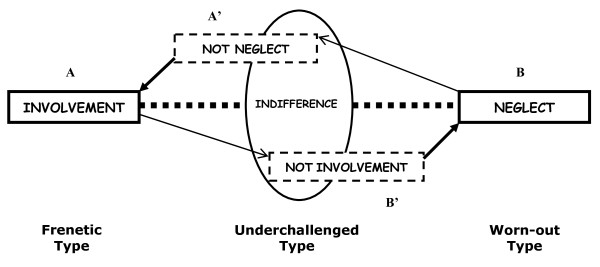
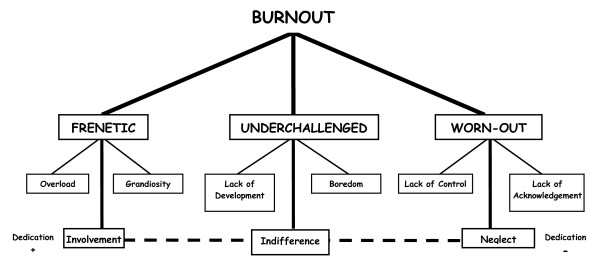
BACKGROUND: Although diverse definitions have been construed for burnout syndrome, most authors consider it to be a single phenomenon, the result of chronic work-related stress. However, in order to enable specific intervention strategies to be adopted, it is first necessary to establish different profiles for the syndrome. In this respect, have been proposed three burnout types ("frenetic", "underchallenged" and "worn-out"), each of which requires different means of dealing with frustration in the workplace. This study is an attempt to define and systematize the properties that characterize this typology proposal. METHODS: For this purpose, the documents considering preliminary typology were examined by means of qualitative content analysis supported by grounded theory. Semiotic analysis was then performed on the core category resulting from the previous analysis. RESULTS: A classification criterion, made up of three different burnout subtypes ("frenetic", "underchallenged", and "worn-out") capable of integrating the entire proposal was formulated. DISCUSSION: Understanding the development of burnout syndrome, as a succession of stages characterized by the progressive diminishing of dedication to work, could serve for the establishment of specific therapies and for the prevention of the syndrome.
Overview
The claims and statistics of this paper haven’t been checked yet.
Free: it reads the open-access text and checks the first 5 claims that cite a source we can check. Create a free account to check every claim.
Integrity signals
Registry
Cites
Statistics
Figures
Verification
Claims the paper makes
The claims and statistics of this paper haven’t been checked yet.
Free: it reads the open-access text and checks the first 5 claims that cite a source we can check. Create a free account to check every claim.
Claims other papers make about this one
Each is checked against this paper’s own text: does it say what the citing paper says it does?
The source backs part of the claim, not all of it — or backs it for a different population, condition or comparison.
In the citing paper
“Finally, the underchallenged and the worn-out subtypes were directly related to negative affect, and indirectly to positive affect, as expected, with higher values for the worn-out because of their theoretical lower levels of effort and persistence [17, 19].”
From Burnout Subtypes and Absence of Self-Compassion in Primary Healthcare Professionals: A Cross-Sectional Study (2016) · cites this paper as [17]
Experimental — accuracy not yet measuredThe cited source says what the claim attributes to it.
In the citing paper
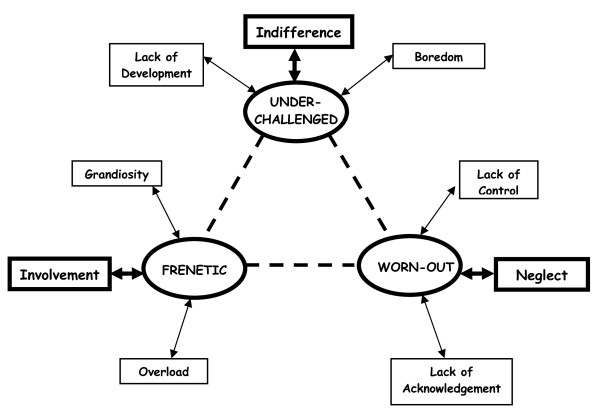
“The ‘worn-out’ subtype presents lack of acknowledgement for the effort they have invested; lack of control over the results of their work; and neglect, as a preferential response to difficulties [17, 19].”
From Burnout Subtypes and Absence of Self-Compassion in Primary Healthcare Professionals: A Cross-Sectional Study (2016) · cites this paper as [17]
The check wasn’t confident either way, so it gives no verdict — never disputed.
In the citing paper
“Each item measured the corresponding factor with the same degree of precision and amount of error, except for lack of acknowledgement, something that may be explained because this factor refers to different sources of gratification, those from the organization and from receptors of the service [17, 19].”
From Burnout Subtypes and Absence of Self-Compassion in Primary Healthcare Professionals: A Cross-Sectional Study (2016) · cites this paper as [17]
Experimental — accuracy not yet measuredIn the citing paper
“The ‘underchallenged’ subtype displays indifference, given that they perform their work-related tasks without interest and superficially; lack of development, as the absence of personal growth experiences together with their desire of take on other jobs; and boredom, given that they suffer from a lack of stimulus and monotony when performing tasks.”
From Burnout Subtypes and Absence of Self-Compassion in Primary Healthcare Professionals: A Cross-Sectional Study (2016) · cites this paper as [17]
In the citing paper
“Recently, a more comprehensive definition of burnout has been proposed to differentiate three clinical subtypes [17].”
From Burnout Subtypes and Absence of Self-Compassion in Primary Healthcare Professionals: A Cross-Sectional Study (2016) · cites this paper as [17]
2 more claims about this paper
Create a free account to see every claim other papers make about this one.
Self-check
Percentages, sums and reported differences re-computed from the paper’s own numbers.
The self-check needs the paper’s full text.
Citations
Cites
Self-efficacy: The exercise of control
Bandura, A., Freeman, W. H., & Lightsey, R. (1999) · Journal of Cognitive Psychotherapy · doi:10.1891/0889-8391.13.2.158 · Cited by 46,835
Basics of Qualitative Research: Grounded Theory Procedures and Techniques.
Ellis, C., Strauss, A., & Corbin, J. (1992) · Contemporary Sociology · doi:10.2307/2074814 · Cited by 29,249
Handbook of Qualitative Research
Crozier, G., Denzin, N., & Lincoln, Y. (1994) · British Journal of Educational Studies · doi:10.2307/3121684 · Cited by 26,666
The Discovery of Grounded Theory: Strategies for Qualitative Research
Glaser, B. G., & Strauss, A. L. (2017) · Aldine (Routledge reprint) · doi:10.4324/9780203793206 · Cited by 25,789
Self-efficacy: the exercise of control
(1997) · Choice Reviews Online · doi:10.5860/choice.35-1826 · Cited by 24,281
Basics of Qualitative Research: Grounded Theory Procedures and Techniques
Long, D. R., Strauss, A., & Corbin, J. (1993) · The Modern Language Journal · doi:10.2307/328955 · Cited by 17,576
Social Cognitive Theory: An Agentic Perspective
Bandura, A. (2001) · Annual Review of Psychology · doi:10.1146/annurev.psych.52.1.1 · Cited by 15,510
Maslach, C., Schaufeli, W. B., & Leiter, M. P. (2001) · Annual Review of Psychology · doi:10.1146/annurev.psych.52.1.397 · Cited by 12,852
Qualitative Analysis for Social Scientists
Strauss, A. L. (1987) · doi:10.1017/cbo9780511557842 · Cited by 12,277
The measurement of engagement and burnout: a two sample confirmatory factor analytic approach.
Schaufeli, W. B., Salanova, M., González-romá, V., & Bakker, A. B. (2002) · Journal of Happiness Studies · doi:10.1023/a:1015630930326 · Cited by 10,014
Research works printed but not linked: 6
- Lazarus RS Folkman S Estrés y procesos cognitivos (Spanish translation of Stress, appraisal and coping) 1984 Barcelona: Martínez Roca 46
- Farber BA Subtypes of burnout: theory, research and practice 2001 Paper presented at the Annual Conference, American Psychological Association. San Francisco
- McKinney M Tipología constructiva y teoría social. (Spanish translation of Constructive typology and social theory) 1966 Buenos Aires: Amorrortu 23
- Gaitán JA Piñuel JL Técnicas de Investigación en comunicación social 1998 Madrid: Síntesis 281 311
- Glaser BG Strauss AL The Discovery of Grounded Theory 1967 Chicago: Aldine
- Barton AH Lazarsfeld PF Lipset SM, Smelser NJ Some functions of Qualitative Analysis in Social Research Sociology: The Progress of a Decade 1961 Englewood-Cliffs: Prentice-Hall 95 122
Cited by
Travis, D. J., Lizano, E. L., & Mor Barak, M. E. (2016) · British Journal of Social Work · doi:10.1093/bjsw/bct205 · Cited by 248
Coping with Stress and Types of Burnout: Explanatory Power of Different Coping Strategies
Montero-Marin, J., Prado-Abril, J., Piva Demarzo, M. M., Gascon, S., & García-Campayo, J. (2014) · PLoS ONE · doi:10.1371/journal.pone.0089090 · Cited by 140
Self-citationThe medical perspective on burnout
Kakiashvili, T., Leszek, J., & Rutkowski, K. (2013) · International Journal of Occupational Medicine and Environmental Health · doi:10.2478/s13382-013-0093-3 · Cited by 124
Montero-Marin, J., Tops, M., Manzanera, R., Piva Demarzo, M. M., Álvarez de Mon, M., & García-Campayo, J. (2015) · Frontiers in Psychology · doi:10.3389/fpsyg.2015.01895 · Cited by 120
Self-citationUchmanowicz, I., Manulik, S. K., Lomper, K., Rozensztrauch, A., Zborowska, A., Kolasińska, J., & Rosińćzuk, J. (2019) · BMJ Open · doi:10.1136/bmjopen-2018-024296 · Cited by 131
Montero-Marin, J., Zubiaga, F., Cereceda, M., Piva Demarzo, M. M., Trenc, P., & Garcia-Campayo, J. (2016) · PLOS ONE · doi:10.1371/journal.pone.0157499 · Cited by 110
Self-citationMontero-Marín, J., & García-Campayo, J. (2010) · BMC Public Health · doi:10.1186/1471-2458-10-302 · Cited by 102
Self-citationSabbah, I., Sabbah, H., Sabbah, S., Akoum, H., & Droubi, N. (2012) · Health · doi:10.4236/health.2012.49101 · Cited by 86
Montero-Marín, J., Skapinakis, P., Araya, R., Gili, M., & García-Campayo, J. (2011) · Health and Quality of Life Outcomes · doi:10.1186/1477-7525-9-74 · Cited by 69
Self-citationUchmanowicz, I., Karniej, P., Lisiak, M., Chudiak, A., Lomper, K., Wiśnicka, A., Wleklik, M., & Rosińćzuk, J. (2020) · Journal of Nursing Management · doi:10.1111/jonm.13135 · Cited by 90
Montero-Marín, J., García-Campayo, J., Fajó-Pascual, M., Carrasco, J. M., Gascón, S., Gili, M., & Mayoral-Cleries, F. (2011) · BMC Psychiatry · doi:10.1186/1471-244x-11-49 · Cited by 69
Self-citationMontero‐Marín, J., Monticelli, F., Casas, M., Roman, A., Tomás, I., Gili, M., & García‐Campayo, J. (2011) · BMC Medical Education · doi:10.1186/1472-6920-11-103 · Cited by 85
Self-citationStress and burnout in anaesthesia: a real world problem?
Rama-Maceiras, P., Jokinen, J., & Kranke, P. (2015) · Current Opinion in Anaesthesiology · doi:10.1097/aco.0000000000000169 · Cited by 75
Montero-Marín, J., Araya, R., Blazquez, B. O., Skapinakis, P., Vizcaino, V. M., & García-Campayo, J. (2012) · BMC Public Health · doi:10.1186/1471-2458-12-922 · Cited by 52
Self-citationBurnout, wellbeing and how they relate: A qualitative study in general practice trainees
Prentice, S., Elliott, T. E., Dorstyn, D., & Benson, J. (2022) · Medical Education · doi:10.1111/medu.14931 · Cited by 60
Hamed, R. A., Elaziz, S. Y. A., & Ahmed, A. (2020) · Middle East Current Psychiatry · doi:10.1186/s43045-020-00044-x · Cited by 61
Sousa, A. R. C., & Mourão, J. I. D. B. (2018) · Brazilian Journal of Anesthesiology · doi:10.1016/j.bjan.2018.04.002 · Cited by 53
Nantsupawat, A., Wichaikhum, O., Abhicharttibutra, K., Sadarangani, T. R., & Poghosyan, L. (2023) · Journal of Clinical Nursing · doi:10.1111/jocn.16761 · Cited by 60
A Narrative Review of Burnout Syndrome in Medical Personnel
Ungur, A. P., Bârsan, M., Socaciu, A. I., Râjnoveanu, A. G., Ionuţ, R., Goia, L., & Procopciuc, L. M. (2024) · Diagnostics · doi:10.3390/diagnostics14171971 · Cited by 57
Iacolino, C., Cervellione, B., Isgrò, R., Lombardo, E. M. C., Ferracane, G., Barattucci, M., & Ramaci, T. (2023) · European Journal of Investigation in Health Psychology and Education · doi:10.3390/ejihpe13010006 · Cited by 50
Martínez‐Rubio, D., Martínez‐Brotons, C., Monreal‐Bartolomé, A., Barceló‐Soler, A., Campos, D., Pérez‐Aranda, A., Colomer‐Carbonell, A., Cervera‐Torres, S., Solé, S., Moreno, Y., et al. (2021) · Journal of Advanced Nursing · doi:10.1111/jan.14870 · Cited by 42
Self-citationWolbring, G., & Lillywhite, A. (2023) · Societies · doi:10.3390/soc13050131 · Cited by 43
Perceived Stress Latent Factors and the Burnout Subtypes: A Structural Model in Dental Students
Montero‐Marín, J., Demarzo, M., Stapinski, L. A., Gili, M., & García‐Campayo, J. (2014) · PLoS ONE · doi:10.1371/journal.pone.0099765 · Cited by 43
Self-citationAbós, Á., Sevil-Serrano, J., Haerens, L., Aelterman, N., & García-González, L. (2019) · Learning and Individual Differences · doi:10.1016/j.lindif.2019.04.008 · Cited by 37
Vitale, E., Galatola, V., & Mea, R. (2020) · Minerva Psichiatrica · doi:10.23736/s0391-1772.20.02090-7 · Cited by 44
Demarzo, M., García‐Campayo, J., Martínez‐Rubio, D., Pérez‐Aranda, A., Miraglia, J. L., Hirayama, M. S., Salvo, V., Cicuto, K. M., Favarato, M. L., Terra, V. D. S., et al. (2020) · International Journal of Environmental Research and Public Health · doi:10.3390/ijerph17031081 · Cited by 40
Self-citationPapaefstathiou, E., Apostolopoulou, A., Papaefstathiou, E., Moysidis, K., Hatzimouratidis, K., & Sarafis, P. (2019) · International Journal of Impotence Research · doi:10.1038/s41443-019-0170-7 · Cited by 36
Burnout Among School Teachers During the COVID-19 Pandemic in Jazan Region, Saudi Arabia
Alqassim, A. Y., Shami, M. O., Ageeli, A. A., Ageeli, M. H., Doweri, A. A., Melaisi, Z. I., Wafi, A. M., Muaddi, M. A., & El‐Setouhy, M. (2022) · Frontiers in Psychology · doi:10.3389/fpsyg.2022.849328 · Cited by 33
Jumping On and Off the Runaway Train of Success: Stress and Committed Intensity in an Academic Life
Ellis, C. (2011) · Symbolic Interaction · doi:10.1525/si.2011.34.2.158 · Cited by 29
Montero‐Marín, J., Prado-Abril, J., Carrasco, J. M., Asensio-Martínez, Á., Gascón, S., & García‐Campayo, J. (2013) · BMC Public Health · doi:10.1186/1471-2458-13-1240 · Cited by 37
Self-citationAbdoli, S., Hessler, D., Vora, A. C., Smither, B., & Stuckey, H. L. (2019) · AJN American Journal of Nursing · doi:10.1097/01.naj.0000615776.64043.be · Cited by 27
Martins, P. S., Luzia, R. W. S., Filho, J. A. P., Welsh, K. S., Fuzikawa, C., Nicolato, R., Alemão, M. M., Gonçalves, M. A., Cavalheiro, J. C., Ávila, I. D., et al. (2024) · PLoS ONE · doi:10.1371/journal.pone.0298187 · Cited by 27
Martínez‐Rubio, D., Sanabria‐Mazo, J. P., Feliu‐Soler, A., Colomer‐Carbonell, A., Martínez-Brotóns, C., Solé, S., Robla, C. E., Fita, E. G., Moreno, Y., Pérez‐Aranda, A., et al. (2020) · International Journal of Environmental Research and Public Health · doi:10.3390/ijerph17197013 · Cited by 32
Self-citationAsfahani, A. M. (2023) · Journal of Applied Research in Higher Education · doi:10.1108/jarhe-03-2023-0125 · Cited by 29
Burnout in Critical Care Nurses
Browning, S. G. (2019) · Critical Care Nursing Clinics of North America · doi:10.1016/j.cnc.2019.07.008 · Cited by 24
Mahony, C., & O’Ryan, C. (2022) · Frontiers in Psychiatry · doi:10.3389/fpsyt.2022.985713 · Cited by 25
Burnout subtypes and associated factors among police officers in Sri Lanka: A cross-sectional study
Wickramasinghe, N. D., & Wijesinghe, P. R. (2018) · Journal of Forensic and Legal Medicine · doi:10.1016/j.jflm.2018.07.006 · Cited by 25
Babineau, T., Thomas, A., & Wu, V. (2019) · Current Treatment Options in Pediatrics · doi:10.1007/s40746-019-00146-7 · Cited by 23
Sousa, A. R. C., & Mourão, J. I. D. B. (2018) · Brazilian Journal of Anesthesiology (English Edition) · doi:10.1016/j.bjane.2018.04.007 · Cited by 21
FACTORIAL VALIDITY OF THE MASLACH BURNOUT INVENTORY (MBI- HSS) AMONG PORTUGUESE PROFESSIONALS
Vicente, C., Oliveira, R. A., & Marôco, J. P. (2013) · Psicologia Saúde & Doenças · doi:10.15309/13psd140110 · Cited by 63
Opoku, D. A., Ayisi‐Boateng, N. K., Mohammed, A., Sulemana, A., Gyamfi, A. O., Owusu, D., Yeboah, D., Spangenberg, K., Ofosu, H. M., & Edusei, A. K. (2022) · Nursing Open · doi:10.1002/nop2.1355 · Cited by 24
Burnout Syndrome Among Critical Care Health Providers in Saudi Arabia
Alshurtan, K. S., Aldhaifi, S. Y., Alshammari, K. F., Alodayli, O. M. O., Alqahtani, K. M., & Aldhaifi, S. (2024) · Journal of Multidisciplinary Healthcare · doi:10.2147/jmdh.s452294 · Cited by 19
Doherty, J., & O’Brien, D. (2021) · Women and Birth · doi:10.1016/j.wombi.2021.06.002 · Cited by 21
Ways of preventing surgeon burnout
Naviaux, A.-F., Barbier, L. A., Chopinet, S., Janne, P., & Gourdin, M. J. (2022) · Journal of Visceral Surgery · doi:10.1016/j.jviscsurg.2022.09.005 · Cited by 18
Montero‐Marín, J., Prado-Abril, J., Demarzo, M., García-Toro, M., & García‐Campayo, J. (2016) · Revista de Psicopatología y Psicología Clínica · doi:10.5944/rppc.vol.21.num.3.2016.15686 · Cited by 29
Self-citationAbós, Á., Sevil‐Serrano, J., Montero‐Marín, J., Clemente, J. A. J., & García‐González, L. (2019) · Current Psychology · doi:10.1007/s12144-019-00333-7 · Cited by 18
Self-citationBurnout, compassion fatigue, and moral distress in palliative care
Cherny, N. I., Ziff‐Werman, B., & Kearney, M. (2015) · doi:10.1093/med/9780199656097.003.0416 · Cited by 27
Facing EL teachers' burnout through motivation
Caruso, G. (2019) · Journal of Pedagogical Research · doi:10.33902/jpr.2019.0 · Cited by 17
Bauernhofer, K., Tanzer, N. K., Paechter, M., Papousek, I., Fink, A., & Weiss, E. M. (2019) · Frontiers in Education · doi:10.3389/feduc.2019.00137 · Cited by 14
Burnout hazard in teachers results of a clinical-psychological intervention study
Wegner, R., Berger, P., Poschadel, B., Manuwald, U., & Baur, X. (2011) · Journal of Occupational Medicine and Toxicology · doi:10.1186/1745-6673-6-37 · Cited by 13
Montero‐Marín, J., Zubiaga, F., Cereceda, M., Demarzo, M., Español, P. T., & García‐Campayo, J. (2020) · PLoS ONE · doi:10.1371/journal.pone.0231370 · Cited by 14
Self-citationOlmos-Bravo, Z. M., Sánchez‐Ortí, J. V., Grevet, E. H., & Balanzá‐Martínez, V. (2025) · Trends in Psychiatry and Psychotherapy · doi:10.47626/2237-6089-2024-0805 · Cited by 13
Krishna, G., Harbli, N. M. A., Krishnan, N., Ghundul, L. B., Aldhahri, R., Aldossary, A., Margalani, A. O., Almeshari, M. A., Alwadeai, K. S., Alshehri, R., et al. (2025) · Journal of Multidisciplinary Healthcare · doi:10.2147/jmdh.s503896 · Cited by 13
Future of Surgery: Technology Enhanced Surgical Training: Report of the FOS:TEST Commission
Adebayo, O., Aldoori, J., Allum, W., Aruparayil, N., Badran, A., Beatty, J. W., Bhatia, S., Bolton, W., Giwa, L., Burke, J., et al. (2022) · doi:10.1308/fos2.2022 · Cited by 21
金山, 三., Suzuki, M., & Yuma, Y. (2016) · Psychology Research and Behavior Management · doi:10.2147/prbm.s93846 · Cited by 11
Factors contributing to burnout among healthcare workers during COVID-19 in Sabah (East Malaysia)
Pang, N. T. P., Hadi, N. M. N., Mohaini, M. I., Kamu, A., Ho, C. M., Koh, E. B. Y., Loo, J. L., Theng, D. Q. L., & Wider, W. (2022) · Healthcare · doi:10.3390/healthcare10061068 · Cited by 9
The impact of faculty and student pharmacist relationships on burnout
Smith, M. D., & Phillips, A. (2021) · Journal of the American Pharmacists Association · doi:10.1016/j.japh.2021.10.029 · Cited by 9
Cheli, S., Zagonel, V., Oliani, C., Blasi, L., & Fioretto, L. (2020) · Psycho-Oncology · doi:10.1002/pon.5589 · Cited by 9
Burnout, compassion fatigue, and moral distress in palliative care
Cherny, N. I., Ziff‐Werman, B., & Kearney, M. (2021) · doi:10.1093/med/9780198821328.003.0017 · Cited by 9
Zeeshan, M., Shaikh, S., & Ahmer, Z. (2021) · Child Care Health and Development · doi:10.1111/cch.12941 · Cited by 10
Kamtsios, S., & Kakouris, V. (2025) · Psychological Reports · doi:10.1177/00332941251320026 · Cited by 9
İş tatmini ile tükenmişlik ilişkisi: Bir meta-analiz çalışması
Erdoğan, P. (2021) · Business And Management Studies An International Journal · doi:10.15295/bmij.v9i2.1749 · Cited by 10
Yang, C., Chen, Y., Wang, X., Xu, P., Song, J., Yang, L., & Fu, Y. (2024) · Frontiers in Psychology · doi:10.3389/fpsyg.2024.1474523 · Cited by 8
Stress and Burnout among Egyptian Undergraduate Medical Students
(2021) · The Egyptian Journal of Community Medicine · doi:10.21608/ejcm.2021.187680 · Cited by 7
Conceitos e Fatores da Síndrome de Burnout em Docentes: um Ensaio Teórico
Santos, K. D. A., & da Silva, J. P. (2021) · Cadernos de Educação Tecnologia e Sociedade · doi:10.14571/brajets.v14.n4.662-672 · Cited by 10
“Burnout syndrome” in anesthesiologists and remedial measures- A narrative review
Panditrao, M. M., & Panditrao, M. M. (2023) · Journal of Anaesthesiology Clinical Pharmacology · doi:10.4103/joacp.joacp_322_22 · Cited by 5
Factores relacionados al síndrome de Burnout en el personal de salud del Hospital Regional Huánuco
Tuesta, B. L., & Barreto, C. B. (2018) · Revista Peruana de Investigación en Salud · doi:10.35839/repis.2.1.214 · Cited by 5
Wessam, A. K., Mariam, O. O. A. A., Dhoha, M. A. S. A., Imad, A. A. M. E., Ghaliah, A. A. M. A., Amal, H., & Elmoselhi, A. B. (2024) · Advances in Biomedical and Health Sciences · doi:10.4103/abhs.abhs_24_24 · Cited by 4
Zhao, H., Kloren-Garcia, M., & Rosenfield, Z. G. (2025) · Worldwide Hospitality and Tourism Themes · doi:10.1108/whatt-04-2025-0160 · Cited by 5
Burnout flattens the professional work productivity
Haque, M., Bhagat, V., & Simbak, N. (2018) · Journal of Datta Meghe Institute of Medical Sciences University · doi:10.4103/jdmimsu.jdmimsu_33_18 · Cited by 4
Qashqary, M. E., Alqahtani, A., Alotaibi, A., Alghamdi, Z., & Alattas, H. (2022) · Medical Science · doi:10.54905/disssi/v26i125/ms319e2290 · Cited by 4
Hosseinian, S., Pordelan, N., Hamid, H., & Samaneh, S. (2014) · Majallah-i dānishgāh-i ̒ulūm-i pizishkī-i Māzandarān/Journal of Mazandaran University of Medical Sciences · Cited by 4
Cognitive Emotion Regulation Strategies Used by Critical Care Nurses: A Descriptive-Analytic Study
Hosseinigolafshani, S. Z. (2018) · Nursing & Healthcare International Journal · doi:10.23880/nhij-16000150 · Cited by 4
Baharuddin, M. A., & Rosa, E. M. (2022) · Jurnal Aisyah Jurnal Ilmu Kesehatan · doi:10.30604/jika.v7i1.891 · Cited by 4
Apakah Technostress Berpeluang Memicu Burnout? Studi pada Guru Honorer Usia Dewasa Madya
Patricia, C. F., & Wibowo, D. H. (2024) · Jurnal Psikologi Perseptual · doi:10.24176/perseptual.v9i2.12553 · Cited by 5
Pamuk, M. (2025) · British Journal of Guidance and Counselling · doi:10.1080/03069885.2025.2476469 · Cited by 3
Mursyidin, R. A. A., & Hakim, A. M. (2023) · MANAGERE Indonesian Journal of Educational Management · doi:10.52627/managere.v5i1.336 · Cited by 3
Silva, J. M. F. (2016) · Portuguese National Funding Agency for Science, Research and Technology (RCAAP Project by FCT) · Cited by 3
Overworked, underchallenged and indifferent: burnout among Indonesian academics
Makmun, A. H., Yusnaidi, Y., Damrus, D., & Mardaleta, M. (2025) · International journal of organizational analysis · doi:10.1108/ijoa-05-2025-5532 · Cited by 2
Agustin, M. A. (2023) · Character: Jurnal Penelitian Psikologi. · doi:10.26740/cjpp.v10i2.54830 · Cited by 2
Stress lavorativo e burnout negli infermieri: analisi del fenomeno in terapia intensiva
Binda, F., Galazzi, A., Roselli, P., Adamini, I., & Laquintana, D. (2018) · Scenario - Il Nursing nella sopravvivenza · doi:10.4081/scenario.2018.243 · Cited by 2
Pallich, G., Holtforth, M. G., & Hochstrasser, B. (2021) · Clinical Psychology in Europe · doi:10.32872/cpe.3819 · Cited by 2
Mknący pociąg, czyli zmienne koleje kariery. Życie akademickie pod wysokim napięciem
Ellis, C. (2011) · Wydawnictwo Uniwersytetu Łódzkiego eBooks · doi:10.18778/7525-639-0.04 · Cited by 2
Gbonjubola, Y. T., Fatudimu, M. B., & Hamzat, T. K. (2022) · Journal of Pediatric Rehabilitation Medicine · doi:10.3233/prm-200675 · Cited by 2
Vardanjani, M. G., Montazeri, S., Jahanbani, E., & Ghanbari, S. (2024) · Journal of Education and Health Promotion · doi:10.4103/jehp.jehp_909_22 · Cited by 2
Relação entre perfis de burnout, sentido de vida e autocompaixão em docentes
de Almeida, E. S., Santos, K. D. A., & da Silva, J. P. (2024) · PSI UNISC · doi:10.17058/psiunisc.v8i2.18574 · Cited by 3
Investigating the Association Between Teacher Burnout and Technology Integration
Munoz, B. (2025) · The Journal of Educators Online · doi:10.9743/jeo.2025.22.2.9 · Cited by 2
Tutar, H., & Şahin, N. (2023) · Journal of Business Research - Turk · doi:10.20491/isarder.2023.1652 · Cited by 2
Carlson-Jaquez, H. (2016) · VCU Scholars Compass (Virginia Commonwealth University) · doi:10.25772/mvxg-zq26 · Cited by 5
C, V. M. M., Venis, P., Glannie, A. R., & Varghese, L. A. (2022) · Healthline · doi:10.51957/healthline_307_2021 · Cited by 1
Níveis de autocompaixão, regulação emocional e síndrome de burnout em professores da Educação Básica
Santos, K. D. A., de Almeida, E. S., de Souza, F. V. S., & da Silva, J. P. (2024) · Teoria e Prática da Educação · doi:10.4025/tpe.v27i1.70280 · Cited by 1
Dura, C., & Chițoiu, L. (2025) · Health Problems of Civilization · doi:10.5114/hpc.2025.156222 · Cited by 1
Qadir, A. H. M. A., Yusnaidi, Y., Damrus, D., & Mardaleta, M. (2025) · Journal of Applied Research in Higher Education · doi:10.1108/jarhe-03-2025-0204 · Cited by 1
Cohen, A. G. (2025) · Journal of Organizational Change Management · doi:10.1108/jocm-03-2025-0214 · Cited by 1
Defining burnout: What is this syndrome and what sets it apart from other labels?
Prentice, S. (2026) · Australian Journal of General Practice · doi:10.31128/ajgp-02-25-7566 · Cited by 1
A Novel Methodology for Configuring a Job Satisfaction Matrix
Yousefpoor, N., & Meisel, S. I. (2012) · International Journal of Strategic Decision Sciences · doi:10.4018/jsds.2012100104 · Cited by 1
Mohammady, P., Mirzaei, R., Sadeghi, J., & Azad, I. (2013) · Cited by 1
Examination Of The Relation Between Burnout Syndrome And Ways Of Coping With Stress In Teachers
GünselI, Y. (2017) · i-manager’s Journal on Educational Psychology · doi:10.26634/jpsy.10.4.13456 · Cited by 5
PROFESSIONAL DEFORMATION CORRELATION WITH BURNOUT BETWEEN AIRLINE CABIN CREW
Zakrizevska, M. (2017) · SGEM International Multidisciplinary Scientific Conferences on Social Sciences and Arts · doi:10.5593/sgemsocial2017/32/s11.034 · Cited by 1
TÜKENMİŞLİK SENDROMU KONUSUNDA YAZILAN TEZLERİN KATEGORİK OLARAK İNCELENMESİ
YİĞİT, B. (2022) · R&S - Research Studies Anatolia Journal · doi:10.33723/rs.1037014 · Cited by 1
Metadata
- Authors
- Montero-Marín, J., García-Campayo, J., Mera, D. M., & del Hoyo, Y. L.
- Affiliations
- Universidad Nacional de Educación a Distancia (ES)
- Venue
- Journal of Occupational Medicine and Toxicology
- Published
- 2009-11-30
- Volume
- 4
- Issue
- 1
- Pages
- 31-31
- ISSN
- 1745-6673 (ISSN-L)
- PMC
- PMC2794272
- OpenAlex
- W2017570934
- Cited by
- 118
- References
- 53
- Citations by year
- 2026: 4 · 2025: 9 · 2024: 15 · 2023: 11 · 2022: 13 · 2021: 11 · 2020: 6 · 2019: 12 · 2018: 8 · 2017: 2 · 2016: 5 · 2015: 4 · 2014: 3 · 2013: 5 · 2012: 3
- FWCI
- 4.35
- Type
- journal article
- Language
- en
- Open access
- gold
- doi.org
- Licence
- cc-by
- Locations
- Journal of Occupational Medicine and Toxicology (publishedVersion, cc-by)
- PubMed Central (publishedVersion, cc-by)
- PubMed (publishedVersion)
- DOAJ (DOAJ: Directory of Open Access Journals) (submittedVersion, cc-by-sa)
- Topics
- Social Sciences › Psychology › Social Psychology › Stress and Burnout Research
- Health Sciences › Medicine › Public Health, Environmental and Occupational Health › Occupational Health and Burnout
- Health Sciences › Health Professions › General Health Professions › Healthcare professionals’ stress and burnout
- Keywords
- burnout, burnout stages, work commitment, burnout prevention
About these checks
Registry, retraction, Cites and statistics results are computed, not judged, with one exception: a printed reference that no index lists is read once by a model before it counts as a citation error. Claims are extracted by a model and kept only when their quote appears verbatim in the text; each cited source is then checked, with a model’s help, for whether it says what the claim relies on. Those verdicts can be wrong — read the claim’s quote and the cited source before relying on one.
Statistics and arithmetic are recomputed, not judged.
Confidence bands are shown only for fields calibrated on our annotated test set. None is calibrated yet, so no band is shown.
What counts as a claim ›How we measure confidence ›How we check this ›
Are you an author, or do you see a problem with this page? Request a review
Data sources
Bibliographic data: Semantic Scholar, OpenAlex, Crossref.
Contains information from the Semantic Scholar Academic Graph Datasets, made available under the ODC Attribution License (ODC-BY 1.0).
Semantic Scholar’s data is described in: Kinney, R., et al. (2023). The Semantic Scholar Open Data Platform. arXiv:2301.10140.
